How to Pay in Korea as a Foreigner (2026): Foreign Cards, Cash, T-money, WOWPASS, Apple Pay and Where Each One Fails
Last updated: 27 November 2026. Rules checked that day: Seoul's cashless-bus route list (January 2026 edition, page modified 6 March 2026) and bus fare table on the Seoul Metropolitan Government transport site; Gyeonggi's cashless-bus expansion as reported by Seoul Shinmun on 5 March 2026; KakaoBank's Apple Pay launch as reported by BizWatch on 18 November 2026. Everything else is as verified in the EpicKor guide linked beside it, with the date of that check.
How do you pay in Korea as a foreigner? As of November 2026, with your own Visa or Mastercard for most shops, restaurants, cafés and taxis, and a T-money (티머니) card or WOWPASS (와우패스) for the subway and buses, because a foreign bank card still cannot be tapped at a Seoul subway gate or on a Seoul bus. Carry some Korean won cash for markets, street stalls and topping up a plain T-money, which takes cash only. Change it in town, not at the airport: 4.20% at every Incheon counter against 1.75% at a city branch. Apple Pay with a foreign card works only where the terminal reads contactless cards, so never rely on it alone.
Each payment method fails in a specific place, and those places are not where visitors expect. In Korea's own exit survey for 2025, 11.7% of visitors said money information, such as ATMs and exchange, was what they could not find before the trip (our analysis of the survey). This page has one decision table, a short section on each case, and a link to the EpicKor guide that covers it in full.
A travel wallet with separate slots, so the T-money card, the bank card, the won notes and the tax-refund receipts don't end up in one pocket. See the TOPBAG RFID travel wallet on AmazonAffiliate link. As an Amazon Associate, EpicKor earns from qualifying purchases at no extra cost to you.
Quick Guide: what works, what fails, and which guide to read
| Situation | What works (November 2026) | What fails | Full guide |
|---|---|---|---|
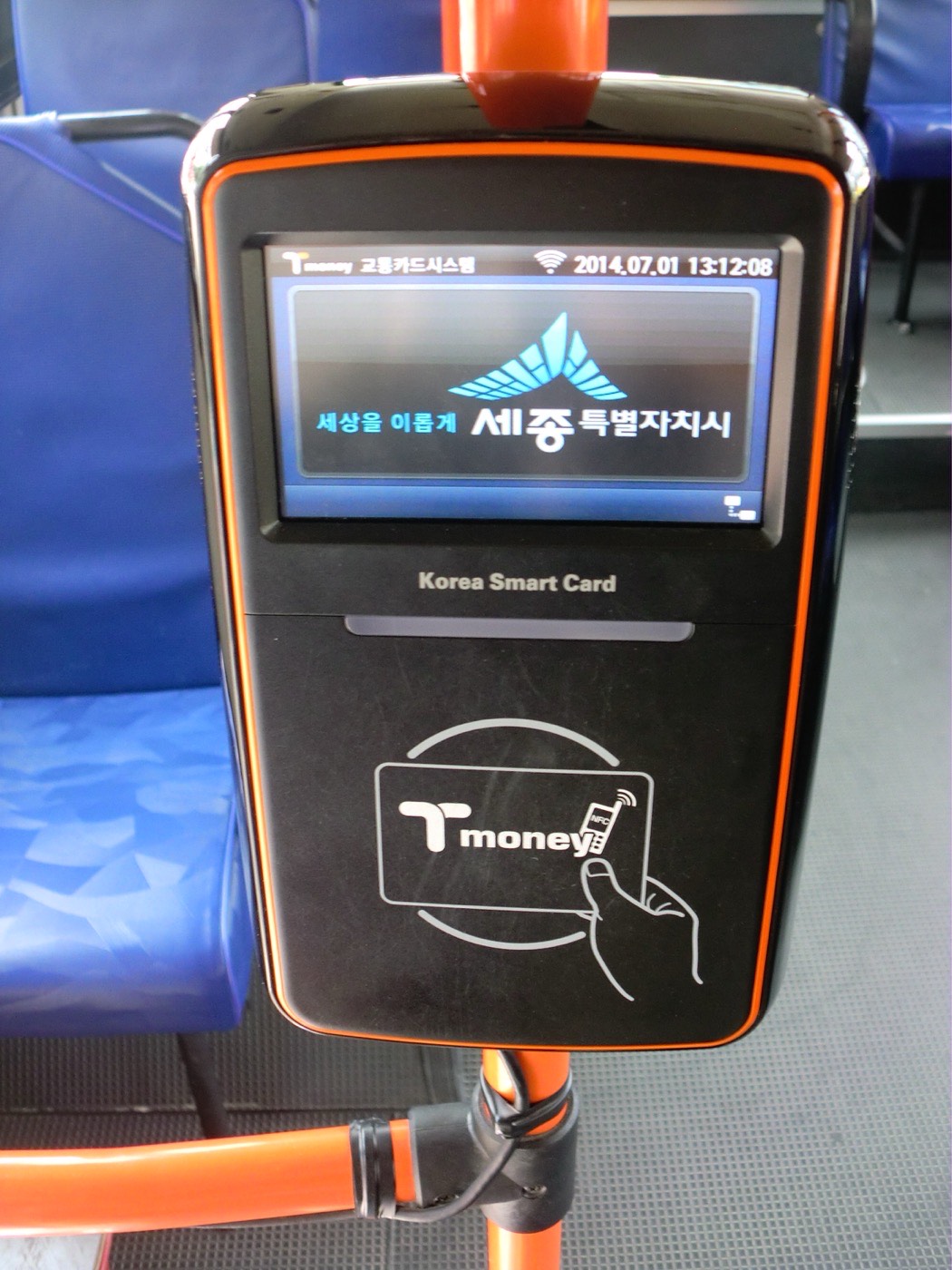
| Seoul subway gate | T-money (about ₩3,000), the T-money side of WOWPASS, or a Climate Card pass. Fare ₩1,550 by card | Tapping your own Visa or Mastercard. Seoul's plan replaces Lines 1–8 readers in 2027 | T-money and WOWPASS |
| Seoul city bus | T-money or WOWPASS's T-money side. Cash on routes that still take it, at the card fare: blue trunk ₩1,500, green branch ₩1,400 | Cash on 183 cashless routes (Seoul's January 2026 list). Your own bank card, until Seoul buses switch, reported for January 2027 | T-money and WOWPASS |
| Jeju city bus | Your own contactless Visa (since August 2025), T-money, or cash ₩1,200 | Cash on express buses always pays the maximum ₩3,000 | Jeju buses |
| Unlimited Seoul rides | Climate Card 1- to 7-day pass, ₩5,000–₩20,000, bought with a foreign card at 440 station kiosks (average 3.7% fee) | Sinbundang Line, airport buses, boarding at Incheon Airport (you may only get off there), anything outside Seoul | Climate Card |
| Seoul taxi on the street | Card at the in-car reader (travellers report foreign cards usually work), T-money, or won | No official guarantee for every foreign card. A cash-only demand is not legitimate | Seoul taxi fares |
| Taxi by app | K-RIDE or Uber with a foreign card; K-RIDE adds a 10% fee | Kakao T's sign-up text and foreign-card registration often fail. Kakao Venti vans take automatic payment only | Taxi apps · Kakao Venti |
| Shops, chains, tourist districts | Foreign card almost everywhere; tax refund from ₩15,000 on one receipt | Ordinary-neighbourhood shops are less used to foreign cards; a decline is more likely there | Where foreign cards get swiped · Tax refund |
| Markets and street stalls | Won cash, small notes | Cards at small outdoor stalls; Dongdaemun's wholesale floors are cash-only in practice | Namdaemun vs Dongdaemun |
| Food delivery | Baemin: foreign Visa, Mastercard, JCB, Amex, and Apple Pay with those cards since 2 June 2026 | Coupang Eats: tourist phone verification not confirmed | Delivery apps |
| Getting won | City bank branch (1.75% on US dollar cash), WOWPASS machines, Global ATMs | Changing everything at Incheon: 4.20% at all three banks, about ₩16,440 less on $500 | Incheon exchange rates |
| Apple Pay or Google Pay with a foreign card | Baemin; terminals that read contactless cards | Many Korean shop terminals do not read contactless EMV cards. Never your only way to pay | This page, below |
The two mistakes that cost visitors the most are changing a large sum at the airport and arriving with only a Visa and no won, then finding that the plain T-money card at the airport convenience store can only be topped up with cash.
You might like: T-money Card for Foreigners in Korea (2026): Cost, Top-Up, Refund, WOWPASS
Your foreign card: where it works and where it doesn't
For most spending, your own card is the right tool. Korea is a card country, and foreign cards are taken in convenience stores, chains, department stores, Olive Young, Daiso and most restaurants in the areas visitors go to. Card-terminal data shows where the edges are.
Korea Credit Data, whose CashNote sales app is linked to about 328,000 shops, separated out overseas-card transactions in August 2026. In Seoul's designated tourist districts (Myeongdong, Hongdae, Itaewon, Gangnam and others), foreign cards are 14.6% of sales. In an ordinary neighbourhood commercial alley they are 1.3%. The top 1% of merchants take 66.9% of all foreign card money (full analysis). Our reading: the shop least used to your card is the ordinary alley restaurant or neighbourhood shop, and that is where a decline is most likely.
Three card habits save money and embarrassment:
- Pay in won, not your home currency. If a terminal or ATM offers to charge you in dollars or euros, choose won. That conversion uses the machine operator's rate, not your bank's (exchange guide).
- Carry two cards on different networks. Some routes take one network and not another: the iPhone mobile T-money top-up below took Mastercard and Amex first and left Visa out.
- Expect a PIN sometimes. WOWPASS, for one, warns that in-person KTX purchases over ₩50,000 need a PIN (WOWPASS section).
South Korea eSIM, 5 GB for 15 days — the data every payment app here runs on The WOWPASS app that moves money to your transit balance, K-RIDE and Uber for taxis, Baemin for delivery, and the bank-rate checks before you change money all need mobile data from the moment you land. Installed before you fly, it works at the gate, not after a queue at an airport counter. The current price is on the listing. As an Amazon Associate, EpicKor earns from qualifying purchases at no extra cost to you.
See the Korea eSIM on AmazonApple Pay in Korea: why it fails more than at home
Apple Pay exists in Korea, but not in the form a visitor expects. For Korean residents, Apple Pay launched in March 2023 with Hyundai Card (현대카드) and stayed with that one issuer for more than three years. The second Korean issuer arrived only this month: KakaoBank (카카오뱅크) started Apple Pay on 16 November 2026 for its check cards and its prepaid "mini" card for teenagers, BizWatch reported. Other issuers are not close. EBN reported on 20 July 2026 that Shinhan Card is still reviewing the timing and business case, and KB Kookmin Card has mostly finished the technical work but set no date; its conclusion was that no further issuer is likely this year.
Because so few Korean cards could use Apple Pay, shops had little reason to install terminals that read contactless cards, and Apple Pay with your foreign card needs exactly that kind of terminal. BizWatch's report on KakaoBank repeated the industry view that contactless terminals are more widely installed abroad than in Korea. News1 put it bluntly in July 2025: EMV-approved terminals have spread slowly, so Apple Pay and Google Pay are often not recognised or fail.
What we could confirm for foreign cards in Apple Pay, as of November 2026:
- Baemin delivery: yes, with foreign Visa, Mastercard, JCB and Amex cards, since 2 June 2026, the first Korean delivery app to offer it (delivery guide).
- Transit on iPhone: partly. T-money in Apple Wallet launched in July 2025. SBS Biz reported in March 2026 that overseas-card top-ups for iPhone run through the Mobile T-money app, with Mastercard, Amex and UnionPay first and Visa excluded. Mastercard's own release of 8 April 2026 says Mastercard holders can top up mobile T-money for subways, buses and taxis (payment guide).
- Shop counters: no official list. We found no official count of Korean shop terminals that take a foreign card in Apple Pay. Try it, but keep the physical card in your pocket.
Cash: how much, where to get it, and where you need it
You need less cash than older guides say, but not none. Cash is still the only way to top up a plain T-money card, it is the safe choice at markets and street stalls, and it is the fallback when a terminal refuses your card at 23:00. Most visitors are covered with a modest amount changed in town and topped up as needed.
Where to get won, cheapest first (full comparison):
- A city bank branch. On US dollar cash, almost every Korean bank charges 1.75% commission (KDB 1.50%). Branches open weekdays 09:00–16:00.
- WOWPASS machines. They take cash in 16 currencies with no exchange fee listed and load it onto the card as won. Withdrawals are up to ₩100,000 at a time, ₩1,000 each (WOWPASS). The machines in the CU stores at Incheon Terminals 1 and 2 take won only.
- Global ATMs. Machines marked Global ATM accept foreign Visa and Mastercard. The airport banks do not publish their foreign-card fee, so read the fee on screen before you confirm.
- The Incheon Airport counters. Woori, Hana and KB Kookmin all charge 4.20% on US dollar cash. At Hana's 5 November 2026 rate, $500 gets you about ₩642,625 at the airport against ₩659,065 at a city branch: ₩16,440 less, about $12. Change only enough for the first day.
Banks will not change coins back, so spend the ₩100 and ₩500 coins before you fly. Korea Customs' traveller rules require you to declare cash and cheques worth more than US$10,000 in total, won included, on arrival and departure (Korea Customs Service).
You might like: Incheon Airport Money Exchange Rate in Korea: 4.20% at Every Counter vs 1.75% in Town
Transit cards: T-money, WOWPASS or the Climate Card
Because your own card cannot be tapped at a Seoul subway gate, the first thing to buy after landing is a transit card. Seoul's open-loop plan starts with buses, reported by Hana Card for January 2027, moves to subway Lines 1–8 in 2027, and covers village buses and private rail by 2030 (timeline).
| Card | Cost | How you load it | Pick it if… |
|---|---|---|---|
| T-money (티머니) | About ₩3,000 at GS25, CU, 7-Eleven, emart24, including at Incheon Airport | Cash only, ₩1,000 units, ₩1,000–90,000 at a time | You have some won and only need transit. Works nationwide, in taxis and convenience stores too |
| WOWPASS (와우패스) | ₩6,000 registration, not refundable | Payment side: foreign card in the app, up to ₩200,000 per top-up, or foreign cash at machines. Transit side: cash, or move money across in the app (one way) | You have only a Visa, or a wallet of dollars, euros or yen |
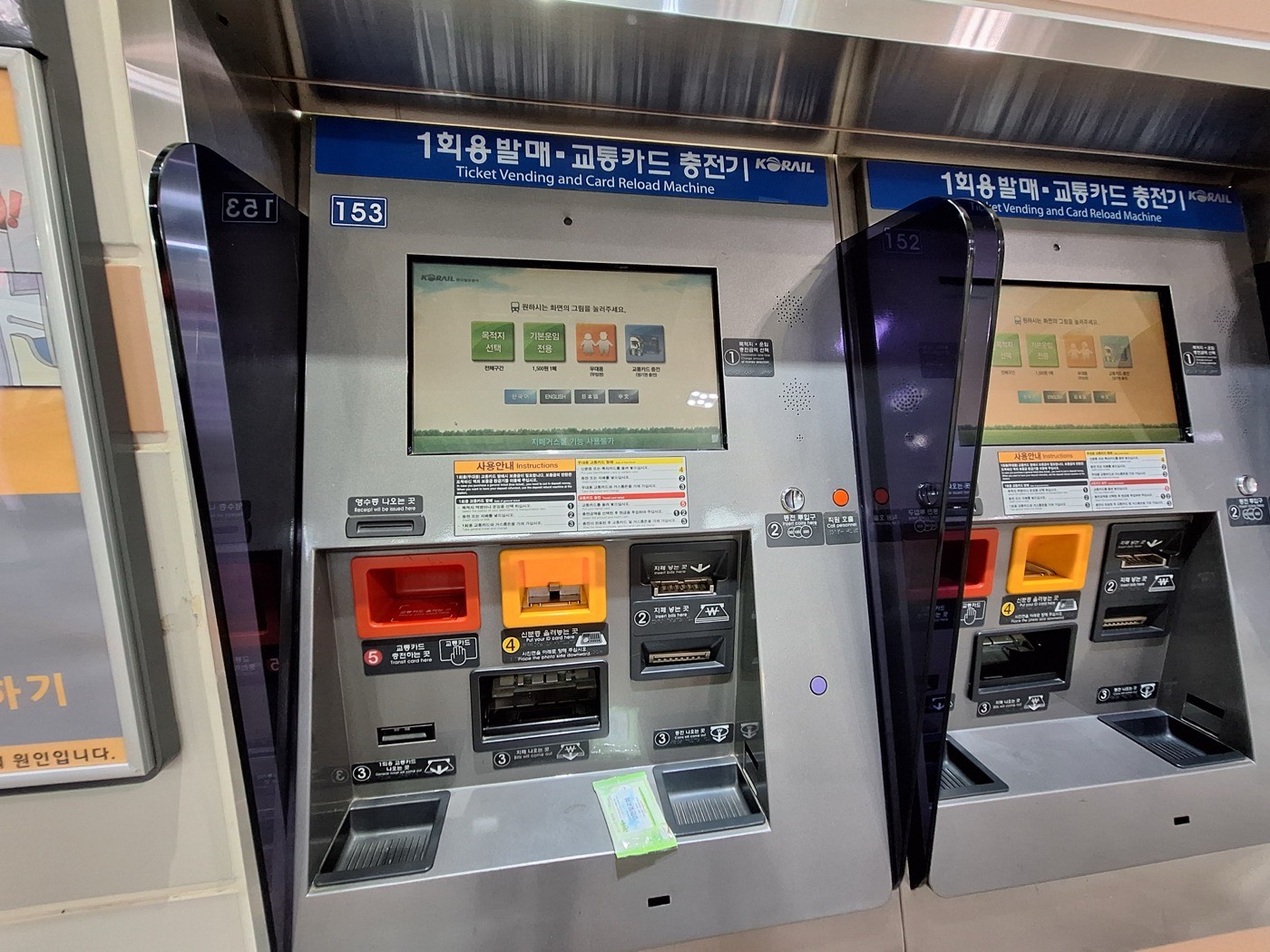
| Climate Card (기후동행카드) pass | Card ₩3,000 + pass ₩5,000 (1 day) to ₩20,000 (7 days) | Cash, or a foreign card at 440 kiosks in 273 stations (average 3.7% fee) | You will ride a lot inside Seoul for 1–7 days |
Two details catch people out. A WOWPASS has two balances: shop payments come from one, gates and buses take only the T-money side, so a full WOWPASS will not open a gate if its T-money side is empty. And the T-money refund is the balance minus ₩500, at convenience stores only for balances under ₩20,000 at GS25, ₩20,000 or less at 7-Eleven, or ₩30,000 or less at CU and emart24, so keep the balance low near the end of the trip (refund rules).
Since 17 March 2026, the new station kiosks also take overseas cards, Kakao Pay and Naver Pay for single-journey tickets. That is how a visitor with no won can still ride on day one. The 30-day Climate Card ended on 1 October 2026; the short passes carry on unchanged (Climate Card guide).
You might like: Seoul Climate Card: Tourist Pass Prices After the 30-Day Pass Ended
Buses: the cashless routes nobody warns you about
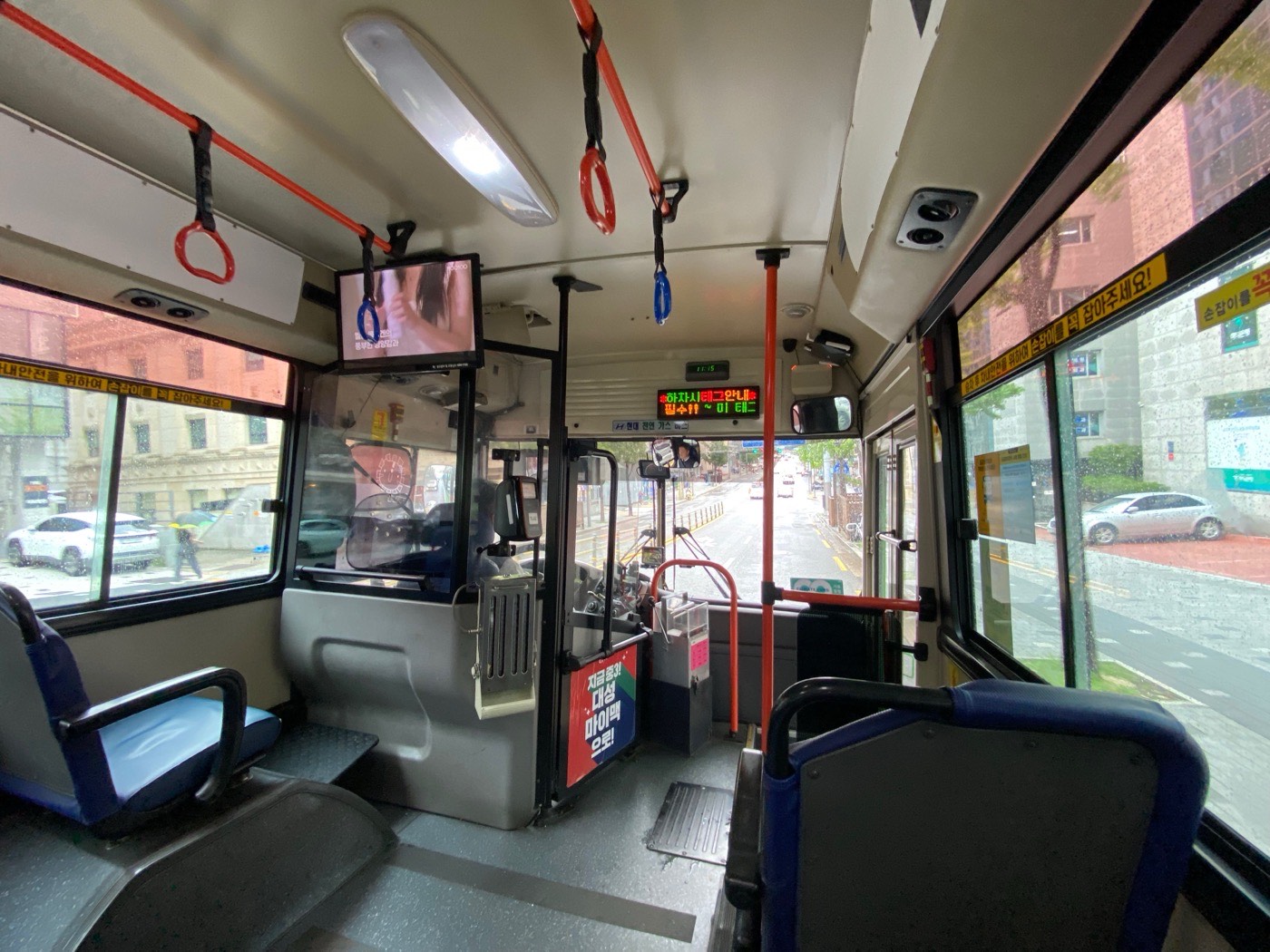
Seoul city buses still cost the same in cash as by card. On the adult fare table the city has used since 12 August 2023, a blue trunk bus is ₩1,500, a green branch bus ₩1,400, a red wide-area bus ₩3,000 and a village bus ₩1,200. The catch is that many buses no longer take cash at all. Seoul's transport site lists the "cashless bus" (현금 없는 버스) routes as of January 2026: 183 entries, against 396 city bus routes in the same month's operating figures. The two lists are not counted the same way (the cashless list includes route variants), but the order of magnitude is clear: a large share of Seoul's buses take no cash, and you cannot tell from the stop which kind is coming.
On a cashless bus, Seoul's guidance is to buy a transit card, download a mobile transit card from the QR code on board, or pay later by bank transfer using the fare-payment slip (요금납부안내서) carried on the bus. A bank transfer needs a Korean account, so for a visitor the practical rule is simple: ride buses with a T-money card, never with cash. Gyeonggi Province, which surrounds Seoul, went the same way and expanded its cashless buses from 5 pilot routes to 80 routes on 1 April 2026, including 41 wide-area express (광역) routes.
Jeju is the exception in the other direction. Since August 2025, Jeju city buses accept a foreign contactless Visa card tapped on the reader, the first place in Korean public transport to allow it. A ride is ₩1,150 by card or ₩1,200 in cash (Jeju bus guide).
Taxis: card, T-money or cash, and the app question
Every licensed Seoul taxi has a card reader, and you can pay with a card, a T-money card or won. Travellers widely report that overseas Visa and Mastercard work at the reader in most Seoul taxis, but we found no official city statement that every reader accepts foreign cards, so carry a backup (taxi fare guide). The base fare is ₩4,800 for 1.6 km, with +20% from 22:00 and +40% from 23:00 to 02:00. A driver who demands cash only, refuses a receipt or adds a "luggage fee" is not following the rules; report it to Seoul's 120 line.
Calling a taxi by app is where foreign cards fail most:
- Kakao T (카카오 T), the app Koreans use, does not bar foreigners, but travellers report that its sign-up text often fails to reach a foreign number and its payment step often rejects foreign cards. If your card registers, there is no extra fee (app comparison).
- K-RIDE, Kakao Mobility's app for non-residents, takes foreign Visa, Mastercard and Amex and reaches the same drivers, for a 10% service fee.
- Kakao Venti (카카오 T 벤티), the big van taxi, cannot be paid at the end of the ride: it runs on automatic card payment only (Venti guide).
You might like: Seoul Taxi Fare in Korea: the ₩4,800 Base Fare, Night Surcharge Hours, and What a Ride from Incheon or Gimpo Costs
Restaurants, cafés and delivery
In restaurants and cafés in the areas visitors go to, your card works. Two Korean rules make the bill simpler than at home. There is no tipping, and since 1 January 2013 the menu must show the final price, with VAT and any service charge included, so the price on the menu is the price you pay (why service feels blunt). Many places take payment at the counter by the door on the way out, and some use self-order kiosks instead of a server.
Where cards are less certain is the small end: alley restaurants that see little foreign money and market food stalls. Carry a few ₩10,000 notes. A ₩50,000 note for a ₩5,000 snack is a hard ask anywhere. Afternoon break times, not payment, are the more common surprise; see our restaurant hours guide.
Delivery changed in 2026. Baemin (배달의민족) runs in English, Chinese and Japanese, takes foreign Visa, Mastercard, JCB and Amex, added Apple Pay with foreign cards on 2 June 2026, and lets a visitor order without a Korean number by verifying a foreign number with a text. Coupang Eats has English menus and has taken foreign Visa and Mastercard since July 2025, but we could not confirm how a tourist passes its phone verification (delivery guide).
Shopping and the tax refund
Shopping is where foreign cards work best, and where the money comes back. At a registered tax-free store, the minimum is ₩15,000 on one receipt (down from ₩30,000 at the end of 2023; old signs still say ₩30,000). Instant refund at the till covers purchases under ₩1,000,000 each, up to ₩5,000,000 per trip. Expect roughly 5 to 8% of the price back, not the full 10% VAT, and take the goods out of Korea within three months. Cosmetic and medical procedures have had no VAT refund since 1 January 2026 (tax refund guide). Some tourist hotels refund VAT on the room too (hotel tax refund guide).
Show your passport before the cashier finishes the sale. After payment, the refund is harder or impossible depending on the store's system.
Skip this: five honest notes
- Don't change your whole budget at Incheon. At 4.20% against 1.75%, it costs about ₩16,440 more on every $500.
- Don't board a Seoul bus with only cash. On a cashless route the remedy is a bank transfer you cannot make.
- Don't load more onto a T-money than you will ride. One top-up is capped at ₩90,000, and convenience-store refunds stop at ₩20,000 or ₩30,000; anything above that means a trip to Tmoney Town.
- Don't plan around Apple Pay at the counter. It is a bonus where it works, not a payment method.
- Don't buy the Korea Tour Card from an old guide. T-money says it has been discontinued; the Tmoney Travel Card replaced it (details).
If you want this, read that
| If you want to… | Read |
|---|---|
| Buy, top up and refund a transit card | T-money Card for Foreigners: Cost, Top-Up, Refund, WOWPASS |
| Ride Seoul unlimited for a few days | Seoul Climate Card tourist pass |
| Change money without losing on the rate | Incheon Airport exchange rates vs town |
| Know where a foreign card is most and least welcome | Where foreign cards actually get swiped in Korea |
| Get VAT back on shopping | Korea tax refund guide · Hotel tax refund |
| Pay a taxi or work out the fare | Seoul taxi fares · Taxi apps for foreigners · Kakao Venti |
| Order food to your hotel | Food delivery in Korea as a tourist |
| Ride the bus in Jeju with your own card | Jeju buses |
| See the fares you will be paying | Getting around Korea: the numbers |
| Budget the whole trip | How much a trip to Korea costs |
| Shop the markets | Namdaemun vs Dongdaemun |
FAQ
Q: Is it better to use cash or card in Korea? A: Card, for almost everything: shops, restaurants, cafés and taxis. Keep some won cash for markets, street stalls and topping up a plain T-money card, which takes cash only. Change it at a city bank branch (1.75% on US dollars) rather than the airport (4.20%).
Q: Can I use my Visa or Mastercard on the Seoul subway and buses? A: Not by tapping it, as of November 2026. Seoul plans to open buses first (reported for January 2027) and subway Lines 1–8 in 2027. Until then, use a T-money card, WOWPASS or a Climate Card pass. You can buy single-journey tickets and Climate Card passes with a foreign card at 440 station kiosks. Jeju city buses are the exception: they take foreign contactless Visa cards.
Q: Can I pay cash on a bus in Seoul? A: On some buses. The fare is the same in cash or by card (₩1,500 on a blue trunk bus, ₩1,400 on a green branch bus), but Seoul's January 2026 list names 183 cashless bus routes, where the only cash alternative is a bank transfer. Use a T-money card on every bus.
Q: Does Apple Pay work in Korea? A: Partly. Korean cards on Apple Pay are limited to Hyundai Card and, since 16 November 2026, KakaoBank. With a foreign card, Apple Pay works in Baemin and on terminals that read contactless cards, but many Korean shop terminals do not. Carry the physical card.
Q: How do I pay for a taxi in Korea as a tourist? A: At the in-car reader by card, by T-money, or in won. Travellers report foreign cards usually work, but no official source guarantees every reader. By app, K-RIDE and Uber take foreign cards; K-RIDE adds 10%. Kakao T often rejects foreign cards.
Q: Do I need to tip in Korea? A: No. Restaurants and cafés must list the final price, including VAT and any service charge, so the menu price is what you pay.
Sources
- EpicKor guides, each with its own dated sources: 201 (T-money, WOWPASS, station kiosks, open-loop timeline, iPhone T-money; checked 12 November 2026), 551 (Climate Card; 28 October 2026), 467 (Incheon and city-bank commissions, Global ATMs; 5 November 2026), 464 (Korea Credit Data foreign-card spending; September 2026), 586 (Seoul taxi fares and payment; 21 November 2026), 222 and 454 (Kakao T, K-RIDE, Venti), 506 (Jeju buses), 178 (Baemin and Coupang Eats; 24 November 2026), 206 and 510 (tax refund), 440 (tipping and final-price rule), 175 (markets), 457 (2025 exit survey, 11.7% money gap).
- Seoul Metropolitan Government, transport site: 현금 없는 버스 운영 노선번호 안내 ('26.1월 기준), 183 route entries, page modified 6 March 2026. Read 27 November 2026.
- Seoul Metropolitan Government, transport site: 시내버스·마을버스 운영현황 ('26년 1월 기준), 396 city bus routes; adult fares from 12 August 2023, the same by card and in cash: trunk ₩1,500, branch ₩1,400, wide-area ₩3,000, village ₩1,200. Read 27 November 2026.
- Seoul Media Hub, 현금 없는 시내버스 확대, 문제점과 개선방안은?, 17 March 2023: what a passenger without a card does on a cashless bus (buy a card, mobile transit card by QR, bank transfer via the fare-payment slip).
- Seoul Shinmun, 경기도, '현금없는 버스' 4월부터 80개 노선으로 확대, 5 March 2026: 5 pilot routes to 80 from 1 April 2026 (41 express, 39 city routes), bank transfer via the slip on board.
- BizWatch, KakaoBank Apple Pay launch, 18 November 2026: service started 16 November 2026 for check cards and the "mini" prepaid card; second Korean financial company after Hyundai Card (March 2023); contactless terminals more common abroad than in Korea.
- EBN via Daum, 애플페이 추가 사업자 연내 난망, 20 July 2026: Shinhan reviewing timing and viability, KB technically mostly ready with no date, no further issuer likely this year.
- News1 via Daum, "카드도, 배달도 안 돼요"…외국인은 한국에서 돈 쓰기 힘들다, 10 July 2025: slow spread of EMV-approved terminals, Apple Pay and Google Pay often not recognised.
- FF News, Mastercard Makes Getting Around Korea Easier for International Travelers with iPhone, 8 April 2026: Mastercard holders can top up mobile T-money on iPhone for subways, buses and taxis.
- Korea Customs Service, traveller guide: means of payment over US$10,000 under the Foreign Exchange Transaction Regulations; the declaration covers foreign cash, won cash and cheques together, as Korean press reports of Customs guidance describe.
You Might Also Like

Korea Cherry Blossom 2027: When Seoul, Jinhae, Busan and Jeju Usually Bloom, and When to Book
No one has published a 2027 cherry blossom forecast yet; the first comes in late February. In 2026 Seoul bloomed on 29 March, 10 days early. Here are the normal dates for each city, the trend and the 2026 festivals, plus why KTX seats open before the forecast is out.

Ice Skating in Seoul, Korea: Lotte World vs Mokdong vs Taereung vs Seoul Plaza Rinks
Lotte World Ice Rink costs ₩21,000 (US$15.44) with skates on a weekday; Seoul's public rinks at Mokdong and Taereung charge about ₩8,000 and open all year. The winter rink on Seoul Plaza, ₩1,000 last season, reopens 18 December 2026.
Incheon Airport to Busan, Korea: Direct Bus, AREX + KTX or a Flight to Gimhae — Fares, Hours and the Last Departure
Yes, a direct bus runs from Incheon Airport to Busan: 18 a day, the last at 23:50, ₩53,900 to ₩91,300, from 4 h 41 min. AREX + KTX costs about ₩67,400 and reaches Busan Station faster. Flights to Gimhae, the last departures and late landings, compared.