How Much Does a Trip to Korea Cost? $238 a Day in the Official Survey
Last updated: 11 October 2026. Survey figures are from the 2025 International Visitor Survey final report (2025년 외래관광객조사 최종 보고서) by the Ministry of Culture, Sports and Tourism (문화체육관광부) and the Korea Culture and Tourism Institute (한국문화관광연구원), posted 26 May 2026, read in the original PDF on 11 October 2026. All survey dollars are US dollars spent in 2025. Won conversions use ₩1,356.7 to the dollar (29 September 2026 close) and are for orientation only. The daily budget table further down is EpicKor's own estimate, built from prices verified in our other guides, and is labelled as such.
How much does a trip to Korea cost? The English web answers with guesses: "$50 a day", "$60 to $160 a day", one person's receipts from one trip. Korea's government answers with a number. Every month it stops foreign visitors at Incheon, Gimhae, Jeju and seven other departure points and asks what they spent. In 2025 it asked 16,110 of them, and the answer was $238.30 a day per person, before the flight. Americans stayed 8.3 days and spent $214.40 a day. Britons stayed 9.6 days at $201.20. Australians stayed 9.0 days at $184.20.
There is a second government number, and you may have seen it in the news: the Bank of Korea's $177.80 a day. Both are real. They measure different things, and only one of them is the number a traveller should plan with. This guide gives you both, the breakdown by passport and by spending line, and then a daily budget built from current Korean prices.
Shopping is the largest line in the survey, ahead of the hotel, and it comes home in your checked bag. An Etekcity digital luggage scale tells you at the hotel, not at the check-in desk, whether the cosmetics haul has pushed the bag over the limit. As an Amazon Associate, EpicKor earns from qualifying purchases.
Quick Guide: what a trip to Korea costs, in the government's numbers
| Question | Answer (2025 survey unless stated) | In won (₩1,356.7/$) |
|---|---|---|
| Average spend per day, before the flight | $238.30 per person (2024: $236.40) | about ₩323,300 |
| Per day, including the flight | $321.90 | about ₩436,700 |
| Average stay | 6.5 days; 60.5% stayed 4–7 days; leisure trips 5.6 days | — |
| Per trip, before the flight | $1,327.60 ($1,802.30 with it) | about ₩1,801,200 |
| Americans | 8.3 days, $214.40 a day, $1,538.80 a trip | about ₩290,900 a day |
| Biggest spending lines, per trip | Shopping $422.60 · lodging $361.00 · restaurants $209.00 | ₩573,300 · ₩489,800 · ₩283,600 |
| What most visitors spent per day | 62.6% spent $100–$300; 16.2% spent under $100; 7.3% over $500 | — |
| The Bank of Korea's figure | $177.80 a day: a different measure (explained below) | about ₩241,200 |
| 2026 so far (provisional) | April–June 2026: 6.2 days, $251.30 a day before the flight | about ₩340,900 |
Lonely Planet Korea — the trip plan the budget hangs on A daily budget only works once you know how many nights go to Seoul, Busan and Jeju. The current Lonely Planet Korea has the itineraries and regional maps to decide that before you price anything. As an Amazon Associate, EpicKor earns from qualifying purchases.
See Lonely Planet Korea on Amazon$238 a day: what the survey actually measured
The International Visitor Survey (외래관광객조사) is the culture ministry's annual exit survey. Interviewers with tablets stop departing foreign travellers at seven airports (Incheon's two terminals, Gimpo, Gimhae, Jeju, Daegu, Cheongju) and four ports (Busan, Incheon, Pyeongtaek, Gunsan) on set days every month, in 14 languages. To be counted you must be 15 or older and have stayed 90 days or less. Transit passengers who only slept in Korea, aircrew, soldiers and the small-time traders known as ttaigong are left out. In 2025 it completed 16,110 interviews, weighted afterwards by nationality, month, sex and age to match actual arrivals.
Three things about the headline number matter for planning:
- "Before the flight" means everything spent in Korea: rooms, food, shopping, local transport, tours, clinics. The $321.90 version adds the international fare.
- The daily figure excludes anyone who stayed 61 days or more, so long-stayers do not drag it down.
- The top and bottom 1% are trimmed to the nearest value, a rule in place since 2023. That is why the report itself warns that comparisons with years before 2023 need care.
Split by how people travelled, the daily number moves a lot. Independent travellers spent $222.60 a day; tour groups $297.70; air-and-hotel packages $304.30. Most readers of this site are independent travellers, so $222.60 is the closer benchmark, and it is about ₩302,000 a day.
You might like: 18.9 Million Visitors Told Korea What They Couldn't Find: the official exit survey, gap by gap
By passport: how long people stay and what they spend per day
This is the table that does not exist in English. Long-haul visitors stay longer and spend less per day; short-hop visitors from Japan and China do the reverse.
| Country of residence | Average stay | Per day, before flight | Per trip, before flight | Stayed in a hotel |
|---|---|---|---|---|
| All visitors | 6.5 days | $238.30 | $1,327.60 | 79.2% |
| United States | 8.3 days | $214.40 | $1,538.80 | 75.1% |
| Canada | 9.2 days | $211.30 | $1,589.40 | 72.4% |
| United Kingdom | 9.6 days | $201.20 | $1,691.10 | 76.9% |
| Australia | 9.0 days | $184.20 | $1,516.10 | 80.0% |
| Germany | 11.4 days | $170.60 | $1,692.30 | 76.3% |
| France | 12.1 days | $158.30 | $1,752.10 | 67.7% |
| Singapore | 7.2 days | $241.60 | $1,636.20 | 84.3% |
| Japan | 3.7 days | $231.80 | $838.50 | 93.0% |
| China | 6.4 days | $279.90 | $1,503.50 | 75.0% |
| Taiwan | 5.3 days | $236.10 | $1,207.70 | 83.8% |
| Hong Kong | 5.6 days | $257.80 | $1,377.10 | 83.6% |
| GCC (Gulf states) | 8.8 days | $342.60 (highest) | $2,597.40 | 86.3% |
Source: 2025 International Visitor Survey final report, residence-country tables for stay, daily and per-trip spend (international transport excluded) and the residence-country lodging table for hotel use (more than one answer allowed). Per-trip and per-day figures are averaged separately, so per-day × days does not equal per-trip.
Read it this way. An American's trip is longer than the average and cheaper per day, because a longer trip spreads the big one-off costs (the haul of cosmetics, the airport transfer) over more days, and because 12.9% of Americans stayed with friends or relatives, against 4.5% of Japanese visitors. Japanese visitors come for a long weekend (3.7 days, and 53.5% stayed three days or less) and spend nearly the average per day. Gulf visitors top the table at $342.60 a day.
The spread matters as much as the average. Among Americans, 58.1% spent $100–$300 a day, 23.9% spent under $100 and 6.1% spent over $500. So $214 is not a floor. It is the middle of a wide band.
Where the money goes: shopping $422.60, lodging $361.00, restaurants $209.00
The survey also breaks spending into lines. These are per visitor, per trip, and each line is averaged over everyone, including people who spent nothing on it, which is why they do not add up neatly to the trip total.
| Line (per trip, US$) | All visitors | United States | United Kingdom | China | Japan |
|---|---|---|---|---|---|
| Shopping | 422.6 | 251.3 | 258.6 | 651.9 | 224.9 |
| Lodging | 361.0 | 579.9 | 693.8 | 262.2 | 194.8 |
| Restaurants | 209.0 | 285.6 | 354.7 | 214.9 | 122.8 |
| Travel-agency payments (packages, tours) | 154.6 | 240.8 | 179.5 | 50.2 | 177.4 |
| Road transport (bus, taxi) | 33.9 | 47.2 | 57.0 | 39.3 | 21.2 |
| Rail | 20.8 | 31.7 | 42.6 | 16.4 | 9.7 |
| Groceries and food shopping | 25.3 | 37.4 | 47.0 | 23.9 | 11.1 |
| Medical and health checks | 61.2 | 20.1 | 4.9 | 88.1 | 63.9 |
| Beauty services | 24.0 | 20.2 | 6.6 | 25.4 | 32.3 |
| Culture (shows, museums) | 23.4 | 14.8 | 21.3 | 42.0 | 11.2 |
The pattern is the useful part. For the average visitor, shopping beats the hotel. For an American or a Briton, the hotel is the biggest line by far, and restaurants come second. Western visitors spend about 40 percent less than the average on shopping and about 60 to 90 percent more on rooms.
Within shopping, the survey says 33.9% of the money went on perfume and cosmetics, 20.2% on clothing and 19.0% on food products. Of the visitors who shopped at all, 71.3% bought cosmetics or perfume. If your shopping is mostly cosmetics, our Olive Young guide and tax refund guide cover the two things that change what you pay.
The lodging line, read correctly. $579.90 is what the average American spent on rooms for the whole trip, per person. Spread over 8.3 days it is about $70 a person a day. Two people sharing at that rate are paying roughly $140, about ₩190,000, for the room. That is EpicKor's arithmetic, not a survey figure, but it lands inside the ₩180,000–₩300,000 band that our Seoul hotel price guide gives for a four-star room, and just above the three-star band. In other words, the average Western visitor is sleeping in a three- or four-star hotel, sharing.
Seoul hotels on Agoda — check the real rate for your dates The survey tells you what visitors paid on average; the price for your week can be far off it, because Seoul rooms jump around festivals and concerts. Compare the grade you budgeted for against the actual dates. EpicKor may earn a commission if you book through this Agoda link, at no extra cost to you.
Check Seoul hotel prices on AgodaYou might like: How Much Is a Hotel in Seoul? The official numbers by month, star grade and neighbourhood
$177.80 or $238.30? Why the Bank of Korea's number is lower
On 5 August 2026 the Bank of Korea (한국은행) published a report on tourism as a service export (서비스수출 관점에서 본 관광산업의 성장효과와 정책방향). Korean and English news quoted its line that a visitor spends $177.80 a day over 6.5 days, and that Korea would need $223 a day to match Japan's tourism share of GDP. If you read that and budgeted $178, you would come up short.
The news reports do not spell out how the bank built its figure, so what follows is EpicKor's reading, not the bank's own explanation.
- The bank's number looks like a national total divided by heads. The same reports give 2025 tourism exports of $21.888 billion and 18.94 million foreign visitors. Divide: $21.888 billion ÷ 18.94 million = $1,155.60 a visitor; ÷ 6.5 days = $177.80, exactly the published figure. We take that match as strong evidence of the method, but it is our arithmetic.
- The survey asks a narrower group. It interviews visitors aged 15 and over who stayed up to 90 days, and leaves out transit passengers, crew, traders and cruise passengers. A head count of all arrivals includes children and people who spend little, which would pull an all-visitor average down.
- They answer different questions. A national total tells you how much money tourism brings into Korea's economy. The survey tells you what a typical adult visitor spent. A traveller's question is the second one.
On that reading, $177.80 is a macroeconomic average, and $238.30 (or $222.60 if you travel independently) is the planning number.
You might like: Where Foreign Cards Actually Get Swiped in Korea: Seoul takes 65% of the spend
EpicKor's estimate: a daily budget for Seoul, October 2026
This table is not from the survey. It is EpicKor's own estimate for one adult in Seoul, built from prices we have verified for other guides, each linked. It excludes shopping and the flight, so you can add your own. Assumptions: one adult with a room to themselves; room prices are per room per night as in our hotel guide, before the 10% VAT that international booking sites may add at checkout; if two of you share, halve the room line; sights and extras are round allowances, not verified prices.
| Per person, per day | Budget | Mid-range | Comfort |
|---|---|---|---|
| Room (per room) | ₩60,000: guesthouse or hostel, from the ₩40,000–₩90,000 band (460) | ₩130,000: three-star, from ₩90,000–₩160,000 (460) | ₩250,000: four-star, from ₩180,000–₩300,000 (460) |
| Food and drink | ₩23,500: convenience-store breakfast about ₩3,000 (497), kimchi-jjigae set ₩8,654, kalguksu ₩10,038 (302), banana milk ₩1,800 (497) | ₩53,700: kimchi-jjigae set ₩8,654, naengmyeon ₩12,692 (467), one serving of samgyeopsal ₩21,321 (172) plus rice and a drink, snacks | ₩100,000: samgyetang ₩18,154 (263), a two-serving barbecue dinner ₩42,642 plus drinks, cafés |
| Local transport | ₩6,200: four subway or bus rides at ₩1,550 (501) | ₩15,000: four rides plus one short taxi from the ₩4,800 flag fare (501) | ₩35,000: mostly taxis, with the 20–40% late-night surcharge (501) |
| Sights and extras | ₩10,000 | ₩30,000 | ₩60,000 |
| Total per day | about ₩100,000 ($74) | about ₩229,000 ($169) | about ₩445,000 ($328) |
EpicKor estimate, October 2026. Restaurant figures are Korea Consumer Agency (한국소비자원 참가격) Seoul averages as checked in the linked guides, July–August 2026; samgyetang is the May 2026 average. Not a survey figure.
Two cross-checks against the survey. First, add shopping: the average visitor spent $422.60 on it over 6.5 days, about $65 a day, and our mid-range $169 plus $65 comes to $234, close to the survey's $238.30. Second, an American's 8.3-day trip at our mid-range rate is about $1,400, plus the $251.30 the average American spent shopping, about $1,650, against the survey's $1,538.80 for Americans. Our estimate runs a little high because it assumes a room to yourself.
One-off costs that do not fit a daily line: a T-money card, about ₩2,500; the airport train to Seoul Station, ₩4,750 all-stop or ₩13,000 express (airport guide); and a KTX to Busan, ₩54,400 each way (getting around Korea). Changing all your cash at Incheon Airport costs about 4.20% on dollars against 1.75% at city branches, which is ₩16,470 on $500 (money exchange guide).
You might like: Getting Around Korea: subway ₩1,550, last trains and KTX booking, in numbers
What the averages hide: five honest notes
- Chinese and Gulf shopping inflates the headline. Chinese visitors spent $651.90 each on shopping and Gulf visitors $967.50, against $251.30 for Americans. If you are not coming to shop, the all-visitor $238.30 overstates what you need, and the American $214.40 is the better guide.
- Group tours make "per day" look expensive. Groups spent $297.70 a day and air-and-hotel packages $304.30, against $222.60 for independent travellers, because the package price is counted inside the trip.
- Free rooms pull the lodging line down. 8.2% of all visitors stayed with friends or relatives, and 12.9% of Americans. If you are paying for every night, budget above the survey's lodging average, not at it.
- Clinic tourism sits inside "spending". The medical line averages $61.20 per visitor, but it is $450.80 for Central Asian visitors and $20.10 for Americans. Most travellers spend nothing here. If yours is a dental or skin trip, our dental implant price guide shows how to check one clinic against the government's price data.
- Do not compare with old guides or pre-2023 surveys. The trimming rule changed in 2023, and 2025's figures are in 2025 dollars. The won has moved since: at ₩1,356.7, $238.30 is about ₩323,300.
2026 so far: a little higher
The ministry also publishes quarterly provisional results. For April to June 2026, visitors stayed 6.2 days on average and spent $251.30 a day before the flight ($338.50 with it), up on the same quarter of 2025, and $1,365.90 a trip against $1,348.20 a year earlier. These are provisional and will be revised in the 2026 final report, due around May 2027, when this guide will be updated. For now, planning at $240–$250 a day per person, before flights and including some shopping, is consistent with what visitors actually did.
If you plan a month rather than a week, the arithmetic changes again; see living in Seoul for a month.
FAQ
Q: How much does a trip to Korea cost per day? A: In the government's 2025 exit survey, foreign visitors spent $238.30 a day per person on average, before the international flight (about ₩323,300 at ₩1,356.7 to the dollar). Independent travellers spent $222.60 a day and Americans $214.40. Including the flight, the all-visitor average was $321.90 a day.
Q: How much money do I need for one week in Korea? A: The survey's average trip was 6.5 days and cost $1,327.60 per person before the flight. Americans, who stayed 8.3 days, spent $1,538.80. On EpicKor's own estimate, a week in Seoul costs about $520 on a budget, $1,180 mid-range and $2,300 in comfort, before shopping and flights.
Q: Is Korea expensive to visit compared with what I read online? A: It costs more than the "$50 a day" guides suggest. 62.6% of visitors in 2025 spent between $100 and $300 a day, and only 4.2% spent $50 or less. Hotels are the main reason: Korea's three- and four-star room rates rose about 30 to 33 percent between 2022 and 2024.
Q: Why does the Bank of Korea say $177.80 a day? A: The reports do not give the method, but the figure matches exactly what you get by dividing Korea's 2025 tourism exports of $21.888 billion by 18.94 million visitors and 6.5 days (EpicKor's arithmetic). A head count of all visitors includes children and others the survey does not interview. On that reading it measures what tourism earns the economy; the survey's $238.30 measures what an adult visitor spent.
Q: What do tourists spend the most money on in Korea? A: Shopping, at $422.60 per visitor per trip, then lodging at $361.00 and restaurants at $209.00. A third of the shopping money went on perfume and cosmetics. For Americans and Britons the order flips: lodging ($579.90 and $693.80) is the largest line.
Sources
- Ministry of Culture, Sports and Tourism (문화체육관광부) and Korea Culture and Tourism Institute (한국문화관광연구원), 2025 International Visitor Survey final report (2025년 외래관광객조사 최종 보고서), posted 26 May 2026 on the Tourism Knowledge Information System (관광지식정보시스템), know.tour.go.kr. Read in the original PDF, 11 October 2026: survey design and 16,110 completed interviews; average stay 6.5 days; per-trip spend $1,802.30 / $1,327.60 and per-day $321.90 / $238.30; spend by travel type; shopping composition (33.9% cosmetics); residence-country tables for stay, per-trip and per-day spend and their distributions; line-by-line spending by residence country; residence-country lodging table for hotel use and stays with friends or relatives.
- Same publishers, 2026 International Visitor Survey, Q2 provisional results (2026년 외래관광객조사 2분기 결과(잠정치)), posted 28 July 2026, same site: 6.2 days, $251.30 a day and $1,365.90 a trip before international transport.
- Bank of Korea (한국은행), 서비스수출 관점에서 본 관광산업의 성장효과와 정책방향 (BOK Issue Note), 5 August 2026, as reported by Money Today, 5 August 2026: $177.80 a day, 6.5 days, 18.94 million visitors, tourism exports $21.888 billion. The original note was not read; the division reproducing $177.80 and the explanation of the gap are EpicKor's.
- Exchange rate: ₩1,356.7 per US dollar, 29 September 2026 close.
- Prices in the daily budget: as verified in EpicKor's guides 460 (hotel rates), 501 and 453 (subway, taxi, KTX), 497 (CU drink prices, 2 October 2026, and a ₩3,000 convenience-store breakfast), 302 and 467 (Korea Consumer Agency Seoul restaurant averages), 172 and 263 (samgyeopsal and samgyetang averages), 202 (airport rail) and 467 (airport exchange rates). See each guide for its own sources and check date.
You Might Also Like
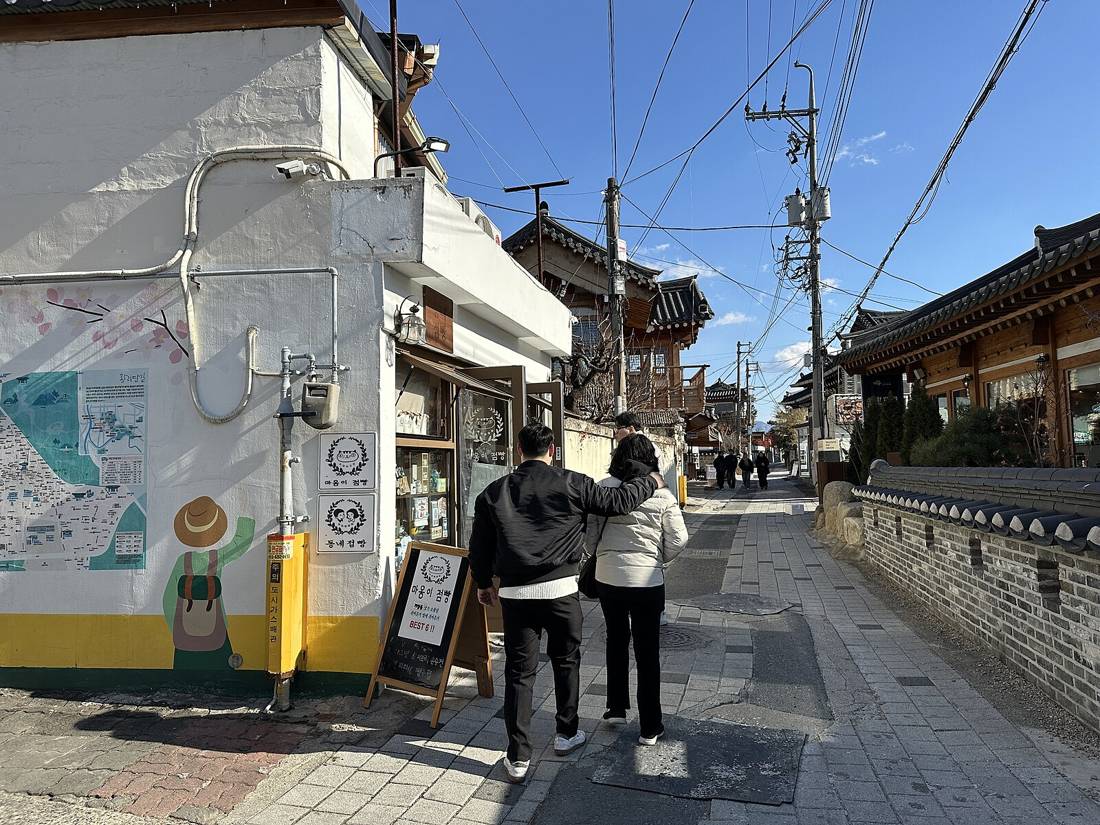
Where to Stay in Gyeongju, Korea: Old-Town Hanok, Bomun Lake or KTX Station
Gyeongju has 356 registered hanok stays, and 171 sit beside the royal tombs — most with two rooms or fewer. Bomun Lake has 11. The KTX station and Bomun are both in the 55% taxi-surcharge zone, so choose your base before the train or bus.
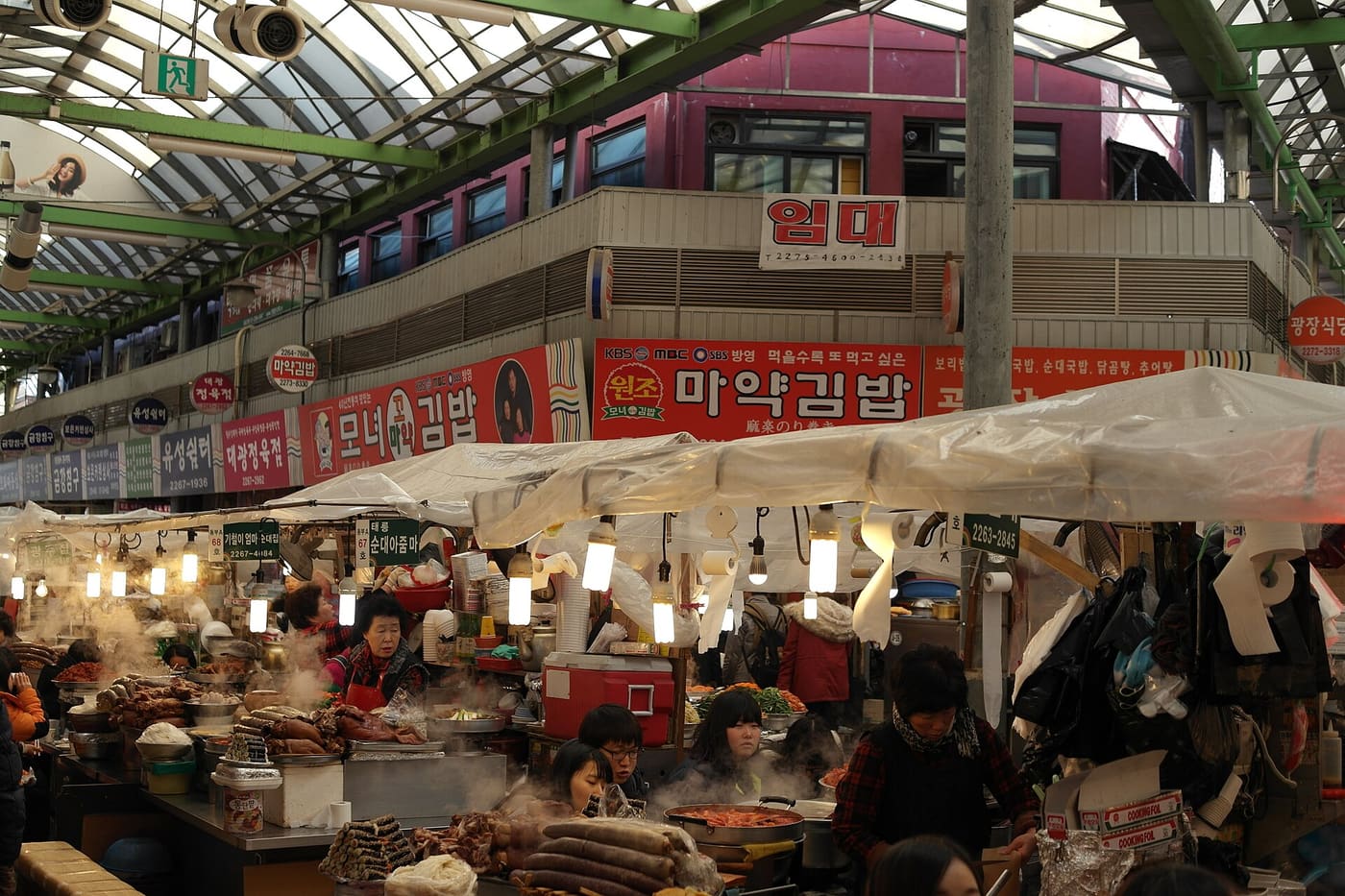
Gwangjang Market's Second Floor: Seoul's Vintage Arcade, and the One Day It's Shut
Everyone knows Gwangjang for the food alley that never closes. Above it is a vintage arcade signed 수입구제 where most items run under ₩20,000 — and it shuts every Sunday, which is exactly when visitors turn up.
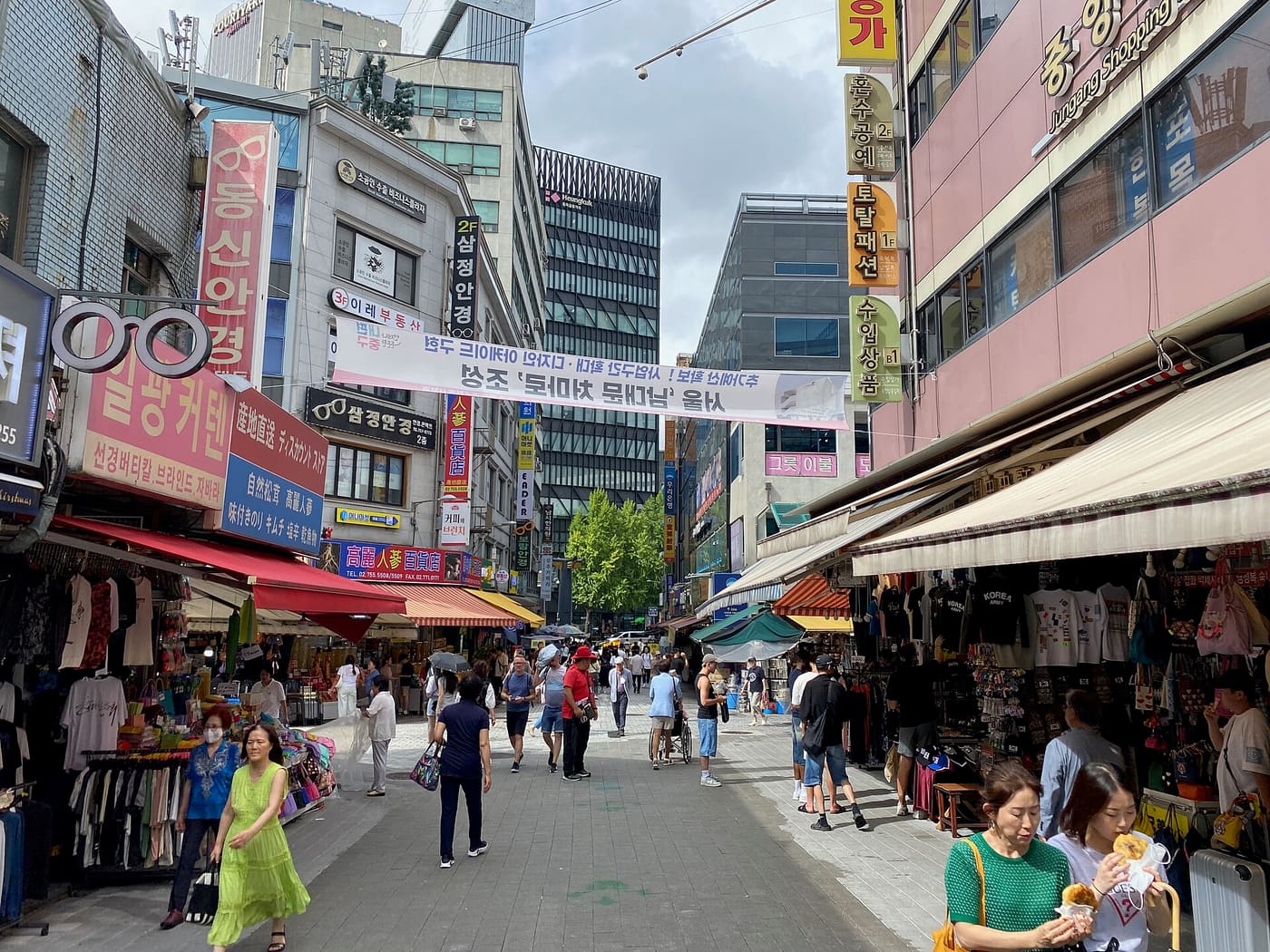
Where to Buy Luggage in Seoul: Namdaemun, Real Prices, and When Not to Bother
You shopped too well and now you need another suitcase. Namdaemun is the answer, but the underground arcade shuts on the 2nd and 4th Sunday, the bag shops close for Chuseok, and a cheap case is not always cheaper than shipping.