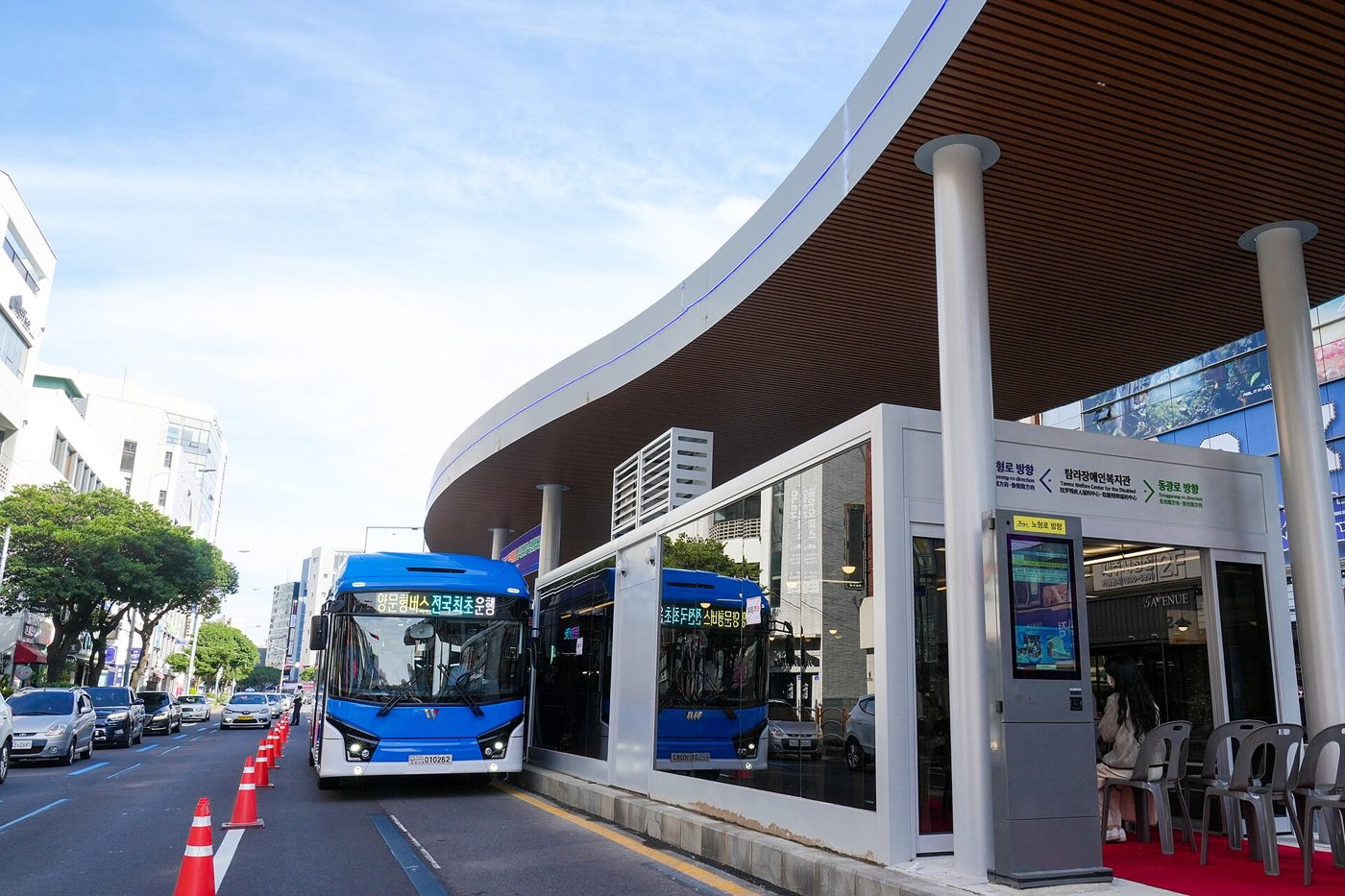
Jeju Buses, Korea (2026): ₩1,150 a Ride, the 600 and 601 Airport Buses to Jungmun, Foreign Cards That Tap, and Getting Around Without a Rental Car
Last updated: 5 October 2026. Fares, timetables and route details were read from the Jeju Bus Information System (제주버스정보시스템, bus.jeju.go.kr), run by Jeju Special Self-Governing Province, on 5 October 2026. Timetables change a few times a year; the effective date of each one is given where it matters.
Most Korean visitors rent a car on Jeju. Most foreign visitors do not, and they are right. In the Jeju Tourism Organization's 2023 visitor survey, foreign visitors got around mainly by taxi (36.2%) and bus (25.3%), and only 18% rented a car. The island-wide bus network carried 61 million passengers in 2024, about 167,000 a day. It is cheap, it covers almost every sight, and it is easier for a foreigner to use now than in any year before.
Three facts about it are missing from most English guides. A normal ride still costs ₩1,150 by card, because the planned fare rise was frozen again for 2026. Since August 2025 you can tap a foreign contactless Visa card to pay, which Jeju offered before anywhere else in Korea. And for the Jungmun resort hotels you want the 601, not the famous 600. This page explains how the system works, the fares, the airport buses, the routes visitors actually use, and when a car or taxi is still the better choice.
Jeju bus stops are often open to the sea wind: the Repel windproof travel umbrella on AmazonAffiliate link. As an Amazon Associate, EpicKor earns from qualifying purchases at no extra cost to you.
Quick Guide: Jeju Buses for Visitors (October 2026)
| Question | Answer |
|---|---|
| What does a ride cost? | ₩1,150 by card, ₩1,200 cash, on all regular and tourist-circular buses, anywhere on the island |
| Express buses (1xx)? | ₩2,000 for the first 20 km, rising by distance to a maximum of ₩3,000. Cash always pays the maximum |
| Airport to Jungmun? | 600 or 601 limousine, about 55 minutes to Yeomiji, ₩4,500 |
| Airport to Seogwipo? | 600 to Seogwipo KAL Hotel (about 1 h 43, ₩5,500), or 800/801 to Seogwipo bus terminal (₩5,000) |
| Can I pay with my own bank card? | Yes, since August 2025: foreign contactless Visa cards (and, per reports, other EMV cards) tap on Jeju city buses. T-money and cash work too |
| Transfers | By card, within 40 minutes of tapping off, up to 2 transfers: free to a bus of the same price or cheaper, otherwise you pay the difference. Between two express or limousine buses only ₩1,150 is taken off |
| Where at the airport? | City and express buses: Gate 2. Limousines 600/601/800: Gate 5 |
| Announcements in English? | Yes. On-board stop announcements are in Korean and English, with Chinese and Japanese added from December 2025 |
| Will the fare go up? | Not in 2026. The planned rise to ₩1,500 was frozen on 12 August 2026; the province says it will try again in 2027 |
Anker 10,000 mAh power bank: keeps the phone that is now your map, timetable and fare card alive On a Jeju bus day your phone does everything: Kakao Map or Naver Map for the next bus, the bus information site for real-time arrivals, and, if your card is in a mobile wallet, the fare. A full day on the 201 and 810 can drain a battery by mid-afternoon, and a dead phone on an oreum road with the next bus 40 minutes away is a long wait. As an Amazon Associate, EpicKor earns from qualifying purchases at no extra cost to you.
See the Anker power bank on AmazonHow the Jeju bus network works
Jeju rebuilt its bus system on 26 August 2017, its first overhaul in about 30 years. Before that, it had separate city and intercity buses with different fares. Afterwards there was one flat fare for the whole island, free transfers and new express routes. The number of routes went from 89 to 194, and the number of buses from 556 to 883. A second large reorganisation followed on 1 August 2024. That is why older blog posts list route numbers that no longer exist.
The route number tells you the type of bus:
| Number | Type | What it is for | Adult card fare |
|---|---|---|---|
| 1xx (101–182) | Express (급행) | Fewer stops between the airport, Jeju City and the far side of the island, such as Seongsan, Pyoseon and Moseulpo | ₩2,000–3,000 by distance |
| 2xx | General trunk (일반간선) | The long coastal and cross-island routes, for example 201 east coast, 202 west coast, 281 to Hallasan | ₩1,150 |
| 3xx / 4xx | Jeju City trunk and feeder | Getting around Jeju City | ₩1,150 |
| 5xx / 6xx | Seogwipo trunk and feeder | Getting around Seogwipo | ₩1,150 |
| 7xx | Village feeder | From the main roads into villages | ₩1,150 |
| 810 / 820 | Tourist circular | Loops through the inland sights: 810 east (oreum volcanic hills, Bijarim), 820 west (O'sulloc tea, Jeoji) | ₩1,150 |
| 600 / 601, 800 / 801 | Airport limousine | Airport to the Jungmun hotels and Seogwipo | ₩1,300–5,500 by stop |
On express buses, tap again when you get off. You pay ₩2,000 when you board and the distance top-up when you tap off. Forget, and you are charged the maximum. Paying cash on an express bus always costs the maximum, ₩3,000.
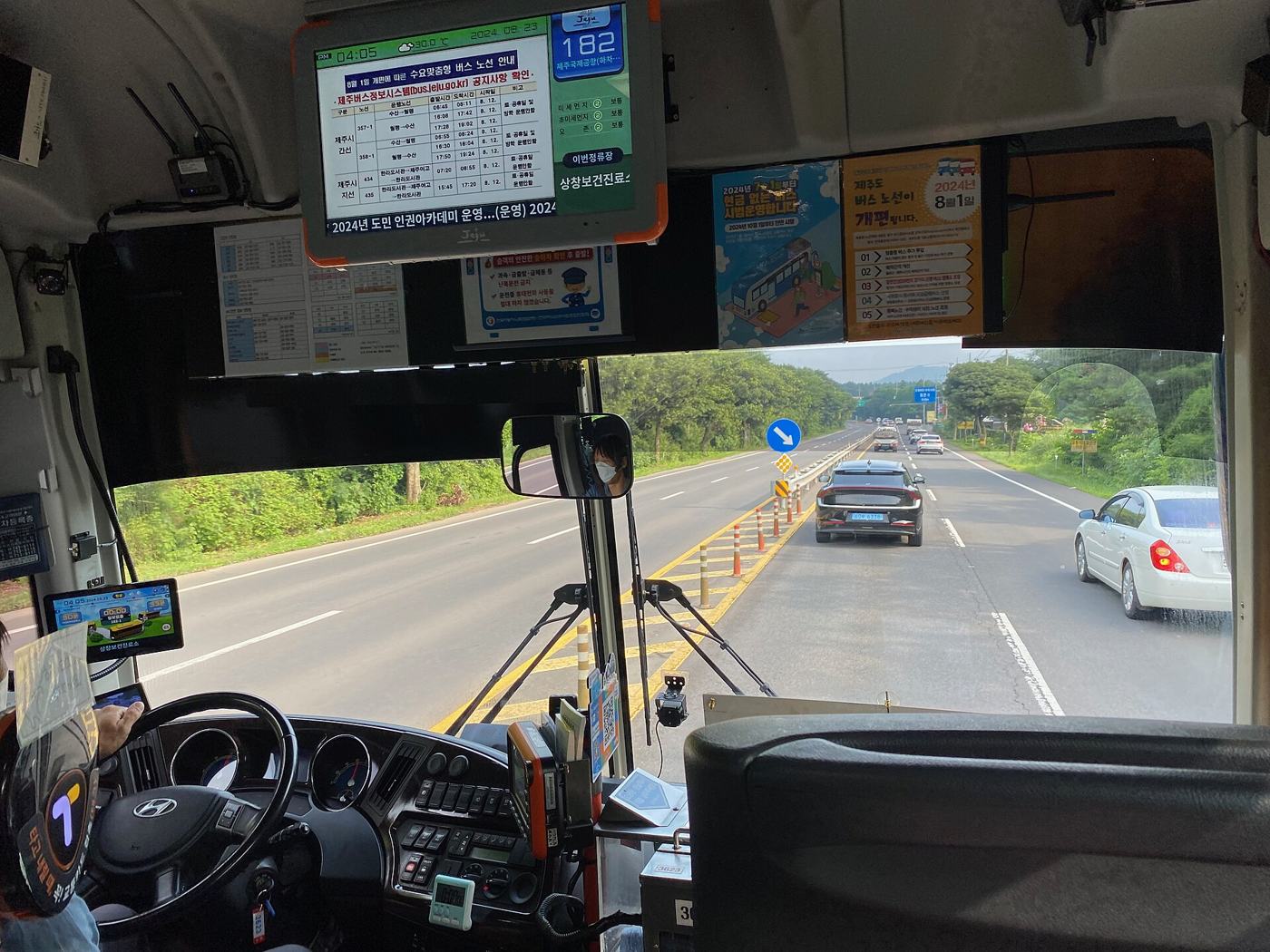
Fares and how to pay
| Bus | Adult (19+) card / cash | Youth (13–18) card / cash | Child (6–12) card / cash |
|---|---|---|---|
| Regular and tourist-circular buses | ₩1,150 / ₩1,200 | ₩850 / ₩900 | ₩350 / ₩400 |
| Express, first 20 km | ₩2,000 / ₩3,000 | ₩1,600 / ₩2,400 | ₩1,000 / ₩1,500 |
| Express, maximum (over 40 km) | ₩3,000 | ₩2,400 | ₩1,500 |
| Airport limousine 600/601 | ₩1,300–₩5,500 by stop | 20% off | 50% off |
| Udo and Chuja island buses | ₩950 / ₩1,000 | ₩550 / ₩600 | ₩350 / ₩400 |
Source: Jeju Bus Information System fare table, read 5 October 2026.
You have four ways to pay:
- Your own contactless bank card. Since August 2025, Jeju city buses accept foreign-issued contactless Visa cards, whatever country issued them, and reports say other EMV cards work too. You tap the card on the reader as you would in London or Sydney. Jeju was the first place in Korean public transport to allow this. Seoul's city buses are only expected to follow in 2027. The launch was announced for Jeju city buses; check for the contactless logo on the reader before relying on it, especially on an airport limousine.
- A T-money or Cashbee transit card. Buy and top up at any convenience store, including those at the airport. The same card works on the subway in Seoul and Busan.
- QR payment. Since August 2024, all Jeju buses accept ZeroPay QR payments, which work with apps such as Alipay and WeChat Pay.
- Cash, ₩1,200 on regular buses. Drivers do not like large notes, and on express buses cash always pays the maximum fare.
Transfers are free if the next bus is the same price or cheaper. You have 40 minutes from tapping off and can make up to two transfers. Moving from a ₩1,150 bus to an express or limousine costs only the difference. Between two express or limousine buses only ₩1,150 is taken off, and the express distance top-up is still charged when you tap off. Transfers work only with a card, not with cash. You cannot transfer to the same route number, including the same route in the other direction.
The free rides are for residents only. Jeju gives free bus travel to residents aged 65 and over and to children aged 6–12, but only with a Jeju Transport Welfare Card, which requires a registered Jeju address. Visitors of any age pay the normal fare.
You might like: Where Foreign Cards Get Swiped in Korea, which shows where foreign visitors' card spending goes, Jeju included.
From the airport: 600, 601, 800 and the city buses
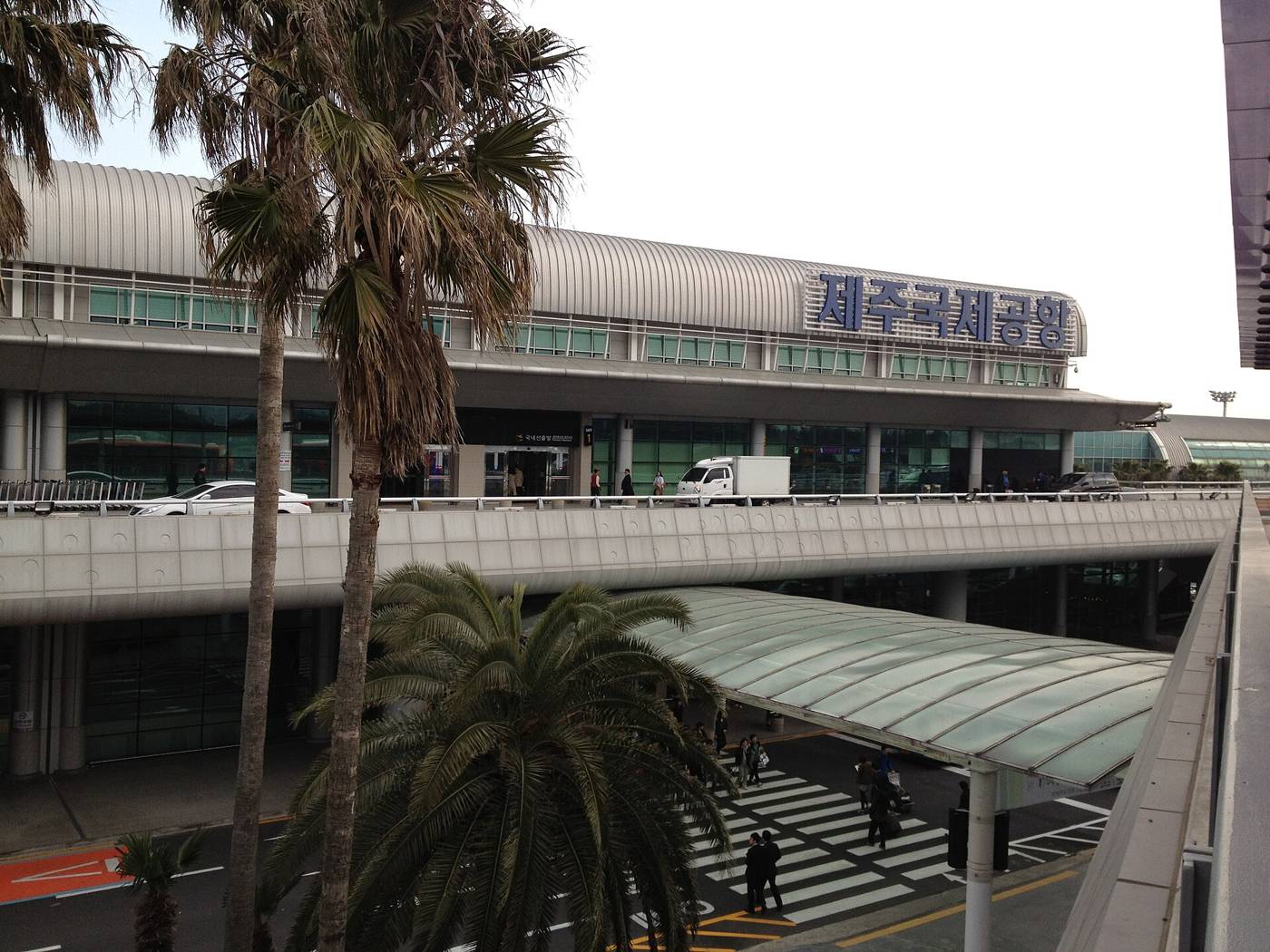
Leave arrivals and cross to the bus area. The limousines (600, 601, 800) stop in front of Gate 5. The city and express buses stop at Gate 2.
600 and 601: the Jungmun buses
Since 1 August 2024 the old 600 has been two routes, and it matters which one you board:
- 601 is the hotel bus. It drives into the Lotte, Shilla and Suite hotels in Jungmun and ends at ICC Jeju, the convention centre. The Jeju Bus Information System's note is explicit: 601 goes via the Lotte, Suite and Shilla hotels, while 600 stops only at their entrances.
- 600 continues to Seogwipo. After Jungmun it goes on past Daepo, Yakcheonsa temple, the World Cup Stadium and Seogwipo port to the Seogwipo KAL Hotel.
| 600 | 601 | |
|---|---|---|
| From the airport | 06:30 → last 22:20 | First 06:00 → last 21:02 |
| Trips a day from the airport | 20 | 19 |
| How often | The two alternate, so one leaves roughly every 22–28 minutes (30–40 at the start and end of the day) | |
| To Yeomiji (Jungmun) | About 55 minutes, ₩4,500 | |
| To ICC Jeju | About 1 h 11, ₩4,500 | |
| To Seogwipo KAL Hotel | About 1 h 43, ₩5,500 | Does not go |
| Hotels | Stops at hotel entrances | Drives into Lotte, Shilla, Suite |
Timetable in effect since 1 August 2024, as listed on bus.jeju.go.kr on 5 October 2026; first-run journey times. Operator: Samyoung Transport (064-713-7000).
The limousine charges by distance, so tell the driver your stop before you tap. From the airport the fare is ₩1,300 for the first few stops in Jeju City, ₩4,500 anywhere in Jungmun and ₩5,500 to Seogwipo. Children pay half and youths 20% less. If you are going back to the airport on the day you leave, the 600 starts from the KAL Hotel at 06:00, and the 601 leaves ICC Jeju from 07:31.
The 600 and 601 are the line most foreign visitors use. They have luggage space, the stops are announced in several languages, and they run frequently enough that you do not need to plan around them. Times can slip around flight delays and on busy weekends, so leave a margin.
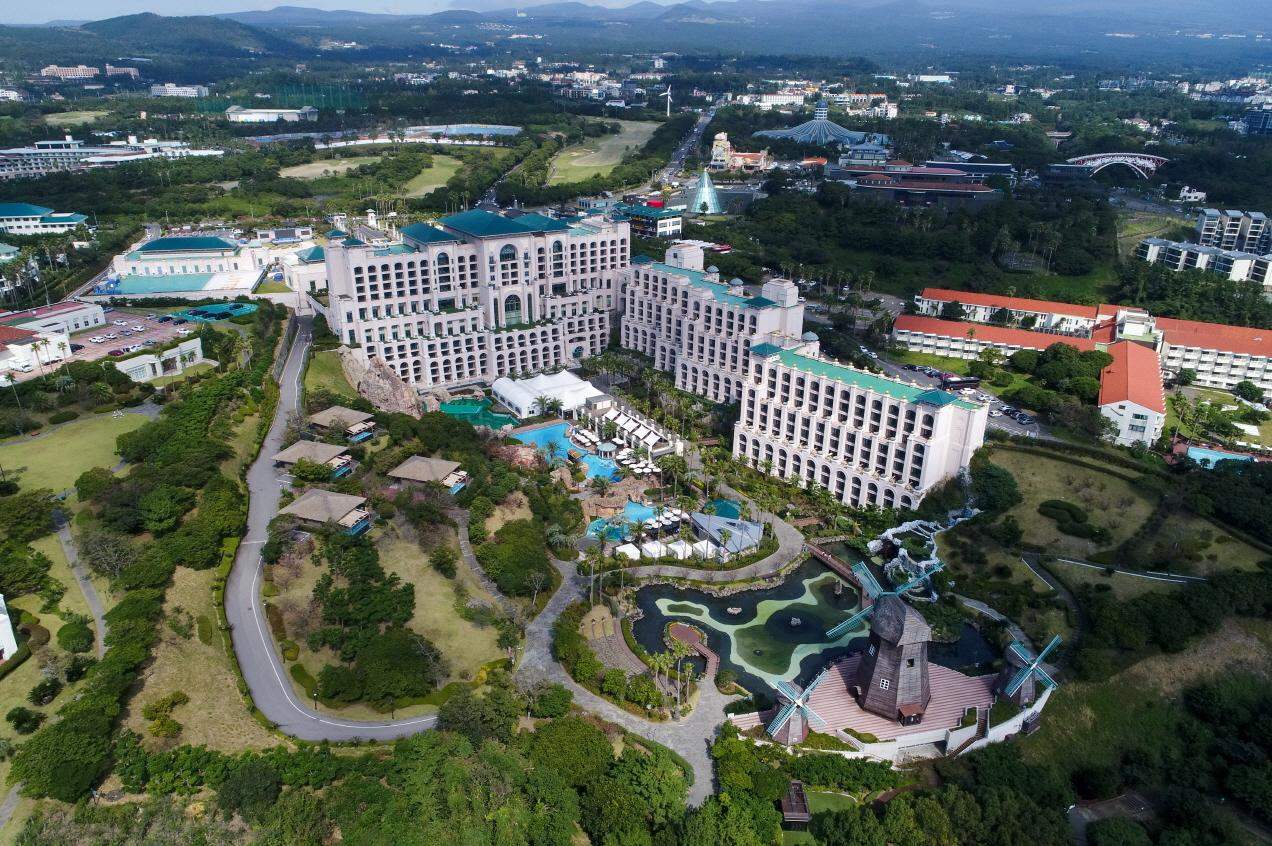
800 and 801: the fast way to Seogwipo town
If you are staying in Seogwipo town rather than Jungmun, the 800 and 801 take the inland Pyeonghwa-ro road and skip Jungmun. The 800 ends at the new Seogwipo bus terminal (₩5,000 from the airport); the 801 ends at the Seogwipo registry office. Both start at the Jeju Bus Terminal and, from 06:50, call at the airport; they take about 80 minutes from the airport and 90 from the terminal. The last airport departures are 20:15 for the 800 and 21:35 for the 801 (timetable effective 3 March 2026).
The routes visitors actually use
| Going to | Bus | From | Time and fare | Notes |
|---|---|---|---|---|
| Seongsan Ilchulbong | Express 111 (also 111-1) | Airport (from 06:50) | About 1 h 26 to Seongsan port; ₩3,000 | Runs every 40–77 minutes. Or 201 along the east coast (slow, ₩1,150) |
| Hallasan, Seongpanak trail | 281 | Jeju Bus Terminal (from 05:40) | About 41 minutes; ₩1,150 | Every 10–20 minutes |
| Hallasan, Seongpanak trail | Express 181 | Airport (first 06:40) | About 46 minutes; ₩2,200 | Every 40–60 minutes |
| Aewol, Hallim, Hyeopjae beach | 202 | Jeju Bus Terminal (from 05:35) | About an hour to Hallim; ₩1,150 | West coast, every 15–25 minutes, continues to Moseulpo, Sanbangsan (every other bus) and Jungmun |
| Moseulpo / Unjin port (ferries to Gapado and Marado) | Express 151 (or 151-1), or 102 | Airport | ₩3,000 | — |
| East or west inland sights | 810 (east) / 820 (west) | Transfer at Daecheon (810) or Donggwang (820) | ₩1,150, loops about hourly | 810 runs past the oreum hills and Bijarim forest; 820 past O'sulloc tea museum and Jeoji. Last loops leave around 17:00–18:00; the first two runs of each (08:20 and 09:20) start at the airport |
| Jungmun via the 1100 road | 240 | Jeju Bus Terminal | ₩1,150 | Climbs past the Eorimok trail to Jungmun and ICC Jeju |
Timetables from bus.jeju.go.kr, read 5 October 2026: 111 effective 21 February 2025, 281 effective 24 June 2026, 202 effective 15 July 2026, 181 effective 1 August 2024. Journey times are from the first run of the day; daytime traffic adds time.
For Hallasan, read our Hallasan winter guide. It covers the reservation system and the cutoff times that decide which bus you need. For Seongsan at dawn, see our New Year sunrise guide, and for the lava caves on the east side, our Jeju lava tubes guide.
Finding the next bus
The Jeju Bus Information System (bus.jeju.go.kr) has English, Chinese and Japanese pages. It does route search and real-time bus locations, and has a stop search. Most bus stops have a QR code that opens the arrivals for that stop. Kakao Map and Naver Map also plan Jeju bus journeys. Our guide to Korea's map apps explains why Google Maps is not enough in Korea.
Language is not a problem. Many stop screens show information in four languages, and on board the next stop is announced in Korean and English. In December 2025 the province added Chinese and Japanese to those announcements, so you hear the stop name in your language before you need to press the bell.
What makes Jeju buses harder than Seoul's is the frequency. In the city, buses come every few minutes. On the coastal and inland routes a 20–60 minute wait is normal, and the tourist circulars stop by early evening. Check the last bus before you set off for a remote oreum or beach.
You might like: Getting Around Korea in 2026: Subway Fares, Last Trains, KTX Booking and Bus Prices, the national version of this page.
The fare rise that keeps not happening
In February 2025 the province proposed raising the regular fare from ₩1,200 to ₩1,500, the express maximum from ₩3,000 to ₩3,800 and the limousine maximum from ₩5,500 to ₩6,400. The price committee deferred it in April 2025, and in June the province postponed it until after the 2026 local elections. Then, on 12 August 2026, it froze all six local public charges, including bus fares, for the rest of 2026. That makes 12 years without a bus fare rise. The province says the system runs a deficit of more than ₩100 billion a year and that it will try again in 2027.
For a visitor, this means two things. Any guide that says the fare is ₩1,500 is reporting a proposal, not the fare. And if you are planning a trip for 2027, check the fare page before you budget, because the rise is expected to come back.
Bus, rental car or taxi?
The bus is the right choice if you are staying in Jeju City, Jungmun or Seogwipo and visiting the coast and the big sights. A car is better for the empty interior and for several remote spots in one day, especially with children or in bad weather. Our guide to renting a car on Jeju as a foreigner covers the licence rules and the 2026 rental-car limits. A taxi, or a large Kakao T taxi for a group with luggage, is often the best way to cover the gap between a bus stop and a far trailhead. See our guide to Kakao Venti large taxis.
Jeju hotels on Agoda: choose the base the bus serves best Without a car, where you sleep decides your trip. Jungmun puts you on the 600 and 601 to the airport and on the 202 along the west coast. Jeju City is the hub for every express bus, the 281 to Hallasan and the airport. Seogwipo town is best for the 800 and the south coast. Compare by the bus stop, not just by the view. EpicKor may earn a commission if you book through this Agoda link, at no extra cost to you. Confirm dates, taxes, cancellation terms and the final price on Agoda before booking.
Compare Jeju stays on AgodaFrequently Asked Questions
Q: How much is a bus ride on Jeju? ₩1,150 by card or ₩1,200 cash on all regular and tourist-circular buses, anywhere on the island. Express buses cost ₩2,000–3,000 by distance, and the airport limousines ₩1,300–5,500 by stop. The planned rise to ₩1,500 was frozen for 2026.
Q: Which bus goes from Jeju airport to Jungmun? The 600 and 601 limousines from Gate 5, together about every 22–28 minutes from 06:00 (30–40 at the start and end of the day), roughly 55 minutes to Jungmun for ₩4,500. Take the 601 if your hotel is the Lotte, Shilla or Suite, because it drives into those hotels. The 600 stops at their entrances and continues to Seogwipo.
Q: Can I pay for Jeju buses with a foreign credit card? Yes. Since August 2025, Jeju city buses accept foreign-issued contactless Visa cards, the first public transport in Korea to do so. T-money, Cashbee and cash also work. The launch was announced for city buses, so check for the contactless logo on the reader of an airport limousine.
Q: Is the Jeju bus free for seniors? Only for Jeju residents. Free fares for people 65 and over and children 6–12 require a Jeju Transport Welfare Card, which needs a registered Jeju address. Visitors pay the normal fare.
Q: Can I see Jeju without a car? Yes, if you base yourself on the main lines and accept some waiting. The coast, Seongsan, Hallasan's trailheads, Jungmun and the west-coast beaches are all on direct routes, and the 810 and 820 cover the main inland sights. The remote interior and very early or late trips are easier by car or taxi.
Q: Are announcements on Jeju buses in English? Yes. Stops are announced in Korean and English, and Chinese and Japanese were added in December 2025. The bus information website also has English pages with real-time arrivals.
Sources
- Jeju Bus Information System (제주버스정보시스템), Jeju Special Self-Governing Province: fare table; 600 and express fare spreadsheets; timetables for 600/601 (effective 1 August 2024, with the hotel-routing note), 800/801 (3 March 2026), 111 (21 February 2025), 181 (1 August 2024), 202 (15 July 2026), 281 (24 June 2026), 810/820 (11 May 2024), transfer and free-fare rules. All read 5 October 2026.
- Korea Airports Corporation, Jeju airport ground transport (limousine stop at Gate 5): airport.co.kr.
- Foreign contactless cards on Jeju buses from August 2025: Visa Korea press release, 14 August 2025; Seoul's plan for 2027: Money Today, 25 September 2026. QR payment from August 2024: Kyunghyang Shinmun, 6 August 2024.
- Fare-rise proposal and postponement: Media Jeju, 25 June 2025; 2026 freeze: Halla Ilbo, 12 August 2026.
- On-board Chinese and Japanese announcements added in December 2025: Jeju Domin Ilbo, 30 December 2025.
- 2017 reform and 2024 ridership (61.26 million, about 167,000 a day): Headline Jeju; BBS News. 1 August 2024 reorganisation: Jeju Ilbo.
- Foreign visitors' transport use (2023 Jeju Tourism Organization survey): Jeju Today, 28 March 2024.
You Might Also Like
Jeju Lava Tubes in 2026, Korea: Manjanggul Reopened After Two and a Half Years, How Foreigners Book Geomunoreum, and the Closed Caves That Open 4–18 October
Jeju's Manjanggul lava tube reopened on 30 May 2026 after a rockfall closure. Geomunoreum takes 50 people per slot, closes on Tuesdays and lets foreigners book with a Google login. The fees, buses and festival-only caves, from Jeju's own pages.
18.9 Million Visitors Told Korea What They Couldn't Find: Transport, Restaurants, Money and Festivals in Korea's Official Exit Survey, and the Answers to All Four
Korea's exit survey: half of 2025's visitors lacked nothing; the rest named transport (16.8%), restaurants (12.9%), money (11.7%) and festivals (11.5%). What 18.9 million visitors did, spent and loved, by passport, and the guide for each gap.
New Year Sunrise in Korea 2027: The 1 January Sunrise Times at Jeongdongjin, Homigot, Ganjeolgot, Haeundae, Seongsan and Seoul, and How to Get There Before 07:31
The first sunrise of 2027 reaches mainland Korea at 07:31 at Ganjeolgot, not famous Jeongdongjin (07:39). No Seoul train arrives in time any more, 300,000 people packed Gangneung last year, and on Jeju the sun usually hides. Times, crowds, trains and a plan.