Korea Payment Guide: T-money, WOWPASS, and the Card You Cannot Tap
Most guides to paying in Korea tell you to bring a credit card, get a transit card, and carry some cash. That is correct and it is useless, because it contains no numbers and no answer to the question people actually arrive with: can I just tap my own card?
The answer, as of September 2026, is no — not at a subway gate, not at a bus reader, and not for another few years. That single fact reorganises everything else.
Two things also changed recently enough that guides published earlier this year are now wrong. Seoul's 30-day Climate Card was discontinued on 1 September 2026. And the city has installed 440 new kiosks at 273 stations that finally accept overseas cards and Apple Pay — with a 3.7% service fee.
Here is the version with the figures in it.
Quick Guide
| Question | Short answer |
|---|---|
| Can I tap my Visa at the gate? | No. EMV open-loop is a 2027–2030 rollout |
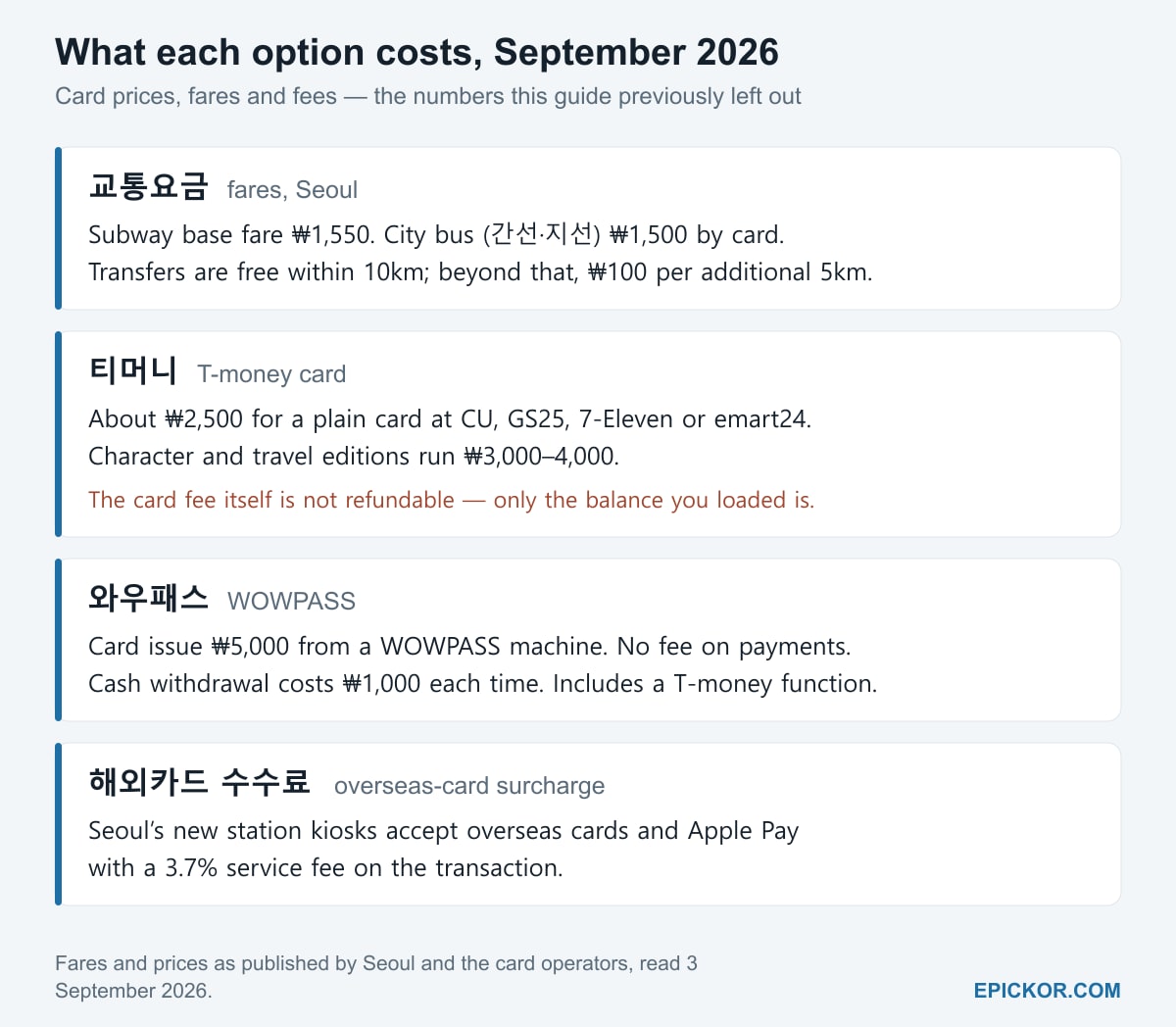
| Subway base fare | ₩1,550; city bus ₩1,500 by card |
| Simplest transit card | 티머니 (T-money), about ₩2,500 at any convenience store |
| Best all-in-one for tourists | WOWPASS — ₩5,000 to issue, includes T-money |
| Unlimited pass | 기후동행카드 short passes, ₩5,000–20,000 |
| The 30-day pass? | Ended 1 September 2026. Short passes continue |
| Overseas card at station kiosks | Works, with a 3.7% fee |
| Cash needed | Small. Markets, older taxis, some street food |
RFID travel wallet — on AmazonAffiliate link. As an Amazon Associate, EpicKor earns from qualifying purchases at no extra cost to you.
The card you cannot tap
This is the correction worth reading twice, because it is the assumption most visitors arrive with.
In London, Sydney and much of Europe you tap the card in your pocket at the gate and the fare is charged to it. Seoul does not work that way. As of mid-2026 you still cannot tap a foreign-issued Visa or Mastercard directly on a subway gate or a bus reader.
Seoul has committed to EMV open-loop — the standard that makes contactless bank cards work as transit tickets — but it is a phased rollout between 2027 and 2030, with full implementation targeted at 2030. That is a plan, not a service you can use on this trip.
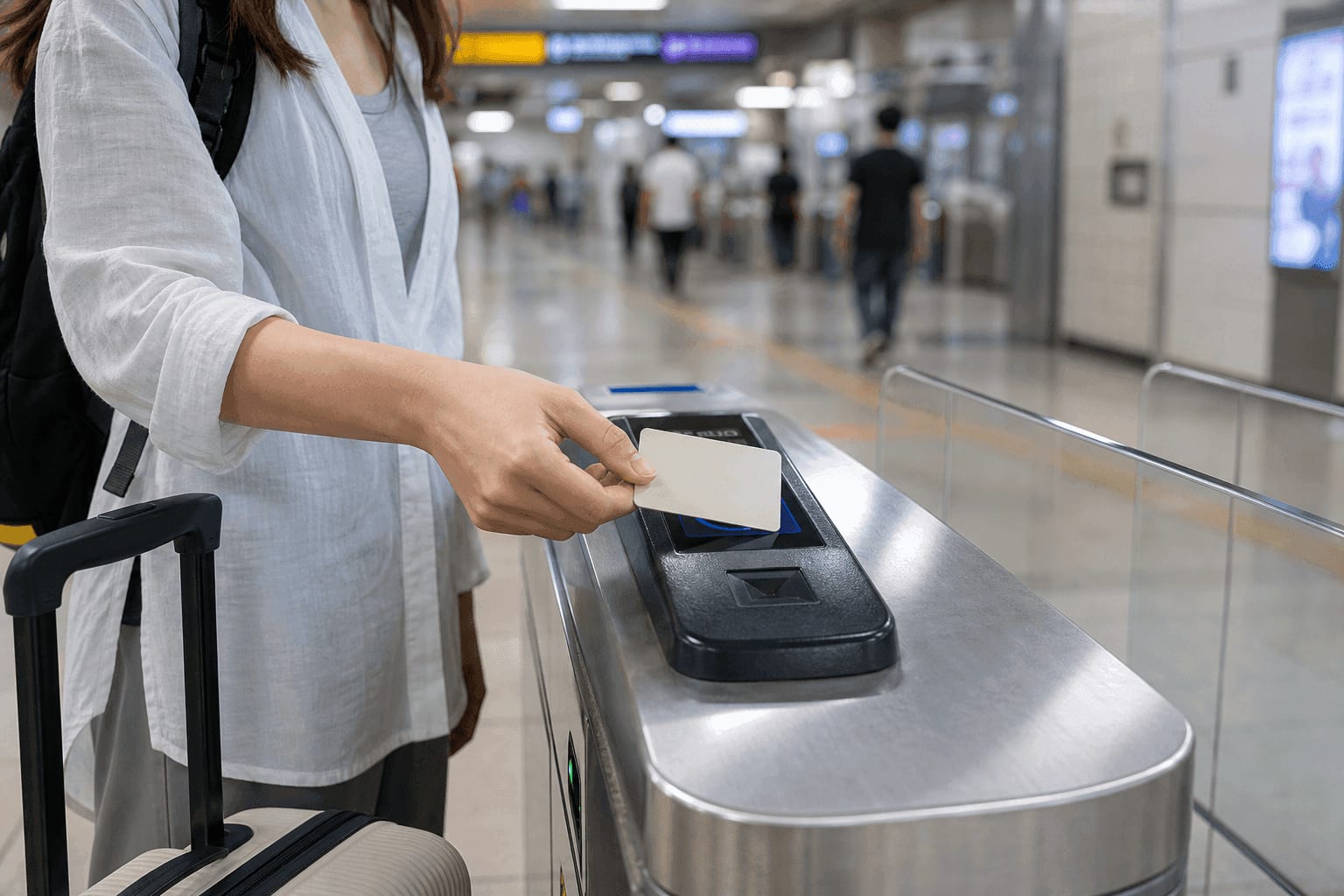
What this means practically: you need a Korean transit product before you can ride anything. Not as a nice-to-have or a money-saver — as the entry condition. Everything below is about which one.
티머니: the default answer
T-money (티머니) is the stored-value transit card, and for most visitors it remains the simplest correct choice.
- About ₩2,500 for a plain card at CU, GS25, 7-Eleven or emart24 — the convenience stores are everywhere and open late.
- Character and travel editions run ₩3,000–4,000. They work identically; you are paying for the design.
- The card fee is not refundable. You can refund the remaining balance, but the ₩2,500 is spent.
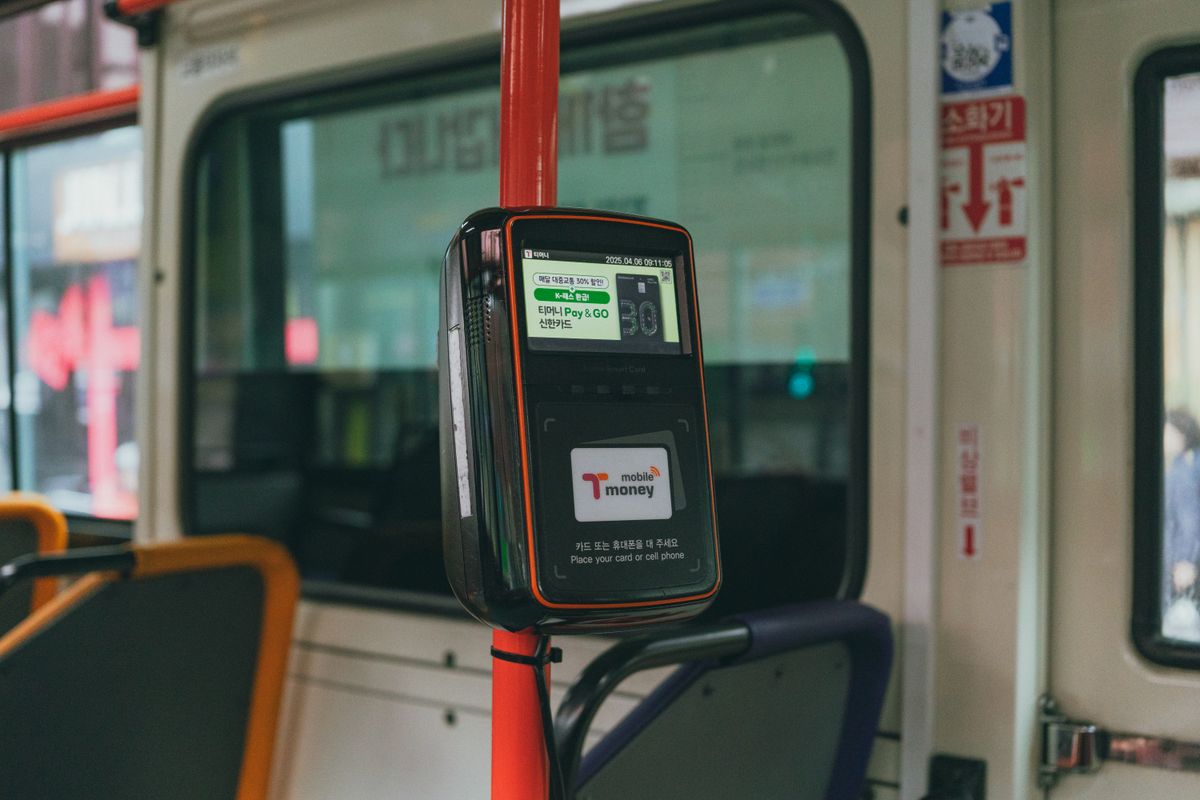
Top it up in cash at the same convenience store counter, or at a machine in any station. It works on subway, buses, most taxis, and a surprising number of convenience-store purchases.
About Apple Wallet
T-money can live in Apple Wallet, and a March 2026 update improved this for foreign visitors — but incompletely. Mastercard and Amex can top up inside the app. Visa cannot, because of payment-gateway restrictions.
If your only card is a Visa, the in-app route stops there and you top up at a machine instead. That is not a workaround; it is the current state.
WOWPASS: what the ₩5,000 buys
WOWPASS is a prepaid card built specifically for foreign visitors, and it is the closest thing to a single-object answer.
- ₩5,000 to issue, from a WOWPASS machine (airports, major stations, tourist areas) or reserved online first.
- No fee on payments — you use it like a debit card at shops and restaurants.
- ₩1,000 per cash withdrawal, each time.
- It contains a T-money function, so the same piece of plastic taps through the gate.
- It doubles as a currency exchange: you feed foreign cash into the machine and it lands as a won balance.
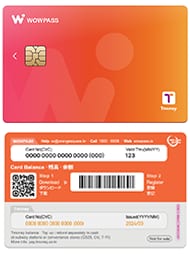
The trap people hit is assuming one balance covers both. The payment balance and the T-money balance are separate, and running the transit side dry at a gate is a common and avoidable annoyance. Load both.
Who should choose WOWPASS over T-money: anyone who would otherwise be exchanging cash at a counter, and anyone who wants one card instead of two. Who should not: short-trip visitors who will mostly use their own credit card in shops and only need transit — for them the ₩2,500 T-money is cheaper and enough.
기후동행카드, and the pass that just ended
Seoul's Climate Card (기후동행카드) is unlimited-ride travel within Seoul, and the important news is a subtraction.
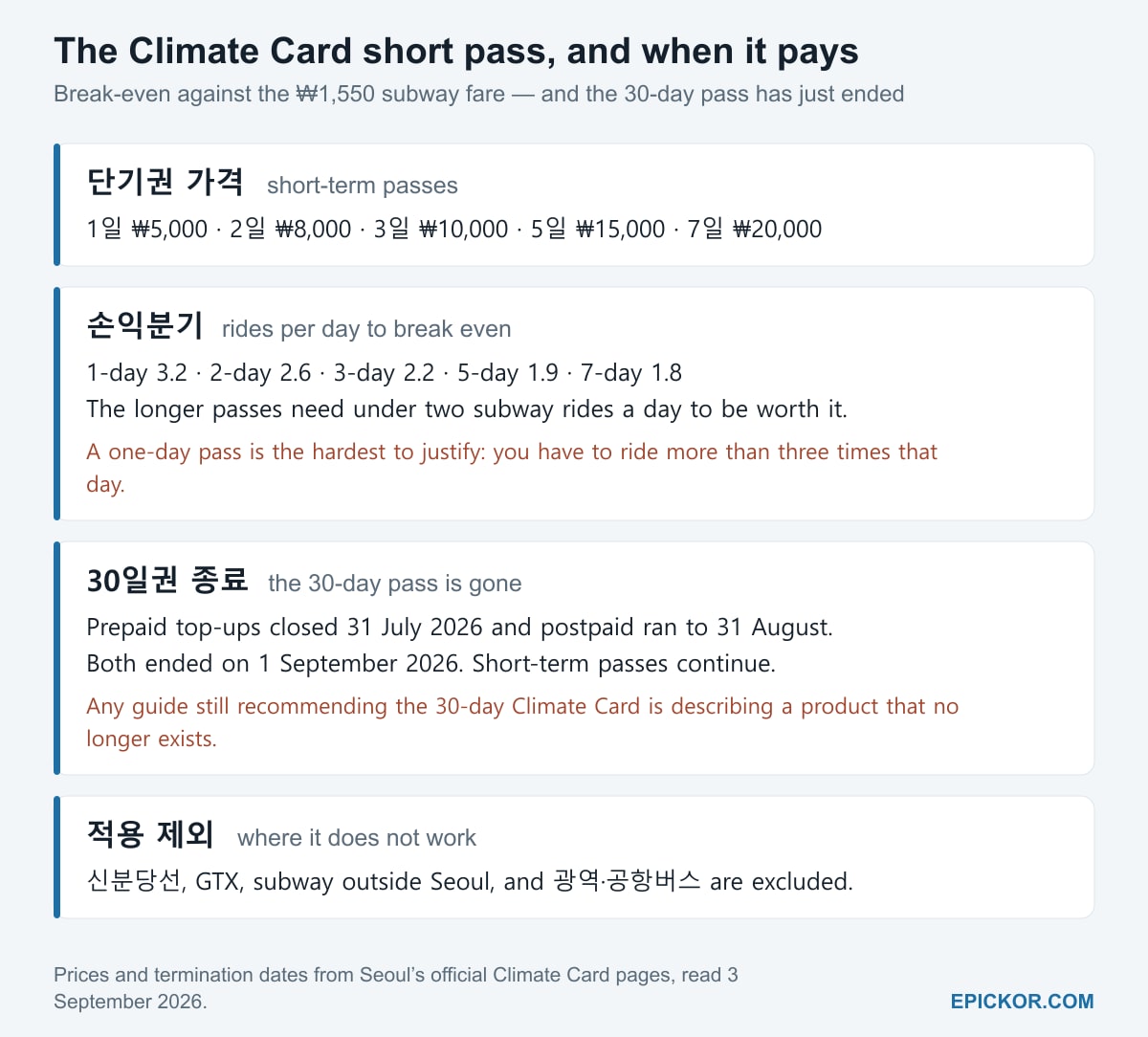
The 30-day pass is gone. Prepaid top-ups closed on 31 July 2026, postpaid ran through 31 August, and both ended on 1 September 2026. Korean users were moved toward the national K-패스 rebate scheme instead. Any guide still recommending the 30-day Climate Card is describing a product that no longer exists.
The short-term passes continue, and they are the tourist-relevant ones:
1일 ₩5,000 · 2일 ₩8,000 · 3일 ₩10,000 · 5일 ₩15,000 · 7일 ₩20,000
Whether they are worth it is arithmetic nobody publishes, so here it is against the ₩1,550 base fare:
- 1-day — needs 3.2 rides that day. Hard to justify unless you are crossing the city repeatedly.
- 3-day — needs 2.2 rides a day.
- 7-day — needs 1.8 rides a day, which is almost any normal sightseeing pattern.
The longer the pass, the easier it pays. Under two subway rides a day is a low bar for a week in Seoul, and the pass removes the top-up question entirely.
Where it does not work matters as much: 신분당선, GTX, subway outside Seoul, and 광역·공항버스 are excluded. If your hotel is in Gyeonggi, or you were counting on it for the airport bus, it will not cover you.
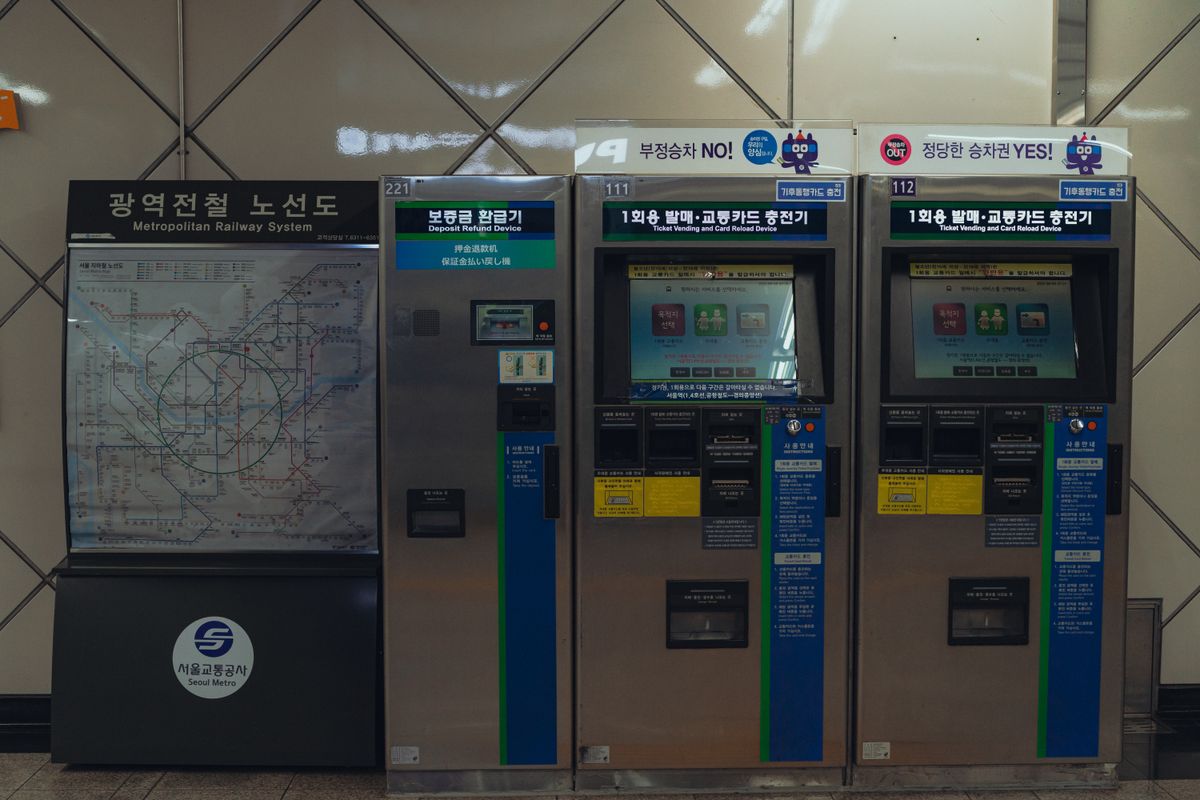
The kiosks that finally take a foreign card
The gap between "you cannot tap your card" and "you need a Korean card" used to be awkward: how do you buy the first one without won?
Seoul closed it. There are now 440 transportation-card kiosks at 273 stations across Lines 1 to 8 that accept overseas credit and debit cards, Apple Pay, Kakao Pay and Naver Pay. They sell and reload the Climate Card and short-term passes.
The fee is 3.7% on overseas cards. On a ₩20,000 seven-day pass that is ₩740 — worth it for the convenience, and worth knowing before it appears on your statement.
This is also the answer for Visa holders locked out of in-app top-ups: the physical machine takes the card the app refuses.
Two things make a card-based trip go wrong, and neither is the card. As an Amazon Associate, EpicKor earns from qualifying purchases at no extra cost to you. The first is a flat phone — every wallet, map and taxi app in Korea dies with the battery, so an Anker 10,000mAh power bank is doing payment work, not just phone work. The second is carrying three cards loose: an RFID travel wallet keeps your T-money away from your bank card, which matters at a gate reader that will happily charge whichever card it senses first.
See Anker 10,000mAh power bank on AmazonYour first hour after landing
A concrete sequence rather than a checklist of principles.
- At the airport, get one transit product before leaving the terminal. A WOWPASS machine if you want the all-in-one; a convenience store T-money card if you want the cheap one. Both exist at Incheon.
- Load it with more than you think. ₩20,000–30,000 covers a couple of days of moving around and saves you topping up while tired.
- Check whether your route to the city is covered. The airport bus and the AREX are not part of the Climate Card. Budget for them separately.
- Keep a small amount of cash — ₩30,000–50,000 is plenty for most trips.
- Set up a map and a taxi app on the plane, not at the gate. Google Maps does not do Korean directions properly; our guide to what actually works instead of Google Maps in Korea covers Naver Map and Kakao T, and Kakao T is where taxi payment happens.
Cash: less than you fear, more than zero
Korea is genuinely card-first. Cafés, restaurants, chains, taxis, convenience stores — all card, all day. But cash still appears in specific places:
- Traditional markets — many stalls take cards now, but not all, and the ones that do not are often the ones you want.
- Older taxis and some independent drivers.
- Street food carts, which vary.
- Small temples, entrance donations, coin lockers in older stations.
₩30,000–50,000 in small notes covers this. You do not need to change hundreds of dollars at the airport, and if you have a WOWPASS its exchange function is usually a better rate than an exchange counter anyway.
The two logistics items a payment plan quietly depends on. As an Amazon Associate, EpicKor earns from qualifying purchases at no extra cost to you. Korea runs on 220V with Type C/F round pins, so a Korea plug adapter is what keeps the power bank above charged at all. And every card app here — WOWPASS balance, Kakao T, Naver Map — needs data, so a Korea eSIM ordered before you fly removes the airport queue. Our comparison of [eSIM, physical SIM and pocket WiFi](/blog/205) covers which suits which trip length.
See Korea plug adapter on AmazonMistakes that cost people time
- Assuming Apple Pay or Google Pay works everywhere. Support depends on your issuer, the terminal and the merchant. Treat it as a bonus, not a plan.
- Confusing a transit card with a credit card. They are separate objects with separate balances, even when they are the same piece of plastic.
- Buying a 1-day Climate Card for a light sightseeing day. You need more than three rides to break even.
- Assuming the Climate Card covers the airport. It does not.
- Relying on one card. One failed authorisation and you are stuck. Two payment methods plus a little cash is the whole insurance policy.
- Exchanging a large sum at the airport counter. You will not need it, and the rate is rarely the best one available.
If you are staying long enough that this starts feeling like a resident's problem rather than a tourist's, our one-month Seoul living guide covers the accounts and apps that open up once you are not on a short trip. And for the ride itself, the subway etiquette guide covers the rules nobody tells visitors.
You might like: 18.9 Million Visitors Told Korea What They Couldn't Find: The Official Exit Survey, and the Answers to All Four Gaps
You might like: What You Cannot Bring Into Korea: jerky, mango, Adderall and CBD are banned, sleeping pills need a permit, and the fine is ₩1–10 million
FAQ About Paying in Korea
Q: Can I tap my foreign credit card at a Seoul subway gate?
No. As of 2026 you cannot tap an overseas Visa or Mastercard directly at a gate or bus reader. Seoul is rolling out EMV open-loop in phases between 2027 and 2030. Until then you need a Korean transit product — T-money, WOWPASS, or a Climate Card pass.
Q: How much is a subway ride in Seoul?
The base fare is ₩1,550, and a city bus is ₩1,500 by card. Transfers are free within 10km, with ₩100 added per additional 5km beyond that.
Q: Is the 30-day Climate Card still available?
No. Prepaid top-ups closed on 31 July 2026 and postpaid ran to 31 August; both ended on 1 September 2026. The short-term passes — 1, 2, 3, 5 and 7 days, ₩5,000 to ₩20,000 — continue.
Q: T-money or WOWPASS?
T-money if you only need transit and will pay for everything else with your own card: about ₩2,500 and available in every convenience store. WOWPASS if you want one card for both, or would otherwise be exchanging cash: ₩5,000 to issue, no payment fee, and it contains a T-money function.
Q: Can I buy a transit card with a foreign card?
Yes. Seoul installed 440 kiosks at 273 stations on Lines 1–8 that take overseas cards, Apple Pay, Kakao Pay and Naver Pay, with a 3.7% service fee. This is also the route for Visa holders, who cannot top up T-money inside Apple Wallet.
Q: How much cash should I carry in Korea?
₩30,000–50,000 in small notes is enough for most trips. Cash still turns up at traditional markets, some older taxis, street-food carts and coin lockers, but almost everything else takes cards.
Bottom Line
The Korean payment question is not which card is best. It is that your own card will not open the gate, and everything follows from solving that first.
₩2,500 buys a T-money card at any convenience store. ₩5,000 buys a WOWPASS that also pays in shops and exchanges your cash. ₩20,000 buys seven days of unlimited Seoul transit, which pays for itself at under two rides a day. The 30-day pass is gone as of 1 September 2026, and the station kiosks will now sell you any of it with your own card for a 3.7% fee.
Sort the transit product at the airport, load it with more than you think, keep ₩30,000 in cash, and the rest of the trip stops being about payment at all.
Sources
- Seoul Metropolitan Government transport fare pages — subway base fare ₩1,550, city bus (간선·지선) ₩1,500 by card, free transfer within 10km with ₩100 per additional 5km.
- Seoul's official 기후동행카드 pages — short-term pass prices (1일 ₩5,000 / 2일 ₩8,000 / 3일 ₩10,000 / 5일 ₩15,000 / 7일 ₩20,000); exclusion of 신분당선, GTX, subway outside Seoul and 광역·공항버스; the 30-day pass termination notice, with prepaid top-ups closing 31 July 2026, postpaid running to 31 August, and both ending 1 September 2026.
- Korean press and Seoul Metropolitan Government announcements — 440 transportation-card kiosks at 273 stations on Lines 1–8 accepting overseas cards, Apple Pay, Kakao Pay and Naver Pay with a 3.7% service fee; EMV open-loop rollout planned in phases from 2027 with full implementation targeted for 2030.
- T-money and WOWPASS operator information — T-money card about ₩2,500 plain and ₩3,000–4,000 for character and travel editions, with the card fee non-refundable; WOWPASS issue cost ₩5,000, no payment fee, ₩1,000 per cash withdrawal, and an included T-money function; the March 2026 Apple Wallet update supporting Mastercard and Amex top-ups but not Visa.
You Might Also Like
Korea Autumn Foliage 2026: The Forecast Peak Dates for Seoraksan, Seoul and Naejangsan
Korea's 2026 foliage forecasts are out: Seoraksan turns first around 30 September, peaks 16–25 October, and the whole season runs 2–9 days late. Peak dates for Seoul and Naejangsan, the ₩16,000 cable car, Nami's ₩19,000 ticket, and the bus times.
Korea Hands-Free Travel Guide: Lockers and Luggage
A Korea hands-free travel guide for tourists: lockers, luggage delivery, hotel storage, Seoul Station check-in, and airport transfer planning.
Chuseok 2026: Korea Slows Down 24-26 September, Train Seats Sell 7-11 September
Chuseok 2026 is Friday 25 September, no substitute holiday. Confirmed: highway tolls waived and the four palaces, Jongmyo and MMCA free 24-27 September. KTX general sale 7-11 September by route, Seoul-Busan ₩54,400. What closes on the 25th and the 27th.