Seoul Taxi Fare in Korea: the ₩4,800 Base Fare, Night Surcharge Hours, and What a Ride from Incheon or Gimpo Costs
Last updated: 21 November 2026. Fares come from the Seoul Metropolitan Government's Korean taxi fare page (서울시 택시요금, modified 14 October 2026) and the Incheon and Gimpo airports' Korean taxi pages, all read on 21 November 2026. Ride examples are EpicKor's estimates worked from the official formula, not quotes. ₩1,335 = US$1 (Bank of Korea ECOS, 17 November 2026).
A Seoul taxi fare starts at ₩4,800 (about US$3.60) for the first 1.6 km in a regular taxi, then adds ₩100 for every 131 metres, or for every 30 seconds when the car is crawling below 15.72 km/h. That is the meter that has applied since 1 February 2023, and as of 21 November 2026 the city has announced no new increase. The fare rises at night: 20% from 22:00 to 23:00, 40% from 23:00 to 02:00, and 20% again from 02:00 to 04:00. A 10 km daytime ride, Myeongdong to Gangnam Station, comes to about ₩11,300 (US$8.46) if traffic flows. Incheon Airport to Myeongdong is about ₩52,600 (US$39) by day with the expressway toll. From Gimpo Airport to Gangnam Station, the airport's own estimate is ₩28,000.
| Korea taxi fare: the short answer (Seoul, November 2026) | Amount |
|---|---|
| Regular taxi (중형택시), base fare | ₩4,800 (US$3.60) for the first 1.6 km |
| After that | ₩100 per 131 m, or ₩100 per 30 seconds below 15.72 km/h |
| Night surcharge, regular taxi | +20% 22:00–23:00 and 02:00–04:00; +40% 23:00–02:00 |
| Deluxe (모범) and large (대형) taxi | ₩7,000 (US$5.24) for 3 km, then ₩200 per 151 m; +20% from 22:00 to 04:00 |
| Leaving Seoul | +20% out-of-city surcharge (시계외 할증), none on the run to Incheon Airport |
| Incheon Airport to Myeongdong, by day | About ₩52,600 (US$39), meter estimate plus the ₩3,200 toll |
| Gimpo Airport to Gangnam Station | ₩28,000 (US$21), Gimpo Airport's estimate |
| Complaints | Seoul's 120 Dasan Call Center, 24 hours |
The fare is not complicated. The things that surprise visitors are the night bands, which start an hour before most people expect, the toll on the airport road, and the 10 percent fee one popular foreigner app adds. This guide covers each with the Korean source behind it.
A South Korea eSIM, so K-RIDE, Uber and your map work the moment you landAffiliate link. As an Amazon Associate, EpicKor earns from qualifying purchases at no extra cost to you.
Quick Guide: Seoul taxi fares by taxi type
Seoul has one meter for ordinary taxis and a second, dearer one for deluxe and large cars. The airport International Taxi uses fixed zone fares. App taxis such as Kakao Venti publish their own rates.
| Taxi type | Looks like | Base fare | Then | Night |
|---|---|---|---|---|
| Regular (중형택시, jung-hyeong taeksi) | Silver, white or orange sedan; the default | ₩4,800 for 1.6 km | ₩100 per 131 m / 30 s | Base ₩5,800 at +20%, ₩6,700 at +40% |
| Deluxe (모범택시, mobeom taeksi) | Black sedan, yellow roof sign | ₩7,000 for 3 km | ₩200 per 151 m / 36 s | +20% from 22:00 to 04:00 (base ₩8,400) |
| Large (대형승용, 9-seat van) | Black van, same meter as deluxe | ₩7,000 for 3 km | ₩200 per 151 m / 36 s | +20% from 22:00 to 04:00 |
| International Taxi (인터내셔널 택시) | Driver speaks English, Chinese or Japanese | Airport to Seoul: fixed zone fare, ₩70,000–95,000 sedan | In town: the meter, plus up to 20% foreigner surcharge | Zone fare does not change |
| Kakao Venti (app van) | Carnival or Staria van, app only | ₩4,000 for 800 m | ₩100 per 123 m and per 40 s | No night band; demand multiplier 0.8–4.0 |
The regular sedan is the one you will take nine times out of ten. Deluxe taxis cost about 1.8 times as much for the same trip on Gimpo Airport's own estimates (about 1.6 times on the Incheon run), and Seoul's own fare page notes that their meters run "alternately": time when the car moves below 15.10 km/h, distance above it. You rarely need one unless the stand has nothing else or you need the van. For groups with suitcases, our Kakao Venti and large-taxi guide compares every van option.
Lonely Planet Korean Phrasebook & Dictionary — the taxi and address pages, in Hangul you can show a driver. Most Seoul drivers will not read an English hotel name. A written Korean address and the words for "receipt" (영수증) and "card, please" (카드요) sort out most trips. If your phone has Papago and a working data plan, you can skip it. Check the current price on the listing. As an Amazon Associate, EpicKor earns from qualifying purchases at no extra cost to you.
See the Korean phrasebook on AmazonYou might like: Does Google Maps Work in Korea? Naver Map, Apple Maps and Taxi Apps, before you try to show a driver where you are going.
How the Seoul taxi meter works
The city's fare page sets four rules for a regular taxi.
- ₩4,800 covers the first 1.6 km. Most short hops between neighbouring subway stations end at ₩4,800 to ₩6,000.
- Then ₩100 per 131 metres. That is about ₩763 per kilometre, so every extra 10 km adds roughly ₩7,600 (US$5.70).
- Below 15.72 km/h, time counts too. In a jam, the meter also adds ₩100 per 30 seconds, or about ₩200 a minute. The city's wording is "시간·거리 부분 동시병산", time and distance partly combined. Ten minutes stuck at a Gangnam junction adds about ₩2,000.
- The final fare is rounded to the nearest ₩10.
This is not new. Seoul raised the base fare from ₩3,800 to ₩4,800 at 04:00 on 1 February 2023, the first rise in four years. At the same time it cut the base distance from 2 km to 1.6 km, moved the distance step from 132 to 131 metres, and the time step from 31 to 30 seconds. Some English guides still quote ₩3,800, which is three years out of date. Others describe the ₩4,800 fare as a recent hike, which it is not.
Is a 2026 or 2027 increase coming? We found none. The city's fare page, modified on 14 October 2026, lists the February 2023 meter as current. We will update this page if a new fare is announced.
You might like: Last Train in Seoul: When Trains Stop, for the hour when the subway ends and the taxi becomes the only option.
Seoul taxi night fare: the three surcharge bands
Late-night surcharge in Korean is 심야할증 (simya halleung). In Seoul it starts at 22:00, not midnight. The city moved the start from midnight to 22:00 on 1 December 2022, and at the same time added the 20% night band for deluxe and large taxis. That is the single most common reason visitors think they have been overcharged. The October 2026 Seoul explanatory note on foreign complaints names "not knowing the surcharge system" as a leading reason reports are closed without action.
| Time (regular taxi) | Surcharge | Base fare (1.6 km) | Per 131 m / per 30 s |
|---|---|---|---|
| 04:00–22:00 | None | ₩4,800 | ₩100 |
| 22:00–23:00 | +20% | ₩5,800 | ₩120 |
| 23:00–02:00 | +40% | ₩6,700 | ₩140 |
| 02:00–04:00 | +20% | ₩5,800 | ₩120 |
Deluxe and large taxis have one band only: +20% from 22:00 to 04:00, with the base going from ₩7,000 to ₩8,400. So a deluxe taxi's premium over a regular one shrinks between 23:00 and 02:00. It is still dearer, though, because its meter steps are twice as large.
Two more rules can stack on top. Leaving the city adds a 20% out-of-city surcharge, explained below. For a regular taxi, Seoul caps the combined night and out-of-city surcharge at 60%. For deluxe and large taxis the cap is 40%. A meter showing 80% extra is wrong.
Seoul taxi fare calculator: worked examples
There is no official fare calculator. Seoul publishes the formula, and the apps show estimates once you enter an address. Below is the formula applied to common visitor rides. These are our estimates using approximate road distances in free-flowing traffic. Add about ₩200 for each minute the car crawls in a jam, and more at night. Dollar figures are at ₩1,335 to US$1.
| Ride (approx. road distance) | Day (04:00–22:00) | +20% (22:00–23:00, 02:00–04:00) | +40% (23:00–02:00) |
|---|---|---|---|
| Short hop, 3 km | ₩5,900 (US$4.42) | ₩7,120 (US$5.33) | ₩8,240 (US$6.17) |
| Myeongdong to Hongdae, 7 km | ₩9,000 (US$6.74) | ₩10,840 (US$8.12) | ₩12,580 (US$9.42) |
| Myeongdong to Gangnam Station, 10 km | ₩11,300 (US$8.46) | ₩13,600 (US$10.19) | ₩15,800 (US$11.84) |
| Hongdae to Gangnam, 15 km | ₩15,100 (US$11.31) | ₩18,160 (US$13.60) | ₩21,120 (US$15.82) |
| Gimpo Airport to Myeongdong, 20 km | ₩18,900 (US$14.16) | ₩22,720 (US$17.02) | ₩26,440 (US$19.81) |
| Incheon Airport T1 to Myeongdong, 60 km (before toll) | ₩49,400 (US$37.00) | ₩59,320 (US$44.43) | ₩69,140 (US$51.79) |
| Incheon Airport T1 to Gangnam, 70 km (before toll) | ₩57,100 (US$42.77) | ₩68,560 (US$51.36) | ₩79,920 (US$59.87) |
How we worked it: ₩4,800 plus ₩100 for each started 131-metre step beyond the first 1.6 km, rounded to ₩10. The night columns use the city's night rates (₩5,800 or ₩6,700 base, ₩120 or ₩140 per step). If you want to check a ride yourself, the shortcut is ₩4,800 plus about ₩760 per kilometre after the first 1.6 km.
Compare with the airport's own figure. Gimpo Airport estimates ₩20,000 to the Lotte Hotel Seoul in Myeongdong, against our ₩18,900 for a clear road. The difference is the traffic minutes. Treat any of these as a floor in rush hour, from about 07:30 to 09:30 and 17:30 to 19:30 on weekdays.
You might like: Incheon Airport Money Exchange Rate in Korea, if you want a little cash in won before the first ride.
Incheon Airport to Seoul by taxi
Incheon Airport is not in Seoul, but a Seoul-bound taxi from the airport pays no out-of-city surcharge. Both Seoul's fare page and the airport's taxi page say Seoul, Incheon, Goyang, Gwangmyeong, Gimpo and Bucheon form one shared zone for airport runs. The surcharge starts only at the edge of those six cities.
What you do pay on top of the meter is the toll. The Airport Expressway (Yeongjong Bridge) costs ₩3,200 to Seoul, cut from ₩6,600 in October 2023. If the driver takes the Incheon Bridge toward Songdo, that toll is ₩2,000. Tolls are charged at cost, once, and only for the road actually driven.
| Incheon Airport T1 to | Regular taxi, day (estimate + ₩3,200 toll) | Regular, 23:00–02:00 | International Taxi, sedan (fixed, toll included) | International Taxi, deluxe or van |
|---|---|---|---|---|
| Myeongdong (zone C) | about ₩52,600 (US$39) | about ₩72,300 (US$54) | ₩85,000 (US$64) | ₩120,000 (US$90) |
| Gangnam (zone D) | about ₩60,300 (US$45) | about ₩83,100 (US$62) | ₩90,000 (US$67) | ₩130,000 (US$97) |
The International Taxi zones, from Seoul's fare page, run from A (Gangseo-gu, ₩70,000 sedan / ₩100,000 deluxe or van) through B (Mapo, Yeongdeungpo, Seodaemun and others, ₩75,000 / ₩110,000), C (Jung-gu, Jongno, Yongsan and others, ₩85,000 / ₩120,000) and D (Gangnam, Seocho, Seongdong and others, ₩90,000 / ₩130,000) to E (Songpa, Gangdong, Nowon and others, ₩95,000 / ₩140,000). The fare is fixed regardless of traffic or time of day, and the toll is included. The International Taxi's own site currently asks for bookings at least 48 hours ahead and lists Visa, Mastercard and Amex alongside cash. Its phone line is 1644-2255.
Is it worth it? On a clear day, a regular metered taxi to Myeongdong is about ₩32,000 cheaper. The International Taxi earns its price when you want a named driver waiting in the arrivals hall who speaks English, a fixed number at 01:00, or a van for a family. At night the gap narrows to about ₩13,000.
Where the taxis wait. Incheon Airport's Korean taxi page lists the stands on the arrivals level. At Terminal 1, Seoul sedans use 5C, 6C and 6D; deluxe 7C; large vans 8C; International Taxi 4C. At Terminal 2, the Seoul sedan stand is 7C, deluxe and large 7D, International Taxi 3C. The same page warns about unlicensed vans whose drivers approach you inside the terminal. Walk past them to the numbered stand.
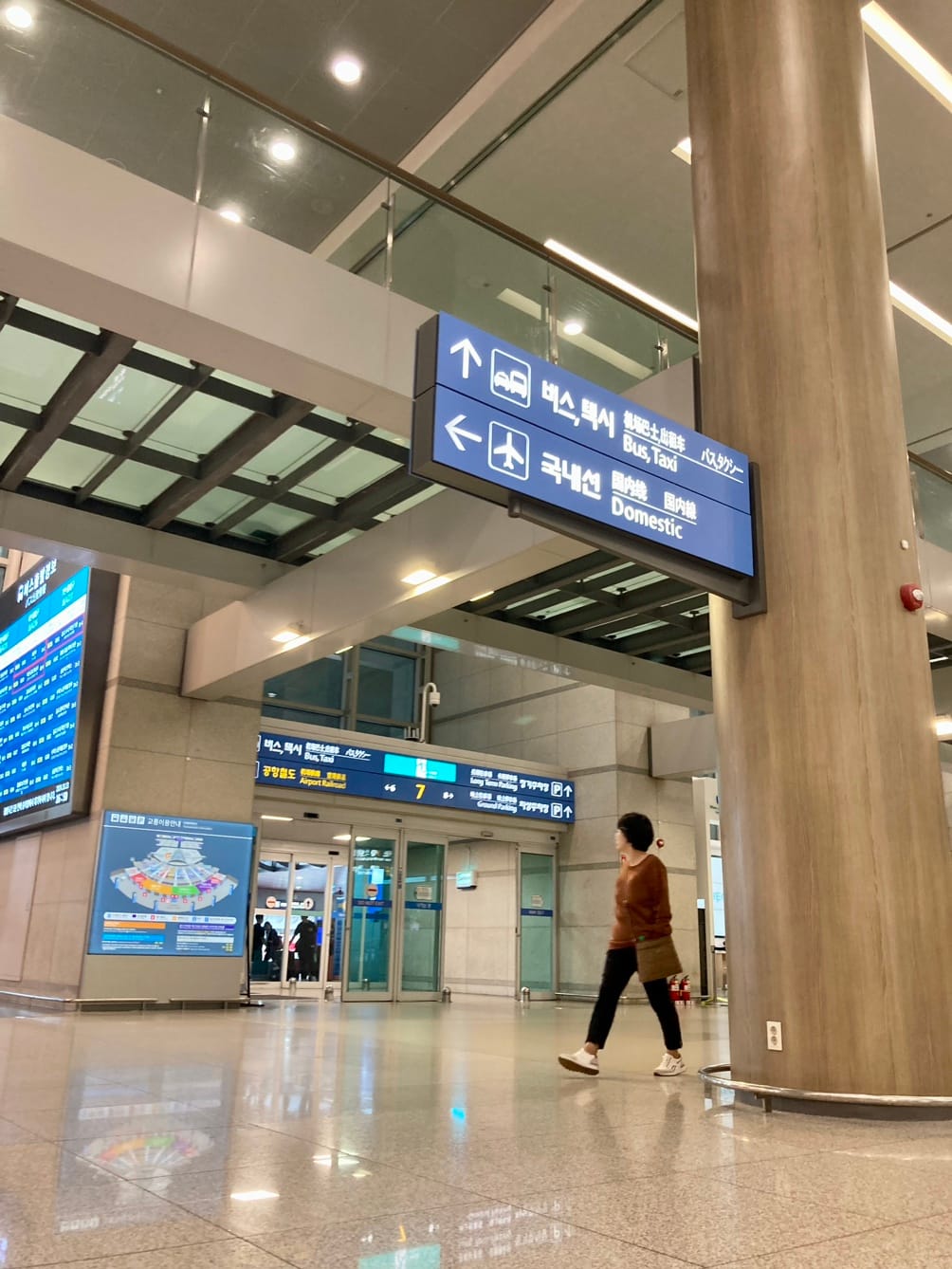
For the train and bus alternatives (AREX at ₩4,750, limousine buses at ₩17,000 to ₩18,000), see our Incheon Airport to Seoul guide. If you are heading straight to Busan instead, our Incheon Airport to Busan guide compares the direct bus, the train and a flight.
Gimpo Airport to Seoul by taxi
Gimpo Airport sits inside Seoul, in Gangseo-gu, so rides into the city are short and there is no toll on the usual routes. The airport publishes its own estimates for a regular and a deluxe taxi:
| Gimpo Airport to | Minutes | Regular taxi | Deluxe (모범) |
|---|---|---|---|
| Hongik University (Hongdae) | 40 | ₩15,000 (US$11) | ₩27,000 |
| Myeongdong (Lotte Hotel Seoul) | 50 | ₩20,000 (US$15) | ₩36,000 |
| Seoul City Hall (The Plaza) | 60 | ₩22,000 | ₩40,000 |
| Gangnam Station | 60 | ₩28,000 (US$21) | ₩50,000 |
| Jamsil Station (Lotte Hotel World) | 60 | ₩28,000 | ₩50,000 |
| Incheon International Airport | 40 | ₩45,000, toll included | ₩70,000 |
Add 40% for a ride between 23:00 and 02:00. Gangnam Station then comes to about ₩39,200 (US$29). Here the taxi often makes little sense for one person. The AREX train to Hongdae costs ₩1,650 and takes 14 minutes, against ₩15,000 and 40 minutes by car. Our Gimpo Airport to Seoul guide shows when the taxi wins: four people with cases going to Gangnam outside rush hour.
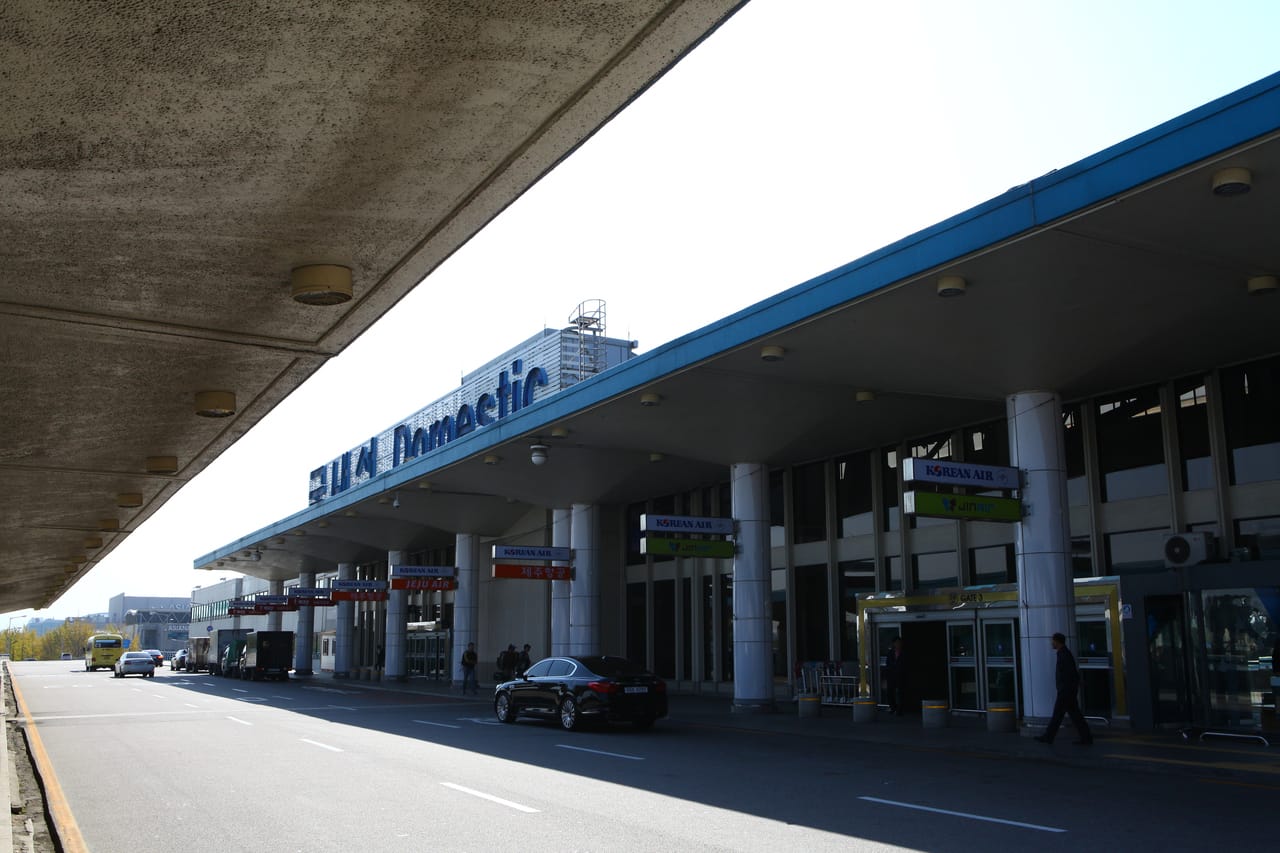
At Gimpo, the airport says the international terminal taxi area is on the second floor, about 20 metres left of exit 1. The domestic terminal pick-up area is on the first floor opposite exits 4 to 6. If you are flying on to Jeju, see our Gimpo–Jeju flight guide.
You might like: Seoul Safety Guide: Taxi Scams, Street Recruiters, and Etiquette, before your first airport ride.
Leaving Seoul: the out-of-city surcharge and tolls
Seoul's fare page applies a 20% out-of-city surcharge (시계외 할증, sigyeoe halleung) on every section of a trip beyond the city boundary. The meter adds it automatically. The fare page counts Gwangmyeong (an integrated taxi zone) and the joint zone that includes Wirye New Town as inside the boundary. So a ride from Gangnam to Bundang or Suwon costs about a fifth more for the stretch outside Seoul, and the toll on top if you use an expressway. At night the cap on the combined surcharges is 60% (40% for deluxe and large taxis).
The Incheon Airport run, covered above, is the one trip outside Seoul with no surcharge. Elsewhere it adds up: Gimpo Airport's own table shows ₩40,000 to Bundang's Seohyeon Station and ₩45,000 to Suwon Station, both including tolls, about 40 to 60 percent more than its ₩28,000 estimate for Gangnam Station.
Tolls are the passenger's cost when you take a toll road, and a driver should not invent one. Seoul's January 2026 notice on foreign complaints says app bookings now show the "Meter Fare" and the "Toll fee" separately. That makes a padded toll easier to spot.
Paying for a Seoul taxi: card, T-money or cash
Every licensed Seoul taxi has a card reader. Seoul's January 2026 notice names T-money Mobility (티머니모빌리티) as the company that runs those taxi payment terminals. You can pay three ways:
- A credit or debit card, tapped or inserted at the reader by the back seat or on the dashboard. Travellers widely report that overseas Visa and Mastercard work in most Seoul taxis. We found no official city statement that every reader accepts foreign cards, so carry a backup.
- A T-money card (티머니), the same transit card you use on the subway. Say "T-money" (티머니) when you arrive, and tap it on the reader. Top it up with cash at a convenience store.
- Cash in won. Drivers carry change for normal fares, but a ₩50,000 note for a ₩5,900 ride at 06:00 is a hard ask.
Since December 2025, Seoul taxi receipts (영수증, yeongsujeung) print the final fare and boarding and drop-off times in English. They also show whether a night or out-of-city surcharge applied, and give the 120 complaint number at the bottom. Ask for one every time. It is your evidence if anything goes wrong.
One more cost you may meet is a call fee. Seoul's standard phone-booking fee is ₩1,000 by day and ₩2,000 at night, and it applies only to taxis called by phone. App call fees are set by each platform and shown in the app.
Kakao T, K-RIDE, Uber and TABA: taxi apps for foreigners
You can hail a Seoul taxi on the street. A red 빈차 (bincha, "vacant") light in the windscreen means it is free. Still, an app removes the address problem, because the destination goes to the driver in Korean. Four apps matter for visitors:
| App | Foreign phone and card? | What it costs on top of the meter | Best for |
|---|---|---|---|
| Kakao T (카카오 T) | Allowed, but the sign-up text and foreign-card registration often fail | Meter; call fees vary by tier | Visitors whose card registers; choose "pay the driver" if it does not |
| K-RIDE (Kakao Mobility's app for non-residents) | Yes, both | 10% service fee on the fare under its terms | The easiest Kakao route for a foreign card, including Venti vans |
| Uber (Uber Taxi in Korea) | Yes, your existing account | Licensed taxis; fare shown in the app | People who already use Uber at home; Premier Van for luggage |
| TABA (city-backed tourist app) | Yes | Meter fare; check the app for any booking fee | A plain sedan at the meter price |
The honest trade-off: K-RIDE is reliable but its 10 percent fee adds about ₩1,130 to an ₩11,300 Myeongdong–Gangnam ride. It adds about ₩5,000 to the airport run. Kakao T itself charges no such fee, if it accepts your card. Our taxi app section in the Google Maps guide explains the sign-up problems. The Venti guide covers vans, multipliers and Uber's Premier Van, which launched in Seoul on 1 April 2026.
Overcharging: what is legal, what is not, and calling 120
Seoul's fare page is blunt. A taxi may charge only the meter, or an approved fixed fare such as the International Taxi zones. Anything else is punishable. The city's January 2026 notice gives a real case: on 4 December 2025, a driver took ₩56,000 from a foreign passenger when the meter read ₩32,600.
Legitimate extras: the 20% or 40% night surcharge, the 20% out-of-city surcharge, the toll actually driven (once), a published app fee such as K-RIDE's 10 percent, a demand multiplier you saw and accepted in an app, and the International Taxi's foreigner surcharge of up to 20% on metered rides.
Not legitimate: a "luggage fee", a round-trip toll, a flat price instead of the meter on an ordinary taxi, a refusal to issue a receipt, or a cash-only demand.
How to report. Call 120 (Dasan Call Center, 02-120 from a foreign phone), 24 hours a day, or scan the complaint QR code inside the taxi. Seoul started that QR system in June 2025. It logged 487 complaints from foreign passengers in its first seven months, and December 2025 alone brought 167. Keep the receipt and a photo of the plate. Seoul's October 2026 explanatory note says that over five years about 67 percent of foreign overcharging complaints were closed without action. The main reasons were missing receipts or photos, and surcharges the passenger did not know about.
When not to take a taxi in Seoul
Taxis in Seoul are cheap by Western standards, but a few rides are poor value:
- Incheon Airport alone, by day. The AREX all-stop train is ₩4,750 to Seoul Station, against about ₩52,600 by taxi to Myeongdong. A limousine bus is ₩17,000 and stops near many hotels.
- Gimpo to Hongdae. The train is ₩1,650 and faster.
- Gangnam at 23:30 on a Friday. The 40% band, the queue, and drivers holding out for long trips. Seoul's last trains leave around 00:50 on weekdays and 23:50 at weekends; check our last-train guide.
- Rush hour across the river. At ₩200 a minute in traffic, a 15 km ride can cost ₩20,000 and take longer than the subway.
Where the taxi wins: three or four people sharing short rides (₩9,000 split four ways beats four subway fares), anything after the last train, and an airport run for a family with cases.
FAQ
Q: How much is a taxi in Seoul? A: A regular Seoul taxi starts at ₩4,800 (about US$3.60) for the first 1.6 km, then ₩100 per 131 metres or per 30 seconds in slow traffic. A 10 km daytime ride is about ₩11,300 (US$8.46) on a clear road. The rate has applied since 1 February 2023.
Q: What are the Seoul taxi night fare hours? A: For regular taxis, +20% from 22:00 to 23:00, +40% from 23:00 to 02:00, and +20% from 02:00 to 04:00. The base fare becomes ₩5,800 or ₩6,700. Deluxe and large taxis add 20% from 22:00 to 04:00.
Q: How much is a taxi from Incheon Airport to Seoul? A: About ₩52,600 (US$39) to Myeongdong and ₩60,300 (US$45) to Gangnam by day, our meter estimates including the ₩3,200 toll. No out-of-city surcharge applies to Seoul. The International Taxi charges a fixed ₩70,000 to ₩95,000 by zone in a sedan, toll included, booked ahead.
Q: Can I pay a Seoul taxi with a foreign credit card? A: Travellers report that Visa and Mastercard usually work at the in-car reader, but no official source guarantees that every taxi accepts foreign cards. Carry a T-money card or some won as a backup. In apps, K-RIDE and Uber take foreign cards; Kakao T often rejects them.
Q: Will Seoul taxi fares go up in 2026 or 2027? A: As of 21 November 2026, no increase has been announced. The city's fare page, modified 14 October 2026, still lists the February 2023 meter. Articles describing a "₩3,800 to ₩4,800" rise refer to that 2023 change.
Q: How do I complain about a Seoul taxi? A: Call 120 (02-120 from a foreign phone), 24 hours, or scan the QR code inside the taxi. Keep the receipt, which has shown the fare in English since December 2025, and a photo of the plate.
Sources
- Seoul Metropolitan Government, 서울시 택시요금 (Seoul taxi fares), modified 14 October 2026, read 21 November 2026: regular, deluxe and large meters effective 1 February 2023, night bands and night rates, the 15.72 km/h and 15.10 km/h time rules, ₩10 rounding, the 20% out-of-city surcharge and 60% / 40% caps, the Incheon Airport shared zone, tolls at cost, International Taxi zone fares (toll included) and foreigner surcharge, Kakao Venti and other platform rates, ₩1,000 / ₩2,000 phone call fee, the ban on charging above the meter, and the 120 Dasan Call Center.
- Seoul Metropolitan Government, 외국인 택시바가지 고리 끊는다…택시영수증 영문 병기, modified 21 January 2026: QR complaint system since June 2025, 487 foreign complaints June–December 2025, English receipts from December 2025 with T-money Mobility, "Meter Fare" and "Toll fee" in apps, the 4 December 2025 ₩56,000 case.
- Seoul Metropolitan Government, [설명자료] 외국인 택시 바가지 신고 5년간 6천건 넘는데…행정처분은 3%, 19 October 2026: 67.4% of foreign complaints closed without action and the reasons.
- Seoul Metropolitan Government, 2월 1일 새벽 4시부터 서울 택시 기본요금 4,800원, and Newsis, 오늘부터 서울 택시 기본요금 3800원→4800원 인상, 1 February 2023: the 2023 increase, base distance 2 km to 1.6 km, 132 m to 131 m, 31 s to 30 s.
- Seoul Metropolitan Government, 서울택시 심야할증 밤 10시부터…연말 승차거부 특별단속, 2 December 2022: night surcharge moved from midnight to 22:00 from 1 December 2022, 40% band 23:00–02:00, new 20% night band for deluxe and large taxis.
- Incheon International Airport Corporation, 택시 이용 안내, updated 21 November 2026: stand numbers at T1 and T2, base fares, the six-city no-surcharge zone, night surcharges, International Taxi 1644-2255, the warning on unlicensed vans.
- Korea Airports Corporation, Gimpo Airport taxi information, read 21 November 2026: estimated fares and times by destination, surcharges, taxi pick-up areas.
- International Taxi (Seoul), intltaxi.co.kr, read 21 November 2026: languages, 48-hour booking, payment methods, 1644-2255.
- Ministry of Land, Infrastructure and Transport, release of 28 February 2023: Airport Expressway (Yeongjong Bridge) toll cut from ₩6,600 to ₩3,200 from October 2023. Incheon Bridge toll ₩2,000 since 18 December 2025, as cited in our Venti guide.
- k.ride, Details of Paid Services (10% service fee), read 2 November 2026 for our Venti guide; Uber Taxi Premier Van launch, 1 April 2026, and TABA, as documented in EpicKor's Kakao Venti guide and Google Maps in Korea guide.
- Ride estimates in this guide are EpicKor's arithmetic from Seoul's published meter, using approximate road distances in free-flowing traffic, rounded to ₩10. They are not quotes. Exchange rate: ₩1,335 = US$1, Bank of Korea ECOS, 17 November 2026.
You Might Also Like
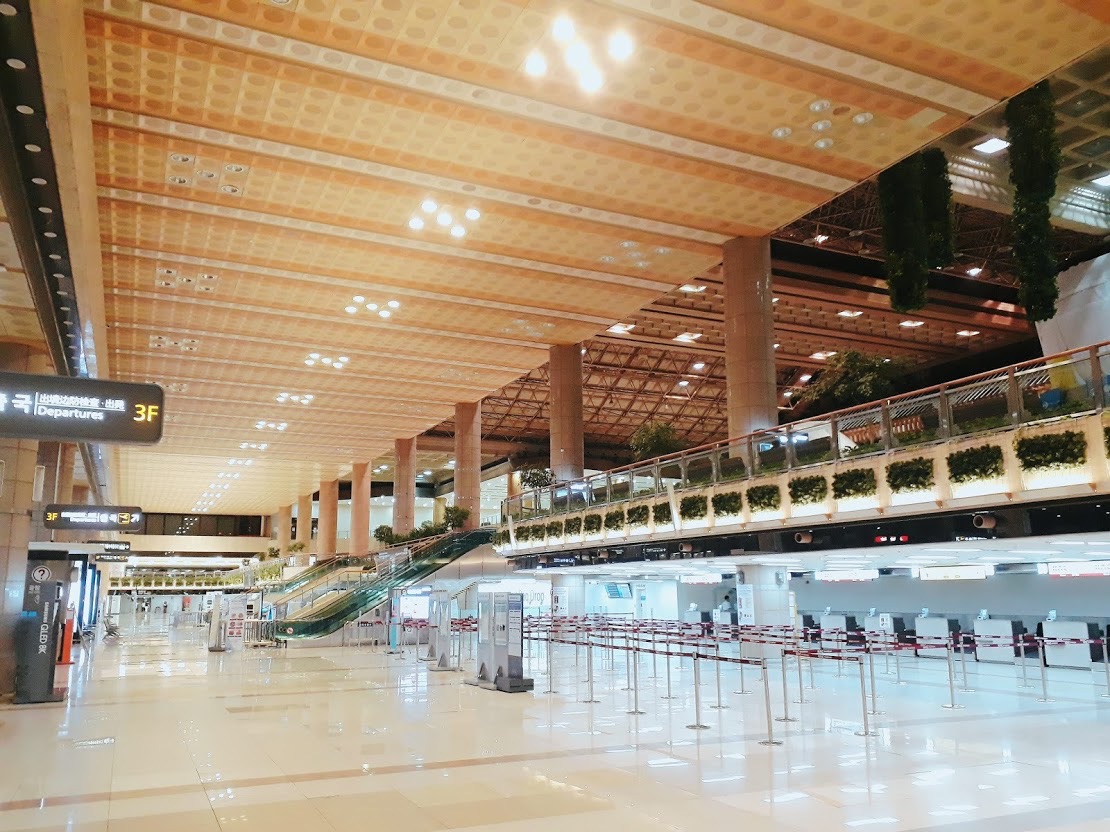
Seoul to Jeju, Korea: Gimpo–Jeju Flights by Airline, Real Fares by Month, Baggage Limits and Getting to Gimpo
Gimpo–Jeju, the world's busiest air route: about 105 flights a day, 06:00 to 21:00, on nine airlines. One-way fares from about ₩37,000 ($28). November's fuel surcharge is ₩25,300 a leg on Korean Air and most budget airlines; sale fares include no bag.
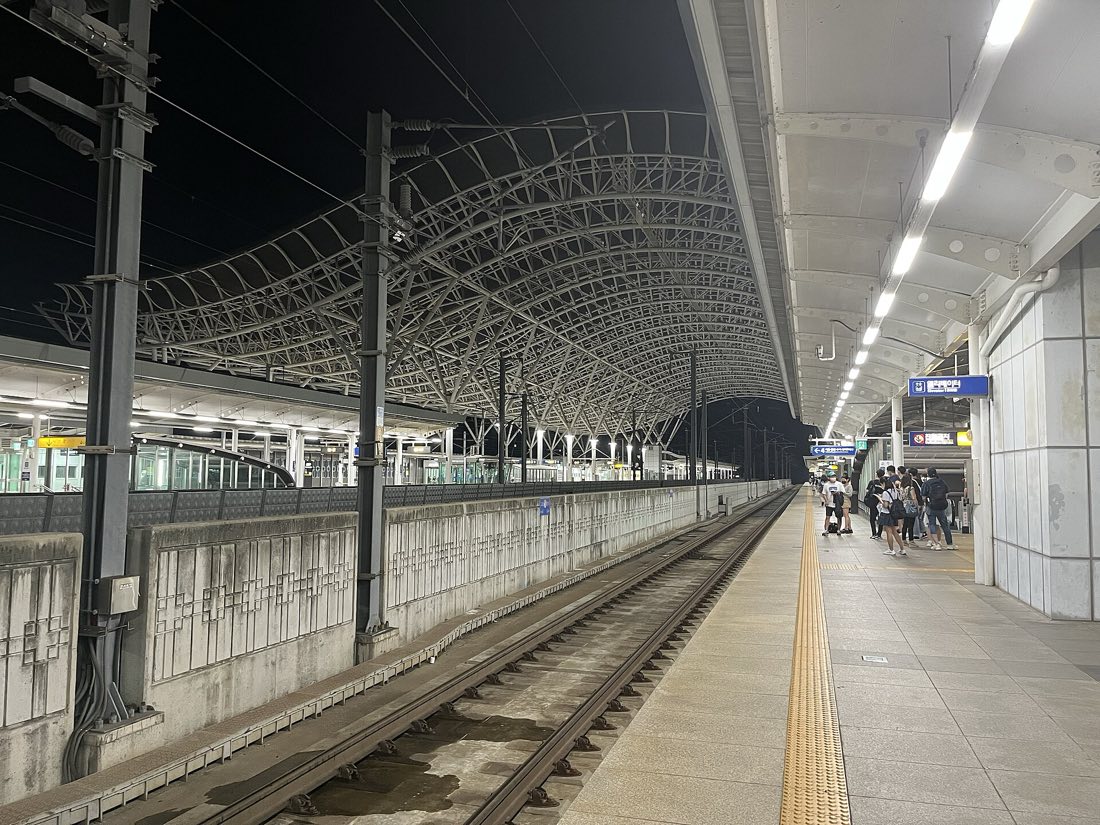
Seoul to Gyeongju, Korea by KTX, Train or Bus: ₩44,500 vs ₩36,700, Which Station You Arrive At and the Last Train Back
Seoul to Gyeongju is about ₩44,500 and about 2 hr 10 by KTX, ₩42,900 from Suseo, or ₩36,700 and almost 4 hours by express bus. Every train stops at Gyeongju Station, 30–40 minutes from the tombs; the last KTX back leaves at 22:38.
Gimpo Airport to Seoul, Korea: ₩1,650 Train in 14 Minutes, Line 9 to Gangnam, Taxis, Last Trains
Gimpo to Seoul: AREX is ₩1,650 (US$1.25) and 14 minutes to Hongdae, ₩1,750 and 22 minutes to Seoul Station; the Line 9 express reaches Gangnam's Sinnonhyeon in 33. No limousine serves Myeongdong or Gangnam. Last train 00:16; taxi ₩15,000–28,000.