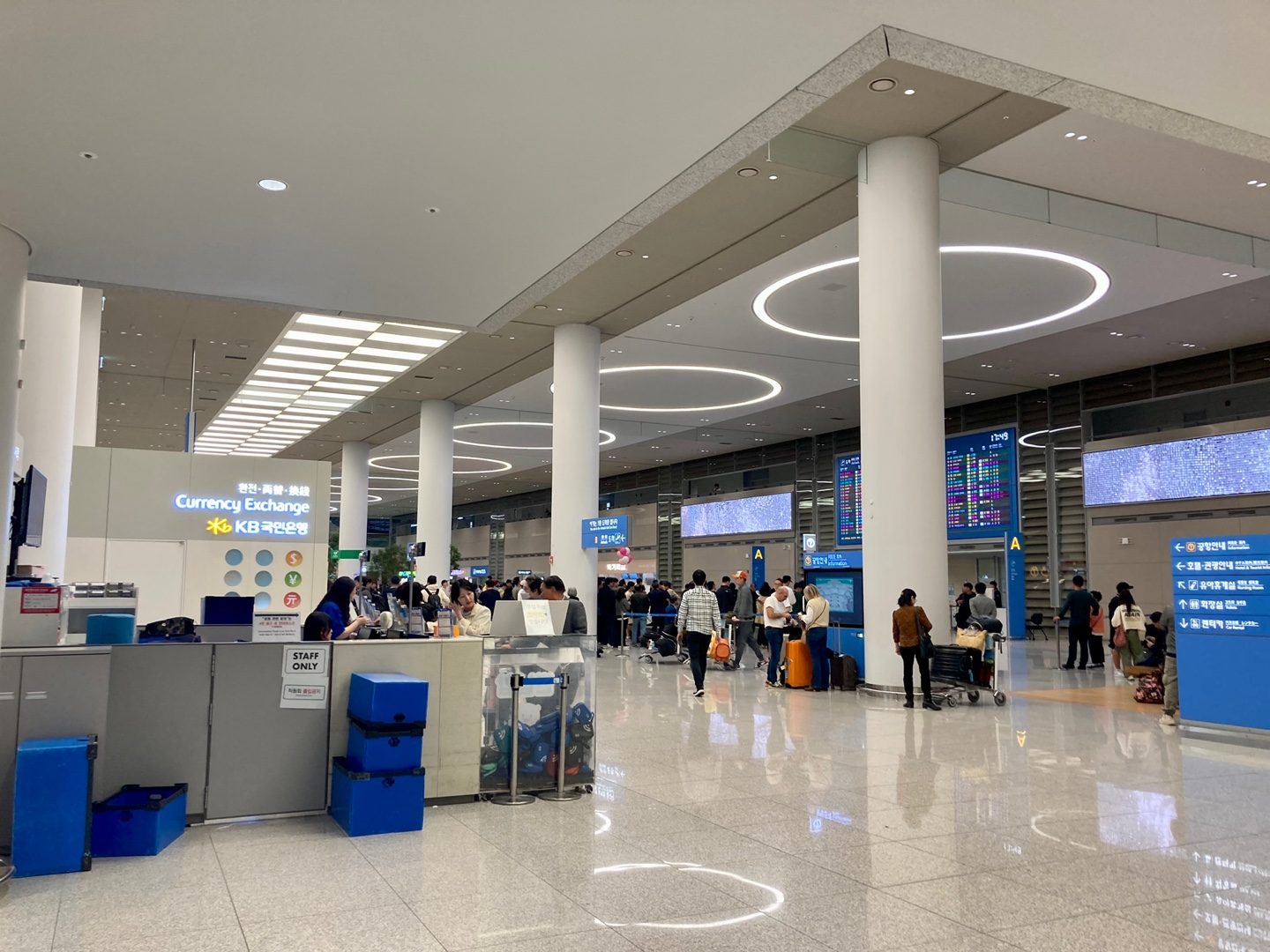
Incheon Airport Money Exchange in Korea: The Banks' Own Disclosure Says 4.20% at the Airport vs 1.75% in Town — ₩16,470 on Every $500
Last updated: September 2026. The commission figures are the banks' own disclosures on the Korea Federation of Banks' foreign-exchange guide (은행연합회 외환길잡이), read on 12 September 2026; the rates are KB Kookmin Bank's posted cash rates for 11 September 2026; the counter locations and hours are Incheon International Airport's facility directory. Sources are listed at the end.
Every guide to Incheon Airport money exchange says the airport rate is "worse", and then disagrees about how much: 3 to 10 percent, "5 to 8 percent worse than Myeongdong", "a few won per dollar". None of them quote a number from the banks, even though the banks publish one. Korea's bank federation runs a disclosure page, 외환길잡이 (the "foreign-exchange guide"), where each bank lists the commission it charges at its Incheon Airport counters, dated. As of September 2026 all three banks at the airport — Woori, Hana and KB Kookmin — charge 4.20 percent on US dollar cash, whether you are buying dollars or selling them. At an ordinary city branch the same banks charge 1.75 percent. On Japanese yen the airport charge is 4.50 percent to buy and 7.00 percent to sell.
At the rates posted on 11 September 2026, that difference is ₩16,470 on every $500 you change at the airport instead of in town, and ₩32,940 on $1,000. It is not a scam and it is not hidden; it is simply a price. This guide shows you exactly what the price is, when it is worth paying, where the counters are and which ones open at 3 a.m., and what a sign photographed on one of the airport booths in 2024 offered to anyone who asked.
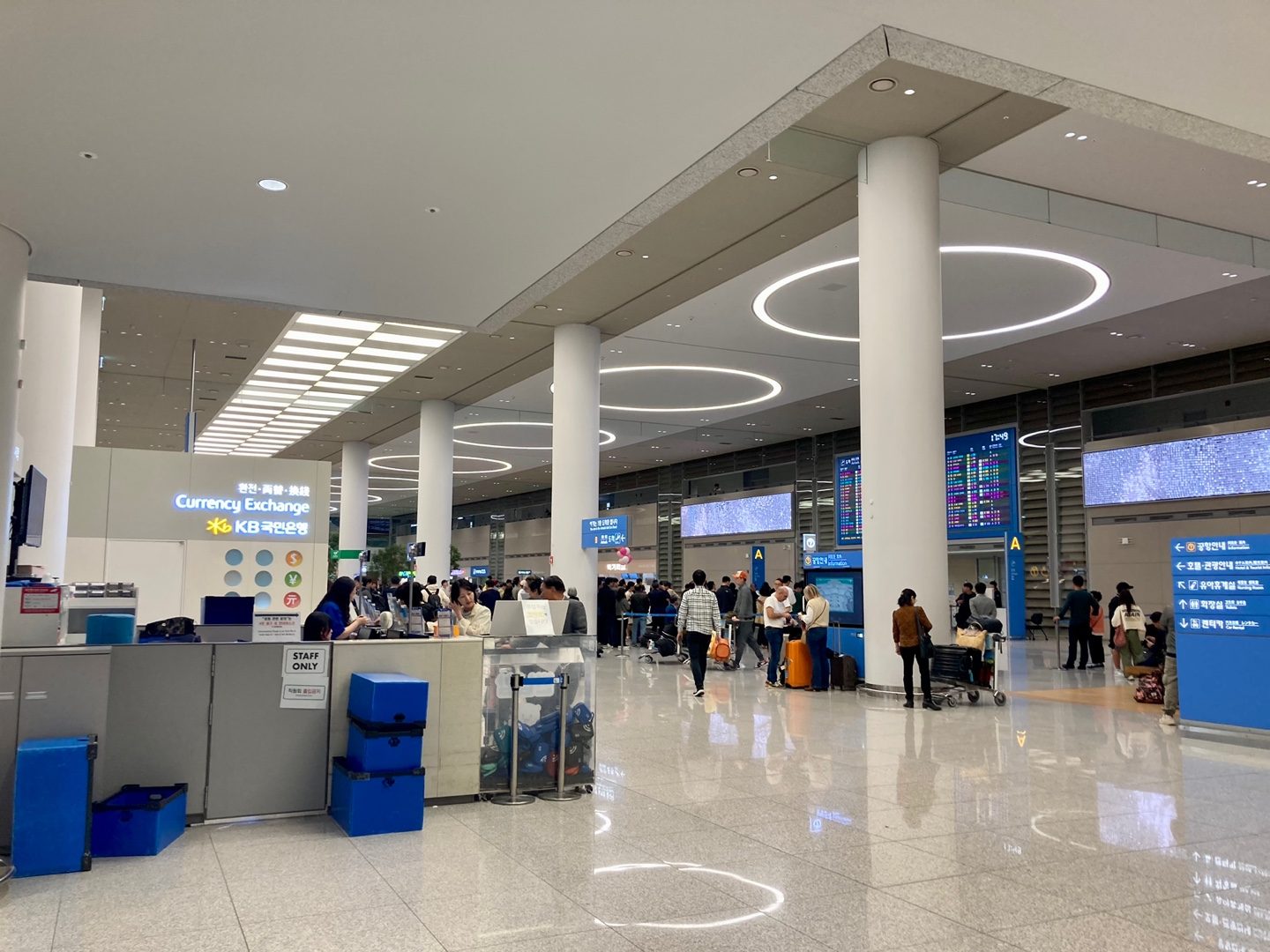
The KB Kookmin Bank (KB국민은행) exchange counter in the arrivals hall of Incheon Airport Terminal 2, October 2024. Photo: Narubaru7, Wikimedia Commons, CC BY 4.0.
Keep the exchange receipt with your passport: the receipt (외국환매입증명서) lets a Korean bank change your leftover won back up to the amount you exchanged, and the BAGSMART RFID travel wallet keeps passport, receipts, T-money card and tax-refund slips flat in one place. As an Amazon Associate, EpicKor earns from qualifying purchases.
Quick Guide: Incheon Airport vs a city bank, September 2026
| What | Incheon Airport counters | City bank branch |
|---|---|---|
| Commission on US dollar cash | 4.20% buying and selling (Woori, Hana, KB) | 1.75% (KB, NH, Shinhan, Woori, Hana, IBK, SC, Citi and most others); KDB 1.50% |
| Commission on Japanese yen cash | 4.50% buying · 7.00% selling | — |
| What you get for $500 (11 Sep 2026 rates) | ₩643,920 | ₩660,390 |
| Difference | ₩16,470 on $500 · ₩32,940 on $1,000 | |
| Discount on offer | KB booth sign (photographed October 2024): "up to 40%" off the commission when you sell foreign cash | Branch discounts vary; the 50–90% online discounts need a Korean bank app |
| 24-hour counters | T1: Woori (1F by exits 6 and 11), KB (baggage claim, before customs), Woori and KB (3F departures) · T2: Woori (1F by exit 7), KB (3F between exits 4 and 5) | Branches open weekdays 09:00–16:00 |
| What to bring | Passport (required above ₩1 million's worth). Changing more than US$10,000 in a day is reported to the National Tax Service; over US$20,000 needs proof of where the money came from | |
The short version: if you land in daylight and have a card that works in Korea, change nothing at the airport, or change only enough for the first day. If you land at night with no card that works, pay the 4.20 percent on a small amount and change the rest in town.
Kakao Friends Ryan coin purse — for the coins Korea hands back Korean banks buy foreign coins at half price or less, so bring notes, not coins; and once you are paying cash in markets you will collect ₩100 and ₩500 coins fast. The official Kakao Friends Ryan purse is the one Koreans actually carry. As an Amazon Associate, EpicKor earns from qualifying purchases.
See the Kakao Friends Ryan coin purse on AmazonWhat the 4.20 percent actually is
Korean banks price foreign cash around a single number for the day, the 매매기준율 (maemae gijun-yul, the "base rate"), which tracks the interbank market. They then add a commission, called the 환전수수료 (hwanjeon susuryo, "exchange commission"), expressed as a percentage of that base rate. When you sell dollars to the bank to get won, the bank pays you the base rate minus the commission; when you buy dollars, you pay the base rate plus the commission. The gap between the two sides is the bank's margin, and it is the entire cost of changing money in Korea. There is no separate service fee on top at a bank counter.
The bank federation's own worked example uses a base rate of ₩1,070: the bank's cash selling price is ₩1,088.73, a commission of ₩18.73 per dollar (1.75 percent), and a 50 percent "preferential rate" (환율우대, hwanyul udae) brings the price down to ₩1,079.37. The airport works the same way. The only difference is the percentage.
On 11 September 2026 KB Kookmin Bank's posted cash rates were ₩1,367.82 to buy a dollar and ₩1,320.78 to sell one. Both sit exactly 1.75 percent either side of a base of ₩1,344.30, which is the standard city-branch spread. The Seoul market closed that afternoon at ₩1,345.9, so the base rate is a fair reading of the day. At the airport, the same base rate with a 4.20 percent commission means the bank pays you ₩1,287.84 per dollar instead of ₩1,320.78.
Why the airport charges more is not a mystery either: the banks bid for the airport concession, pay rent for counters that run from 5 or 6 a.m. to 10 p.m. or around the clock, and serve a customer who has no alternative in the next hour. The commission is published, dated and identical across all three banks, which tells you it is a set price, not a trick at one booth.
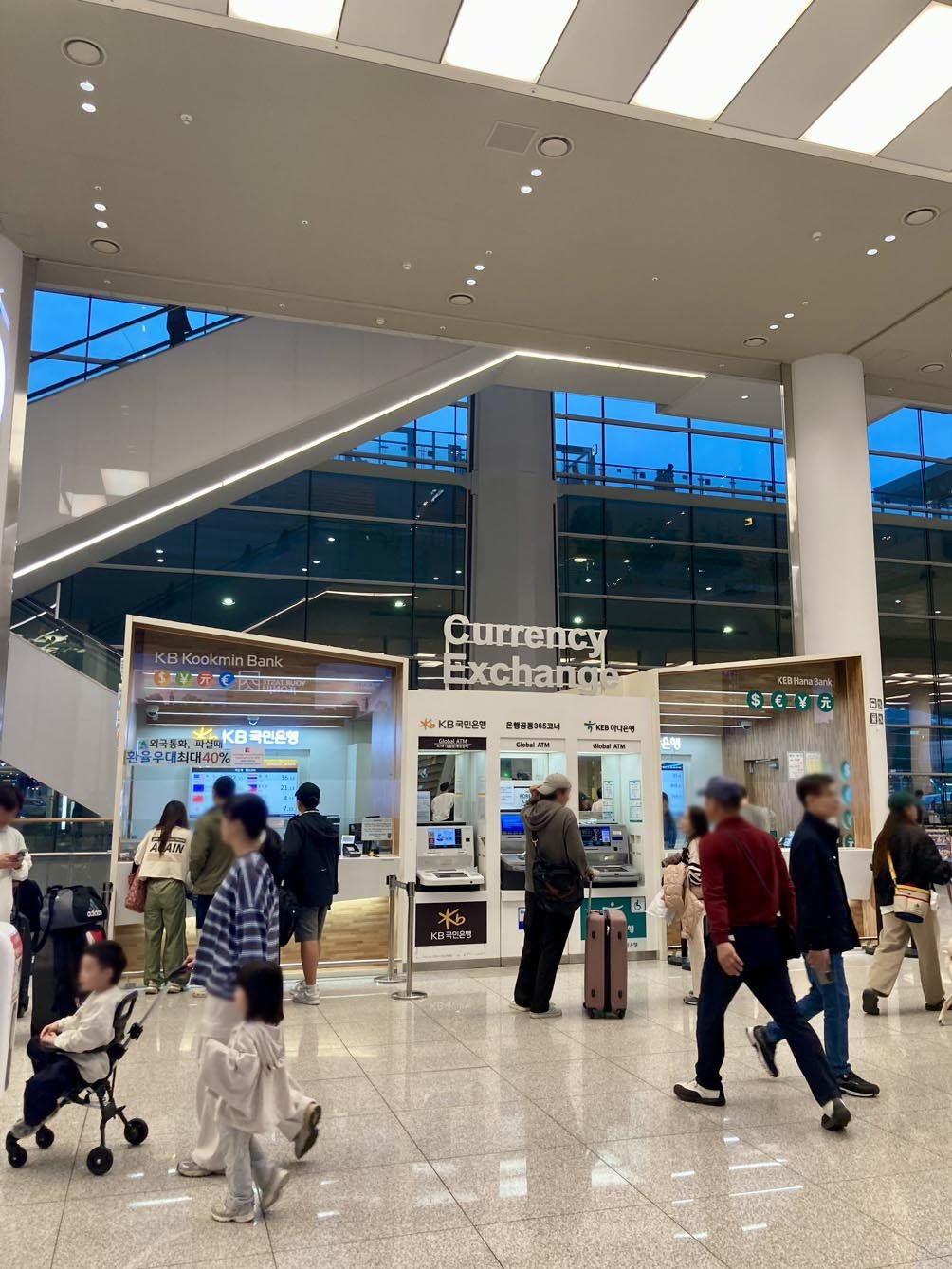
KB Kookmin Bank and Hana Bank booths in Terminal 2, with Global ATMs between them, October 2024. The red-lettered sign on the KB booth reads 외국통화 파실때 환율우대 최대 40% — "when you sell foreign currency, up to 40 percent off the exchange commission". Photo: Narubaru7, Wikimedia Commons, CC BY 4.0.
What it costs you on $100, $500 and $1,000
The table below uses the 11 September 2026 base rate of ₩1,344.30 for all three columns, so the only thing that changes is the commission. Your own numbers will move with the day's rate, but the gaps scale in proportion.
| You change | City branch (1.75%) | Airport (4.20%) | Airport with the full 40% discount (2.52%) | Airport costs you extra |
|---|---|---|---|---|
| $100 | ₩132,078 | ₩128,784 | ₩131,042 | ₩3,294 (₩1,036 with the discount) |
| $300 | ₩396,234 | ₩386,352 | ₩393,126 | ₩9,882 (₩3,108) |
| $500 | ₩660,390 | ₩643,920 | ₩655,210 | ₩16,470 (₩5,180) |
| $1,000 | ₩1,320,780 | ₩1,287,840 | ₩1,310,420 | ₩32,940 (₩10,360) |
Put in things a visitor buys: ₩16,470 is more than a bowl of naengmyeon at the Seoul average of ₩12,692 a bowl. On $100 the airport costs you roughly a triangle gimbap and a drink. That is the honest framing. The airport rate does not ruin a trip, but changing your whole budget there is a choice to pay for a few meals you will not eat.
Two things make the gap larger than the table. First, if you change money back at the airport on the way out, you pay the airport commission again on the other side, so a round trip through the airport counters costs about 8 percent of whatever you did not spend (about 3.4 percent through a city branch). Second, if you are changing yen, the airport's selling commission is 7.00 percent, not 4.50, because the 4.50 is what you pay to buy yen. A Japanese visitor changing ¥50,000 at the airport loses noticeably more than an American changing the equivalent in dollars.
The 40 percent sign, and why you should ask
The booth in the photo above advertises "환율우대 최대 40%": up to 40 percent off the commission when you sell foreign currency to the bank, which is exactly what an arriving visitor does. Taken at the maximum, that turns 4.20 percent into 2.52 percent and shrinks the $500 gap from ₩16,470 to ₩5,180, as the last column of the table shows.
We could not find the conditions for that discount published anywhere, which usually means it depends on the amount, the currency and the day, and "최대" (choedae) means "up to". What costs nothing is asking. Say "환율우대 돼요?" (hwanyul udae dwaeyo?, "is there a preferential rate?") or simply point at the sign before you hand over your notes, then check the rate on the receipt against the day's base rate. If the booth next door offers nothing, walk ten metres.
When changing at the airport is the right call
The airport is the correct place to change money in three situations, and the wrong place in most others.
- You land at night. Bank branches in Seoul open around 09:00 and close at 16:00 on weekdays. If you arrive at 11 p.m. on a Friday, the next city branch opportunity is Monday morning. Change enough for two days at the airport.
- You have no card that works in Korea. Most foreign Visa and Mastercard cards work in Korean shops and taxis (though you cannot tap one at a subway gate), but some prepaid and regional cards do not, and you will not know until the first terminal refuses it. If that is you, change enough cash to get to your hotel and eat.
- You need cash for something specific on day one. Markets, some street-food stalls and topping up a transit card at older machines still want notes. Our Korea payment guide covers which of those actually need cash in 2026.
In every other case, change the minimum at the airport, or nothing. If your plan is to spend mostly by card, you may need less cash than you think: see where foreign cards actually get swiped in Korea.
Where the airport counters are, and which ones open at 3 a.m.
Both terminals have exchange counters on the arrivals floor (1F) and the departures floor (3F), and a few inside the secure areas. Most open 06:00 to 22:00. For a night arrival these are the ones that matter, from the airport's own facility directory in September 2026:
| Terminal | 24-hour counters | Other counters (06:00–22:00 unless noted) |
|---|---|---|
| Terminal 1 | Woori, 1F general area near exit 6 · Woori, 1F general area near exit 11 · KB Kookmin, 1F inside the baggage-claim area near arrival hall B (before customs) · Woori, 3F departures near departure gate 4 · KB Kookmin, 3F departures near check-in counter F | Hana, 3F near departure gate 2 · Hana, 1F near exit 4 · KB, 1F near exit 9 |
| Terminal 2 | Woori, 1F general area near exit 7 · KB Kookmin, 3F general area between exits 4 and 5 | Hana, 1F near exits 4 and 10 · KB, 1F between exits 1 and 2 · KB near arrival hall B (customs side), 05:00–20:00 |
"General area" (일반지역) means the public side, where anyone can walk up; the KB counter by baggage claim in Terminal 1 is inside the customs area, but if you miss it, Woori's public-side counters by exits 6 and 11 on the same floor are also open 24 hours. All three banks quote the same 4.20 percent, so there is no cheaper bank at the airport; there is only the discount question above. If you are heading straight into Seoul, our Incheon Airport to Seoul guide covers the train and bus.
Changing money in Seoul: bank branches and Myeongdong's changers
Bank branches charge the 1.75 percent standard commission on dollars, and some branches will give a preferential rate on larger amounts. The eye-catching "50 to 90 percent" discounts you see on the bank federation's comparison table apply to online exchange booked through a bank's app, which needs a Korean bank account and phone verification. A visitor walking in with a passport pays the counter rate. The practical catch with branches is time: weekdays only, 09:00 to 16:00, with a numbered ticket and a queue.
Private money changers (환전소, hwanjeonso) in Myeongdong, Itaewon and Hongdae are the other option, and many visitors swear by them. We cannot give you an official number for them, because they are not banks and do not appear in the bank federation's disclosure. What you can do is measure them yourself in thirty seconds:
- Look up the day's base rate (매매기준율) on any Korean bank's site or by searching "환율" on Naver.
- Read the changer's board for the rate at which it buys your currency ("We Buy").
- Divide the gap by the base rate. On 11 September a board paying ₩1,330 per dollar would be taking about 1.1 percent; one paying ₩1,300 would be taking 3.3 percent, not much better than the airport.
Bring your passport either way; licensed changers ask for it too. Count the notes at the window, and do not change with anyone approaching you in the street.
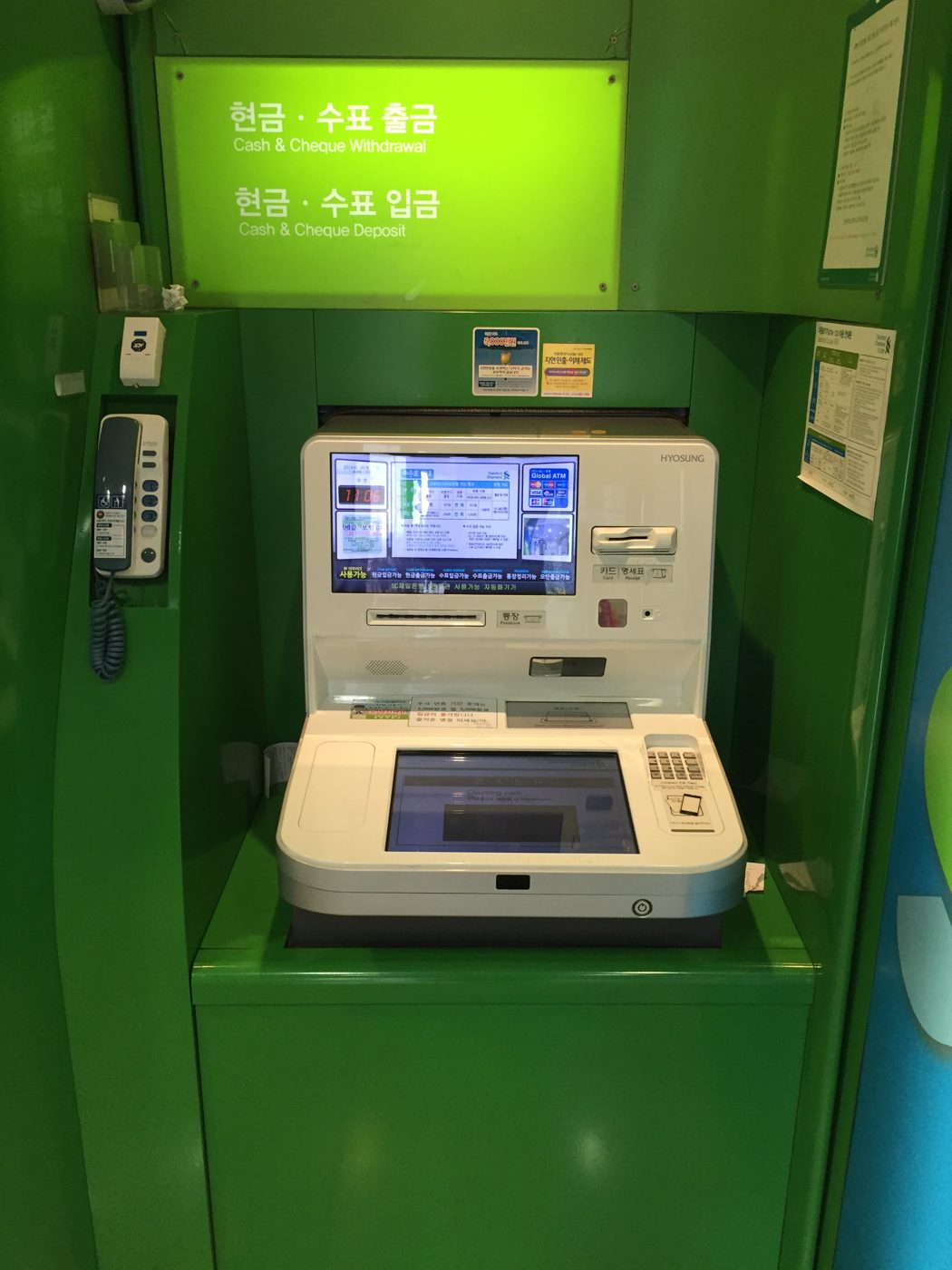
A Standard Chartered (SC제일은행) cash machine in Seoul, September 2016. The "Global ATM" panel on the screen marks machines that take foreign Visa, Mastercard and other network cards. Photo: Lofor, Wikimedia Commons, CC BY-SA 4.0.
ATMs are the third option. Machines marked Global ATM take foreign cards, including three between the booths in Terminal 2. The withdrawal fee depends on the Korean bank that owns the machine and on your own bank at home, and published figures disagree, so read the fee the screen shows you before confirming. If the machine offers to charge you "in your home currency", decline and choose won; that conversion is done at the machine operator's rate, not your bank's.
The rules a visitor should know
Changing money in Korea is lightly regulated for visitors, but four rules come up:
- Passport. Banks and licensed changers ask for it (it is legally required above ₩1 million's worth); it is the identity document for a non-resident.
- US$10,000 and US$20,000. A non-resident can change up to the equivalent of US$20,000 into won without any prior report; above that you need proof of how you got the money, such as the customs declaration you filled in on arrival. Exchanges above US$10,000 in a day are reported to the National Tax Service.
- Declaring cash on arrival. If you are carrying more than US$10,000 in total — foreign cash, won and cheques together — you must declare it to customs when you land and get a certificate; it cannot be issued after you leave the terminal. Failing to declare up to US$30,000 brings an administrative fine; above that, penalties go up to a year in prison or a ₩100 million fine. The same US$10,000 threshold applies when you leave Korea with cash; declare it at customs before departure.
- Coins. Korean banks buy foreign coins at a discount of 50 percent or more, if they take them at all. Spend your home coins before you fly, and bring notes.
Leaving Korea: what to do with leftover won
The cheapest way to deal with leftover won is not to have much. In the last two days, pay cash for small things and keep cards for large ones. Then:
- Anything left over can be changed back to dollars at any bank branch, up to the amount on your exchange receipt, or up to US$10,000 without one (the bank notes it in your passport); at the airport you pay the 4.20 percent again.
- Banks hand back only foreign notes, so coins are hard to change back; spend them at a convenience store or drop them in a charity box at the airport.
- If you shopped a lot, collect your tax refund before you think about re-exchanging: our Korea tax refund guide explains the ₩15,000 minimum and the instant-refund limits, and the refund can be paid in won you then spend at the duty-free shops.
FAQ
Q: Is it better to exchange money at Incheon Airport or in Seoul? In Seoul, if you can. The banks' own disclosure shows 4.20 percent commission on US dollars at all three airport banks (Woori, Hana, KB) against 1.75 percent at city branches. At 11 September 2026 rates that is ₩16,470 less on every $500 changed at the airport. Change a small amount at the airport only if you land at night or have no working card.
Q: How much is the exchange fee at Incheon Airport? 4.20 percent of the base rate for US dollar cash in both directions, and 4.50 percent to buy or 7.00 percent to sell Japanese yen, according to the Korea Federation of Banks' disclosure read in September 2026. There is no extra service fee at a bank counter; the commission is the whole cost.
Q: Are Incheon Airport exchange counters open 24 hours? Some are. In Terminal 1, Woori's arrivals-floor counters by exits 6 and 11, the KB Kookmin counter in the baggage-claim area, and Woori and KB counters on the 3F departures floor run 24 hours; in Terminal 2, Woori near 1F exit 7 and KB between 3F exits 4 and 5. Most other counters open 06:00 to 22:00.
Q: Are Myeongdong money changers better than banks? Often, but not always, and they publish no official rates. Compare the changer's "We Buy" rate with the day's base rate (매매기준율): a gap of about 1 percent beats a bank branch; a gap above 3 percent is close to the airport.
Q: How much cash do I need in Korea? Less than most visitors bring. Cards work in most shops, restaurants and taxis; for the subway you need a T-money or WOWPASS card. A few days' worth of small notes for markets, street food and transit-card top-ups is enough for most trips.
Q: Do I need my passport to exchange money in Korea? Bring it. A bank may change up to ₩1 million's worth without ID, but most counters ask for a passport anyway, and you need it above that amount and to change won back; changing more than US$10,000 in a day is reported to the National Tax Service.
Sources
- Korea Federation of Banks, 외환길잡이 (exchange.kfb.or.kr), "Incheon Airport exchange commission comparison" (주요통화 인천공항 환전수수료 비교), read 12 September 2026: USD cash 4.20% buy / 4.20% sell at Woori (updated 2026-09-01), Hana (2026-09-03) and KB Kookmin (2026-08-04); JPY 4.50% buy / 7.00% sell at all three.
- Korea Federation of Banks, 외환길잡이, "Internet exchange commission comparison by bank" (은행별 주요통화 인터넷환전수수료 비교), read 12 September 2026: USD buying commission 1.75% at KB (2026-08-04), NH, Shinhan, Woori, SC, IBK, Citi (2026-09-01), Hana (2026-09-03) and most regional banks, 1.50% at KDB (2025-11-07); online preferential rates up to 70–90%. Worked example of base rate ₩1,070, cash selling rate ₩1,088.73, commission ₩18.73, 50% preferential rate ₩1,079.37. Korea Federation of Banks, 환전 유의사항 (exchange09): exchanges up to ₩1 million without ID; re-exchange limits.
- KB Kookmin Bank, posted USD rates, 11 September 2026 (06:11, round 759): cash buying ₩1,367.82, cash selling ₩1,320.78.
- Asia Business Daily / Financial News, 11 September 2026: won–dollar closes at ₩1,345.9 (15:30).
- Incheon International Airport Corporation, facility directory, currency exchange (공항 환전소), Terminals 1 and 2, read 12 September 2026.
- Woori Bank, "Exchanging foreign currency into won" (외국통화를 원화로 환전): non-resident limit US$20,000 without report; National Tax Service notification above US$10,000; proof of acquisition above US$20,000; foreign coins bought at a discount of 50% or more.
- Korea Customs Service, entry and exit foreign-exchange declaration (출·입국 외환신고): declaration above US$10,000; penalties.
- Korea Consumer Agency, 참가격 dining-out prices for Seoul, July 2026: naengmyeon average ₩12,692.
You Might Also Like
Where Foreign Cards Actually Get Swiped in Korea: Seoul Takes 65%, Dermatology Takes 40% of Service Spending, the Top 1% of Shops Take 67%, and ₩166,000 Per Foreign Service Payment
Korean card-terminal data on where visitors actually spend: 65% in Seoul, Seoul's tourist zones 14.6% foreign vs 1.3% in ordinary alleys, dermatology 40% of service spending, the top 1% of shops taking two-thirds. Busan and Jeju rising fastest.
How Much Is a Hotel in Seoul, Korea, Per Night? The Official Numbers by Month, Star Grade and Neighbourhood: ₩207,000 Revenue per Room, ₩460,000 for Central Five-Star, the Cheapest and Dearest Months, and Why Rates Keep Rising
Seoul hotel prices from Korea's own hotel statistics: ₩207,000 revenue per room in 2025, ₩460,000 for a central five-star, 79% occupancy, 71% foreign guests, 1,000 new rooms a year. Month by month, with the weeks that double and the ones that fall.
What You Cannot Bring Into Korea: Beef Jerky, Sausage, Mango, Adderall and CBD Are Banned, Sleeping Pills Need a Permit, the Fine Is ₩1 Million to ₩10 Million, and the Souvenirs Korea's Customs Take Most (2026)
Korea bans all meat and fresh fruit from hand luggage, fines undeclared jerky or sausage ₩1–10 million, refuses Adderall even on prescription, and needs a 10-day online permit for sleeping pills. The souvenirs customs take most, and how to declare.