Gwangjang Market's Second Floor: Seoul's Vintage Arcade, and the One Day It's Shut
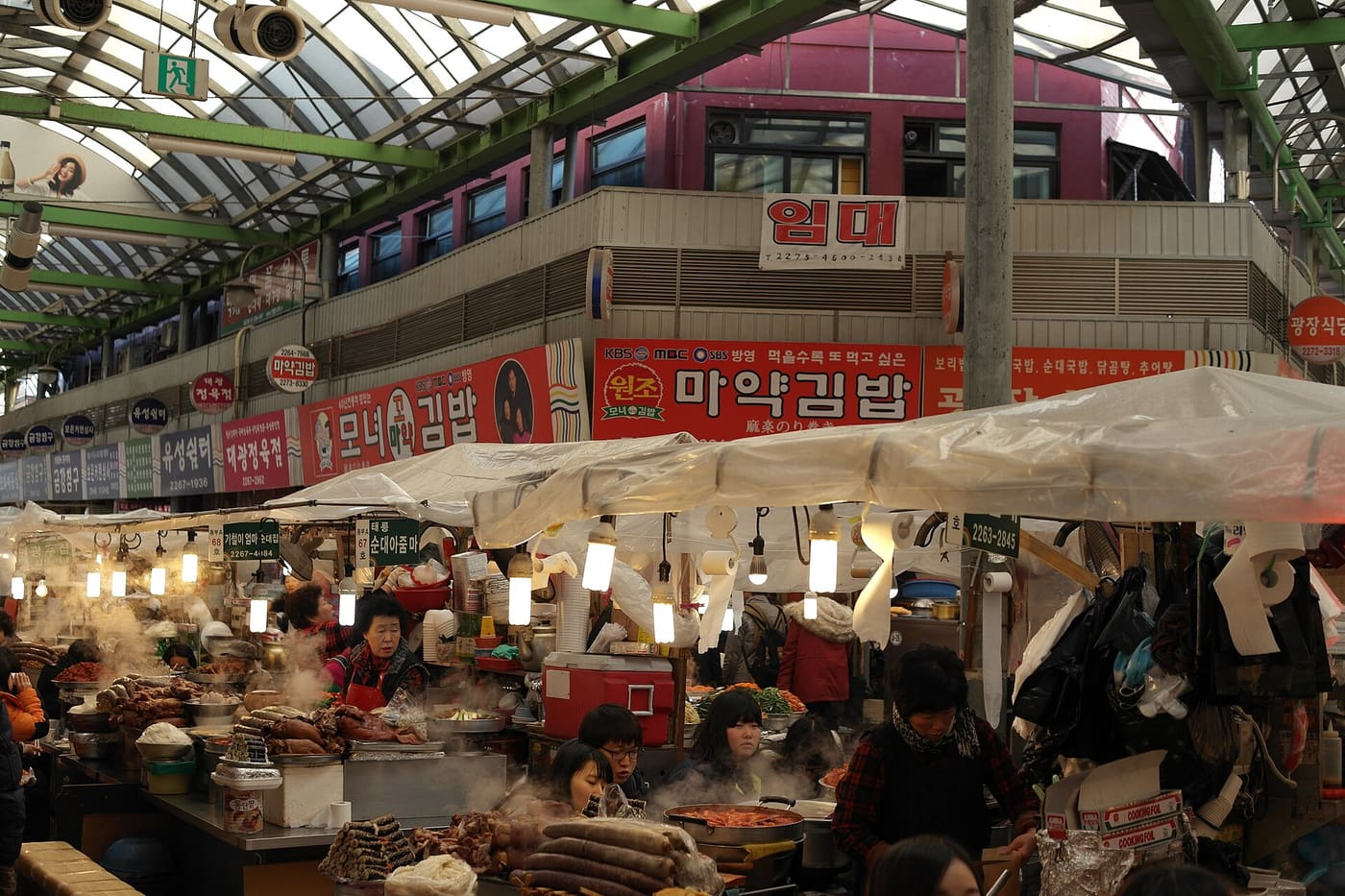
You know Gwangjang Market from the food. Everyone does — the bindaetteok, the mayak gimbap, the woman who has been cutting the same thing for thirty years, the Netflix episode. That alley is genuinely open until eleven at night, every day of the year.
Walk up one of the unremarkable staircases between the fabric stalls and there is a second market up there: rows of small vintage clothing stalls, most of them signed 수입구제 — literally imported second-hand.
And here is the part that catches people out. The vintage arcade is closed on Sundays. The food alley below it never closes at all. So the single most popular day for visitors to wander into Gwangjang is the one day the upstairs is dark, and almost nothing in English mentions it.
The Short Answer
| Question | Answer |
|---|---|
| What it is | A vintage and second-hand clothing arcade above the food alley |
| Look for | Red signs reading 수입구제 (imported second-hand) |
| Hours | 10:00 – 19:00 |
| Closed | Every Sunday. Open normally on public holidays |
| Food alley, for contrast | Until 23:00, open year-round |
| Rest of the market | 09:00 – 18:00, closed Sunday |
| Getting there | Jongno 5-ga Station (Line 1), Exit 8 |
| Alternative exit | Euljiro 4-ga (Lines 2, 5), Exit 4, about 100m |
| Market office | 02-2267-0291 |
| Typical prices | ₩5,000 – 20,000 an item, about ₩30,000 for a full outfit |
| Bring | Cash, patience, and space in your bag |
The one fact that decides your trip
Gwangjang runs on three different clocks, and mixing them up is how an afternoon gets wasted.
| Section | Hours | Closed |
|---|---|---|
| 먹자골목 food alley | until 23:00 | Never |
| 구제상가 vintage arcade | 10:00 – 19:00 | Sundays. Public holidays are normal trading days |
| General market (textiles, hanbok, bedding) | 09:00 – 18:00 | Sundays |
Those are the market's own published hours, not an estimate. The public-holiday detail is worth keeping: on a Korean public holiday when much of the city is shut, the vintage arcade is open as usual — but on an ordinary Sunday it is not.
English guides get this wrong in both directions, and at least one puts the station exit at 7. It is Exit 8 from Jongno 5-ga on Line 1.
You might like: Why Your Phone Screams in Korea: Emergency Alerts, Air-Raid Sirens, and Telling Them Apart
Why the upstairs exists at all
Gwangjang opened in 1905 as Korea's first permanent market, and it was a textile market long before it was a food destination. That history is still visible: the ground floor and the surrounding buildings trade in fabric, bedding, hanbok and sewing supplies, and the food alley grew up in the aisles between them.
The vintage arcade upstairs is a later layer on the same logic — a floor full of small operators who each buy and sort their own stock. That structure is why the experience is different from a thrift shop at home. These are not donation bins. Each stall owner selects and imports their own pieces, which means the hit rate is higher than a charity shop and the prices are set by a person who knows what they have.
How to actually find it
This is the part where people give up, because the stairs are not signposted for tourists.
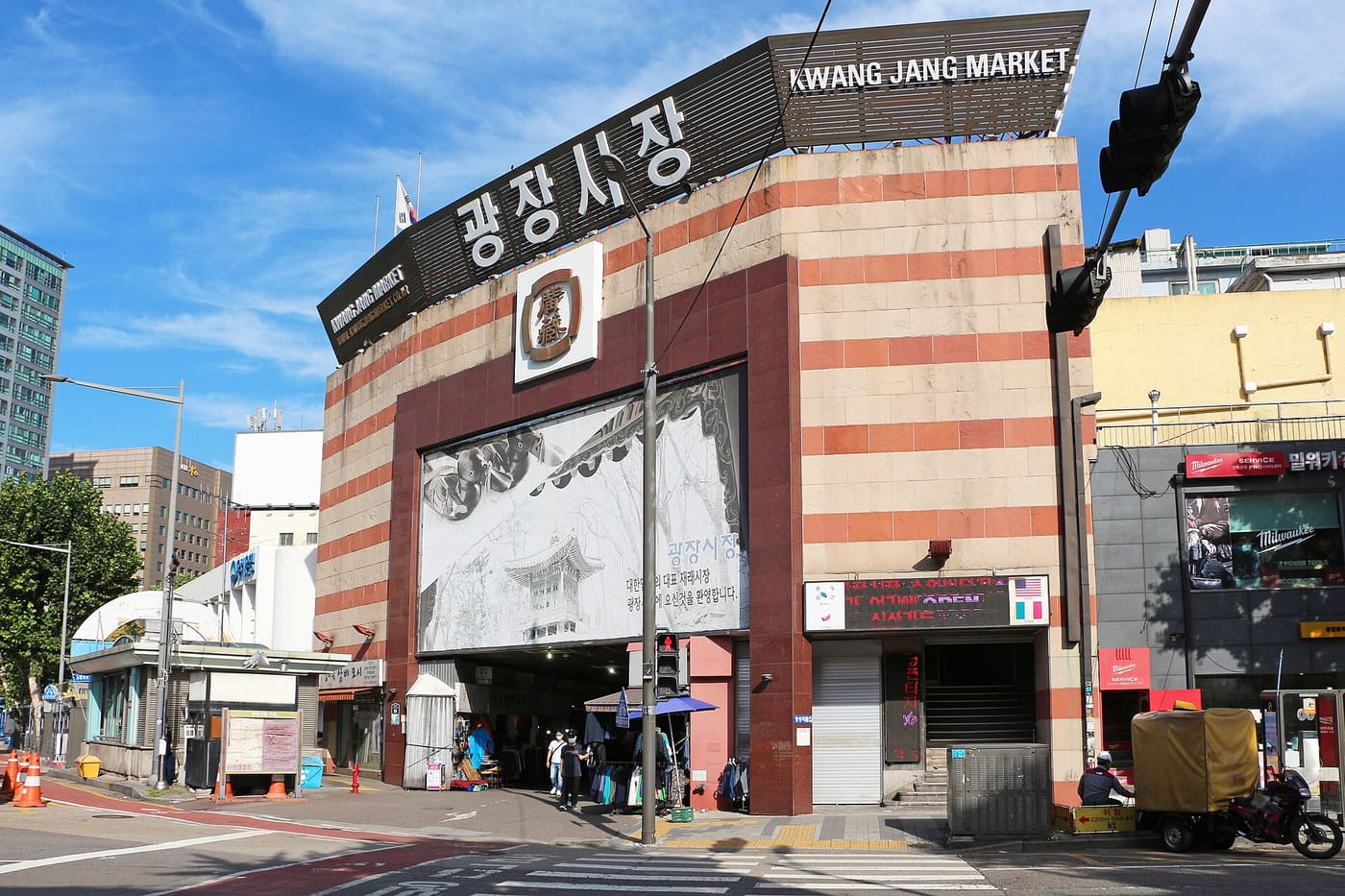
- Come out of Jongno 5-ga Station, Line 1, Exit 8. The market is a short walk.
- Go into the market rather than along the outside — the food alley is the spine.
- Look for staircases between the fabric and clothing stalls. They are narrow, unglamorous, and look like they lead to a storeroom.
- Follow the 수입구제 signs. Learning those four characters is the single most useful preparation for this trip — they are painted on signboards in red and they mean you are in the right place.
- If you cannot find a staircase, ask. Stall owners here are used to it and will point.
Give it at least ninety minutes. This is a hunt, not a shop. The stalls are small, the stock is unsorted by size, and the whole point is that you are looking through things nobody has curated for you.
Vintage knitwear is where this market is strongest and where condition matters most. As an Amazon Associate, EpicKor earns from qualifying purchases at no extra cost to you. A fabric shaver takes bobbling off a wool piece in minutes and turns a "maybe" into a keeper — it is the cheapest thing you can own that makes second-hand clothes look bought. Compare fabric shavers on Amazon before you start buying wool.
What to expect, and what not to
What is genuinely here: wool knitwear, coats, leather bags, jackets, and a lot of 1980s and 1990s Western brands that arrived through the second-hand import trade. Stall owners specialise — one does outerwear, the next does bags — so walking the whole floor matters more than digging through one stall.
What is not here: a curated concept store. If you want vintage arranged by decade with good lighting and English tags, that is Hongdae and Seongsu, and it costs more. Our Seoul vintage shopping guide covers those.
Sizing is the real friction. Stock is imported, so it runs to whatever the source country wore. There is no consistent Korean sizing to rely on and there is often nowhere proper to try things. Wear something easy to change over, and measure a garment you own before you come.
Bring cash. Cards work in many stalls now but not all, and cash is what makes a negotiated price land.
On bargaining: it is normal here, it is not a performance, and it is not the aggressive haggling of a tourist bazaar. Ask once, politely, and expect a modest movement rather than half off. Buying two things from the same stall does more than arguing about one.
What it costs
This is the number English guides skip, and it is the reason the floor exists.
| Typical | |
|---|---|
| Entry-level pieces | ₩5,000 – 10,000 |
| Most individual items | under ₩20,000 |
| A full outfit, top and bottom | around ₩30,000 |
| Outerwear, leather, better wool | Higher, and this is where bargaining matters |
Those figures come from Korean coverage of the arcade — 투데이신문 and 위키트리 have both walked the floor — rather than from a tourist blog. They are the reason to come. A full outfit for ₩30,000 is less than a single item in most of the curated vintage shops in Hongdae, and less than lunch for two in a Seoul department store food hall.
Korean reporting also describes the stock as spanning 1920s through 1990s fashion, which is a wider range than "vintage" usually means abroad. In practice the volume sits in the 1980s and 1990s, with older pieces as occasional finds.
Set the expectation properly, though. These prices are for unbranded and lightly-known second-hand. The Burberry-trench stories that circulate online are real but they are the outcome of many visits, not of one afternoon. Come for ₩15,000 knitwear and treat anything better as luck.
Gwangjang, Dongmyo or Hongdae?
Seoul has three distinct second-hand cultures and picking the wrong one wastes a day.
| Gwangjang 구제상가 | Dongmyo flea market | Hongdae / Seongsu shops | |
|---|---|---|---|
| What it is | Stall owners who import and select their own stock | A true flea market, piles and tables | Curated boutiques |
| Price | ₩5,000 – 30,000 typical | Cheapest of the three | Highest |
| Condition | Reasonably consistent | Variable, dig required | Cleaned, repaired, tagged |
| Effort | Medium — a hunt with a floor plan | High | Low |
| Closed | Sundays | Busiest at weekends | Usually Mondays, varies |
| Best for | Wool, coats, bags | Bargain hunting and the experience | Buying one good piece quickly |
The short version: Gwangjang is the middle option, and the middle option is usually the right one for a visitor with limited time who still wants to do the hunting themselves. Our Seoul vintage guide covers Dongmyo and the Hongdae shops in more detail.
Is it worth it if you only have one afternoon?
Honest answer: only if you like the hunt.
If you want to bring home one nice Korean thing and you have three hours, this is not the efficient choice — a department store or Olive Young will serve you better and faster. Gwangjang's vintage floor rewards people who enjoy looking through racks and do not mind leaving empty-handed.
But if that is you, it is one of the few places in central Seoul where the shopping is still genuinely unmanaged — no algorithm, no merchandising, no English-language brand story. And the food is directly downstairs when you give up.
One practical warning. If you do well here, you will have a volume problem on the way home. That is a real and common outcome, and we wrote the fix: where to buy luggage in Seoul, which also explains why the empty weight of the case matters more than its price.
FAQ About Gwangjang Market Vintage Shopping
Q: What day is the vintage arcade closed?
A: Sunday. The 구제상가 trades 10:00 – 19:00 and closes Sundays, while public holidays are normal trading days. This is the opposite of what most visitors assume, because the food alley below runs until 23:00 and never closes.
Q: Which subway exit?
A: Jongno 5-ga Station, Line 1, Exit 8. From Euljiro 4-ga on Lines 2 and 5, use Exit 4 and walk about 100m. Some English guides say Exit 7; the market's own directions say 8.
Q: How do I find the second floor?
A: Look for narrow staircases between the fabric and clothing stalls inside the market — they are unmarked and look like service stairs. Follow signs reading 수입구제. If you are lost, ask a stall owner; they are asked this constantly.
Q: What does 수입구제 mean?
A: Literally imported second-hand. 구제 (gujae) is the Korean term for used clothing, and 수입 (suip) means imported. It is the standard signage for this trade and the phrase to look for.
Q: Can I bargain?
A: Yes, moderately. Ask once and expect a small reduction rather than a dramatic one. Buying several pieces from one stall is more effective than negotiating hard on a single item. Cash helps.
Q: Are there fitting rooms?
A: Often not, or only improvised ones. Wear layers you can change over easily, and bring the measurements of a garment that fits you — sizing is imported and inconsistent.
Q: How much do things cost?
A: Korean coverage of the arcade puts most individual items under ₩20,000, entry-level pieces at ₩5,000 – 10,000, and a full outfit at around ₩30,000. Outerwear and leather run higher and are where negotiating actually matters. Prices vary by stall and by what you are holding.
Q: Is this the same as Dongmyo flea market?
A: No. Dongmyo is cheaper, rougher and more of a genuine flea market; Gwangjang's arcade is stall owners who select and import their stock, so prices are higher and quality is more consistent. See Seoul vintage shopping for how the districts differ.
Q: Do I need to go early?
A: Not especially — the arcade opens at 10:00 and stock does not turn over hourly. Allow at least ninety minutes, and avoid arriving after about 18:00 since stalls start closing before the official 19:00.
The rule worth remembering
The food never closes. The clothes close on Sunday.
Gwangjang is two markets stacked on top of each other with different opening hours, and the only reason anyone gets this wrong is that the famous half is the half that is always open. Check the day before you plan the trip, look up above the awnings when you arrive, and learn the four characters on the red signs.
Related reading on EpicKor: Seoul vintage shopping compares Dongmyo, Hongdae and Seongsu, three Seoul markets puts Gwangjang next to Majang and Dongmyo, and where to buy luggage in Seoul is the guide you will want if the hunt goes well.
Sources: Opening hours, Sunday closure, public-holiday trading, station exits and the market office number from Gwangjang Market's official site (kwangjangmarket.co.kr), read 14 August 2026. Individual stall hours vary and the arcade thins out before its official close — treat 19:00 as the outer limit, not a promise.
You Might Also Like
Where to Buy Luggage in Seoul: Namdaemun, Real Prices, and When Not to Bother
You shopped too well and now you need another suitcase. Namdaemun is the answer, but the underground arcade shuts on the 2nd and 4th Sunday, the bag shops close for Chuseok, and a cheap case is not always cheaper than shipping.
Why Your Phone Screams in Korea: Emergency Alerts, Air-Raid Sirens, and Telling Them Apart
Korea has two alarm systems and visitors confuse them constantly. One is a text on your phone, usually a heat advisory. The other is a street siren that stops traffic. On 20 August 2026 both go off at 2pm, and neither means what you fear.
Korea's KTX and SRT Merged on 1 September: Cheaper Fares, One App, One Thing to Do First
Korail and SR merged on 1 September and the SRT is now KTX-Sancheon. Seoul-Busan dropped from ₩59,800 to ₩54,400 that day, not gradually. Chuseok booking runs 7-11 September by route, Suseo on the 10th, and an SR-only account cannot book.