How Much Is a Hotel in Seoul, Korea, Per Night? The Official Numbers by Month, Star Grade and Neighbourhood: ₩207,000 Revenue per Room, ₩460,000 for Central Five-Star, the Cheapest and Dearest Months, and Why Rates Keep Rising
Last updated: September 2026. The numbers below are from Korean sources that do not appear in English: the Ministry of Culture, Sports and Tourism's 2025 lodging statistics, the Korea Hotel Association's operating returns as reported by Cushman & Wakefield and the Korean press, STR monthly rate data as published in Korean business papers, and Yanolja Research's quarterly accommodation reports. Booking-site "average price" widgets are quoted only where labelled. Rates are per room per night, before the 10 percent VAT and any service charge shown at checkout.
The English answer to "how much is a hotel in Seoul" is a booking-site widget that averages whatever happened to be listed that week. The Korean answer is a set of published statistics, and it says something the widgets do not: Seoul's hotels now earn two-thirds more per available room than in 2019 while adding almost no rooms, and they are full. In 2025 the city's hotels ran at an estimated 79.2 percent occupancy with 71.2 percent of guests from abroad, earned ₩207,345 per available room per night (67 percent above 2019), and added about 1,000 rooms to a stock of roughly 53,700. Seoul's four-star rates are up about 92 percent on 2017. A central five-star averaged ₩460,000 a night in mid-2025, more than double Hanoi and two-thirds of Tokyo. And on one Saturday in March 2026, when BTS played Gwanghwamun Square, the Koreana Hotel's ₩320,000 room sold for ₩1,350,000.
This guide puts those numbers in the order a traveller needs them: what a night costs by star grade and neighbourhood, which months cost what, and how to book around it.
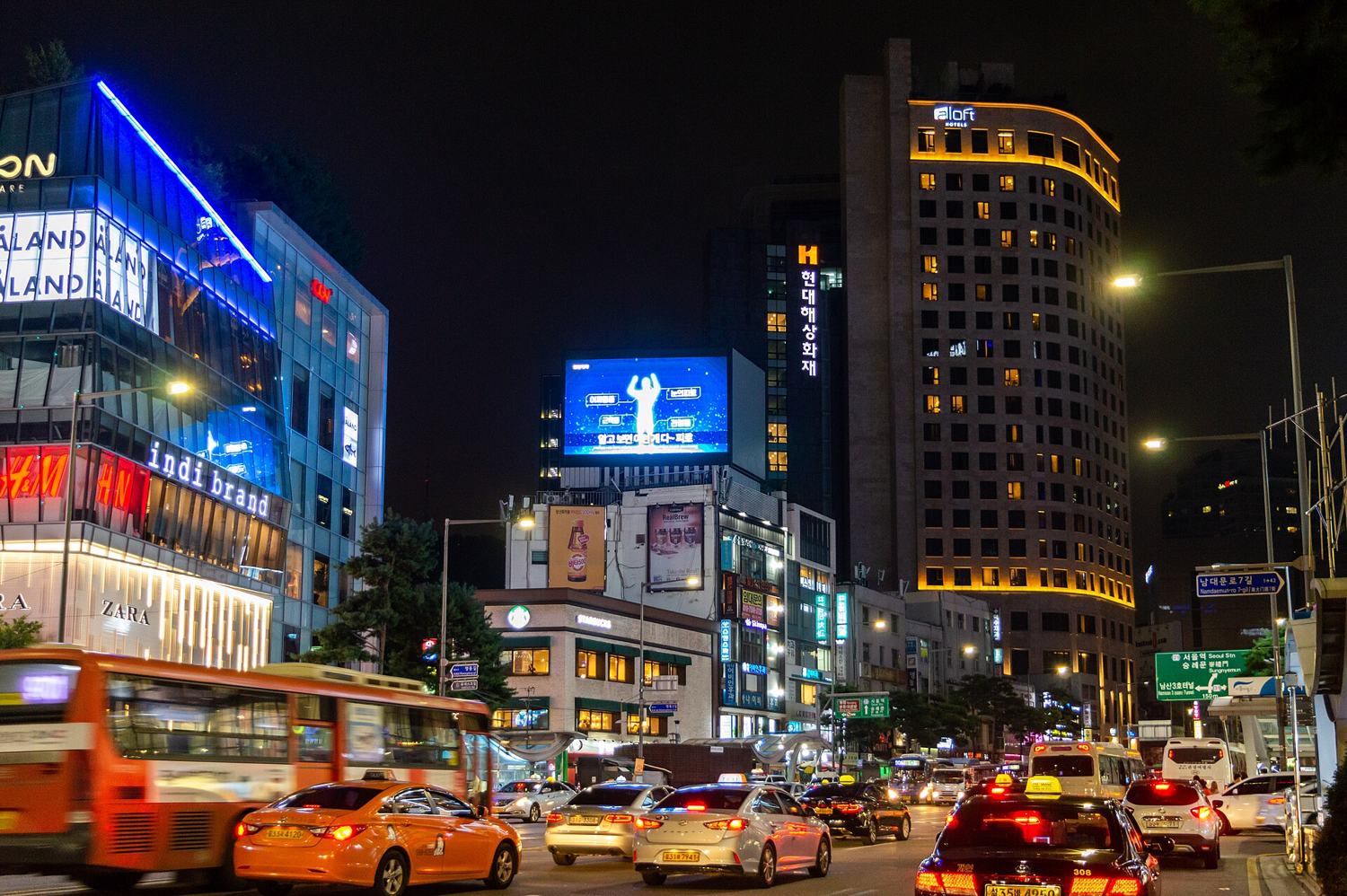
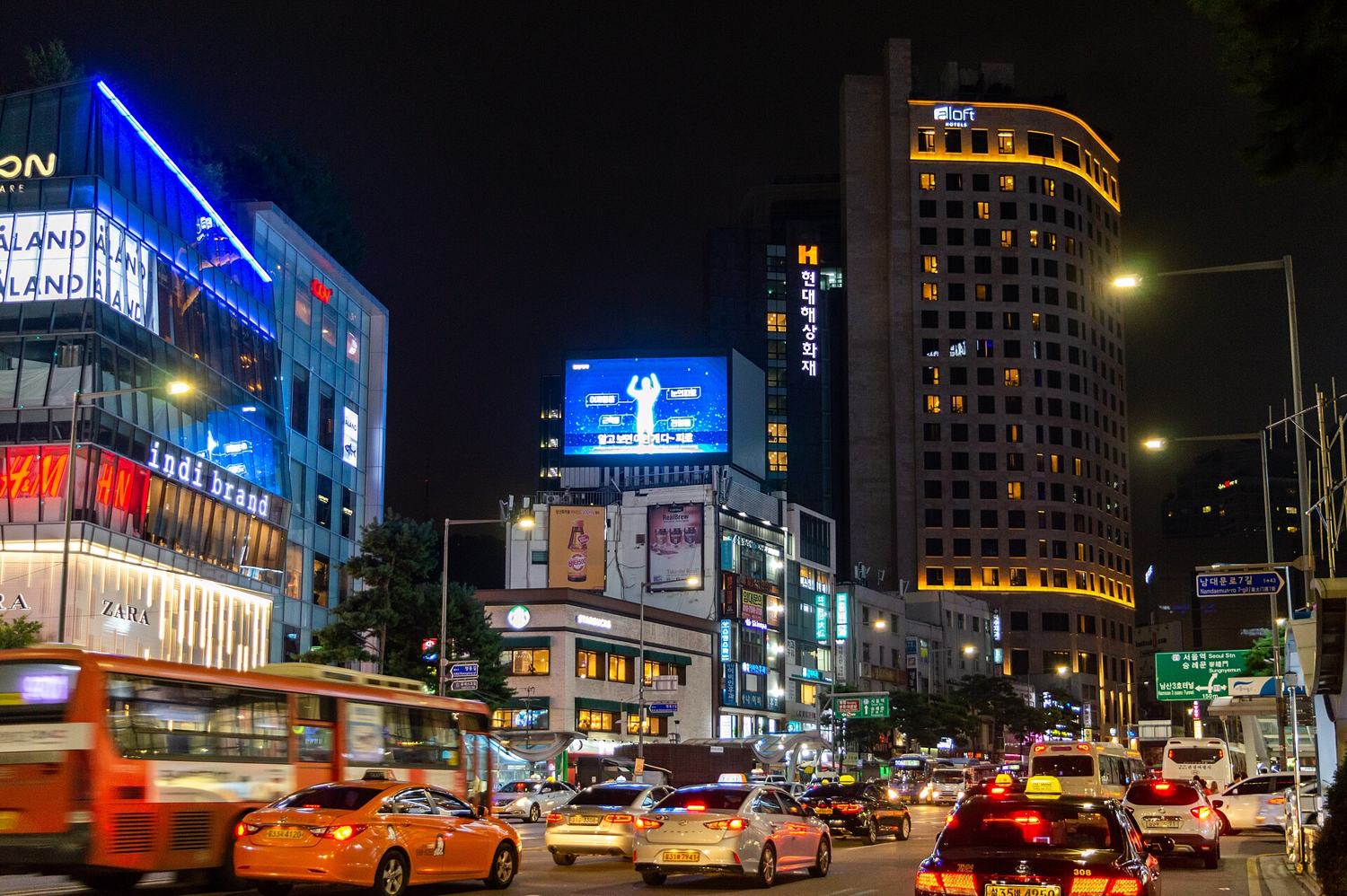
Myeongdong at night: the Aloft on Namdaemun-ro. Foreign guests filled 78 to 94 percent of the rooms at Myeongdong's big hotels in 2024–26, and one Myeongdong three-star reported 87 to 88 percent occupancy. Photo: Tristan Surtel, Wikimedia Commons, CC BY-SA 4.0 (2019).
The socket beside the bed is a two-round-pin Type F at 220 V, and Korean hotels rarely lend adapters; since 29 March 2024 any hotel with 50 or more rooms may not give away toothbrushes, toothpaste, shampoo, conditioner or razors. Pack a TESSAN Korea plug adapter (Type F, 220 V, with USB ports) and the room is ready the moment you walk in. As an Amazon Associate, EpicKor earns from qualifying purchases.
Quick Guide: what a Seoul hotel night costs in 2026
| Grade | Typical rate, ordinary week | What the statistics say | Where it lives |
|---|---|---|---|
| Five-star (74 in Korea, most in Seoul) | ₩350,000–₩600,000; ₩800,000–₩1,000,000+ at Signiel, Four Seasons, Josun Palace | Korea-wide five-star average ₩362,000 (Hotels.com index, June 2025); Seoul central five-star ₩460,000 | Sogong-dong and Euljiro (Lotte, Westin Josun, Plaza), Gwanghwamun (Four Seasons), Jangchung (Shilla), Itaewon (Grand Hyatt), Jamsil (Signiel), Gangnam (Josun Palace, Park Hyatt) |
| Four-star | ₩180,000–₩300,000 | National four-star average ₩167,051 in 2024, up 30.5 percent in two years (Yanolja Research); Seoul four-star rates up about 92 percent since 2017 (Cushman & Wakefield) | Myeongdong, Namdaemun, Hongdae, Dongdaemun: Four Points, Courtyard, L7, Aloft, Mercure |
| Three-star and business hotels | ₩90,000–₩160,000 | National three-star average ₩127,331 in 2024, up 33.4 percent in two years; one Myeongdong three-star ran 87–88 percent full in 2025–26 | Myeongdong, Dongdaemun, Jongno: Toyoko Inn, Solaria, Nine Tree, Tmark, Ibis |
| Guesthouses, hostels, motels | ₩40,000–₩90,000 | Not in the hotel statistics; motels are the one segment whose demand held up in the 2025 low season | Hongdae, Sinchon, Jongno, Dongdaemun |
| Seoul, all grades, 2025 | — | Occupancy 79.2 percent (estimate); foreign guests 71.2 percent; revenue per available room ₩207,345 (+67 percent vs 2019); about 53,700 rooms, +1,000 a year | Cushman & Wakefield 2026 Seoul Hospitality Report, from Korea Hotel Association returns |
Compare the actual week before you decide the grade: EpicKor may earn a commission if you book through this Agoda link, at no extra cost to you. Check Seoul hotel prices on Agoda for your dates, then read the month table below to see whether those dates are the reason.
Dorco Pace 7 razor, made in Korea — because the hotel razor is gone Since March 2024 Korean hotels with 50 or more rooms may not give away razors, toothbrushes or toothpaste; they are sold at reception or not offered at all. Dorco is a Korean razor maker behind many supermarket own-brand razors, and the seven-blade Pace is the one Koreans pack. As an Amazon Associate, EpicKor earns from qualifying purchases.
See the Dorco Pace 7 on AmazonWhy a Seoul room costs what it does: 18.9 million visitors, 1,000 new rooms
The mechanism is simple and every Korean hotel report says the same thing. Korea received 18.9 million foreign visitors in 2025, the most ever and 8 percent above 2019, and the survey the ministry runs at the airport says 79.8 percent of them stayed in a hotel and 77 percent of them came to Seoul (our exit-survey guide has the full breakdown). Seoul's hotel stock, meanwhile, went from 52,160 rooms in 2019 to about 53,675 in 2025. During the pandemic three-star hotels closed or became offices, new supply has run at under a quarter of the pre-pandemic pace, and construction costs rose, so almost nothing new was started. What is in the pipeline is mostly five-star: Cushman & Wakefield names Rosewood, Aman, Mandarin Oriental and Ritz-Carlton projects.
So the hotels raised prices instead of building. Korea-wide, the average daily rate went from ₩138,874 in 2022 to ₩169,171 in 2024; in Seoul it went from ₩145,000 to ₩207,000, a 38.6 percent rise in two years (average daily rate, 2022 to 2024). The rise was steepest in the middle: five-star rates barely moved from 2022 to 2024 (+1.1 percent, because luxury guests are price-sensitive and the five-stars had already reset), while four-star rates rose 30.5 percent and three-star rates 33.4 percent. That is where most visitors sleep, and it is why the ₩120,000 Myeongdong business hotel of 2019 is a ₩180,000 hotel now.
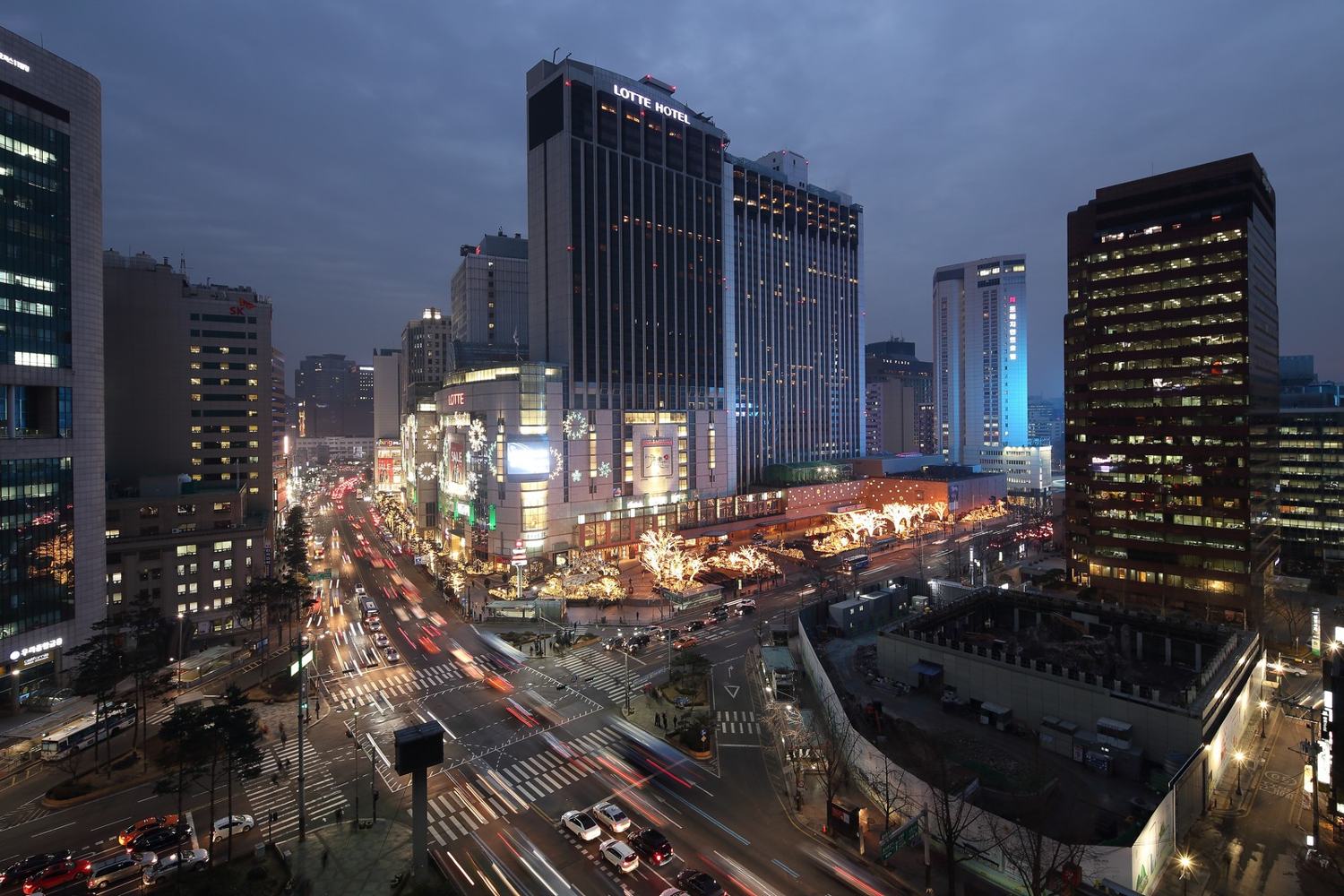
Sogong-dong, the five-star block: Lotte Hotel Seoul and the department store at Euljiro 1-ga, with the Westin Josun and the Plaza a street away. Photo: Seoul Institute, Wikimedia Commons, CC BY 4.0 (2015).
The other half of the mechanism is who is in the rooms. Myeongdong's hotels report foreign guests at 80 percent (Westin Josun), over 90 percent (L7 Myeongdong) and 94 percent (Four Points Myeongdong) in 2026, and Korea Hotel Association returns show one Myeongdong three-star at 87.4 percent in 2025 and 88 percent in the first half of 2026, with one four-star going from 65.9 to 78.1 percent. Foreign demand has proved almost indifferent to price: two of them raised rates 6.5 and 11.6 percent between the first five months of 2025 and 2026 and occupancy went up, not down. The industry consensus quoted in the trade press is that rates rise again.
Month by month: what the data says, and what it only implies
Two honesty notes. First, Korea does not publish a public month-by-month rate series; the monthly figures below are the STR numbers that Korean business papers print, the Yanolja Research quarterly reports, and the association's occupancy returns. Where a month has a measured figure it says so; where it has only a driver (a festival, a holiday, a concert) it is marked as a pattern. Second, the year-on-year changes are what the industry publishes; the absolute rates are Seoul's ₩207,000 revenue per room and the ₩247,000 to ₩296,000 Seoul-and-Incheon average daily rate in the two months STR was quoted, scaled by those changes.
| Month | Price level | What drives it | Evidence |
|---|---|---|---|
| January | Lowest of the year after the New Year weekend | Cold, short days; Seoul Winter Festa runs to 31 January 2027 but does not fill hotels | Pattern; nationally, Q1 2025 lodging occupancy fell 11.2 percent year on year (Yanolja Research), a post-December-2024 slump rather than a seasonal measure |
| February | Low, with a Seollal bump | Lunar New Year (7 February 2027) fills Korean-family demand for three days, then empties the city | Pattern |
| March | Rising; can spike without warning | Spring break from Japan and Southeast Asia; in 2026 the BTS comeback show at Gwanghwamun on 21 March took a ₩320,000 Koreana room to ₩1,350,000 | Measured: BTS-week rates (Hankyung, January 2026); Westin Josun and L7 above 85 percent occupancy in March–April |
| April | High, first peak | Cherry blossom (Yeouido 3–7 April in 2026), Seoul Spring Festival, the start of the tour-group season | Measured: Myeongdong hotels above 85 percent occupancy in April 2025; pattern for rates |
| May | High, softening late | Children's Day and Buddha's Birthday holidays, tea and food festivals; Koreans travel domestically | Pattern; Q2 2025 major-hotel occupancy above 85 percent (Mastern Insights) |
| June | Shoulder, good value | Monsoon begins late June; few holidays; local election in 2026 moved festivals | Pattern; Hotels.com's 2025 index put a central Seoul five-star at ₩460,000 (at 16 June 2025 exchange rates), so "good value" is relative |
| July | Low first half, rising in the last week | Rain; Korean summer holiday starts around 25 July and pushes domestic demand into coastal resorts more than Seoul | Pattern; Hotels.com advises early July as the cheap window |
| August | Firm, then a dip after the 20th | Peak inbound month; Koreans return from holiday after mid-August and city rates ease | Measured: Seoul and Incheon ADR ₩247,000 in August 2025, +5.5 percent (STR/CoStar) |
| September | High | Autumn Festa opens, Chuseok (25 September in 2026) and the fireworks weekend; Seoul inspects hotels for price-gouging around the fireworks | Measured: Seoul and Incheon ₩296,000 in September 2025 (provisional), +14.6 percent, occupancy 81.6 percent (STR/CoStar) |
| October | Highest of the year, first half | Foliage, the densest festival weeks, conferences | Pattern; nationally Q4 2025 five-star occupancy +28.6 percent and ADR +6.4 percent, partly a rebound from a weak Q4 2024 (Yanolja Research) |
| November | Falling from the October peak | Foliage in the palaces, then cold; K-pop award season fills weekends | Pattern; part of the strong Q4 2025 |
| December | Rising to a Christmas and New Year's Eve peak | Seoul Winter Festa from 14 December, Christmas as a couples' night, the 31st stronger than the 25th | Pattern; five-star packages on 24 and 31 December from about ₩260,000 to ₩430,000 |
Read as three seasons, which is how the hotels price: peak is the first half of October, cherry-blossom April, Christmas week and any weekend with a stadium-scale concert; shoulder is May, June, September outside Chuseok and November; low is January, February outside Seollal, the monsoon weeks of late June and July, and the last ten days of August. The gap between low and peak at the same hotel is routinely 1.5 to 2 times, and at a concert weekend 3 to 4 times. Our festival calendar and Winter Festa guide carry the dates that create the peaks.
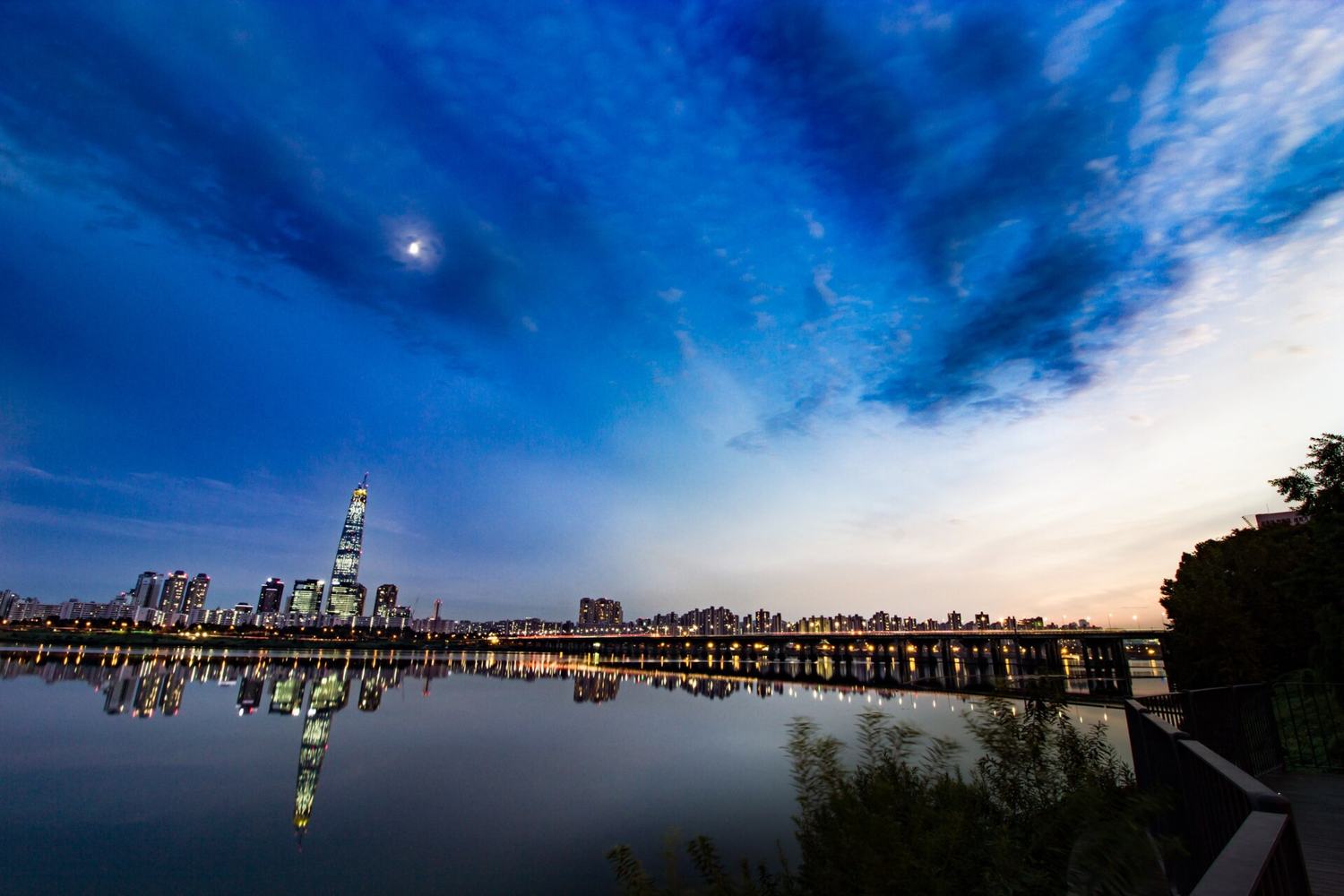
Lotte World Tower, Jamsil. Signiel Seoul occupies floors 76 to 101 and sells from about ₩800,000 on a weekday and ₩1,000,000 at weekends, the top of the Seoul market. The photo is from 2015, two years before the tower opened. Photo: Jongjin Lee, Wikimedia Commons, CC BY 3.0.
The weekend, and the night a K-pop group plays
Two smaller cycles sit inside the monthly one. Friday and Saturday nights usually cost more than weeknights at the same hotel, because domestic "hocance" (hotel-vacation) demand is a weekend habit. A Sunday-to-Thursday stay in Seoul is the single cheapest calendar choice you can make.
The other cycle is events, and Seoul's is now the most extreme in Asia. When BTS announced a free comeback show for Gwanghwamun Square on 21 March 2026, the rate card for that Saturday became a news story: Lotte Hotel ₩540,000 to ₩960,000, Shilla Stay Gwanghwamun ₩270,000 to ₩620,000, Hotel Thomas Myeongdong ₩310,000 to ₩1,090,000, Koreana ₩320,000 to ₩1,350,000, the Plaza's ₩2,230,000 suites sold out, and a Jongno motel went from ₩140,000 to ₩500,000. Booking.com put Gwanghwamun-area rates at about three times the February level, and the foreign visitors who came for it stayed 8.7 days and spent ₩3.53 million each against the quarter's average of 6.1 days and ₩2.45 million. The pattern repeats at a smaller scale for every stadium concert (Seventeen, Stray Kids and Blackpink weekends move Jamsil and Gocheok hotels) and for the Seoul fireworks night, which is why the city now inspects Yeouido-area hotels for price-gouging before it. If your dates are fixed by a concert, book the hotel the day the concert is announced, not the day tickets go on sale.
Neighbourhood by neighbourhood
| Area | Rate band (three- to four-star, ordinary week) | Who stays, and why |
|---|---|---|
| Myeongdong / Euljiro / Namdaemun | ₩150,000–₩300,000 | Foreign guests 78–94 percent; walking distance to shopping, Line 4 and the airport bus; highest occupancy in Seoul, so book earliest |
| Gwanghwamun / Jongno / Insadong | ₩150,000–₩280,000; Four Seasons ₩900,000+ | Palaces, Bukchon, Cheonggyecheon; quieter at night; the BTS-square premium in March 2026 |
| Hongdae / Sinchon / Mapo | ₩90,000–₩200,000 | Direct AREX from the airport, nightlife, younger travellers; hotel occupancy 87 percent in 2025 with 90 percent forecast for 2026 |
| Dongdaemun | ₩80,000–₩180,000 | Business hotels (Toyoko Inn, Ibis), night markets, DDP; cheapest three-star band in the centre; our [Namdaemun vs Dongdaemun guide](/blog/175) covers the area |
| Gangnam / Samseong / Yeoksam | ₩180,000–₩350,000; Josun Palace ₩600,000+ | Business travel, K-pop agencies, COEX; revenue per room up 11.8 percent in 2025; weekends cheaper than weekdays here, the reverse of the centre |
| Jamsil | ₩150,000–₩300,000; Signiel ₩800,000+ | Lotte World, the tower, stadium concerts at the Olympic complex |
| Itaewon / Yongsan | ₩150,000–₩350,000 (Grand Hyatt from ₩350,000) | Hillside five-stars with views, Yongsan Station for KTX, a long walk to the subway |
| Incheon Airport | ₩100,000–₩250,000 | Only for late arrivals and early departures; our [layover guide](/blog/257) covers the transit hotels and the capsule rooms |
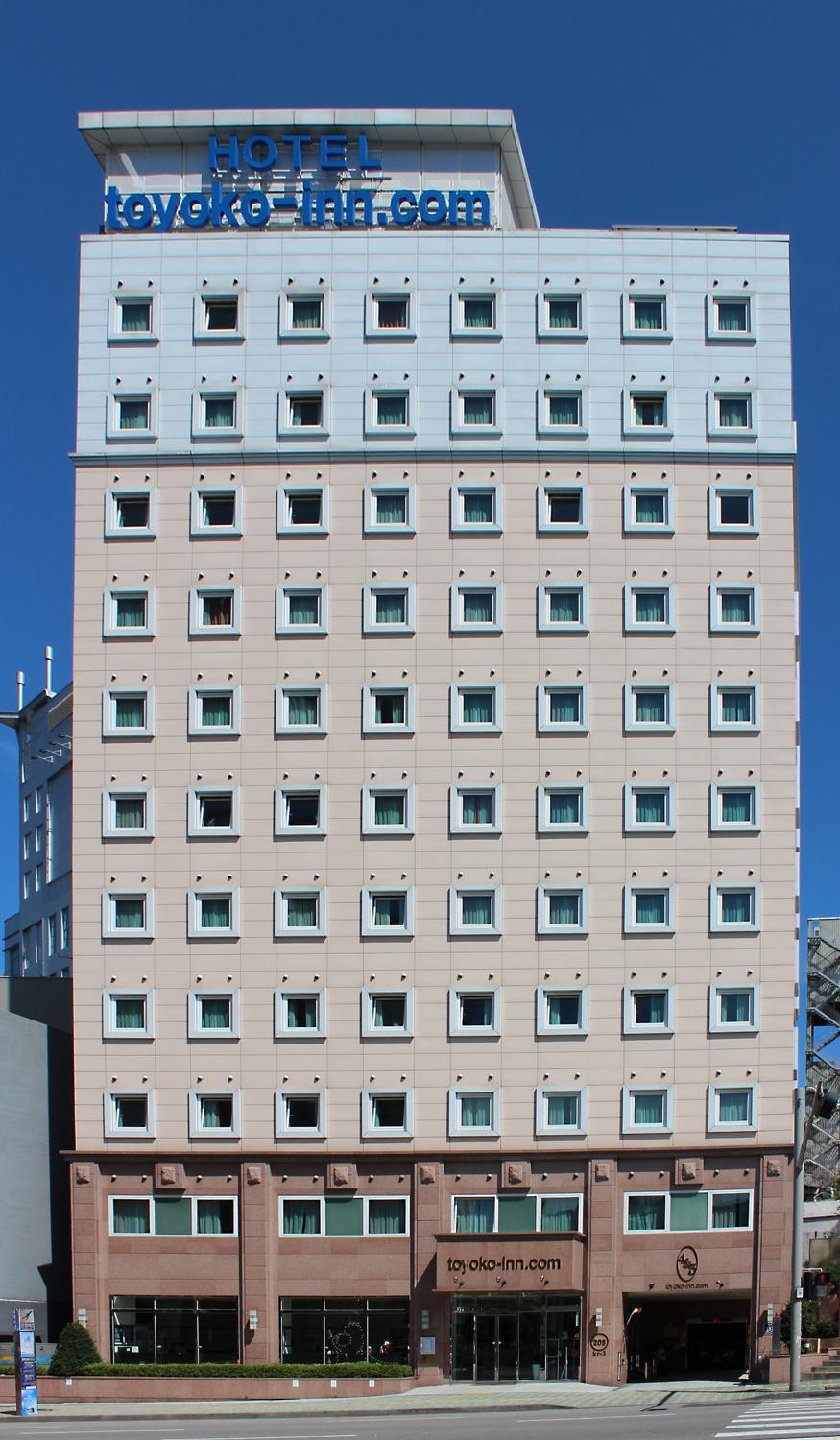
Toyoko Inn Seoul Dongdaemun: the Japanese business-hotel chain's Seoul branches are the reliable floor of the three-star market, with small rooms, a free breakfast and rates that start under ₩100,000 in the low season. Photo: Rsa, Wikimedia Commons, CC BY-SA 3.0 (2017).
What is in the price, and what is not
Tax. Korean hotel rates on Korean sites are usually shown including 10 percent VAT; international booking sites often show the net rate and add VAT and, at five-stars, a 10 percent service charge at the last step. A ₩300,000 five-star headline rate is ₩363,000 at checkout. Foreign tourists can still reclaim VAT on stays of 30 nights or fewer at participating tourist hotels. The law runs the scheme to 31 December 2028; the government's August 2026 tax proposal would end it on 30 June 2027 if the National Assembly passes it, so ask at check-in rather than assume. Our tax-refund guide has the current rule.
Breakfast. Rarely included above three stars; ₩30,000 to ₩60,000 per person at a five-star buffet, which is why Koreans walk to a bakery or a 24-hour gukbap shop instead (our breakfast guide covers what Koreans eat in the morning).
Amenities. Since 29 March 2024, hotels with 50 or more rooms may not give away disposable toothbrushes, toothpaste, razors, shampoo or conditioner; the legal ceiling on the fine is ₩3 million. Most now sell a kit at reception for ₩2,000 to ₩5,000, or provide refillable dispensers in the shower. Bring your own toothbrush.
Room size. Korean three-star rooms are small, often 15 to 18 square metres with a double bed and no wardrobe; four-star rooms are 24 to 30. The "family room" that sleeps four is usually two doubles in 30 square metres. Children under a stated age, usually 6 or 12, share free; a third adult pays ₩30,000 to ₩60,000.
Deposits and check-in. Check-in 15:00, check-out 11:00 almost everywhere; early check-in is sold, not given, at busy hotels. A credit-card hold of one night is normal; the passport is scanned at check-in under the immigration rules for foreign guests.
How to pay less for the same room
- Move the dates before the hotel. The same Myeongdong four-star is ₩180,000 on a Tuesday in early July and ₩320,000 on a Saturday in early October. Our festival calendar shows which weeks are peaks.
- Book the weekday, not the weekend. Sunday to Thursday is the cheapest run in the centre; in Gangnam it is the reverse, so a Gangnam weekend is the best five-star value in the city.
- Stay one stop out. Hongdae, Dongdaemun and Yongsan are 10 to 15 minutes from Myeongdong on the subway and ₩50,000 to ₩100,000 a night cheaper for the same grade; our first and last train guide shows how late the trains run.
- Book the concert weekend the day it is announced. The rate the hotel publishes that morning is the last sane one.
- Compare a live week on one screen rather than trusting an "average" figure: Seoul hotels on Agoda with your dates entered will show you the season faster than any table. EpicKor may earn a commission on qualifying bookings, at no cost to you.
- Do not book the airport hotel unless you will clear arrivals after about 23:30. The last all-stop train leaves Terminal 1 at 23:40 and reaches Seoul Station in about an hour, and the city is cheaper; our airport guide has the options.
FAQ
Q: How much does a hotel in Seoul cost per night? Roughly ₩90,000–₩160,000 for a three-star business hotel, ₩180,000–₩300,000 for a four-star and ₩350,000–₩600,000 for a five-star on an ordinary week, with the top hotels above ₩800,000. Seoul's 2025 revenue per available room, the industry's average across all rooms and nights, was ₩207,345.
Q: What is the cheapest month for hotels in Seoul? January, and February outside the Lunar New Year days. Korea publishes no monthly rate series, but these are the hotels' low season; in early 2025, a weak year, occupancy across all Korean lodging fell 11.2 percent year on year (Yanolja Research). Early July and the last ten days of August are the cheap windows in summer.
Q: What is the most expensive month for hotels in Seoul? The first half of October, then cherry-blossom April and Christmas week. Seoul and Incheon hotels' provisional September 2025 rate was ₩296,000, up 14.6 percent on the year.
Q: Why are Seoul hotels so expensive now? Visitors reached a record 18.9 million in 2025 while Seoul added only about 1,000 rooms a year to a stock of 53,700. Seoul four-star rates rose about 92 percent between 2017 and 2024 and Seoul's average rate rose 38.6 percent from 2022 to 2024. Occupancy is 79 percent and 71 percent of guests are foreign, so hotels keep raising rates.
Q: Where is the cheapest area to stay in Seoul? Dongdaemun and Hongdae for three-star and business hotels, typically ₩80,000–₩200,000, both 10–15 minutes by subway from Myeongdong. Myeongdong itself has the highest occupancy in the city and the fewest cheap rooms.
Q: Do Seoul hotels include tax and breakfast? Korean sites usually show rates with 10 percent VAT; international sites often add VAT and a 10 percent five-star service charge at checkout. Breakfast is rarely included above three stars and costs ₩30,000–₩60,000 at a five-star buffet.
Sources
- Ministry of Culture, Sports and Tourism, 2025 tourism lodging statistics (31 December 2025): 2,996 businesses, 226,840 rooms; 74 five-star hotels; Seoul 62,057 rooms.
- Cushman & Wakefield Korea, 2026 Seoul Hospitality Report (via Newswire, Hankyung, August 2026): 2025 occupancy 79.2 percent, foreign share 71.2 percent, RevPAR ₩207,345, supply 53,675 rooms, +1,000 a year, transactions ₩2.1 trillion.
- Korea Hotel Association operating returns via Financial News (19 July 2026): Myeongdong hotel occupancy and foreign-guest shares 2024–2026 at named hotels, ADR changes January–May 2026.
- STR/CoStar data via Hankyung (17 October 2025): Seoul and Incheon ADR ₩247,000 (August 2025) and ₩296,000 (September 2025, provisional), occupancy.
- Yanolja Research quarterly reports (Q1 2025, Q4 2025, national figures) and Hotel & Restaurant magazine (19 February 2026): Seoul ADR 2022–2024, grade-level ADR.
- Hotels.com Hotel Price Index via Segye Ilbo (3 July 2025): five-star averages, Seoul ₩460,000.
- Hankyung (28 January 2026), Financial News (8 February 2026) and Herald Business (29 April 2026): BTS Gwanghwamun show hotel rates and foreign visitors' stay and spending.
- Samsung Securities hotel-sector report (April 2026): Hongdae and Gangnam occupancy and RevPAR.
- Korea.kr and easylaw.go.kr: disposable-amenity ban (toothbrush, toothpaste, shampoo, conditioner, razor) for hotels with 50+ rooms from 29 March 2024. Newspim (7 August 2026): hotel VAT refund law to 31 December 2028 and the proposal to end it on 30 June 2027.
You Might Also Like
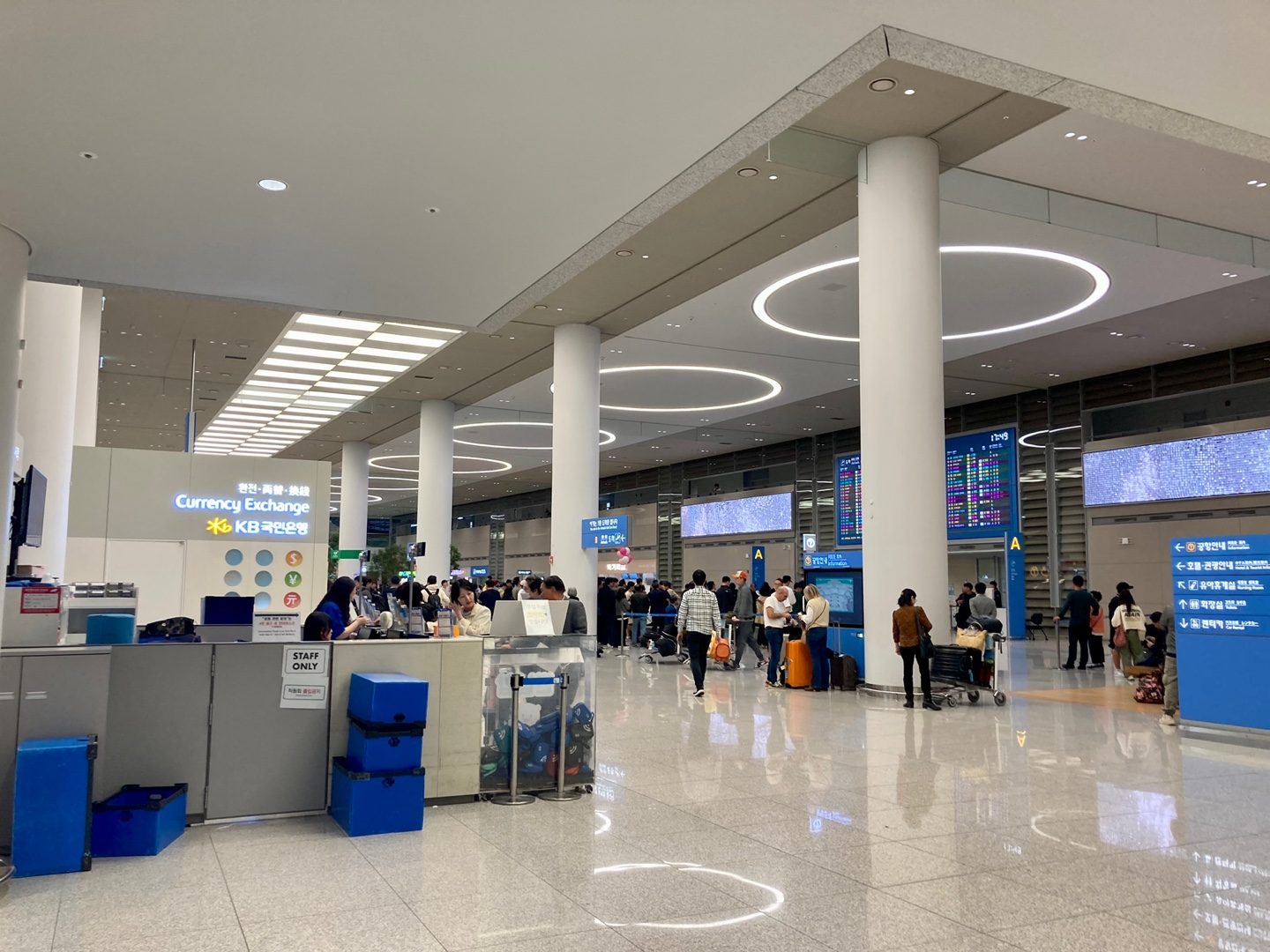
Incheon Airport Money Exchange in Korea: The Banks' Own Disclosure Says 4.20% at the Airport vs 1.75% in Town — ₩16,470 on Every $500
Korea's bank federation publishes it: Incheon Airport counters take 4.20% on US dollars and 7% when you sell yen, against 1.75% at city branches. At 11 September rates that is ₩16,470 on $500. Which counters open 24 hours, and the 40% discount sign.
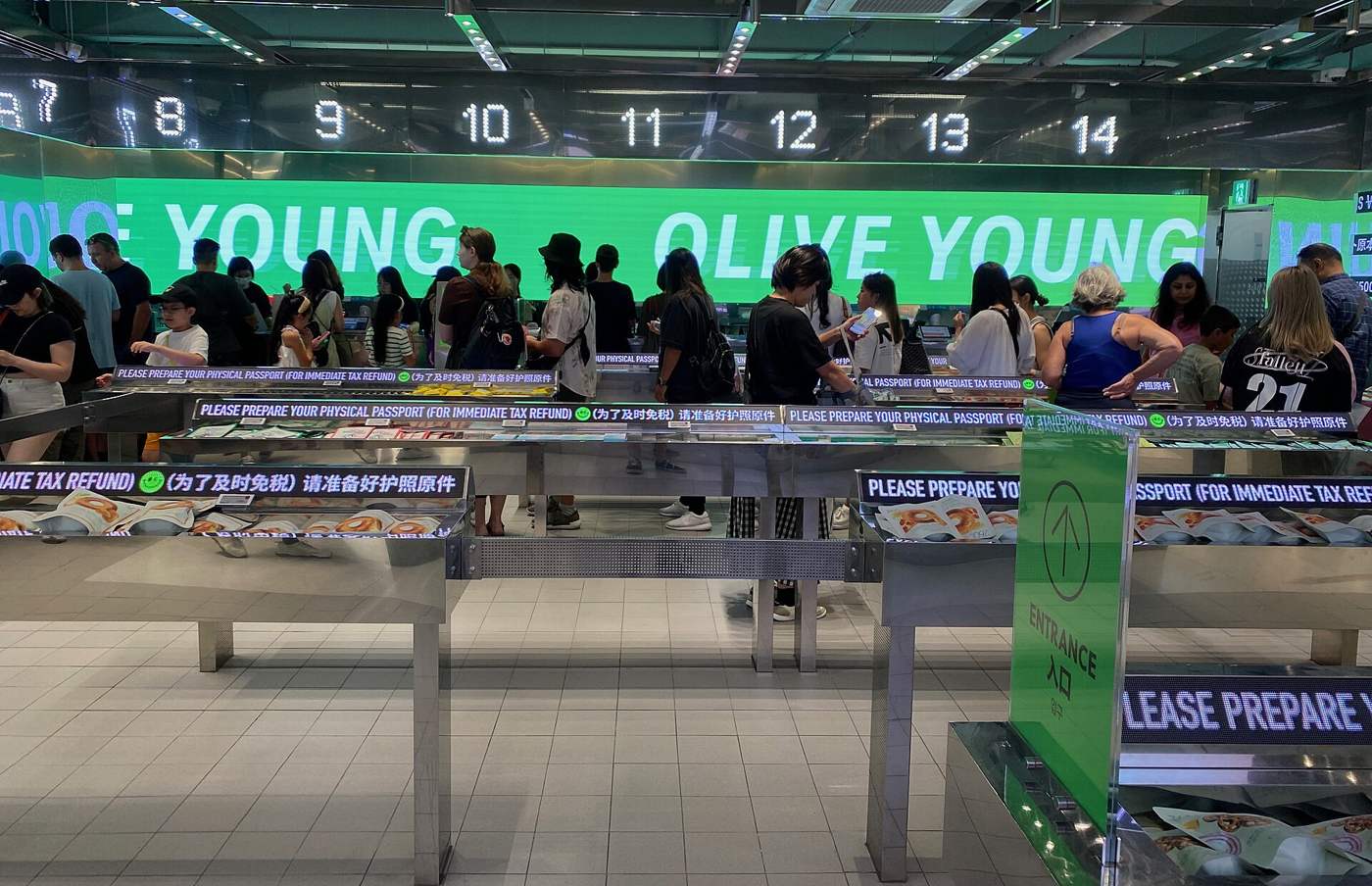
Where Foreign Cards Actually Get Swiped in Korea: Seoul Takes 65%, Dermatology Takes 40% of Service Spending, the Top 1% of Shops Take 67%, and ₩166,000 Per Foreign Service Payment
Korean card-terminal data on where visitors actually spend: 65% in Seoul, Seoul's tourist zones 14.6% foreign vs 1.3% in ordinary alleys, dermatology 40% of service spending, the top 1% of shops taking two-thirds. Busan and Jeju rising fastest.
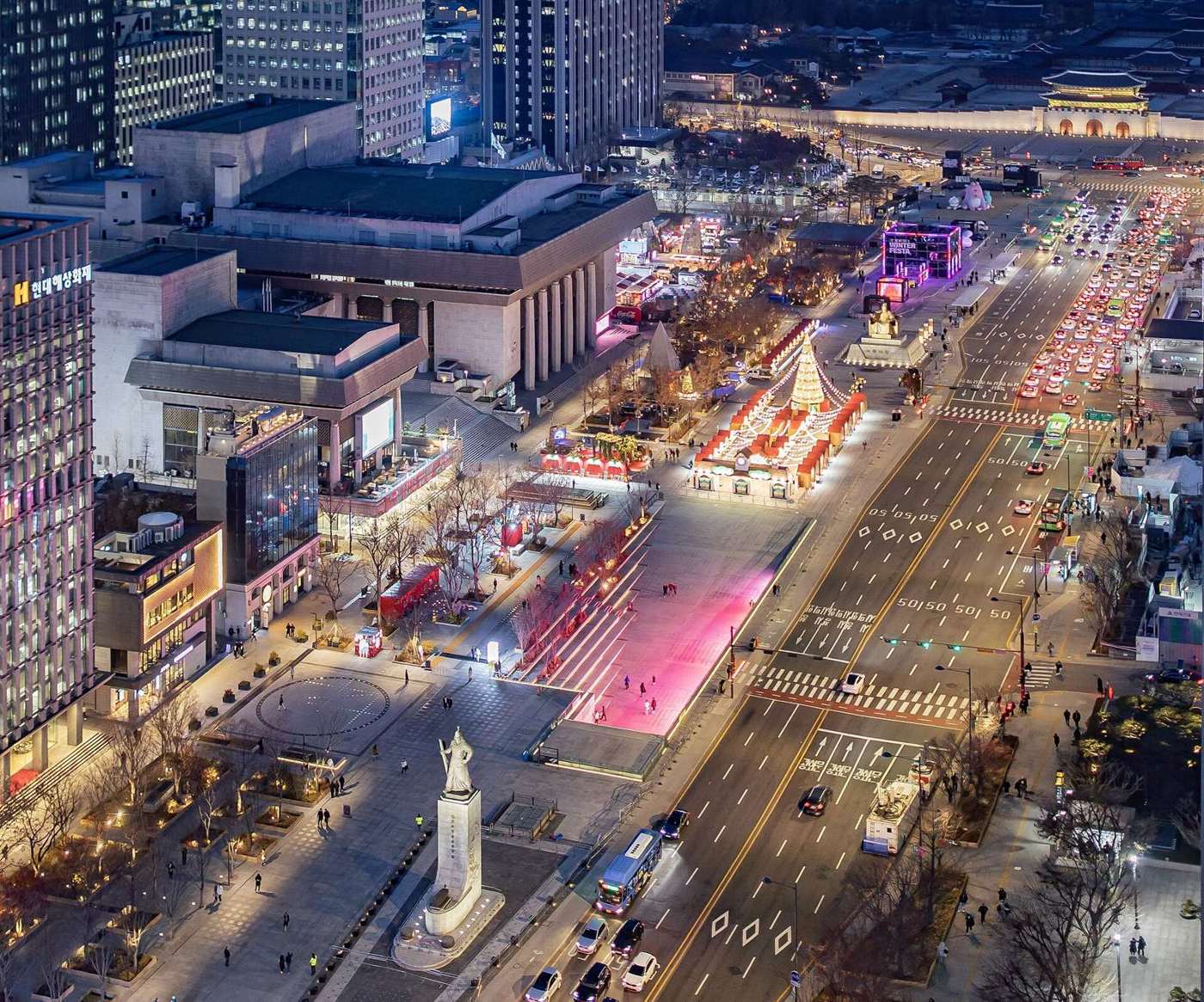
Seoul Winter Festa 2026 Dates Confirmed (14 December 2026 to 31 January 2027): Seoul Lantern Festival on Cheonggyecheon, Gwanghwamun Christmas Market Hours, the ₩1,000 Seoul Plaza Skating Rink, and New Year's Eve at Bosingak
Seoul's official calendar fixes Winter Festa 2026 at 14 December to 31 January, twice last year's run. What 2025 actually ran: lantern hours on Cheonggyecheon, the free Gwanghwamun market, the ₩1,000 skating rink, and the subway to 2 a.m. on New Year's Eve.