Last Train in Seoul: When Trains Stop — 00:50 Weekdays, 23:50 Weekends
Last updated: 18 October 2026 (every Line 1 to 9 last train re-read from Seoul Metro's station data, refreshed 17 October 2026)
Short answer: when is the last train in Seoul? As of October 2026, the Seoul subway stops running at about 01:00 at the ends of each line, so the last train passes the central stations visitors use between about 00:40 and 00:58 on weekdays (Monday to Friday) and between 23:44 and 23:59 on Saturdays, Sundays and public holidays. Line by line: Line 2 last trains leave Gangnam at 00:46 and 00:54, Line 4 leaves Myeongdong at 00:50 and 00:57, Line 6 leaves Itaewon at 00:48, and the Airport Railroad's last all-stop train leaves Incheon Airport Terminal 1 at 23:38 every day. Most last trains are short-turns that end a few stations on, so the last one that reaches your stop is often 10 to 30 minutes earlier. First trains run from about 05:30.
| Line (station checked) | Weekday last train (Mon to Fri) | Weekend and holiday last train |
|---|---|---|
| Line 1 (Seoul Station) | 00:48 north, 00:12 south | 00:00 north, 00:07 south |
| Line 2 (Gangnam, Hongdae, City Hall, Jamsil, DDP) | 00:46 to 00:58 | 23:45 to 23:58 |
| Line 3 (Express Bus Terminal) | 00:49 and 00:53 | 23:53 and 23:54 |
| Line 4 (Seoul Station, Myeongdong) | 00:42 to 00:57 | 23:44 to 23:57 |
| Line 5 (Gimpo Airport, toward the city) | 00:41 | 23:37 |
| Line 6 (Itaewon) | 00:48 both ways | 23:59 both ways |
| Line 7 (Express Bus Terminal) | 00:39 and 00:42 | 23:57 both ways |
| Line 9 (Express Bus Terminal, Gimpo Airport) | 00:48 to 00:54 | 23:48 to 23:55 |
| Sinbundang (Gangnam, south) | 00:26 | 23:54 |
| Airport Railroad (Incheon T1 to Seoul Station) | 23:38 all-stop; express 22:48 | 23:38 all-stop; express 22:48 |
| Last train that actually reaches your stop | Often 00:15 to 00:40 | Often 23:05 to 23:40 |
| Missed it? | 14 owl bus routes (N13 to N75), 23:00 to 06:00, ₩2,500 by card; taxis +20% from 22:00, +40% from 23:00 to 02:00 | |
Every English guide says "about 05:30 to midnight," which is true of the network and wrong about your station. The last Line 2 train through Gangnam on a weekday leaves at 00:54 and it does not go around the loop; it stops three stations later at Samseong. The last train from Hongdae toward the city on a Saturday leaves at 23:49 and goes only as far as Euljiro 1-ga. The last Airport Railroad train that will actually get you from Terminal 1 to Seoul Station leaves at 23:38, and the express that costs ₩13,000 stops 50 minutes before that. The Gangnam time is a weekday one; on Saturdays, Sundays and holidays the subway's last trains run roughly an hour earlier, while the airport line's cutoffs are the same every day.
This post is the table the guides do not have. The times below are the scheduled first and last departures at the stations visitors actually use, taken from Seoul Metro's station data (re-read on 18 October 2026 against the 17 October refresh), split by weekday and weekend and by direction, with the destination of the last train, because the destination is the part that strands people. Then the airport line, Busan, and the honest options after the doors close: the N-numbered owl buses, the taxi surcharge that peaks at 40 percent from 23:00 to 02:00, and the ₩12,000 bathhouse.
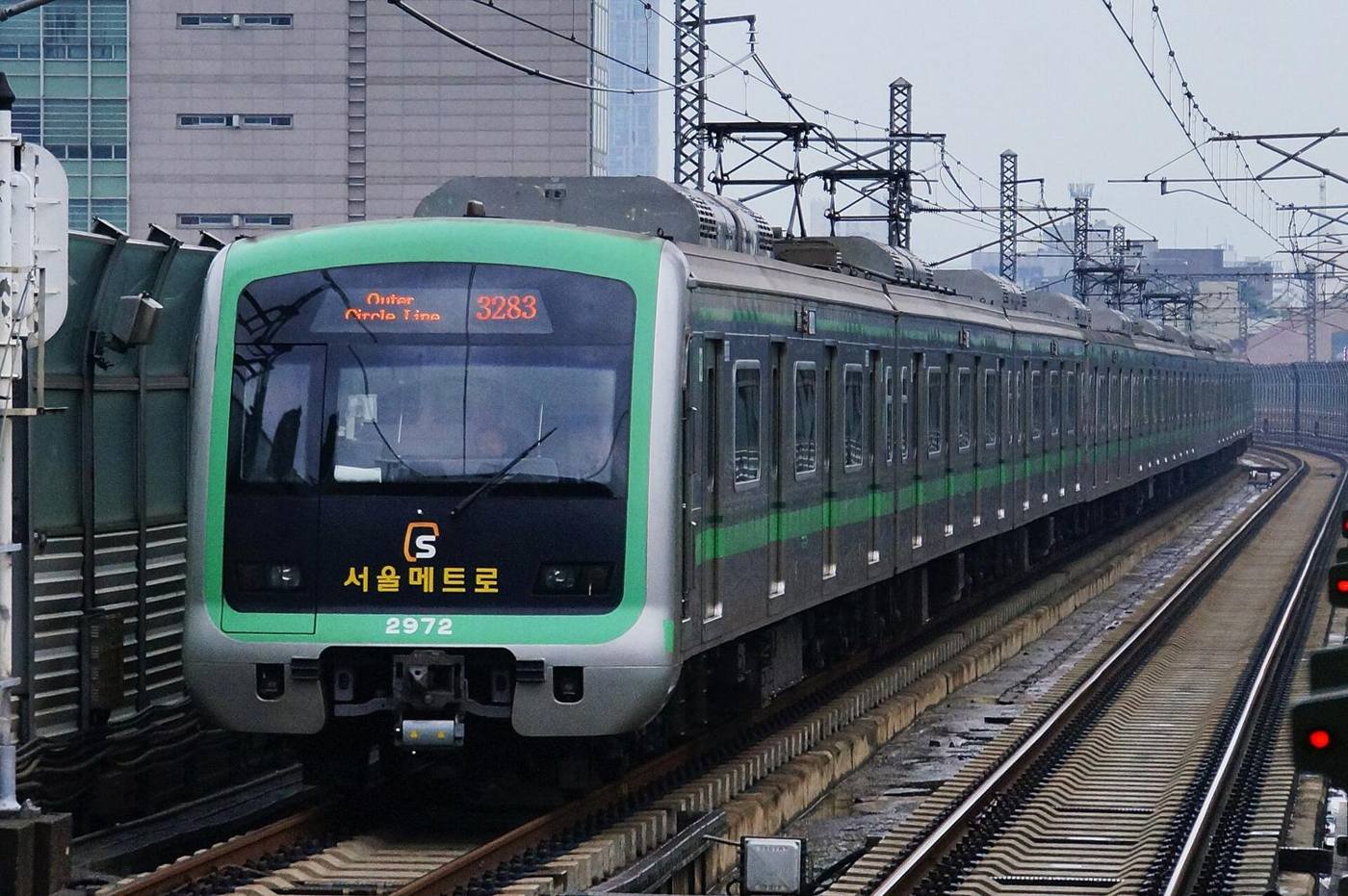
A Line 2 train on the outer circle. In the last hour of service these trains stop circling and end at Seongsu, Samseong, Sindorim or Euljiro 1-ga, which is what makes the last train from Gangnam a three-stop shuttle. Photo: Mtattrain, Wikimedia Commons, CC BY-SA 4.0.
The last train is a phone problem: since March 2026 tourists can carry T-money in Apple Wallet, which means a dead phone at 00:40 is a dead ticket and no Naver Map. An Anker 10,000mAh power bank is the one thing this post can sell you with a straight face. As an Amazon Associate, EpicKor earns from qualifying purchases.
Quick Guide: the last train, where you actually are
All times are scheduled departures from that station. Weekday means Monday to Friday; Friday has no late service. Weekend means Saturday, Sunday and public holidays, which run the shorter timetable.
South Korea eSIM, 5GB for 15 days — the last-train time lives in Naver Map, and Naver Map needs data Every time in this post changes on holidays and after incidents; Naver Map shows the live last train and the night-bus arrival for the station you are standing in, but only with a connection. Install the eSIM before you land so the 00:40 check is not on hotel Wi-Fi three stations away. As an Amazon Associate, EpicKor earns from qualifying purchases.
See the Korea eSIM on Amazon| Station (line) | Direction | Weekday last train | Weekend last train | Where that last train ends |
|---|---|---|---|---|
| Gangnam (2) | Inner loop (toward Sadang, Sindorim, Hongdae) | 00:46 | 23:45 | Seoul Nat'l Univ.; the last one that reaches Hongik University leaves 00:21 (weekend 23:24) |
| Gangnam (2) | Outer loop (toward Samseong, Jamsil) | 00:54 | 23:55 | Samseong, three stations on; last to go further (to Seongsu) 00:38 (weekend 23:38) |
| Hongik University (2) | Inner loop (toward Sinchon, City Hall) | 00:49 | 23:49 | Euljiro 1-ga; last to Seongsu 00:33 (weekend 23:33) |
| Hongik University (2) | Outer loop (toward Hapjeong, Sindorim, Gangnam) | 00:50 | 23:51 | Sindorim; the last one that reaches Gangnam leaves 00:15 (weekend 23:16) |
| City Hall (2) | Inner loop (toward Euljiro) | 00:58 | 23:58 | Euljiro 1-ga, one stop; last to Seongsu 00:42 (weekend 23:43) |
| City Hall (2) | Outer loop (toward Sinchon) | 00:51 | 23:51 | Hongik University; last to Sindorim 00:40 (weekend 23:41) |
| Jamsil (2) | Inner loop (toward Gangnam) | 00:54 | 23:54 | Samseong, three stations on; last to go past Gangnam 00:34 (weekend 23:33) |
| Jamsil (2) | Outer loop (toward Seongsu) | 00:50 | 23:50 | Seongsu |
| Dongdaemun History & Culture Park (2) | Inner loop (toward Seongsu) | 00:50 | 23:50 | Seongsu |
| Seoul Station (1) | North (City Hall, Jongno, Cheongnyangni) | 00:48 | 00:00 | Weekdays a short run to Dongmyo; the last to Cheongnyangni or beyond leaves around 00:10. Weekends to Gwangwoon Univ. |
| Seoul Station (1) | South (Guro, Incheon) | 00:12 | 00:07 | Guro |
| Seoul Station (4) | North (Myeongdong, Hansung Univ.) | 00:47 | 23:44 | Hansung University; last to Bulamsan 00:28 (weekend: to Nowon 23:28) |
| Seoul Station (4) | South (Sadang) | 00:42 | 23:44 | Sadang on weekdays, Sanbon on weekends |
| Myeongdong (4) | North (Dongdaemun, Hansung Univ.) | 00:50 | 23:48 | Hansung University |
| Myeongdong (4) | South (Seoul Station, Sadang) | 00:57 | 23:57 | Seoul Station, two stops; last to Sadang 00:38 (weekend: 23:29 to Sadang, 23:40 to Sanbon) |
| Itaewon (6) | West (Samgakji, Gongdeok) | 00:48 | 23:59 | Gongdeok |
| Itaewon (6) | East (Hangangjin) | 00:48 | 23:59 | Hangangjin, one stop; last to go further 00:30 (weekend 23:48 to Anam) |
| Express Bus Terminal (3) | Toward Ogeum | 00:49 | 23:53 | Dogok; the last train that reaches Ogeum itself leaves 00:22 on weekdays, 23:34 on weekends |
| Express Bus Terminal (7) | Toward Cheongdam | 00:42 | 23:57 | Konkuk University on weekdays, Cheongdam on weekends |
| Express Bus Terminal (9) | Toward Yeouido, Gimpo Airport | 00:53 | 23:55 | Dongjak; the last train that reaches Gimpo Airport leaves 00:36 on weekdays, 23:35 on weekends |
| Gimpo Airport (5) | Toward downtown | 00:41 | 23:37 | Hwagok, five stops; the last train into the city (to Aeogae) leaves 00:19 (weekend 23:24) |
| Gimpo Airport (9) | Toward Yeouido, Gangnam | 00:48 | 23:48 | Gayang; the last train that reaches Sinnonhyeon (Gangnam) leaves 00:09 (weekend 23:06) |
| Gangnam (Sinbundang) | South (Pangyo, Gwanggyo) | 00:26 | 23:54 | Jeongja; the last train to Gwanggyo leaves 00:02 (weekend 23:30) |
Read the last column before the third. A 00:54 train from Gangnam exists, and it is useless if you live past Samseong. Seoul Metro's last trains of the night are almost all short-turns that finish at a turn-back siding, so the practical last train to a given destination is usually ten to thirty minutes before the number on the wall.
You might like: Getting Around Korea in 2026: Subway Fares, Last Trains, KTX Booking, Bus Prices and Which App to Use
Is the Seoul subway 24 hours? No, and here is the shape of the night
Seoul's subway runs from about 05:30 to about 01:00 on weekdays, measured at the terminals. That is the one-line answer to "what time do trains stop running in Seoul." Trains leave the ends of each line at roughly 05:30 and the last ones leave the ends around 00:30 to 01:00, which is why a central station sees its last train in the 00:40s and an outer station sees it before midnight. On Saturdays, Sundays and public holidays the last trains run about an hour earlier: central stations lose their trains between 23:44 and 23:59. Friday night is a weekday night.
It was not always this tight. From April 2020 the operator pulled weekday last trains back to midnight for pandemic cleaning, and only restored the 01:00 timetable line by line between May and August 2022. In May 2025 the city announced first trains would move to 05:00 from that August, with last trains 30 minutes earlier to protect maintenance time; as of October 2026 the timetables have not moved: Seoul Metro's own last-train data, refreshed on 17 October 2026, still shows 00:46 to 00:58 departures at central Line 2 stations, which is the 01:00 timetable, not the 00:30 one. The union opposed the change and no start date has been announced. The one night a year that runs later is New Year's Eve, when the city has in past years extended Seoul-section subway and bus service to about 02:00 for the Bosingak bell ringing and announced the times in late December; our Seoul Winter Festa guide covers that night. Check the operator's app in the week you travel, not a guide from last year, this one included.
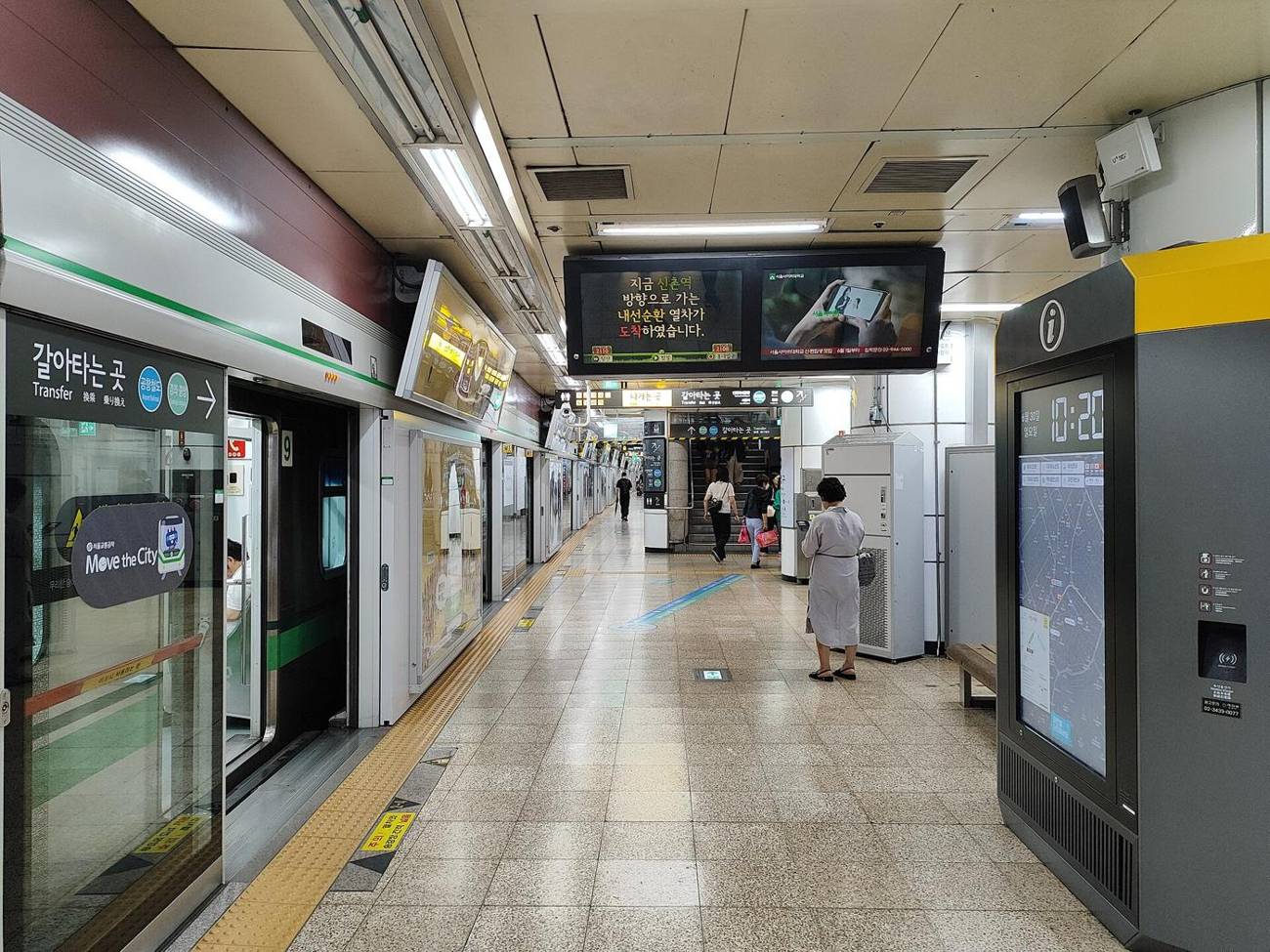
Hongik University, Line 2, with the transfer sign to the Airport Railroad. The overhead screen is announcing an inner-circle train toward Sinchon, the direction whose last train stops at Euljiro 1-ga. Photo: ZKang123, Wikimedia Commons, CC BY-SA 4.0 (2024).
Two Korean words are worth knowing: 첫차 (cheotcha, first train) and 막차 (makcha, last train). They head the timetables posted in stations, and Naver Map shows the same two numbers when you tap a station, under the timetable tab, together with the last train's destination. If Naver Map is new to you, our Naver Map and Kakao T setup guide covers the English mode and why Google Maps cannot route you here.
First trains, for the airport run
First trains matter for one reason: a morning flight. The first trains from central Seoul leave between about 05:20 and 05:50, and that is early enough for an 08:00 departure from Incheon only if you take the airport line directly.
| Station (line) | Weekday first train | Weekend first train |
|---|---|---|
| Seoul Station (1) both directions | 05:19 to 05:20 | 05:20 |
| Seoul Station (4) north / south | 05:30 / 05:47 | 05:30 / 05:50 |
| City Hall (2) inner / outer | 05:39 / 05:32 | same |
| Gangnam (2) inner / outer | 05:36 / 05:44 | 05:35 / 05:44 |
| Hongik University (2) both loops | 05:30 | 05:30 |
| Jamsil (2) inner / outer | 05:40 / 05:36 | 05:40 / 05:36 |
| Myeongdong (4) north / south | 05:33 / 05:43 | 05:33 / 05:47 |
| Itaewon (6) west / east | 05:38 / 05:41 | same |
| Express Bus Terminal (3 / 7 / 9) | 05:35 / 05:40 / 05:34 | 05:36 / 05:40 / 05:34 |
| Gimpo Airport (5 / 9 / AREX) | 05:34 / 05:30 / 05:42 | same |
| Gangnam (Sinbundang) south | 05:34 | 05:34 |
The Airport Railroad: two trains, two cutoffs
The Airport Railroad (AREX, 공항철도) runs two services on one track and they stop at different times. The express (직통열차) runs non-stop between Seoul Station and the two airport terminals for ₩13,000, 43 minutes to Terminal 1 and 51 to Terminal 2. The all-stop train (일반열차) stops at Gongdeok, Hongik University, Digital Media City, Gimpo Airport and the rest, costs about ₩4,750 (Terminal 1) to ₩5,350 (Terminal 2) with a T-money card from Seoul Station to the terminals, and takes about an hour.
| Journey | First | Last | Note |
|---|---|---|---|
| Seoul Station to airport, express | 06:00 | 22:50 | Weekday and weekend express timetables differ since 29 December 2025; seat reservation possible |
| Airport to Seoul Station, express | 05:15 from T2 | 22:40 from T2, 22:48 from T1 | Land after 22:00 and you will miss it |
| Seoul Station to airport, all-stop | 05:20 | 23:40 | A later train ends at Geomam, short of the airport |
| Terminal 1 to Seoul, all-stop | 05:14 | 23:38 | The real last train out of the airport |
| Hongik University to airport, all-stop | 05:28 | 23:48 to 00:08 | The 00:08 does not reach the terminals |
| Gimpo Airport toward Seoul, all-stop | 05:42 | 00:16 to 00:34 | Last full runs before 00:20 |
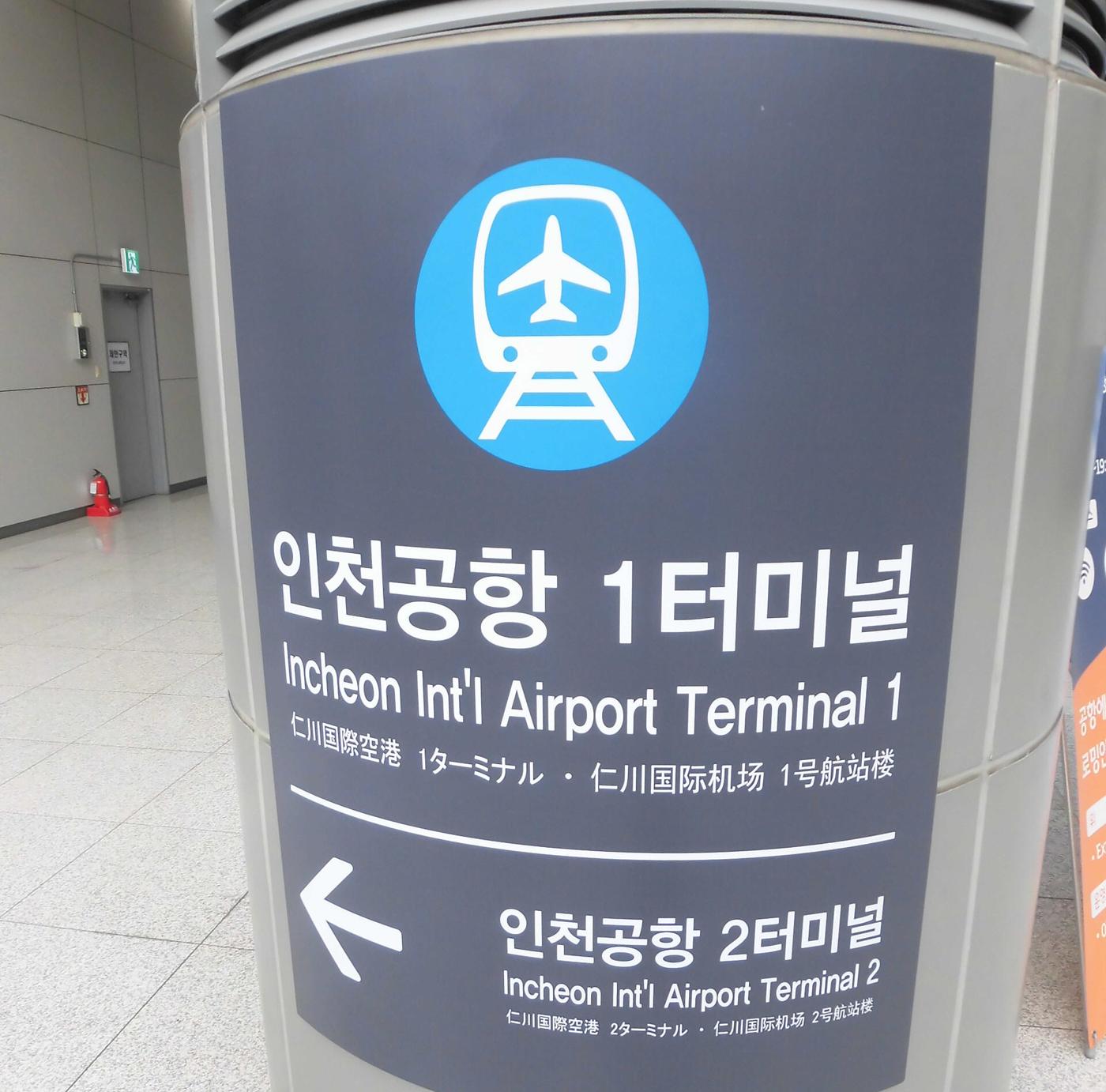
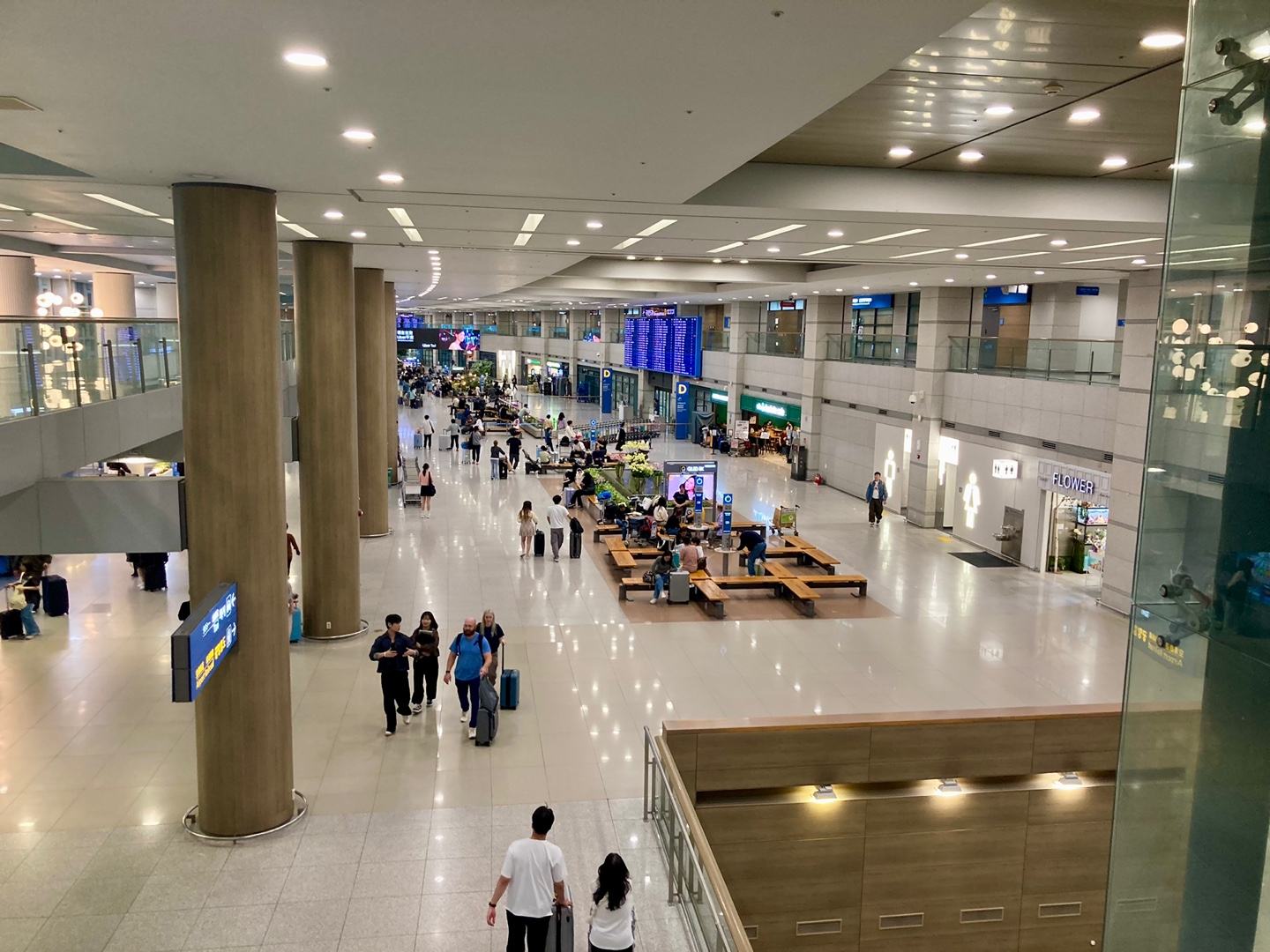
Terminal 1's Airport Railroad station. The express from here stops at 22:48; the all-stop train runs until 23:38. Photo: Hyolee2, Wikimedia Commons, CC BY-SA 4.0.
The 23:38 all-stop departure from Terminal 1 is the number to write down. Most long-haul arrivals land well before the railway closes, but the late bank from Southeast Asia and the delayed ones arrive after 23:00, and at that point the railway is closed and the choice is the airport night bus or a taxi.
Busan, since you will ask
Busan's metro keeps a similar shape with earlier last trains. At Busan Station on Line 1 the last trains leave at 23:49 northbound and 00:12 southbound (a short turn to Sinpyeong), and the first at 05:26 to 05:49. At Seomyeon, the city's central interchange, Line 1's last trains leave between 23:44 and 00:00 and Line 2's between 23:44 and 00:16, with first trains from 05:26. The corporation's website lists only weekday daytime departures, so confirm weekend and holiday times in the app. Daegu and Incheon's metros end in the same window. If you are going between the two cities rather than across one, the last KTX is a separate question: see our Seoul to Busan train and bus guide, which also covers the new two-month booking window from 1 October 2026.
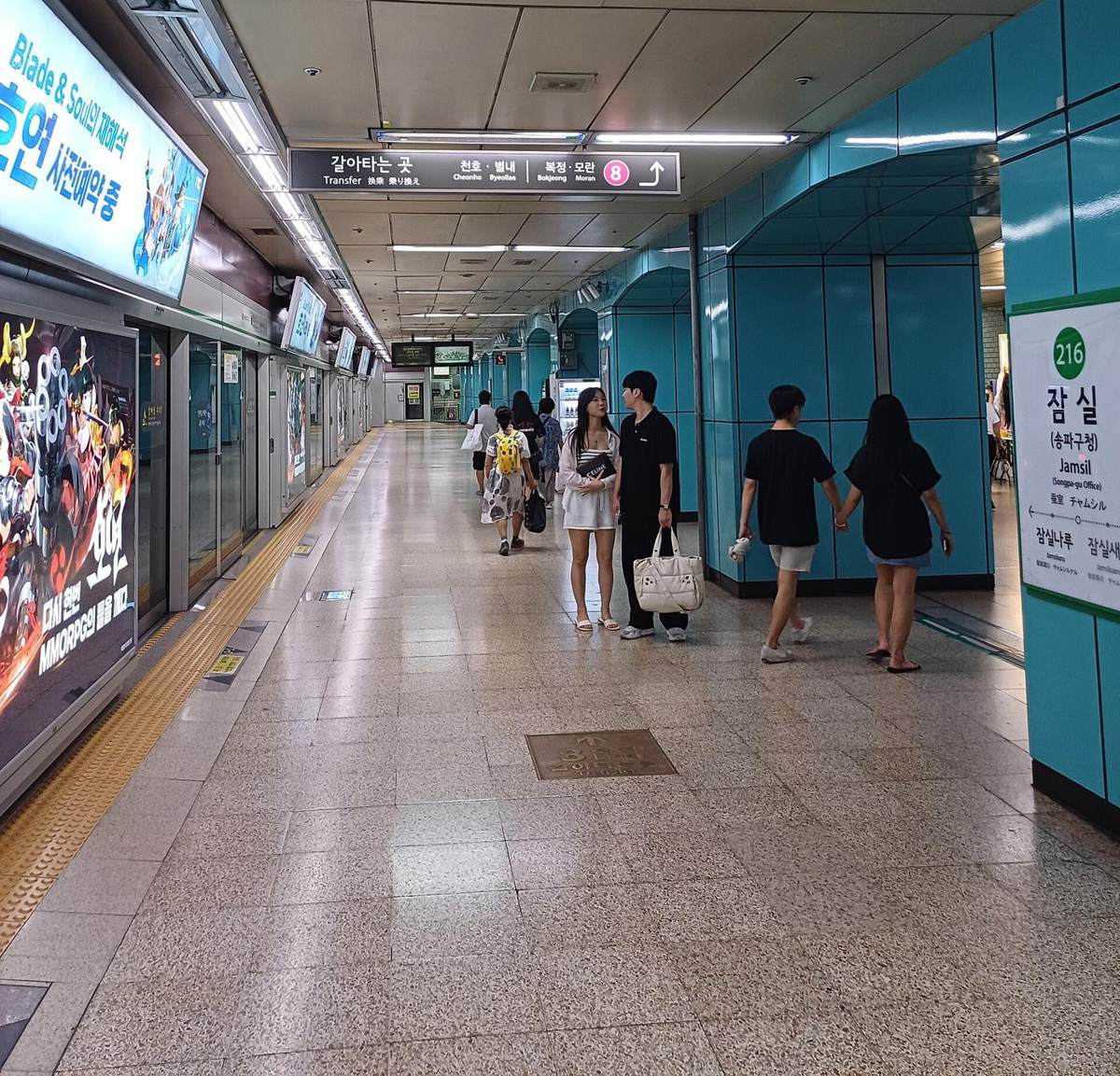
Jamsil, Line 2, with the Line 8 transfer. The last inner-loop train here on a weekday leaves at 00:54 and ends at Samseong. Photo: Wikimedia Commons, CC0 (2024).
Why the last train does not go where you think
Three habits of the Seoul timetable catch visitors, and none of them is on the network map.
Short-turn last trains. The final departures on most lines do not run end to end. They run to whichever station has a turn-back siding: Seongsu and Samseong on Line 2, Sadang on Line 4, Hansung University going north, Gongdeok on Line 6. The destination is on the front of the train and on the platform screen, in Korean and English. If your stop is past that station, the last useful train left earlier.
Line 2 is a loop that stops being one. The green line is a circle in the daytime. In the last hour of service (from about midnight on weekdays, 23:00 on weekends) the trains stop circling and begin terminating at Seongsu, Samseong, Sindorim, Seoul National University or Euljiro 1-ga, which is why the last "train" from Gangnam toward Jamsil at 00:54 is really a three-stop shuttle. If you are going from Hongdae to Gangnam late, take the outer loop (counter-clockwise, via Sindorim and Sadang): the last outer train that reaches Gangnam leaves Hongik University at about 00:15 on weekdays and about 23:16 on weekends and holidays. The inner-loop trains after midnight end at Seongsu or Euljiro 1-ga and never reach Gangnam.
Line 9 has two kinds of train, and the express stops first. The gold line's express trains (급행, red on the platform screen) skip most stations and their last runs leave earlier than the all-stop trains; from Gimpo Airport the last express toward the city leaves at 23:28 on weekdays and 22:32 on weekends. The last all-stop leaves at 00:48 but only runs to Gayang; the last one that reaches Sinnonhyeon in Gangnam leaves at 00:09 on weekdays and 23:06 on weekends. After that, assume trains from Gimpo toward Gangnam are all-stop only and slower.
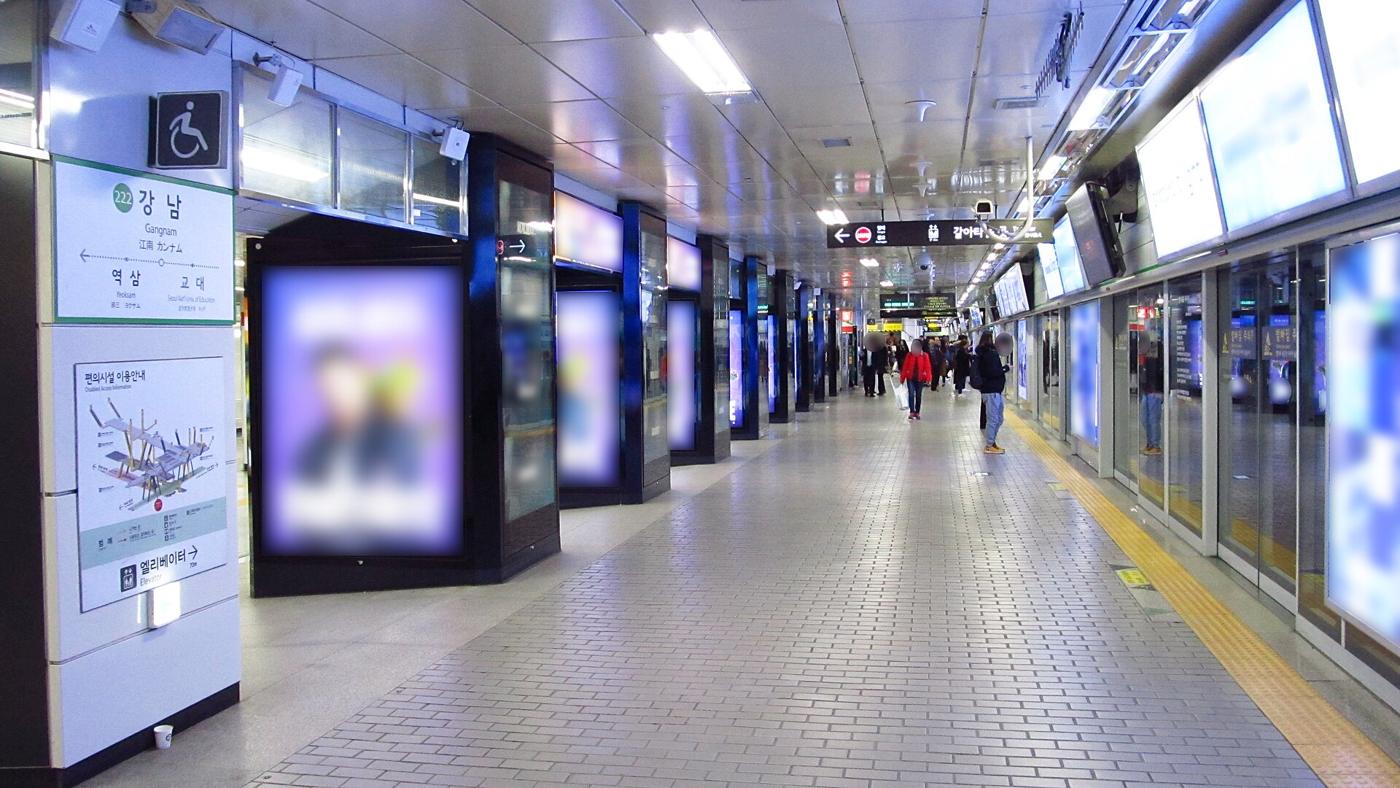
Gangnam, Line 2. The last train here on a weekday leaves at 00:54 and ends three stations later at Samseong. Photo: LERK, Wikimedia Commons, CC BY-SA 4.0 (2018).
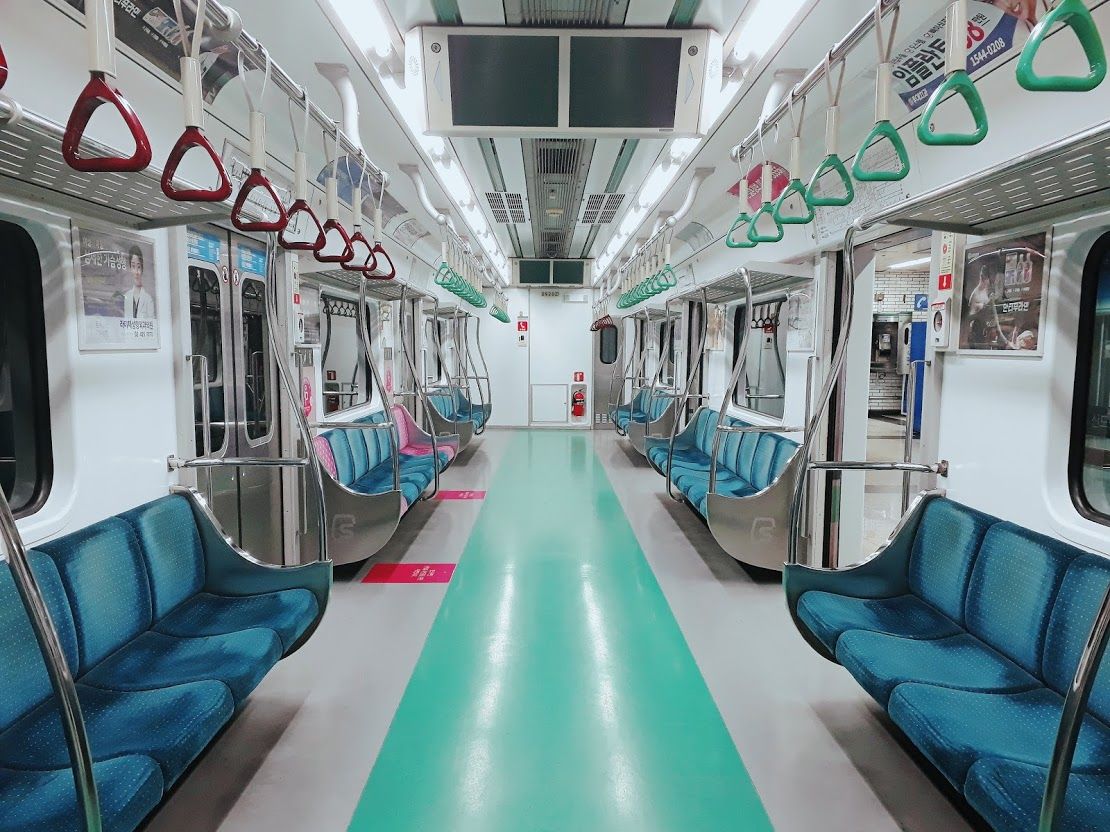
A Line 2 car late enough to be empty. Photo: Brit in Seoul, Wikimedia Commons, CC BY-SA 4.0 (2019).
Missed the last train in Seoul? What to do next
When the subway closes, Seoul does not. Open Naver Map, enter your destination, and it will switch to the night network on its own: owl buses first, then taxis. Here is what it is choosing between, with the prices in force as of October 2026. For short hops there is a fourth option, Seoul's public bikes (Ttareungi), which rent around the clock; our Seoul bike rental guide explains the ₩1,000 pass.
| Option | Hours | Cost | Use it when |
|---|---|---|---|
| Owl bus (올빼미버스, N routes) | About 23:00 to 06:00; first buses 23:10 to 00:00, last buses 03:10 to 04:10, depending on the route | ₩2,500 by card | You are on one of the 14 corridors and can wait 10 to 40 minutes |
| Taxi, 22:00 to 23:00 and 02:00 to 04:00 | All night | Base ₩5,800 (+20%) | Two or more people, or no bus within 20 minutes |
| Taxi, 23:00 to 02:00 | All night | Base ₩6,700 (+40%) | The peak; Gangnam and Hongdae queues are longest around 01:00 on Saturdays |
| Airport night bus (N6000, N6002, N6701, N6703) | About 23:30 to 04:40 from Terminal 1 | ₩17,000 to ₩18,000 | You landed after the 23:38 train |
| 24-hour jjimjilbang | All night | About ₩12,000 to ₩25,000 | You are far from the hotel and can wait for the 05:30 first train |
Owl buses (올빼미버스, N routes). Seoul runs 14 night-only routes with 140 buses, according to the city's transport page (updated 20 March 2026). They are ordinary blue city buses with an N on the front, they take T-money, and the fare is ₩2,500 with a card, ₩1,000 more than a daytime bus. Each route links the edge of the city to the centre and out the other side, so the termini sound obscure even when the bus passes your hotel:
| Route | From and to (termini) | Every | First and last bus |
|---|---|---|---|
| N13 | Sanggye-dong to Jangji-dong | 20 to 30 min | 23:30 to 03:40 |
| N15 | Ui-dong to Sadang Station | 15 to 30 min | 23:30 to 03:30 |
| N16 | Dobongsan to Onsu-dong | 20 to 30 min | 23:50 to 03:45 |
| N26 | Banghwa-dong to Sinnae-dong | 20 to 25 min | 00:00 to 03:25 |
| N30 | Gangil-dong to Seoul Station | 30 to 35 min | 23:10 to 03:50 |
| N31 | Gangil-dong to Jeongneung-dong | 35 to 40 min | 23:30 to 03:50 |
| N37 | Jangji-dong to Jingwan-dong | 25 to 30 min | 00:00 to 03:10 |
| N51 | Siheung-dong to Hagye-dong | 30 min | 23:40 to 03:45 |
| N61 | Sinjeong-dong to Sanggye-dong | 10 to 30 min | 23:40 to 04:10 |
| N62 | Sinjeong-dong to Myeonmok-dong | 15 to 20 min | 23:40 to 03:10 |
| N64 | Gaehwa-dong to Yeomgok-dong | 30 to 35 min | 23:40 to 03:15 |
| N72 | Susaek-dong to Sinnae-dong | 30 to 40 min | 23:30 to 03:45 |
| N73 | Gusan-dong to Jangji-dong | 35 min | 23:30 to 03:35 |
| N75 | Jingwan-dong to Sillim-dong | 25 to 30 min | 23:30 to 03:50 |
The city gives one first-to-last window per route, and on the long routes the last bus is still on the road well after it, close to 05:00. Do not try to match termini to your hotel; let Naver Map pick the route, and it will say plainly when nothing runs. Weekday nights have also had a driverless bus, the 심야 A21, launched in December 2023 between Hapjeong and Dongdaemun via Hongik University, Sinchon, Gwanghwamun and Jongno; at launch it ran about every 70 minutes from 23:30 to 05:10 and was free with a card tap. Check in Naver Map that it is running and what it charges before you count on it.
Airport night buses. Four night airport buses run after the railway closes: N6000 to the Gangnam Express Bus Terminal (₩17,000), N6002 to Hongik University, Gwanghwamun, Dongdaemun and Cheongnyangni (₩17,000, re-routed on 1 August 2025), N6701 to Seoul Station and DDP (₩18,000) and N6703 to COEX, Jamsil and Gwangnaru (₩18,000). They leave Terminal 1 roughly every 60 to 80 minutes from about 23:30 until about 04:40, and they are the reason a midnight landing is not a taxi emergency.
Taxis, with the surcharge clock (심야할증). Seoul's standard taxi starts at ₩4,800 for the first 1.6 km and adds ₩100 every 131 m or every 30 seconds in slow traffic, the fare set on 1 February 2023 and still the one the city's price page lists. The night surcharge is tiered: 20 percent from 22:00 to 23:00, 40 percent from 23:00 to 02:00, and 20 percent again from 02:00 to 04:00, so a base fare of ₩4,800 at 21:30 reads ₩5,800 at 22:30 and ₩6,700 at 23:30. Leave the city limits (to Ilsan or Bundang, say) and a further 20 percent out-of-town surcharge applies, up to 60 percent combined. Hailing works on the street when the roof light shows 빈차 in red; the apps are Kakao T, which now accepts foreign cards in its K.ride version, and the ordinary taxi rank at any station. Gangnam and Hongdae at 01:00 on a Saturday are the two places where a taxi may take a while.
The bathhouse. If you have missed the last train, are far from the hotel and it is raining, the honest Korean answer is a 24-hour jjimjilbang, where ₩12,000 to ₩25,000 buys a hot bath, a floor to sleep on and a 06:00 subway three minutes away. Our jjimjilbang guide explains how it works, and our Seoul safety guide covers the taxi rules for the airport run.
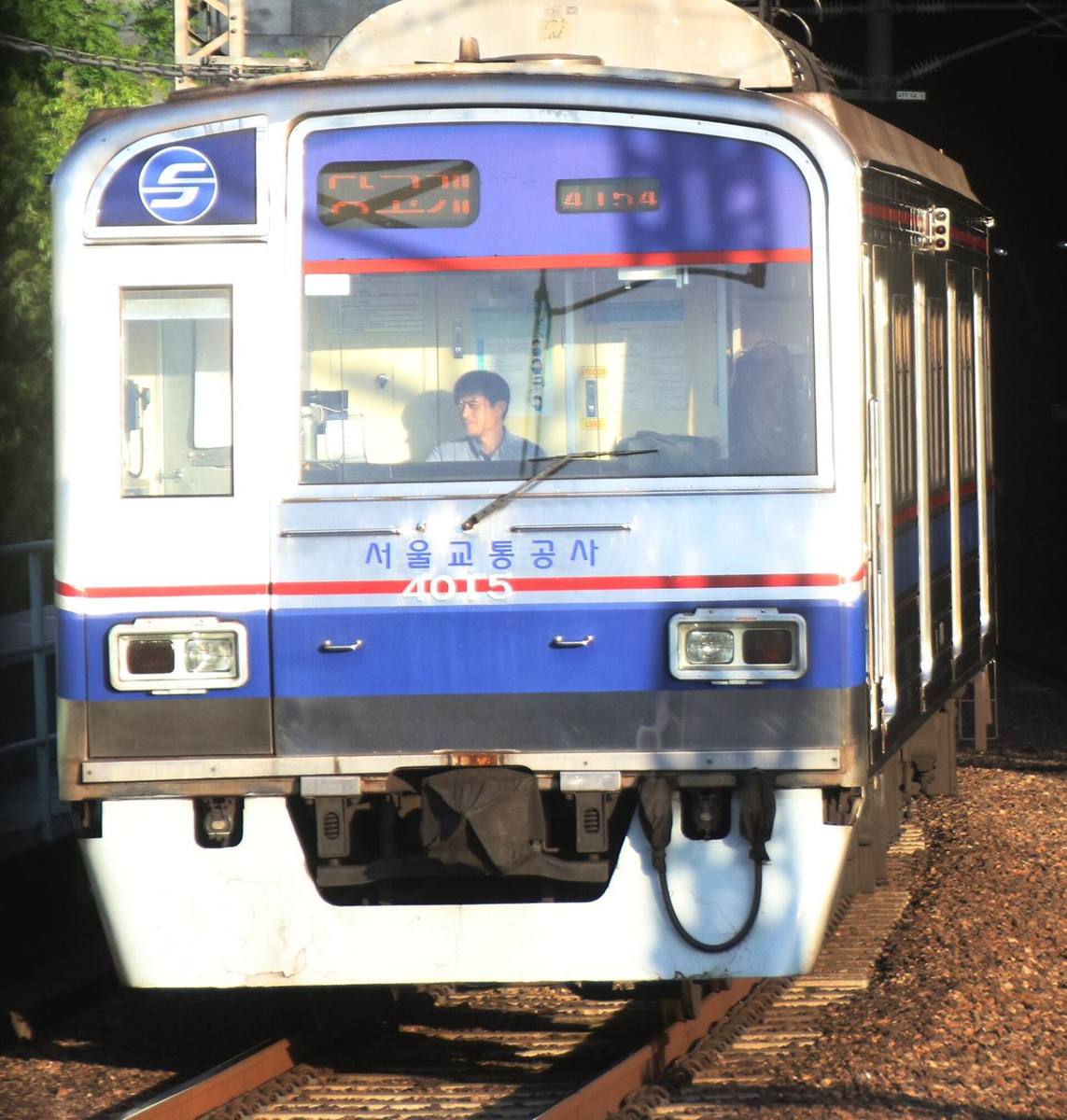
A Line 4 train bound for Danggogae (renamed Bulamsan in 2024). Line 4's last trains through Seoul Station and Myeongdong leave between 00:42 and 00:57 on weekdays and between 23:44 and 23:57 on weekends. Photo: Mtattrain, Wikimedia Commons, CC BY-SA 4.0.
The habits that keep you on the train
- Look at the destination, not the time. Naver Map lists the last train's terminus. If it is Samseong, Seongsu, Sadang or Gongdeok, that is a turn-back point, not your stop.
- Treat 23:30 as the weekday warning and 22:30 as the weekend one. Anything after that needs the destination check.
- The airport express is not the last train. The 22:48 express from Terminal 1 has a 23:38 all-stop train behind it, on the other platform.
- Transfers stop earlier than trains. A last train on one line arrives after the last train on the next has gone. If your route needs a transfer after midnight, check both.
- Friday is a weekday; a public holiday is a weekend. Korean public holidays that fall on a weekday run the shorter weekend timetable.
- Carry ₩10,000 in cash and a charged phone. The owl bus takes a card; the taxi takes cards too; both apps need the phone alive.
You might like: Kakao Venti, Korea's Big Taxi: The Van That Costs the Same as a Sedan by Day, and the Large-Taxi Options from Incheon Airport
You might like: What Time Do Restaurants Close in Korea? Closing Times, Break Time, Last Order and Monday Closures
You might like: 18.9 Million Visitors Told Korea What They Couldn't Find: The Official Exit Survey, and the Answers to All Four Gaps
You might like: K-Pop Concert Tickets in Seoul (2026): Seat Prices, the Passport Name Check and Korea's New Resale Fine
FAQ
Q: What time does the Seoul subway stop running? Weekday last trains leave the ends of each line around 01:00 and pass central stations between about 00:40 and 00:58; on Saturdays, Sundays and holidays about an hour earlier, so central stations lose their last train between 23:44 and 23:59. The last trains are usually short-turns that stop at a turn-back station rather than the end of the line.
Q: What time is the first Seoul subway train? About 05:30 from the terminals and between about 05:20 and 05:50 at central stations, every day. Seoul Station's Line 1 platforms see the first trains at 05:20. A 2025 plan to move first trains to 05:00 (and last trains 30 minutes earlier) had not taken effect as of October 2026.
Q: Is the Seoul subway 24 hours on weekends? No. Weekend service is shorter, not longer: Saturdays, Sundays and public holidays run the same timetable, with last trains about an hour earlier than on weekdays. Friday night runs the weekday timetable.
Q: What should I do if I miss the last train in Seoul? Open Naver Map and enter your destination; after the subway closes it routes you onto Seoul's 14 owl bus routes (N13 to N75), which run about 23:00 to 06:00 for ₩2,500 by card, every 10 to 40 minutes. If nothing runs, take a taxi: the base fare is ₩4,800, ₩5,800 from 22:00 to 23:00 and 02:00 to 04:00 (+20%), and ₩6,700 from 23:00 to 02:00 (+40%). A 24-hour jjimjilbang for ₩12,000 to ₩25,000 is the fallback until the 05:30 first train.
Q: What time is the last train in Korea outside Seoul? Other Korean metros end in the same window. In Busan the last Line 1 trains leave Busan Station at 23:49 northbound and 00:12 southbound, and Seomyeon's last trains run 23:44 to 00:16. Daegu and Incheon close around midnight too. The last intercity KTX of the night is a separate timetable, usually before midnight.
Q: What is the last AREX train from Incheon Airport? The last express leaves Terminal 2 at 22:40 and Terminal 1 at 22:48. The last all-stop train that reaches Seoul Station leaves Terminal 1 at 23:38. After that, the N6002 (₩17,000, to Hongik University, Gwanghwamun, Dongdaemun and Cheongnyangni), N6701 (₩18,000, to Seoul Station and DDP) and N6000 (₩17,000, to the Gangnam Express Bus Terminal) night buses run from about 23:30 to about 04:40.
Q: Does the last Line 2 train go all the way around? No. In the last hour of service the loop trains begin terminating at Seongsu, Samseong, Sindorim, Seoul National University or Euljiro 1-ga. The 00:54 last train from Gangnam toward Jamsil ends at Samseong, three stations on; the last train from Hongik University that reaches Gangnam is the outer-loop train at about 00:15 on weekdays.
Q: How do I check the last train for my exact station? Tap the station in Naver Map and open the timetable tab, which lists first and last trains and the destination of each. In the station, the posted timetable marks them 첫차 (first) and 막차 (last).
Bottom Line
Seoul's subway closes, and it closes earlier than the guides say for the two reasons that matter to you: your station is not a terminal, and the last train is usually a shuttle to a turn-back station. On a weekday, plan to be on a train by 00:30 in the centre and by 23:30 if you need a transfer; on a weekend, an hour before that. The airport line's real cutoff is the 23:38 all-stop train from Terminal 1, not the express. After that the city still moves, on N buses for ₩2,500, taxis at 40 percent over until 02:00, and bathhouses that will sell you a floor until the 05:30 first train. Check the destination, keep the phone charged, and the last train stops being a problem.
You might like: Incheon Airport to Seoul Guide: AREX, Bus, Taxi and Korean Jjimjilbang Guide: Sauna Etiquette and Tips.
Sources
- Seoul Metro last-train data by station (서울시 역코드로 지하철 막차시간표, Seoul Open Data OA-109, data refreshed 17 October 2026), queried station by station on 18 October 2026 for every Line 1 (Seoul Station) and Line 2 to 9 row in the tables, weekday, Saturday and holiday tags; Seoul Metro station timetables (호선별 첫차·막차 정보, Seoul Open Data OA-15492), read station by station for Seoul Station, City Hall, Gangnam, Hongik University, Jamsil, Dongdaemun History & Culture Park, Myeongdong, Itaewon, Express Bus Terminal and Gimpo Airport via the metro-time-info mirror, September 2026; Seoul Metro Line 9 timetable for express cutoffs.
- Airport Railroad (AREX) express and all-stop timetables as published on the operator's station pages, the metro-time-info mirror of the airport-station timetables (re-checked 29 September 2026: last Terminal 1 all-stop to Seoul Station 23:38) and Trip.com, KKday and Chadorri's 2026 AREX guides; Korail Line 1 and Sinbundang Line times at Seoul Station and Gangnam via the same mirror; Seoul Station last-train notice (September 2024); the Airport Railroad fare page (airportrailroad.com, read 3 October 2026) for the ₩13,000 express and ₩4,750 to ₩5,350 all-stop card fares; Namu Wiki on journey times.
- Namu Wiki, "막차" and "첫차," on the 2020 to 2022 pandemic cuts and restorations and the 2025 first-train proposal; SBS and Hankyung (May 2025) on the 05:00 plan.
- Seoul Metropolitan Government transport site (news.seoul.go.kr/traffic, 올빼미버스 page updated 20 March 2026) for the 14 owl routes, 140 buses, intervals, first and last starts and the ₩2,500 card fare; Seoul price information (sftc.seoul.go.kr, 서울시 물가정보 공공요금 택시) and Seoul Media Hub (1 February 2023) for the ₩4,800 base fare, ₩100 per 131 m or 30 seconds and the 20/40 percent night surcharge (22:00 to 04:00) with the 20 percent out-of-town surcharge; Seoul Media Hub (6 December 2023) on the 심야 A21 autonomous bus; Seoul Media Hub and Seoul transport site on past New Year's Eve service extensions; FN News, Newsis and Hankyung (21 May 2025) on the 05:00 first-train plan and the union's objection; Incheon International Airport Corporation (airport.kr night-bus page, re-checked 29 September 2026) and Airport Limousine on the N6000, N6002, N6701 and N6703 night buses (N6002 route change 1 August 2025); Korea JoongAng Daily on Apple Pay T-money for foreigners (March 2026).
- Busan Transportation Corporation station timetables via the metro-time-info mirror for Busan Station and Seomyeon.
You Might Also Like
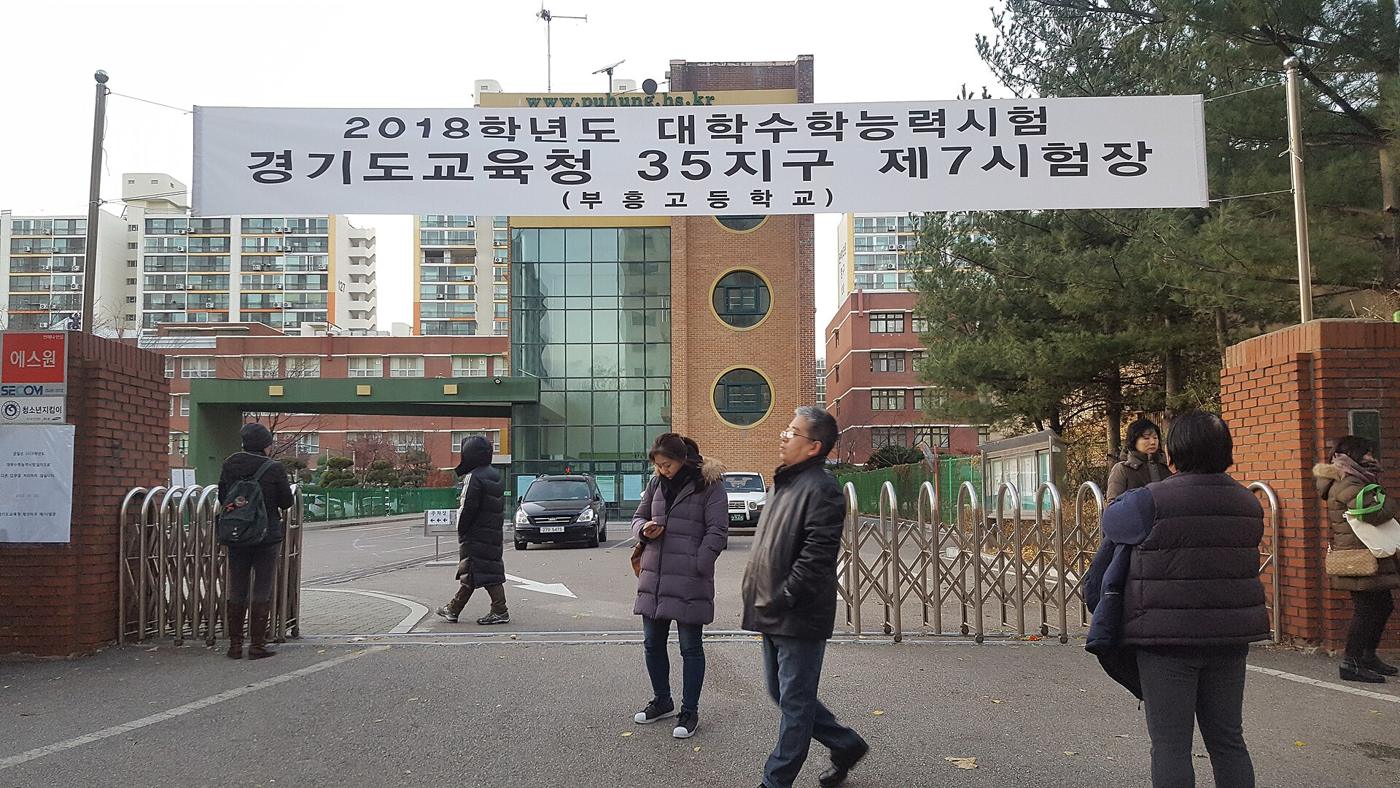
Suneung Day in Korea, 19 November 2026: The 35-Minute Flight Ban, 10 a.m. Office and Bank Openings, Extra Subway Trains and a Tourist's Hour-by-Hour Plan
Korea's Suneung exam is Thursday 19 November 2026. Last year the 35-minute listening-test flight ban (13:05–13:40) moved 140 flights, banks and the stock market opened at 10:00 and Seoul added 29 subway runs. An hour-by-hour plan for visitors.
What You Cannot Bring Into Korea: Beef Jerky, Sausage, Mango, Adderall and CBD Are Banned, Sleeping Pills Need a Permit, the Fine Is ₩1 Million to ₩10 Million, and the Souvenirs Korea's Customs Take Most (2026)
Korea bans all meat and fresh fruit from hand luggage, fines undeclared jerky or sausage ₩1–10 million, refuses Adderall even on prescription, and needs a 10-day online permit for sleeping pills. The souvenirs customs take most, and how to declare.
Flight Delay Compensation in Korea: 10–30% Back, US$600 If Bumped
Korea has no EU261, but it has an official table: 10–30% of the delayed leg's fare, from 1 hour late on domestic flights, and up to US$600 if you're bumped. Weather only excuses the airline if it proves it. How to claim, step by step.