Korea Health Insurance for Foreigners (2026): At Least ₩158,630 a Month After Six Months — Students, Workers, and What Happens If You Don't Pay
Last updated: 30 September 2026. Premium figures are from the National Health Insurance Service (국민건강보험공단, NHIS) notice of its 2026 rates and its page on premiums for foreign regional subscribers, which applies the Ministry of Health and Welfare's standard for long-term foreign residents (고시 제2019-151호). The rules on enrolment, dependants and arrears are read from the National Health Insurance Act (국민건강보험법) Article 109 and its Enforcement Decree Articles 76-2 to 76-6, as in force in September 2026. Student figures are from Korean universities' 2026 notices. Dollar figures use about ₩1,360 to US$1 and are approximate. This is a guide to the rules, not legal advice.
Search "health insurance for foreigners in Korea" and the English pages have mostly caught up on one number: ₩158,630 a month. What they rarely explain is where that number comes from, why a student pays half of it, why a minimum-wage office worker pays less than a jobless foreigner, and what actually happens if you stop paying — a rule the Constitutional Court found unconstitutional in 2023 and the National Assembly rewrote in 2024, effective April 2025. English pages rarely describe the current version.
The Korean sources answer all of it. NHIS's 2026 rate notice sets the average premium for foreign regional subscribers at ₩158,630 a month (about US$117), up 3.8% from ₩152,790: ₩140,210 health insurance plus ₩18,420 long-term care. That average is also the minimum, and Article 109 of the National Health Insurance Act puts almost every registered foreigner into the system after six months. Here is who pays what, and the exact rule on arrears.
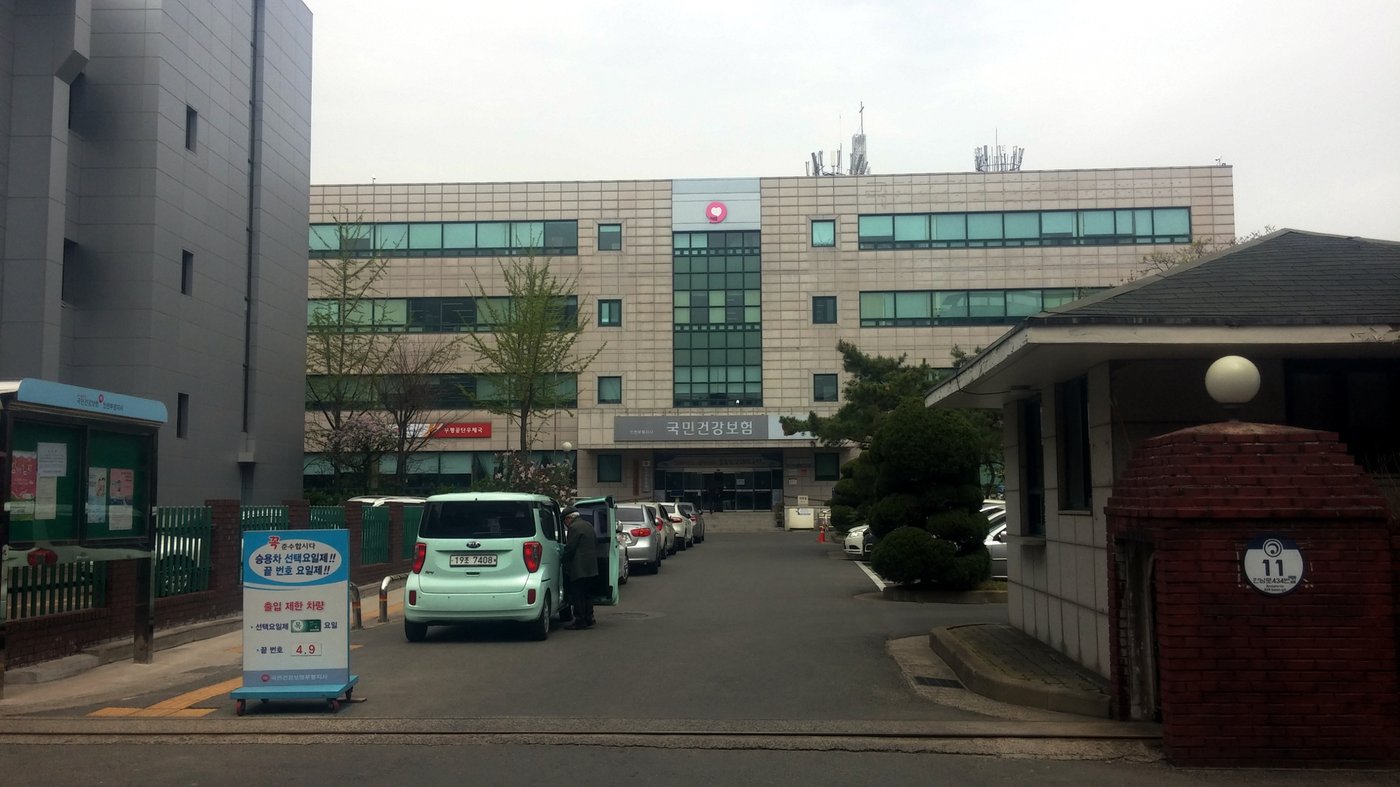
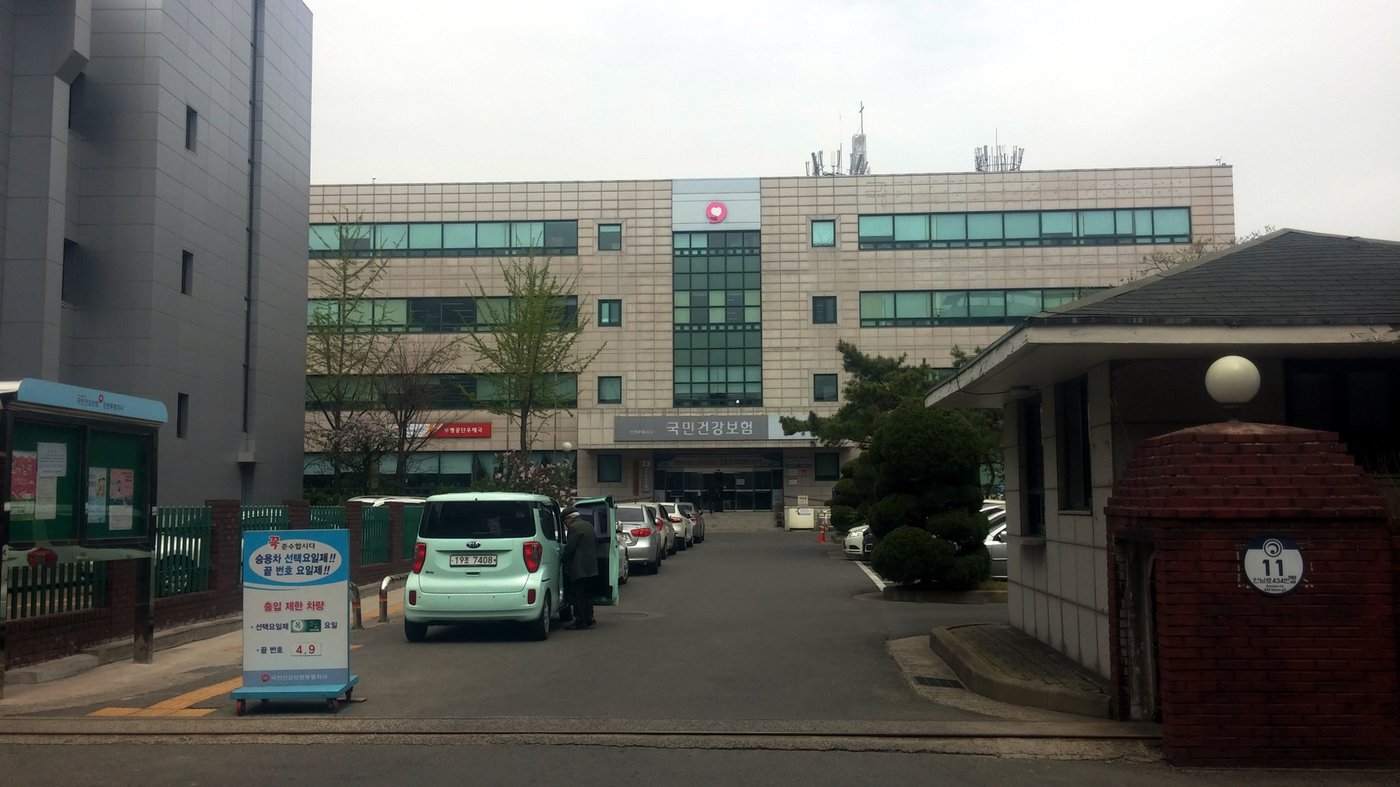
The Bupyeong branch of the National Health Insurance Service in Incheon, one of the local offices where foreign residents can register dependants, change their household, or get a payment certificate for immigration. Photo: IRTC1015, Wikimedia Commons, public domain (2017).
NHIS bills, payment receipts and the certificate immigration asks for all arrive on A4 paper — an A4 accordion file keeps a year of them in one place: Sooez 13-pocket expanding fileAffiliate link. As an Amazon Associate, EpicKor earns from qualifying purchases at no extra cost to you.
Quick Guide: health insurance for foreigners in Korea, 2026
| Who you are | How you are covered | What you pay each month (2026) |
|---|---|---|
| Registered foreigner, no Korean job (지역가입자, regional subscriber) | Enrolled automatically after 6 months in Korea | At least ₩158,630 (≈US$117), including long-term care; more if your income and property put you higher |
| University student, D-2 visa | Enrolled from arrival (alien registration) | ₩79,320 (≈US$58), a 50% reduction |
| Language student, D-4 visa | Enrolled after 6 months | ₩79,320, the same 50% reduction |
| Employee at a Korean workplace (직장가입자) | Enrolled from the first day of work | 3.595% of pay, plus half of the 0.9448% long-term care rate; the employer pays the same again |
| Permanent resident (F-5) or marriage migrant (F-6) | Regional subscriber on the Korean rules | Calculated like a Korean household; the ₩158,630 floor does not apply |
| Religious worker (D-6), humanitarian stay (G-1-6, G-1-12) | Regional subscriber | 30% reduction |
| Payment deadline | For foreign regional subscribers, the 25th of the month before: October's premium is due on 25 September | |
| If you do not pay | One month overdue and NHIS can stop paying its share of your treatment (only D-8, E-1, E-3, E-4, E-5 and F-2 holders keep cover while fewer than three months are unpaid); immigration limits a visa extension to six months or less, in principle, until the arrears are cleared | |
| Help | NHIS 1577-1000, then 6 for English, Chinese, Vietnamese or Uzbek, or 033-811-2000 directly; from abroad +82-33-811-2001 (weekdays 9am–6pm) | |
Every premium and rate here changes on 1 January.
Where ₩158,630 comes from
The NHIS page on premiums for foreign regional subscribers (재외국민 및 외국인 지역보험료 부과기준) reproduces the ministry's standard in two sentences. Foreign regional subscribers are charged "내국인 지역가입자와 동일한 기준에 따라" — on the same basis as Korean regional subscribers, from income and property. Then the catch: "산정된 보험료가 전년도 11월말 전체 평균보험료보다 적은 경우에는 그 평균보험료를 다음해 1월~12월분 보험료에 부과" — if the calculated premium is lower than the average premium of all subscribers at the end of the previous November, that average is charged for January to December of the following year.
Most newly arrived foreigners have no Korean income or property on record, so the average becomes the bill:
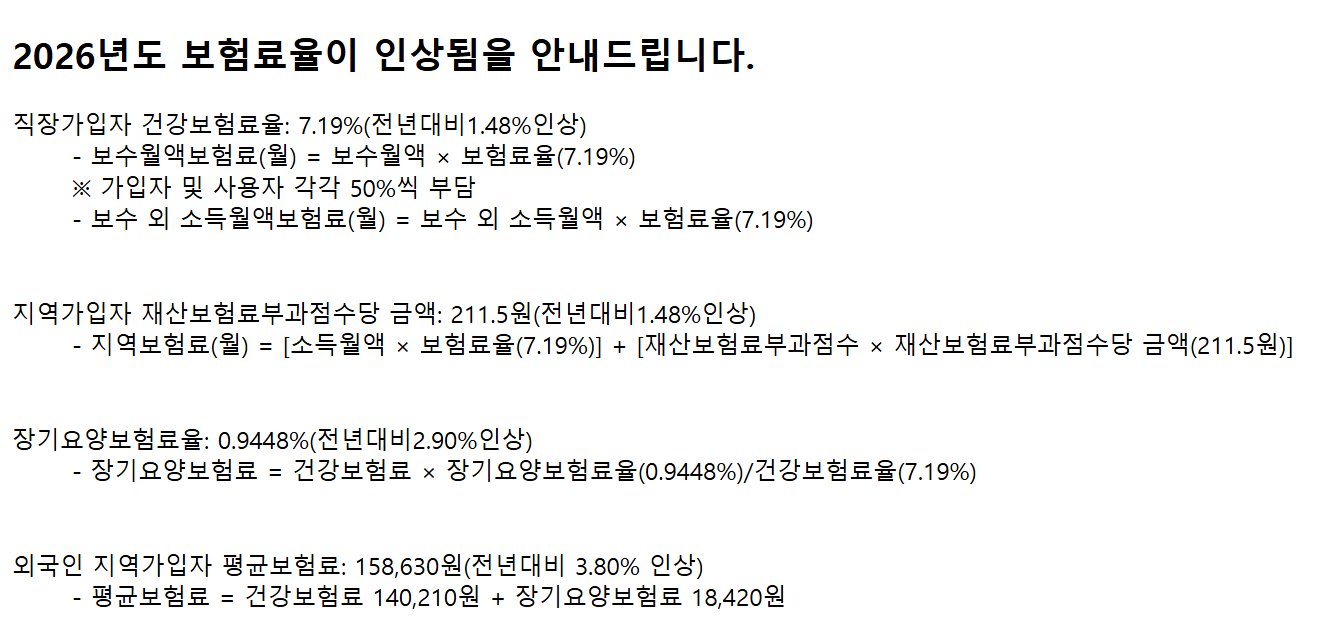
NHIS's notice of the 2026 rates. The last block is the one that decides most foreigners' bill: 외국인 지역가입자 평균보험료 158,630원 (전년대비 3.80% 인상). Screenshot by EpicKor of edi.nhis.or.kr, 30 September 2026.
Lonely Planet Korean Phrasebook & Dictionary — for the registration desk and the NHIS office Your insurance only helps if you can use it: hospital registration forms, the NHIS branch counter and the Korean-language bill are where foreign residents get stuck, and the English line is busiest on the 25th. A pocket phrasebook with a medical section is the one thing we suggest here; nothing on Amazon makes the premium smaller. As an Amazon Associate, EpicKor earns from qualifying purchases at no extra cost to you.
See the Korean phrasebook on AmazonFrom ₩152,790 in 2025 to ₩158,630 in 2026 is ₩5,840 a month, about ₩70,000 a year. If you have Korean income without being an employee — a business owner on a D-8 visa, for instance — your calculated premium (income × 7.19%, plus property points × ₩211.5, plus long-term care) can exceed the average, and you pay the higher figure.
Two groups sit outside the floor entirely. Permanent residents (F-5) and marriage migrants (F-6) are charged exactly like a Korean household — the NHIS page says so directly — so a low-income F-6 household can pay far less than ₩158,630. And where the head of household is a recognised refugee or a minor, the premium is whichever is higher of the Korean calculation and the national monthly minimum, not the average.
You might like: Korea Minimum Wage 2027: ₩10,700 an Hour — What Foreign Workers Are Owed
Who is enrolled, and from when
Article 109(3) of the National Health Insurance Act makes a registered foreigner who is not an employee a regional subscriber once they hold a listed visa status and have lived here for the period set by ministry ordinance: six months, compulsory since 16 July 2019. Before that, a foreigner could decline to join.
The Enforcement Decree (Article 76-2) sets the start date in two ways. If you qualify by having lived in Korea for the required period, you join on the day the six months end. If your status is one where continuous residence can be expected from the start, you join on the day you entered Korea. In practice that splits foreigners like this:
- Six-month wait: most visas — D-4 language students, D-10 job seekers, E-2 teachers between jobs, F-4 overseas Koreans, H-1 working holiday makers and the rest of the list NHIS publishes, from C-0 to H-2.
- From arrival: D-2 university students and D-4 students at primary and secondary schools, who have been enrolled from their alien registration since 1 March 2021; and, among others, permanent residents (F-5) and marriage migrants (F-6).
- From the first day of work: anyone employed at a workplace covered by national health insurance becomes an employee subscriber under Article 109(2), whatever the visa, with no waiting period. E-9 factory workers, E-7 professionals and E-2 teachers with a school contract are all in this group.
The one way out is narrow. Article 109(5) allows an exclusion (가입 제외) if foreign law, a foreign insurer or an employment contract gives you cover equivalent to Korean national health insurance benefits. NHIS decides what counts, and the exclusion normally runs from the day you apply. It is not a way to swap the national scheme for a cheap travel policy.
Coverage ends by itself in three situations under the same Article 76-2: the day after your permitted stay expires, the day after a deportation order, or — for regional subscribers — the day after you left Korea if you stay abroad for more than a month. Tell NHIS when you leave for good; premiums paid for months after you lost coverage can be refunded.
Students: ₩79,320 in 2026
International students are the group that notices this premium most, because it arrives on day one. The NHIS page lists the reduction plainly: 유학(D-2), 일반연수(D-4), 재외국민 유학생, 재외동포(F-4) 유학생: 50% — overseas Korean and F-4 students qualify only at schools and universities, not at graduate schools.
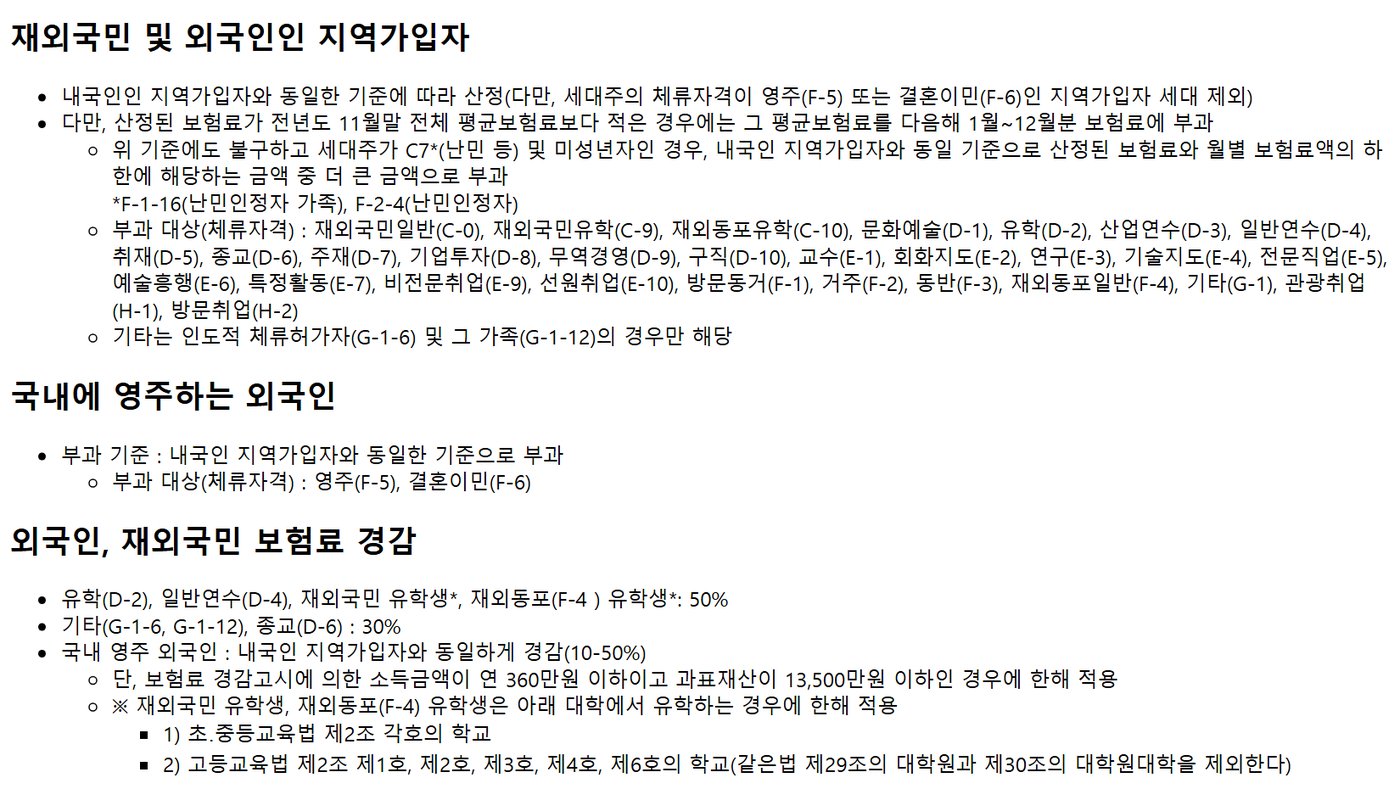
The NHIS summary of the ministry standard, 고시 제2019-151호. The 50% line for D-2 and D-4 students is near the bottom. Screenshot by EpicKor of nhis.or.kr, 30 September 2026.
Half of ₩158,630 is ₩79,315, and Korean universities' notices for 2026 give the student premium as ₩79,320 a month. Hanyang University's international office (guide updated 1 March 2026) gives the change as ₩76,390 → ₩79,320; ₩76,390 was the 2025 student figure, half of ₩152,790. Sogang University (26 February) and Sungshin Women's University (6 March) published the same ₩79,320.
The timing differs inside the reduction. A D-2 degree student pays from the first month; a D-4 language student pays nothing to NHIS for six months, then joins at the same ₩79,320. Universities often add their own group insurance — Sogang's notice ties its benefits to having no NHIS arrears.
You might like: Flu in Korea (2026): a ₩30,000 Rapid Test, a ₩30,000–₩40,000 Shot, and Who Gets the Free Vaccine
Employees: 7.19%, split in half
For anyone on a Korean payroll the floor does not exist. NHIS's 2026 notice sets the employee health insurance rate at 7.19% of monthly pay (보수월액), up 1.48% from 7.09% in 2025, and states that the subscriber and the employer each pay 50%. Long-term care insurance is charged on top: the 2026 rate is 0.9448%, and the notice gives the formula as health premium × 0.9448% ÷ 7.19% — about 13.1% of the health premium. It is also split half and half.
For a full-time worker on 2026's monthly minimum wage of ₩2,156,880, that works out on our own calculation to about ₩77,530 of health insurance and ₩10,180 of long-term care deducted from pay, roughly ₩87,700 a month (about US$64), with the employer paying the same again. That is the quiet oddity of the system: a foreigner on the minimum wage pays barely more than half of what an unemployed foreigner of the same nationality pays as a regional subscriber, because the employer carries the other half and there is no floor for employees. Your payslip (임금명세서) should show the deduction as 건강보험 and 장기요양보험 on separate lines.
Dependants are where the 2024 change bites. Since 3 April 2024, Article 109(4) requires a foreign dependant (피부양자) of an employee to have lived in Korea for six months before joining the employee's cover — except for the spouse and children under 19 (including the spouse's children), who can be added from arrival. Parents brought over for treatment now wait six months. For regional subscribers, the rule is different again: each foreigner is billed as their own household unless they apply to add a spouse or children under 19 to a single household, which then pays one premium.
What the insurance covers, and what it does not
Once enrolled, a foreigner gets the same benefits as a Korean subscriber: consultations, tests, surgery, hospital stays, prescription drugs and the national health check-up programme, at the co-payment rates the Enforcement Decree sets by type of institution. For an outpatient visit in a city (동) area that is 30% at a clinic (의원), 40% at a hospital (병원) and 50% at a general hospital (35% and 45% in 읍·면 areas), and at a tertiary hospital the full consultation fee plus 60% of the rest; for an inpatient stay it is 20% (plus half of meal costs); at the pharmacy, 30%. A clinic first visit that costs ₩18,840 at the full national fee (see what a doctor costs without insurance) becomes a bill of a few thousand won.
What it does not cover is 비급여 (non-covered) care: cosmetic procedures, most vision correction, upgraded rooms, many dental treatments, some scans without a qualifying reason, and many newer procedures. The hospital sets those prices itself — our guides to LASIK, dental implants and MRI scans show what they cost. Nor is it travel insurance: it pays nothing abroad.
Since 20 May 2024 Korean hospitals and clinics must check the patient's identity, so bring your residence card (외국인등록증), your passport, or the NHIS mobile health card. Without one you can be charged as uninsured at the desk — bring the ID and the receipt back within 14 days to have the bill settled at the insured price.
You might like: What a Doctor Costs in Korea Without Insurance (2026)
If you don't pay: one month for most, three for a few
From 2019, Article 109(10) stopped benefits for a foreign regional subscriber from the first missed payment, with no notice and no exceptions. On 26 September 2023 the Constitutional Court ruled unanimously (2019헌마1165) that this violated equal treatment. The amended act (법률 제20505호), promulgated on 22 October 2024, took effect on 23 April 2025, with the detail in two new decree articles:
- Article 76-5: benefits can be withheld once a premium has been unpaid for one month — the same threshold as for Koreans.
- Article 76-6(1), for D-8, E-1, E-3, E-4, E-5 and F-2 holders only (the decree's Annex 6-2): NHIS may continue to pay benefits while the total number of unpaid monthly premiums is fewer than three. Months you have since paid do not count, and neither does how long they were overdue.
- Article 76-6(2), same six statuses only: treatment received while benefits were suspended is recognised retroactively if you pay the arrears in full by the payment deadline of the month in which two months have passed since NHIS notified you.
In plain terms: for students, job seekers, F-4 holders and most other foreign regional subscribers, one overdue month is enough to lose cover until the arrears are paid, with no three-month grace. The grace period and the retroactive rescue apply only to the six business, professional and residence statuses listed above. Once benefits are suspended, the hospital bills you the full amount, including NHIS's share.
The other consequence is at immigration. The Ministry of Justice checks tax and health-insurance arrears when a registered foreigner aged 19 or over applies to extend their stay. Its own page states that if the arrears are paid, the extension proceeds normally; if not, the extension is restricted — in principle to six months or less. The system has run since 2019. Pay before the appointment, and bring the NHIS payment certificate (완납증명서) if the officer asks.
How to pay and check your premium
The bill goes to the address on your alien registration. For foreign regional subscribers, Article 109(8) makes it due by the 25th of the month before the month it covers. Pay by transfer to the bill's virtual account, by card, at a bank, ATM or convenience store — or set up automatic debit from a Korean bank account, the easiest way never to miss a month.
To check what you owe, use the NHIS website (nhis.or.kr, which has an English section), the NHIS app "The건강보험", or call 1577-1000 and press 6 for English, Chinese, Vietnamese or Uzbek, or dial 033-811-2000. NHIS branch offices handle household changes, dependant applications, exclusions and certificates in person; bring your residence card.
The honest part: when ₩158,630 is the wrong number for you
- Employees, F-5 and F-6 holders: it is not your number. You pay a percentage of pay, or the Korean household calculation.
- It can be higher. A self-employed foreigner with Korean business income or Korean property is billed on the calculated amount when that exceeds the average.
- It is not a fee for a policy you can refuse. Since 2019 enrolment is compulsory. Private insurance does not replace it unless NHIS accepts an exclusion application.
- It changes every January. Check the current year's NHIS notice before you budget.
- Short stays are outside it. A tourist or a visitor here for less than six months on a non-student visa is not enrolled and pays nothing — and is billed as uninsured at a hospital, which is what our clinic and emergency-room cost guide is about.
Before your six months are up, our guide to emergencies and pharmacies for visitors covers care without NHIS.
FAQ
Q: How much is health insurance for foreigners in Korea in 2026? A foreign regional subscriber — a registered foreigner without a Korean employer — pays at least ₩158,630 a month in 2026, which is ₩140,210 of health insurance plus ₩18,420 of long-term care. It is the previous November's average premium, charged whenever the premium calculated from your Korean income and property is lower. D-2 and D-4 students pay half, ₩79,320.
Q: When does NHIS enrolment start for foreigners? After six months' residence for most registered foreigners, a rule in force since 16 July 2019. D-2 university students and D-4 primary and secondary school students are enrolled from their alien registration, and employees from their first day of work.
Q: How much do foreign employees pay for health insurance in Korea? In 2026 the health insurance rate is 7.19% of monthly pay, split equally with the employer, so the employee pays 3.595%. Long-term care adds 0.9448% of pay, also split, calculated as health premium × 0.9448 ÷ 7.19. On the 2026 minimum monthly wage that is about ₩87,700 deducted per month.
Q: What happens if I don't pay my Korean health insurance premium? Since 23 April 2025, NHIS may withhold benefits once a premium is a month overdue. Only D-8, E-1, E-3, E-4, E-5 and F-2 holders keep cover while fewer than three monthly premiums are unpaid and can have treatment recognised retroactively by paying in time; for D-2, D-4 and most other visas, one overdue month is enough. Once benefits stop, you pay the full hospital bill. Immigration also restricts stay extensions, in principle to six months or less, until the arrears are paid.
Q: Can my family be covered? If you are an employee, your spouse and children under 19 can be added as dependants from arrival; other relatives must first live in Korea for six months (the rule since 3 April 2024). If you are a regional subscriber, you can apply to put your spouse and children under 19 in one household with a single premium.
Sources
- National Health Insurance Service, 2026년도 보험료율 인상 안내 (edi.nhis.or.kr): employee rate 7.19% (+1.48%), regional property point value ₩211.5, long-term care rate 0.9448% (+2.90%), foreign regional subscriber average premium ₩158,630 (+3.80%) = ₩140,210 + ₩18,420. Read 30 September 2026.
- National Health Insurance Service, 재외국민 및 외국인 지역보험료 부과기준 (nhis.or.kr), summarising 보건복지부 고시 제2019-151호 (11 July 2019): the Korean-basis calculation with the previous-November average as a floor, the visa list C-0 to H-2, the F-5/F-6 rule, and the 50% and 30% reductions. Read 30 September 2026.
- National Health Insurance Act (국민건강보험법) Article 109, as amended by 법률 제20505호 (promulgated 22 October 2024, in force 23 April 2025), read on law.go.kr: employee and regional enrolment, dependants' six-month rule and its exceptions (amended 2 January 2024), exclusion, the 25th-of-the-previous-month deadline, and benefit restriction.
- Enforcement Decree of the National Health Insurance Act, Articles 76-2 (enrolment and loss of coverage), 76-3 (dependants), 76-5 and 76-6 with Annex 6-2 (new 15 April 2025: one-month threshold; fewer-than-three-months exception and retroactive recognition for D-8, E-1, E-3, E-4, E-5 and F-2 only), and Appendix 2 (co-payment rates), read on law.go.kr.
- Ministry of Health and Welfare, 고시 제2025-69호 (23 April 2025), amending the standard for long-term foreign residents to match the new arrears rules.
- National Law Information Center, amendment reasons for 법률 제20505호, citing Constitutional Court decision 2019헌마1165 of 26 September 2023.
- Ministry of Justice, 외국인 비자연장 전 세금·건강보험료 체납 확인제도: arrears checked at extension for registered foreigners aged 19+, extension restricted to six months or less in principle.
- Hanyang University Office of International Affairs, NHIS guide updated 1 March 2026 (₩76,390 → ₩79,320; 1577-1000 option 6 and 033-811-2000); Sungshin Women's University and Sogang University 2026 notices (₩79,320; D-2 from arrival, D-4 after six months; group insurance conditional on no NHIS arrears).
- National Health Insurance Service English site, Contact us: 1577-1000 extension 6, 033-811-2000, +82-33-811-2001; English, Chinese, Uzbek, Vietnamese; 9am–6pm.
You Might Also Like
How Much Is Rent in Seoul (2026)? Officetels Average ₩949,000 a Month — Jeonse vs Wolse, Deposits, and What Foreigners Need
Seoul officetels average ₩949,000 a month on a ₩22.85 million deposit (Korea Real Estate Board, June 2026); villa one-rooms ₩670,000, apartments ₩1.64 million. Jeonse vs wolse, the 5% conversion cap, agent fees and protecting a deposit.
Korea Minimum Wage 2027: ₩10,700 an Hour, ₩2,236,300 a Month — What Foreign Workers Are Owed and What They Actually Earn
Korea's 2027 minimum wage is ₩10,700 an hour, ₩2,236,300 a month on 209 hours (2026: ₩10,320). It covers every visa. The government's own survey: 36.9% of foreign wage workers earn ₩3 million+ a month, half earn ₩2–3 million.
Legal Age in Korea: Adult at 19, Drinking From 1 January of the Year You Turn 19, Voting at 18 — Every Age Limit in Korean Law
Korea's adult age is 19, but alcohol and cigarettes go by birth year: anyone born in 2007 could buy them from 1 January 2026. Voting and driving are 18, marriage 18 with parental consent, consent 16 — every age limit, with the Korean law article.