Korea Minimum Wage 2027: ₩10,700 an Hour, ₩2,236,300 a Month — What Foreign Workers Are Owed and What They Actually Earn
Last updated: 30 September 2026. Minimum wage figures are from the Ministry of Employment and Labor (고용노동부) notice of 5 August 2026 and the Minimum Wage Commission (최저임금위원회) decision of 14 July 2026. Pay figures for foreign workers are from the 2025 Survey on Immigrants' Living Conditions and Labour Force (이민자체류실태 및 고용조사) by the Ministry of Data and Statistics (국가데이터처, formerly Statistics Korea) and the Ministry of Justice. Dollar figures use about ₩1,360 to US$1 (September 2026) and are approximate. This is a guide to the rules, not legal advice.
Search "minimum wage in Korea per month" in English and you mostly get last year's answer. English Wikipedia's minimum wage table stops at 2024, at ₩9,860. Salary guides updated this month still give 2026's ₩10,320 as the latest figure and say nothing about January. Nearly all of them skip the two things a foreign worker actually needs: why a Korean "monthly minimum" assumes 209 hours when nobody works 209 hours, and what foreigners in Korea really take home.
Korea publishes both answers, in Korean. The Ministry of Employment and Labor gave notice on 5 August 2026 that from 1 January 2027 the minimum wage (최저임금) is ₩10,700 an hour (about US$7.87), up 3.7% from ₩10,320. On the standard 209-hour month that is ₩2,236,300 (about US$1,644). The government's immigrant survey counted 1,047,000 foreign wage workers in May 2025 and found 36.9% earning ₩3 million or more a month and 50.2% earning ₩2–3 million. This guide sets out what the law guarantees, who it covers, what it leaves out, and how to report an employer who pays less.
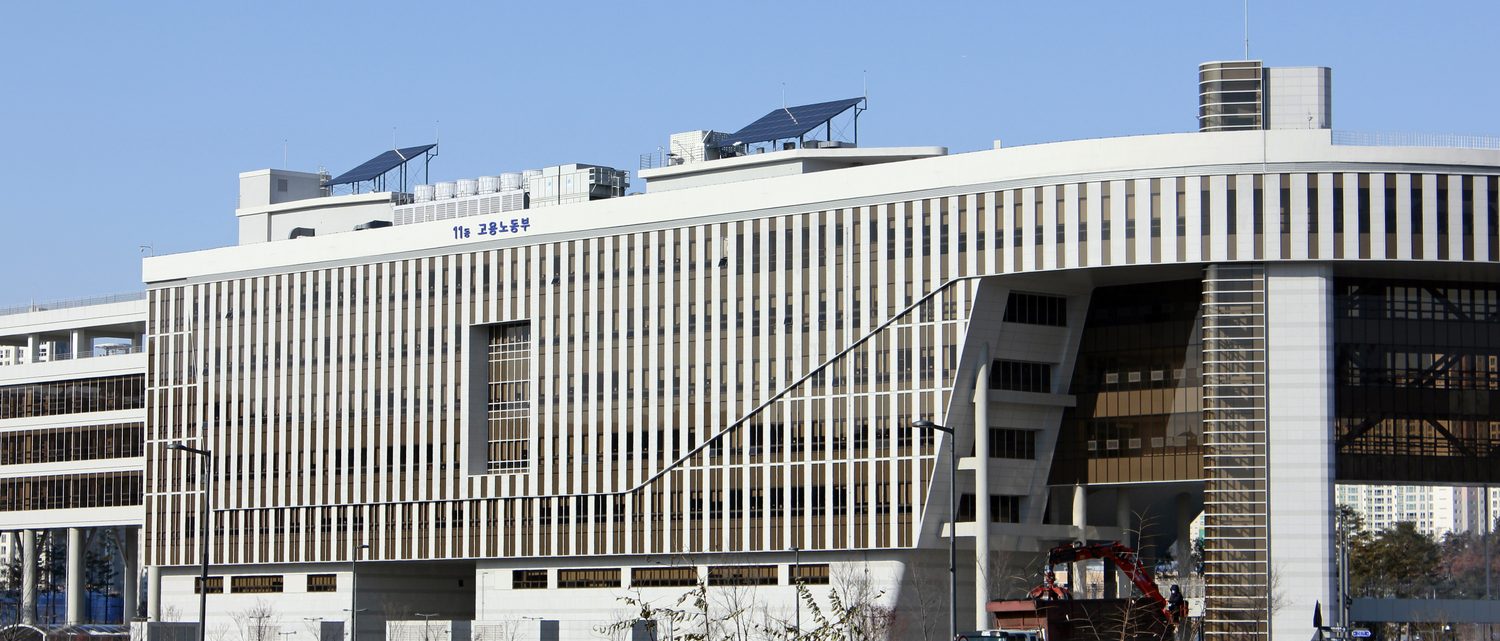
Building 11 of Government Complex Sejong, home of the Ministry of Employment and Labor (고용노동부), which issues the minimum wage notice each August. Photo: Minseong Kim, Wikimedia Commons, CC BY-SA 4.0 (2014); cropped.
For students, your TOPIK level sets how many hours you may work — the standard grammar book for getting there: Korean Grammar in Use, BeginningAffiliate link. As an Amazon Associate, EpicKor earns from qualifying purchases at no extra cost to you.
Quick Guide: Korea's minimum wage for 2027 and 2026
| Year | Per hour (시간급) | Per month, 209 hours (월 환산액) | Rise |
|---|---|---|---|
| 2027 (from 1 January) | ₩10,700 (≈US$7.87) | ₩2,236,300 (≈US$1,644) | +₩380, +3.7% |
| 2026 (now) | ₩10,320 (≈US$7.59) | ₩2,156,880 (≈US$1,586) | +₩290, +2.9% |
| 2025 | ₩10,030 | ₩2,096,270 | +1.7% |
| 2024 | ₩9,860 | ₩2,060,740 | +2.5% |
| Per 8-hour day | ₩85,600 in 2027, ₩82,560 in 2026 | ||
| Who is covered | Every worker at every business with at least one employee, of any nationality and on any visa. Exceptions: domestic workers hired by a household, businesses that employ only relatives living together, and seafarers (who have their own law) | ||
| Weekly holiday pay (주휴수당) | One paid day a week for anyone scheduled 15 or more hours a week; this is why a full-time month counts as 209 hours, not 174 | ||
| Probation | 90% (₩9,630 in 2027) only for the first three months of a contract of one year or more, and never for simple manual work | ||
| Where to report | Ministry of Employment and Labor 1350; Foreign Workforce Counseling Center 1577-0071 (multilingual); online at labor.moel.go.kr | ||
The rate is one national number. The Commission voted down a separate rate by industry, 11 votes to 14, so a convenience store in Seoul and a farm in South Jeolla owe the same ₩10,700 from January.
Sooez 13-pocket expanding file folder — an A4 accordion file for contracts and payslips Every wage claim in Korea is decided on paper: the signed contract (근로계약서), each monthly payslip (임금명세서), and your own record of hours. Korean documents are A4, and this file takes A4 flat. One pocket a month, and a year of evidence fits in a bag. As an Amazon Associate, EpicKor earns from qualifying purchases at no extra cost to you.
See the Sooez expanding file on AmazonHow 2027's ₩10,700 was decided
The Minimum Wage Commission, 27 members split evenly between labour, business and the public interest, voted on 14 July 2026. After twelve rounds of offers the two sides were ₩30 apart, labour at ₩10,730 and business at ₩10,700, and the business figure won 15 votes to 11. The Commission estimated that 660,000 to 2.98 million workers will need a raise to reach it, and the ministry published the rate as a formal notice (고시) on 5 August, the legal deadline. If your contract states only a monthly salary, divide it by 209 (for a 40-hour week) to check it.
Where the 209-hour month comes from
A 40-hour week averages about 174 hours a month. The other 35 hours are weekly holiday pay, 주휴수당 (juhyu sudang). Article 55 of the Labor Standards Act (근로기준법) gives every worker at least one paid day off a week, and the Minimum Wage Act counts that paid day as part of the monthly minimum.
The arithmetic is: 40 working hours plus 8 paid holiday hours is 48 hours a week, and 48 × 365 ÷ 7 ÷ 12 = 208.6, rounded to 209. ₩2,236,300 is what 40 hours a week must pay once the paid day off is included.
For part-timers this matters more than the hourly rate:
- Scheduled 15 hours a week or more: you earn holiday pay in proportion, (weekly hours ÷ 40) × 8 hours at your rate, for each week you work your scheduled days. At 20 hours a week in 2027 that is 20 hours of work plus 4 paid hours, ₩256,800 a week rather than ₩214,000, and about ₩1.12 million a month.
- Under 15 hours a week (averaged over four weeks): Article 18 of the Labor Standards Act removes weekly holiday pay and paid annual leave. That is why some part-time rotas stop at 14 hours; the hourly minimum still applies.
- Effective hourly rate: for a full-time worker, ₩10,700 with holiday pay works out to ₩12,840 per hour actually worked. A job advert offering "₩11,000 an hour, holiday pay included" is below the minimum for anyone on 15 hours or more a week.
You might like: Jobs in South Korea: Career Sectors and Work Culture
Who is covered: every visa, with different limits on work
The Minimum Wage Act (최저임금법) has no nationality clause. Article 3 applies it to "every business or workplace that employs workers." What differs by visa is not the wage but whether you may work at all, where, and for how many hours:
| Visa | Who | Minimum wage? | What limits the work |
|---|---|---|---|
| E-9 (비전문취업) | Employment Permit System workers in factories, farms, fishing, construction and some services | Yes | A standard contract (표준근로계약서) signed before arrival; changing employer needs a permitted reason |
| H-2 (방문취업) | Visiting-employment ethnic Koreans, mostly from China and Central Asia | Yes | Listed industries only; no new H-2 visas since 12 February 2026, when the category was merged into F-4 |
| D-2 / D-4 (유학 / 일반연수) | Degree students / language-school students | Yes | Part-time work only with a permit (체류자격외 활동허가) obtained first; roughly 10–35 hours a week in term depending on course, year and TOPIK level; D-4 students only after six months |
| H-1 (관광취업) | Working holiday | Yes | Paid work is part of the visa; programme rules still apply |
| F-2, F-4, F-5, F-6 | Residents, overseas Koreans, permanent residents, marriage migrants | Yes | Few or no job restrictions (F-4 still bars a published list of simple-labour jobs such as delivery, cleaning and security-guard work; the list was narrowed on 12 February 2026) |
| E-7 and other skilled visas | Professionals | Yes | Immigration sets separate, higher salary floors for these visas |
A student working without the permit risks their visa, but the employer still owes the minimum wage: two separate laws.
Probation, small workplaces, and what does not count
The probation cut is narrow. Article 5 of the Minimum Wage Act and its enforcement decree allow 90% of the minimum (₩9,630 an hour, ₩2,012,670 a month in 2027) only when all three conditions hold: the contract runs one year or more, the worker is on probation, and it is within the first three months. Since 2018 it cannot be used at all for simple manual work (단순노무), the category that covers most convenience-store, restaurant-floor, cleaning and packing jobs. A three-month contract with a "training wage" is simply below the minimum.
Workplaces with fewer than five employees (5인 미만 사업장) follow only part of the Labor Standards Act. What still applies: the full minimum wage, weekly holiday pay, the written contract, rest breaks, notice of dismissal, and severance pay (퇴직금) after a year of 15+ hours a week. What does not: the 50% premium for overtime, night and holiday work, paid annual leave, protection against unfair dismissal, and the 52-hour weekly cap. A night shift at a small café can therefore legally pay ₩10,700 an hour. It cannot legally pay ₩10,000.
What counts towards the minimum (산입범위). Article 6 of the Minimum Wage Act counts wages paid at least once a month for your contracted hours. Since 2024 that has included, in full, monthly bonuses and cash allowances for meals, housing and transport, after a five-year phase-in. It excludes overtime, night and holiday premiums, bonuses paid less often than monthly, and anything given in kind. A free dormitory or free meals do not count towards your minimum wage.
That last point is where E-9 pay disputes usually start. Instead of counting in-kind housing, the ministry's 2017 guideline lets an employer deduct accommodation and meals from wages, within caps: up to 20% of monthly ordinary wages for housing plus meals (13% if the housing is a temporary structure such as a container or a vinyl greenhouse), or 15% for housing alone (8% for temporary structures). It requires the worker's written consent, in their own language. A deduction above the cap, or one never agreed in writing, is unpaid wages.
Gross is not net: what a minimum-wage month pays out
The monthly figure is gross, and English guides that assume a flat 20% deduction overstate it at this pay level. EpicKor's estimate for a 2026 full-time minimum-wage month (₩2,156,880), using 2026 employee rates:
| Deduction | 2026 employee rate | Estimated monthly amount |
|---|---|---|
| National pension (국민연금) | 4.75% | about ₩102,400 |
| Health insurance (건강보험) | 3.595% | about ₩77,500 |
| Long-term care insurance (장기요양보험) | 13.14% of the health premium | about ₩10,200 |
| Employment insurance (고용보험) | 0.9% | about ₩19,400 |
| Total before income tax | about ₩209,500 (9.7%) |
Income tax at this level is small, so take-home pay is roughly ₩1.9 million. Which deductions apply depends on visa and nationality: the national pension, for example, excludes student visas and some nationalities through reciprocity rules. In 2027 the employee's pension share rises to 5% as the 2025 reform phases in. Our guide to paying for a doctor without insurance shows what the health insurance deduction buys you.
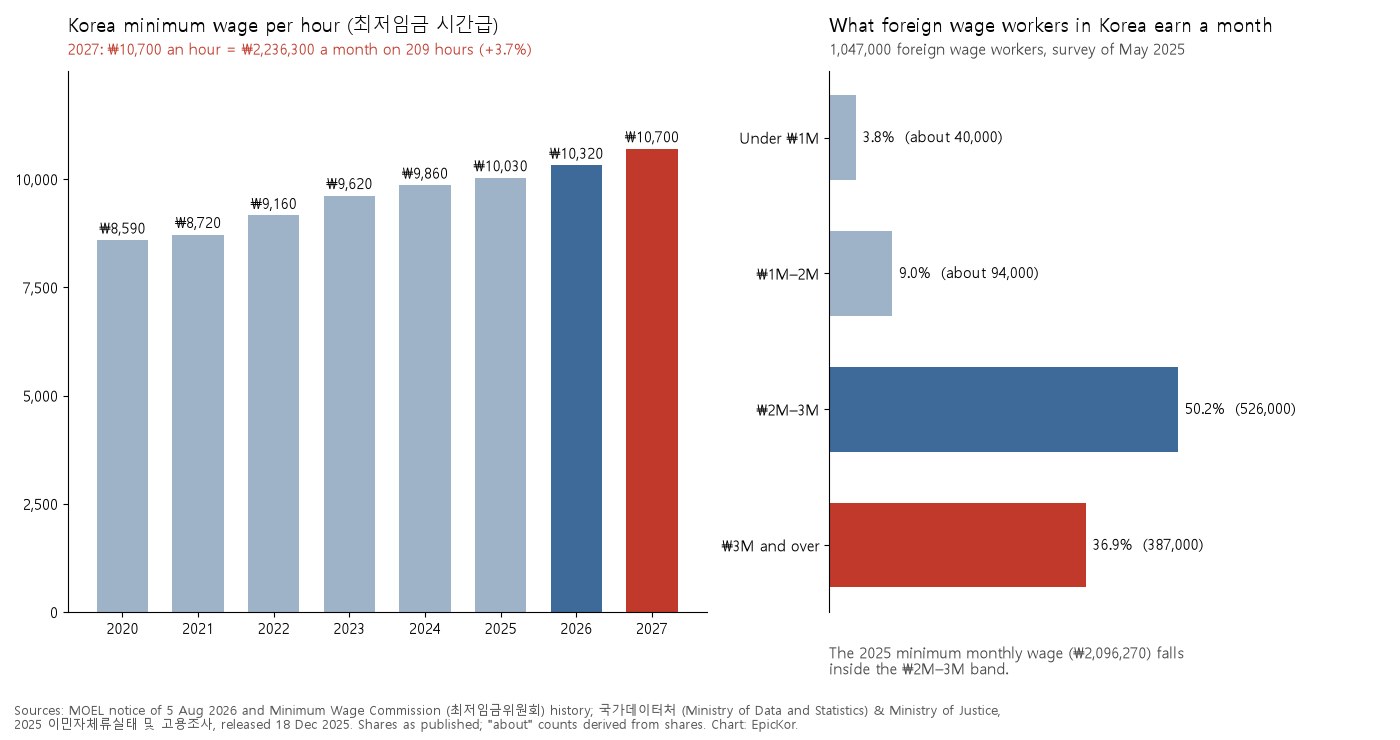
Chart drawn by EpicKor from the Minimum Wage Commission's rate history, the Ministry of Employment and Labor notice of 5 August 2026, and the 2025 immigrant survey (released 18 December 2025).
What foreign workers in Korea actually earn
The immigrant survey is Korea's official count of foreigners at work. Its 2025 round (May 2025, foreigners aged 15+ resident 91 days or more) found 1,692,000 resident foreigners, of whom 1,109,000 were employed. 1,047,000 of them were wage workers, 94.4% of all employed foreigners. Their monthly wages:
- Under ₩1 million: 3.8%
- ₩1–2 million: 9.0% (about 94,000 people)
- ₩2–3 million: 50.2% (526,000)
- ₩3 million or more: 36.9% (387,000), up from 354,000 in the 2024 survey
The 2025 full-time minimum was ₩2,096,270, so most foreign workers earn at or above it; the 12.8% under ₩2 million include most working students, who average 23.3 hours a week. The breakdown by visa, published on 10 March 2026:
| Visa group (2025 survey) | Largest pay band | Other detail |
|---|---|---|
| Non-professional employment, E-9 (비전문취업) | ₩2–3 million: 68.9% | Average 45.9 hours a week |
| Visiting employment, H-2 (방문취업) | ₩2–3 million: 42.8% | Category merged into F-4 in February 2026 |
| International students with jobs (유학생) | ₩1–2 million: 51.2% | Average 23.3 hours a week; 83.4% in retail, hotels and restaurants |
| Professionals (전문인력) | ₩3 million+: 50.8% | |
| Overseas Koreans, F-4 (재외동포) | ₩3 million+: 46.3% | |
| Permanent residents, F-5 (영주) | ₩3 million+: 59.3% | |
| Marriage migrants, F-6 (결혼이민) | ₩2–3 million: 48.9% |
The E-9 line explains the headline: a factory worker averaging 45.9 hours a week passes ₩2 million on the base rate alone, and overtime at 150% pushes many towards ₩3 million. The pay comes from the length of the week, not the hourly rate. By industry, 44.9% of employed foreigners were in mining and manufacturing and 20.4% in retail, hotels and restaurants.
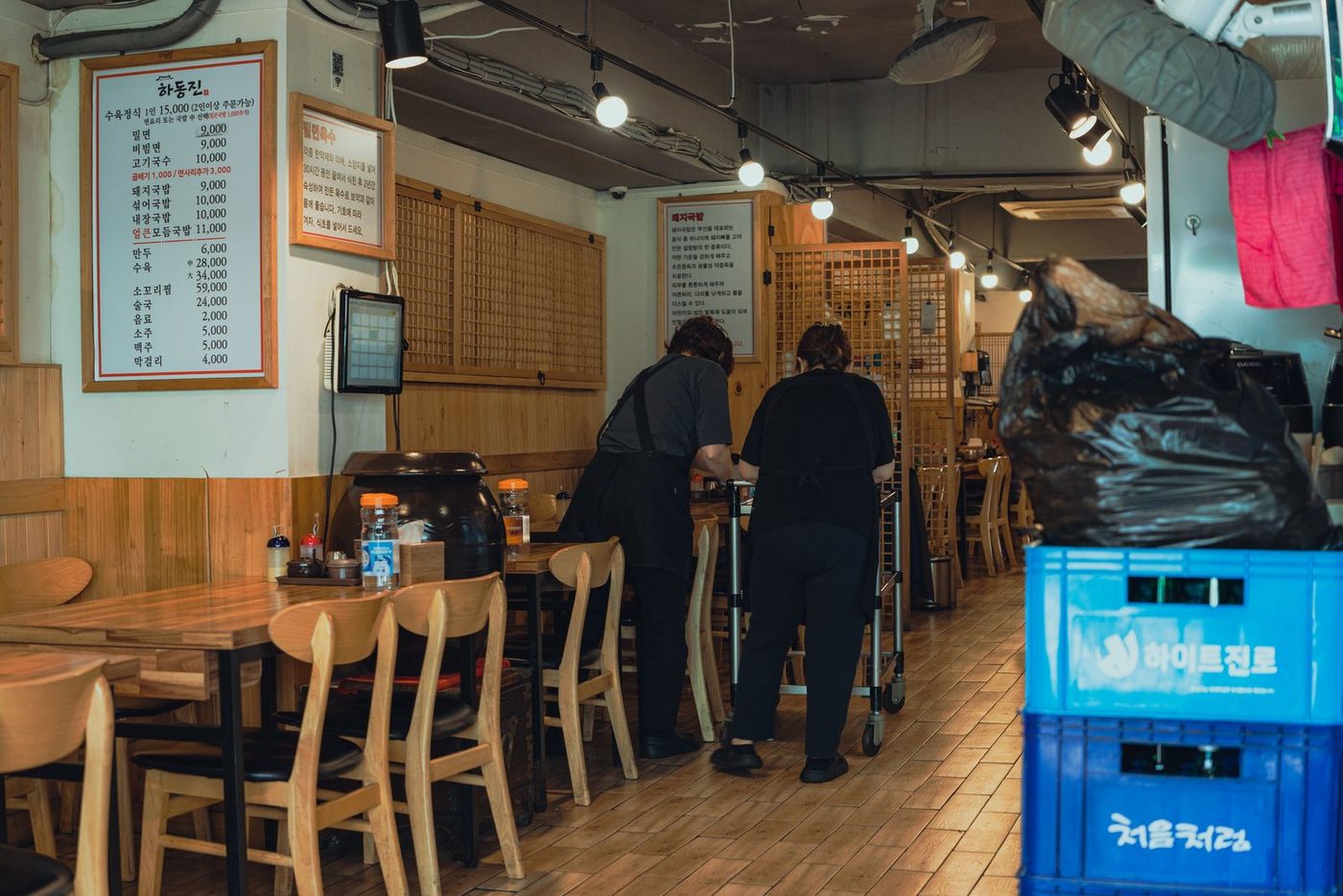
Staff at a Korean restaurant. Restaurants, hotels and shops employ 83.4% of working international students in the 2025 survey. Photo: Theodore Nguyen, Pexels.
What the English-language guides get wrong
- Stale rates. English Wikipedia's table ends at 2024 (₩9,860); salary guides updated in September 2026 still give ₩10,320 as the only figure. From January they are ₩380 an hour short.
- "Hourly × 40 × 4." That gives about ₩1.71 million for 2027 and leaves out weekly holiday pay. The legal monthly figure is ₩2,236,300.
- "Foreigners can be paid less on probation" or "housing is provided, so the salary is lower." Neither is true as stated: see the probation and in-kind rules above.
- An "average foreigner salary" with no source. The official figure is a distribution: half of foreign wage workers are in the ₩2–3 million band.
You might like: Korea's Digital Nomad Visa (F-1-D): 743 Issued, the New Income Bar, and What a Month in Seoul Costs
Paid less than the minimum? How to report it
Paying below the minimum is a crime under Article 28 of the Minimum Wage Act: up to three years in prison or a fine of up to ₩20 million. Wage claims can be made for three years (Article 49 of the Labor Standards Act), including after you leave the job.
- Collect the evidence. Contract, itemised payslips (임금명세서, which employers must give), bank deposits, and your own record of hours, with photos of rotas or messages.
- Call for advice. The Ministry of Employment and Labor's customer centre, 1350, handles labour-law questions (weekdays, mainly in Korean). E-9 and H-2 workers can call the Foreign Workforce Counseling Center, 1577-0071, run by the ministry and the HRD Service of Korea, with counsellors in the main sending-country languages.
- File a complaint (진정). Online through the ministry's labour portal (labor.moel.go.kr), or in person at the regional employment and labour office (지방고용노동청) for your workplace. A labour inspector investigates and can order payment.
- If the employer cannot pay. For businesses that have closed or cannot pay, a state substitute payment (대지급금) covers part of unpaid wages. The inspector's confirmation of the arrears is the usual starting point.
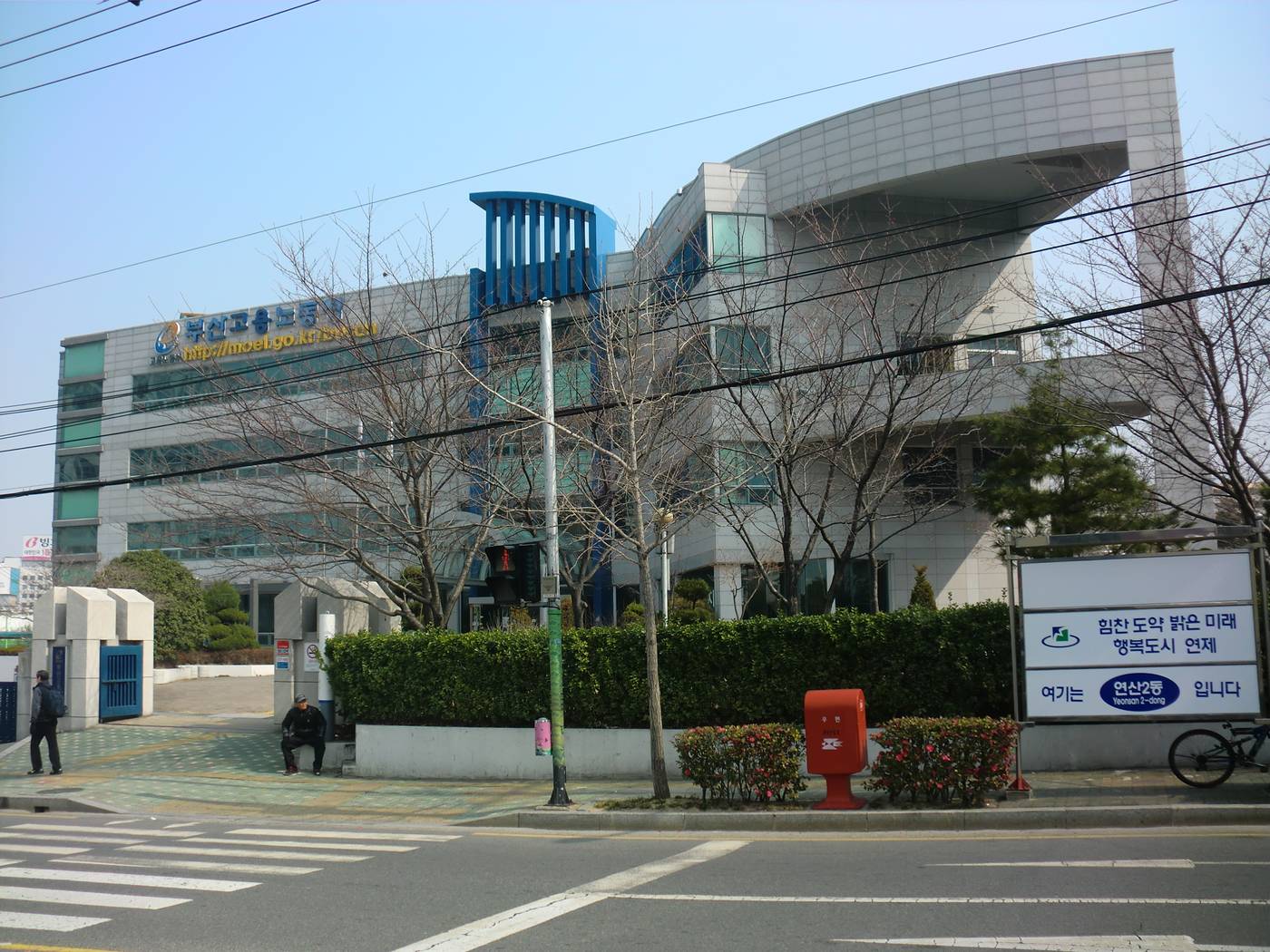
The Busan Regional Employment and Labor Office (부산지방고용노동청) in Yeonje-gu, one of the regional offices where wage complaints are filed and investigated. Photo: hyolee2, Wikimedia Commons, CC BY-SA 3.0 (2014).
The honest part: what this guide cannot tell you
- The minimum is a floor, not a market rate. Many café and convenience-store jobs pay exactly the minimum; skilled and bilingual work pays more.
- ₩2.24 million does not go far in Seoul. A Seoul officetel averaged ₩949,000 a month in June 2026; our guide to rent in Seoul, our month in Seoul cost guide and our guide to paying in Korea cover the spending side.
- Your visa may matter more than your wage. A student who reports underpayment for unpermitted work has a real claim to the money, and also a visa problem. Get advice before filing.
- The survey is from May 2025. The 2026 round (reference month May 2026) is due around December.
- Deduction figures are estimates. Payroll, dependants and visa decide the exact amount.
FAQ
Q: What is the minimum wage in Korea for 2027? A: ₩10,700 an hour from 1 January 2027, up 3.7% from ₩10,320 in 2026. On the standard 209-hour month that is ₩2,236,300, and ₩85,600 for an 8-hour day. The Ministry of Employment and Labor gave notice of the rate on 5 August 2026.
Q: What is the minimum wage in Korea per month? A: ₩2,156,880 in 2026 and ₩2,236,300 in 2027, for a 40-hour week. The monthly figure uses 209 hours because it includes one paid holiday a week (주휴수당). Take-home pay after social insurance is roughly ₩1.9 million in 2026.
Q: Does the Korean minimum wage apply to foreigners? A: Yes. The Minimum Wage Act applies to every business with employees, with no nationality or visa exception, whether you hold an E-9, H-2, D-2, D-4, H-1, F or E-7 visa. The only exclusions are domestic workers hired by households, family-only businesses and seafarers.
Q: How much do foreign workers earn in Korea? A: In the government's 2025 survey of 1,047,000 foreign wage workers, 50.2% earned ₩2–3 million a month, 36.9% earned ₩3 million or more, 9.0% earned ₩1–2 million and 3.8% under ₩1 million. Among international students with jobs, the largest group (51.2%) earned ₩1–2 million.
Q: Where can I report unpaid wages in Korea? A: Call 1350 (Ministry of Employment and Labor) or, for E-9 and H-2 workers, 1577-0071 (Foreign Workforce Counseling Center). File a complaint online at labor.moel.go.kr or at your regional employment and labour office. Claims can be made up to three years after the wages were due.
Sources
- Ministry of Employment and Labor (고용노동부), press release on the 2027 minimum wage notice (고시), 5 August 2026 (moel.go.kr, news_seq 19744): ₩10,700 an hour, ₩2,236,300 a month on 209 hours, +₩380 (3.7%), one rate for all business types.
- Minimum Wage Commission (최저임금위원회), rate history by year (minimumwage.go.kr): hourly, daily and 209-hour monthly figures for 2020–2027.
- Korea.net (Ministry of Culture, Sports and Tourism), 14 July 2026: decision at the Commission's plenary meeting in Sejong; affected-worker estimates of 660,000 (3.8%) and 2.98 million (13.3%). KB Kookmin Bank's KB Think, July 2026: final proposals ₩10,730 and ₩10,700, vote 15–11 with one invalid ballot, industry-specific rates rejected 11–14, gig-worker extension rejected 11–15.
- Minimum Wage Act (최저임금법) Articles 3, 5, 6 and 28, and Enforcement Decree Article 3 (law.go.kr); Labor Standards Act (근로기준법) Articles 18, 49 and 55, and Enforcement Decree Article 7 with Annex 1 (rules for workplaces with four or fewer employees).
- Ministry of Employment and Labor, guideline on accommodation and meal deductions for foreign workers (외국인근로자 숙식정보 제공 및 비용징수 관련 업무지침, 2017), as summarised by the ministry and HRD Korea: 20% / 13% / 15% / 8% caps and written consent in the worker's language.
- Ministry of Data and Statistics (국가데이터처) and Ministry of Justice, 2025 이민자체류실태 및 고용조사, released 18 December 2025 via 정책브리핑 (korea.kr), with 매일노동뉴스 (18 December 2025) for the full wage bands; the visa-status breakdown released 10 March 2026, reported by 이투데이, 브레이크뉴스 and 투데이신문. 2024 comparison from the 2024 release (17 December 2024).
- Ministry of Justice / HiKorea and 찾기쉬운 생활법령정보 (easylaw.go.kr), part-time work rules for D-2 and D-4 students, page updated 15 August 2026.
- HRD Service of Korea (한국산업인력공단), Foreign Workforce Counseling Center, 1577-0071.
- 2026 social insurance employee rates (national pension 4.75%, health insurance 3.595%, long-term care 0.9448% of pay, employment insurance 0.9%), as published by the National Health Insurance Service and National Pension Service for 2026; deduction amounts are EpicKor calculations.
- English-language comparison, read 29 September 2026: English Wikipedia, "Minimum wage in South Korea" (table ends at 2024); wagecentre.com, "Salary in South Korea" (updated 9 September 2026, 2026 rate only).
You Might Also Like
Korea Health Insurance for Foreigners (2026): At Least ₩158,630 a Month After Six Months — Students, Workers, and What Happens If You Don't Pay
Foreigners in Korea are enrolled in national health insurance after six months and billed at least ₩158,630 a month in 2026. Students pay half, ₩79,320. A month behind and most foreigners lose cover until they pay; immigration shortens the visa extension.
How Much Is Rent in Seoul (2026)? Officetels Average ₩949,000 a Month — Jeonse vs Wolse, Deposits, and What Foreigners Need
Seoul officetels average ₩949,000 a month on a ₩22.85 million deposit (Korea Real Estate Board, June 2026); villa one-rooms ₩670,000, apartments ₩1.64 million. Jeonse vs wolse, the 5% conversion cap, agent fees and protecting a deposit.
Legal Age in Korea: Adult at 19, Drinking From 1 January of the Year You Turn 19, Voting at 18 — Every Age Limit in Korean Law
Korea's adult age is 19, but alcohol and cigarettes go by birth year: anyone born in 2007 could buy them from 1 January 2026. Voting and driving are 18, marriage 18 with parental consent, consent 16 — every age limit, with the Korean law article.