What a Doctor Costs in Korea Without Insurance (2026): ₩18,840 at a Clinic, ₩68,070 to Walk Into a Regional ER, and Why the 119 Ambulance Is Free
Last updated: September 2026. Fee figures are calculated from Korean primary sources: the health ministry's 응급의료수가기준 notice (고시 제2014-83호, in force since 5 June 2014) for the emergency-department point values, the National Health Insurance Service's published conversion factors for 2026, the Health Insurance Policy Deliberation Committee's October 2025 decision for the clinic consultation fee, and the Emergency Medical Service Act enforcement rules amended on 14 August 2026 for ambulance fares. This is a guide to money and procedure. It contains no medical advice of any kind.
Every English page about going to a hospital in Korea without insurance gives you a range, and the ranges do not agree. One says an emergency room costs ₩30,000 to ₩70,000. Another says a cold costs about seven dollars. A third gives one figure and labels it the wrong grade of hospital. There is a specific reason none of them can tell you the number.
Korea's emergency-department access fee — 응급의료관리료, the charge you pay simply for walking through the emergency-room door — is not written in won anywhere in Korean law. It is written as relative value points. The ministry's fee notice lists three: 812.28, 703.98 and 270.76. To turn a point into money you multiply by that year's conversion factor (환산지수), renegotiated every May and changed every January. The source document contains no currency, so English pages can only approximate it.
This guide does the multiplication, sets it against what a neighbourhood clinic charges for the same illness, and covers the two ambulance fares — one of which changed five weeks ago, and one of which is zero.
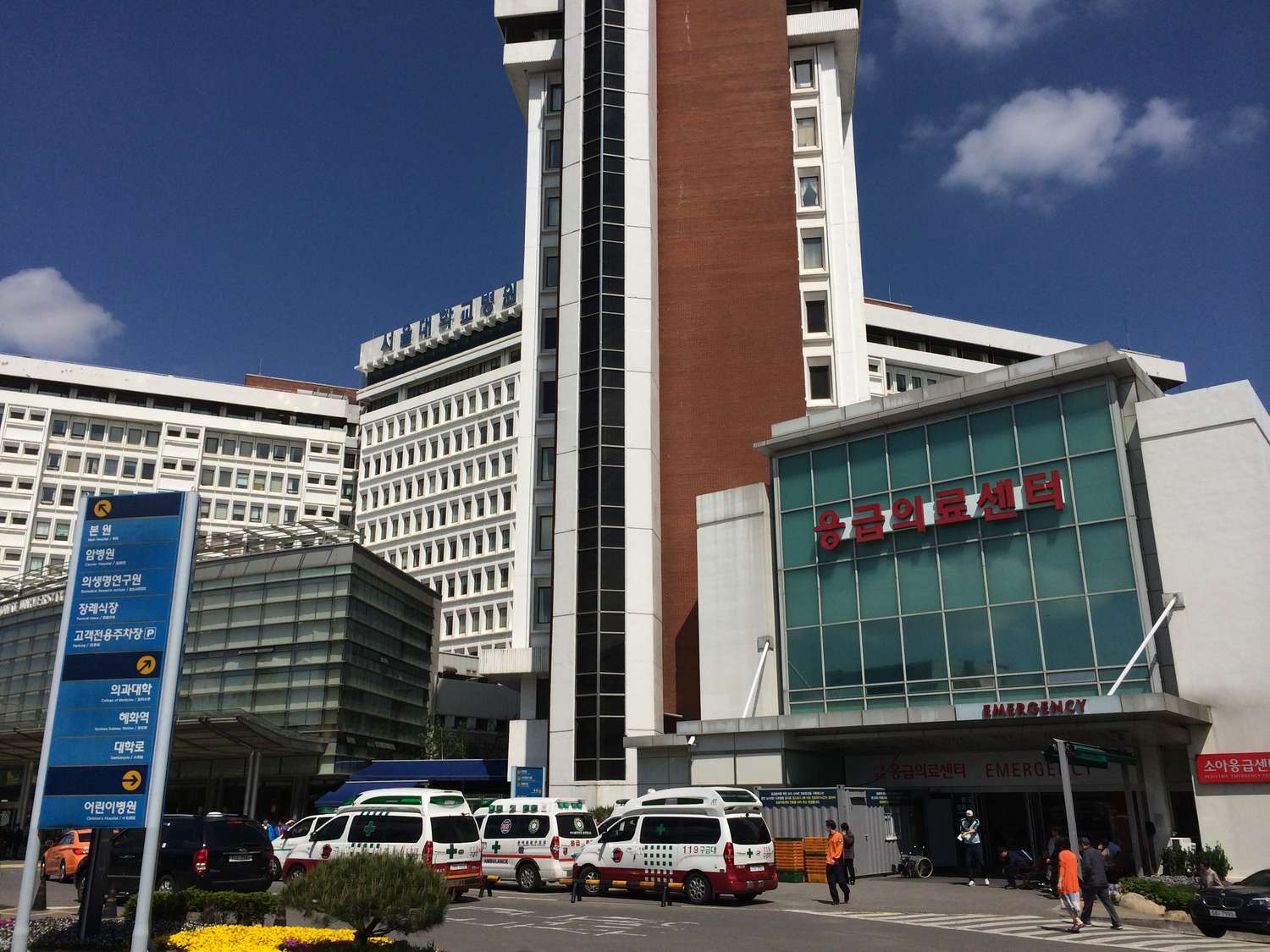
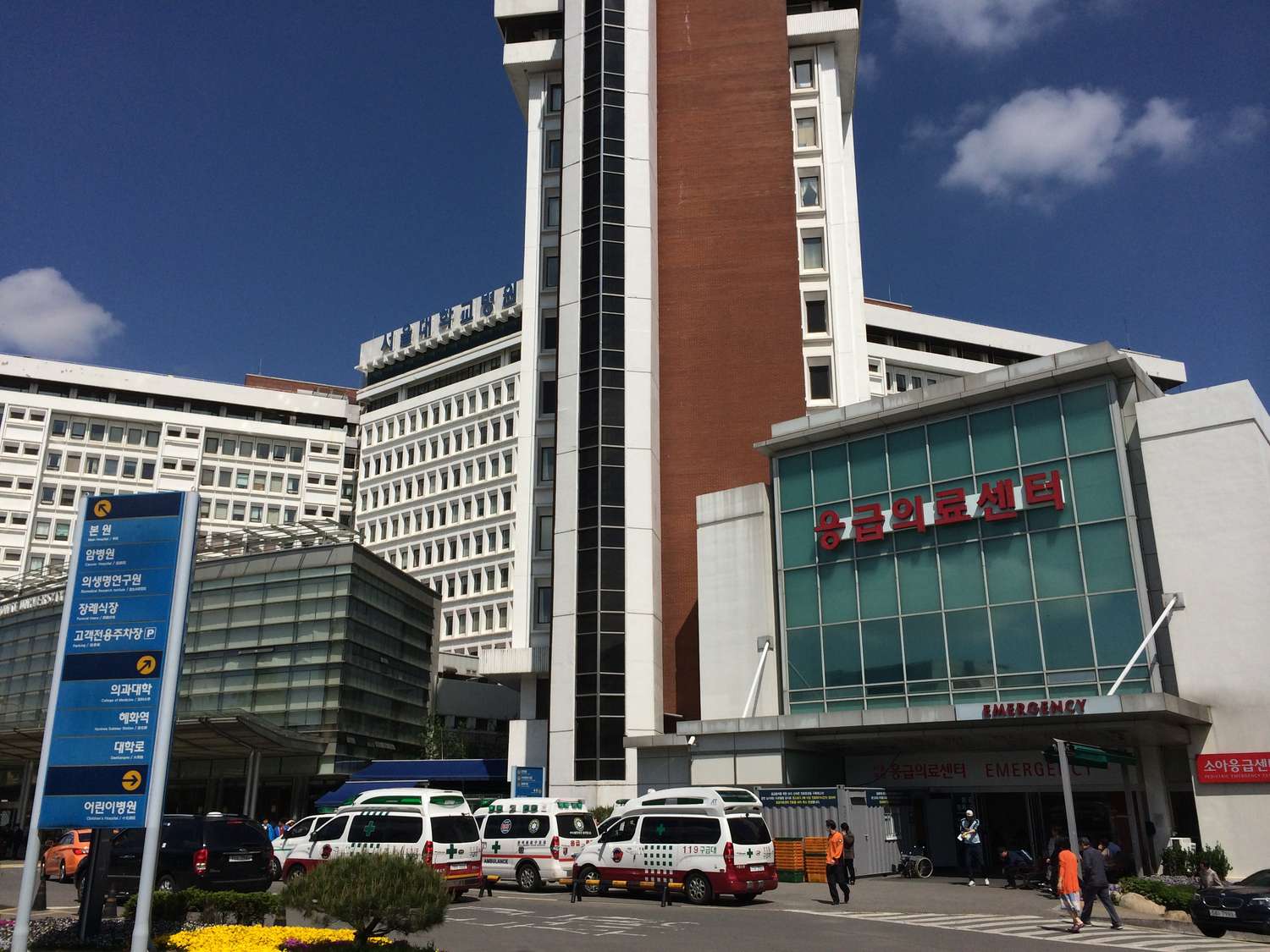
Seoul National University Hospital's emergency department. E-Gen, the national emergency-medicine portal, classifies this one as a 권역응급의료센터 — the top grade, and the ₩68,070 access fee. Photo: parkyongjoo, Wikimedia Commons, CC BY-SA 3.0.
The Korean registration desk asks for one thing before anything else: your passport. Whatever you carry it in should also hold your insurance card and the itemised receipt you will need to claim the bill back — a BAGSMART RFID travel wallet is the plain version of that, one zip with document slots. As an Amazon Associate, EpicKor earns from qualifying purchases at no extra cost to you.
Quick Guide: what each door costs in Korea in 2026
| Door | 2026 figure | Where the number comes from |
|---|---|---|
| Neighbourhood clinic (의원), first visit | ₩18,840 | 197.12 points × ₩95.6, from 1 January 2026 |
| Clinic, repeat visit (재진) | ₩13,370 | "Repeat" means the same illness within 30 days |
| Tertiary hospital (상급종합병원), first visit | ₩29,580 | Wonju Severance published list, 1 January 2026 |
| ER access fee — central / regional centre (중앙·권역응급의료센터) | ₩68,070 | 812.28 points × ₩83.8 |
| ER access fee — specialist / local centre (전문·지역응급의료센터) | ₩58,990 | 703.98 points × ₩83.8 |
| ER access fee — local institution (지역응급의료기관) | ₩22,690 | 270.76 points × ₩83.8 |
| 119 ambulance | ₩0 | No fee under any circumstances |
| Private general ambulance, first 10 km | ₩40,000 (+₩1,500/km) | Up from ₩30,000 on 14 August 2026 |
| Private specialised ambulance, first 10 km | ₩95,500 (+₩2,300/km) | Up from ₩75,000 on 14 August 2026 |
| Night, Sunday and public-holiday surcharge | +30% | On the basic-consultation component, not the whole bill |
The access fee is not the bill. It is the cover charge — consultation, tests, materials and treatment are billed on top. What the table gives you is the one number that differs by a factor of three depending only on which building you walk into.
Lonely Planet Korean Phrasebook & Dictionary — the one thing worth carrying for this Korean hospital registration forms, the triage question at the ER desk and the itemised receipt your insurer will want are all in Korean, and translation apps struggle with a paper form on a clipboard. This is the only product we are putting in this article: there is no gadget that makes a Korean hospital bill smaller, and pretending otherwise would be padding. As an Amazon Associate, EpicKor earns from qualifying purchases at no extra cost to you.
See the Korean phrasebook on AmazonThe clinic is the cheap door, and it is cheap by a factor of three
A Korean 의원 (uiwon) is a one- or two-doctor practice, usually on the second to fifth floor of an ordinary commercial building, with a specialty on the sign: 내과 (internal medicine), 이비인후과 (ENT), 정형외과 (orthopaedics), 피부과 (dermatology). There are tens of thousands of them, and they are the level of care the Korean system expects an ordinary illness to use.
On 1 January 2026 the clinic first-visit consultation fee (초진진찰료) rose to ₩18,840. The arithmetic is public: the Health Insurance Policy Deliberation Committee met on 31 October 2025 and raised the relative value points for a clinic first visit from 195.63 to 197.12, worth ₩140. Multiply 197.12 by the 2026 clinic conversion factor of ₩95.6 and you get ₩18,844.7, billed as ₩18,840. A repeat visit (재진진찰료) is ₩13,370 — and "repeat" is a defined term, not a courtesy. You are a 재진 patient if you come back for the same condition while it is still being treated, or within 30 days of the treatment being closed off. Beyond that you are a new patient again.
One more rise is already scheduled. Under the health ministry's 건강보험 수가 구조 혁신방안, confirmed on 25 June 2026, the clinic first-visit fee goes up 6 percent to ₩19,980 and the repeat fee to ₩13,900, phased in from December 2026. If you are reading this in 2027, add that.
For comparison, the same first consultation at a 상급종합병원 — a tertiary teaching hospital, the largest tier — is ₩29,580, according to the price list Wonju Severance Christian Hospital published for 1 January 2026. Same illness, same day: roughly sixty percent more, before the emergency room is even in the conversation.
You might like: Dental Implant Cost in Korea (2026): The Government's Own Price Data Says ₩1.19 Million
Why no English page can tell you what a Korean ER costs
Here is the document. The ministry's 응급의료수가기준 (Emergency Medical Fee Standards), notice 제2014-83호, in force since 5 June 2014, is a short text whose Appendix 1 — 응급의료수가 기준액표 — opens with three rows and one column of numbers:
| Grade of emergency medical institution | Relative value points | × ₩83.8 (2026) | × ₩82.2 (2025) |
|---|---|---|---|
| 중앙응급의료센터, 권역응급의료센터 Central and regional emergency medical centres | 812.28 | ₩68,070 | ₩66,770 |
| 분야별전문응급의료센터, 지역응급의료센터 Specialist and local emergency medical centres | 703.98 | ₩58,990 | ₩57,870 |
| 지역응급의료기관 Local emergency medical institutions | 270.76 | ₩22,690 | ₩22,260 |
That is the whole mechanism. The law fixes the ratio between the three grades and nothing else; the money comes from the conversion factor, which the National Health Insurance Service negotiates every May and publishes. For hospital-grade institutions it went from ₩82.2 in 2025 to ₩83.8 in 2026, a rise of 1.95 percent — so the access fee at a regional centre went up ₩1,300 on 1 January without any rule changing.
Nothing newer has replaced the notice: the ministry's administrative-rules board lists the full history — 1995-7, 1995-62, 1997-69, 1998-62, 2000-12, 2000-34, 2013-158, and then 2014-83, with nothing after it.
The notice also settles a question the English guides fudge. Its own wording: "응급환자에 해당되지 않는 경우에는 환자본인이 응급의료관리료 전액을 부담한다" — if you are not an emergency patient, you pay the access fee in full yourself. It is charged once, on the first day, and walking out again because the wait is long does not undo it.
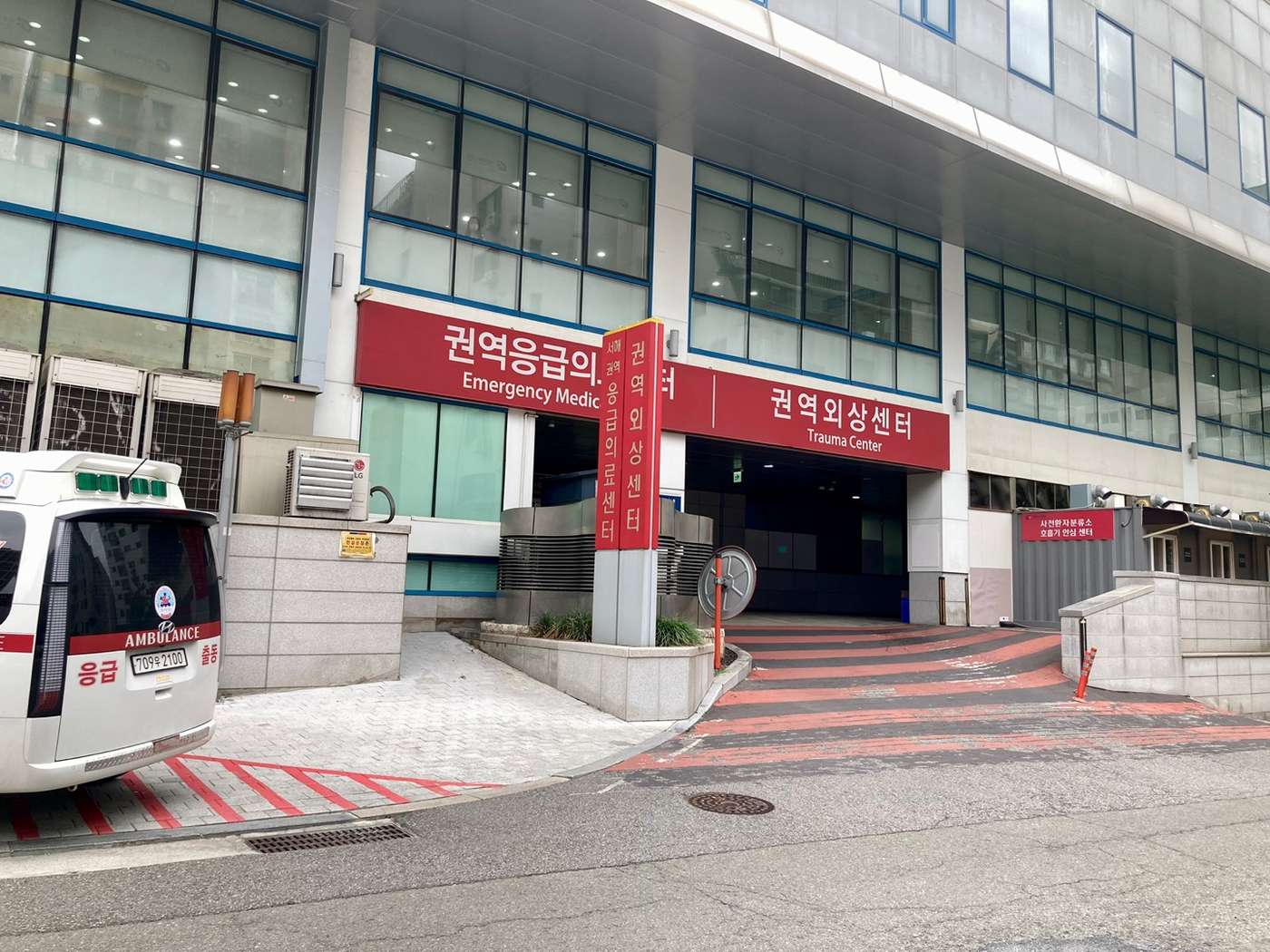
The sign tells you the tariff. 권역응급의료센터 is the top grade in the table above — 812.28 points, ₩68,070 in 2026. Photo: Narubaru7, Wikimedia Commons, CC BY 4.0 (2024).
How to tell which grade of ER you are walking into
The grade is not a secret and it is not a judgement about quality — it is a designation, printed on the building and published online. In the health ministry's announcement of 15 April 2026, Korea had 44 regional emergency medical centres, 14 specialist (paediatric) centres, 139 local emergency medical centres and 234 local emergency medical institutions.
The place to look it up is E-Gen (e-gen.or.kr), run by the National Emergency Medical Center. Its 응급실 찾기 (Find an emergency room) tool takes a province, a district and a neighbourhood, or your location, and lists every emergency room within 1, 3, 5 or 10 km. Each result carries the grade on the second line, before the phone number.
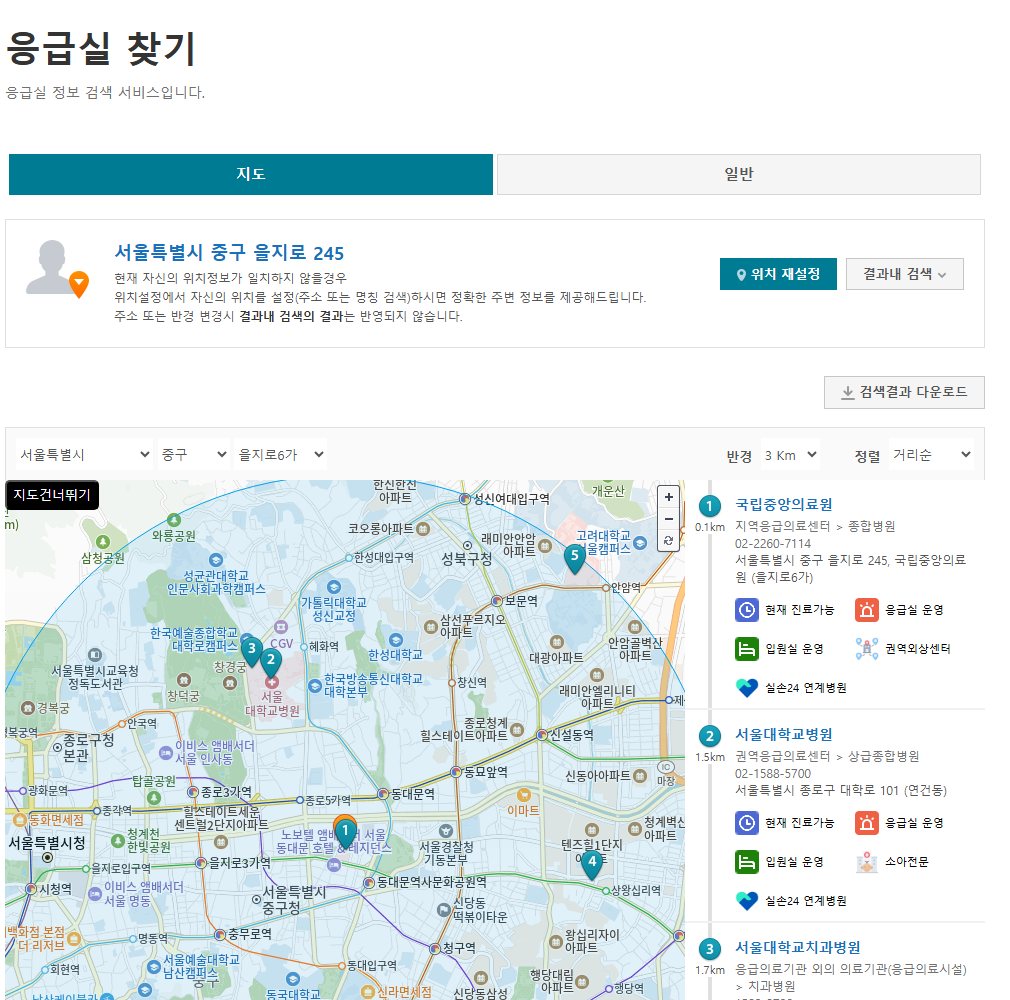
E-Gen's 응급실 찾기, searched from Euljiro in central Seoul. The second line of each result is the grade: National Medical Center is a 지역응급의료센터 (₩58,990), Seoul National University Hospital 1.5 km away is a 권역응급의료센터 (₩68,070). Screenshot by EpicKor, September 2026.
The finder also shows whether each ER is currently accepting patients (현재 진료가능) and whether it runs a trauma centre, and it has sister tools for hospitals, pharmacies and — usefully for the next section — private ambulance operators. The portal has an English section, but the emergency-room search itself is on the Korean site; a browser translator handles it.
One thing to diarise if you are here later this year: the current designations were awarded for three years and the next cycle runs 1 November 2026 to 31 October 2029, with the ministry intending to expand regional centres from 44 to around 60. A hospital that is a ₩58,990 door today may be a ₩68,070 door in November.
The 90 percent rule that probably does not apply to you
English guides for foreigners often repeat a rule from September 2024: go to an emergency room with something minor and you now pay 90 percent of the bill instead of the usual outpatient share. It is a real rule, and for an uninsured visitor it is the wrong rule.
The Health Insurance Review and Assessment Service published a question-and-answer sheet on 12 September 2024, the day before it took effect. Question 1-1 asks which institutions and which patients it covers, and the answer ends with one line: "대상 환자는 건강보험 환자를 대상으로 함" — the rule applies to national health insurance patients.
If you are not enrolled in Korean national health insurance, you were never inside that system, so there is no 10-percent-versus-90-percent to move between. You are billed as a non-covered patient at the institution's own posted price. The English pages that tell a tourist "you will pay 90 percent" are describing a Korean resident's bill.
For completeness: the rule as written applies at regional emergency medical centres, specialist emergency medical centres and regional trauma centres to KTAS level 4 and 5 patients, and at local emergency medical centres to KTAS level 5 only. Local emergency medical institutions — the ₩22,690 tier — are not in it at all.
The ambulance: 119 is free, and the private one got more expensive on 14 August
Korea runs two ambulance systems and they are priced at opposite ends of the scale.
The fire service's 119 ambulance is free. The National Fire Agency's own public-information page says so without qualification: "소방서에서 운영하고 있는 119구급대는 이송거리 환자의 수 등과 관계없이 어떠한 경우에도 요금을 징수하지 않습니다" — the 119 ambulance service collects no fee under any circumstances, regardless of distance or number of patients. There is no bill afterwards, no insurance paperwork, and no charge for a foreign passport holder.
Private ambulances — run by hospitals, non-profit foundations and licensed transport companies — are metered, and the meter changed on 14 August 2026, when an amendment to the Emergency Medical Service Act enforcement rules took effect. The new schedule:
| Private ambulance | Base fare (first 10 km) | Per km beyond 10 km |
|---|---|---|
| General (일반구급차), medical institution | ₩30,000 → ₩40,000 | ₩1,000 → ₩1,500 |
| General, non-profit corporation | ₩20,000 → ₩26,600 | ₩800 → ₩1,000 |
| Specialised (특수구급차), medical institution | ₩75,000 → ₩95,500 | ₩1,300 → ₩2,300 |
| Specialised, non-profit corporation | ₩50,000 → ₩63,600 | Not given in the ministry's summary |
Three other changes matter more than the headline numbers. The 20 percent surcharge window used to run from midnight to 4am; it now covers weekdays from 18:00 to 09:00 the next morning, plus all day Saturday and public holidays, and the night and weekend surcharges do not stack. There is a new waiting charge of ₩6,000 per 10 minutes once the ambulance has waited more than 30 minutes at the hospital during handover. And the amendment spells out what may not be added to the fare: medical equipment, procedures, consumables, road tolls, card-processing fees, and a charge for a family member riding along.
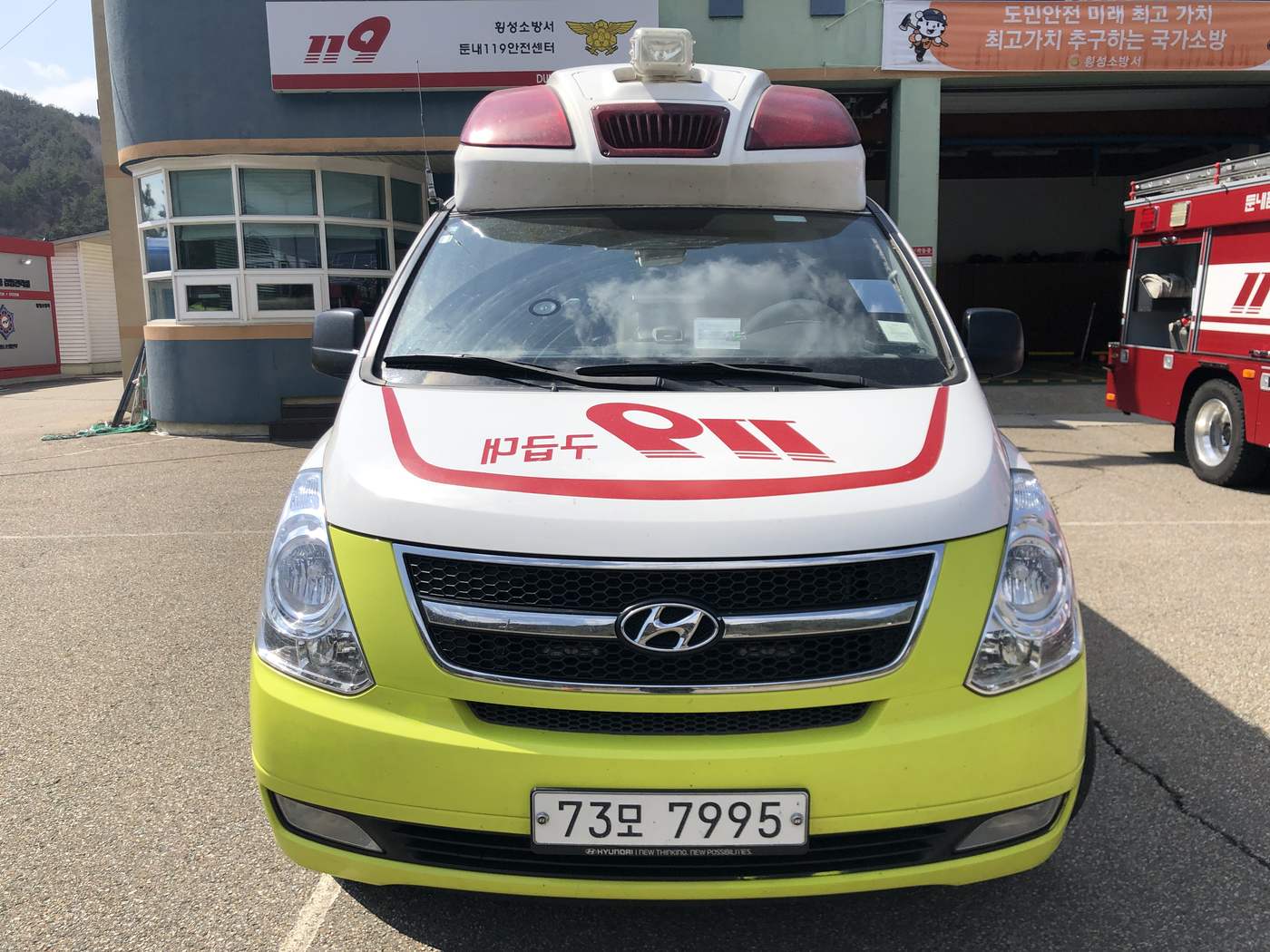
A fire-service 119 ambulance at Dunnae 119 Safety Center. This vehicle is free to use; the private ambulance that looks similar is not. Photo: Choi Kwang-mo, Wikimedia Commons, CC0 (2020).
What you are actually being billed, and the price list you can demand
For someone outside Korean national health insurance, almost everything is 비급여 (bigeubyeo) — non-covered care, priced by the institution rather than by the national schedule. That is less alarming than it sounds, because of one article of the Medical Service Act.
의료법 제45조 (비급여 진료비용 등의 고지) requires every medical institution to post its non-covered prices where a patient or a patient's guardian can easily see them. Paragraph 3 is the one that protects you: "의료기관 개설자는 제1항 및 제2항에서 고지·게시한 금액을 초과하여 징수할 수 없다" — the institution may not collect more than the amount it has posted.
So the honest description of what an uninsured foreigner pays is this: the national schedule above is the benchmark the Korean system builds its own bills from, and your bill is the hospital's own posted non-covered price, which starts from that schedule and can sit above it — but never above the posted list. That list is a real document, on the wall or at the desk, and you can ask to see it before agreeing to anything non-urgent.
Name the right pieces of paper at the cashier. The 진료비 영수증 is the payment receipt; the 진료비 세부내역서 is the itemised breakdown, line by line — the one a travel insurer will ask for, and the only one that shows whether an access fee or a surcharge is on your bill. Ask for both before you leave. Payment itself is rarely the problem, though our Korea payment guide covers the terminals where foreign cards still fail.
The honest part: when this guide is the wrong guide
- This is not a triage tool. Nothing here tells you whether something is an emergency, and it is not written to. If it is an emergency, call 119; the ambulance is free and the money question comes afterwards.
- The access fee is the entry ticket, not the total. Consultation, imaging, laboratory work, materials and treatment are billed on top at each institution's own prices. Do not budget ₩68,070 for an emergency-room visit and expect it to be the whole number.
- If you have lived in Korea more than six months, none of this applies to you. Foreign residents are enrolled in national health insurance by law, pay the resident co-pay, and — yes — the September 2024 90-percent rule does apply to them.
- The clinic is not always open. Most 의원 close in the early evening and on Sundays, which is precisely how people end up in an emergency room paying three times as much for the same complaint. If it can wait until the morning, the morning is ₩18,840.
- Weekday evenings and Saturdays cost more everywhere. The 30-percent surcharge runs from 18:00 on weekdays and from 13:00 on Saturdays for hospital-grade facilities, but clinics and pharmacies charge it from 09:00 on Saturday. It applies to the basic-consultation component rather than the whole fee, so a clinic first visit rises by roughly ₩4,500 on our own calculation, not by the full 30 percent of ₩18,840 — treat that figure as an estimate.
- Medication you brought with you is a separate problem. Some of it cannot legally enter Korea and some needs a permit — see what you cannot bring into Korea before you pack a prescription.
If you want the other half of this decision — which number to call, which door to use, and how the pharmacy system works — that is our Korean healthcare guide for tourists. This article is the money side of the same trip.
Korea saw 2.01 million foreign patients in 2025 (2.72 million patient-visits), the third consecutive year of roughly doubling, from 610,000 in 2023 and 1.17 million in 2024, on the health ministry's figures released on 24 April 2026; the Korea Institute for Industrial Economics and Trade puts their medical spending at ₩3.3 trillion. Almost all of the English writing aimed at them is about cosmetic and dental packages, and hardly any about the ordinary unplanned visit — the fever on day three, the ankle on the stairs at Bukchon — which is the one that actually happens.
FAQ
Q: How much does it cost to see a doctor in Korea without insurance? At a neighbourhood clinic (의원), the 2026 first-visit consultation fee is ₩18,840 and a repeat visit ₩13,370, before tests or medicine. At a tertiary teaching hospital the same consultation is about ₩29,580. An emergency room adds an access fee of ₩22,690 to ₩68,070 on top, depending on the institution's grade.
Q: How much is the emergency room in Korea? The access fee alone — 응급의료관리료, charged once on the first day — is ₩68,070 at a central or regional emergency medical centre, ₩58,990 at a specialist or local centre, and ₩22,690 at a local emergency medical institution in 2026. Consultation, tests and treatment are billed separately. The law sets these as points (812.28, 703.98, 270.76), so the won figure changes each January with the conversion factor.
Q: Is the 119 ambulance free for foreigners in Korea? Yes. The National Fire Agency states that the 119 ambulance collects no fee under any circumstances, regardless of distance or number of patients. Nationality, visa status and insurance make no difference. Private ambulances, which look similar, are metered and start at ₩40,000.
Q: Do foreigners pay 90 percent at a Korean emergency room for a minor problem? Not if they are uninsured. The September 2024 rule raising the patient share to 90 percent for KTAS level 4 and 5 patients applies, in the review agency's own words, to national health insurance patients. A visitor without Korean insurance is outside that system and is billed as a non-covered patient at the posted price.
Q: Can a Korean hospital charge a foreigner whatever it likes? No. Under Article 45 of the Medical Service Act an institution must post its non-covered prices and may not collect more than the posted amount. Ask to see the list, and ask for the 진료비 세부내역서 — the itemised breakdown — as well as the receipt.
Q: Is it cheaper to go to a clinic than an emergency room in Korea? For anything that is not an emergency, substantially: ₩18,840 against ₩68,070 at a regional centre before anyone examines you. The trade-off is opening hours, since most clinics close in the early evening and on Sundays.
Sources
- Ministry of Health and Welfare, 응급의료수가기준, notice 제2014-83호 (announced 27 May 2014, in force 5 June 2014), Appendix 1: the points 812.28, 703.98 and 270.76, and the rule that a non-emergency patient bears the fee in full. The ministry's administrative-rules board lists no later amendment.
- National Health Insurance Service, 연도별 환산지수 결정 현황: hospital ₩82.2 (2025) and ₩83.8 (2026); clinic ₩94.1 and ₩95.6.
- Health Insurance Policy Deliberation Committee, 31 October 2025, via the Korean medical press: clinic first-visit points 195.63 → 197.12, giving ₩18,840 from 1 January 2026. Ministry of Health and Welfare, 건강보험 수가 구조 혁신방안, 25 June 2026: ₩19,980 and ₩13,900 from December 2026.
- Wonju Severance Christian Hospital, published price list effective 1 January 2026: tertiary-hospital first visit ₩29,580.
- Health Insurance Review and Assessment Service Q&A, 12 September 2024, on the raised patient share for mild and non-emergency centre visits: applicable institutions, KTAS levels, and the line stating the rule covers national health insurance patients.
- Ministry of Health and Welfare press release, 15 April 2026: institution counts by grade as of March 2026, the planned expansion of regional centres, and the 1 November 2026 – 31 October 2029 designation period.
- Emergency Medical Service Act enforcement rules, in force 14 August 2026, via the Korean medical press: ambulance fares, the widened surcharge window, the ₩6,000 per 10 minutes waiting charge, and the items that may not be charged separately.
- National Fire Agency, 119 안전신고센터: the 119 ambulance collects no fee under any circumstances.
- Medical Service Act (의료법) Article 45 ①–③: duty to post non-covered fees and the ban on collecting more than the posted amount.
- National Emergency Medical Center, E-Gen (e-gen.or.kr) 응급실 찾기, read September 2026.
- Ministry of Health and Welfare, 2025 foreign-patient results, 24 April 2026; Korea Institute for Industrial Economics and Trade estimate of ₩3.3 trillion.
You Might Also Like
Korean Ski Resorts 2026–27: Season-Pass Prices, the Rounds Closing This Month, and Why Konjiam's English Page Says ₩42,000 When Its Korean Page Says ₩72,000
Konjiam's English page quotes ₩42,000 for a two-hour lift ticket. Its Korean page says ₩72,000 — and that there is no on-site ticket window at all. Verified 26/27 season-pass prices and round deadlines for Muju, Konjiam, X6+, Phoenix and Yongpyong.
Is Korea Kid-Friendly? What Foreign Parents Report — and What Korean Data Shows: Strangers Who Hand Out Tangerines, 114 No-Kids Zones, and the 68% Who Accept Them
Foreign parents say older Koreans shower babies with snacks and department-store nursing rooms beat London's. Korean data adds 114 no-kids zones, 68% public acceptance, and 64% of Korean parents who feel watched. What that means for your trip.
Car Seat Taxis in Korea: The Law Requires a Seat for Every Child Under 6, Ordinary Taxis Don't Carry One — What Tourists Can Actually Book in Seoul
Korea's Road Traffic Act requires a car seat for children under 6 in any car, taxis included, and fines the driver ₩60,000. Ordinary taxis carry none and police paused taxi enforcement in 2018. TADA, whose app takes foreign phones and cards, runs about 300 car-seat vans.