Studying in Korea (2026): Average University Tuition ₩7.27 Million a Year, 307,464 Foreign Students, and the 25-Hour Part-Time Rule
Last updated: 2 October 2026. Tuition averages: Ministry of Education 대학알리미 disclosure for 2026 (April 2026). Student numbers: 2026 Basic Education Statistics (교육기본통계, released 26 August 2026). Work and visa rules: easylaw.go.kr, the Ministry of Justice and university international offices. University fees: each school's 2026 fee table, read 2 October 2026. Dollar figures use about ₩1,360 to US$1. Full list under Sources.
Search "studying in Korea" in English and the blog posts quote a US-dollar bank balance, a 20-hour work limit and scholarship stipends that have all changed. The Korean-language numbers are public, and most were updated this year.
Here they are. In the 2026 academic year a Korean four-year university charged ₩7,270,300 a year on average (about US$5,346), up 2.1% on 2025. A private university averaged ₩8,231,500 and a national or public one ₩4,250,000, roughly half. Korea had 307,464 international students in higher education on 1 April 2026, and an undergraduate who meets the Korean-language bar may work 25 hours a week during term (graduate students 30), with no immigration cap at weekends or in the holidays.
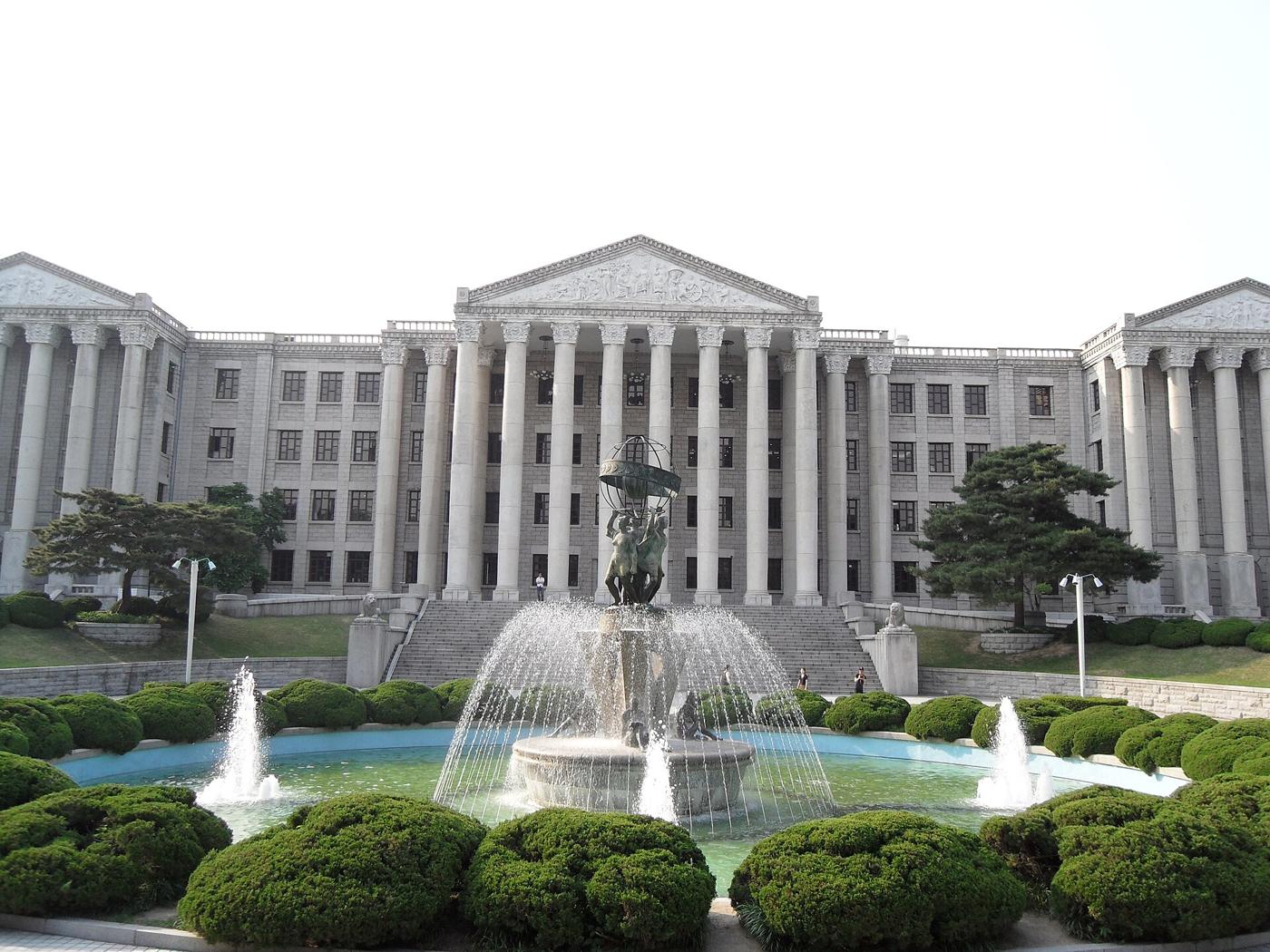
The Main Building (본관) on Kyung Hee University's Seoul campus in Dongdaemun-gu. Kyung Hee is a private university, the type that averaged ₩8.23 million a year in 2026. Photo: Kys951, Wikimedia Commons, CC BY 3.0 (2010).
Your TOPIK level decides both admission and how many hours you may work — TOPIK Master Final Actual Test II, ten full TOPIK II mock tests with explanations, is the book to practise for level 3 and 4Affiliate link. As an Amazon Associate, EpicKor earns from qualifying purchases at no extra cost to you.
Quick Guide: studying in Korea in numbers, October 2026
| What | The number | Source and date |
|---|---|---|
| Average tuition, four-year university | ₩7,270,300 a year (≈US$5,346) | 대학알리미, 2026 academic year |
| Private / national or public | ₩8,231,500 / ₩4,250,000 | same |
| Most expensive field | Medicine, ₩10,325,900; humanities and social sciences cheapest at ₩6,433,700 | same |
| International students in Korea | 307,464 (+21.3%): 223,191 on degrees, 84,273 non-degree | 교육기본통계, 1 April 2026 |
| Part-time work, undergraduate with TOPIK 3 (years 1–2) or 4 (years 3–4) | 25 hours a week on weekdays; no cap at weekends and in vacations; 10 hours (15 in years 3–4) without the TOPIK level | Ministry of Justice rule in force since July 2023 (easylaw.go.kr) |
| Bank balance for a D-2 visa | ₩20,000,000 for a university in the Seoul area, ₩16,000,000 elsewhere | Ministry of Justice, 5 February 2026 |
| Health insurance, D-2 student | ₩79,320 a month from arrival | NHIS student rate, 2026 |
| GKS 2027 undergraduate allowance | ₩14,400,000 a year in degree years (about ₩1.2 million a month), all-inclusive | NIIED guidelines, September 2026 |
The averages are what Korean students pay. As the next sections show, international students at the big Seoul universities usually pay the same departmental fee, but they also need the bank balance, the insurance and the right TOPIK level for the work permit.
Korean Grammar in Use: Intermediate — the Darakwon grammar book for levels 3 and 4 TOPIK 3 is the bar for 25 working hours in your first two years and TOPIK 4 in years three and four. This volume covers exactly the grammar of those two levels, with English explanations. As an Amazon Associate, EpicKor earns from qualifying purchases at no extra cost to you.
See Korean Grammar in Use: Intermediate on AmazonWhat Korean universities charge: the 2026 averages
Every April the Ministry of Education and the Korean Council for University Education (한국대학교육협의회) publish what each university charges on the disclosure site 대학알리미 (Academy Info). The 2026 release covered 192 four-year universities. 130 of them (67.7%) raised tuition for 2026; the rest froze it.
| Average annual tuition, 2026 academic year | ₩ | ≈US$ |
|---|---|---|
| All four-year universities | 7,270,300 | 5,346 |
| Private universities (사립) | 8,231,500 | 6,053 |
| National and public universities (국공립) | 4,250,000 | 3,125 |
| Seoul capital area (수도권) | 8,270,000 | 6,081 |
| Outside the capital area (비수도권) | 6,619,600 | 4,867 |
| Medicine (의학) | 10,325,900 | 7,593 |
| Arts and physical education (예체능) | 8,338,100 | 6,131 |
| Engineering (공학) | 7,677,400 | 5,645 |
| Natural sciences (자연과학) | 7,323,300 | 5,385 |
| Humanities and social sciences (인문사회) | 6,433,700 | 4,731 |
| Two- and three-year colleges (전문대학), for comparison | 6,653,100 | 4,892 |
The type of university matters more than the field: the private–national gap (₩3.98 million a year) is bigger than the gap between medicine and humanities (₩3.89 million). The figures are per year; universities bill each semester (학기), from March and September, so each invoice is about half. And they are averages: every university sets a fee per college, as the next table shows.
What international students actually pay at named universities
The averages hide the most useful fact for a foreign applicant: at some universities you pay a different, higher rate. Yonsei publishes a separate 2026 tuition table for international undergraduates that is about 20% above its Korean rate in most colleges (11% at Underwood International College, 14% at the Global Leaders College) (humanities ₩4,556,000 a semester against ₩3,809,000 for Korean students; engineering ₩6,004,000 against ₩5,021,000). Seoul National, Korea University and Pusan National charge foreigners the same table as everyone else. All figures below are per semester for the 2026 academic year, from each university's own fee tables; none has published 2027 rates yet.
| University (Korean name) | Humanities / social sciences | Engineering | Application fee | What else to know |
|---|---|---|---|---|
| Seoul National University (서울대학교), national | ₩2,442,000 | ₩2,998,000 | ₩70,000 (spring 2027) | One flat rate a semester, no entrance charge; medicine ₩5,038,000 (pre-med ₩3,072,000) |
| Yonsei University (연세대학교), private | ₩4,556,000 from year two (₩4,770,000 for a first semester outside the GLC) | ₩6,218,000, then ₩6,004,000 | ₩200,000 (spring 2027; ₩230,000 medicine, dentistry, pharmacy) | Separate international table. Freshmen spend year one in the Global Leaders College at ₩7,388,000 then ₩7,174,000; Underwood International College ₩8,416,000 then ₩8,202,000 |
| Korea University (고려대학교), private | ₩4,059,000 new students, ₩3,846,000 continuing | ₩5,442,000, then ₩5,229,000 | ₩150,000 (arts ₩200,000), spring 2027 | Admission-score scholarships of 50–100% for two semesters (2027 guide) |
| KAIST (한국과학기술원), Daejeon | not offered | ₩3,433,000 listed | US$80 (2027 guide) | Every admitted international undergraduate gets full tuition for eight semesters, ₩350,000 a month and health insurance; keep a GPA above 2.7 out of 4.3 |
| Pusan National University (부산대학교), national, Busan | ₩2,500,000 in the Global Open Major Division, the entry route for international freshmen (spring 2026) | ₩144,000 (spring 2026) | First-semester tuition award by TOPIK level: full tuition at level 6, part at levels 4 and 5 | |
Read the table in years, because that is how the bank balance and your budget work. A humanities year at Seoul National costs ₩4,884,000; the first year at Yonsei's Global Leaders College costs ₩14,562,000, three times as much, before rent. Korea University sits between them at ₩7,905,000 for a first humanities year. KAIST, for the students it admits, costs nothing in tuition.
Two warnings. First, Yonsei and Korea University charge a new student about ₩210,000 more in the first semester than in later ones, so the first bill is the dearest. Second, Korea University adds about ₩40,000 a semester in small fees (student union, health centre and others), plus a ₩50,000 alumni fee in the second semester, that are not in the headline number. Check the international admissions guide of each school you shortlist; these figures were read on 2 October 2026.
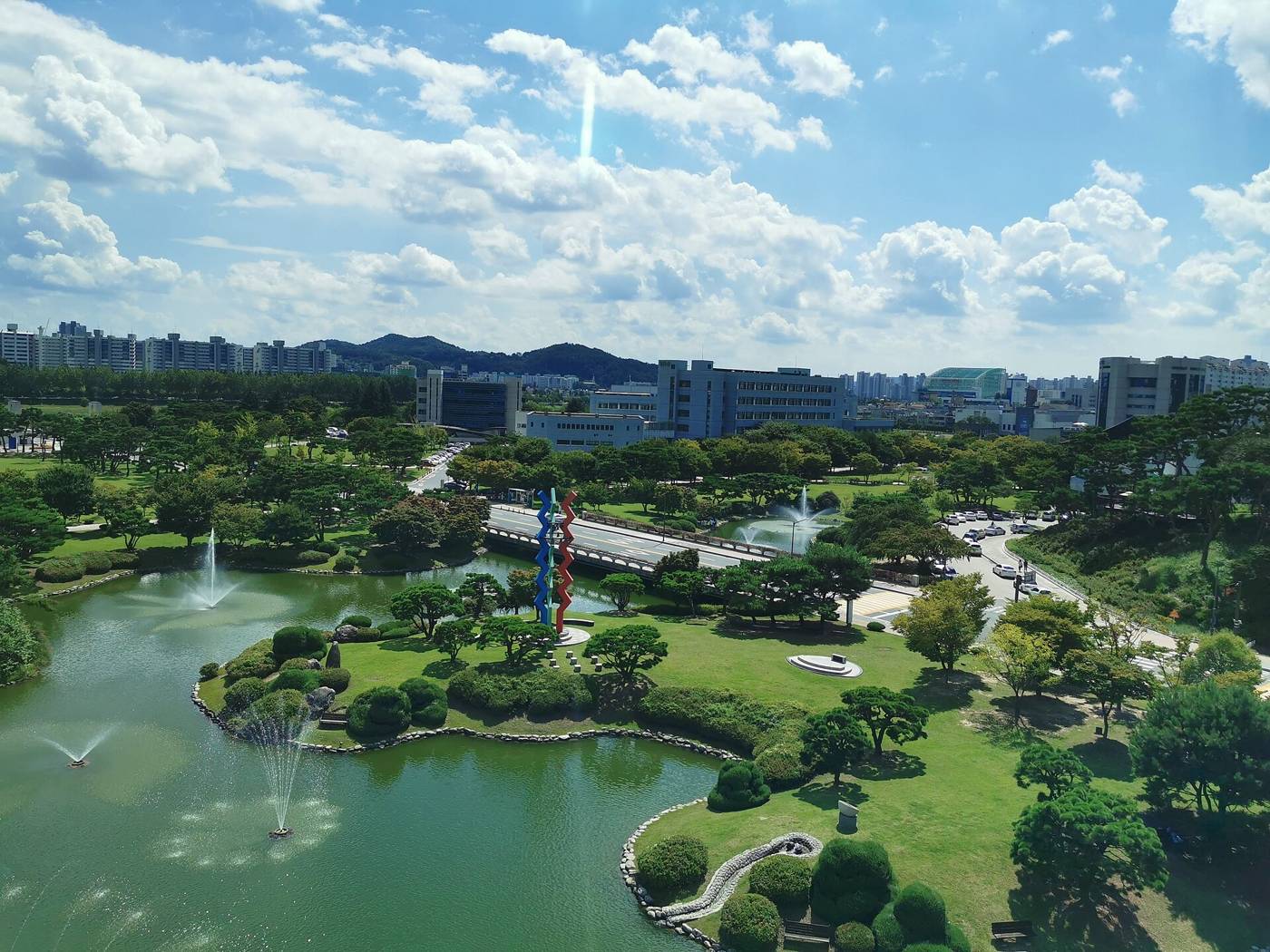
The pond and fountains on KAIST's main campus in Daejeon. KAIST covers tuition for every international undergraduate it admits. Photo: AhmadElq, Wikimedia Commons, CC BY-SA 4.0 (2019).
You might like: SKY vs KAIST: Choosing a Korean University by Major, Not Rank
307,464 foreign students: who they are
The Ministry of Education's 2026 Basic Education Statistics counted 307,464 international students in Korean higher education on 1 April 2026, up 54,030 (21.3%) in a year. The total passed 250,000 for the first time only in 2025, and it was 153,695 in 2020.
- 223,191 were on degree programmes (bachelor's, master's and doctoral), 72.6% of the total; 84,273 were non-degree students, mostly in university Korean-language schools. If that second group is you, our Korean language school fees guide compares Yonsei, SNU, Korea, Sogang, Ewha, Sungkyunkwan and Pusan National term by term.
- Vietnam overtook China for the first time: 96,834 Vietnamese students (31.5%, up 28.9%) against 78,890 Chinese (25.7%, up 3.1%). Then come Uzbekistan (20,876), Nepal (20,118) and Mongolia (17,189).
The 25-hour rule: part-time work on a D-2 visa
A D-2 student may work part-time only with a permit (시간제취업 허가) from immigration, applied for with the university's confirmation, before the first shift. The hours depend on your course and your Korean, under the table in force since July 2023 (it was 20 hours before):
| Course | Korean level required | Weekly hours without it | Weekday hours with it | With a preferential condition |
|---|---|---|---|---|
| Bachelor's, years 1–2 (and associate degrees) | TOPIK 3 or KIIP level 3 | 10 | 25 | 30 |
| Bachelor's, years 3–4 | TOPIK 4 or KIIP level 4 | 15 | 25 | 30 |
| Master's and doctoral | TOPIK 4 or KIIP level 4 | 15 | 30 | 35 |
| With the language level there is no immigration hour cap at weekends, on public holidays or in vacations. The extra 5 hours come with a certified university (인증대학), an A average last semester or TOPIK 5. English-taught students can use an English score (e.g. TOEFL iBT 71). | ||||
So the "25-hour rule" is real, but it is a weekday rule for students with the right TOPIK level, not a flat limit. The rest of the conditions are where students lose permits:
- Grades: an average of C (2.0) or better in the previous semester. First-semester students can be exempted.
- Workplaces: at most two, with the hours added together.
- Jobs you cannot take: delivery work, including app-based delivery riding, is singled out by universities as the typical violation, along with construction, private tutoring or conversation teaching, designated driving and door-to-door sales; manufacturing jobs need about TOPIK 4.
- The penalty: working without a permit can mean up to three years in prison or a fine of up to ₩30 million under the Immigration Act, plus visa cancellation and deportation. Employers can be punished too.
The minimum wage is ₩10,320 an hour in 2026 and ₩10,700 from 1 January 2027, and it applies to students like anyone else (what foreign workers are owed). In the government's 2025 survey, international students with jobs worked 23.3 hours a week on average, and 83.4% of them in shops, hotels and restaurants. At 25 hours and ₩10,320, that is about ₩1.1 million a month before deductions: real help with rent, but not enough to pay tuition and living costs.
You might like: Korea Minimum Wage 2027: ₩10,700 an Hour — What Foreign Workers Are Owed
The visa money test: ₩20 million in Seoul, ₩16 million outside
To issue a D-2 visa, immigration wants proof that you can pay. The Ministry of Justice gave the figure in a press release on 5 February 2026: ₩20,000,000 for a university in the Seoul capital area and ₩16,000,000 for a university outside it (유학(D-2) 비자발급시 재정요건 : 수도권 소재 대학 2,000만원, 지방대학 1,600만원). It is set in won. English pages that still quote US$20,000 and US$16,000 are describing an older version.
Universities can ask for more. Yonsei's guide for international degree applicants (May 2026) asks new and transfer students for ₩22,000,000 or more; Ewha asks for ₩20 million and Jeonbuk National University, in Jeonju, ₩16 million. The balance usually has to be in your or a parent's name and recent; check how many days old your university accepts.
The one exception, new in 2026: students entering one of 16 pilot technical departments (육성형 전문기술학과) at junior colleges with TOPIK 3 skip the money test and may work 35 hours a week.
Health insurance from the first month
D-2 degree students are enrolled in the National Health Insurance Service from alien registration and pay the student rate, ₩79,320 a month in 2026, half the foreigner minimum. Language-school students on D-4 wait six months. Our health insurance guide explains how the bill arrives and what an unpaid month does to a visa extension. Some universities add their own group insurance on top; it does not replace NHIS.
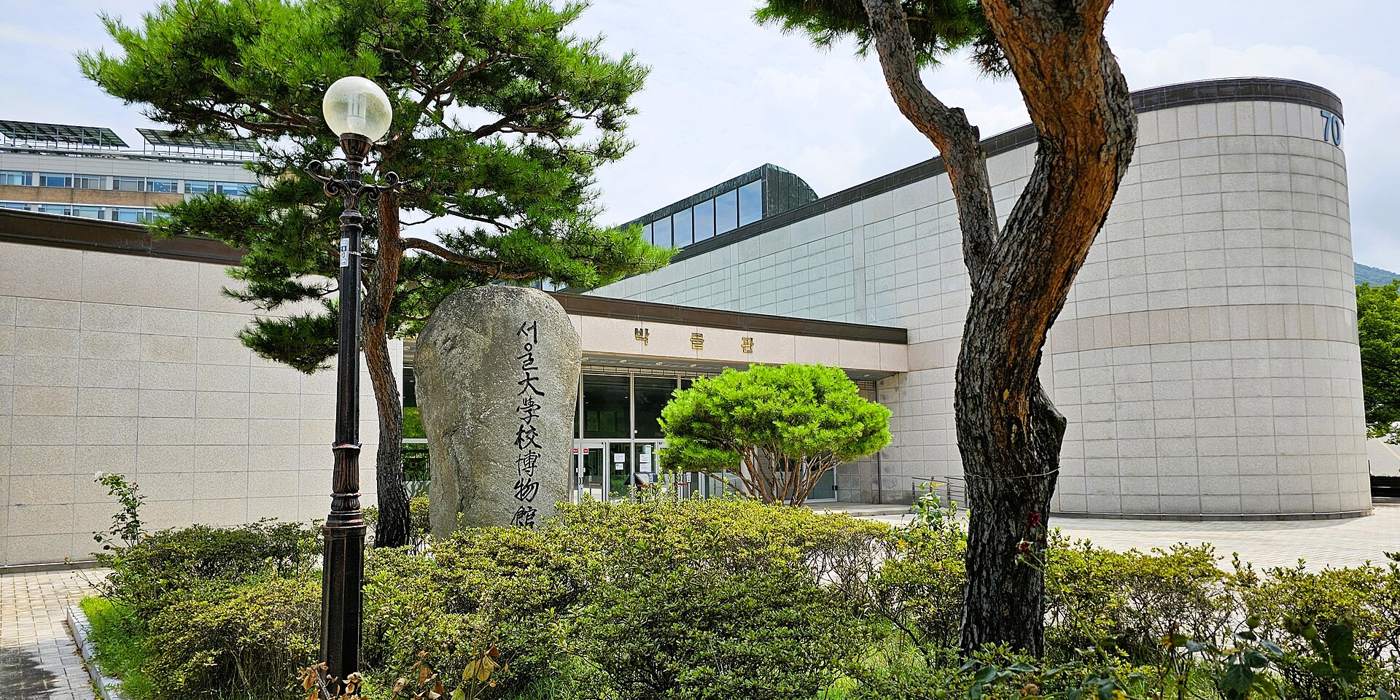
The Seoul National University Museum (서울대학교 박물관) on the Gwanak campus, with its carved name stone. SNU is Korea's flagship national university. Photo: EllalineSeoul, Wikimedia Commons, CC0 (2024).
GKS 2027: what the government scholarship now pays
The Global Korea Scholarship (GKS, 정부초청외국인장학생), run by the National Institute for International Education (국립국제교육원, NIIED), published its 2027 undergraduate call on Study in Korea on 9 September 2026. What changed:
- The embassy track closed on 30 September 2026 (18:00 Korean time). The university track runs September to November 2026 on each university's own schedule, and for 2027 it covers only University-Industry Cooperation and associate-degree places. Final results are due on 7 January 2027.
- The allowance is now one all-inclusive sum: ₩14,400,000 a year in the degree years (about ₩1.2 million a month) and ₩13,560,000 in the Korean-language year, covering living costs, housing, health insurance, the TOPIK fee and the settlement and completion grants that used to be paid separately. University pages that still show "₩1,000,000 a month plus a settlement allowance" describe the old scheme.
- Tuition: NIIED pays up to ₩5,000,000 and the university covers any amount above that, plus the admission fee. One year of Korean language training is paid (₩5.2 million) unless you already hold TOPIK 5 or 6. Economy airfare to Korea is covered.
- Who can apply: under 25 (born after 1 March 2002), with an 80% average, a top-20% class rank or an equivalent GPA (for example 2.64 out of 4.0). Graduate applicants (GKS-G) can be under 40; the 2026 graduate call paid ₩16,560,000 a year in the degree years.
If you are reading this in October 2026, the general 2027 round has closed; the 2028 call should come next September, so read the date off the Study in Korea notice board, not a blog.
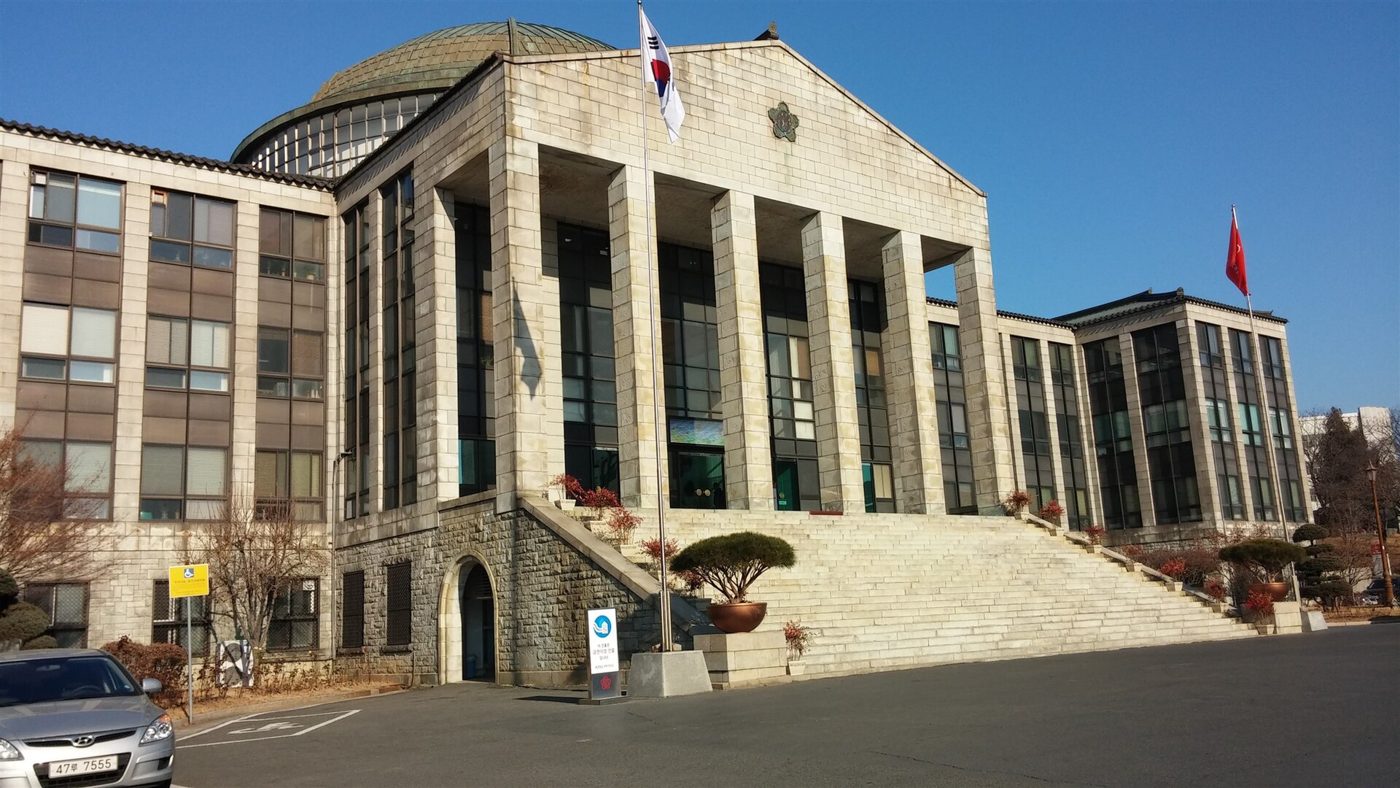
The main administration building (본관) of Kyungpook National University in Daegu, a national university, the type that averaged ₩4.25 million a year in 2026. Photo: Ken Eckert, Wikimedia Commons, CC BY-SA 4.0 (2014).
A year's budget: a Seoul private university against a Seoul national one
Here is one year (two semesters) at two Seoul universities for an international undergraduate, using the fee tables above and the rent figures from our Seoul rent guide:
| One year, 2026 prices | Yonsei, engineering, years 2–4 | Seoul National, humanities |
|---|---|---|
| Tuition | 2 × ₩6,004,000 = ₩12,008,000 | 2 × ₩2,442,000 = ₩4,884,000 |
| One-room rent with management fee (Dabang, July 2026, ₩10 million deposit) | ₩758,000 × 12 = ₩9,096,000 | ₩624,000 × 12 = ₩7,488,000 |
| Health insurance (₩79,320 a month) | ₩951,840 | ₩951,840 |
| Total before food, phone and transport | about ₩22.1 million (≈US$16,200) | about ₩13.3 million (≈US$9,800) |
Both also need a refundable rent deposit (₩10 million in the survey) unless you get a dorm, and ₩20 million in the bank for the visa. In Busan, Pusan National's entry division charges about ₩5 million a year and the visa balance drops to ₩16 million.
The honest part: when a Korean degree is the wrong plan
- You are counting on part-time work to pay for it. Twenty-five weekday hours at the minimum wage is about ₩13 million a year; a private-university year in Seoul with rent costs more than that before food. And the work hours disappear if your grades fall below a C average or your TOPIK level is short.
- Your Korean is below TOPIK 3. Most undergraduate degrees are taught in Korean. Without level 3 you are limited to 10 working hours and will struggle in class; a year at a language school first (fees here) costs about ₩7.56 million at Yonsei, application fee included, and can be the cheaper route to a degree you finish.
- You only want a Seoul name on the certificate. A national university outside Seoul charges about half the private average and asks for ₩4 million less in the bank, and rent is lower. KAIST and the regional flagships do not need a Seoul address to carry weight in their fields.
- What English pages miss: the bank balance is set in won, the 25-hour limit is weekday-only and needs TOPIK 3 or 4, Yonsei charges foreigners its own higher rate, and GKS no longer pays a separate settlement allowance.
FAQ
Q: How much is university tuition in Korea for international students in 2026? A: The 2026 average for a four-year university was ₩7,270,300 a year (about US$5,346): ₩8,231,500 private, ₩4,250,000 national or public. Per semester, humanities costs ₩2,442,000 at Seoul National and ₩4,556,000 at Yonsei, which has a separate, higher table for foreigners.
Q: How many international students are there in Korea? A: 307,464 on 1 April 2026, according to the Ministry of Education's Basic Education Statistics: 223,191 on degree programmes and 84,273 non-degree. Vietnam (96,834) overtook China (78,890) for the first time.
Q: How many hours can a D-2 student work in Korea? A: With a permit and TOPIK 3 (bachelor's years 1–2) or TOPIK 4 (years 3–4), 25 hours a week on weekdays and no immigration cap at weekends and in vacations; without that level, 10 hours (15 in years 3–4). Graduate students get 15 or 30.
Q: How much money do I need in the bank for a D-2 student visa? A: ₩20,000,000 for a university in the Seoul capital area and ₩16,000,000 for one elsewhere, per the Ministry of Justice (February 2026). Some universities ask for more; Yonsei asks degree applicants for ₩22,000,000.
Q: What does the GKS scholarship pay in 2027? A: For undergraduates, ₩14,400,000 a year in the degree years and ₩13,560,000 in the language year as one all-inclusive allowance, tuition (NIIED pays up to ₩5,000,000, the university the rest), one year of Korean training and economy airfare. The 2027 embassy-track deadline was 30 September 2026.
Sources
- Ministry of Education and Korean Council for University Education, April 2026 university disclosure (대학알리미), 2026 academic year, as reported by 헤럴드경제 (28 April 2026) and 대학저널 (29 April 2026): average ₩7,270,300 (+₩147,100, +2.1%), private ₩8,231,500, national/public ₩4,250,000, capital area ₩8,270,000, outside ₩6,619,600, by field, 130 of 192 universities raising fees, junior colleges ₩6,653,100.
- Ministry of Education, 2026 교육기본통계 (as of 1 April 2026), release of 26 August 2026 as reproduced by KDI 경제정보센터 (307,464; 223,191 degree; 84,273 non-degree), with 한국교육신문 (27 August 2026) and 헤럴드경제 (25–26 August 2026) for the +54,030 rise and nationalities (Vietnam 96,834, China 78,890, Uzbekistan 20,876, Nepal 20,118, Mongolia 17,189).
- 찾기쉬운 생활법령정보 (easylaw.go.kr), 외국인 유학생 시간제 취업, as of 15 September 2026: hours table "2023. 7. 시행", penalty of up to 3 years or ₩30 million. Sungshin Women's University Office of International Affairs notice (20 March 2026, edited 9 June 2026) and Jeonbuk National University international office (14 February 2026): preferential hours, C/2.0 grade rule, two workplaces, restricted jobs.
- Ministry of Justice press release, 5 February 2026, 「육성형 전문기술학과」 16개 시범지정: D-2 financial requirement ₩20 million (capital area) and ₩16 million (elsewhere); exemption and 35 hours for the pilot departments. Yonsei University international admissions guide (file of 29 May 2026): ₩22,000,000; Ewha (spring 2026) ₩20,000,000; Jeonbuk National University ₩16,000,000.
- National Institute for International Education, 2027 Global Korea Scholarship for Undergraduate Degrees, notice on studyinkorea.go.kr (9 September 2026) and application guidelines (September 2026); 2026 GKS-G guidelines (February 2026).
- Minimum wage 2026 and 2027 and the 2025 이민자체류실태 및 고용조사 student figures: see the sources in our post 490. NHIS student premium: see 492.
- University fee tables, 2026 academic year, read 2 October 2026: Seoul National University 2026 tuition table (28 January 2026) and Spring 2027 international undergraduate guide (27 May 2026, ₩70,000 fee); Yonsei University "2026 Undergraduate Tuition Fee for International Students" (26 January 2026) and Korean-student table (same date), 2027 international application guide (May 2026; ₩200,000); Korea University 2026 tuition table (13 February 2026) and 2027 spring international undergraduate guide (2 July 2026, fees and scholarships); KAIST international undergraduate admission pages (scholarship, cost of attendance) and 2027 admissions guide; Pusan National University international office, Spring 2026 additional-round guide (₩2,500,000, ₩144,000) and scholarship page.
- Dabang one-room rent survey near universities (July 2026): see the sources in our post 491.
You Might Also Like
Seoul to Gangneung and Sokcho, Korea: KTX-Eum vs Express Bus After the October Fare Rise, and Why Sokcho Still Has No Train
Seoul to Gangneung is ₩26,000 by KTX-Eum in about 1½ hours; the deluxe bus now costs ₩26,800 after the 1 October rise and takes nearly three. Sokcho has no train until 2029, so there the bus still wins — from ₩18,700.
Korean Language School Fees in Korea (2026): Yonsei ₩1.86 Million for 10 Weeks — Every Major Seoul Program Compared
A 10-week, 200-hour term at Yonsei's Korean Language Institute costs ₩1,860,000 plus a ₩120,000 fee (October 2026). SNU, Korea, Sogang, Ewha and SKKU charge ₩1.65–1.86 million; Pusan National ₩1.5 million. Deadlines, dorms and D-4 rules.
Busan to Gyeongju, Korea: KTX, the Donghae Line Train and the Bus Compared — Fares After the 1 October Bus Rise, Times and Which Station You Arrive At
Busan to Gyeongju costs ₩10,100 by KTX in 27 minutes, or ₩8,400 by bus after today's 9% rise. But the train stops at Gyeongju Station, the old Singyeongju, 30–40 minutes from the tombs; the bus lands downtown.