Korean Language School Fees in Korea (2026): Yonsei ₩1.86 Million for 10 Weeks — Every Major Seoul Program Compared
Last updated: 1 October 2026. Every fee was read on the school's own page or brochure on 1 October 2026 (Yonsei, Seoul National, Korea, Sogang, Ewha, Sungkyunkwan and Pusan National; full list under Sources). Visa rules follow the Ministry of Justice manual as summarised by easylaw.go.kr and by universities. Dollar figures use about ₩1,360 to US$1. Schools can change fees without notice, so confirm on the application page before you pay.
Search "Korean language school tuition" in English and the comparison posts quote fees from 2023 or 2024, often without saying which term. Fees are reset every year (Korea University says it does so each spring), Sungkyunkwan cut its year from six terms to four in 2026, and two of the big six now charge less for afternoon classes than for morning ones.
Here are the current numbers. As of October 2026, one regular 10-week term at Yonsei University's Korean Language Institute (연세대학교 한국어학당) costs ₩1,860,000 (about US$1,368), plus a ₩120,000 application fee, for 200 hours of class. Its neighbours in Seoul charge between ₩1,650,000 and ₩1,860,000 for the same ten weeks. Outside Seoul, Pusan National University charges ₩1,500,000, textbooks included.
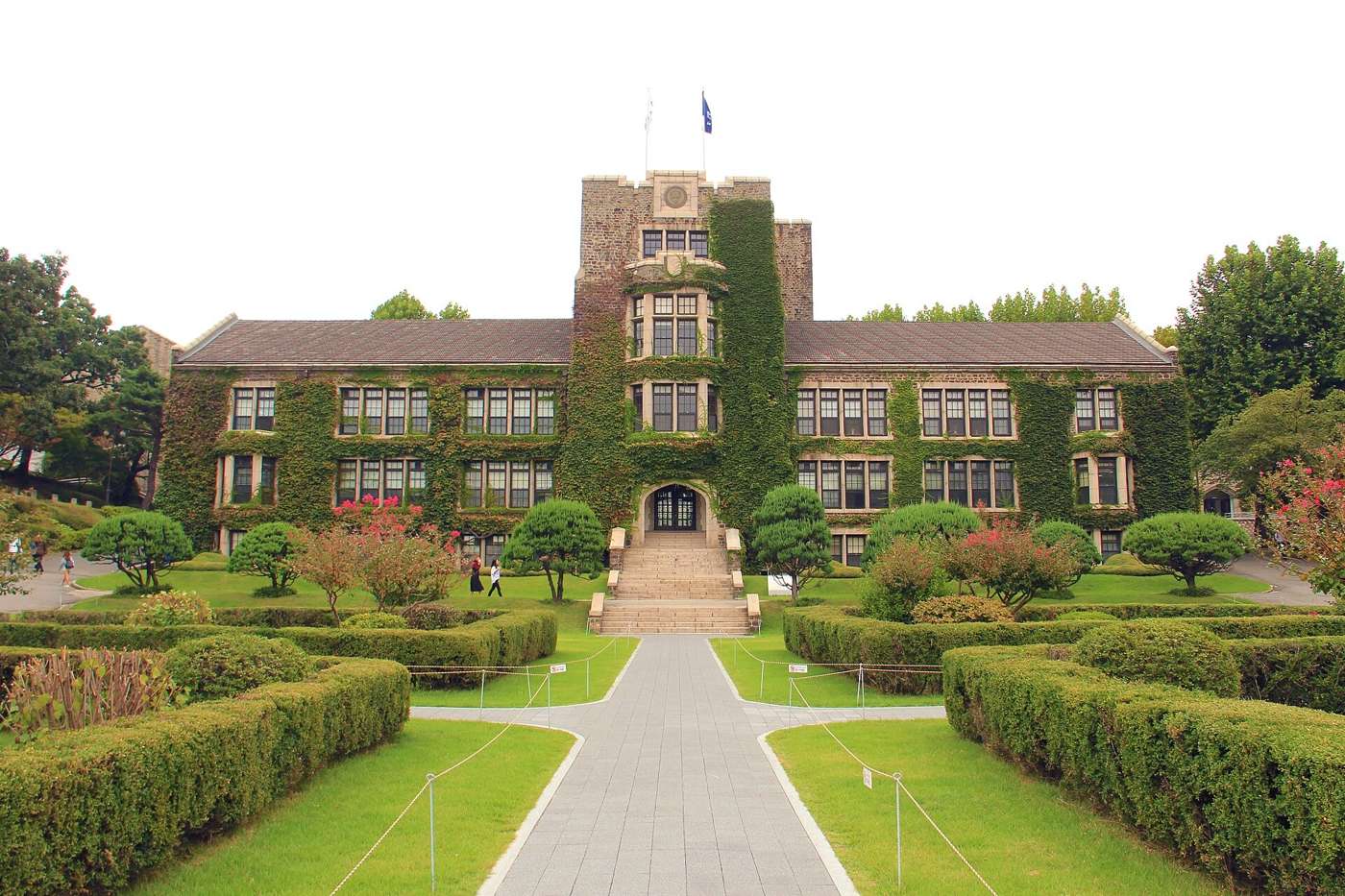
Underwood Hall (언더우드관) on Yonsei University's Sinchon campus in Seoul. The Korean Language Institute, one of the best-known Korean language schools for foreigners, teaches on this campus. Photo: Tungdangthanh, Wikimedia Commons, CC BY-SA 4.0 (2016).
Every school on this list starts you with a placement test — Korean Grammar in Use: Beginning, the Korean-published grammar book many students bring to Seoul, is a cheap way to prepare for itAffiliate link. As an Amazon Associate, EpicKor earns from qualifying purchases at no extra cost to you.
Quick Guide: Korean language school fees in Korea, October 2026
| School (Korean name) | Tuition per 10-week term | One-off fee | Hours | First term total |
|---|---|---|---|---|
| Yonsei University Korean Language Institute (연세대학교 한국어학당) | ₩1,860,000 (≈US$1,368) | ₩120,000 application fee, non-refundable | 200; Mon–Fri 9:00–13:00 or 14:00–17:50 | ₩1,980,000 |
| Seoul National University Language Education Institute (서울대학교 언어교육원 한국어교육센터) | Morning ₩1,800,000; afternoon ₩1,650,000 | ₩100,000 application fee | 200; Mon–Fri 9:00–13:00 or 13:30–17:20 | ₩1,900,000 / ₩1,750,000 |
| Korea University Korean Language Center (고려대학교 한국어센터) | ₩1,800,000, morning or afternoon | ₩120,000 application fee, non-refundable | 200; 4 hours a day, 5 days a week | ₩1,920,000 |
| Sogang University Korean Language Education Center (서강대학교 한국어교육원) | Morning (KGP200) ₩1,860,000; afternoon (KAP200) ₩1,800,000 | ₩100,000 admission fee, new students only | 200; 9:00–13:00 or 13:30–17:30 | ₩1,960,000 / ₩1,900,000 |
| Ewha Language Center (이화여자대학교 언어교육원) | ₩1,850,000 | ₩120,000 admission fee | Mon–Fri 9:10–13:00 | ₩1,970,000 |
| Sungkyunkwan University Korean Language Institute (성균관대학교 성균어학원) | ₩1,780,000 | ₩80,000 application fee | Four 50-minute classes a day, 9:00–12:50 or 14:00–17:50 | ₩1,860,000 |
| Pusan National University Language Education Institute (부산대학교 언어교육원), Busan | ₩1,500,000 (≈US$1,103), textbooks and cultural activities included | none listed separately | 10-week terms | ₩1,500,000 |
| All fees as of October 2026, from each school's own page. Textbooks are extra except at Pusan National. SNU also runs a four-day "research class" (연구반, 160 hours) for ₩1,450,000. | ||||
The spread among the six Seoul schools is ₩210,000 a term, about US$154. Price does not separate them; timetable, dorm access and the deadline you can still meet do.
Sogang Korean 1A (3rd edition, 2024) — the student's book Sogang's speaking-first course is built around Sogang's regular course sells its textbooks separately, and the series was rewritten in 2024. Working through the first units at home shows you whether a class where you speak from day one suits you before you commit ₩1.96 million. As an Amazon Associate, EpicKor earns from qualifying purchases at no extra cost to you.
See Sogang Korean 1A on AmazonWhat ₩1.86 million buys: the 10-week, 200-hour term
Every large university language school in Seoul runs the same basic product, called the regular course (정규과정):
- Four terms a year: spring, summer, autumn and winter, each about ten weeks. Sungkyunkwan joined this pattern in 2026; until 2025 it ran six shorter terms.
- Four hours a day, five days a week, which comes to about 200 hours a term. You attend either a morning or an afternoon class, not both.
- Six levels (1급 to 6급), each normally one term. A beginner who passes every level reaches level 6 in a year and a half.
- A placement test before the first term, so a student who already reads Hangul and knows basic grammar can skip level 1.
At Yonsei, an hour of class costs about ₩9,300 (US$6.80), but four terms in a row at Yonsei cost ₩7,560,000 with the application fee, more than the ₩7.27 million that the average student paid for a whole year at a Korean four-year university in 2026, according to the Ministry of Education's university disclosure data (대학알리미). A year at a private university averaged about ₩8.23 million and at a national or public one about ₩4.25 million.
You will not be alone. The Ministry of Education's 2026 Basic Education Statistics (교육기본통계, counted on 1 April) found 307,464 international students in Korean higher education, up 21.3% in a year and double the 153,695 of 2020. Of those, 84,273 were on non-degree courses, the category that includes university language-school students, and Vietnamese students (96,834) outnumbered Chinese (78,890) for the first time.
Classes are small: Korea University caps them at 14 students, Sogang at 16 and Sungkyunkwan at 10 to 15. The schools are also strict about attendance. Korea University will not let you finish a level with less than 80% attendance (160 of the 200 hours), and a student under 60% (20 days absent) cannot register for the next term.
School by school: what the fee page does not tell you
Yonsei University Korean Language Institute (연세대학교 한국어학당)
The best-known name, and the joint most expensive at ₩1,860,000. The morning class runs 9:00 to 13:00 and the afternoon class 14:00 to 17:50, both Monday to Friday, 200 hours a term. The ₩120,000 application fee is not refunded. Yonsei lists two on-campus dorms for language students: International House (국제학사), twin rooms for women only, at ₩1,440,000 a term, and SK Global House, ₩1,680,000 for a twin and ₩2,320,000 for a single. Both cap stays at two terms, take about 10% of students and, the institute says, usually fill on the first day; the winter 2026 round required tuition paid by 2 October. A first term with the cheapest room comes to about ₩3.42 million (US$2,515), or ₩3.66 million with an SK Global House twin.
Seoul National University Language Education Institute (서울대학교 언어교육원 한국어교육센터)
SNU has the widest morning–afternoon gap of the big Seoul schools (Sogang is the other that charges less for afternoons): ₩1,800,000 for the morning class, ₩1,650,000 for the afternoon, both 200 hours, plus a ₩100,000 application fee. Its brochure notes that all fees can change without notice. The language institute keeps dormitory places for regular-course students on and off the Gwanak campus, first come, first served, giving new students priority, for at most two terms (six months), and pays them into a different bank account from tuition; costs are on its website, not in the brochure.
SNU also states something the others leave out: the institute does not apply for D-4 visas on a student's behalf (언어교육원에서는 사증(D-4) 신청을 대행하지 않습니다). It issues the admission documents; you take them to the Korean consulate yourself.
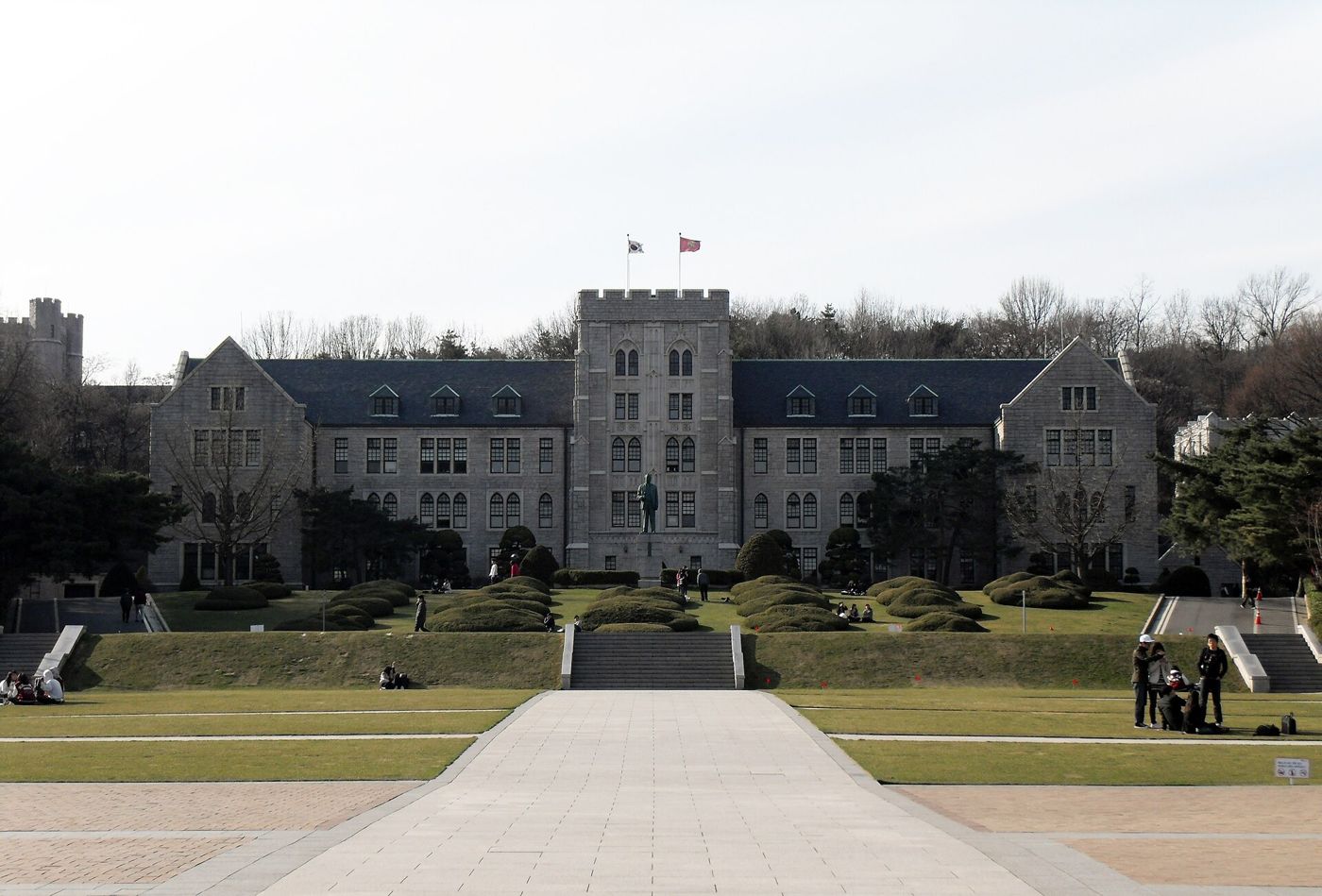
Korea University's Main Hall (본관) in Anam-dong, Seongbuk-gu. The Korean Language Center teaches in its own Korean Education Building (한국어교육관) at 41 Bugaksan-ro 27-gil. Photo: Ksiom, Wikimedia Commons, CC BY-SA 3.0 (2009).
Korea University Korean Language Center (고려대학교 한국어센터)
₩1,800,000 a term whichever class you take (general-purpose morning or afternoon, academic-purpose afternoon, or the post-level-6 course), plus a ₩120,000 application fee. Tuition is adjusted each spring, and early payers for 2027 are settled at the 2027 rate.
Two rules matter more than the fee:
- A D-4 visa needs at least two terms paid at once. Korea University issues the standard certificate of admission (표준입학허가서) only to applicants who register for at least two terms (about six months); nationals of Vietnam, Mongolia and Uzbekistan must register for a full year of four terms. A one-term registration, its page says, cannot be used to apply for a D-4.
- Refunds shrink by the day. The full ₩1,800,000 before the start, ₩1,560,000 for the first seven class days, ₩1,080,000 from day 11, ₩360,000 from day 31 and nothing from day 41. A refused visa, cancelled before day one, gets all tuition back but not the application fee.
Its dormitory is Frontier Hall (프런티어관), ₩1,450,000 a term for a twin room with its own bathroom, open to new regular-course students for one term only.
Sogang University Korean Language Education Center (서강대학교 한국어교육원)
Sogang's morning course (KGP200) costs ₩1,860,000 and its afternoon course (KAP200) ₩1,800,000, each 200 hours; the ₩100,000 admission fee is charged to new students only, and textbooks are bought separately. Each class has two or more teachers.
What its fee line does not show: Sogang enrols every language student in group insurance for international students at no charge, so you do not need to buy travel insurance at home for the first term. And on the other side, regular-course students cannot apply for its dormitory. Its on-campus Gonzaga International Hall (곤자가국제학사) takes only summer-programme students.
Ewha Language Center (이화여자대학교 언어교육원)
The intensive Korean program costs ₩1,850,000 plus a ₩120,000 admission fee, Monday to Friday 9:10 to 13:00 for ten weeks, and is open to men and women. Insurance is included in the tuition; textbooks are not. Two points from its May 2026 brochure: the certificate of admission for a D-4 visa is issued only after the full tuition is paid, and D-4 applicants must show a bank balance of at least ₩10,000,000 for two terms.
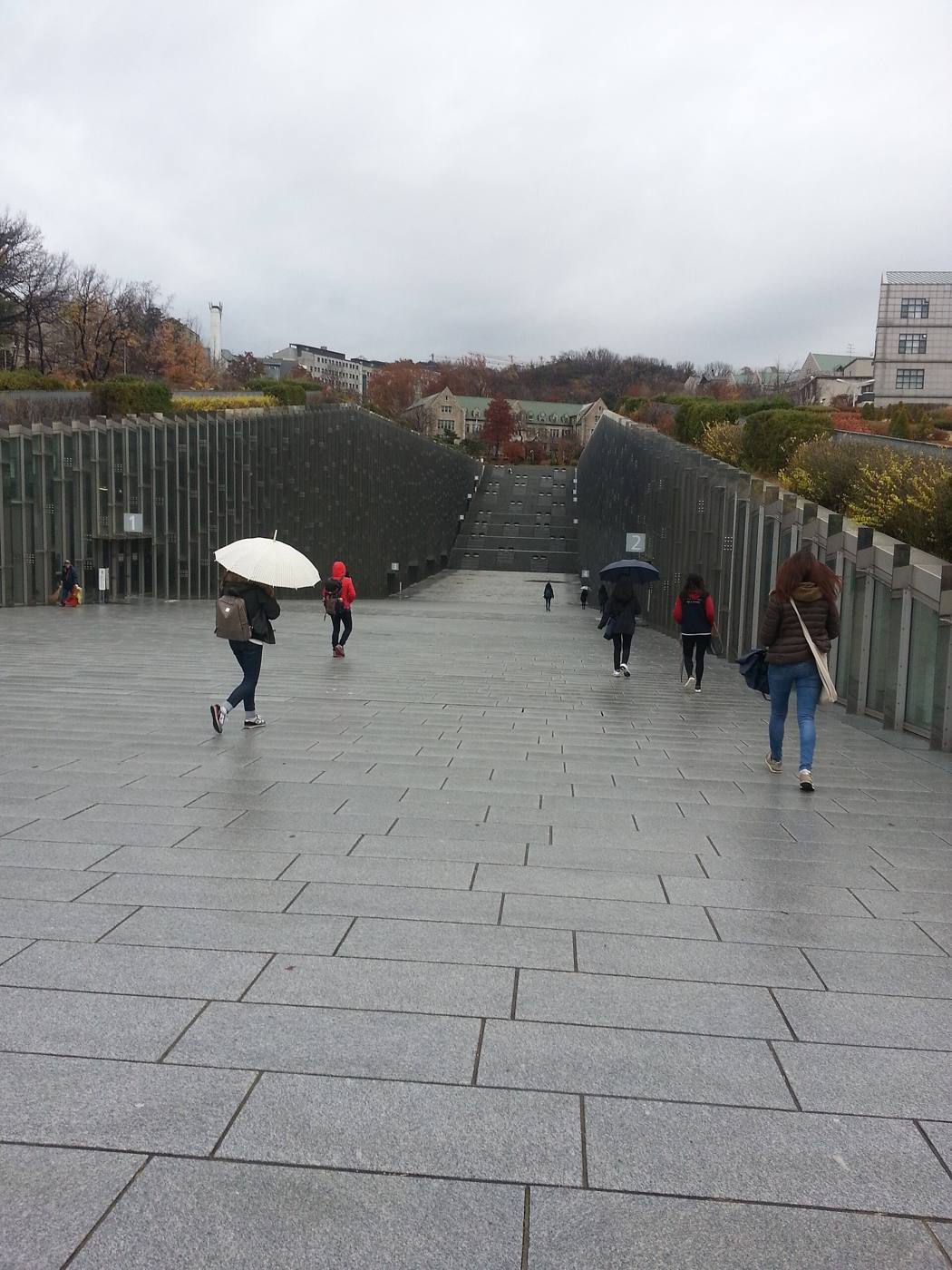
The Ewha Campus Center (이화캠퍼스센터, ECC) in Sinchon, Seoul. Ewha Language Center itself is in the Ewha-Samsung Education Culture Building on the same campus. Photo: Hdb1115, Wikimedia Commons, CC BY-SA 3.0 (2015).
Sungkyunkwan University Korean Language Institute (성균관대학교 성균어학원)
The cheapest single-rate school of the six (only SNU's afternoon class is lower) at ₩1,780,000 a term, with an ₩80,000 application fee, so a first term costs ₩1,860,000. A school day is four 50-minute classes, 9:00 to 12:50 or 14:00 to 17:50. You do not choose: level 1 and some level 2 students study in the afternoon, levels 3 to 6 in the morning, with no changes allowed.
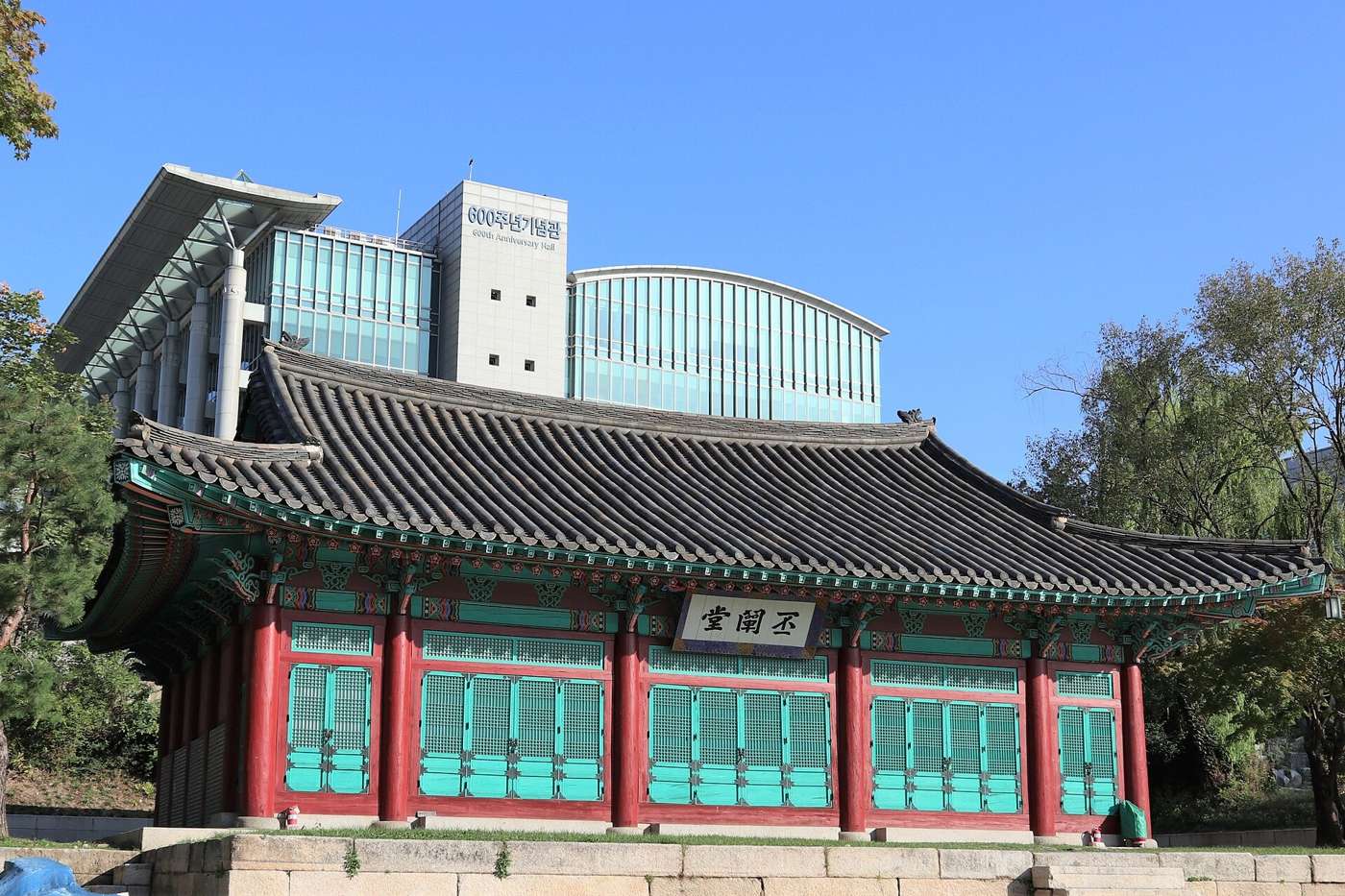
Bicheondang (비천당), a Joseon-era hall, in front of the 600th Anniversary Hall on Sungkyunkwan University's Humanities and Social Sciences Campus in Jongno-gu, where the Korean Language Institute teaches. Photo: S h y numis, Wikimedia Commons, CC BY-SA 4.0 (2020).
You might like: SKY vs KAIST: Choosing a Korean University by Major, Not Rank
Outside Seoul: Pusan National University at ₩1.5 million
Pusan National University's Language Education Institute (부산대학교 언어교육원) lists its 2027 regular course at ₩1,500,000 a term, and that figure "includes all costs, such as fees for textbooks and cultural activities". Against Yonsei's first term with textbooks bought separately, that is a saving of at least ₩480,000 (about US$353) per term.
The 2027 spring term runs 22 February to 30 April, with online applications 30 November to 18 December 2026. That is the earliest spring start of any school here, eleven days before Yonsei. The trade-off: a city where daily Korean is unavoidable, and rent well below Seoul's.
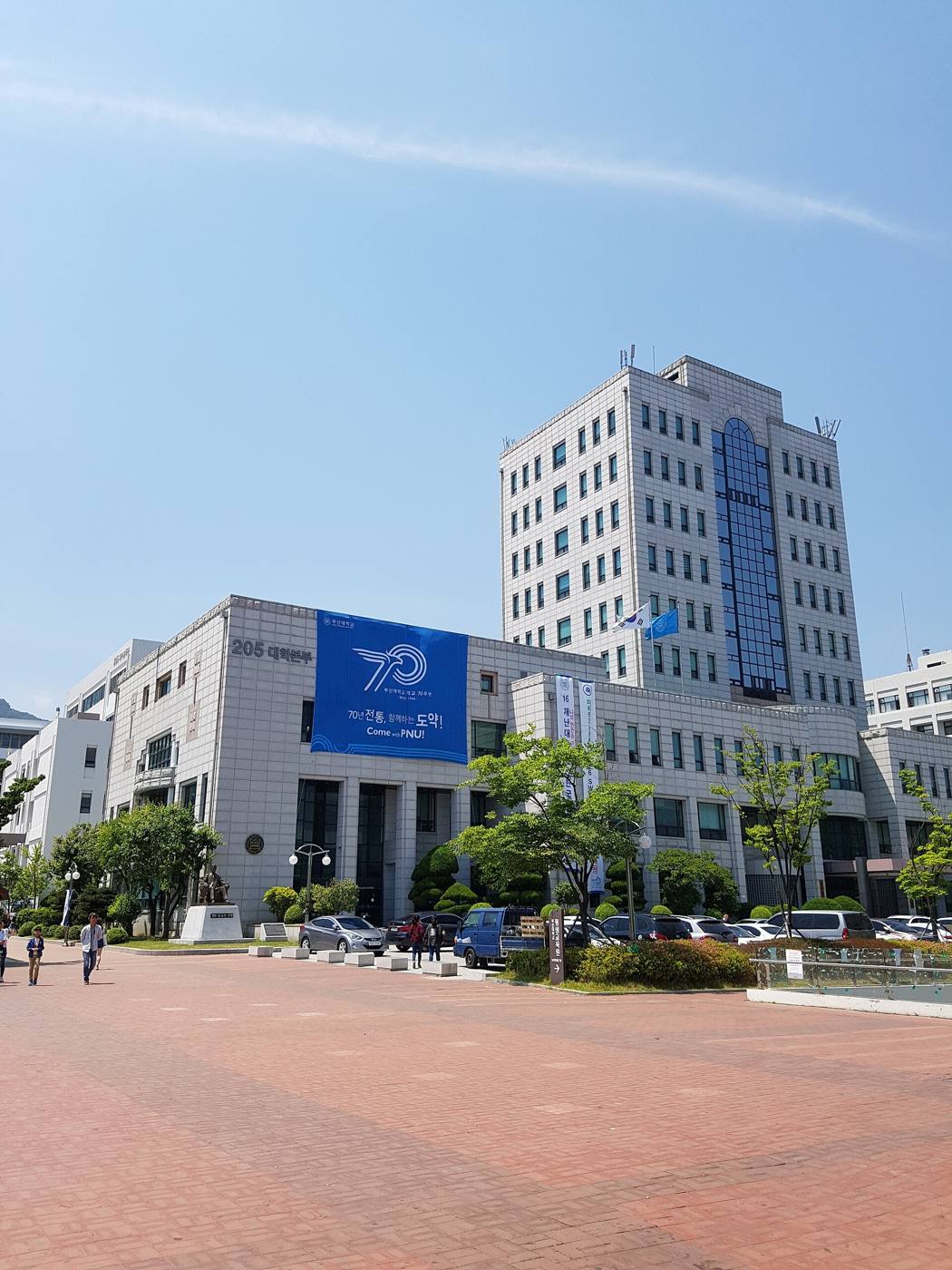
Pusan National University's main building (본관) in Geumjeong-gu, Busan, in 2016, with a banner for the university's 70th anniversary. Photo: Hyowonian, Wikimedia Commons, CC BY-SA 4.0 (2016).
Next intakes: winter 2026 and spring 2027 deadlines
As of 1 October 2026, five Seoul schools are still taking applications for a winter term that starts in December. The rest of the table is the spring 2027 round.
| School | Winter 2026 term | Apply by | Spring 2027 term | Application window |
|---|---|---|---|---|
| Yonsei | starts 1 Dec 2026 | 16 Oct 2026, 17:00 (tuition by 23 Oct) | starts 5 Mar 2027 | 7 Dec 2026 – 15 Jan 2027 |
| Sogang | 3 Dec 2026 – 22 Feb 2027 | 22 Oct 2026 | 9 Mar – 25 May 2027 | 14 Dec 2026 – 15 Jan 2027; pay by 22 Jan |
| Sungkyunkwan | 2 Dec 2026 – 17 Feb 2027 | 23 Oct 2026 (1 Oct for Nepal, Mongolia, Myanmar, Bangladesh, Vietnam) | not yet posted | — |
| Ewha | 1 Dec 2026 – 12 Feb 2027 | 27 Oct 2026 (documents and tuition) | 5 Mar – 18 May 2027 | 7 Dec 2026 – 26 Jan 2027 |
| Korea University | 11 Dec 2026 – 25 Feb 2027 | 28 Oct 2026 (documents screened and tuition paid) | 18 Mar – 31 May 2027 | 7 Dec 2026 – 22 Jan 2027 |
| Seoul National | applications closed | — | 8 Mar – 14 May 2027 | 2 Nov – 24 Dec 2026 |
| Pusan National | — | — | 22 Feb – 30 Apr 2027 | 30 Nov – 18 Dec 2026 |
These are last dates, not safe dates: Korea University asks for original documents at least two weeks before the deadline and says screening takes one to two weeks; Ewha says D-4 applicants' originals must arrive two weeks before the payment deadline; and popular terms close early when classes fill. Add consulate time for the D-4, and a winter applicant who has not started by mid-October should aim at spring.
The D-4 visa: what the schools and immigration ask for
Language students at university-affiliated schools come on a D-4-1 (일반연수, Korean language training) visa: the school issues a standard certificate of admission, you apply at a Korean consulate, and you register as a foreign resident within 90 days of arrival. The details that cost people a term:
- Money in the bank: ₩10,000,000 (about US$7,350). SNU, Korea University and Ewha all ask for a bank balance of at least ₩10 million, in your or a parent's name, issued within 30 days (Korea University: within a month of applying) and, at Korea University, kept for the length of the course. At Korea University, Vietnamese and Uzbek applicants must show the balance held for three months and Chinese applicants a deposit frozen for six; nationals of the 20 countries on a Ministry of Justice list (among them Nepal, Mongolia, India, Indonesia and the Philippines) must also document their parents' jobs and income.
- Apostilled diploma. Korea University, SNU and Ewha want your final school certificate with an apostille or Korean consular confirmation; Korea University wants originals by post.
- More than one term. Korea University issues D-4 papers only for two terms paid at once, Ewha's ₩10 million covers two terms, and Yonsei treats a one-term student as a non-D-4 applicant. Plan for six months, or settle the visa question for a single term with the consulate yourself.
- Health insurance after six months. D-4 language students join the National Health Insurance Service after six months in Korea and pay the student rate, ₩79,320 a month in 2026, half the foreigner minimum (our health insurance guide explains how it is billed and what happens if you miss a month).
- Part-time work only after six months, with a permit. Under the immigration manual summarised by universities, a D-4 language student can apply for part-time work permission (체류자격외 활동허가) once six months have passed since entry, with average attendance of 90% or more and Korean at TOPIK level 2 or the equivalent. The base allowance is 10 hours a week, rising to 20 on weekdays at certified universities or for strong students; the permit covers one workplace for up to six months. Working without it can lead to a fine or deportation; the 2026 minimum wage is ₩10,320 an hour, ₩10,700 from 1 January 2027 (what foreign workers are owed).
You might like: Korea Health Insurance for Foreigners (2026): At Least ₩158,630 a Month After Six Months
A year of Korean in Seoul: the full budget
Tuition is the smaller half of the bill. Here is a year (four terms) at Yonsei with a Seoul one-room, using the official and survey figures from our Seoul rent guide:
- Tuition: 4 × ₩1,860,000 + ₩120,000 = ₩7,560,000.
- Rent: a one-room near Yonsei averaged ₩758,000 a month with management fee on a ₩10 million deposit in Dabang's July 2026 survey. Twelve months is about ₩9.1 million, and the deposit comes back at the end. A goshiwon room runs ₩400,000–₩600,000.
- Health insurance: nothing for six months, then ₩79,320 a month, about ₩476,000 for the rest of the year.
- Textbooks: bought per level at every Seoul school here.
That is roughly ₩17 million (about US$12,500) before food, phone and transport, plus a ₩10 million deposit you need to have and get back. A dorm (from ₩1.44 million a term at Yonsei for women, ₩1.68 million otherwise) is cheaper per month but time-limited at most schools.
Seoul National University Korean 1A — the student's book from SNU's own Language Education Institute If you are choosing between a speaking-first school and a more structured one, compare SNU's book with Sogang's before you pay an application fee you will not get back. It comes with QR-code audio. As an Amazon Associate, EpicKor earns from qualifying purchases at no extra cost to you.
See SNU Korean 1A on AmazonThe honest part: when a university language school is the wrong choice
- You want conversation, not a timetable. Four hours a day, five days a week, with homework and graded exams, is a full-time course. If you only want to speak better on a holiday, SNU's evening class (저녁반, Monday and Thursday 18:30–21:20, 60 hours) costs ₩660,000 a term, but SNU restricts it to people who already hold a visa; Sogang also runs a two-term-a-year evening course (KGP60).
- You care about price above all. Seoul's cheapest and dearest first terms (SNU afternoons ₩1,750,000, Yonsei ₩1,980,000) are only ₩230,000 apart; moving to Busan saves far more on rent than on tuition.
- What English comparison pages miss: SNU has three prices, not one; Sungkyunkwan now runs four terms, not six; Sogang's regular students cannot use its dorm; and Korea University needs two terms for a D-4.
FAQ
Q: How much does a Korean language school cost in Korea in 2026? A: As of October 2026, a 10-week, roughly 200-hour term at the big Seoul university schools costs ₩1,650,000 to ₩1,860,000, plus a ₩80,000–₩120,000 application or admission fee. Pusan National in Busan charges ₩1,500,000 including textbooks.
Q: What is the Yonsei Korean Language Institute tuition? A: ₩1,860,000 per 10-week, 200-hour term, plus a ₩120,000 non-refundable application fee, as of October 2026. Winter 2026 starts on 1 December (apply by 16 October); spring 2027 starts on 5 March (apply 7 December 2026 to 15 January 2027).
Q: How much money do I need in the bank for a D-4 visa? A: The Seoul schools that state a figure (SNU, Korea University and Ewha) ask for a balance of at least ₩10,000,000, about US$7,350, in your or a parent's name and issued within 30 days. Some nationalities must show the money has been held for months.
Q: Can I work part-time on a D-4 language student visa? A: Only with permission from immigration, and only after six months in Korea. You need 90% average attendance, TOPIK level 2 or equivalent and the school's confirmation; the base allowance is 10 hours a week at one workplace.
Q: Which Korean language school in Seoul is cheapest? A: By tuition, SNU's afternoon class at ₩1,650,000 a term (₩1,750,000 with the application fee); among schools with one price, Sungkyunkwan at ₩1,780,000. Outside Seoul, Pusan National charges ₩1,500,000 with textbooks.
Sources
- Yonsei University Korean Language Institute (yskli.com), regular course page: tuition ₩1,860,000, application fee ₩120,000, 10 weeks / 200 hours, class times, 2026–2027 term and application dates, dormitories: International House twin ₩1,440,000 (women only), SK Global House twin ₩1,680,000 and single ₩2,320,000 per term, about 10% of students, winter 2026 dorm deadlines (read 1 October 2026).
- Seoul National University Language Education Institute, Korean Language Education Center, 2026~2027 brochure (language.snu.ac.kr): morning ₩1,800,000, afternoon ₩1,650,000, research class ₩1,450,000, evening ₩660,000, 13-week course ₩1,150,000; application fee ₩100,000; 2027 calendar; dormitory rules; "does not apply for D-4 visas on students' behalf".
- Korea University Korean Language Center (klc.korea.ac.kr), regular course introduction (2026–2027 calendar) and registration pages, last revised 7 August 2026: ₩1,800,000 per term, ₩120,000 application fee, 2026 refund table, two-term rule for D-4, Frontier Hall ₩1,450,000, class size 14, attendance rules.
- Sogang University Korean Language Education Center (klec.sogang.ac.kr), KGP200 and KAP200 course pages, 2026 and 2027 academic calendars and dormitory page.
- Ewha Language Center (elc.ewha.ac.kr), "2026~2027 Korean as a Foreign Language Program", published May 2026: tuition ₩1,850,000, admission fee ₩120,000, schedules, D-4 document and bank-balance rules.
- Sungkyunkwan University Korean Language Institute (skb.skku.edu), regular course overview, last modified 6 March 2026: tuition ₩1,780,000, application fee ₩80,000, 2026 four-term schedule.
- Pusan National University Office of International Affairs (international.pusan.ac.kr), Korean Language Course: 2027 schedule and ₩1,500,000 tuition including textbooks and cultural activities.
- Ministry of Education and Korean Council for University Education, 2026 tuition disclosure (대학알리미), as reported by Kyosu Shinmun, 29 April 2026: four-year average ₩7.27 million, private ₩8.23 million, national/public ₩4.25 million.
- Ministry of Education, 2026 Basic Education Statistics (교육기본통계, as of 1 April 2026), as reported by Hangyo (한국교육신문), 27 August 2026 (307,464 international students, +21.3%; Vietnam 96,834, China 78,890) and by Financial News, 26 August 2026 (degree students 72.6%: 223,191 degree, 84,273 non-degree including language programmes). The 2020 figure of 153,695 is from the same statistics series.
- 찾기쉬운 생활법령정보 (easylaw.go.kr), "외국인유학생 > 시간제 취업", citing the Ministry of Justice 체류자격별 통합 안내 매뉴얼 (1 September 2026); Cheongju University and Seojeong University international offices, D-4 part-time work conditions (six months, 90% attendance, TOPIK 2, 10/20 hours, one workplace).
- National Health Insurance Service premium for D-2 and D-4 students in 2026 (₩79,320) and Dabang's July 2026 university-area rent survey: see the sources in our posts 492 and 491.
You Might Also Like
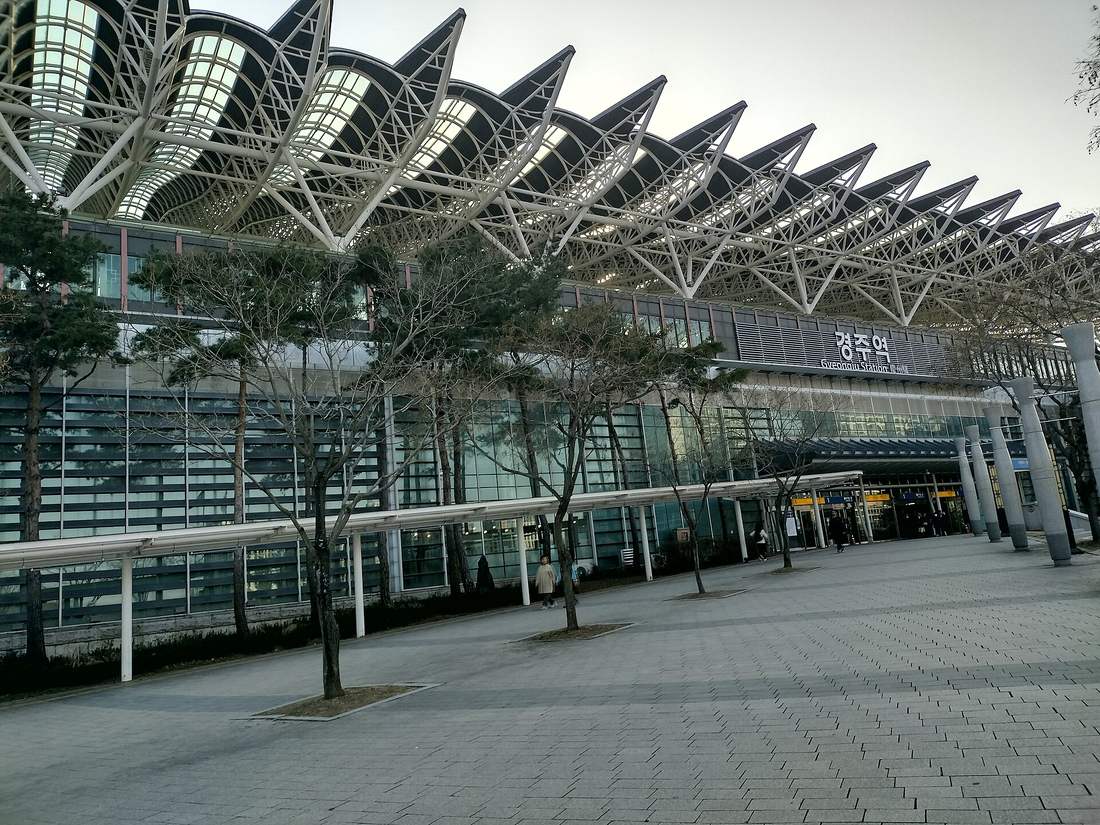
Busan to Gyeongju, Korea: KTX, the Donghae Line Train and the Bus Compared — Fares After the 1 October Bus Rise, Times and Which Station You Arrive At
Busan to Gyeongju costs ₩10,100 by KTX in 27 minutes, or ₩8,400 by bus after today's 9% rise. But the train stops at Gyeongju Station, the old Singyeongju, 30–40 minutes from the tombs; the bus lands downtown.
Korea Health Insurance for Foreigners (2026): At Least ₩158,630 a Month After Six Months — Students, Workers, and What Happens If You Don't Pay
Foreigners in Korea are enrolled in national health insurance after six months and billed at least ₩158,630 a month in 2026. Students pay half, ₩79,320. A month behind and most foreigners lose cover until they pay; immigration shortens the visa extension.
How Much Is Rent in Seoul (2026)? Officetels Average ₩949,000 a Month — Jeonse vs Wolse, Deposits, and What Foreigners Need
Seoul officetels average ₩949,000 a month on a ₩22.85 million deposit (Korea Real Estate Board, June 2026); villa one-rooms ₩670,000, apartments ₩1.64 million. Jeonse vs wolse, the 5% conversion cap, agent fees and protecting a deposit.