Korea Visa Overstay: What Happens, Fines by Length, How to Leave
Last updated: 28 October 2026. Law read that day on law.go.kr: the Immigration Act (출입국관리법) in the version in force from 2 October 2026, its Enforcement Decree (시행령) in force from 2 October 2026, and its Enforcement Rule (시행규칙) in force from 23 October 2026, including the fine schedule in Table 7 as revised on 23 January 2026. ₩1,334 = US$1 (Federal Reserve, 16 October 2026). A guide, not legal advice; sources at the end.
What happens if you overstay in Korea? On paper, you have committed a crime. Article 94 of the Immigration Act (출입국관리법) punishes anyone who stays beyond their permitted period, or works without a status that allows work, with up to three years in prison or a fine of up to ₩30 million (about US$22,490). That is the number most English-language pages quote, and it is real. It is also not what usually happens.
What usually happens is set out in a table most of those pages never open. Article 102 lets the immigration office settle the case with a fine-like payment called beomchikgeum (범칙금), and Table 7 of the Enforcement Rule fixes its base amount by how long you overstayed. For an overstay of under a month, the base is ₩500,000 to ₩2,000,000 (about US$375 to US$1,500), depending on which of two rows the office applies, and it climbs to ₩30 million after seven years. After the fine, the office decides whether you leave on a departure order (출국명령) or are deported (강제퇴거), and that decision is what shapes whether you can come back.
This guide gives you the dates that matter, the fine table in won and dollars, what changes if you worked, what the law actually says about entry bans, how voluntary departure works, and the one step that avoids all of it: applying to extend before your stay period ends.
The date that decides everything is printed on the entry sticker inside your passport. A slim passport holder keeps the sticker, your return ticket and any extension receipt together: FINTIE slim RFID passport holderAffiliate link. As an Amazon Associate, EpicKor earns from qualifying purchases at no extra cost to you.
Quick Guide: overstaying in Korea, October 2026
| Question | Answer (Immigration Act and Rule in force 28 October 2026) |
|---|---|
| Is overstaying a crime? | Yes. Art. 94(7) and (17): up to 3 years in prison or ₩30,000,000 (about US$22,490) |
| What usually happens instead? | A beomchikgeum (범칙금) notice under Art. 102, paid within 15 days (Art. 105), then a departure order or deportation |
| Fine for under a month | Base ₩500,000 (about US$375) for staying past the period without an extension; ₩2,000,000 (about US$1,500) on the stricter row (Table 7) |
| Fine after a year | Base ₩10,000,000 (about US$7,500) on both rows; ₩30,000,000 after 7 years |
| Can the fine change? | The office can cut or raise it by up to half (Rule Art. 86(2)) or waive it (Act Art. 103(2)) |
| Worked on a tourist entry? | Art. 18(1) and 94(8): same 3 years / ₩30 million cap, same length-based fine scale as the stricter overstay row |
| Entry ban | The Act fixes one period: after a deportation order, a ban of up to 5 years is possible (Art. 11(1)6). Other periods reportedly come from an internal Ministry guideline not found on law.go.kr |
| How to avoid it | Apply for an extension before the period ends (Art. 25, Decree Art. 31). Fee ₩60,000 (about US$45); free if it is only to wait for a way out (Rule Art. 32) |
| Help line | 1345, the Ministry of Justice foreigner call centre, with interpreters |
Valante travel document organizer — passport, ticket and paperwork in one zipped wallet. An extension or a voluntary-departure report at an immigration window often asks for the same things: passport, the application form, supporting documents and receipts, and for a voluntary-departure report, your air ticket. Losing one of them on the day costs you another trip to the office. As an Amazon Associate, EpicKor earns from qualifying purchases at no extra cost to you.
See the Valante document organizer on AmazonHow long you can stay: the date on your entry sticker, not your K-ETA
Article 17(1) of the Immigration Act is one sentence: a foreigner may stay in Korea within the scope of their status of stay (체류자격) and period of stay (체류기간). Both are given to you at the border. Officers usually put a small Entry Confirmation sticker in your passport with three lines that matter: the date of entry, the status code and the date you must leave by. If you have none, check your end date with the 1345 call centre.
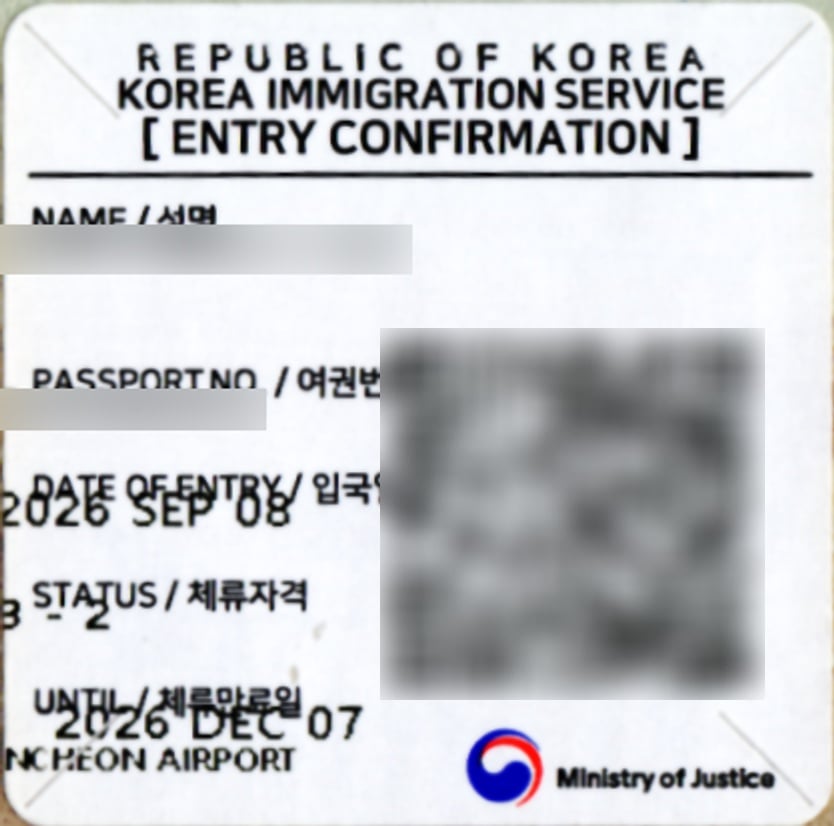
Most short visitors fall into one of three codes, all defined in Table 1 of the Enforcement Decree:
| Code | What it is (Decree Table 1) | Typical stay | Work allowed? |
|---|---|---|---|
| B-1 사증면제 (visa waiver) | Nationals of a country with a visa-waiver agreement, doing what that agreement covers | Set by each agreement and nationality | No |
| B-2 관광·통과 (tourism, transit) | Entry without a visa for tourism or transit under Korea's own waiver list | Depends on nationality; check the K-ETA portal or the Ministry of Foreign Affairs list | No |
| C-3 단기방문 (short-term visit) | Visa for tourism, family visits, business meetings, events and similar, "not exceeding 90 days", excluding anyone seeking profit | Up to 90 days | No |
Two points trip people up. First, K-ETA is not a period of stay. It is an authorisation to board a flight to Korea without a visa, valid for three years, and nationals of 22 countries do not need it at all through 31 December 2026. It says nothing about how long you may remain once you land; the sticker does. Our K-ETA and e-Arrival Card guide covers who needs which. Second, the period is fixed per entry. If you leave and come back, you get a new sticker and a new date, but the officer at the border decides that, and the Act gives no automatic right to a fresh 90 days.
You might like: Korea e-Arrival Card vs K-ETA: 22 Countries Are Exempt, and the Paid One Cancels the Free One
What the Immigration Act says, article by article
The English summaries online tend to merge several different offences into one. The law keeps them apart, and the difference changes the fine.
| Article | What it requires | Penalty article | Maximum |
|---|---|---|---|
| Art. 17(1) | Stay only within your status and period | Art. 94(7) | 3 years / ₩30,000,000 |
| Art. 25(1) | To stay beyond your period, get an extension before it ends | Art. 94(17) | 3 years / ₩30,000,000 |
| Art. 18(1) | To work, hold a status that allows work | Art. 94(8) | 3 years / ₩30,000,000 |
| Art. 18(3) | No one may employ a person without such a status | Art. 94(9) | 3 years / ₩30,000,000 |
| Art. 20 | Activity outside your status (such as a student's part-time job) needs a permit | Art. 94(12) | 3 years / ₩30,000,000 |
| Art. 18(2) | A work-status holder may work only at the designated workplace | Art. 95(5) | 1 year / ₩10,000,000 |
Each of the foreigner's breaches above, under Articles 17(1), 18(1), 20 and 25, also makes the foreigner deportable: Article 46(1)8 lists breaches of Articles 17, 18, 20, 23, 24 and 25 among the grounds for deportation. So an overstay has two tracks running at once. One is the criminal track (prosecution or the fine that replaces it). The other is the administrative track (how you leave, and whether you can return).
This is not rare paperwork. The Ministry of Justice processed 139,727 immigration-offence cases in 2024, up 4.2% from 134,083 in 2023, counting deportations, departure orders, fine notices, referrals and administrative fines together (e-나라지표 indicator 1757).
The criminal track rarely reaches a court for an overstayer alone. Article 102 lets the head of the immigration office, once the facts are established, issue a written notice to pay a beomchikgeum instead of sending the case to prosecutors. The Ministry's internal rule on referrals, the 출입국사범 고발규정 (in force from 20 January 2025), lists the cases that must be referred: smuggling people, false invitations of five or more foreigners, and employers who hired five or more people without status or employed someone for six months or more. A tourist who simply overstayed is not on that list. That list is the principle, not an absolute: under Article 3(1), even a listed case can be settled by a fine notice instead, for example when the offender cooperated fully, after the office reports it to the Minister. The office still must refer a case when it judges the facts deserve imprisonment (Art. 102(3)), and it may refer any case where the motive, profit or social impact warrants it.
Korea overstay fines by length: the Table 7 schedule
This is the table most guides skip. Article 103 says the amounts are set by ministry ordinance, and Rule Article 86 points to Table 7 of the Enforcement Rule. It has two rows that can apply to a person who stayed too long:
- Row 고 (Art. 25 breach): "stayed beyond the period of stay without an extension permit".
- Row 거 (Art. 17(1) breach): "stayed outside the scope of the status or period of stay".
Which row the office uses is its call on the facts; the law text does not say a tourist who simply forgot always falls under one or the other. Some Korean immigration-agency guides quote only the stricter row 거 figures. We show both.
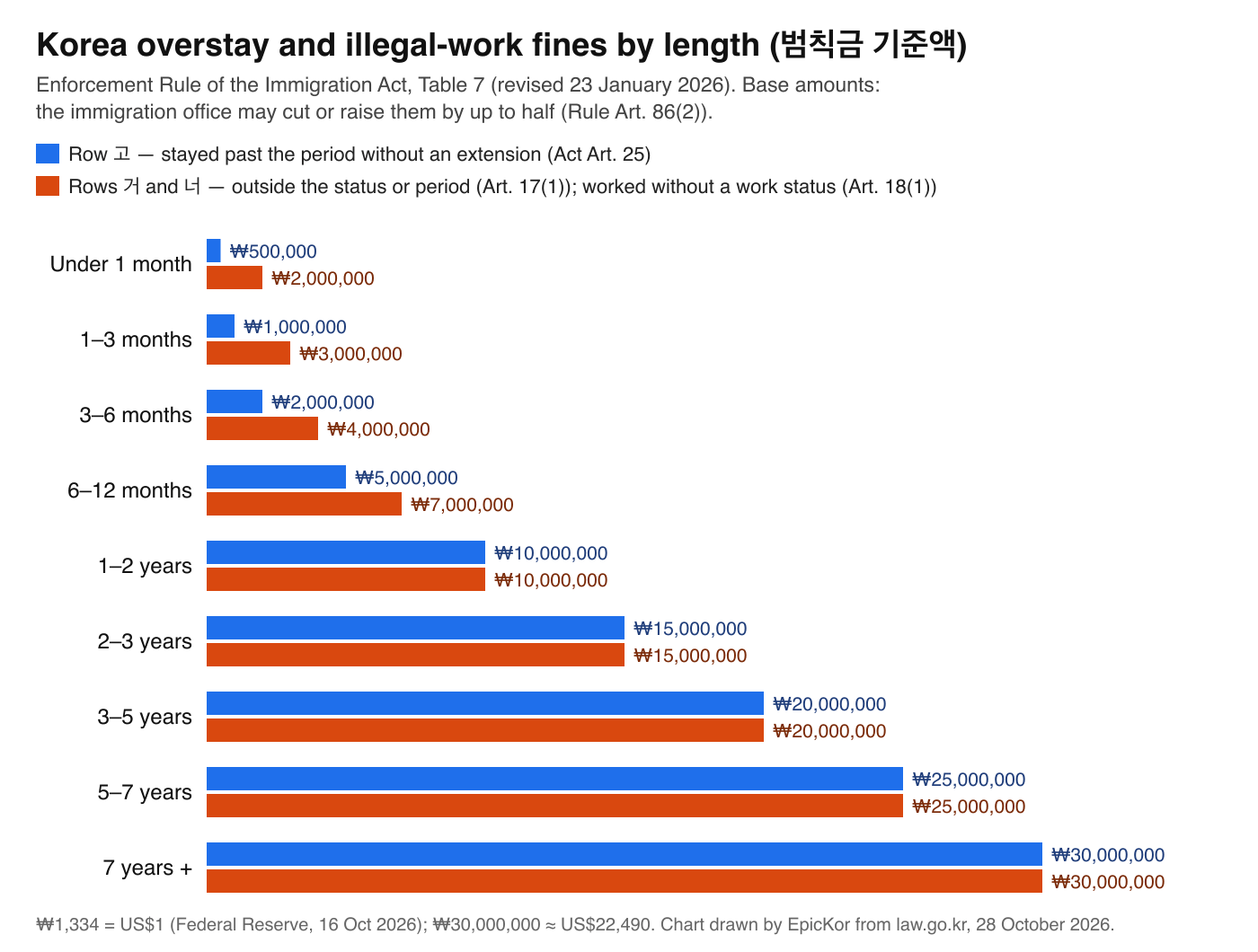
| Length of overstay | Row 고 — no extension (Art. 25) | Row 거 — outside status or period (Art. 17(1)) |
|---|---|---|
| Under 1 month | ₩500,000 (≈ US$375) | ₩2,000,000 (≈ US$1,500) |
| 1 to under 3 months | ₩1,000,000 (≈ US$750) | ₩3,000,000 (≈ US$2,250) |
| 3 to under 6 months | ₩2,000,000 (≈ US$1,500) | ₩4,000,000 (≈ US$3,000) |
| 6 months to under 1 year | ₩5,000,000 (≈ US$3,750) | ₩7,000,000 (≈ US$5,250) |
| 1 to under 2 years | ₩10,000,000 (≈ US$7,500) | |
| 2 to under 3 years | ₩15,000,000 (≈ US$11,240) | |
| 3 to under 5 years | ₩20,000,000 (≈ US$14,990) | |
| 5 to under 7 years | ₩25,000,000 (≈ US$18,740) | |
| 7 years or more | ₩30,000,000 (≈ US$22,490) — the legal maximum | |
Four rules sit around the table and matter as much as the numbers:
- It is a base, not a price. Rule Article 86(2) lets the office cut or raise the amount by up to half, looking at your age and circumstances, the motive and result, your ability to pay and how many times you have done it. Article 86(3) allows a different amount with the Minister's approval.
- It can be waived. Act Article 103(2) lets the Minister of Justice exempt you from the notice altogether on the same grounds. A two-day overstay caused by a cancelled flight and reported straight away is the kind of case this exists for; it is a discretion, not a right.
- Pay within 15 days. Article 105(1) gives you 15 days from receiving the notice. If you do not pay, the office must refer you for prosecution (Art. 105(2)), unless a deportation order has already been issued, in which case it does not (Art. 105(3)).
- Repeat offences cost more on the count-based rows; the general rules of Table 7 count repeats within three years.
Working on a tourist entry: the same law, and the employer pays too
The second half of the target question is the one people ask quietly: what if I worked while I was here as a visitor? Article 18(1) says a foreigner who wants to work in Korea must hold a status that allows employment. Decree Article 23(1) lists those statuses: C-4 short-term employment, E-1 to E-10 and H-2. Article 23(2) frees some F-2 residence sub-types and F-6 marriage migrants from work limits, and Article 23(3) does the same for F-4 overseas Koreans except for simple labour. H-1 working holiday counts as a work status for the jobs it allows. B-1, B-2 and C-3 do not, and the C-3 definition itself excludes "anyone seeking profit".
Working without a work status is Article 94(8), with the same three years or ₩30 million cap. Its row in Table 7, row 너, uses exactly the same length-based scale as the stricter overstay row: ₩2,000,000 for under a month of work, up to ₩30,000,000 after seven years. If you both overstayed and worked, those are two breaches, and the office can charge both.
| Who | Breach | Base fine (Table 7 or 8) |
|---|---|---|
| Visitor who worked | Art. 18(1) → Art. 94(8), row 너 | ₩2,000,000 under 1 month; ₩7,000,000 for 6–12 months; ₩10,000,000 for 1–2 years |
| Student working without the part-time permit | Art. 20 → Art. 94(12), row 어 | Same scale: ₩2,000,000 under 1 month |
| Work-status holder at an unauthorised workplace | Art. 18(2) → Art. 95(5), row 더 | ₩1,000,000 under 3 months, up to ₩10,000,000 after 2 years |
| Employer of one person without status | Art. 18(3) → Art. 94(9), Table 8 | ₩3,000,000 under 3 months, ₩5,000,000 for 3–6 months, ₩11,000,000 for 2 years or more |
The employer's side is in a separate schedule, the current Table 8, priced by both the number of workers and the length of employment: one worker for under three months is ₩3,000,000 (about US$2,250), ten workers for two years or more is ₩29,000,000. Under the referral rule above, an employer who hired five or more people without status, or kept one for six months or more, is in principle referred for prosecution. That is why Table 8 still prices five or more workers: the Article 3(1) exceptions, such as full cooperation, let the office settle those cases by fine notice after reporting to the Minister.
For a student, the legal route is a permit, not silence. Article 20 permission for activity outside your status costs ₩120,000, or ₩20,000 for D-2 and D-4 students' part-time work that the Ministry allows (Rule Art. 72(2)). Wage rights do not depend on status: the Labor Standards Act protects anyone who actually worked, and the minimum wage figures are in our minimum wage guide.
What about remote work for a company abroad while on a visa-free entry? The Act does not mention it by name, and the C-3 definition's "profit" exclusion is the closest the text comes. If that is your plan for more than a few weeks, the cleaner route is the workation visa (F-1-D), whose income rules and real issuance numbers are in our digital nomad visa guide.
You might like: Korea Minimum Wage 2027: ₩10,700 an Hour, ₩2,236,300 a Month — What Foreign Workers Are Owed and What They Actually Earn
Departure order, deportation, and the real rule on entry bans
After the fine, the immigration office decides how you leave. The Act gives it three tools, and they are very different for your future visits.
| Measure | When (Immigration Act) | Deadline to leave | What follows |
|---|---|---|---|
| Departure recommendation 출국권고 | Art. 67: a minor breach of Art. 17 or 20 | Up to 5 days from the notice (Art. 67(3)) | If ignored, becomes a departure order (Art. 68(1)2) |
| Departure order 출국명령 | Art. 68: deportable, but leaving at your own expense; or after a fine notice where leaving is appropriate | Up to 30 days from issue (Rule Art. 65(1)); a bond of up to ₩20,000,000 may be required (Art. 68(3)) | Miss the deadline or a condition and a deportation order is issued "without delay"; the bond can be forfeited (Art. 68(4)) |
| Deportation 강제퇴거 | Art. 46: grounds include breaches of Arts. 17, 18, 20 and 25; may involve detention | Removed by the state | Entry can be banned for up to 5 years after you leave (Art. 11(1)6) |
The entry-ban period the law actually fixes is that one: Article 11(1)6. The Minister of Justice "may" ban entry for a person who left under a deportation order fewer than five years ago. It is a power, not an automatic sentence, and it is the only ban length written into the Act for an overstayer.
Every other period you will read online, such as one year for a short overstay, three years for longer ones, or ten years, is attributed to a reported Ministry of Justice internal guideline on entry restrictions (입국규제 업무처리 등에 관한 지침). We searched the National Law Information Center's administrative-rules database for it on 28 October 2026 and it is not published there, and we found no official table of its periods. Blog tables of ban lengths cannot be checked against a public text, so we do not reproduce one. What the Ministry has said in public is about the link between the fine and the ban: in its normal voluntary-departure scheme, entry restrictions are deferred only if the fine was paid.
That came from the Ministry's press release of 28 November 2025, which announced a special voluntary-departure period from 1 December 2025 to 28 February 2026. During those 90 days, overstayers who reported and left had the fine waived and entry restrictions deferred even without paying. Excluded were smuggled entrants, users of forged passports, criminal offenders (형사범), people subject to deportation such as those who ignored a departure order, and anyone who became an overstayer on or after 1 December 2025. Similar windows ran from 11 September 2023 (extended to the end of February 2024) and from 30 September 2024 (extended to 31 January 2025). That 2025–26 window has closed. We found no new one announced as of 28 October 2026, so assume the normal rules apply: report, pay, leave.
You might like: Things to Know Before Traveling to Korea: 2026 Guide
Voluntary departure: how to leave before you are caught
If you have already overstayed, the step that limits the damage is to report yourself before an inspection finds you. The Ministry's own published procedure, the voluntary-departure pre-report (자진출국 사전 신고제), works like this:
- Report 3 to 15 days before you fly. Three days not counting public holidays, up to fifteen days counting them. Report at the immigration office for the area where you live, or online at HiKorea (hikorea.go.kr), giving your name, address, departure date, airport and flight number.
- Bring the voluntary-departure form, your passport and your air ticket if you go in person.
- On departure day, the airport or seaport immigration office re-checks criminal records and wanted lists, then you leave.
The Ministry runs the 1345 foreigner call centre with interpreters for questions about the process. Under the normal scheme, the fine is assessed on the length table above; paying it is what lets the entry restriction be deferred. People who already hold a departure order or a deportation order reportedly cannot use the online pre-report; confirm with 1345.
Leaving without dealing with it is not a clean exit. The overstay is in the immigration record whether or not you were stopped, and it is there when you next apply for a visa or K-ETA. Korea can refuse entry to people who have broken its immigration rules, and the officer at the border decides on the facts in front of them.
Extend before it ends: the step that avoids all of this
Article 25(1) is the most useful sentence in the Act for a visitor: a foreigner who wants to stay beyond their period must get the Minister's extension permit before the period ends. Decree Article 31(1) repeats it: submit the extension application before the stay period expires, with the documents the Rule requires, to the immigration office. An application filed in time is the difference between a paperwork question and an Article 94 offence.
What it costs and what to expect:
| Situation | Rule | Fee |
|---|---|---|
| Ordinary extension of stay | Act Art. 25, Decree Art. 31 | ₩60,000 (≈ US$45); ₩30,000 for F-6 marriage migrants (Rule Art. 72(6)) |
| Extension only to leave: no flight or ship, or another unavoidable reason | Rule Art. 32(1)2 | Free (Art. 32(3)); over 30 days needs the Minister's approval |
| Registered foreigner who finished their status activity and wants to travel in Korea briefly before leaving | Rule Art. 32(1)1 | Free |
| Already given a departure deadline but cannot make it (no transport, illness) | Rule Art. 33: postpone the deadline | Apply with proof |
For a short-stay visitor, an ordinary extension is a discretionary decision, and the Act's review standards are set by ministry ordinance (Art. 25(2)); expect to explain why you need it and to show proof, such as a hospital note or a cancelled flight. Registered foreigners with residence cards can usually apply on HiKorea. For registered foreigners aged 19 or over (not short-stay visitors), unpaid national health insurance limits the extension, in principle to six months or less, until the arrears are cleared; the details are in our health insurance guide.
The practical rule is simple. Look at the date on your sticker or residence card the week you arrive. If anything could push you past it, such as illness, a strike or a change of plans, go to the office or call 1345 before that date, not after.
You might like: Korea Health Insurance for Foreigners: At Least ₩158,630 a Month After Six Months — Students, Workers, and What Happens If You Don't Pay
The honest part: what this guide cannot tell you
- Which fine row your office will use. Table 7 has a ₩500,000 row and a ₩2,000,000 row for a short overstay. The law text does not say which one a given tourist falls under, and offices can move either by half.
- How long a ban you would get. The only ban length in the Act is up to five years after deportation. The guideline reported to set other periods is internal and was not found on law.go.kr when we checked.
- Whether a new amnesty is coming. The Ministry has run special windows in 2023–24, 2024–25 and 2025–26. Do not plan around another one.
- Nationality-specific periods. Whether your visa-free stay is 30, 60 or 90 days depends on your passport's agreement or Korea's waiver list. The sticker is the answer for your trip.
If you are already past your date, this is the moment for the 1345 call centre or a licensed immigration lawyer (행정사 or 변호사), not a forum thread.
FAQ
Q: What happens if you overstay your visa in South Korea by one day?
A: Legally, a one-day overstay is still a breach of Article 17(1) or 25. The base fine in Table 7 for under a month is ₩500,000 (about US$375) on the extension row or ₩2,000,000 (about US$1,500) on the stricter row, and the office can reduce it by half or, with the Minister, waive it (Rule Art. 86, Act Art. 103(2)). Report it before you fly rather than hoping nobody notices; a cancelled flight or illness with proof is the kind of reason the waiver exists for.
Q: Is overstaying in Korea a criminal offence?
A: Yes. Article 94 of the Immigration Act sets up to three years in prison or a fine of up to ₩30 million. Most overstayers are settled by a beomchikgeum notice under Article 102 instead of a court case. If you do not pay within 15 days, the office must refer you for prosecution (Art. 105).
Q: Will I be banned from Korea after overstaying?
A: It depends on how you leave. After a deportation order, the Act allows an entry ban of up to five years (Art. 11(1)6). Other ban lengths reportedly come from an internal Ministry guideline that we could not find on law.go.kr. In the Ministry's normal voluntary-departure scheme, entry restrictions are deferred only if the fine is paid.
Q: Can I work in Korea on a visa-free entry or a C-3 visa?
A: No. Working needs a status listed in Decree Article 23, such as C-4, E-1 to E-10, H-2 or H-1 working holiday; some F-2 sub-types, F-6 and (outside simple labour) F-4 are also free to work. Working without one is Article 94(8): the same three years or ₩30 million maximum, with a base fine of ₩2,000,000 for under a month. The employer is liable separately under Article 94(9).
Q: How do I extend my stay in Korea as a tourist?
A: Apply at the immigration office before your permitted date ends (Act Art. 25, Decree Art. 31). The fee is ₩60,000. If you only need time to leave because there is no flight or you are ill, a departure extension under Rule Article 32 is free. Approval is discretionary, so bring proof.
Q: Does K-ETA let me stay longer?
A: No. K-ETA only authorises boarding. Your period of stay is set at the border and printed on the entry sticker in your passport.
Sources
- Immigration Act (출입국관리법), Act No. 21857 promulgated 4 August 2026, version in force from 2 October 2026 (MST 290729): Art. 7, Art. 11(1)6 (ban up to 5 years after deportation), Art. 17 (stay within status and period), Art. 18 (employment), Art. 20, Art. 25 (extension before the period ends), Art. 46 (deportation grounds), Art. 67 (departure recommendation), Art. 68 (departure order, bond), Art. 94 (3 years / ₩30 million: items 7, 8, 9, 12, 17), Art. 95, Art. 100, Arts. 102–105 (fine notice, standards, 15-day payment, referral), National Law Information Center (law.go.kr), read 28 October 2026.
- Enforcement Decree of the Immigration Act (출입국관리법 시행령), in force from 2 October 2026 (MST 290501): Art. 12 and Table 1 (B-1, B-2, C-3, C-4 definitions), Art. 23 (statuses that allow work), Art. 31 (extension application before expiry), Art. 104 (fine procedure), law.go.kr, read 28 October 2026.
- Enforcement Rule of the Immigration Act (출입국관리법 시행규칙), in force from 23 October 2026 (MST 291289): Art. 32 (extension to leave, free), Art. 33 (postponing a departure deadline), Art. 65 (30-day departure-order deadline), Art. 72 (fees: extension ₩60,000, activity permit ₩120,000 or ₩20,000), Art. 86 (fine standards, half up or down), Table 7 (fine schedule, revised 23 January 2026: rows 거, 너, 더, 어, 고) and Table 8 (employers, current version), law.go.kr, read 28 October 2026.
- Ministry of Justice, 출입국사범 고발규정 (rules on referring immigration offenders for prosecution), Directive No. 1564, in force from 20 January 2025, Arts. 2–3, via the law.go.kr administrative-rules database, read 28 October 2026. The entry-restriction guideline (입국규제 업무처리 등에 관한 지침) was not found in that database.
- Ministry of Justice press release, "법무부, 2025년 불법체류 외국인 특별 자진출국 제도 한시 시행", 28 November 2025 (special voluntary departure 1 December 2025 – 28 February 2026; exclusions; normal-scheme rule that restrictions are deferred only if the fine is paid; 3–15-day pre-report procedure; 1345), moj.go.kr.
- Earlier special voluntary-departure windows: Ministry of Justice / Korea Immigration Service notices on the 2023 programme (from 11 September 2023, extended to the end of February 2024), immigration.go.kr and immigration.go.kr (extension); and on the 2024 programme (from 30 September 2024, extended to 31 January 2025), moj.go.kr and moj.go.kr (extension).
- Ministry of Justice, 출입국관리법 위반자 처리 현황 indicator (definitions of deportation and departure order; 139,727 immigration-offence cases processed in 2024, 134,083 in 2023), e-나라지표 (index.go.kr).
- K-ETA exemption for 22 countries through 31 December 2026: as set out in our K-ETA and e-Arrival Card guide.
- Exchange rate: Federal Reserve H.10 via FRED (DEXKOUS ₩1,334.03 per US$), 16 October 2026. Dollar figures are rounded.
The short version: in Korea, the date on your entry sticker is a legal line. Cross it and you face a fine set by how long you stayed, ₩500,000 to ₩2,000,000 for under a month depending on which row the office applies, plus a departure order or deportation. Working without a work status is priced the same way. Apply to extend before the date, or report and leave on your own before an inspection finds you.
You Might Also Like
Seoul Climate Card: Tourist Pass Prices After the 30-Day Pass Ended
Seoul's Climate Card 30-day pass is gone: last top-up 31 August, last ride 29 September 2026. Visitors can still buy 1- to 7-day passes for ₩5,000–₩20,000 (US$3.75–$15). Residents move to the K-Pass based Climate Pass.
Drunk Driving in Korea: 0.03% Covers Bikes and E-Scooters Too
Korea's 0.03% drink limit covers bikes and e-scooters: ₩30,000 (US$22) on a Ttareungi, ₩100,000 on a scooter, up to ₩20 million for a first offence in a car.
Smoking and Vaping in Korea: Where It's Banned and the ₩100,000 Fine
Smoking is legal in Korea from 19 by birth year, but every restaurant, café, pub, PC bang, station and school is a no-smoking zone with a ₩100,000 (US$75) fine. Since 24 April 2026 synthetic-nicotine vape liquid is legally tobacco too.