LASIK Cost in Korea (2026): The Government's Price Data Says ₩2.5 Million for Both Eyes, LASEK ₩1.6 Million, and SMILE Is Hiding Inside the LASIK Number
Last updated: September 2026. Prices are from the Health Insurance Review and Assessment Service (건강보험심사평가원, HIRA) non-covered fee disclosure — the 2026 release of 753 items, published on 3 September 2026 — queried item by item on 26 September 2026, plus the fee notices two large Seoul eye-clinic groups publish under Article 45 of the Medical Service Act. This is a cost guide. It contains no medical advice, and nothing here tells you whether surgery suits your eyes.
Search "LASIK cost Korea" in English and the first page is almost entirely clinics and booking agents. One Seoul price guide lists standard LASIK at ₩1,000,000 to ₩2,500,000 "per eye", and SMILE at "₩3,000,000+ per eye". Another quotes dollars for both eyes. None says where its numbers come from, and the unit — one eye or two — changes from page to page.
Korea has a number that does not move around, because the government makes every clinic report it. HIRA's non-covered fee disclosure lists two vision-correction items, and each carries the same one-line definition in the agency's own glossary: "수술 전 안검사 비용은 제외하며 양안 기준 비용입니다" — the price excludes the pre-operative eye examination and is for both eyes.
With that unit fixed, the 2026 data is short and clear. Across 521 LASIK prices reported by 252 institutions, the national median is ₩2,500,000 for both eyes. Across 604 LASEK prices from 342 institutions, it is ₩1,600,000. A "₩1–2.5 million per eye" range, doubled for two eyes, is ₩2–5 million: its floor is above the LASEK median and its ceiling is twice the LASIK median. And SMILE, the procedure many English pages lead with, does not have a line in the government data at all. This guide shows where it went.
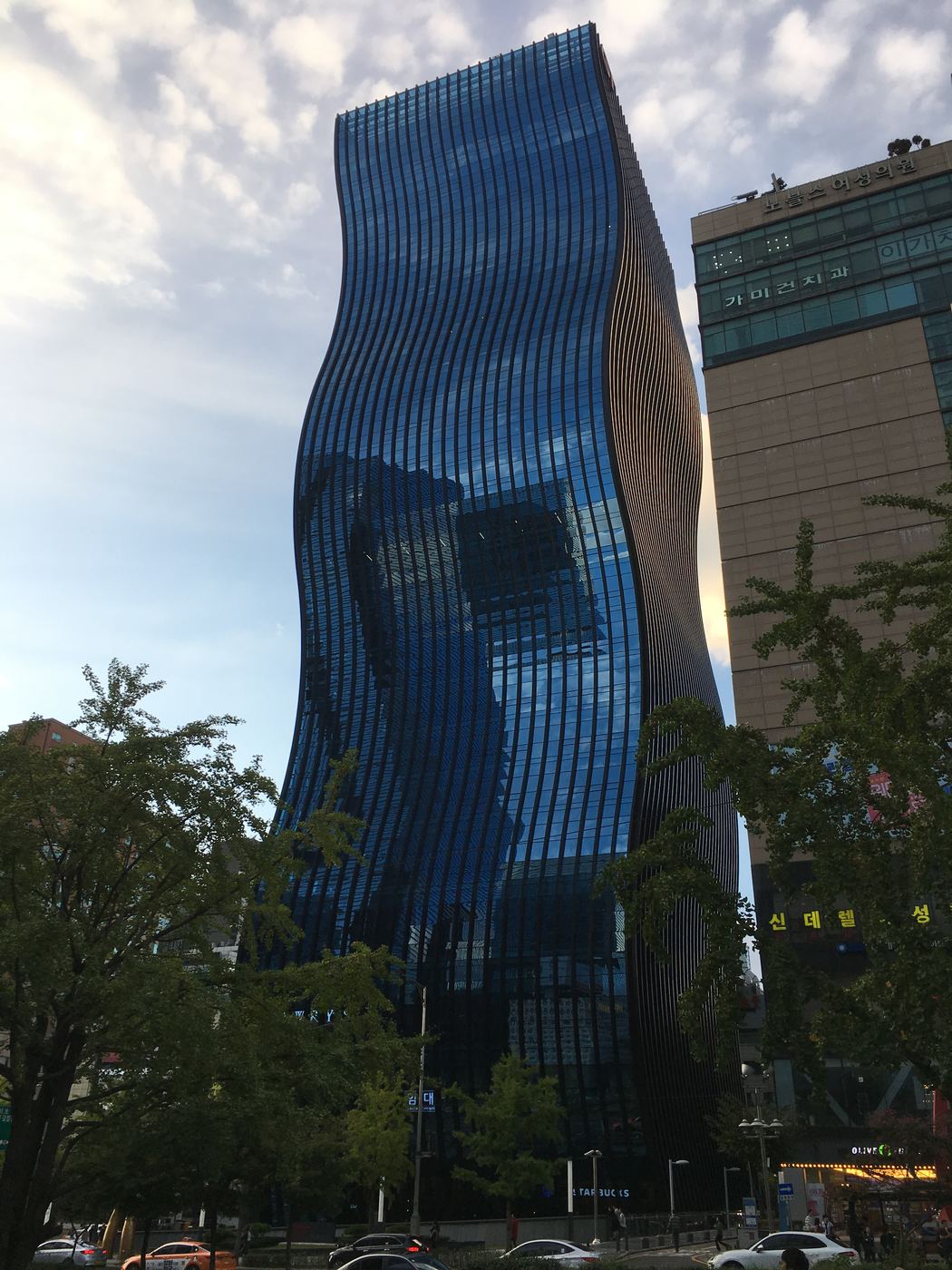
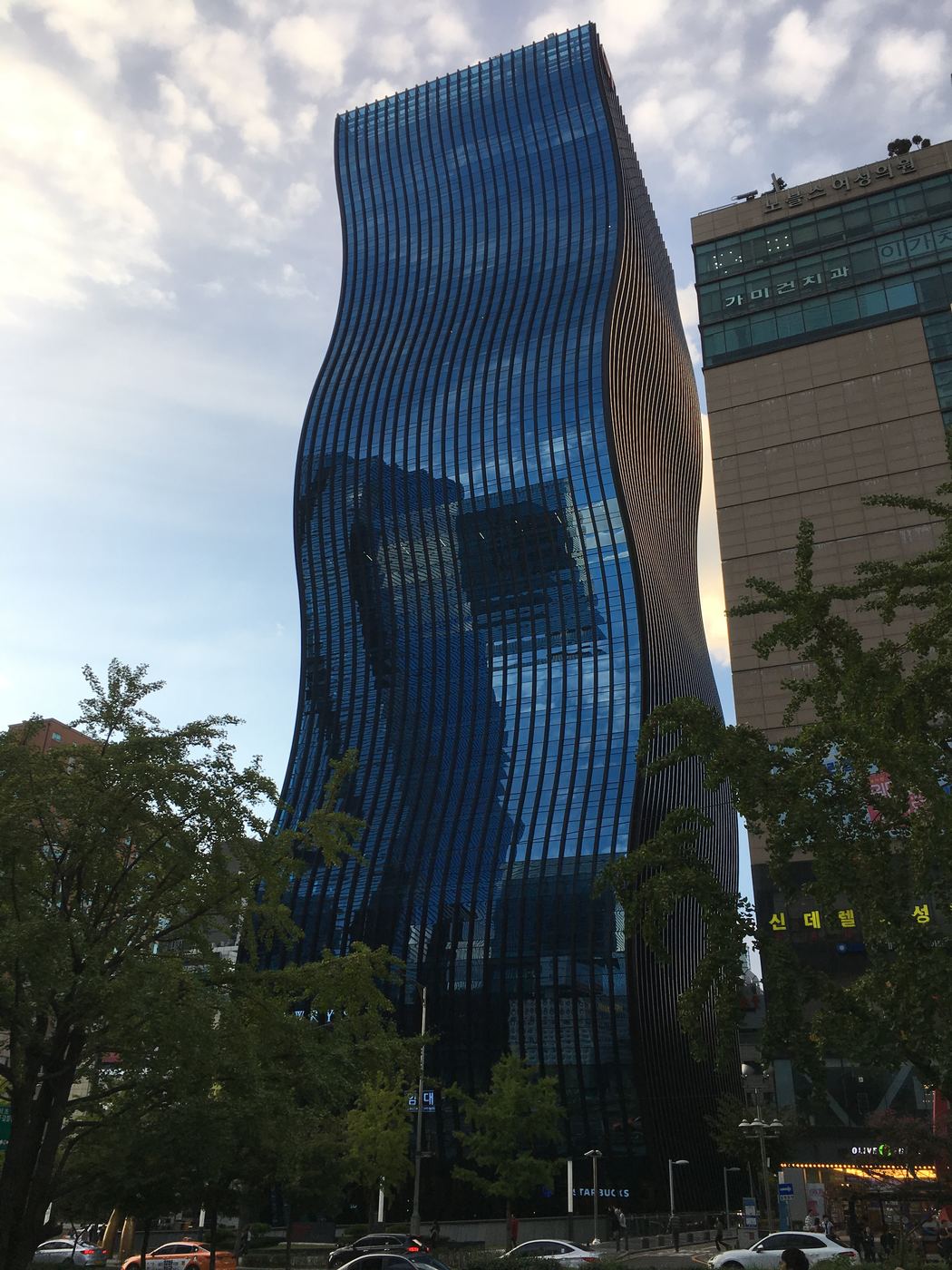
GT Tower at Gangnam Station, on the Seocho side of Gangnam-daero. B&VIIT Eye Center, one of the two clinic price lists quoted below, gives its address as this building, 50 metres from exit 9; the tower next door is lettered with clinic signs floor by floor. Photo: LittleT889, Wikimedia Commons, CC BY-SA 4.0 (2018).
A carry-on staple for the long flight home: preservative-free artificial tears in single-use vials — REFRESH OPTIVE Preservative-Free, 30 vialsAffiliate link. As an Amazon Associate, EpicKor earns from qualifying purchases at no extra cost to you.
Quick Guide: what Korean eye surgery costs, by the government's numbers
| Procedure | 2026 national figure (both eyes) | Reported range | What to know |
|---|---|---|---|
| LASIK — 레이저각막절삭성형술 (라식), HIRA code 2Z9610001 | Median ₩2,500,000; average ₩2,572,107; most common price ₩2,500,000 | ₩690,000 – ₩7,700,000 | 521 reported prices from 252 institutions. Includes SMILE at clinics that file it under LASIK |
| LASEK — 레이저각막상피절삭성형술 (라섹), HIRA code 2Z9620001 | Median ₩1,600,000; average ₩1,753,787; most common price ₩1,500,000 | ₩690,000 – ₩5,500,000 | 604 reported prices from 342 institutions — more places offer LASEK than LASIK |
| SMILE (스마일라식) | No separate HIRA item | B&VIIT ₩2,100,000 – ₩3,000,000; BGN ₩4,500,000 – ₩5,200,000 | Clinic fee notices, both eyes |
| SmilePro (스마일프로) | No separate HIRA item | B&VIIT ₩3,700,000 – ₩4,700,000; BGN ₩7,700,000 | BGN's figure is the exact national LASIK maximum |
| Pre-operative eye examination | Not included in HIRA's surgery price | B&VIIT ₩50,000 – ₩200,000; BGN ₩100,000 | Budget it separately |
Institutions set these prices themselves; HIRA publishes them, it does not approve them.
Nitrogen Polarized Wrap Around Sunglasses — UV400 lenses that also cover the side of the eye B&VIIT's pre-surgery notice asks patients to bring sunglasses or a hat for the trip home, and for LASEK tells them UV protection is required for six months after surgery. A wraparound frame is the plain version of that: it blocks light from the side as well as the front. As an Amazon Associate, EpicKor earns from qualifying purchases at no extra cost to you.
See the Nitrogen wraparound sunglasses on AmazonBoth eyes, not one: what the government price actually covers
The disclosure system works like this. Korean national health insurance does not cover vision correction, so LASIK and LASEK are 비급여 (bigeubyeo) — non-covered care, priced by each institution. Since the Medical Service Act requires every institution to report its non-covered prices, the Health Insurance Review and Assessment Service collects them and publishes the lot once a year. The 2026 release came out on 3 September 2026: 753 items from 74,449 medical institutions.
Vision correction is one of the smallest categories in that list. Under 시력교정술료 (vision-correction fees) there are exactly two items, and each has the same definition attached in HIRA's glossary:
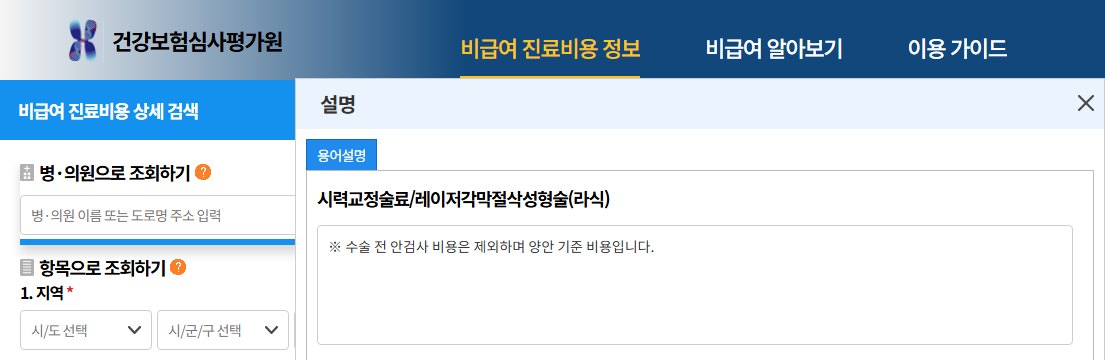
HIRA's glossary entry for the LASIK item: "the pre-operative eye examination is excluded, and the price is for both eyes." The LASEK item carries the same sentence. Screenshot by EpicKor from hira.or.kr/npay, 26 September 2026.
That sentence settles two things English pages leave open. First, every HIRA LASIK and LASEK figure is a two-eye price. If a clinic quotes you one eye, double it before comparing. Second, the examination is extra. Korean clinics run a long work-up before any refractive surgery — B&VIIT's notice says the full examination takes two to three hours — and they bill it separately. B&VIIT lists its vision-correction examination at ₩50,000 to ₩200,000 for both eyes; BGN's Jamsil clinic lists ₩100,000, and ₩50,000 for a re-operation work-up.
Clinic fee notices use the same unit: B&VIIT marks every refractive-surgery line 양측기준 (both sides), BGN 양안 (both eyes).
You might like: Dental Implant Cost in Korea (2026): The Government's Own Price Data Says ₩1.19 Million
LASIK, LASEK and SMILE: where each one sits in the data
LASIK cuts a thin flap in the cornea, reshapes the tissue underneath with an excimer laser, and lays the flap back. LASEK removes the thin surface layer instead of cutting a flap, then reshapes the surface. SMILE — sold in Korea as 스마일라식 (smile-LASIK) — uses a femtosecond laser to shape a small lens of tissue inside the cornea and remove it through a small incision. SmilePro (스마일프로) is a newer version of SMILE that Korean clinics price as a separate, dearer line.
HIRA's list has LASIK and LASEK. It has no SMILE line. So where do the clinics put it? The two clinic groups whose notices we read answer that directly.
- BGN (밝은눈안과), Jamsil clinic, lists SMILE as a kind of LASIK: (라식-스마일), ₩4,500,000 to ₩5,200,000, and (라식-프로 스마일), ₩7,700,000 — both eyes, beside plain (라식) at ₩2,700,000 to ₩3,200,000. (BGN prefixes every line with 레이저각막상피절삭성형술, HIRA's name for LASEK; the 라식 tag is what places SMILE under LASIK. Its prices were last changed on 13 June 2024.)
- B&VIIT (비앤빛안과), at Gangnam Station, lists 라식 at ₩1,300,000 to ₩4,700,000, 스마일 at ₩2,100,000 to ₩3,000,000, and 스마일프로 at ₩3,700,000 to ₩4,700,000 — all both eyes, all dated 1 September 2026. Its LASIK range tops out at exactly the top of its SmilePro range.
Now look at the national LASIK maximum: ₩7,700,000. It is reported by a Seoul clinic, and it matches BGN's SmilePro price to the won. The practical reading is that the HIRA "LASIK" item is a blend: conventional LASIK at clinics that offer it, plus SMILE and SmilePro at clinics that file those under the LASIK code. The median of ₩2,500,000 is the middle of that blend, and the top of the range is most likely SmilePro, not conventional LASIK.
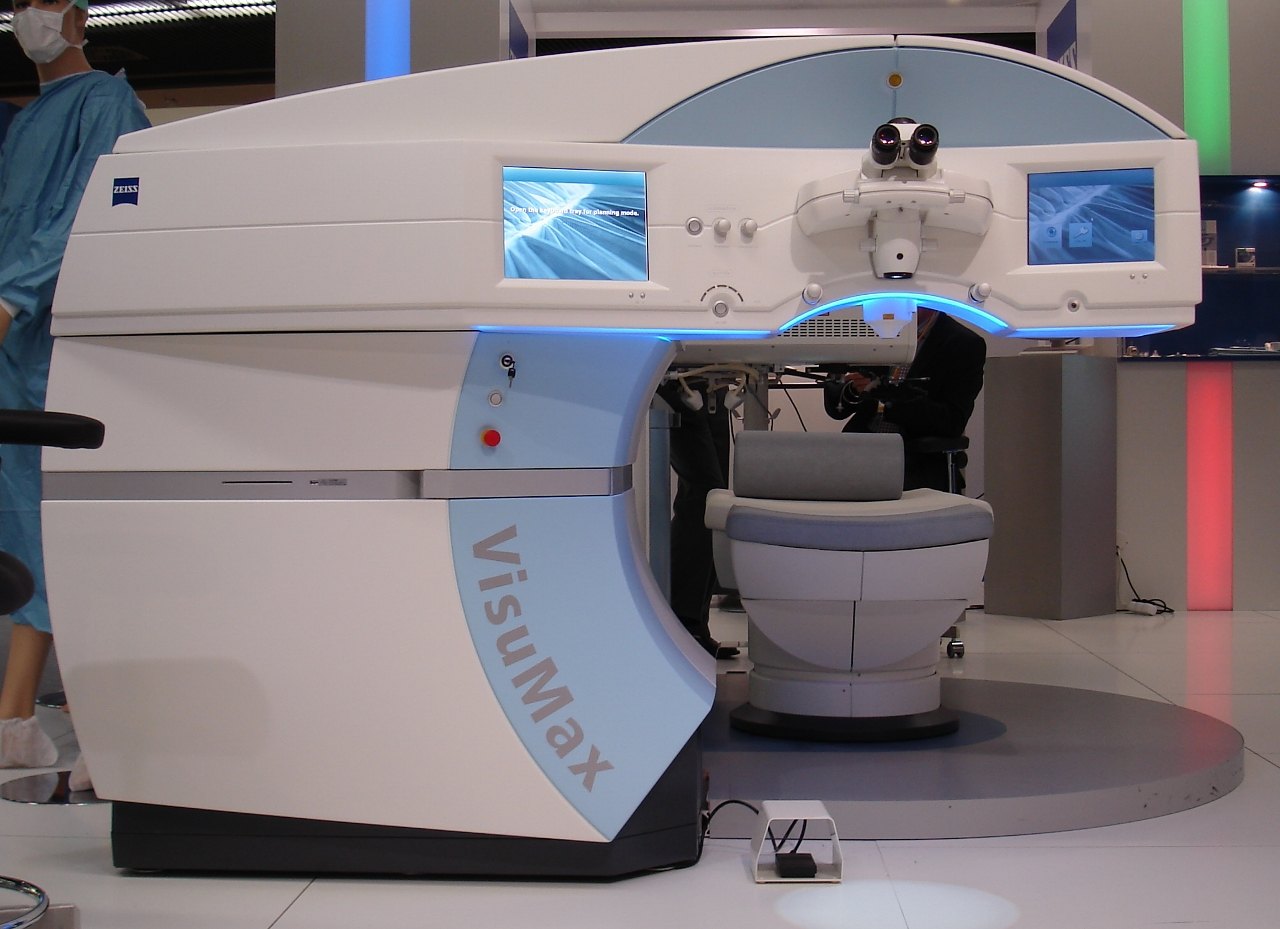
A Zeiss VisuMax femtosecond laser, the machine family SMILE is performed on. SMILE has no line of its own in HIRA's data, so clinics have to report it under another item — BGN lists it as a LASIK variant. Photo: Philos2000, Wikimedia Commons, CC BY-SA 3.0 (2007).
Clinic size matters less than the English web suggests. HIRA splits the same items by tier:
| Tier | LASIK median (reported prices) | LASEK median (reported prices) |
|---|---|---|
| 의원 — clinic (most eye clinics, including the big chains) | ₩2,500,000 (425) | ₩1,600,000 (507) |
| 병원 — hospital | ₩2,780,000 (74) | ₩1,740,000 (69) |
| 종합병원 — general hospital | ₩1,961,000 (8) | ₩1,929,000 (14) |
| 상급종합병원 — tertiary teaching hospital | ₩2,464,000 (14) | ₩2,250,000 (14) |
Nine in ten institutions reporting LASIK are ordinary clinics (227 of 252), and their median is the national one. Teaching hospitals are not the premium option: their LASIK median is slightly below the clinics', their LASEK median higher.
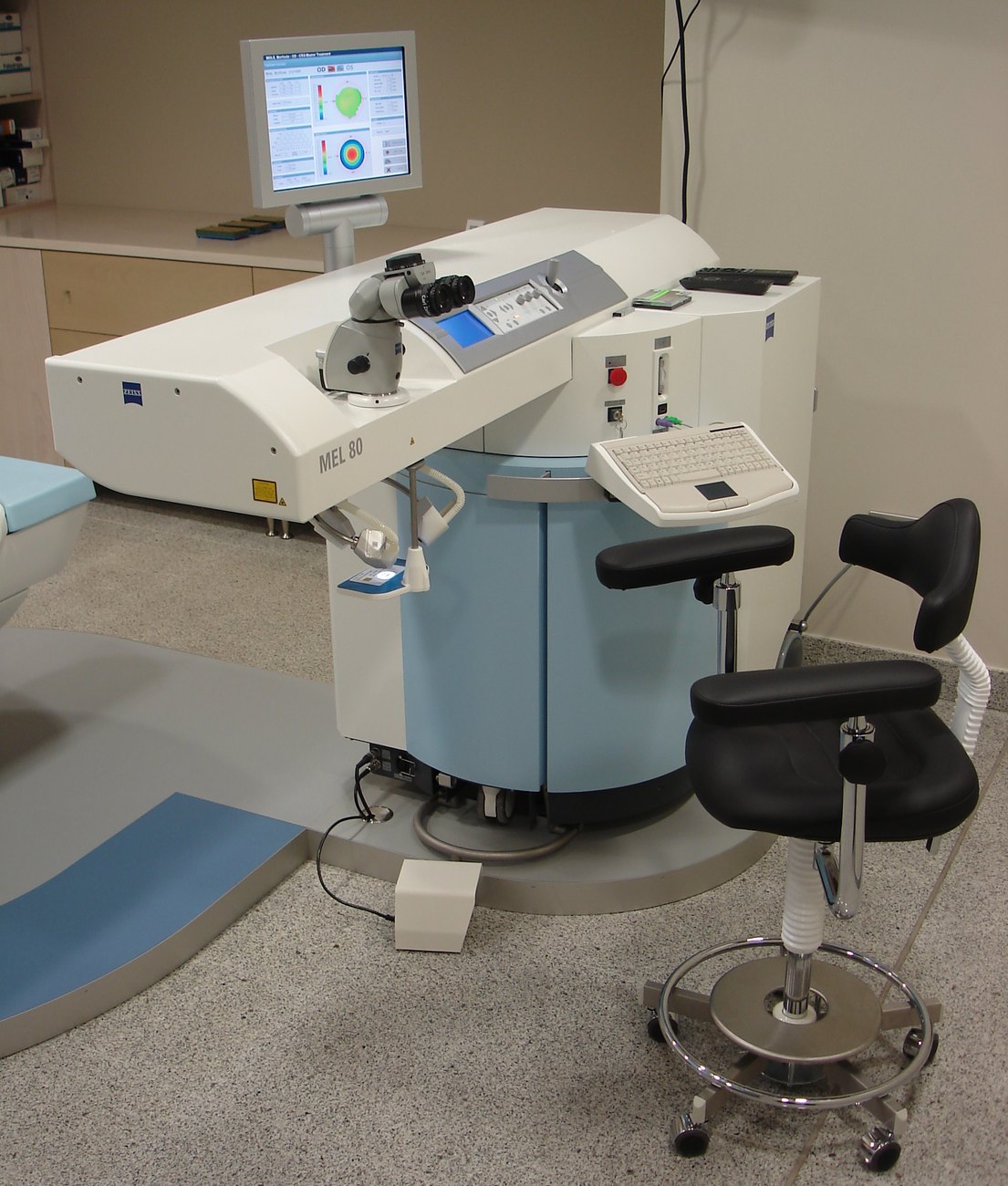
A Zeiss MEL 80 excimer laser — the kind of machine that does the reshaping in LASIK and LASEK. The two procedures differ in how the surface is opened; in the data LASEK is the cheaper of the two, and in clinic notices it is the one with the longer wait to the first check-up. Photo: Philos2000, Wikimedia Commons, CC BY-SA 3.0 (2010).
Seoul is not the most expensive place in Korea for this
The same data broken down by region upends another assumption. For LASIK, Busan's median (₩2,900,000, 63 prices from 22 institutions) is higher than Seoul's (₩2,500,000, 180 prices from 92 institutions), and Daejeon's is ₩2,650,000. For LASEK, Seoul is near the top at ₩1,990,000 across 213 prices from 120 institutions — but neighbouring Incheon's median is ₩1,350,100.
| Region | LASIK median (reported prices) | LASEK median (reported prices) |
|---|---|---|
| Seoul (서울) | ₩2,500,000 (180) | ₩1,990,000 (213) |
| Busan (부산) | ₩2,900,000 (63) | ₩1,925,000 (60) |
| Gyeonggi (경기) | ₩2,200,000 (79) | ₩1,500,000 (101) |
| Incheon (인천) | ₩2,175,000 (30) | ₩1,350,100 (40) |
| Daegu (대구) | ₩2,200,000 (25) | ₩1,500,000 (28) |
| Daejeon (대전) | ₩2,650,000 (32) | ₩1,450,000 (39) |
Seoul also holds both extremes for LASIK: the lowest price in Korea, ₩690,000 (also the LASEK floor), and the ₩7,700,000 top. The LASEK top, ₩5,500,000, is in Daejeon. The capital's advantage is choice, not price.
You might like: What a Doctor Costs in Korea Without Insurance (2026): ₩18,840 at a Clinic
How to look up a specific Korean eye clinic's price yourself
The same database is searchable clinic by clinic, free, in Korean.
- Go to hira.or.kr/npay (비급여 진료비용 정보). The same data is in HIRA's app 건강e음. Close the notice about commercial misuse of the data.
- Under 항목으로 조회하기 (search by item), choose a region — 시/도, then 시/군/구, for example 서울 → 강남구 or 서초구.
- Tap the eye icon, 시력 교정술료, and tick 레이저각막절삭성형술(라식) or 레이저각막상피절삭성형술(라섹). The small question mark beside each shows the "both eyes, excluding examination" definition.
- Press 선택항목 검색. Each result lists the clinic, its tier, and its reported lowest and highest price. The button 지역별·규모별 금액 비교 gives the regional and tier medians used in this guide.
- To check one clinic, type its Korean name under 병·의원으로 조회하기 instead.
Then compare against the clinic's own notice, which Article 45 of the Medical Service Act requires it to post. That is where SMILE and SmilePro appear by name, with the date each price last changed.
What booking looks like for a visitor
The practical steps are set out in the clinics' own pre-surgery notices, and they shape how many days you need.
- Contact lenses come out first. B&VIIT's notice requires you to stop wearing lenses before the examination: soft lenses 4 days, toric soft lenses 6 days, hard (RGP) lenses 10 days, orthokeratology lenses one month. Arriving in Seoul in lenses and booking an examination the next morning does not work.
- The examination takes two to three hours, and includes dilating drops. The notice says you cannot drive that day and should not attempt examinations at two different clinics on the same day.
- Same-day surgery is possible if you set aside the whole day, according to the same notice. Come with a companion: you cannot drive yourself home after surgery.
- Bring your passport. Registration at any Korean clinic starts with identification, and it is the name that goes on your receipt. Ask for the 진료비 세부내역서 (itemised statement) as well as the 영수증 (receipt) — our doctor-cost guide explains why.
- Language. Both clinic groups run foreign-language sites — B&VIIT in English, Chinese, Japanese, Vietnamese and Mongolian; BGN in English, Russian, Mongolian and Chinese. Ask for the written quote to use HIRA's terms: which procedure, both eyes, examination included or not.
- Paying. Eye clinics take international cards; our payment guide covers the terminals where foreign cards fail.
There is no VAT to reclaim. Korea charges 10% VAT on cosmetic procedures — the list in the VAT Act enforcement decree runs from double-eyelid surgery and rhinoplasty to tooth whitening and hair removal. Vision correction is not on it: when the list was expanded, LASIK and LASEK were left out because they were judged to have a treatment function. The price on the notice is the price, and the cosmetic-surgery refund question does not arise. Our tax refund guide covers the shopping refund, which is a separate system.
The honest part: when not to book this on a short trip
- The follow-up visits set your minimum stay. B&VIIT's notice gives the first post-operative check as the next day for LASIK and SMILE, and day four for LASEK, and says that until that first check you will have trouble keeping your eyes open and cannot go about daily life. A LASEK patient on a five-day trip spends most of it in a hotel room. Ask the clinic for its full follow-up schedule before you book flights — this guide does not give one.
- LASEK is cheaper, and the cost is time. The ₩900,000 gap between the LASIK and LASEK medians is paid for in recovery days and, in B&VIIT's words, six months of mandatory UV protection.
- Re-treatment is priced separately. B&VIIT lists re-operation after vision correction at ₩300,000 to ₩9,700,000 per eye; BGN lists an additional LASEK at ₩250,000 to ₩500,000 and an additional LASIK at ₩400,000 to ₩800,000. If you live far away, the cheapest clinic in Seoul is not cheap if you have to fly back.
- The examination can end with "no", and you pay for it either way.
- This is a price guide, not medical advice. Which procedure suits your corneas, and whether any does, is for the examining ophthalmologist. For the rest of the healthcare system — pharmacies, emergencies, which number to call — see our healthcare guide for tourists.
You might like: Flu in Korea (2026): a ₩30,000 Rapid Test, a ₩30,000–₩40,000 Shot, and Who Gets the Free Vaccine
FAQ
Q: How much does LASIK cost in Korea in 2026? The government's 2026 non-covered fee data puts LASIK at a national median of ₩2,500,000 and an average of ₩2,572,107, across 521 prices reported by 252 institutions. That price is for both eyes and excludes the pre-operative examination, which clinics charge separately (₩50,000 to ₩200,000 at the clinics we checked).
Q: Are Korean LASIK prices per eye or for both eyes? Both eyes. HIRA's definition for both the LASIK and LASEK items reads "양안 기준 비용" — the price is for both eyes — and Korean clinic fee notices mark refractive surgery 양안 or 양측기준. If an English page quotes a price per eye, double it before comparing with Korean figures.
Q: How much is LASEK in Korea? The 2026 national median is ₩1,600,000 for both eyes, the average ₩1,753,787 and the most common price ₩1,500,000, across 604 prices reported by 342 institutions. In Seoul the median is ₩1,990,000; in Incheon ₩1,350,100.
Q: How much does SMILE cost in Korea? There is no separate government figure, because HIRA's list has no SMILE item and clinics file it under LASIK. On clinic fee notices read in September 2026, SMILE was ₩2,100,000 to ₩3,000,000 at B&VIIT and ₩4,500,000 to ₩5,200,000 at BGN; SmilePro was ₩3,700,000 to ₩4,700,000 and ₩7,700,000.
Sources
- Health Insurance Review and Assessment Service (건강보험심사평가원), 비급여 진료비용 정보 (hira.or.kr/npay): item list for 시력교정술료 — 2Z9610001 레이저각막절삭성형술(라식) and 2Z9620001 레이저각막상피절삭성형술(라섹) — with the glossary note "수술 전 안검사 비용은 제외하며 양안 기준 비용입니다"; national, regional and tier median, average, most-common, minimum and maximum prices and price counts from the site's 지역별·규모별 금액 비교 query, run 26 September 2026, reproduced exactly from the institution-level 2026 listings (공개연월 202608, 적용 시작 2026-09-03/16); an institution may report several prices for one item. Site banner: 2026년 전국 의료기관의 753개 비급여 항목 가격 공개.
- K-Health (헬스경향), report of the 3 September 2026 release: 753 items, 74,449 institutions (secondary, for the release date and totals).
- B&VIIT Eye Center (비앤빛안과), 비급여진료비 notice under Medical Service Act Article 45, read 26 September 2026: LASIK, LASEK, SMILE, SmilePro, examination and re-operation prices, all dated 1 September 2026 or earlier; pre-examination and pre-surgery notice (lens-free periods, examination length, same-day surgery, first follow-up days, six months of UV protection after LASEK); address at GT Tower, Gangnam Station exit 9.
- BGN Eye Clinic Jamsil (밝은눈안과 잠실), 라식·라섹·스마일 라식 비용 안내 (비급여항목), read 26 September 2026: LASIK, 라식-스마일, 라식-프로 스마일, LASEK, examination and additional-surgery prices.
- seoulvisionclinic.com/lasik-cost-korea, read 26 September 2026: the "per eye" and SMILE claims quoted in the introduction, as an example of English-language pricing, not as data.
- VAT Act Enforcement Decree Article 35, list of taxable cosmetic procedures, as summarised by a Korean tax-practice guide (September 2026); 의학신문 (8 August 2013) on the exclusion of LASIK and LASEK from the cosmetic-procedure VAT as procedures with a treatment function.
You Might Also Like
Dental Implant Cost in Korea (2026): The Government's Own Price Data Says ₩1.19 Million, Not the ₩1.5–3 Million the Clinic Ads Quote
Korea publishes what every clinic charges. The 2026 government data puts a dental implant at a national median of ₩1,190,000, below where most English clinic ads start. Crowns, fillings, scaling, and how to check any clinic's price yourself.
Korean Snack Prices From 1 October 2026: Haitai Raises 25 Brands by 7.8%, Pocky Jumps 15.8%, and 14 Packs Shrink Instead
Pocky goes from ₩1,900 to ₩2,200 in Korea on 1 October 2026, and Honey Butter Chip is on both of Haitai's lists: the 60 g bag rises ₩100 while other packs shrink instead. Every new price, the shrink list, and Ottogi's 20% rice rise.
Hallasan, Jeju, Korea This Winter: Gwaneumsa Reopened 24 September 2026, the 11:30 Summit Cutoff From 1 October, 1,500 Places a Day and the No-Show Ban
Hallasan's Gwaneumsa summit trail reopened on 24 September 2026 after rockfall-fence repairs. From 1 October the summit checkpoints close at 11:30, not the 12:00 English guides list; 1,500 summit places a day, and one no-show costs three months.