Korea Working Holiday Visa (H-1) 2026–27: The 30 Countries, Quotas From 50 to 12,000 and Age Limits 25 to 35
Last updated: 2 November 2026. Country table read that day on the Working Holiday Info Center, the Overseas Koreans Agency's site at whic.mofa.go.kr ("Updated for 2026/27"). Fees and documents come from its August 2026 country sheet, its 2026–2027 guide and the consulate pages listed at the end. Headcount from the Ministry of Justice's September 2026 statistics. ₩1,325 = US$1 (Federal Reserve, 23 October 2026). A guide, not legal advice.
Does your country qualify for the Korea working holiday visa? It does if you hold a passport from one of 30 partner countries or regions, and if you are young enough: the upper limit runs from 25 at several Japanese consulates to 35 for Canada, France, Luxembourg, the UK and Finland. The visa is called H-1 (관광취업). It gives most people a year in Korea, lets them take short-term jobs up to 25 hours a week, and needs no job offer.
The annual quotas sound tight on paper, from 50 for Andorra to 12,000 for Canada, with four countries unlimited. The Ministry of Justice's own count tells a different story. On 30 September 2026, 5,094 people in all of Korea held an H-1 status (체류자격). Canada's 12,000 places had 113 people here. For most passports, the quota is not the hurdle. The paperwork is.
The official guide says Korean makes you more employable. Sogang Korean 1A is the Student's Book from one of the Seoul university programmes it lists. See it on AmazonAffiliate link. As an Amazon Associate, EpicKor earns from qualifying purchases at no extra cost to you.
Quick Guide: Korea working holiday visa, November 2026
| Question | Answer |
|---|---|
| Which countries? | 30 countries and regions on the official list. Finland signed in May 2026, and its quota and limits still read "To be updated" |
| Quota range | 50 (Andorra) to 12,000 (Canada). Australia, Denmark, Germany and Sweden are unlimited |
| Age | 18 to 30 for most; 34 or 35 for 14 others; Japan 25 or 30, depending on the consulate |
| Stay | About 1 year. Canada up to 24 months, twice. UK: choose 1 or 2 years. US up to 18 months (Seattle) |
| Work | Up to 25 hours a week, no separate work permit. Canada is exempt (up to 40 hours) |
| Barred jobs | Language instructor, entertainment venues, licensed professions such as doctor, lawyer, professor, pilot |
| Money to show | Usually ₩3,000,000 (about US$2,260), but set in local currency by each mission |
| Insurance | Cover for the whole stay, minimum ₩40,000,000 (about US$30,200) on the official list |
| Visa fee | Free for Japan, Spain, Italy and others; A$588 for Australia; €225 plus €60 for the UK |
| Where to apply | In your home country, at a Korean embassy, consulate or visa centre (KVAC). Not from inside Korea |
| On arrival | Register within 90 days, fee ₩35,000 (about US$26) |
Korean Grammar in Use: Beginning — a study book for the months before you fly. The Info Center's guide warns that English is not widely spoken in Korea, and Japan's Tokyo route wants proof of Korean study with the application. If you only need the basics, try the free KBS and EBS courses the guide lists first. As an Amazon Associate, EpicKor earns from qualifying purchases at no extra cost to you.
See Korean Grammar in Use on AmazonThe full table: all 30 countries, ages, quotas and limits
This is the Info Center's table, cell by cell and in its own order. We added thousands commas to the quotas and changed nothing else. "Limit of Employment period" means how many months you may work, and it is separate from the weekly hours limit.
| Country | Age | Quota | Limit of Employment period | Limit of Academic Activity period |
|---|---|---|---|---|
| Andorra* | 18-30 | 50 | No limitation | No limitation |
| Argentina | 18-34** | 200 | No limitation | No limitation |
| Australia | 18-30 | Unlimited | 6 months under same employer | 4 months |
| Austria | 18-30 | 300 | No limitation | No limitation |
| Brazil | 18-34** | 300 | No Limitation | No limitation |
| Belgium | 18-30 | 200 | 6 months | 6 months |
| Canada | 18-35** | 12,000 | No limitation** | 6 months |
| Chile | 18-34** | 100 | No limitation | No limitation |
| Czech Republic | 18-30 | 300 | No limitation | No limitation |
| Denmark | 18-34** | Unlimited | 9 months | 6 months |
| Finland | 18-35 | To be updated | To be updated | To be updated |
| France | 18-35** | 2,000 | No limitation | No limitation |
| Germany | 18-34** | Unlimited | No limitation | No limitation |
| Hong Kong* | 18-30 | 1,000 | 6 months under same employer | 6 months |
| Hungary | 18-30 | 100 | No limitation | No limitation |
| Ireland | 18-34** | 800 | No limitation | 6 months |
| Israel | 18-30 | 200 | 3 months under same employer | 6 months |
| Italy | 18-30 | 500 | 6 months | No limitation |
| Japan | 18-25** | 10,000 | No limitation | No limitation |
| Latvia | 18-34** | 100 | No limitation | No limitation |
| Luxembourg | 18-35** | 100 | No limitation | No limitation |
| Netherlands | 18-30 | 200 | No limitation | No limitation |
| New Zealand | 18-30 | 3,000 | No limitation | 6 months |
| Poland | 18-30 | 200 | No limitation | No limitation |
| Portugal | 18-34** | 200 | No limitation | No limitation |
| Spain | 18-30 | 1,000 | No limitation | No limitation |
| Sweden | 18-30 | Unlimited | No limitation | No limitation |
| Taiwan | 18-34** | 800 | No limitation | No limitation |
| U.K. | 18-35** | 5,000 | No limitation | No limitation |
| U.S.A. | 18-30** | 2,000 | No limitation | No limitation |
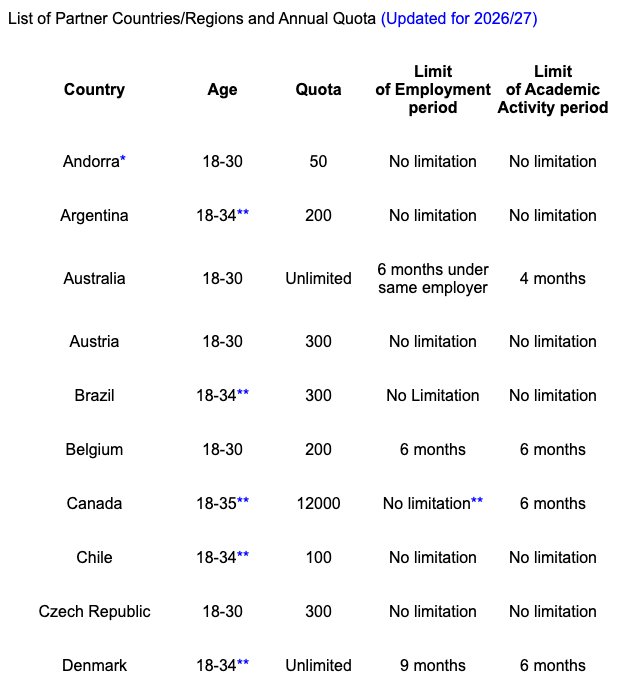
The page's two kinds of asterisk matter. A single * marks Hong Kong as a Special Administrative Region of China (Andorra carries the same mark on the page with no note of its own). A double ** points to a country-specific notice, and these are the ones that change your plans:
- Canada: exempt from the 25-hour rule, up to 24 months, and up to two participations.
- Japan: a lower limit of 25, or 30 "if it is determined that there are unavoidable circumstances", and consulates apply it differently (see the age section). Two participations, since 1 October 2025.
- UK: extension of up to 1 year. The August 2026 country sheet says applicants choose a visa of one or two years, and must enter within 6 months of issue.
- USA: bona fide post-secondary students or graduates of the past year only, with proof from the school. Extension of up to 6 months.
- France: the upper age rose from 30 to 35 on 1 October 2026, so some other guides are out of date.
Finland is the exception to "30 countries". The agreement was signed on 13 May 2026 and enters into force 60 days after both sides finish their domestic procedures. The Info Center has not announced that date, so check before planning around it.
You might like: Korea's Digital Nomad Visa (F-1-D), Two and a Half Years On: 743 Issued, 398 Still Here
How many places are actually taken
We found no public tracker of how many visas each mission has issued against its quota this year. The closest official number is the Ministry of Justice's monthly table of foreign residents by nationality and status. This is a snapshot of people holding H-1 status in Korea on 30 September 2026:
| Country | H-1 holders in Korea, 30 Sept 2026 | Annual quota |
|---|---|---|
| Japan | 2,225 | 10,000 |
| France | 740 | 2,000 |
| Taiwan | 501 | 800 |
| Germany | 291 | Unlimited |
| Italy | 176 | 500 |
| Spain | 145 | 1,000 |
| U.K. | 133 | 5,000 |
| Canada | 113 | 12,000 |
| Chile | 88 | 100 |
| U.S.A. | 75 | 2,000 |
| Poland | 72 | 200 |
| Brazil | 71 | 300 |
| Australia | 67 | Unlimited |
| Sweden | 57 | Unlimited |
| Belgium | 52 | 200 |
| Hong Kong | 51 | 1,000 |
| Netherlands | 50 | 200 |
| Hungary | 34 | 100 |
| Denmark | 33 | Unlimited |
| Portugal | 25 | 200 |
| Czech Republic | 24 | 300 |
| Argentina | 22 | 200 |
| Austria | 22 | 300 |
| Ireland | 7 | 800 |
| Israel | 7 | 200 |
| Latvia | 4 | 100 |
| New Zealand | 4 | 3,000 |
| Luxembourg | 3 | 100 |
| Andorra | 1 | 50 |
| Finland | 0 (not listed) | To be updated |
| Total (includes 1 listed as British overseas territories) | 5,094 | 40,650, plus 4 unlimited |
Read this as a stock of people on one date, not as quota used or as demand. It counts H-1 holders staying in Korea, including registered long-stay residents, and leaves out anyone who has gone home, switched visa or not yet flown. Against that, the 25 capped countries add up to 40,650 places a year.
Japan alone is 44% of the total. The closest to a cap are Chile (88 of 100) and Taiwan (501 of 800). Chile's embassy rations about 10 application slots a month by email, and its sheet says the notice for January and February slots goes out in November, so Chileans should watch for it now. A low count doesn't prove approval is easy. It only suggests the cap isn't the limit for most passports.
How old can you be?
Age is normally checked when you apply, not when you land, and most wording is inclusive: "18–30" means until your 31st birthday, as Poland and Italy spell out. Ireland says "before the 35th birthday". Two sources read differently. Hungary's sheet says "under 30", and Ottawa's page measures age at visa issuance. If you are close to a birthday, don't leave it late.
- Japan depends on your consulate. The 10-mission information sheet gives four versions and one blank: up to 25, or 30 with accepted reasons (Tokyo, Fukuoka, Niigata, Yokohama); up to 25, or under 30 with a reason letter (Kobe, Nagoya); 18 to under 30 with no 25 limit (Hiroshima); 18 to 30 (Sapporo, Sendai). Osaka's entry states no age. Your jurisdiction is set by where you live, so confirm yours by email before you plan around any of these.
- Up to 30: Andorra, Australia, Austria, Belgium, Czech Republic, Hong Kong, Hungary, Israel, Italy, Netherlands, New Zealand, Poland, Spain, Sweden, USA.
- Up to 34: Argentina, Brazil, Chile, Denmark, Germany, Ireland, Latvia, Portugal, Taiwan.
- Up to 35: Canada, Finland, France, Luxembourg, UK.
You cannot bring dependants on this visa, and in general you get one go. Canada and Japan are the only official exceptions.
One trap for Korean-heritage applicants. The Houston consulate says dual citizens cannot apply and may be asked for Korean family records. Ottawa asks anyone who once held Korean nationality for proof of renunciation (국적상실신고). Sort this out first, because the document takes time.
How to apply, step by step
The route is the same in outline everywhere, and the details belong to your mission. All steps below come from the Info Center unless a country is named.
- Confirm your mission. Your embassy or consulate is set by where you live, and the rules differ even inside one country.
- Be at home. You must be in your country when you apply and when the visa is granted. Austrians alone may also use missions in Tokyo, Beijing, Shanghai, Hong Kong and Taiwan.
- Fill in the form. Several missions want the printed e-form from the Korea Visa Portal (visa.go.kr), named on some sheets as Form no. 17.
- Gather the documents. The base list is the form, passport, photo (3.5 × 4.5 cm), return ticket or money for one, bank statement, insurance, travel plan, criminal record check, medical certificate, and proof of study or highest qualification.
- Book and lodge. Applications run year-round, first-come, first-served, except where noted. Taiwan and Chile use announced windows. The UK, France and the Netherlands go through a Korea Visa Application Center (KVAC); Germany offers KVAC Berlin or a consulate. Japan's September sheet says Tokyo applications go through a designated counsellor (korea-wh@koen.or.jp).
- Check and enter. Houston says sticker visas are gone and the visa grant notice is what you bring for entry. You usually have a year to enter, or 6 months for the UK. Chile warns against buying a ticket before you have a slot, while Israel and Seattle list a round-trip ticket as a document, so follow your own mission.
What it costs and how long it takes, by country
Fees and proof of funds vary far more than most guides admit. An Australian pays A$588, while a Spaniard pays nothing because of a bilateral fee waiver. This table is from the Info Center's August 2026 sheet, except the USA row and France's age. Some fees reset every six months with exchange rates, so treat them as a guide and confirm with your mission.
| Country | Visa fee | Money to show | Processing | How to lodge |
|---|---|---|---|---|
| Andorra | €81 | US$4,000 (or €5,000 covering the ticket) | 2–3 weeks | In person, Madrid |
| Argentina | Free | US$3,000 | 14 days | In person, by email slot |
| Australia | A$588 | A$5,000 | About 20 working days | Post or in person |
| Austria | €72 (H1 2026 rate, check) | ₩3,000,000 | 10 working days | In person |
| Belgium | €81 | €2,500 | 7 working days | In person |
| Brazil | Exempt | ₩3,000,000 equivalent | 14 working days | In person |
| Canada | C$121.50 | About C$3,400 | 7–10 business days | In person |
| Chile | Free | US$3,000 | About 3 weeks | In person, slot by email |
| Czech Republic | US$90 | US$6,000 (ticket or US$1,200 more) | 2 weeks | In person |
| Denmark | DKK 630 | DKK 17,000 (ticket or DKK 10,000 more) | About 15 working days | In person, by appointment |
| France | €0 + €60 KVAC fee | €2,500 | Not stated | KVAC Paris or post |
| Germany | €81 | €2,300 (€500 more with no return ticket) | 2 weeks | In person, online booking |
| Hong Kong | N/A in the sheet | HK$20,000, then HK$25,000, held 3 months | 10 + 7 working days at least | In person, two stages |
| Hungary | US$90 (paid in forints) | About US$3,000 | 10 days | In person, reservation |
| Ireland | About €80–83 | Enough for 3 months | About 2 weeks | In person, reservation |
| Israel | US$40 (waived over 91 days) | US$3,000 | About 7 working days | Appointment by email |
| Italy | Free | €2,500 (€3,500 replaces the flight booking) | About 10 working days | By appointment |
| Japan | Free | ¥300,000 (Tokyo: ¥400,000 replaces the ticket) | About 2 weeks (Tokyo) | Varies by mission |
| Latvia | €81 | €2,000 (ticket or €1,000 more) | 14 days | In person |
| Luxembourg | €81 or free (see notes) | Sufficient funds | Not stated | In person, online booking |
| Netherlands | €81 + €60 KVAC fee | €2,500 | 14 working days or more | KVAC The Hague or post |
| New Zealand | NZ$126 | NZ$4,200 | 14 working days | Post or in person |
| Poland | PLN 360 | US$4,500 including ticket money | 5–6 working days | In person |
| Portugal | €81 | ₩3,000,000 equivalent | 7–10 working days | By appointment |
| Spain | Free | US$3,000 (or €4,000 covering the ticket) | 2–3 weeks, longer in peak months | In person, by appointment |
| Sweden | SEK 900 | Statement for 3 months (ticket or SEK 20,000) | 2–3 weeks | Post or appointment |
| Taiwan | None | US$3,000 | 10 days | In person, in announced period |
| U.K. | €225 + €60 KVAC fee (H1 2026 rate, check) | £2,530 | 3–8 weeks | KVAC London, by post |
| U.S.A. | US$45 | ₩3,000,000 (Seattle); US$3,000 (Houston) | 3–4 weeks (Seattle) | Consulate or post |
Table notes. UK and Austria fees are first-half 2026 rates, and the sheet says UK fees change every six months. Luxembourg: the sheet's table says €81 but its own notes say free, and the embassy page also says both, so ask before paying. USA: the August sheet has no US row. The main page says a 6-month extension while Seattle writes up to 18 months in total, and Seattle's page still names only six participating countries, so consular pages can lag.
Read your own sheet in full for the smaller demands. Tokyo wants proof of Korean study and a 1-year plan. Italy wants a booking for the first 2 weeks, Luxembourg for 15 days. Australia requires a narcotic drug test. Ottawa and Wellington want a chest X-ray, blood test, urinalysis and HIV test. The Netherlands and the UK ask for a tuberculosis test. Passport validity ranges from 6 months to 18 months (Israel).
Seoul stays on Agoda — for the first weeks, and for missions that want a booking. Italy, Luxembourg and Japan's Tokyo route ask to see where you will sleep at first, and the Info Center's guide recommends starting in a hostel or guest house while you look for a lease. Pick a cancellable rate if the visa is still pending, and check dates, taxes and terms on Agoda. EpicKor may earn a commission if you book through this link, at no extra cost to you.
Compare Seoul stays on AgodaYou might like: How Much Is Rent in Seoul (2026)? Officetels Average ₩949,000 a Month
What you can actually do on an H-1
Work. You need no extra permit and no job offer. The cap is 25 hours a week, "according to the Ministry of Justice"; Canadians may do 40 a week and 2,080 a year. The period limit in the table applies on top. Some missions add a total: 1,300 hours for Brazil and at Japan's Kobe, Nagoya and Niigata consulates, 1,300 over six months or 25 a week for Argentina, 625 for Italy, and 300 at one workplace for Israel.
Barred work. The guide and country sheets list entertainment-venue staff (receptionist, dancer, singer, musician, acrobat) and licensed jobs such as doctor, lawyer, professor, pilot and language instructor. Seattle adds journalism, religion, academic research and teaching engineering skills. So teaching English on an H-1 is out: Seattle says you would have to change to an E-2 first. Check any language or cooking job with the Immigration Contact Center (1345 in Korea, +82-2-6908-1345 abroad) before accepting.
Jobs. The guide points to hotels and restaurants, language work such as editing and subtitling, and WWOOF farm volunteering. It is blunt that the government finds you neither a job nor a room.
Pay. Foreign workers get the same minimum wage as Koreans: ₩10,320 an hour in 2026 and ₩10,700 in 2027 (full breakdown). By our arithmetic, scaling the legal 209-hour month to 25 hours a week gives about ₩1.35 million a month in 2026, or ₩1.40 million in 2027, before deductions. The guide's average budget is ₩1,300,000 a month. So minimum-wage work at the cap roughly covers a modest life, and the ₩3,000,000 proof of funds is a real floor.
Study and travel. Language schools and hagwon are allowed within the table's study limit; a degree course needs a D-2 visa. The guide promises unlimited re-entry, but single-entry visas exist: the Tokyo embassy warns that if you leave before you hold your residence card, you cannot come back on it.
You might like: Korea Severance Pay for Foreigners: 30 Days' Pay for Each Year Worked
Your first 90 days in Korea
- Register within 90 days at the immigration office for your address. Book on hikorea.go.kr and bring your passport, form, ₩35,000, housing contract and a photo. The card takes about 3 weeks, and then replaces the passport you must carry.
- Report a move within 14 days. That is the guide's figure; Article 36 of the Immigration Act gives 15 for an address, so 14 meets both.
- Know the money rules. Covered employees join health insurance from day one, others after six months at at least ₩158,630 a month. See also what you are owed, pension refunds and overstay fines.
The honest part: what the official sources don't settle
- Visas issued per country. We found no published count against each quota, so the headcount above is the nearest proxy. A mission can still stop at its cap.
- Sheets and the main table disagree. The August sheet lists France at 18–30, while the 14 October notice says 18–35. Chile's gives 18–34 in one line and 18–30 in another. Sheets say 12 months of employment for Austria, France, New Zealand and Ireland, where the main table says "No limitation". Your mission's answer beats both.
- Where the 25 hours comes from. We read it in Info Center pages and several consular notices, not in a statute. Seattle's page doesn't state it, and says only that there are no specific time limits at a workplace. Follow the 25 hours unless immigration tells you otherwise.
FAQ
Q: Which countries can get a working holiday visa for Korea?
A: The official list has 30: Andorra, Argentina, Australia, Austria, Belgium, Brazil, Canada, Chile, Czech Republic, Denmark, Finland, France, Germany, Hong Kong, Hungary, Ireland, Israel, Italy, Japan, Latvia, Luxembourg, Netherlands, New Zealand, Poland, Portugal, Spain, Sweden, Taiwan, the UK and the USA. Finland's details are still "to be updated".
Q: What is the age limit for the Korea working holiday visa?
A: Usually 18 to 30 at the time of application. It is 18 to 34 for nine countries, 18 to 35 for five, including Canada, France and the UK. Japan is 25 or 30, depending on the consulate.
Q: Can Americans get a working holiday visa in Korea?
A: Yes, with a condition. US applicants must be aged 18 to 30 and be post-secondary students or have graduated within a year, with proof from the school. The quota is 2,000, the fee US$45, and Seattle lists stays of up to 18 months.
Q: How many hours can you work on an H-1 visa in Korea?
A: Up to 25 hours a week, according to the Ministry of Justice as quoted in the official guide. Canadians are exempt and may work up to 40 hours a week. Some nationalities also have a limit on months with one employer, such as 6 for Australia and 3 for Israel.
Q: Can I teach English on a Korean working holiday visa?
A: No. Language instructor is on the barred list. You would need to change to an E-2 visa first, and the guide says other language jobs depend on their duties, so call 1345 before accepting.
Q: Can I apply for the working holiday visa from inside Korea?
A: No. The Info Center says working holiday visas are not granted to people in Korea. You must be in your own country when you apply and when the visa is granted.
Q: How much money do I need for the Korea working holiday visa?
A: The standard figure is ₩3,000,000 (about US$2,260), but missions set their own amounts, such as A$5,000 for Australia, £2,530 for the UK and ¥300,000 for Japan. You also need a return ticket or the money to buy one.
Sources
- Working Holiday Info Center (Overseas Koreans Agency), General Information: List of Partner Countries/Regions and Annual Quota (Updated for 2026/27), eligibility, documents and application process, read 2 November 2026.
- Working Holiday Info Center, Working Holiday (H-1) Visa Information by Country and Region, 3 August 2026, with the attached country sheet (28 pages) for fees, funds, documents and processing times.
- Working Holiday Info Center, Korea Working Holiday 2026–2027 guide (PDF): work rules, registration, living costs, deductions, FAQ.
- Working Holiday Info Center notices: French age limit raised to 35 (14 October 2026), Korea and Finland sign agreement (18 May 2026) and Japan H-1 information (15 September 2026), with its 10-mission PDF.
- Ministry of Justice, Korea Immigration Service, September 2026 immigration and foreigner policy statistics (출입국외국인정책 통계월보): H1 column by nationality at 30 September 2026. The 5,094 is a stock of H-1 holders staying in Korea, including registered long-stay residents, not visas issued.
- Consulate General in Seattle, H-1 Visa (including WEST Program), 2 January 2026; Consulate General in Houston, (H-1) Working Holiday, 19 September 2023.
- Embassy in Canada, [H-1] Working Holiday Visa and Youth Mobility Program notice (up to 40 hours a week, 2,080 a year).
- Embassy in Japan, 観光就業(H-1)のご案内, updated 19 June 2026; Embassy in Latvia, Working Holiday Visa Information; Embassy of Luxembourg in Seoul, Working Holiday Program.
- Immigration Act Art. 36, as read on law.go.kr for our passport guide, 27 October 2026. Wage and health-insurance rules as sourced in our minimum wage and health insurance guides.
- Exchange rate: Federal Reserve H.10 via FRED (DEXKOUS ₩1,325.06 per US$), 23 October 2026. Dollar figures are rounded. Monthly pay is our own calculation from 209 legal hours.
The short version: check the table for your passport and age, then ignore the quota scare unless you are Chilean or Taiwanese, then read your own mission's page. Budget for ₩3,000,000 in the bank, a full-year insurance policy and weeks of paperwork. Once here, register within 90 days, keep to 25 hours, and stay out of teaching.
You Might Also Like
Do You Have to Carry Your Passport in Korea? Yes — the ₩100,000 Rule
Yes. Korea's Immigration Act, Article 27, says every foreigner aged 17 or over must carry a passport or residence card at all times. A photocopy is not on the list. The standard penalty is ₩100,000 the first time, rising to ₩1,000,000 by the fourth.
Korea Winter Festivals 2026–27: Hwacheon, Pyeongchang Trout, Taebaek Snow and Seoul Winter Festa — Dates, Fees and Which One to Pick
Only two Korea winter festivals have 2026–27 dates: Hwacheon (9–31 January) and Seoul Winter Festa (from 11 December). Pyeongchang and Taebaek have not announced; Inje has been cancelled three winters running. Fees, trains, which to pick.
Seoul to Gyeongju, Korea by KTX, Train or Bus: ₩44,500 vs ₩36,700, Which Station You Arrive At and the Last Train Back
Seoul to Gyeongju is about ₩44,500 and about 2 hr 10 by KTX, ₩42,900 from Suseo, or ₩36,700 and almost 4 hours by express bus. Every train stops at Gyeongju Station, 30–40 minutes from the tombs; the last KTX back leaves at 22:38.