Teaching English in Korea with EPIK: Salary by Pay Level, Housing Allowance and Application Deadlines
Last updated: 11 November 2026. Pay levels and allowances come from the EPIK office's own Salary & Benefits page (updated 4 May 2026 for the Fall 2026 intake) and the Seoul Metropolitan Office of Education's 2026 pay table. Leave, housing cash and travel rules come from the Gyeonggi Provincial Office of Education's Korean-language 2025 EPIK manual, and apply to Gyeonggi unless we say otherwise. Each source is dated at the end. ₩1,362 = US$1 (Federal Reserve H.10 rate for 6 November 2026). Pay levels are confirmed by your office of education on your contract start date, not by this guide.
What is the EPIK salary for teaching English in Korea? On the official table, a new EPIK teacher outside Seoul earns ₩2.2 million to ₩2.35 million a month at Level 2 (about US$1,615–1,725) and up to ₩2.8 million at Level 1+ (about US$2,056). Seoul runs its own scale, from ₩2.3 million to ₩3.0 million. On top of that comes a rent-free apartment or studio, a ₩300,000 settlement allowance, a ₩1,800,000 entrance allowance that works as a loan for your first six months, a ₩1,300,000 bonus when the contract ends, and severance of roughly one month's pay. EPIK, the English Program in Korea (원어민영어보조교사 사업), is run by the National Institute for International Education (국립국제교육원, NIIED) under the Ministry of Education. It places native English speakers in Korean public schools.
Three facts from the official documents matter most. The province you land in moves your pay by up to ₩300,000 a month at the same level. The offices of education are not hiring Level 3 at all, so a degree on its own no longer gets you a contract. And there is no application deadline: the Spring 2027 application opened on 1 August 2026 and closes when the places run out.
After the interview EPIK wants originals: ink-signed recommendation letters, an apostilled diploma and a background check. A 13-pocket A4 file keeps them flat and in order: Sooez expanding file folderAffiliate link. As an Amazon Associate, EpicKor earns from qualifying purchases at no extra cost to you.
Quick Guide: EPIK pay and terms, November 2026
| Question | Short answer (sources at the end) |
|---|---|
| Monthly salary, Level 2 (new teacher with a TEFL or relevant degree) | ₩2.2M–₩2.35M outside Seoul (≈US$1,615–1,725), depending on province. Seoul's entry grade E: ₩2.3M (≈US$1,689) |
| Top regular level | Level 1+: ₩2.5M–₩2.8M. Seoul S: ₩3.0M. Chungbuk adds S (₩2.9M) and S+ (₩3.0M) for long-serving renewers |
| Is Level 3 (degree only) hired? | No. EPIK says applicants must qualify for at least Level 2 before signing |
| Housing | Leased apartment or studio provided by the office of education. You pay utilities and maintenance fees. In Gyeonggi's case, ₩500,000 a month in cash instead if you ask at the application stage |
| One-off money | Settlement ₩300,000 (first contract only). Entrance ₩1,800,000 (₩1,300,000 in Chungbuk), repayable if you leave within six months. Completion bonus ₩1,300,000 (₩1,800,000 in Chungbuk) |
| Severance | About one month's salary after a completed one-year contract |
| Airfare | No separate flight line on the current EPIK page. In Gyeonggi the ₩1.8M entrance and ₩1.3M exit payments are paid against one-way tickets and boarding passes |
| Contract and hours | One year (365 days). 8 hours a day, 5 days a week. No more than 22 teaching hours a week unless overtime is paid |
| Paid leave | Set by each office of education. Gyeonggi: 26 days a year, taken during school vacations |
| Next intake | Spring 2027: open since 1 Aug 2026, rolling. Contracts start 26 Feb 2027 (national) or 1 Mar 2027 (Seoul, Gyeonggi). Fall 2027 opens 1 Feb 2027 |
| Who can apply | Citizens of the US, UK, Canada, Australia, New Zealand, Ireland or South Africa (India with a teaching licence), with a bachelor's degree and English-medium schooling from grade 7 |
The 2026 EPIK pay scale by province
EPIK does not set the salary. Each of Korea's 17 metropolitan and provincial offices of education (시·도교육청) sets its own, and the EPIK page says plainly that the scale "is subject to change between intakes". The table below is the one EPIK published on 4 May 2026 for the Fall 2026 intake, in million won a month. When we checked on 11 November 2026, it was still the table on the site for the Spring 2027 application.
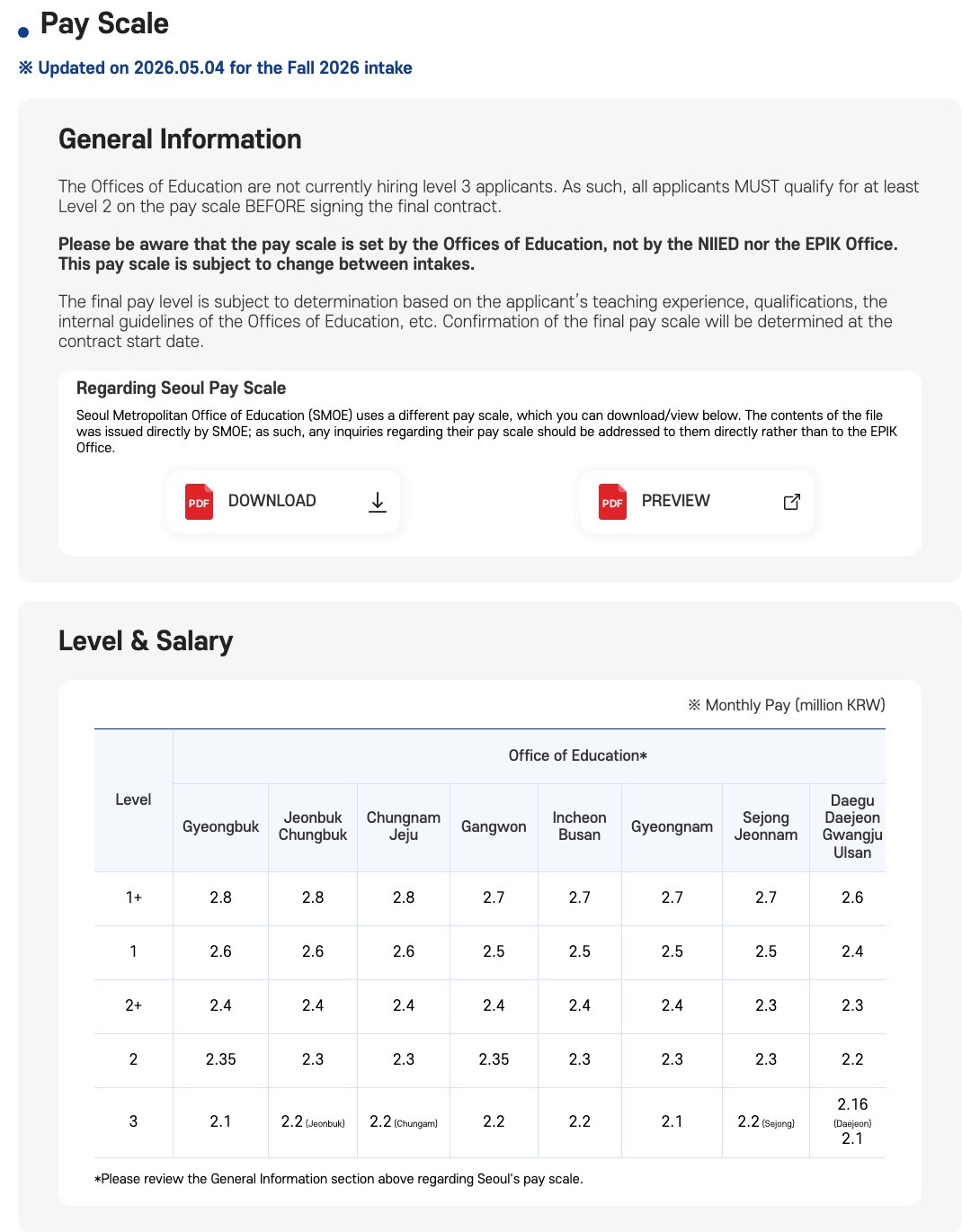
| Office of education | Level 2 | Level 2+ | Level 1 | Level 1+ |
|---|---|---|---|---|
| Gyeongbuk (경북) | ₩2.35M | ₩2.4M | ₩2.6M | ₩2.8M |
| Jeonbuk, Chungbuk (전북·충북) | ₩2.3M | ₩2.4M | ₩2.6M | ₩2.8M |
| Chungnam, Jeju (충남·제주) | ₩2.3M | ₩2.4M | ₩2.6M | ₩2.8M |
| Gangwon (강원) | ₩2.35M | ₩2.4M | ₩2.5M | ₩2.7M |
| Incheon, Busan (인천·부산) | ₩2.3M | ₩2.4M | ₩2.5M | ₩2.7M |
| Gyeongnam (경남) | ₩2.3M | ₩2.4M | ₩2.5M | ₩2.7M |
| Sejong, Jeonnam (세종·전남) | ₩2.3M | ₩2.3M | ₩2.5M | ₩2.7M |
| Daegu, Daejeon, Gwangju, Ulsan (대구·대전·광주·울산) | ₩2.2M | ₩2.3M | ₩2.4M | ₩2.6M |
| Gyeonggi (경기) | ₩2.2M | ₩2.3M | ₩2.4M | ₩2.5M |
Seoul is not on this table. It uses its own six grades, shown in the Seoul section below.
In dollars at ₩1,362: ₩2.2M is about US$1,615, ₩2.3M about US$1,689, ₩2.4M about US$1,762, ₩2.5M about US$1,836, ₩2.6M about US$1,909 and ₩2.8M about US$2,056.
The big cities pay least. Gyeonggi, the province that wraps around Seoul, and the Daegu–Daejeon–Gwangju–Ulsan group start Level 2 at ₩2.2 million. Rural Gyeongbuk and Gangwon start at ₩2.35 million. At Level 1+ the gap is ₩300,000 a month between Gyeonggi (₩2.5M) and Gyeongbuk, Jeonbuk, Chungbuk, Chungnam or Jeju (₩2.8M).
There are a few extra levels. Chungbuk has S (₩2.9M) and S+ (₩3.0M) for teachers who renew there for two straight years at the level below. Gyeonggi has 1++ at ₩2.6M, which needs three years at 1+ and seven consecutive years in Gyeonggi. Level 3, for a bachelor's degree with nothing else, still sits on the table at ₩2.1M–₩2.2M, but EPIK states that "the Offices of Education are not currently hiring level 3 applicants".
Rural and multi-school pay on top
The EPIK page adds one line that matters: "The amount of provincial pay varies depending on the location within the POE and the number of schools taught." Gyeonggi's Korean manual shows what that means in won, in Gyeonggi's case. A teacher at a rural or remote school (농어촌 및 벽지) gets ₩100,000 a month extra. A teacher who travels between schools gets a travelling allowance (순회수당) of ₩100,000 a month for two schools and ₩150,000 for three, but no separate travel expenses for the school visits. Both allowances count toward your severance. Other provinces have their own versions. Ask your office of education at orientation.
Sogang Korean 1A (3rd edition, 2024): the textbook to start before your placement letter arrives. You won't know your town until after orientation, and a school in rural Gyeongbuk or Jeonnam may have one English speaker on staff, your co-teacher. Sogang's speaking-first course gets you through the first weeks of daily life faster than an app alone. As an Amazon Associate, EpicKor earns from qualifying purchases at no extra cost to you.
See Sogang Korean 1A on AmazonWhat each level needs
The level is decided by your documents, and EPIK says the final level is "confirmed at the contract start date". The national rules below come from the EPIK page.
| Level | What qualifies you (one route is enough) |
|---|---|
| 2 | Bachelor's in Education, Teaching, TESOL or Second Language Studies; or any bachelor's + a TEFL/TESOL/CELTA of 100+ hours; or any bachelor's + a teacher's licence |
| 2+ | One year of full-time teaching + a Level 2 qualification; or a relevant master's (Education, TESOL and similar) with any bachelor's, or any master's with an Education bachelor's; or one year at Level 2 with the province you renew with |
| 1 | Two years of full-time teaching + a Level 2 qualification; or one year at 2+ with the province you renew with |
| 1+ | Two consecutive years at Level 1 with the province you renew with |
A Juris Doctor counts as a non-Education master's. The rule that catches most first-time applicants is the TEFL: if your degree is not in education, you need a 100-hour TEFL, TESOL or CELTA. EPIK lets you finish it during the application, as long as it is done six weeks before your expected arrival. Its FAQ also says applicants with an in-class component "will receive a benefit to their application".
Seoul's scale is different
The Seoul Metropolitan Office of Education (서울특별시교육청, SMOE) publishes its own table, in Korean with an English courtesy translation (서울 고용등급별 급여 및 자격). It has six grades, each with a national-level label in brackets on the document itself.
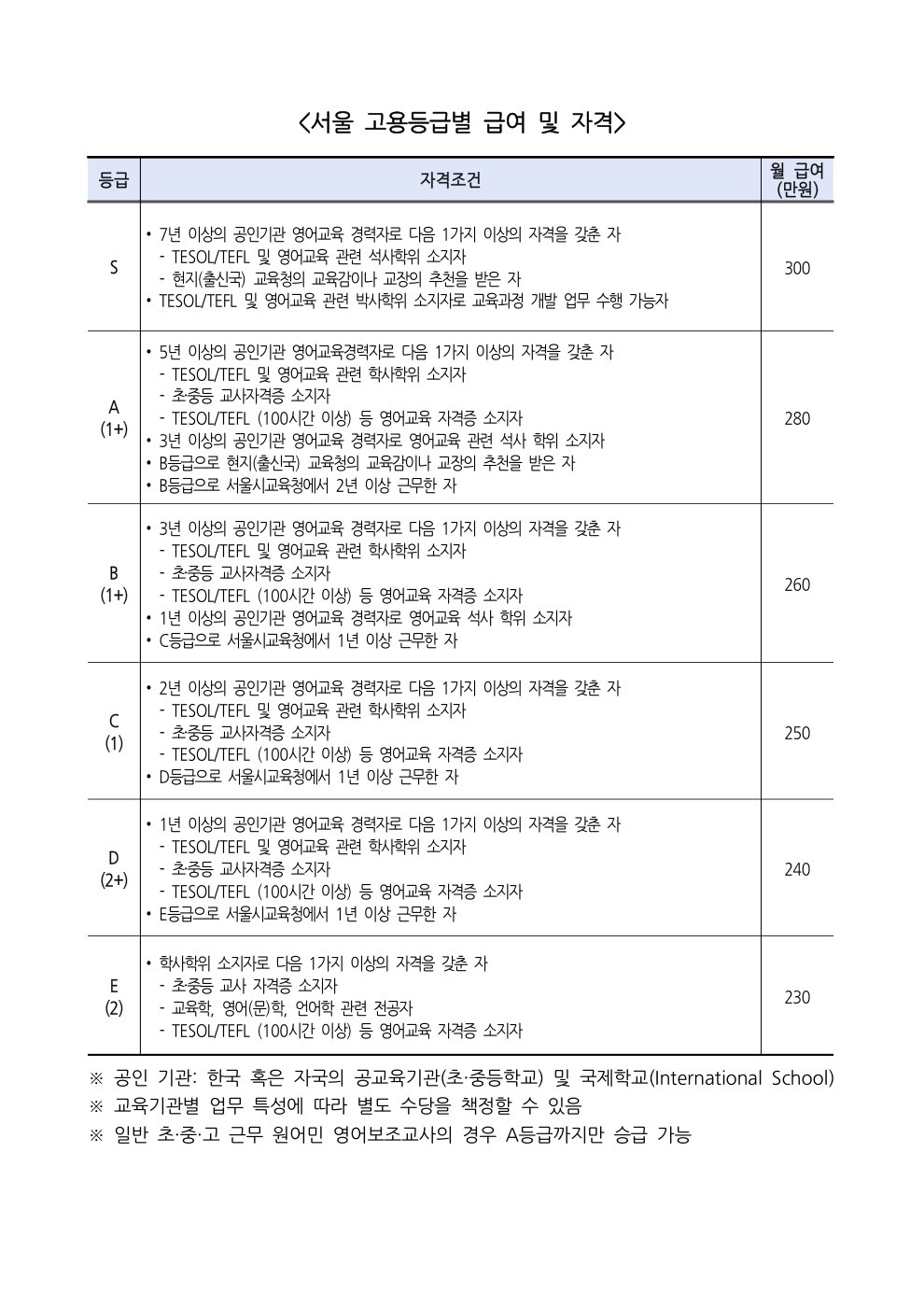
| Seoul grade (label on SMOE's table) | Monthly pay | Main route in (summary) |
|---|---|---|
| S (no label) | ₩3.0M (≈US$2,203) | 7+ years at a public institution plus a TESOL/TEFL or English Education master's or a home-country superintendent's or principal's recommendation; or a doctorate for curriculum development |
| A (1+) | ₩2.8M (≈US$2,056) | 5+ years plus a relevant bachelor's, licence or 100-hour certificate; or a relevant master's plus 3 years; or two full years at B with SMOE |
| B (1+) | ₩2.6M (≈US$1,909) | 3+ years plus a relevant bachelor's, licence or certificate; or a relevant master's plus 1 year; or one year at C with SMOE |
| C (1) | ₩2.5M (≈US$1,836) | 2+ years plus a relevant bachelor's, licence or certificate; or one year at D with SMOE |
| D (2+) | ₩2.4M (≈US$1,762) | 1+ year plus a relevant bachelor's, licence or certificate; or one year at E with SMOE |
| E (2) | ₩2.3M (≈US$1,689) | Bachelor's plus a teacher's licence, an education, English or linguistics major, or a 100-hour TESOL/TEFL |
SMOE's own table marks both A and B as "(1+)", so the national labels don't line up one to one. The experience Seoul counts is also narrower than the national rules: English teaching at a public institution, meaning a public primary or secondary school or an international school, in Korea or your home country. The footnote matters too: teachers at ordinary Seoul elementary, middle and high schools can rise only as far as A. Seoul also has no late intake.
You might like: Korea Minimum Wage 2027: ₩10,700 an Hour, ₩2,236,300 a Month — What Foreign Workers Are Owed and What They Actually Earn
Housing, allowances and the money you get once
EPIK's benefits page lists the same package for every teacher, with exceptions by province.
| Payment | Amount | When, and the catch |
|---|---|---|
| Settlement allowance (생활정착금) | ₩300,000 (≈US$220) | Within the first month of your first contract only |
| Entrance allowance (입국지원비) | ₩1,800,000 (≈US$1,322); ₩1,300,000 in Chungbuk | End of the first month. Busan, Daegu, Jeju, Incheon and Chungbuk pay it after six months. It is a loan: leave within six months, for any reason, and you repay it |
| Contract completion bonus | ₩1,300,000 (≈US$955); ₩1,800,000 in Chungbuk | End of each contract. Seoul, Jeju and Gyeonggi pay no completion bonus, only a ₩1,300,000 exit allowance at the end of your final contract |
| Renewal bonus | ₩700,000 (≈US$514) | On completing each renewed contract. Gyeonggi: ₩2,000,000 (₩1.3M at the start of the renewal, ₩0.7M at the end). Jeju: flat ₩1,300,000 at the start |
| Severance (퇴직금) | About one month's pay | After completing the contract |
| Housing | Free lease | Size and location vary by region. Utilities and building maintenance fees are yours |
| Health insurance | Employer pays half | Your half comes out of your salary each month, and dependants living with you are covered on the same terms |
Housing. The office of education leases the place, usually a studio (원룸, one-room) or small apartment. You don't choose it, and you don't see it until after orientation. Gyeonggi's 2025 manual adds an option the English page doesn't mention, in Gyeonggi's case only: if you say so at the application stage, you can find your own home and take ₩500,000 a month (about US$367) in cash instead. The manual raised that figure from ₩400,000 in 2025. Gyeonggi also asks every teacher for a ₩900,000 security deposit against damage, paid as ₩300,000 a month for three months. It may not be deducted from your salary, and you pay it even if you rent your own place. Couple housing is only for married couples who are both hired, and EPIK does not allow pets.
Flights. Many guides still mention airfare. The current EPIK page doesn't list a flight benefit at all. The money for getting there and back is the entrance and exit payments. Gyeonggi's manual shows how they are paid there. The entrance payment needs a dated one-way ticket or receipt and a boarding pass or passport stamp proving you flew in from abroad. Teachers already living in Korea don't get it. The ₩1.3M exit payment is paid only if you fly home within 10 days of the contract ending, on a one-way ticket. A round-trip ticket doesn't qualify, and neither does flying on to a third country.
What a first year adds up to
The table models a teacher who does one year and goes home. The figures are 12 months' salary, plus the settlement, entrance and completion or exit payments, plus about one month's severance. Housing comes free on top. Tax and deductions are not taken off.
| Placement and level | Monthly | One year, before deductions | In US$ |
|---|---|---|---|
| Gyeonggi or Daegu, Level 2 | ₩2.2M | ≈₩32.0M | ≈US$23,500 |
| Jeonbuk, Busan or Seoul (grade E), Level 2 | ₩2.3M | ≈₩33.3M | ≈US$24,450 |
| Gyeongbuk or Gangwon, Level 2 | ₩2.35M | ≈₩33.95M | ≈US$24,930 |
| Gyeongbuk, Level 1+ | ₩2.8M | ≈₩39.8M | ≈US$29,220 |
Our severance figure follows EPIK's "approximately one month's salary". The legal rule is at least 30 days' average wage, explained in our severance guide. In Busan the entrance payment arrives after six months, not after one, so it doesn't help with the first-month costs of a deposit, a phone and furniture.
What comes off. Health insurance in 2026 is 7.19% of pay, split in half, so you pay about 3.6%, plus a small long-term-care share. EPIK's benefits page still quotes an older rate of about 5.89%, so go by the 2026 figure. National pension is 4.75% of pay from you in 2026 and 5% in 2027. South African nationals are not enrolled at all. Americans, Canadians and Australians can claim their pension contributions back when they leave Korea. Britons, Irish and New Zealanders cannot. On income tax, Gyeonggi's manual tells its schools that teachers from the US, UK, Australia, New Zealand, Ireland and South Africa can be exempt for their first two years under Korea's tax treaties, and that Canada's treaty has no teacher clause, so Canadians pay income tax like Korean employees. The manual puts the saving at about 2% of monthly pay. That is Gyeonggi's guidance. Confirm your own case with your school's administrative office.
You might like: Korea Severance Pay for Foreigners: 30 Days' Pay for Each Year Worked
Hours, leave and the contract
The EPIK Duties page sets the frame. The contract is one calendar year, 365 days (366 in a leap year), renewable by written agreement. You work 8 hours a day, 5 days a week, with weekends and Korean public holidays off. Teaching time is capped at 22 hours a week. Anything above that is paid as overtime under your contract. Classes are 40 minutes in elementary, 45 in middle and 50 in high school. On class size, the EPIK FAQ says: "Classes usually have 30-40 students depending on the size of the school with some rural schools having much smaller class sizes." The Duties page gives a wider range, "anywhere from 10 to 40 students".
Vacation is the part people misread. School vacations are not your vacation. EPIK's page says teachers "may be required to teach programs such as English camps" in the summer and winter breaks. Gyeonggi's manual spells it out for Gyeonggi:
- Paid leave is 26 days a year (유급휴가 연 26일), taken during school vacations. Weekends and public holidays don't use it up.
- On vacation days when you are not on leave, you go to school for a normal 8-hour day. The school can run English camps of up to 20 hours a week with no extra pay. From 2025, every Gyeonggi school must run at least two weeks of camp a year, at four hours a day.
- Unused leave disappears when you renew. You can't use leftover days to finish your contract early.
- Teaching beyond 44 hours over two weeks is paid at ₩20,000 an hour (about US$15). You can bank it as leave instead, up to five days.
- Paid sick leave exists. You need a doctor's note after more than three days in a row or more than six days in a year.
Other provinces set their own leave in their own contracts. EPIK posts sample contracts for 16 offices on its Duties page, but it labels them "outdated". Treat the Gyeonggi numbers as one province's rules and read the contract you are sent.
You might like: Korea Working Holiday Visa (H-1) 2026–27: The 30 Countries, Quotas From 50 to 12,000 and Age Limits 25 to 35
Spring 2027 and Fall 2027: application windows and deadlines
EPIK hires twice a year, in step with the Korean school year, which starts on 1 March. The Spring 2027 application has been open since 1 August 2026, and EPIK's Apply page still showed it as "Available" on 11 November 2026. EPIK sets no fixed deadline. Its FAQ calls the process "similar to rolling admission": the closing date depends on how many positions there are and how many people apply, and "those who apply sooner have a definite advantage".
| Step | Spring 2027 intake | Fall 2027 intake |
|---|---|---|
| Application open | From 1 Aug 2026 (now) | From 1 Feb 2027 |
| Online interview with EPIK | Oct 2026 – Jan 2027 | Apr – Jul 2027 |
| Documents and office-of-education decision | Oct 2026 – Jan 2027 | Apr – Jul 2027 |
| Visa documents sent | Dec 2026 – Jan 2027 | Jun – Jul 2027 |
| E-2 visa and flight | Jan – Feb 2027 | Jul – Aug 2027 |
| Orientation (unpaid, board and lodging free) | Late Feb 2027 | Late Aug 2027 |
| Contract start, main intake | 26 Feb (national); 1 Mar (Seoul, Gyeonggi) | 26 Aug (national); 25 Aug (Seoul, Gyeonggi) |
| Late intakes | 26 Mar and 26 Apr (not Seoul) | 26 Sep and 26 Oct (not Seoul) |
EPIK calls these months "a general reference", so they can shift. The start dates come from its FAQ, which adds that "some exceptions do apply". The deadlines that actually bind you are smaller ones inside the Spring 2027 guide:
- Recommendation letters must be dated on or after 1 August 2024. Scans work for the first application. After the interview you need the ink-signed originals.
- A TEFL in progress must be finished six weeks before your arrival date.
- A final-year student needs the apostilled diploma with EPIK 1.5 months before the contract starts.
- You get one application per intake. Once it has a final result, you can't reapply for the same intake under another email or through an agency.
You can apply directly to EPIK, through one of its listed university and TEFL partners (MOU/MOA organisations), or through an approved recruitment agency. All three lead to the same EPIK interview. Direct applicants get an EPIK coordinator.
The honest counterpoint: low pay, a placement lottery and a hard exit
EPIK is the safest way to teach English in Korea. It is not the best-paid, and the official documents show where it costs you.
The pay sits near the legal minimum. Korea's 2026 minimum wage works out to ₩2,156,880 a month for a 40-hour week (209 paid hours). A Level 2 teacher in Gyeonggi or the Daegu–Daejeon–Gwangju–Ulsan group earns ₩2.2 million, about ₩43,000 more. From 1 January 2027 the statutory monthly minimum is ₩2,236,300, and no employment contract can lawfully pay below it. A ₩2.2 million Level 2 salary in those offices is ₩36,300 short of that figure, so for Spring 2027 it has to rise, or the shortfall has to be topped up. The Spring 2027 pay table was not on the EPIK site when we checked, and the site says scales can change between intakes. Expect the number in your contract to be at least the 2027 minimum, and query it if it isn't. Level 3 shows the same squeeze: at ₩2.1 million in several provinces it is already below the 2026 minimum, which may be one reason no office is hiring at that level.
Housing is what makes the package better than the base pay suggests. In Gyeonggi's case it is priced at ₩500,000 a month, the cash Gyeonggi pays teachers who find their own home.
Hagwons can pay more, with conditions. Private academies (학원, hagwon) hire on the same E-2 visa. They often advertise higher base pay, usually for afternoon and evening hours, and with no national scale. No government source publishes average hagwon pay, so compare offers by the hour: an EPIK teacher is at school 40 hours and teaches up to 22. A hagwon contract only has to meet the Labor Standards Act. That means 15 days' annual leave after a year with 80% attendance (one day a month in the first year), severance after a year, and minimum wage. Gyeonggi's 26 days of EPIK leave beat that floor. Housing at a hagwon depends on the contract, not on a provincial rule. If the school closes or doesn't pay, there is no office of education behind it.
You don't choose where you go. The application lets you name one preferred office of education. EPIK "will try our best", but placement "is not guaranteed" and depends on open positions and how early your documents arrive. You learn your school and town only after orientation, when you meet your office's supervisors. You may teach at several schools, and you won't know your students' ages before you arrive. Couples can't be guaranteed a placement near each other.
Leaving early costs you. Quit in the first six months and you repay the ₩1.8M entrance loan. Gyeonggi also pays no exit allowance to a teacher who breaks a contract early. Pull out after final placement and the EPIK FAQ says you cannot apply for the next two terms.
Some people can't apply at all. You must be a citizen of one of seven countries (India too, under the CEPA, with a teaching licence). You need English-medium schooling from grade 7 through university, and a bachelor's degree. Tattoos on hands, arms, legs, neck or head must be photographed for the application. Pets are not allowed.
You might like: Korea Visa Overstay: What Happens, Fines by Length, How to Leave
What this guide cannot tell you
- The Spring 2027 pay scale. EPIK's table is labelled for Fall 2026. Spring 2027 teachers should expect the figures to be confirmed, or changed, in their contracts.
- Leave days, housing cash and allowances outside Gyeonggi. We read Gyeonggi's 2025 manual in full. Other offices publish theirs separately, and EPIK's sample contracts are marked outdated.
- Your housing. Size and quality depend on the region and the school's administrative office, which arranges it before you arrive.
- How many places are left. EPIK doesn't publish open positions or a closing date.
FAQ
Q: What is the EPIK salary in 2026?
A: On EPIK's table for the Fall 2026 intake, Level 2 pays ₩2.2M–₩2.35M a month outside Seoul, Level 2+ ₩2.3M–₩2.4M, Level 1 ₩2.4M–₩2.6M and Level 1+ ₩2.5M–₩2.8M, depending on the province. Seoul's own 2026 scale runs from ₩2.3M (grade E) to ₩3.0M (grade S). At ₩1,362 to the dollar, ₩2.3M is about US$1,689.
Q: Does EPIK provide housing or a housing allowance?
A: It provides a leased apartment or studio, rent-free. You pay utilities and maintenance fees. In Gyeonggi's case, you can take ₩500,000 a month in cash instead if you ask for it when you apply, and Gyeonggi takes a ₩900,000 damage deposit in three monthly payments of ₩300,000.
Q: Does EPIK pay for flights?
A: Not as a separate benefit on the current EPIK page. You get a ₩1,800,000 entrance allowance (₩1,300,000 in Chungbuk), repayable if you leave within six months, and ₩1,300,000 at the end of the contract (₩1,800,000 in Chungbuk). Gyeonggi pays both against one-way tickets and boarding passes, and pays the exit amount only if you fly home within 10 days.
Q: When is the EPIK Spring 2027 deadline?
A: There isn't a fixed one. The application opened on 1 August 2026 and runs on a rolling basis until positions fill. Interviews and placements run October 2026 to January 2027, and contracts start on 26 February 2027 (1 March in Seoul and Gyeonggi). Fall 2027 applications open on 1 February 2027.
Q: Can I join EPIK with just a bachelor's degree?
A: Not right now. A degree alone is Level 3, and EPIK says offices of education are not hiring Level 3. Add a 100-hour TEFL, TESOL or CELTA, a teaching licence or an education degree to reach Level 2. The TEFL can be finished during the application, up to six weeks before arrival.
Q: Is EPIK or a hagwon better paid?
A: Hagwons often advertise higher base pay, but there is no official average, and hours, housing and leave depend on each contract. EPIK pays on a public scale, adds housing and fixed allowances, and is backed by an office of education. Compare the hourly figure and the leave days, not just the monthly number.
Sources
- EPIK (NIIED), Salary & Benefits, "Updated on 2026.05.04 for the Fall 2026 intake": pay by level and office of education, no Level 3 hiring, level requirements, Chungbuk S/S+ and Gyeonggi 1++, settlement, entrance, completion, exit and renewal payments by province, housing, severance, health insurance (quoted at about 5.89%), unpaid orientation. Read 11 November 2026.
- Seoul Metropolitan Office of Education, 2026 SMOE Pay Scale (서울 고용등급별 급여 및 자격), hosted on epik.go.kr: page 1 Korean original, page 2 English courtesy translation. Grades S to E, ₩3.0M–₩2.3M, qualifying conditions, "public institution" definition, A-grade cap at regular schools. Read 11 November 2026.
- EPIK, Duties & Contract: 365-day contract, 8-hour day, 22 teaching hours a week, class lengths, "10 to 40 students", vacation and English camps, sample contracts (labelled outdated). Read 11 November 2026.
- EPIK, Apply Now: "2026.08.01: The Spring 2027 application is now available!", status "Available". Read 11 November 2026.
- EPIK, Initial Application Preparation Guide (Spring 2027): one application per intake (p. 2), recommendation letters dated on or after 1 August 2024 (p. 4), ink-signed originals after interview (p. 3), tattoo photos and lesson plan rules (p. 5). Read 11 November 2026.
- EPIK, Application Timeline and How to Apply: month-by-month steps for spring and fall terms, 1 August and 1 February opening dates, direct, MOU/MOA and agency routes. Read 11 November 2026.
- EPIK, Eligibility: seven countries plus India under the CEPA, English-medium schooling from grade 7, TEFL deadline six weeks before arrival, E-2 visa. Read 11 November 2026.
- EPIK, FAQ: Application tab (rolling admission, no set deadline), Duties tab (start dates by intake, "30-40 students"), Eligibility tab (diploma 1.5 months before start), Placement tab (one preferred office, school revealed after orientation), Miscellaneous tab (two-term ban after withdrawal, in-class TEFL, couples, pets). Read 11 November 2026.
- Gyeonggi Provincial Office of Education (경기도교육청), 2025 EPIK 원어민영어보조교사 업무편람 (EPIK 위탁채용), February 2025, in Korean (printed page numbers): housing cash raised from ₩400,000 to ₩500,000 (pp. 1, 10); deposit ₩900,000 (p. 18); tax-treaty exemption list (p. 22); 26 days' paid leave (pp. 26, 28); ₩20,000 overtime teaching rate and ₩100,000 rural allowance (p. 29); travelling allowance, entrance payment and 10-day exit rule (p. 30); severance basis (p. 31). Read 11 November 2026.
- Ministry of Employment and Labor (고용노동부), 2027 minimum wage notice, 5 August 2026 (moel.go.kr), and the Minimum Wage Commission's rate history (minimumwage.go.kr): ₩10,320 an hour in 2026 (₩2,156,880 a month), ₩10,700 in 2027 (₩2,236,300 a month). As set out in our minimum wage guide.
- National Health Insurance Service, 2026년도 보험료율 인상 안내 (edi.nhis.or.kr): employee rate 7.19%, split equally. As set out in our health insurance guide.
- National Pension Service, Foreigners and Lump-sum Refund and National Pension Act Addendum Art. 4 (2025 reform): 9.5% in 2026 and 10% in 2027, refund countries. As set out in our pension refund guide.
- Labor Standards Act (근로기준법), Art. 60 (annual paid leave), National Law Information Center.
- Minimum Wage Act (최저임금법), Art. 6 (a contract term below the minimum wage is void and replaced by the minimum), National Law Information Center.
- Exchange rate: US Federal Reserve H.10, 6 November 2026, ₩1,361.89 per dollar, via FRED (DEXKOUS).
You Might Also Like
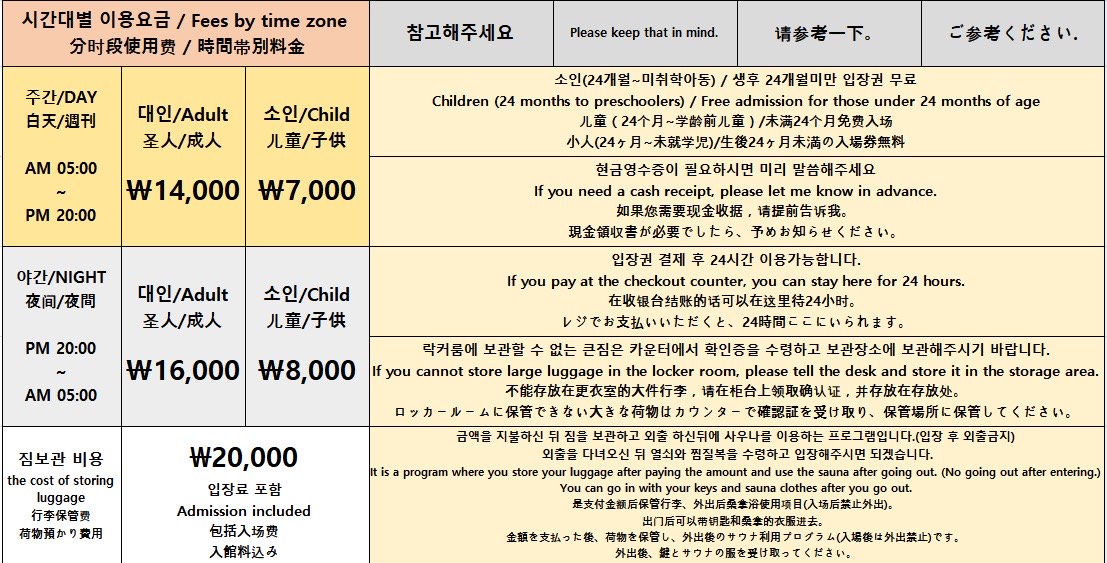
Best Jjimjilbang in Seoul, Korea for Foreigners: Prices, 24-Hour Options and Tattoo Rules
Dragon Hill Spa and Siloam, the two Seoul jjimjilbangs every guidebook still names, are shut with no reopening notice. What is open this winter: Sparex Dongdaemun at ₩14,000 by day and ₩16,000 overnight, Hongdae's 24-hour kiln sauna, and each spa's tattoo rule as written.
Opening a Bank Account in Korea as a Foreigner: ARC, Mobile ARC and the ₩1 Million Limit Account
Most Korean banks open a full account only on an ARC. Without proof of salary you get a limit account: ₩1 million a day by app or ATM, ₩3 million at the counter. Mobile ARC is accepted from day one at six banks, and KB's app takes it too.
Black Friday in Korea 2026: What Actually Goes on Sale (Olive Young, K-Sale Festa) and the Tax-Free Rule That Stacks
Korea's Black Friday runs in early November, not on 27 November: Olive Young's ended 7 Nov, K-Sale Festa ends 15 Nov. What is still on later, and how the ₩15,000 instant tax refund stacks on a sale price.