Health Checkup in Korea (2026): Hospitals Run Two Price Lists — ₩791,000 on Samsung's Korean Page, ₩1,874,000 on Its English One
Last updated: 7 October 2026. Every price below was read from the hospitals' own Korean and English pages and brochures on 7 October 2026: Samsung Medical Center's Korean health-screening pages and its English Health Promotion Center page, and Severance Health Check-up's Korean program page plus its 2026 Korean and English brochures. National screening rules come from the National Health Insurance Service. This guide covers prices and procedure only. It contains no medical advice and does not recommend any hospital.
If you search for the cost of a health checkup in Korea in English, you get agency pages quoting packages from about a thousand dollars up. Those figures are real. They are the international price. The same hospitals publish a second, lower price list in Korean, and the two lists are rarely shown side by side.
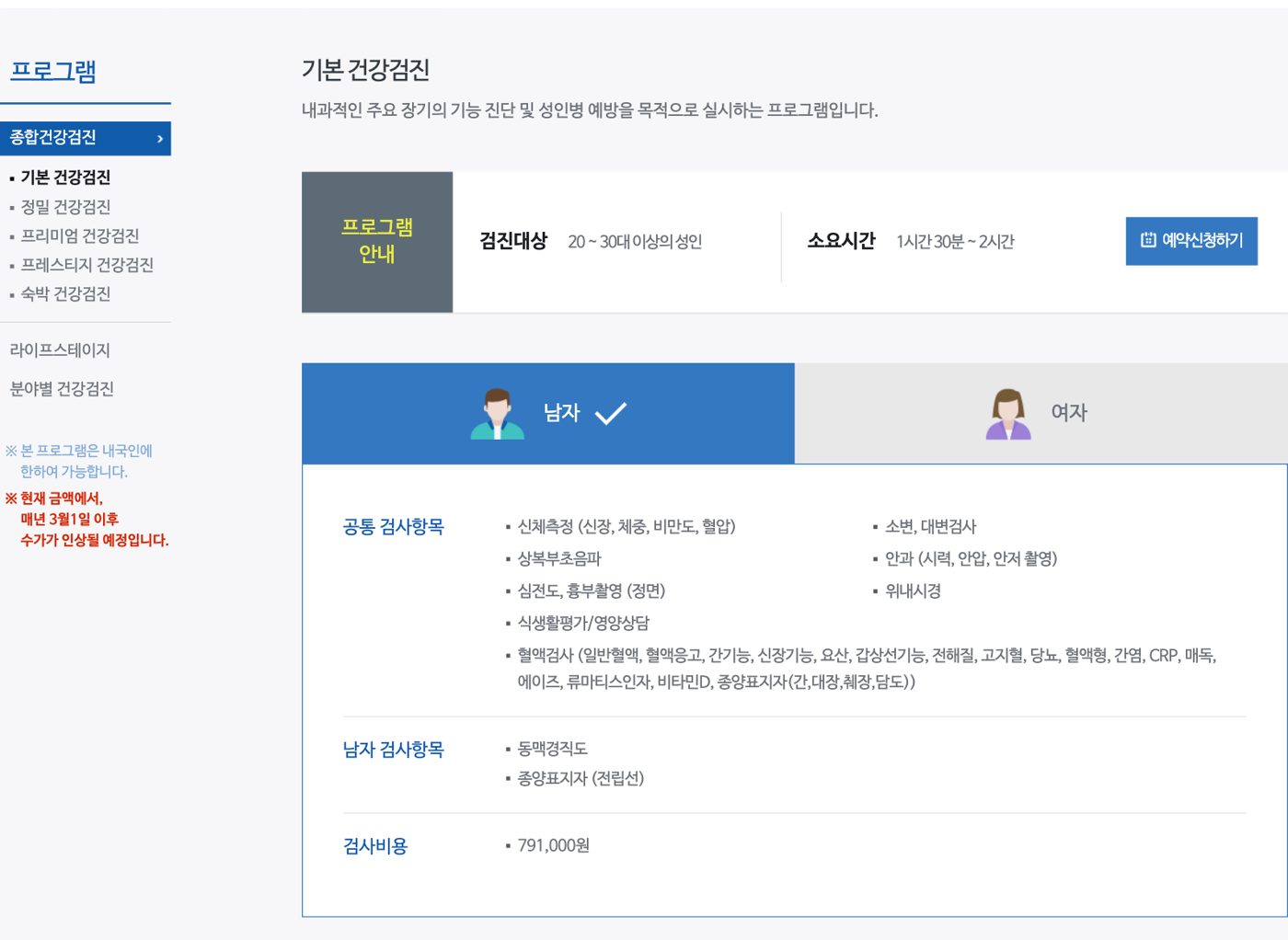
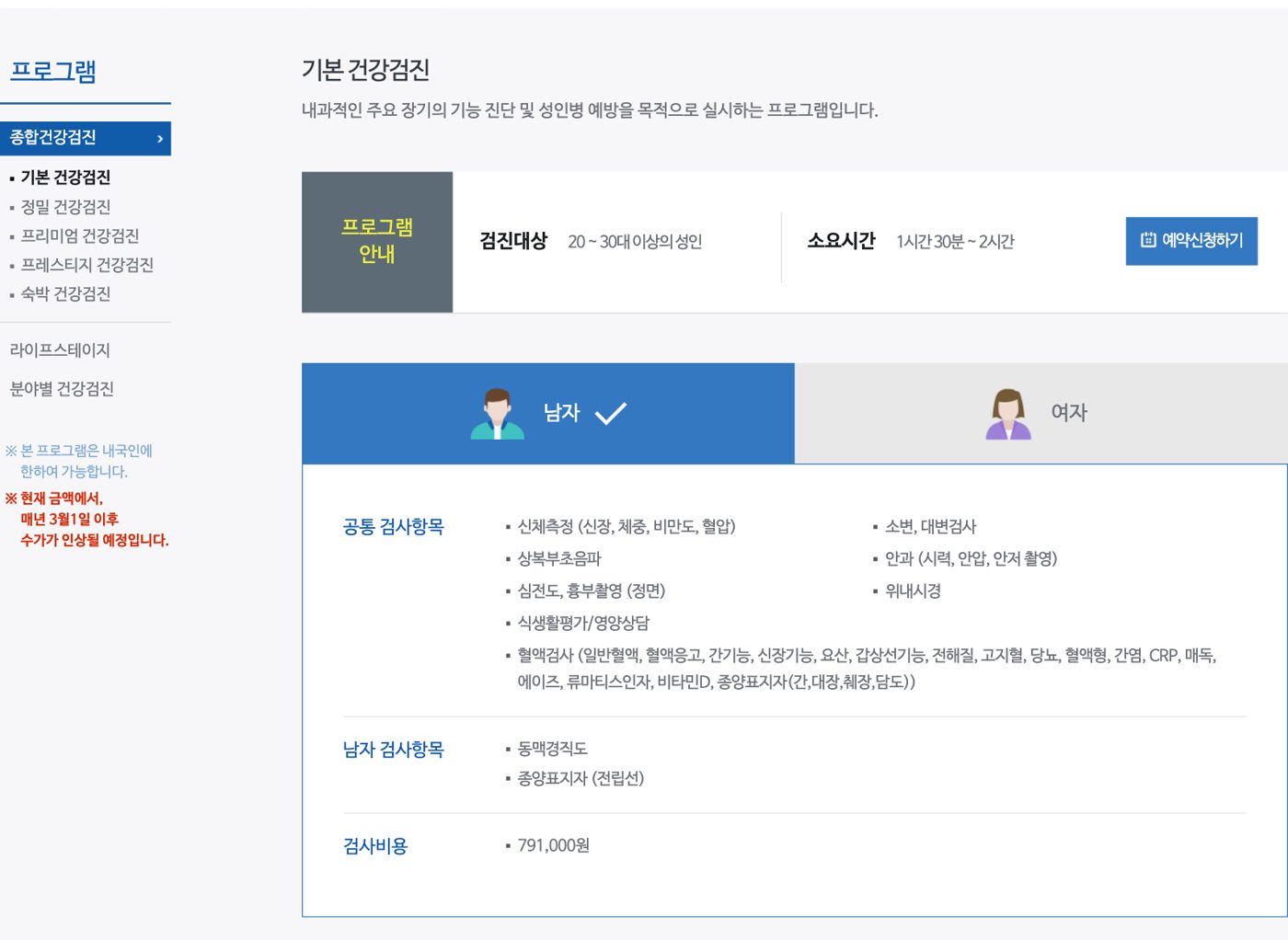
Samsung Medical Center (삼성서울병원) shows it most clearly. Its Korean page for the basic comprehensive checkup (기본 건강검진) lists ₩791,000 for men and adds a line in small blue type: "※ 본 프로그램은 내국인에 한하여 가능합니다", meaning "this program is available to Korean nationals only." Its English page lists the entry package, called Primary, at ₩1,874,000. That is 2.37 times as much.
Part of that gap is real: the English package includes tests the Korean one charges extra for. When you add those tests at the hospital's own Korean prices, the English package still costs 57% more. At Severance (세브란스) the rule is printed outright, and so is the size of the markup: exactly 30% on every item that appears in both brochures.
Below: both lists side by side, who gets which, what the extra buys, and the free national checkup many foreign residents never use.
The cheaper list is on Korean pages and Korean phone lines. For reading 수면내시경 on a booking form: Lonely Planet Korean Phrasebook & Dictionary on AmazonAffiliate link. As an Amazon Associate, EpicKor earns from qualifying purchases at no extra cost to you.
Quick Guide: Korea's two checkup price lists, October 2026
| Question | Answer (as of October 2026) |
|---|---|
| Samsung Medical Center, basic package, Korean page | ₩791,000 men / ₩851,000 women, "Korean nationals only" |
| Samsung Medical Center, Primary package, English page | ₩1,874,000 men / ₩2,323,000 women |
| Samsung, after adding the English package's extra tests at Korean prices | ₩1,194,000 vs ₩1,874,000 (men): 57% more on the English list |
| Severance Health Check-up, basic package | ₩750,000 / ₩800,000 in Korean; ₩975,000 / ₩1,040,000 in English: +30%, same tests |
| Who pays the international price at Severance | Foreign nationals without Korean national health insurance |
| Free option for insured residents | The NHIS general checkup (일반건강검진): ₩0, every two years, at designated clinics |
| Do these two centres do the free NHIS checkup? | No. Both say so on their own pages |
| What the extra money buys | English booking, English report, interpreters, an international desk, results sent abroad (per Samsung's English pages) |
Samsung Medical Center: the same building, two lists
Samsung Medical Center runs its checkups from the Health Promotion Center (건강의학센터) on the 4th floor of its cancer centre on Irwon-ro, Gangnam. The Korean site lists five comprehensive packages (종합건강검진), and every one of them carries the same blue note: 내국인에 한하여, "Korean nationals only." The English site lists four packages for international visitors. These are the entry-level packages from each list:
| Package | Men | Women | Page |
|---|---|---|---|
| 기본 건강검진 (basic), Korean page | ₩791,000 | ₩851,000 | Korean, "Korean nationals only" |
| Primary, English page | ₩1,874,000 | ₩2,323,000 | English, for international visitors |
| Raw multiple | 2.37× | 2.73× |
Sources: samsunghospital.com Korean basic-checkup page and English screening-packages page, both read 7 October 2026.
A raw multiple is not a fair comparison, because the two packages do not contain exactly the same tests. The English Primary package for men includes two things the Korean basic package treats as add-ons: sedation for the gastroscopy (수면내시경) and a carotid ultrasound (경동맥초음파). For women, it adds sedation, a breast ultrasound (유방초음파), a pelvic ultrasound (골반초음파) and an HPV test (인유두종 바이러스). The Korean page prices every one of those as an add-on, so you can rebuild the English package from Korean parts.
Sooez 13-pocket expanding file (A4): somewhere to keep the report Whichever list you pay, the result is a printed report. At Samsung, you collect it at the in-person consultation. Severance sends it by post or email, or goes through it with you in person or by phone. Keeping each year's copy in one A4 file lets you compare results and hand them to a doctor at home. This is the only product box in this guide, because nothing you can buy makes the checkup cheaper. As an Amazon Associate, EpicKor earns from qualifying purchases at no extra cost to you.
See the Sooez expanding file on AmazonTest by test: the English package still costs 57% more
Here is the rebuild, using the add-on prices printed on Samsung's own Korean page:
| Men | Korean list |
|---|---|
| 기본 건강검진 (includes 위내시경, gastroscopy without sedation) | ₩791,000 |
| + 수면내시경 (sedation for the gastroscopy) | ₩175,000 |
| + 경동맥초음파 (carotid ultrasound) | ₩228,000 |
| Korean list, rebuilt to match Primary | ₩1,194,000 |
| English Primary package | ₩1,874,000 |
| Difference | ₩680,000 (57% more) |
| Women | Korean list |
|---|---|
| 기본 건강검진 (includes 위내시경, 유방촬영 mammography, gynaecological exam) | ₩851,000 |
| + 수면내시경 (sedation) | ₩175,000 |
| + 유방초음파 (breast ultrasound) | ₩235,000 |
| + 골반초음파 (pelvic ultrasound) | ₩153,000 |
| + 인유두종 바이러스 (HPV test) | ₩65,000 |
| Korean list, rebuilt to match Primary | ₩1,479,000 |
| English Primary package | ₩2,323,000 |
| Difference | ₩844,000 (57% more) |
All figures as of October 2026, from samsunghospital.com. The blood panels are not identical in either direction: the English package lists iron studies and a sex hormone, while the Korean one lists rheumatoid factor. The men's Korean package also includes an arterial-stiffness test (동맥경직도), which the English Primary package does not.
Done this way, the gap falls from 2.37 times to 1.57 times for men, and from 2.73 to 1.57 for women. It does not disappear.
There is also a useful detail on the English page. Its optional tests cost exactly what the Korean add-on list charges: carotid ultrasound ₩228,000 on both, colonoscopy ₩265,000, thyroid ultrasound ₩192,000, low-dose chest CT ₩200,000, coronary calcium CT ₩185,000, brain MRI and MRA ₩1,500,000. The difference is in the package price, not in the individual tests. So if you are paying the international price anyway, adding extra tests costs you no more than it costs a Korean patient.
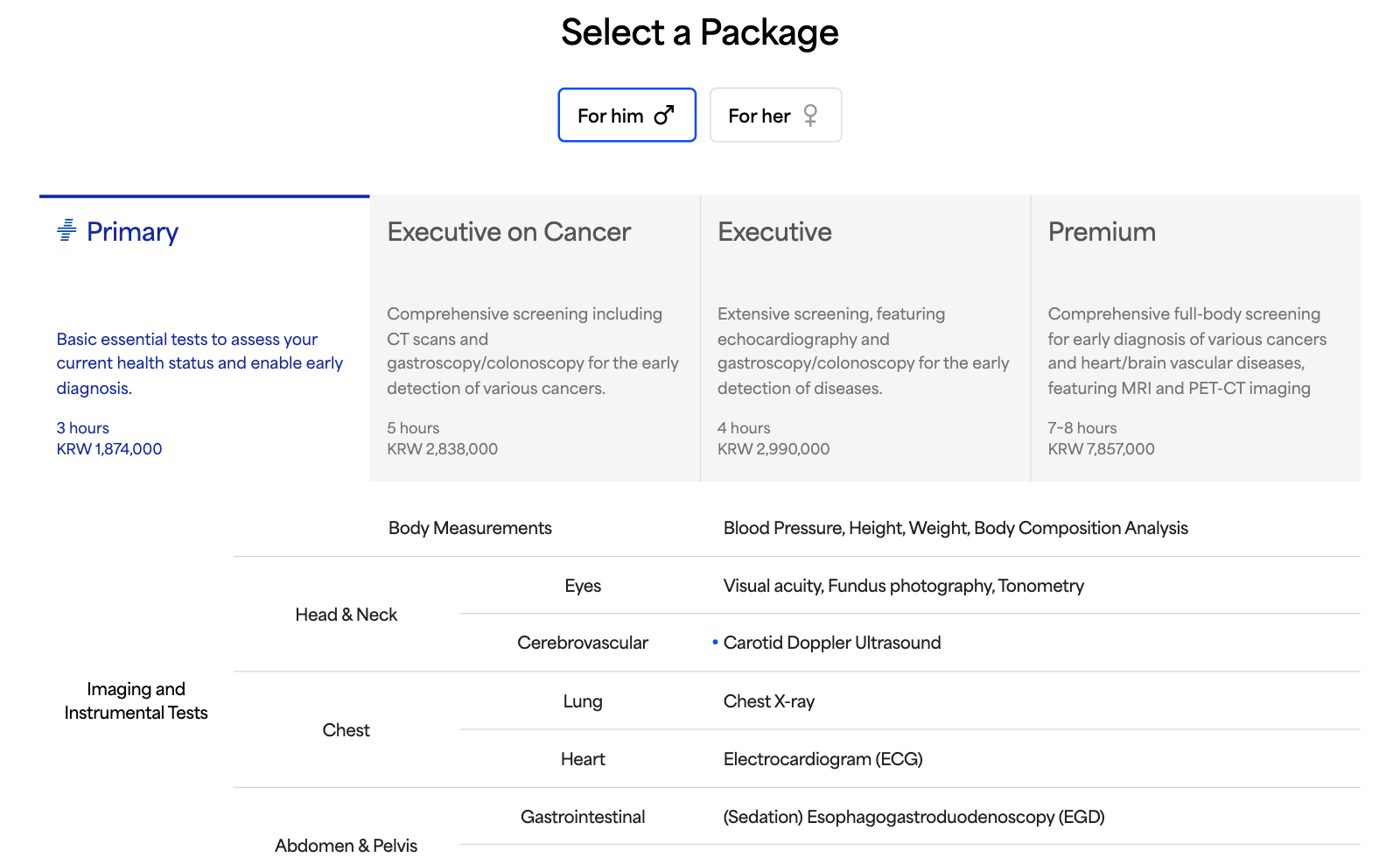
We have not compared Samsung's top packages: the English Premium (₩7,857,000) includes MRI and PET-CT and matches no single Korean package.
You might like: Dental Implant Cost in Korea (2026): The Government's Own Price Data Says ₩1.19 Million, the same idea applied to dentistry.
Severance: one rule, and the markup is exactly 30%
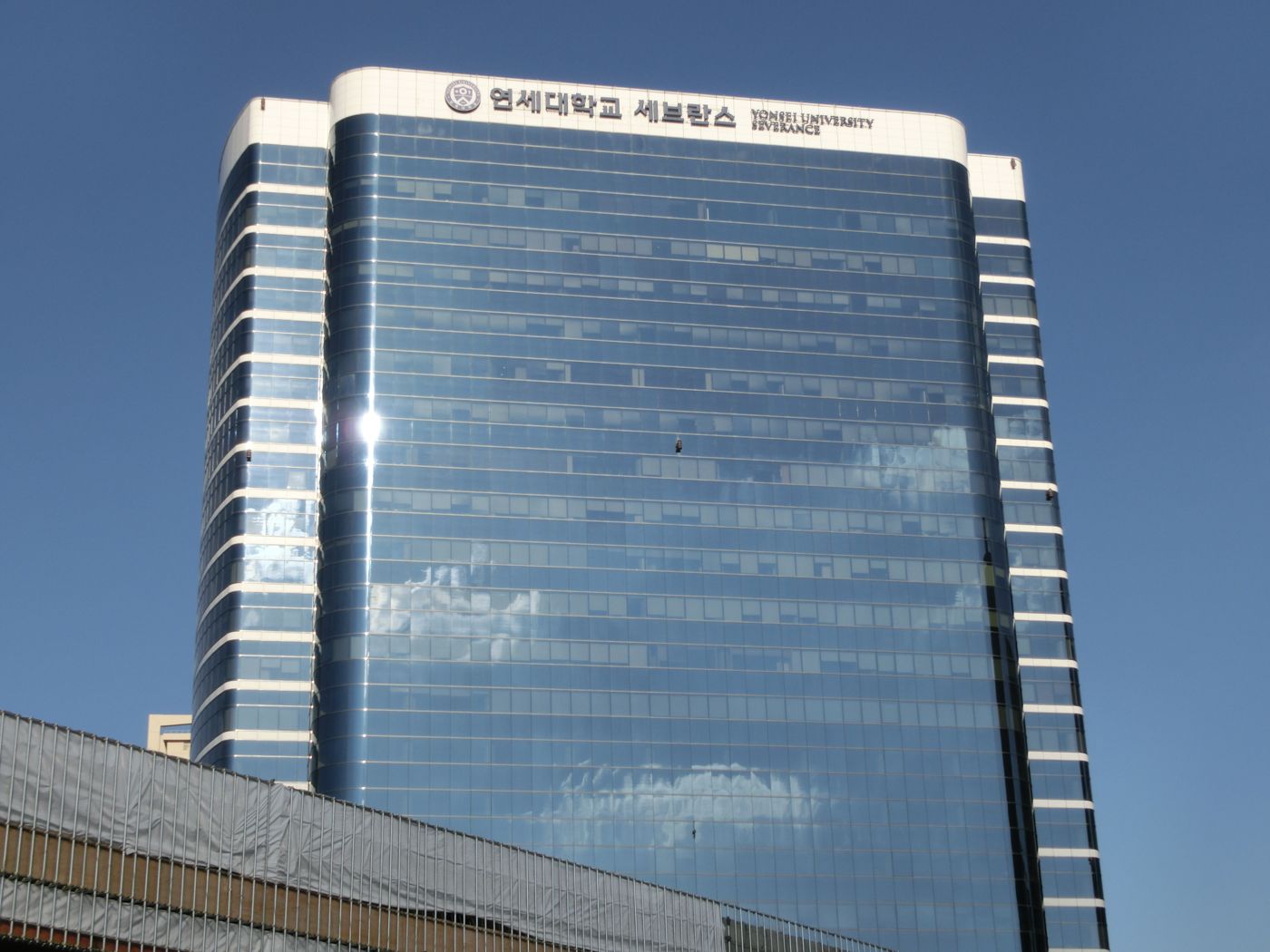
Severance Health Check-up (세브란스헬스체크업) is Severance Hospital's checkup centre. It is not on the main Sinchon campus. It occupies the 4th and 5th floors of the Yonsei University Severance Building (연세대학교세브란스빌딩), across from Seoul Station. Its Korean program page says plainly who pays which price:
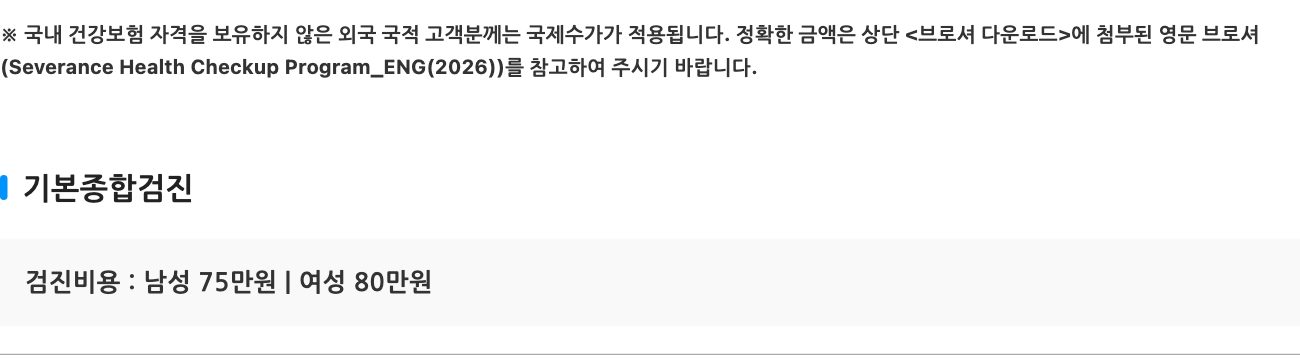
※ 국내 건강보험 자격을 보유하지 않은 외국 국적 고객분께는 국제수가가 적용됩니다. "The international price (국제수가) applies to customers of foreign nationality who do not hold Korean national health insurance eligibility."
The Korean page lists the Korean prices and sends everyone else to an English brochure, Severance Health Checkup Program_ENG (2026). We downloaded both brochures and compared them line by line:
| Severance package or test | Korean price | International price | Multiple |
|---|---|---|---|
| 기본종합검진 basic, men / women | ₩750,000 / ₩800,000 | ₩975,000 / ₩1,040,000 | 1.30 |
| Sedation for gastroscopy (진정내시경), add-on | ₩130,000 | ₩169,000 | 1.30 |
| 프리미엄 Premium, men / women | ₩2,520,000 / ₩3,080,000 | ₩3,276,000 / ₩4,004,000 | 1.30 |
| 플래티넘 Platinum, men / women | ₩4,300,000 / ₩4,860,000 | ₩5,590,000 / ₩6,318,000 | 1.30 |
| 대장내시경 colonoscopy, add-on | ₩290,000 | ₩377,000 | 1.30 |
| 뇌 MRI+MRA, add-on | ₩1,300,000 | ₩1,690,000 | 1.30 |
Sources: Severance Health Check-up Korean brochure (printed 3 February 2026) and English brochure (dated 4 February 2026), both downloaded from sev.severance.healthcare on 7 October 2026.
The basic packages list the same tests in both brochures, down to the hearing test from age 50 and the mammogram from age 35. So at Severance the comparison is simple: the international list is the Korean list plus 30%. It covers the packages, the sedation add-on and every optional test listed in both brochures; two packages (circulatory, adolescent) drop one Korean-only test from the English version and still come out at exactly 1.30. A basic checkup with sedation costs ₩880,000 on the Korean list and ₩1,144,000 on the international one, for men.
Who gets the Korean price
The two hospitals word this differently, and it matters if you live in Korea.
- Severance draws the line at insurance, not passport. The note applies the international price to foreign nationals without Korean health insurance. If you are a foreign resident enrolled in the National Health Insurance Service (국민건강보험공단, NHIS), the wording puts you on the Korean list. Most registered foreigners are enrolled automatically once they have lived in Korea for six months (employees from their first day of work); see Korea's health insurance for foreigners for who and how much.
- Samsung's Korean page says only 내국인, "Korean nationals," and does not say where an insured foreign resident with an Alien Registration Card (외국인등록증) falls. We could not find a Samsung page that answers this. If you are insured, ask when you book. Mention that you hold an ARC and NHIS coverage, and ask whether the 내국인 program applies to you. Don't assume either answer.
- A tourist is on the international list at both. Without Korean insurance, the international price is the one that applies. The question is how much more you pay and what you get for it.
What the extra money buys, and when it is worth paying
The international price is not simply a foreigner tax. The English service is a separate operation, and Samsung's English pages list what comes with it:
- A booking you can make from abroad, in English. Samsung's English site takes requests through a form, and a nurse confirms the date. The Korean online booking needs a Samsung member login (ID and password, or KakaoTalk certificate sign-in).
- A screening kit sent before you arrive. Samsung says it delivers the kit four to five days ahead, to your hotel before check-in if needed.
- Interpreters at no extra charge if you ask at least a week ahead. Russian, Mongolian, Chinese, Arabic, Japanese and Vietnamese are listed, and Samsung says most staff can help in English.
- An official report in Korean and English, and results sent to you by DHL or email if you have flown home. A translated doctor's summary in another language follows 7 to 10 business days after the report.
- Payment by international card on the day. Samsung says its centre does not handle insurance claims for checkups.
When the international price is probably worth it: you are visiting, you don't read Korean, you need an English report for a doctor at home, or you will be gone before results are ready. A coordinator who walks you between ten rooms is worth something when every sign is in Korean.
When it probably is not: you live in Korea, hold NHIS coverage, can manage a Korean phone call or bring a Korean-speaking friend, and can come back in person for results. In that case the Korean list, or the free national checkup below, is the one to ask about first.
You might like: What a Doctor Costs in Korea Without Insurance (2026), for the unplanned visit rather than the planned one.
Before either list: the free national checkup
If you are enrolled in NHIS, you may not need a ₩791,000 package at all, at least not every year. The general health checkup (일반건강검진) is NHIS's own programme, and NHIS states in English that foreign enrollees get "the same coverage as it does for the Korean citizens."
- Who: employee-insured members (직장가입자), and for the self-employed insured, householders (세대주) and household members aged 20 or over, plus dependants aged 20 or over.
- How often: once every two years, or every year for non-office workers.
- Cost: the general checkup is fully covered by NHIS, so you pay ₩0. The national cancer screenings carry a 10% co-payment, except colorectal and cervical screening, which NHIS pays in full. People in the lowest 50% of premium payers, and medical-aid recipients, pay nothing for cancer screening. Stomach-cancer screening (위암 검진) is offered from age 40 every two years.
- What it includes: a consultation, body measurements, vision and hearing, blood pressure, chest X-ray, a basic blood panel (haemoglobin, fasting glucose, liver and kidney markers), urine test and dental check, with more tests at set ages. It is much narrower than a ₩791,000 package. No abdominal ultrasound is included, for example.
- Where: designated clinics and hospitals, not the two premium centres in this guide. Severance's FAQ says it does not do NHIS checkups (공단 검진), and Samsung's English FAQ says its centre "is not designated for NHIS check-ups." Look up a designated clinic and check your eligibility (검진대상 조회) on NHIS's site, or call 1577-1000 (English line 033-811-2000). Bring an ID; NHIS lists a passport as acceptable.
A sensible order: do the free one first, then pay only for the extra tests you want.
How to book the Korean package, step by step
- Confirm you qualify. At Severance, that means Korean health insurance. At Samsung, ask, as explained above.
- Call. Severance Health Check-up's reservation line is 1588-7757 (from abroad, +82-2-2228-1004, extension 4), open 07:30–17:30 on weekdays. Samsung's main line is 1599-3114; ask for 건강의학센터 개인 건강검진 (Health Promotion Center, individual checkup). Have your ARC number ready, and choose your add-ons, especially sedation, when you book. Samsung's Korean page says sedation and colonoscopy must be requested at booking.
- Bring someone if you choose sedation. Both centres say you need a companion (보호자) and must not drive yourself home after sedation.
- Do the paperwork beforehand. Severance sends a mobile questionnaire (문진표) by KakaoTalk or email a week before, and asks you to collect a stool sample the evening before or that morning.
- Fast. Severance asks for nothing by mouth from 21:00 the night before, including water, gum and sweets. Samsung's English guide says at least 10 hours. Colonoscopy has its own diet and prep instructions, so follow the hospital's sheet.
- Pay on the day, then wait for results. Samsung says consultations are usually available 7 to 14 days after the exam. Severance offers consultations in person or by phone, and reports by email or post.
Samsung's Korean page also has a red note saying prices will rise after 1 March each year. Every figure here is as of October 2026, so check the page again if you are booking for next spring.
The honest part
- We are not recommending either hospital, or a checkup at all. Whether you need a gastroscopy, a CT or anything else is a question for a doctor. This guide compares prices only.
- The 57% is for one package at one hospital. It is the clearest like-for-like case we found, not a national average. Korea publishes no official median price for comprehensive checkups: they are not among the uninsured items whose prices the Health Insurance Review and Assessment Service (심평원) discloses.
- The international price buys real things. If you would need an interpreter, a coordinator and an English report anyway, pricing those separately could cost close to the difference.
- Prices change. Samsung's own page says prices rise each March. Severance's brochures are dated February 2026.
- Demand is growing. The health ministry counted 2.01 million foreign patients in 2025, about 65,000 of them (3.1%) at health-screening centres. Most English-language search results show only the international list.
Frequently Asked Questions
Q: How much is a full health checkup in Korea in 2026? At Samsung Medical Center, the basic package costs ₩791,000 for men on the Korean list and ₩1,874,000 on the English list for international visitors, as of October 2026. At Severance Health Check-up, the basic package costs ₩750,000 for men on the Korean list and ₩975,000 at the international price. The figure you pay depends on which list you are on and which add-ons, such as sedation, you choose.
Q: Why do foreigners pay more for a health checkup in Korea? Hospitals run a separate international price (국제수가) for patients without Korean national health insurance. Neither hospital states a reason on its price pages; Samsung's English pages list English booking, coordinators, free interpreters and an English report with the international packages. At Severance, the markup is 30% on every item. At Samsung, the English package costs 57% more than the Korean package rebuilt with the same tests.
Q: Can a foreigner get the Korean price? At Severance, the international price applies to foreign nationals without Korean health insurance, so an insured foreign resident falls on the Korean list. Samsung's Korean page says "Korean nationals only" without defining it, so insured residents should ask when booking.
Q: Is there a free health checkup for foreigners in Korea? Yes, if you are enrolled in NHIS. The general health checkup (일반건강검진) costs ₩0 every two years for employee-insured members, and for self-employed householders and household members aged 20 or over. National cancer screenings carry a 10% co-payment, and colorectal and cervical screening are free. It is done at NHIS-designated clinics, not at Samsung's or Severance's premium centres.
Sources
- Samsung Medical Center, Korean comprehensive checkup pages (basic, detailed, premium; "내국인에 한하여" note; add-on price table), read 7 October 2026: samsunghospital.com, 기본 건강검진; 프리미엄 건강검진.
- Samsung Medical Center, English Health Promotion Center pages (packages, optional tests, process, FAQ), read 7 October 2026: Screening packages; Screening process; Tips & information; Appointments.
- Severance Health Check-up, Korean program page (국제수가 note, Korean prices), FAQ and preparation pages, with the brochures 세브란스헬스체크업 건강검진프로그램_국문(2026) and Severance Health Checkup Program_ENG(2026), read 7 October 2026: checkup-program; FAQ; preparation.
- National Health Insurance Service: English health-checkup page (targets, co-payments) nhis.or.kr; English guidance for foreigners ("same coverage as … Korean citizens") nhis.or.kr; Korean general-checkup page (일반건강검진 대상, 검사항목, ID) nhis.or.kr; cancer-screening page (암검진, 본인부담 10%) nhis.or.kr.
- Ministry of Health and Welfare foreign-patient figures for 2025 (announced 24 April 2026): Herald Economy, 23 April 2026 (total of 2,011,822); breakdown by department including 검진센터 65,000 (3.1%): 치과신문, 10 May 2026.
You Might Also Like
Flu in Korea (2026): The Advisory Came on 11 September, a Rapid Flu Test Costs ₩30,000 and a Flu Shot ₩30,000–₩40,000 Without Korean Insurance, and Short-Term Visitors Cannot Get the Free One
Korea declared its 2026–27 flu advisory on 11 September, the earliest date in KDCA's records back to 2011. Uninsured, a rapid flu test's median posted price is ₩30,000 and a shot ₩30,000–₩40,000. Visitors staying under 3 months get no free vaccine.
What a Doctor Costs in Korea Without Insurance (2026): ₩18,840 at a Clinic, ₩68,070 to Walk Into a Regional ER, and Why the 119 Ambulance Is Free
Korea's emergency-room access fee is not written in won. It is 812.28 relative value points times 2026's ₩83.8, making it ₩68,070 at a regional centre and ₩22,690 at a local one, against ₩18,840 at a clinic. The 119 ambulance is free.
Korea Departure Tax (2026): The ₩24,000 Already Inside Every Ticket Out of Incheon, Who Pays Nothing, and the Rise Waiting in Parliament
Korea has no departure tax to pay at the airport: ₩24,000 is already in every ticket out of Incheon, a ₩17,000 airport charge plus a ₩7,000 tourism levy. Under-12s skip the levy, ferries pay ₩1,000, and two bills would raise it to ₩20,000 or ₩30,000.