How Much Is Rent in Seoul (2026)? Officetels Average ₩949,000 a Month — Jeonse vs Wolse, Deposits, and What Foreigners Need
Last updated: 30 September 2026. Rent averages are from the Korea Real Estate Board (한국부동산원), the state agency that runs Korea's official housing statistics: its Q2 2026 officetel survey (released 15 July 2026, prices as of June) and its August 2026 national housing survey (released 15 September). One-room figures are from the property platform Dabang (다방): its monthly report analyses the Ministry of Land, Infrastructure and Transport's (국토교통부) filed rental deals, and its university-area survey uses listings on its own platform. Legal figures were checked against the Housing Lease Protection Act (주택임대차보호법) and the Bank of Korea's rate record. Dollar figures use about ₩1,360 to US$1 (September 2026) and are approximate. This is a guide, not legal advice.
Search "how much is rent in Seoul" in English and you get ranges: "₩450,000 to ₩850,000 for a one-room", "₩800,000 to ₩1.8 million for an officetel", rarely with a source and almost never with the quarter it describes. English Wikipedia's article on jeonse still cites a 2014 price and a 2022 market share.
Korea publishes the actual averages every quarter, in Korean. In June 2026 a Seoul officetel (오피스텔), the studio-style building most single foreigners rent, averaged ₩949,000 a month (about US$698) on a ₩22.85 million deposit (about US$16,800), the highest of any region. In the second quarter Seoul officetel rents rose 0.90%, the fastest quarterly rise since the survey began in 2018. A small villa one-room (원룸) averaged ₩670,000 in August; the average Seoul apartment, ₩1.64 million.
Below: those numbers side by side, the deposit system (jeonse, wolse and the in-between), and what a foreigner needs to get the deposit back.
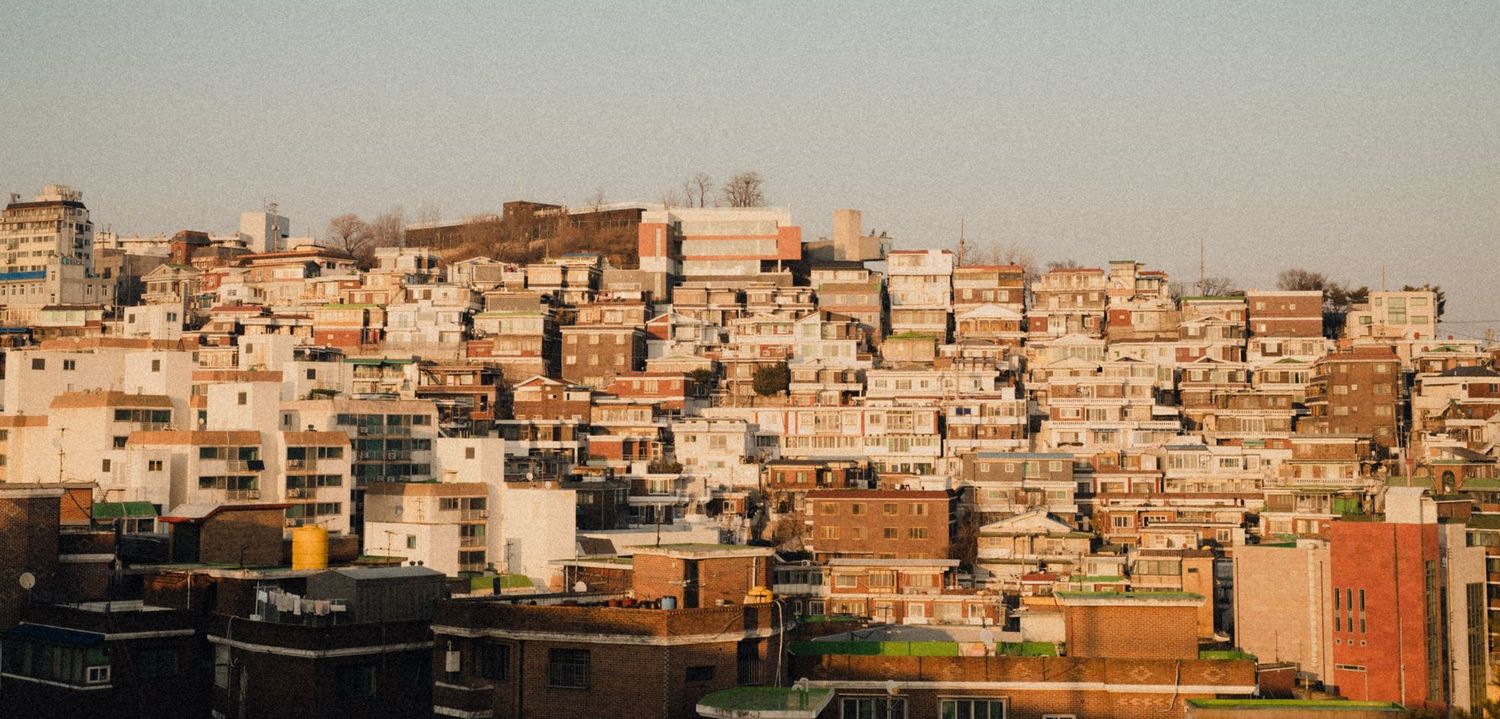
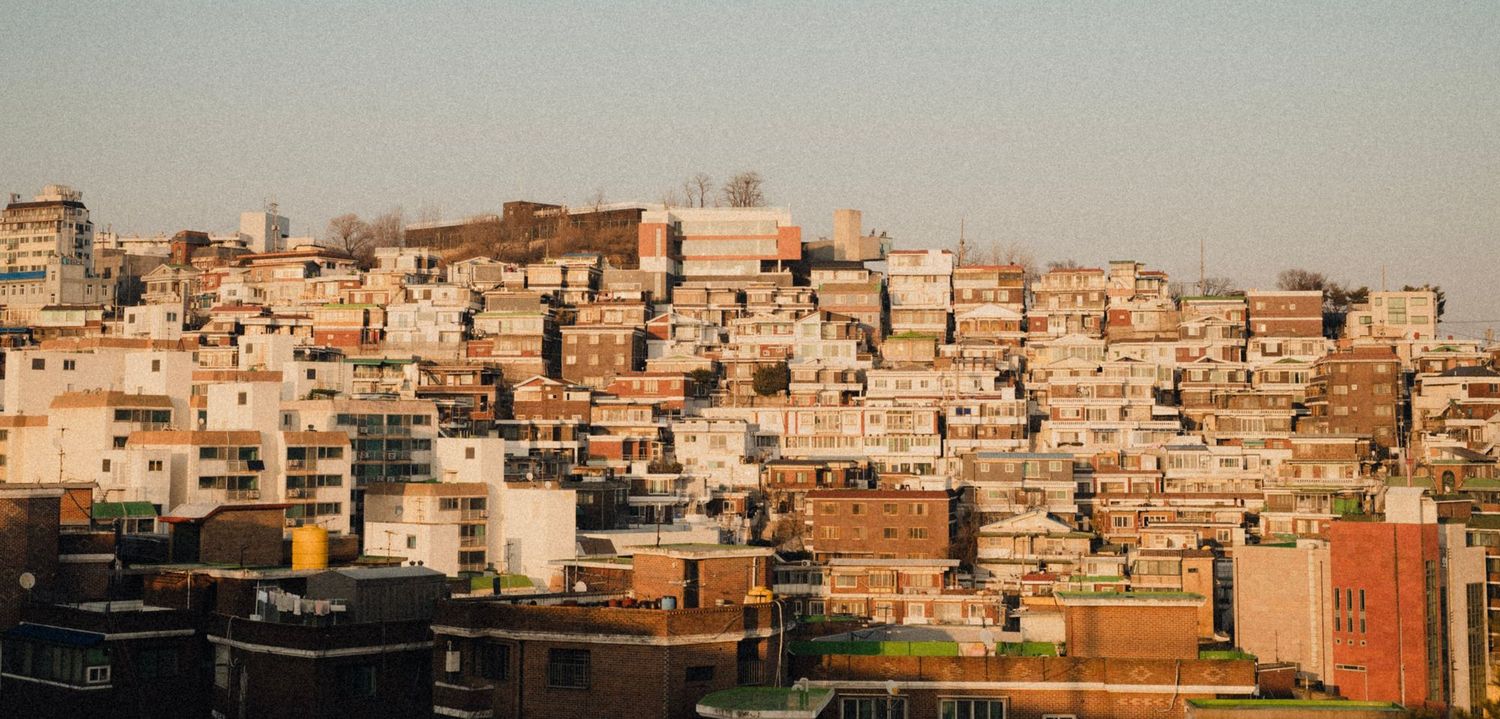
A residential hillside in Seoul. Low-rise villas and multi-unit houses (다세대·다가구) like these hold many of the city's one-room rentals. Photo: Junsu Park, Pexels.
Your deposit comes back on the strength of one stamped lease — an A4 accordion file for the contract, register printout and receipts: Sooez 13-Pocket Expanding FileAffiliate link. As an Amazon Associate, EpicKor earns from qualifying purchases at no extra cost to you.
Quick Guide: rent in Seoul in 2026, by type of home
| Type of home (Korean) | Average monthly rent | Deposit | Source, date |
|---|---|---|---|
| Officetel (오피스텔), Seoul | ₩949,000 (≈US$698) | average ₩22,851,000 (≈US$16,800) | Korea Real Estate Board, June 2026 |
| Officetel, whole country | ₩811,000 | average ₩16,570,000 | Korea Real Estate Board, June 2026 |
| Villa one-room, 33 m² or less (연립·다세대 원룸) | ₩670,000 (≈US$493) | rent set on a ₩10 million deposit | Dabang from MOLIT deals, August 2026 |
| One-room near 10 big universities | ₩625,000 + ₩84,000 management fee | rent set on a ₩10 million deposit | Dabang, July 2026 |
| Apartment (아파트), Seoul | ₩1,641,000 (≈US$1,207) | average ₩195,650,000 | Korea Real Estate Board, August 2026 |
| All Seoul housing on wolse | ₩1,313,000 | varies | Korea Real Estate Board, August 2026 |
| Goshiwon room (고시원) | ₩400,000–₩600,000; premium up to ₩1.2 million | little or none | Edaily survey of 10 goshiwon near Sinchon and Seoul National University, August 2026 |
| Jeonse (전세), officetel, Seoul | ₩0 rent | average ₩223,137,000 (≈US$164,000) | Korea Real Estate Board, June 2026 |
| Legal cap on converting deposit to rent | 5.0% a year (Bank of Korea base rate 3.00% + 2 points), during an existing lease | ||
| Agent fee (중개보수), Seoul cap | 0.3–0.6% of the deal value for homes, 0.4% for a residential officetel; on the average officetel lease, at most about ₩471,000 | ||
"Rent" in Seoul is never one number: every monthly figure sits on a deposit, and the same flat can be let at ₩10 million down and ₩900,000 a month or ₩100 million down and ₩400,000.
Addalock portable door lock — a second lock you own, for the first weeks in a new room Goshiwon owners keep master keys, and a one-room's digital door lock (도어락) may still open to the last tenant's code until you reset it. This wedge-and-plate lock needs no tools and leaves no marks, so it works on a rented door without asking the landlord. As an Amazon Associate, EpicKor earns from qualifying purchases at no extra cost to you.
See the Addalock on AmazonHow much is rent in Seoul? The official averages
Officetels. The Korea Real Estate Board's quarterly officetel survey is the cleanest official number for a single renter. For the second quarter of 2026 it put the Seoul average at ₩949,000 a month and ₩22,851,000 deposit, against ₩850,000 in Gyeonggi and ₩700,000 in Incheon. Seoul officetel rents rose 0.90% on the quarter, after 0.75% in the first; the board pointed to renters avoiding jeonse and to demand near stations by universities and office districts. By area, the northwest (Mapo, Seodaemun, Eunpyeong) rose 1.33% and the southeast (Gangnam, Seocho, Songpa, Gangdong) 1.12%.
Expensive leases are also more common. Ministry of Land deal filings show 5,660 new Seoul officetel wolse contracts of ₩1 million a month or more in January–June 2026, up 28% on a year earlier and more than four times the 1,223 of the first half of 2022.
Apartments. The board's monthly survey for August 2026 put the average Seoul apartment on wolse at ₩1,641,000 a month on a ₩195.65 million deposit, up 0.91% on July and about 14% on a year earlier (₩1.44 million). Across all Seoul housing types the average was ₩1,313,000, the first time above ₩1.3 million since the series began in July 2015. Apartments are what most Seoul families live in (why Koreans live in apartments), and few are let as single rooms.
Villa one-rooms. Dabang's "Dabang Yeojido (다방여지도)" report, published 29 September, reads MOLIT's filed deals for villa one-rooms of 33 m² or less. August's Seoul average was ₩670,000 a month (rents restated to a ₩10 million deposit), down 2.4% on July, while the average jeonse deposit for the same rooms rose 1.3% to ₩222,280,000.
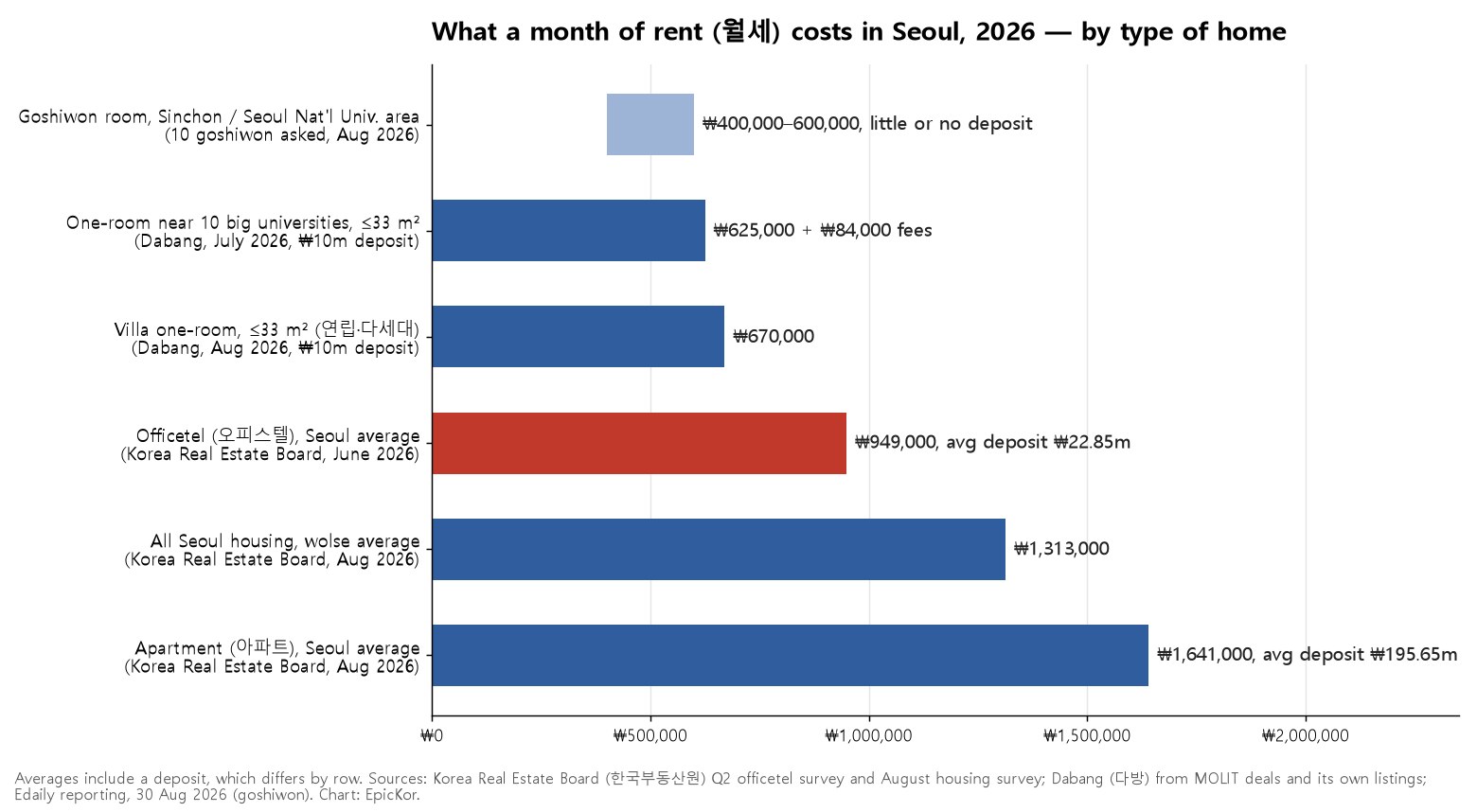
Chart drawn by EpicKor from the Korea Real Estate Board's Q2 officetel survey and August housing survey, Dabang's July and August one-room reports, and Edaily's goshiwon survey (August 2026). Each row has a different deposit behind it.
Rent by district: Gangnam, Yongsan, Mapo and the student areas
District averages move a lot month to month because a few new-build deals can swing a small sample. Treat them as a ranking, not a quote.
| Area | Villa one-room (33 m² or less) | Officetel (33 m² or less) |
|---|---|---|
| Yongsan-gu (용산구) | ₩1,165,000 (most expensive) | ₩1,271,000 (most expensive) |
| Gangnam-gu (강남구) | ₩980,000 | ₩1,041,000 |
| Seocho-gu (서초구) | ₩977,000 | ₩967,000 |
| Songpa-gu (송파구) | — | ₩1,009,000 |
| Seongdong-gu (성동구) | ₩908,000 | ₩600,000 (second cheapest) |
| Nowon-gu (노원구) | ₩464,000 (cheapest) | ₩595,000 (cheapest) |
Figures are August 2026 MOLIT filings analysed by Dailypop (데일리팝), 9,891 deals, restated to a ₩10 million deposit using the board's 5.8% Seoul conversion rate. They are higher than Dabang's ₩670,000 citywide figure because the method differs; compare districts within one table, not across sources.
Dabang's own August ranking agrees on the top: Yongsan at ₩1.16 million (173% of the Seoul average, lifted by new-build deals), then Gangnam at 131%, Seongdong 118%, Seocho 114%. Mapo-gu (마포구), home to Hongdae and Hapjeong, sat at 106%, about ₩710,000.
Student areas. Dabang's July survey of one-rooms listed on its platform near ten major universities, on a ₩10 million deposit, found rent plus management fee averaging ₩709,000, up 8.0% in a year. Near Ewha Womans University (Sinchon area) it was ₩870,000; Yonsei ₩758,000; Hankuk University of Foreign Studies ₩755,000. Around Seoul National University in Gwanak-gu (관악구), long the cheap option, it was ₩624,000, up 24.6% in a year from ₩501,000, the fastest rise of the ten.
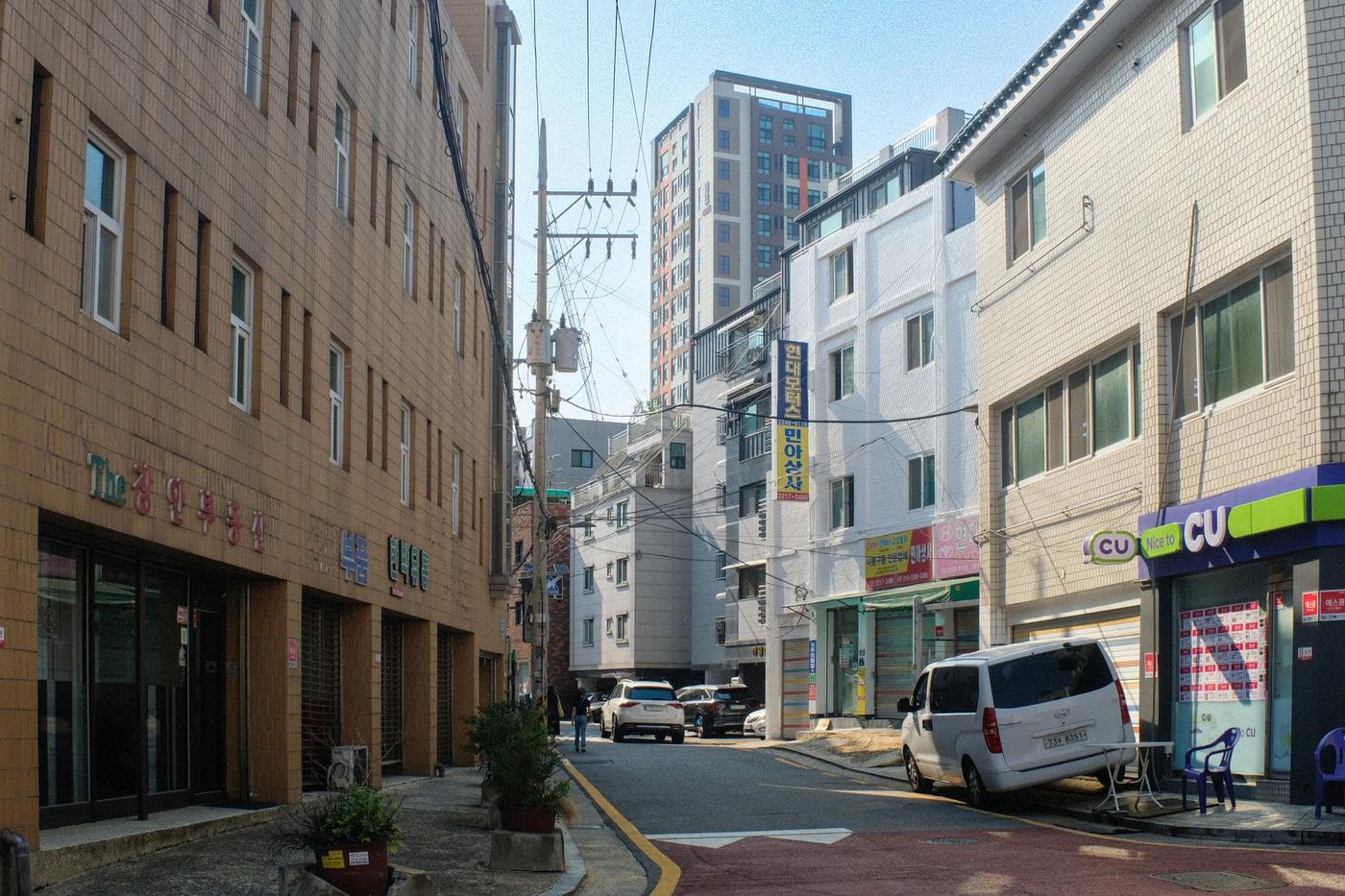
A Seoul side street of small multi-unit buildings with a CU on the ground floor, the typical setting of a one-room or small officetel. Photo: Andre Tran, Pexels.
You might like: Living in Seoul for a Month: Cost, Apps, Neighborhoods
Jeonse vs wolse: how the Korean deposit system works
Korean leases are defined by the ratio of deposit (보증금) to monthly rent (월차임). The Korea Real Estate Board classifies them this way:
| Type | Deposit | Typical Seoul example | Who it suits |
|---|---|---|---|
| Wolse (월세) | Up to 12 months' rent | ₩5–10 million down, ₩650,000–₩950,000 a month | Most foreigners; stays of one to two years |
| Semi-wolse (준월세), what people call banjeonse (반전세) | 12 to 240 months' rent | ₩22.85 million on ₩949,000 (the officetel average, about 24 months) | Anyone who can put more down to pay less each month |
| Semi-jeonse (준전세) | More than 240 months' rent | ₩150 million down, ₩200,000 a month | People with savings or a jeonse loan |
| Jeonse (전세) | A lump sum, no monthly rent | ₩223 million average for a Seoul officetel; ₩222 million for a villa one-room | Residents with large savings or bank loans |
"Banjeonse" is everyday speech, not a legal term; in the statistics it is mostly semi-wolse. Whatever the label, the deposit comes back at the end, and all of it is at risk if the landlord cannot pay (see below).
Wolse is winning. In January–July 2026, 69.7% of Seoul rental deals were wolse of some kind, and for apartments the share passed half (52%, from 43.9% a year earlier), according to MOLIT filings reported by Newsis. Across villas, multi-unit houses and officetels the Seoul share was 73.07%, against 52.41% in the same months of 2023.
The conversion rate: deposit into rent
The conversion rate (전월세전환율) says how much monthly rent replaces each won of deposit. The formula is: monthly rent = (deposit given up) × annual rate ÷ 12.
- Market rate. For officetels in June 2026, 6.62% nationally and 6.06% in Seoul, the lowest of any region (Sejong was highest at 9.05%). Dailypop cites the board's all-housing Seoul figure as 5.8%.
- Legal cap. Article 7-2 of the Housing Lease Protection Act and Article 9 of its decree cap the rate at the lower of 10% or the Bank of Korea base rate plus 2 points. The base rate rose to 2.75% on 16 July 2026 and to 3.00% on 27 August, so the cap is now 5.0%.
Worked example: an officetel on jeonse at ₩223 million, re-let on a ₩23 million deposit. The ₩200 million difference at the Seoul market rate of 6.06% is ₩1,010,000 a month. At the 5.0% legal cap it is ₩833,000.
The catch: Article 7-2 is written for converting a deposit into rent during a lease or at renewal, and it is generally read as not binding a brand-new lease with a new landlord, which is priced freely. That is why the market rate sits above the cap.
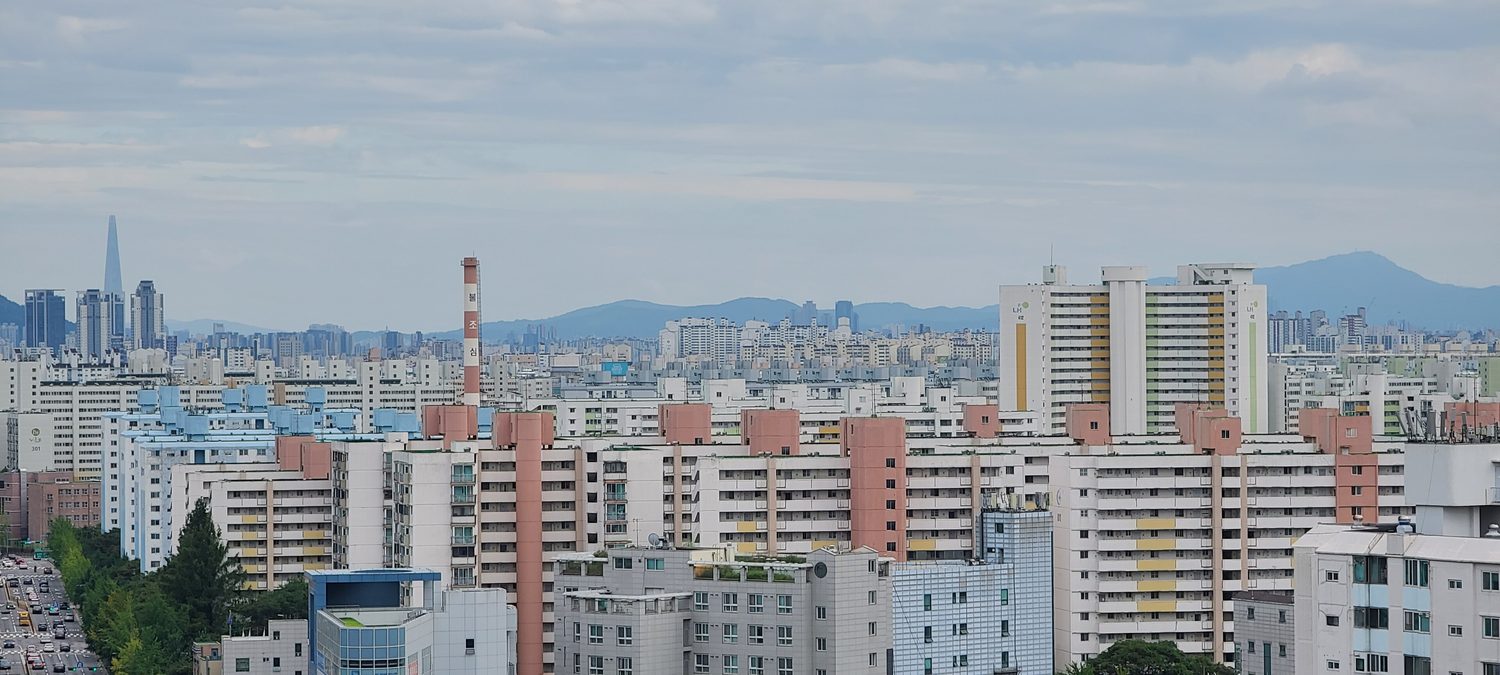
Apartment complexes in Nowon-gu, northeast Seoul, which also had the cheapest one-rooms and officetels in August 2026. Lotte World Tower is on the horizon. Photo: Ox1997cow, Wikimedia Commons, CC BY-SA 3.0 (2022).
Management fees, agent fees and the costs on top
Management fee (관리비). Usually a flat monthly sum for building cleaning, lifts and common electricity; internet, water and gas may or may not be included. Near universities it averaged ₩84,000 in July, up 10.9% in a year. Since 21 September 2023, an agent advertising a home online with a flat fee of ₩100,000 or more must split it into general fee, usage charges (electricity, water, heating) and other items; the ministry set fines of up to ₩5 million for breaches. If a listing says only "관리비 15만원", ask what it covers; winter heating (난방비) is often billed on top (our ondol and boiler guide explains the dial).
Agent fee (중개보수). Seoul's ordinance on housing agent fees sets maximum rates. Each side, landlord and tenant, pays up to:
| Deal value (rent) | Maximum rate | Maximum fee |
|---|---|---|
| Under ₩50 million | 0.5% | ₩200,000 |
| ₩50 million to under ₩100 million | 0.4% | ₩300,000 |
| ₩100 million to under ₩600 million | 0.3% | no cap |
| ₩600 million to under ₩1.2 billion | 0.4% | no cap |
| Officetel, 85 m² or less with kitchen and bathroom | 0.4% | no cap |
For wolse, the "deal value" is deposit + monthly rent × 100 (× 70 if that total is under ₩50 million). Worked out:
- Average Seoul officetel (₩22.85 million + ₩949,000 × 100 = ₩117.75 million) × 0.4% = up to ₩471,000.
- Villa one-room (₩10 million + ₩670,000 × 100 = ₩77 million) × 0.4% = ₩308,000, capped at ₩300,000.
- Average Seoul apartment on wolse (₩195.65 million + ₩164.1 million) × 0.3% = up to ₩1,079,000.
These are ceilings, and the fee is negotiable below them. An agent registered as a general VAT business may add 10% VAT.
Moving-in costs. Budget the deposit, the first month's rent, the agent fee and often a cleaning or fixture charge. On a ₩10 million / ₩700,000 one-room that is roughly ₩11 million up front (about US$8,100).
Goshiwon and share houses: the no-deposit end
A goshiwon (고시원) is a single room of a few square metres with a bed, desk and often a tiny shower, and a shared kitchen with free rice and kimchi in many. They began as rooms for civil-service exam candidates and are now the cheapest private room in the city with no real deposit. Seoul had 5,180 in 2025, up from 5,115 in 2024 after years of decline (5,741 in 2020), and the Sinchon cluster grew from 114 to 121 since 2022, according to city figures cited by Seoul Shinmun.
Prices rose with one-room rents. Edaily contacted ten goshiwon near Sinchon and Seoul National University station at the end of August 2026: six were full for September, rooms of up to about 10 m² cost ₩400,000–₩600,000 a month, and "premium" goshiwon with private bathrooms reached ₩1.2 million. Deposits or booking payments in the cases reported by Edaily and Seoul Shinmun ran from ₩100,000 to ₩550,000.
Share houses (셰어하우스), a bedroom in a shared flat, sit between the two. There is no official price series for them; ask whether utilities are included.
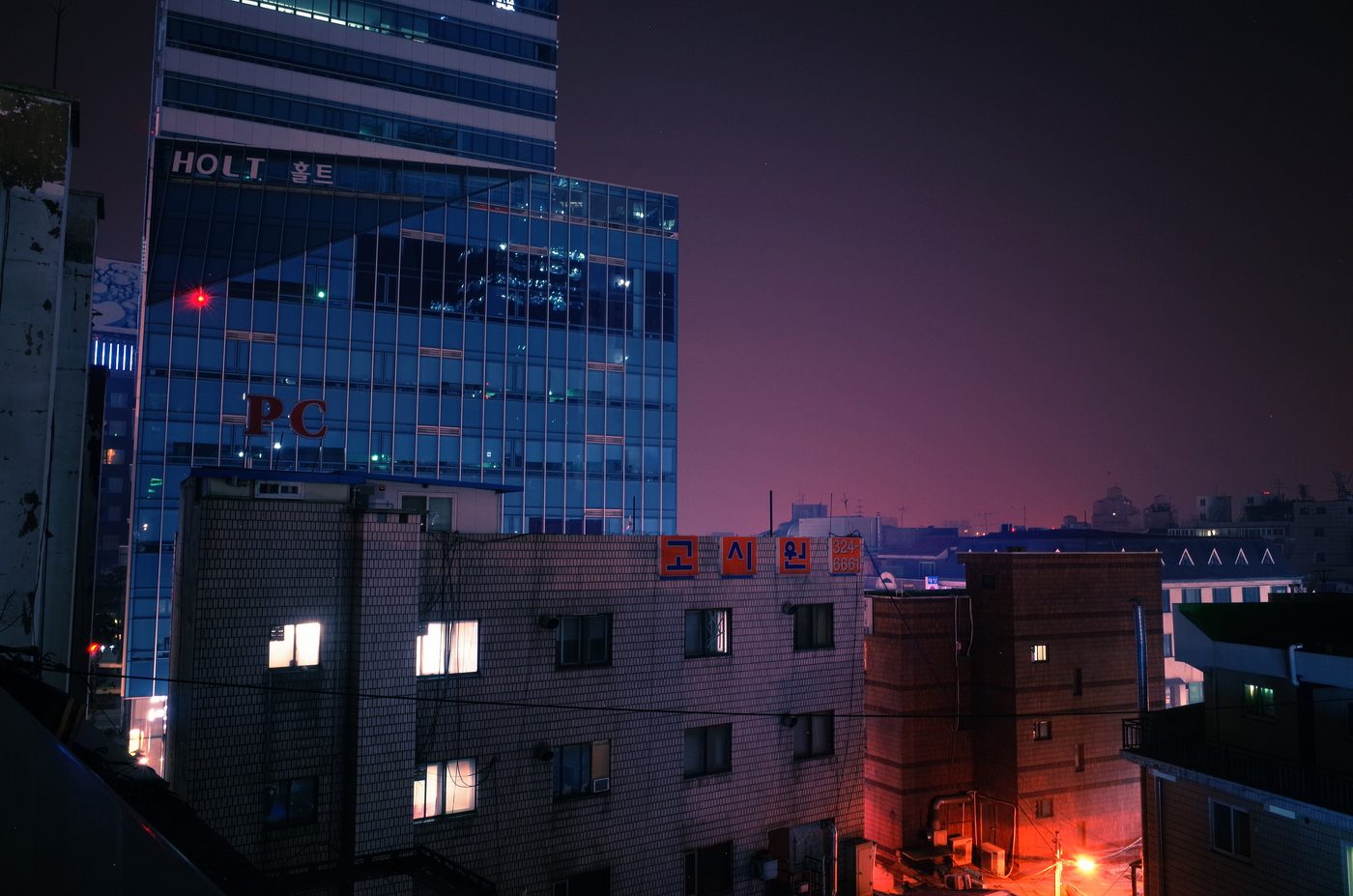
A goshiwon sign (고시원) on a residential building in Korea at night. Photo: Tony from Russia, Wikimedia Commons, CC BY 2.0 (2015).
What foreigners need to rent in Seoul and protect the deposit
A lease can be signed on a passport, and nothing in the Housing Lease Protection Act limits it to Koreans. What matters is what happens after signing.
- Alien Registration Card (외국인등록증). Required if you stay more than 90 days, and it is what gets you a Korean bank account (see our guide to paying in Korea) and the steps below. Most landlords want rent paid by bank transfer.
- Report your address (체류지 변경신고) within 15 days. At the community service centre (주민센터) or immigration office, free, with the lease. For a foreigner this counts as the move-in report (전입신고) that Koreans file: the Supreme Court ruled in 2016 (case 2015다14136) that alien registration and an address report give the same protection as a Korean resident registration.
- Get a fixed date (확정일자) on the lease. Stamped at the community centre. With the address report and actual occupation it gives your deposit priority over creditors registered after that date if the home is auctioned.
- File the lease report (임대차 신고) within 30 days if the deposit is over ₩60 million or rent over ₩300,000 a month, which covers almost every officetel. The grace period ended on 31 May 2025; late filing can be fined ₩20,000–₩300,000. Filing with the contract attached also gives the fixed date.
- Consider deposit insurance (전세보증금반환보증). HUG (주택도시보증공사) insures the return of a deposit of up to ₩700 million in the capital region, provided the deposit plus any prior mortgages is within 90% of the home's value; for villas that value is usually 140% of the official assessed price, so the deposit must be at or under about 126% of it. Bank and HUG guidance says foreign tenants with an alien registration card or residence card can apply through HUG's partner banks; ask the bank for its document list first.
Renewal rights. A lease runs at least two years (Article 4). The tenant can demand one two-year renewal, and the landlord can raise rent by no more than 5% (Articles 6-3 and 7).
Small-deposit priority (최우선변제). In Seoul, a tenant whose deposit is ₩165 million or less gets up to ₩55 million ahead of other creditors in an auction, under the thresholds in force since 21 February 2023 (older mortgages on the property use older, lower thresholds).
You might like: Korea's Digital Nomad Visa (F-1-D): 743 Issued, the New Income Bar, and What a Month in Seoul Costs
The honest part: deposit risk and what English guides get wrong
- The deposit is an unsecured loan to your landlord. Korea's jeonse fraud wave (전세사기) of 2022–2023 hit mostly villa and officetel tenants. The national officetel jeonse-to-price ratio was 86.04% in June 2026, close to HUG's 90% line; in Seoul the average jeonse (₩223 million) was 79% of the average sale price (₩281 million, EpicKor's calculation). Read the property register (등기부등본) before you pay, and walk away from a flat whose mortgages plus your deposit come near its value.
- Foreign landlords too. HUG data released to lawmaker Ahn Tae-jun in September 2026 counted 82 guarantee claims against foreign landlords from 2022 to August 2026, worth ₩17.8 billion; HUG had not recovered ₩6.7 billion of what it paid out.
- Set against a wage. The 2026 full-time minimum wage is ₩2,156,880 a month (₩2,236,300 from January 2027; minimum wage guide); the average Seoul officetel rent is 44% of it before fees, 42% of next year's.
- Pay the deposit to the owner named on the register, not to an agent's or relative's account.
- What English guides miss: most give unsourced ranges with no quarter; none we found cites the board's officetel average or the Seoul deposit behind it; Wikipedia's jeonse article cites 2014 prices; and few mention that the conversion cap rose from 4.5% to 5.0% with this summer's two rate rises, or that it does not bind a new lease.
- These are averages that mix old and new stock. A new officetel by Gangnam station will be well above ₩949,000; a hillside villa in Nowon well below ₩670,000.
FAQ
Q: How much is rent in Seoul per month in 2026? A: The Korea Real Estate Board put the average Seoul officetel at ₩949,000 a month on a ₩22.85 million deposit in June 2026, and the average apartment on wolse at ₩1,641,000 on a ₩195.65 million deposit in August. Small villa one-rooms averaged ₩670,000 on a ₩10 million deposit (Dabang, August 2026). A goshiwon room costs ₩400,000–₩600,000.
Q: What is the difference between jeonse and wolse? A: With wolse you pay a deposit, usually ₩5–20 million in Seoul, plus monthly rent. With jeonse you pay a single large deposit (₩223 million on average for a Seoul officetel) and no rent; the landlord returns it at the end. Banjeonse is the everyday name for a larger deposit with lower rent.
Q: What is the legal jeonse-to-wolse conversion rate in Korea? A: The lower of 10% a year or the Bank of Korea base rate plus 2 points. With the base rate at 3.00% since 27 August 2026, the cap is 5.0%. It applies when a deposit is converted during an existing lease or renewal; new leases are priced freely, and Seoul officetels changed hands at 6.06% in June 2026.
Q: Can foreigners rent an apartment in Seoul? A: Yes. You can sign on a passport, but register as a foreign resident (after 90 days), report your address within 15 days of moving in, get a fixed date (확정일자) on the lease, and file the lease report if rent is over ₩300,000 a month. Together these protect the deposit, and foreign residents can buy HUG deposit insurance.
Q: How much is the real estate agent fee in Seoul? A: Seoul caps it by deal value: 0.5% (maximum ₩200,000) under ₩50 million, 0.4% (maximum ₩300,000) up to ₩100 million, 0.3% up to ₩600 million, and 0.4% for residential officetels. For wolse the deal value is deposit plus rent × 100. On the average Seoul officetel lease the tenant's fee is at most about ₩471,000.
Sources
- Korea Real Estate Board (한국부동산원), 2026년 2분기 오피스텔 가격동향조사, released 15 July 2026 (reb.or.kr, R-ONE), as reported by Newspim and Nate News (15–17 July 2026): Seoul average rent ₩949,000 and deposit ₩22,851,000; national ₩811,000 and ₩16,570,000; Gyeonggi ₩850,000, Incheon ₩700,000; Seoul jeonse ₩223,137,000, sale ₩281,100,000; conversion rate 6.62% national, 6.06% Seoul, 9.05% Sejong; jeonse-to-price 86.04%; Seoul rent +0.90% (northwest 1.33%, southeast 1.12%).
- Korea Real Estate Board, 8월 전국주택가격동향조사, released 15 September 2026, as reported by Newsis via Financial News (25 September 2026): Seoul apartment wolse ₩1,641,000, deposit ₩195,650,000; all Seoul housing ₩1,313,000; wolse share 69.7% and apartments 52% (MOLIT filings, January–July).
- Ministry of Land, Infrastructure and Transport (국토교통부) real transaction system, first-half 2026 officetel wolse of ₩1 million or more (5,660), as reported 17 July 2026; Edaily analysis of January–July wolse share for villas and officetels (73.07%), 30 August 2026.
- Dabang (다방), 8월 다방여지도 (29 September 2026) and July university-area survey (reported by Money Today, 19 August, and Hankyung, 6 September 2026). Dailypop (데일리팝), August district analysis of 9,891 MOLIT deals.
- Edaily, goshiwon survey near Sinchon and Seoul National University (30 August 2026); Seoul Shinmun, Seoul City goshiwon counts (23 August 2026).
- Housing Lease Protection Act (주택임대차보호법) Articles 3, 4, 6-3, 7 and 7-2, and Enforcement Decree Articles 9–11 (law.go.kr); Supreme Court judgment 2015다14136, 13 October 2016.
- Bank of Korea base rate history (bok.or.kr): 2.50% (29 May 2025), 2.75% (16 July 2026), 3.00% (27 August 2026).
- Seoul ordinance on housing agent fees (서울특별시 주택 중개보수 등에 관한 조례), rate table as published by Yeongdeungpo-gu Office.
- Government24 (gov.kr), foreigner address-change report: within 15 days, free. MOLIT, housing lease reporting rules and end of the grace period on 31 May 2025. Korea.kr policy briefing, itemised management fees of ₩100,000 or more from 21 September 2023.
- HUG (khug.or.kr), jeonse deposit return guarantee product page; HUG data on foreign-landlord claims via Rep. Ahn Tae-jun (Financial News, 20 September 2026).
- English-language comparison, read 30 September 2026: English Wikipedia, "Jeonse"; krinsider.com, "Average Rent in Seoul 2026"; 90daykorean.com, "Cost of Living in Korea" (updated 24 August 2026).
You Might Also Like
Korea Health Insurance for Foreigners (2026): At Least ₩158,630 a Month After Six Months — Students, Workers, and What Happens If You Don't Pay
Foreigners in Korea are enrolled in national health insurance after six months and billed at least ₩158,630 a month in 2026. Students pay half, ₩79,320. A month behind and most foreigners lose cover until they pay; immigration shortens the visa extension.
Korea Minimum Wage 2027: ₩10,700 an Hour, ₩2,236,300 a Month — What Foreign Workers Are Owed and What They Actually Earn
Korea's 2027 minimum wage is ₩10,700 an hour, ₩2,236,300 a month on 209 hours (2026: ₩10,320). It covers every visa. The government's own survey: 36.9% of foreign wage workers earn ₩3 million+ a month, half earn ₩2–3 million.
Legal Age in Korea: Adult at 19, Drinking From 1 January of the Year You Turn 19, Voting at 18 — Every Age Limit in Korean Law
Korea's adult age is 19, but alcohol and cigarettes go by birth year: anyone born in 2007 could buy them from 1 January 2026. Voting and driving are 18, marriage 18 with parental consent, consent 16 — every age limit, with the Korean law article.