Why Koreans Live in Apartments: Korea's One-Generation Shift
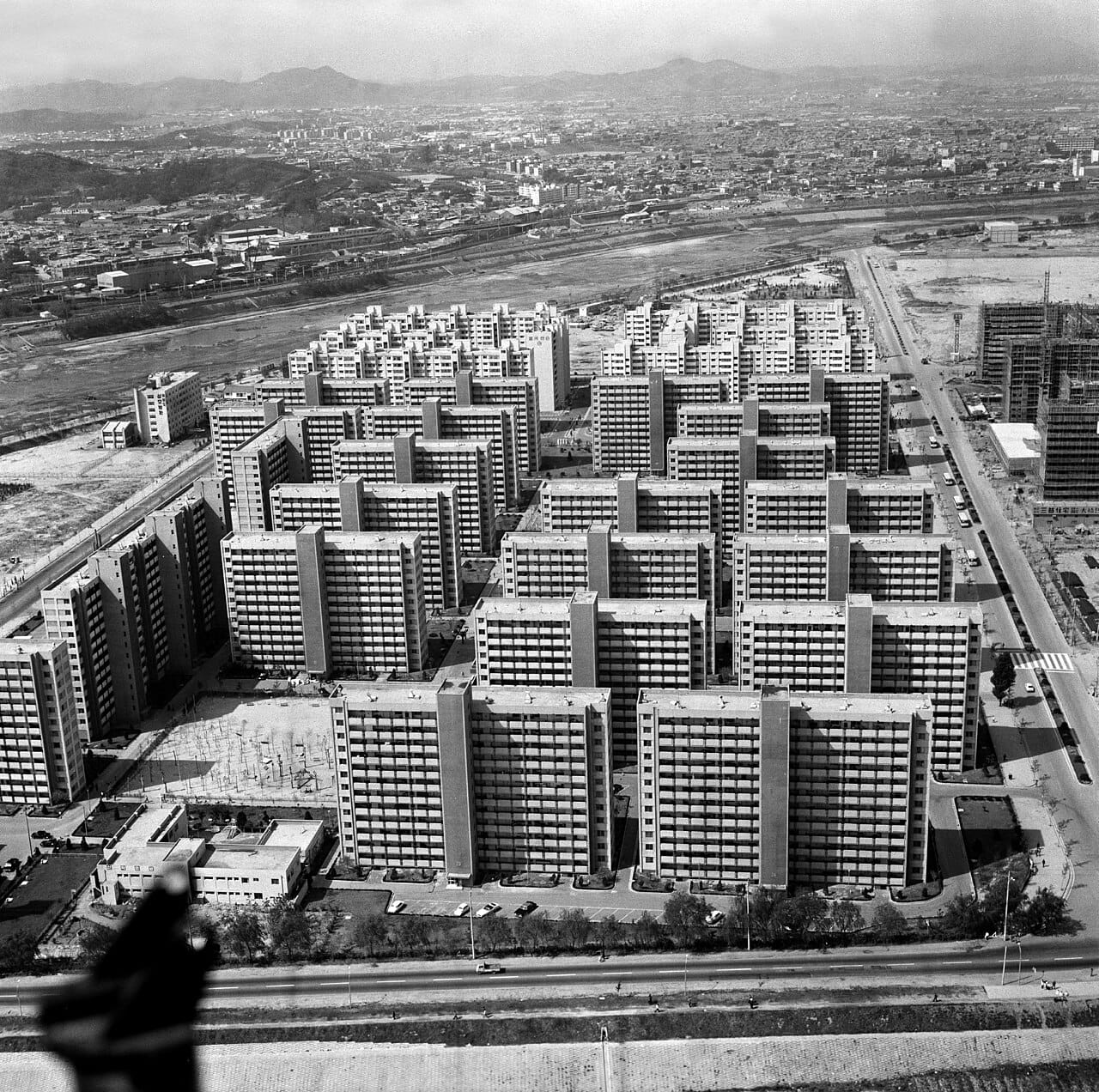
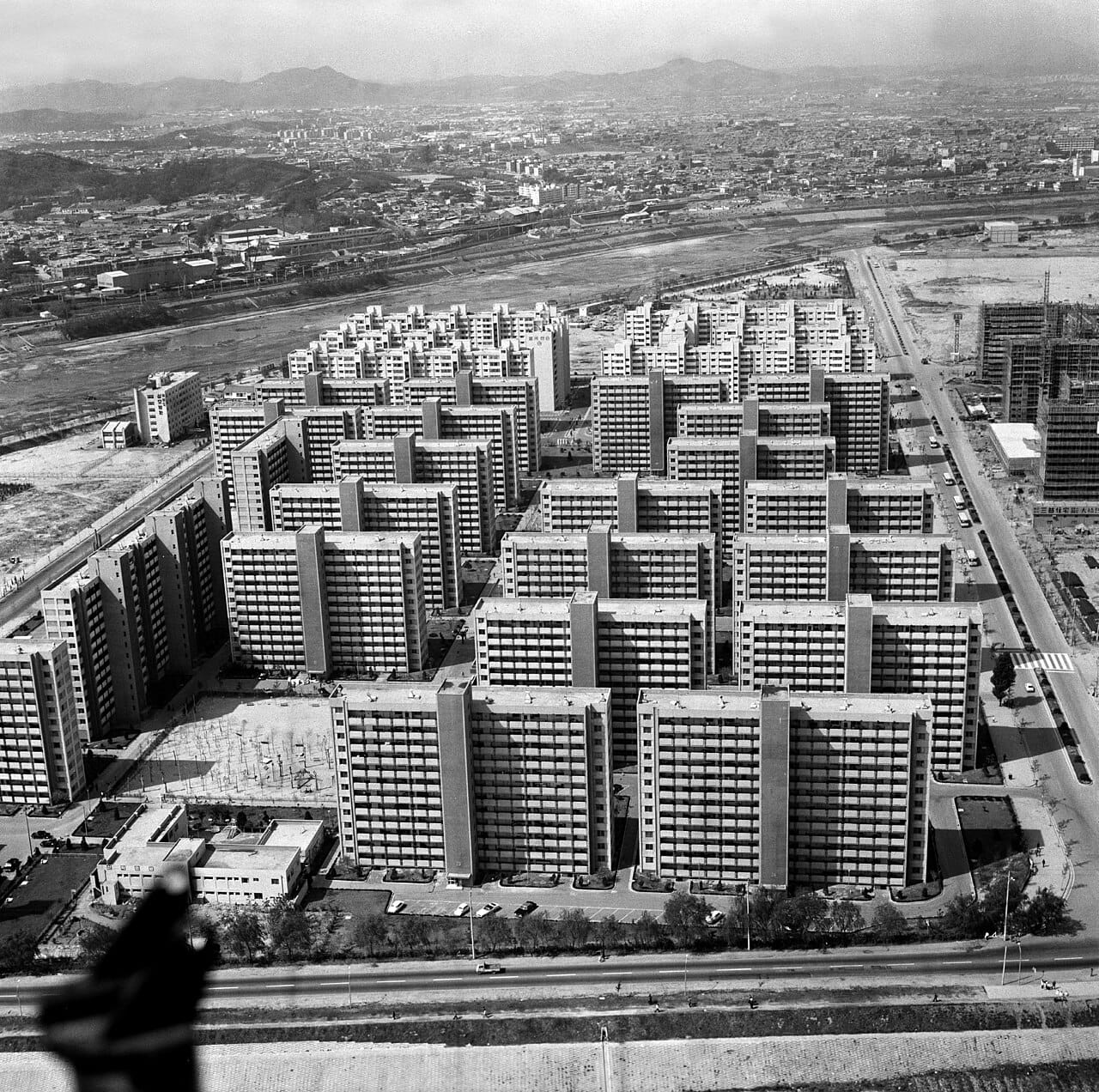
Yeouido, 10 May 1975. Identical blocks in rows, cranes still working at the right edge, and the old low-rise city behind. Photo: 한국정책방송원 (KTV), KOGL Type 1.
Most Koreans live in apartments, and the landscape says so before anyone tells you. Fly into Seoul and the view repeats in every direction: rows of near-identical high-rise blocks, numbered, arranged in complexes, stretching past the horizon. Visitors usually reach for the obvious explanation — Korea is crowded and mountainous, so it built upward.
That explanation is not wrong, but it is not the answer. Japan is comparably mountainous, its major cities are comparably dense, and it did not develop the same pattern.
The real answer is that Korea did not drift into apartments. It built them, deliberately, in about one generation, using a financing arrangement that made this specific building type the only thing that made sense to construct.
Here is the number that frames everything: in 1978, apartments were 5.2% of Korean homes. By 2015 they were 59.9%.
The Short Answer
| Year | Apartments as a share of Korean housing |
|---|---|
| 1978 | 5.2% |
| 1990 | 28% |
| 1996 | 34.4% — the year apartments passed detached houses (34.2%) |
| 2015 | 59.9% |
Korean-style storage organisers — compare on AmazonAffiliate link. As an Amazon Associate, EpicKor earns from qualifying purchases at no extra cost to you.
And in Seoul specifically:
| Year | Apartment share of Seoul housing |
|---|---|
| 1980 | 19.0% |
| 2000 | 50.9% |
| 2010 | 58.9% |
A country went from one-in-twenty to three-in-five in under forty years. That is not a slow adaptation to geography. Geography did not change in those forty years.
The Mechanism Nobody Explains: You Pay Before It Exists
This is the part that actually answers the question, and it is almost never in English coverage.
Korea buys apartments through 선분양 (seonbunyang) — pre-sale. You sign a contract based on drawings and a model unit, before construction begins. You pay a deposit, then instalments tied to construction progress, and you receive the apartment years later.
Look at what that does to the builder. The buyer is supplying the construction funds, interest-free, in advance. A developer can start a project worth hundreds of billions of won holding very little of its own capital, because the future residents are financing it.
Korea adopted this in the 1970s and 1980s precisely as the instrument of mass housing supply. It was not an accident of the market; it was the tool chosen for the job.
Why this selects for apartments specifically
Follow the logic and the building type falls out of it.
- You cannot pre-sell a house that is one of a kind. You can pre-sell unit 1204 in Block 3 because it is identical to unit 1104 and to a thousand others. Standardisation is what makes a drawing sellable
- The bigger the complex, the more buyers financing it, so scale is rewarded rather than penalised
- Uniformity reduces the buyer's risk of the finished thing differing from the drawing — which is the central risk of buying something that does not exist yet
- A detached house, custom-built, cannot be financed this way at all
So the financing system chose the building. Ask "why do Koreans live in apartments" and the honest answer is that for four decades, apartments were the form of housing Korea's system could actually finance and build at scale.
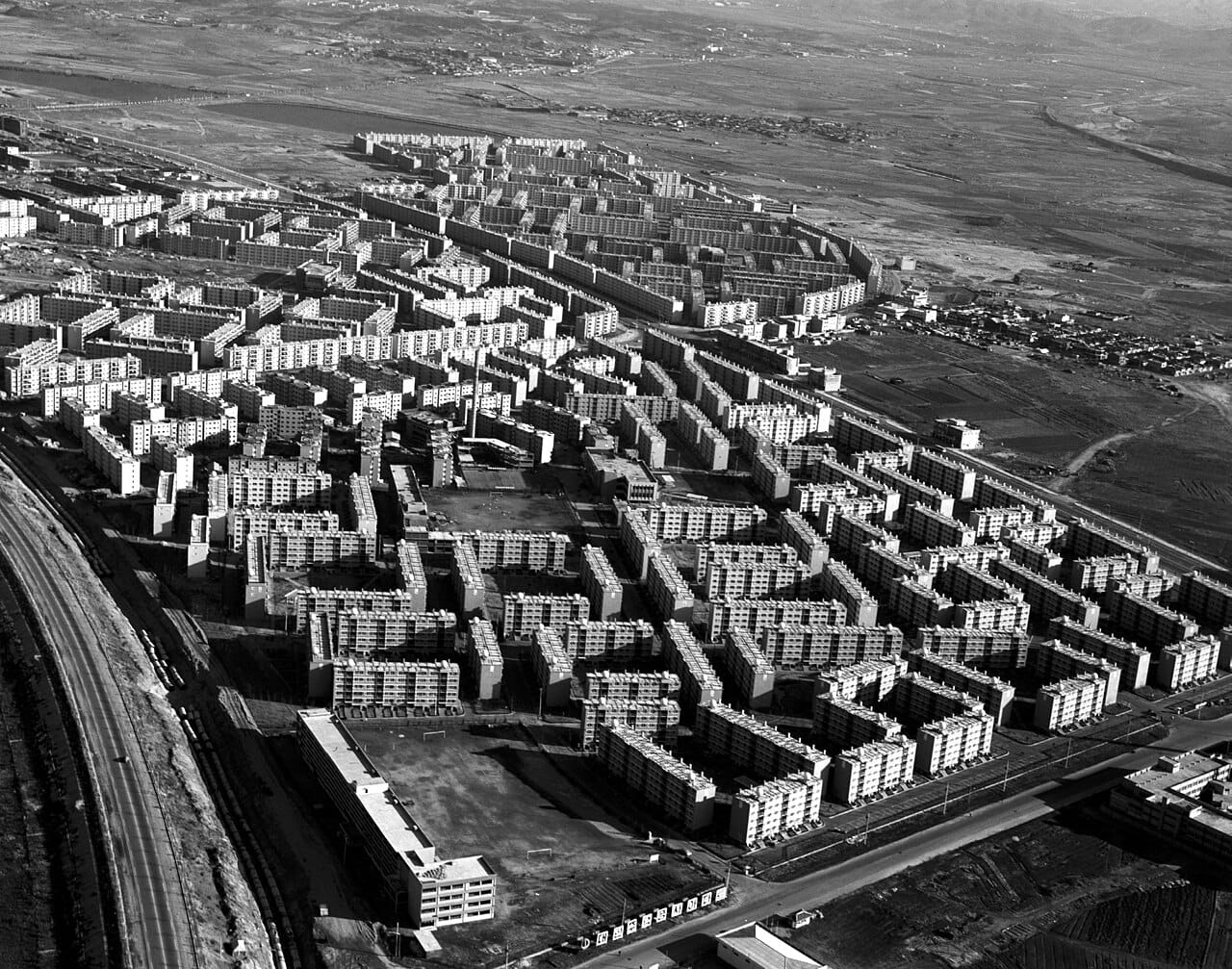
The Han River area, 29 November 1976. The same arrangement running out to bare earth. Photo: Government of the Republic of Korea, public domain.
The Policy Push That Made It National
The financing tool needed a reason to run at full speed, and the late 1980s supplied one.
Korea launched a two-million-home construction plan (주택 200만호 건설), and the capital region got five new towns built more or less from nothing — planned satellite cities, apartment-first by design.
That is why the 1990 number is 28% while 1978 was 5.2%. The apartment share more than quintupled in twelve years because the state set a supply target and the pre-sale system funded it.
By 1996, apartments passed detached houses in the national housing stock for the first time: 34.4% against 34.2%. A one-point gap sounds trivial, but it marks the year the default Korean home changed.
"Republic of Apartments"
The phenomenon is well enough recognised that it has a name, and it came from outside.
French geographer Valérie Gelézeau studied Seoul's apartment landscape and described Korea as an 아파트 공화국 — a "Republic of Apartments." The framing stuck in Korea and is still used in Korean media and academic writing.
What makes the observation sharp is that in France, and in much of Europe, large uniform apartment estates carry a connotation of public housing and social decline. In Korea they became the aspirational form. The same building type that reads as a compromise in one country reads as arrival in another.
The Other Half of the Financing: Jeonse
Pre-sale explains how apartments get built. 전세 (jeonse) helps explain how they get held.
Under jeonse, a tenant hands the owner a very large lump-sum deposit — historically a substantial fraction of the property's value — pays no monthly rent for the lease term, and gets the deposit back at the end. The owner's return is whatever they can do with that money in the meantime.
Read it as finance rather than as rent and the shape becomes obvious: jeonse is an interest-free loan from tenant to owner, secured against the home. It let owners acquire and hold property with less of their own capital, in exactly the same way pre-sale let builders build with less of theirs.
Two interest-free lending arrangements, stacked. Buyers financing construction at one end, tenants financing ownership at the other. That is a large part of how a country with limited household capital produced this much housing this quickly.
It also carries real risk, and Korea has been living through that. When property values fall below the deposit owed, owners cannot return deposits, and Korea saw a wave of failed jeonse refunds in the early 2020s serious enough to prompt a dedicated support law. If you are renting in Korea, this is the reason people advise 월세 (monthly rent) or 반전세 (part-deposit) over full jeonse for short stays — the exposure is the deposit, and it is large.
Korean home living note: As an Amazon Associate, EpicKor may earn from qualifying purchases. Apartment life here shapes how homes are organised — compare Korean-style storage organisers if the compact, everything-has-a-place approach is what appeals to you.
Compare on AmazonWhy Koreans Talk About Apartments Like Assets
Foreign visitors often notice that Korean conversation treats apartments the way other countries treat stocks. That is not materialism; it follows from the structure.
A standardised unit is a comparable unit. Because unit 1204 really is like unit 1104 and like thousands of others in similar complexes, apartments can be priced, indexed, compared and traded in a way that individual houses cannot. Korea effectively built a housing stock with the properties of a financial asset class.
Complexes age together, so they redevelop together. Enormous numbers of units were built in the same few decades, which means they reach redevelopment age in clusters. 재건축 (reconstruction) is therefore a permanent fixture of Korean news, and the possibility of it is priced into old buildings — which is why a visibly ageing complex in a good location can cost more than a newer one elsewhere.
Brand carries information. Construction-company brand names on complexes function as quality and status signals, which is why they are painted on the buildings in letters visible from a distance.
None of this is unique to Korea in kind. What is unusual is the degree, and the degree follows from having built most of the country's homes as interchangeable units inside one financing system.
Why Are Korean Apartments So Small?
A common follow-up, and the answer is again policy rather than land.
Korean housing policy has long used a standard-size threshold — 국민주택규모, national housing scale, set at 85㎡ of exclusive floor area. Units at or below that line have historically been the target of public support, preferential financing and tax treatment.
When one size is the size the system favours, builders build a great many of it. That threshold shaped the Korean apartment's proportions for decades.
Two things worth knowing if you are comparing listings:
- Korean floor area is quoted as 전용면적 (exclusive area) — your actual private space — separately from shared corridors and lobbies. A listing's headline number may be the larger, supply-area figure, so check which one you are reading
- Koreans still talk in 평 (pyeong), an older unit of about 3.3㎡. "34평" is roughly 112㎡ of supply area. You will hear this constantly even though official documents use square metres
You might like: Living in Korea as a Foreigner: Social Rules Nobody Explains
What This Means If You Are Here
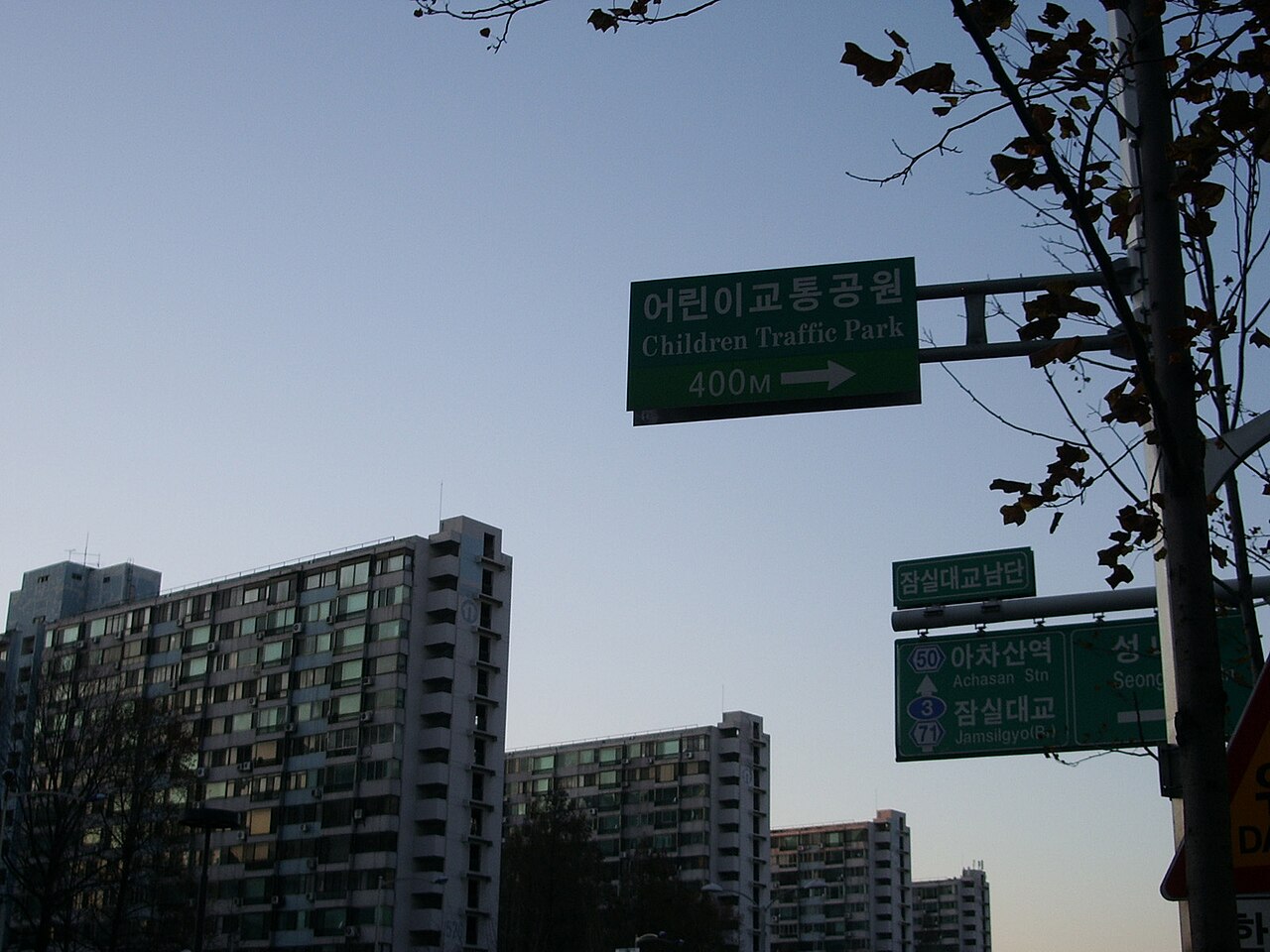
Jamsil, at street level. The same form, still the default. Photo by InSapphoWeTrust, CC BY-SA 2.0.
Understanding the history changes how a few everyday things read.
Apartment complexes are addresses, not just buildings. Koreans navigate by complex name, building number and unit — and the brand of the complex carries social information the way a neighbourhood does elsewhere.
A complex is a serviced environment. Most include their own playgrounds, gyms, parcel handling, waste separation rooms and often a small shop. This is a consequence of building at complex scale rather than house scale, and it is why living in one is genuinely convenient.
Rebuilding is a national conversation. Because so much stock was built in the same decades, large numbers of complexes reach redevelopment age together, and 재건축 is a permanent feature of Korean property news.
And the uniformity is not a failure of imagination. It is the visible trace of a country that had to house a rapidly urbanising population fast, and found a financing method that could do it.
Understanding Korean cities: If the policy and history side interests you more than the interiors, compare books on Seoul and Korean urban development — this post covers one mechanism, and the literature covers the rest.
Compare on AmazonFAQ About Korean Apartments
Q: Why do most Koreans live in apartments?
A: Because Korea deliberately built them at scale over about one generation. Apartments were 5.2% of Korean homes in 1978 and 59.9% by 2015. The driver was a pre-sale financing system that let buyers fund construction in advance, combined with state supply targets like the two-million-home plan and the capital-region new towns.
Q: Is it just because Korea is crowded and mountainous?
A: That is a contributing factor, not the cause. Geography did not change between 1978 and 2015 while the apartment share went from 5.2% to 59.9%. Other dense, mountainous countries did not develop the same housing pattern.
Q: What is the pre-sale system?
A: 선분양 (seonbunyang) means buying an apartment from drawings and a model unit before construction starts, paying instalments as building progresses. It supplies builders with interest-free construction funding from future residents, which is why large standardised complexes are financially feasible and one-off houses are not.
Q: Do Koreans live in apartments or houses?
A: Predominantly apartments — they passed detached houses in the national housing stock in 1996, at 34.4% against 34.2%, and the gap has widened since. Detached houses, villas and officetels all still exist, but the apartment is the default.
Q: Why are Korean apartments so small?
A: Korean housing policy has long favoured units at or below 85㎡ of exclusive floor area, the national housing scale threshold, through financing and tax treatment. Builders built to the favoured size. Also check which figure a listing quotes, since exclusive area and supply area differ.
Q: What does "Republic of Apartments" mean?
A: It is a translation of 아파트 공화국, a description of Korea's apartment landscape associated with the French geographer Valérie Gelézeau. It stuck in Korea partly because it captures something unusual — large uniform estates read as aspirational here, where in much of Europe they do not.
The One Thing to Remember
5.2% to 59.9% in under forty years.
Korea did not end up an apartment country because it ran out of room. It became one because it chose a way to finance housing — buyers paying for buildings that did not exist yet — and that method only works for large numbers of identical units.
The view from the plane is not the shape of the land. It is the shape of the financing.
Sources and Further Reading
- Korean housing statistics on apartments as a share of national housing stock: 5.2% in 1978, 28% in 1990, 34.4% in 1996 against 34.2% for detached houses, and 59.9% in 2015
- Seoul-specific apartment share figures: 19.0% in 1980, 50.9% in 2000, 58.9% in 2010
- Korean coverage of the 선분양 pre-sale system, adopted in the 1970s–1980s as the financing instrument for mass housing supply, and how it provides builders with interest-free construction funding from buyers
- Korean coverage of the two-million-home construction plan and the capital-region new towns
- Valérie Gelézeau's characterisation of Korea as an 아파트 공화국 and its reception in Korean discussion
- Image sources and licensing are documented in this post's
image-sources.md
You Might Also Like
Why Do Koreans Stare at Foreigners? The 5% Country, and Where the Looking Actually Happens
In central Seoul nobody looks at you. In a provincial market, a small town or a subway car of grandmothers, they do. Korea only became a 5%-foreign country in 2025. Where the staring happens, what it means and does not mean, and what to do with it.
Why Koreans Seem Cold to Foreigners: The Gap Between How Korea Sees Itself and How You See It
Foreigners abroad rate Korea 82.3% favourable. Foreigners living in Korea rank Koreans 39th of 46 countries for friendliness, and 84% of Koreans say they would not trust a stranger. Where the gap comes from, and how to get to the other side of it.
Why Korea Is Watching the 2026 World Cup Over Brunch
A guide to Korea's 2026 World Cup brunch watch culture: why morning kickoffs changed street cheering, what to expect, and how visitors can join.