Korea Garbage Bags and Recycling (2026): The ₩490 Bag, Which Nights to Put Rubbish Out in Seoul, and the ₩100,000 Fine
Last updated: 5 October 2026. Prices come from Seoul's district price table and Mapo-gu's live waste page (updated April 2026). Fines come from the Enforcement Decree of the Wastes Control Act, and put-out times from each district's own page. Rules differ by district, so check yours using the steps at the end.
If you are renting a flat, staying a month in an Airbnb or moving to Korea for work, rubbish is the first Korean system you have to get right, and it is the one most likely to get you a note on your door. Korea charges for household waste by the bag (종량제, jongnyangje, "pay as you throw"). Food waste goes separately, recyclables are sorted by material, and you can only put it all out on certain nights.
This is the practical version for 2026: what the bags cost, what goes in which, which nights your district collects, and the fines. It is the follow-up to our guide Why Are There No Trash Cans in Korea?, which covers rubbish on the street. This one covers rubbish at home.
Reading 일반쓰레기 and 음식물 on a bag or a bin: Lonely Planet Korean Phrasebook on AmazonAffiliate link. As an Amazon Associate, EpicKor earns from qualifying purchases at no extra cost to you.
Quick Guide: Rubbish in Seoul, 2026
| Question | Answer |
|---|---|
| General rubbish bag (종량제봉투), 20 L | ₩490, the same in all 25 Seoul districts, unchanged since January 2017 |
| Other sizes | 5 L ₩130 · 10 L ₩250 · 50 L ₩1,250 · 75 L ₩1,880 (not in every district) |
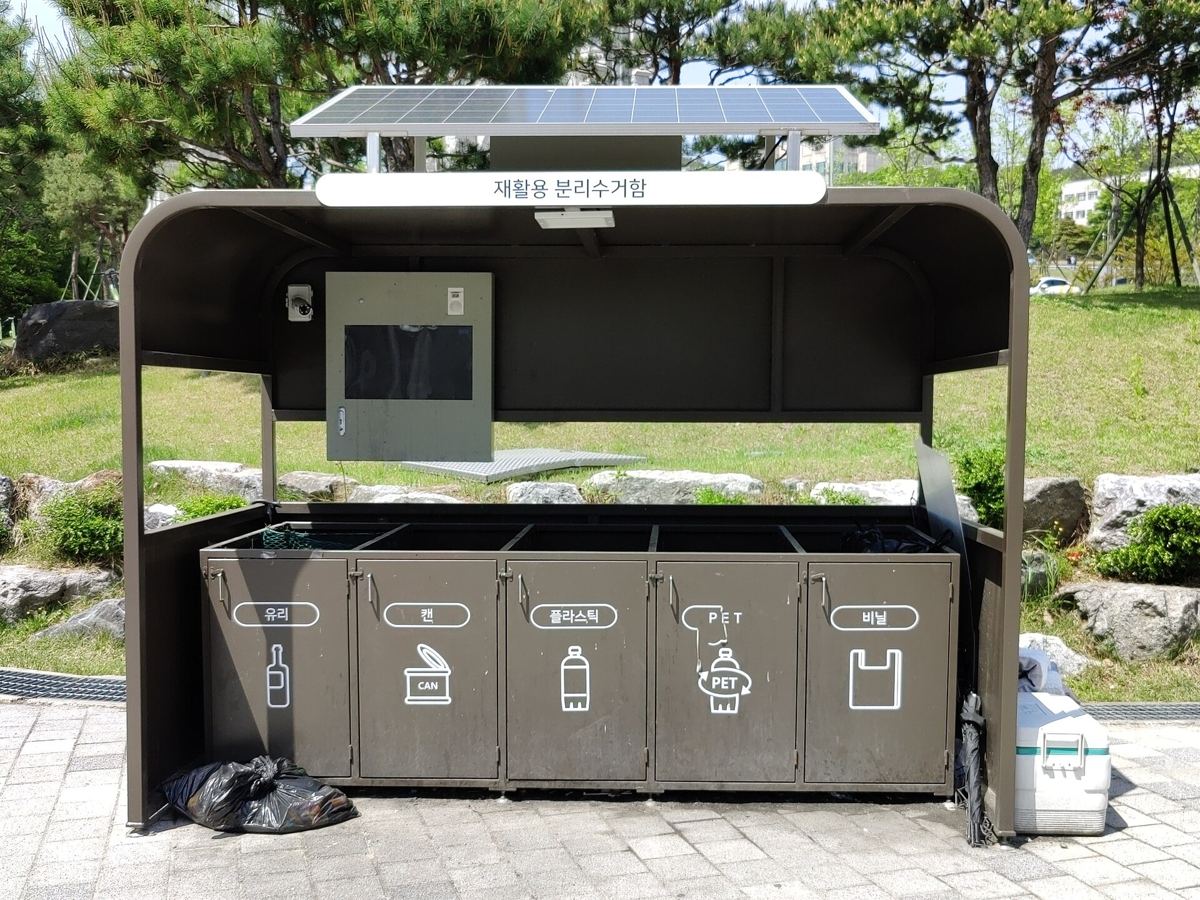
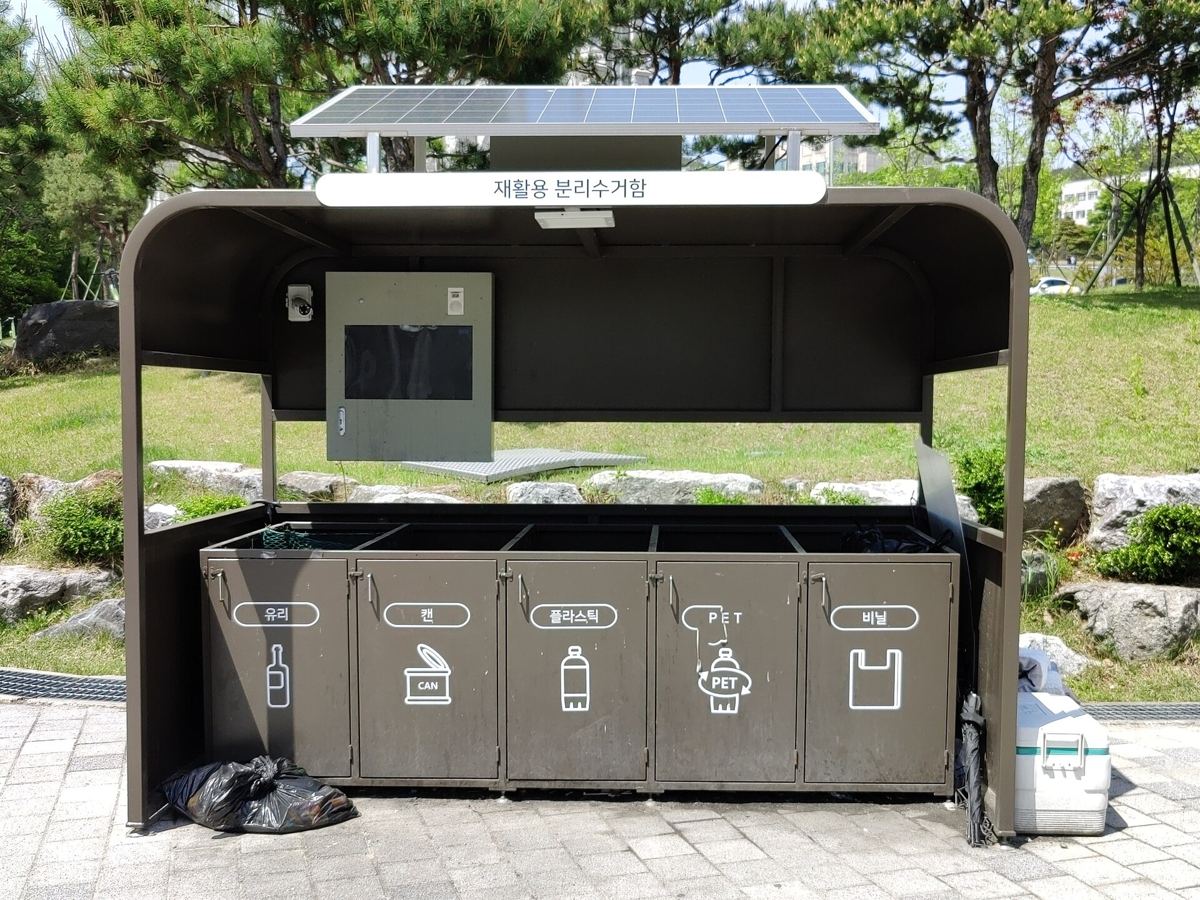
| Where to buy | Convenience stores and supermarkets with a "쓰레기봉투판매소" sign. Buy your own district's bag |
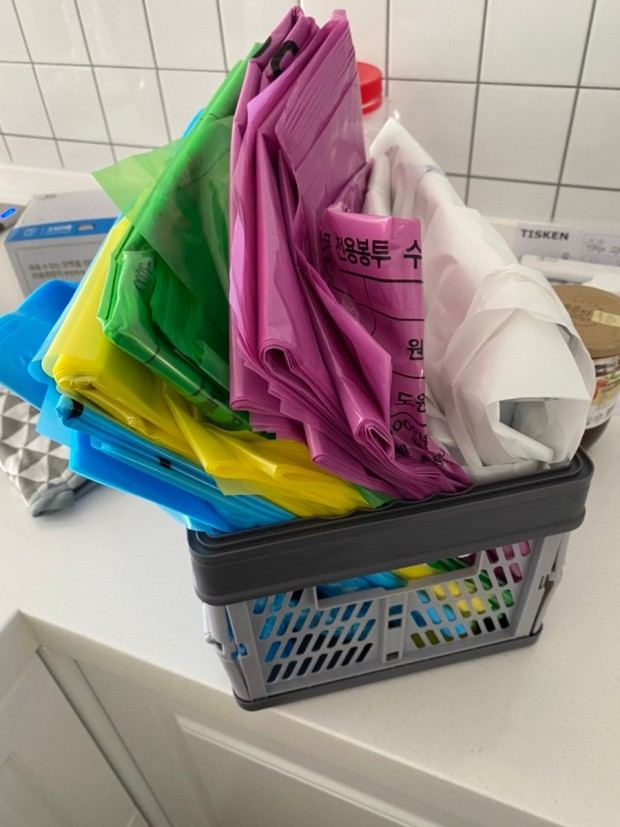
| Food waste | Separate yellow food-waste bag (2 L about ₩190–200), or an RFID bin in apartment blocks |
| Recyclables | Free. Sort by material into clear bags; clear PET bottles go separately, labels off |
| When to put it out | After sunset, in front of your own building, on your district's nights only (e.g. Mapo not Fri/Sat; Gangnam Mon–Fri) |
| Fine for wrong bag, mixing or wrong time | ₩100,000 first time, ₩200,000 second, ₩300,000 third (within a year) |
| Fine for dumping a bag of rubbish | ₩200,000. Legal ceiling ₩1,000,000 |
| Big items (chair, mattress) | Book online or at the community centre, pay a small fee (single mattress ₩5,000 in Gangnam) |
The bag: ₩490 everywhere in Seoul, but it has to be your district's
Every household rubbish bag in Seoul is a volume-rate bag (종량제봉투, jongnyangje bongtu). The price of the bag is the collection fee. You do not pay a separate bin charge. Seoul's district price table lists the same prices in all 25 districts:
| Size | Seoul price | What it holds |
|---|---|---|
| 5 L | ₩130 | A studio's bathroom bin |
| 10 L | ₩250 | Two or three days for one person |
| 20 L | ₩490 | The standard household size |
| 50 L | ₩1,250 | A move-in or move-out |
| 75 L | ₩1,880 | Not sold in Seongdong, Gwangjin, Seongbuk, Seocho or Gangnam |
Source: Seoul Metropolitan Government, district price table (September 2023, the latest published), matching Mapo-gu's live page in April 2026.
The 20 L bag has been ₩490 since January 2017. Before that it rose from about ₩363 in 2014 in two steps. For comparison, the same 20 L bag costs ₩850 in Busanjin-gu, Busan, so Seoul is one of the cheaper places in Korea.
The price is the same, but the bag is not interchangeable. Each district prints its own bags under its own ordinance, so buy your district's bag at a nearby convenience store or supermarket; look for the 쓰레기봉투판매소 sign. Busanjin-gu's rules show how strict this is: if you move in from outside Busan, your old bags need a transfer sticker (전입스티커) from the community centre within a month. If you change district within Seoul, ask your new community centre before using up old bags.
Why the price may not stay at ₩490. On 1 January 2026, Seoul, Incheon and Gyeonggi stopped burying household rubbish directly in landfill, except in emergencies, as planned and without a delay. No new incinerators were ready in time. Districts including Gangnam, Songpa, Seongdong, Yeongdeungpo and Jung now pay private incinerators in other provinces about ₩181,000 a tonne, against ₩131,000 at public plants. In March 2026, a naphtha shortage linked to the Middle East set off a run on bags, and Seoul asked residents to buy normal amounts. Seoul says the price is set by ordinance, and it held at ₩490. The press calls a rise inevitable, but none has been announced.
Epica stainless countertop compost bin (1.3 gallon): somewhere for food waste to wait Food waste can only go out on your district's nights, and in summer two days on the counter in an open bag is enough to fill a studio with smell. A lidded caddy with a charcoal filter keeps it shut until the night, then you tip it into the yellow bag or the apartment's RFID bin. As an Amazon Associate, EpicKor earns from qualifying purchases at no extra cost to you.
See the Epica compost bin on AmazonYou might like: How Much Is Rent in Seoul, Korea? The Official Numbers, the other bill you'll set up in your first week.
Food waste: the "could an animal eat it?" rule, and its exceptions
Food waste (음식물쓰레기) is collected separately and turned into feed and compost. Mapo-gu bans food in the general bag. There are two ways to put it out:
- A food-waste bag, usually yellow. In Mapo, 1 L costs ₩100, 2 L ₩190, 3 L ₩300 and 5 L ₩500; in Gangnam it is ₩100 a litre. Buy it where you buy rubbish bags.
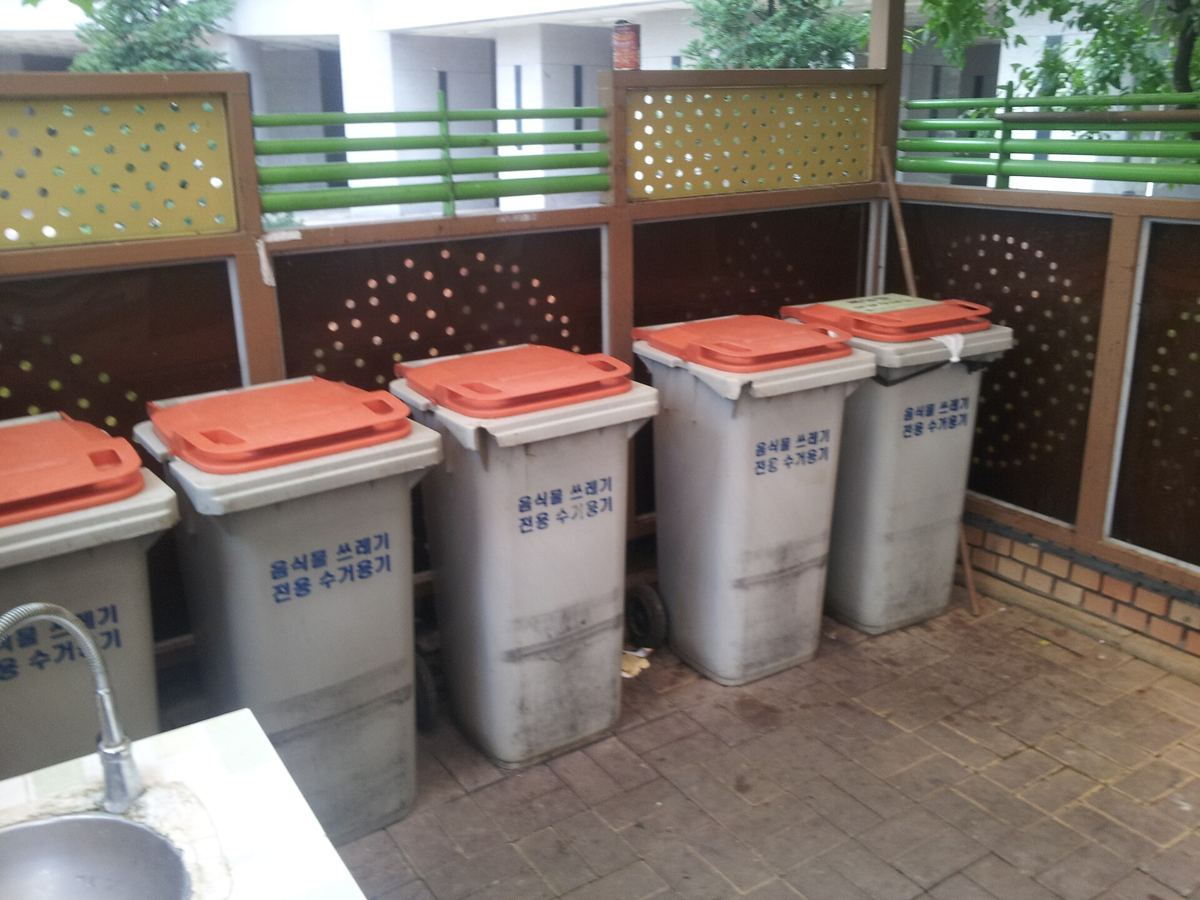
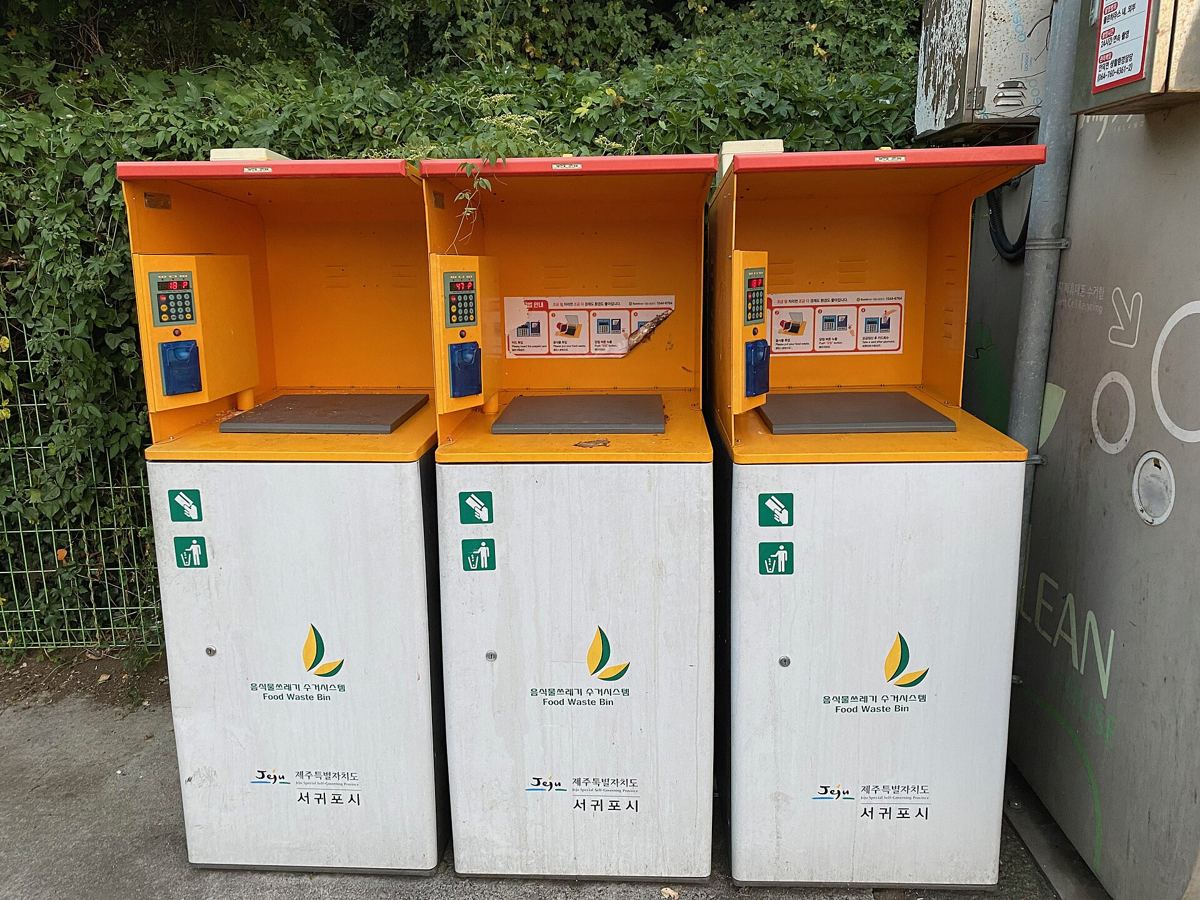
- An RFID bin, in most apartment blocks. You tap a card, the bin weighs what you tip in, and the fee goes on your management bill. Mapo requires them in apartment complexes; in Gangnam, apartments with RFID bins use no bag. Just tip in the food.
The rule of thumb Mapo gives is: if an animal could eat it, it is food waste. Seoul's standard then lists exceptions that catch out almost everyone. These go in the general bag, not the food bag:
| Looks like food, but goes in the general bag | Why |
|---|---|
| Bones: beef, pork, chicken (so: fried-chicken bones) | Animals can't eat them safely |
| Eggshells (chicken, duck, quail) | Too hard |
| Shells: clams, mussels, oysters, crab, crayfish; fish bones | Too hard |
| Fruit stones (peach, apricot, persimmon), walnut and chestnut shells, pineapple skin | Too hard |
| Onion, garlic and ginger skins; green-onion roots; corn husks | Fibrous |
| Chili seeds | The capsaicin spoils compost |
| Tea bags and tea or herbal-medicine dregs | Not feed |
Source: Seoul's food-waste standard (2022, updated August 2025). Not every district has adopted it word for word, so check your district's page for edge cases.
Drain the liquid first, rinse very salty food such as kimchi before it goes in, and cut up large vegetables. Busan is stricter on bones: there they go in the yellow non-burnable sack, not the general bag. Seoul translated its food-waste standard into 10 languages, including English, Chinese, Vietnamese and Japanese, because districts with many foreign residents were seeing fines and neighbour disputes. Ask your community centre (주민센터) for a copy.
Recyclables: free, but sorted by material
Recycling costs nothing. You don't need a special bag, just sort by material and put it out in clear or see-through bags. Mapo bans black bags for recyclables.
- Clear PET bottles go separately. Remove the label, crush the bottle and put the cap back on. Put them in a clear bag of their own. This has been compulsory in apartments since 25 December 2020 and in houses since 25 December 2021. Coloured PET goes with other plastics.
- Vinyl and film (snack and ramyeon wrappers, delivery bags, bubble wrap) go in a clear bag even if slightly dirty. Cling film, rubber gloves and hoses go in the general bag.
- Paper and cardboard: remove tape. Receipts, delivery waybills, foil-lined cool boxes and double-coated cups go in the general bag.
- Cans: empty them. Vent butane and spray cans outdoors, then pierce them. Aluminium foil goes in the general bag.
- Glass: remove the cap and rinse. Soju and beer bottles carry a deposit you can get back at the shop, so don't throw money away.
- Plastics that are not packaging (toys, hangers, toothbrushes, CDs) go in the general bag. Suitcases, umbrellas and strollers count as large items.
- Batteries and fluorescent tubes go in the collection boxes at community centres and apartment blocks.
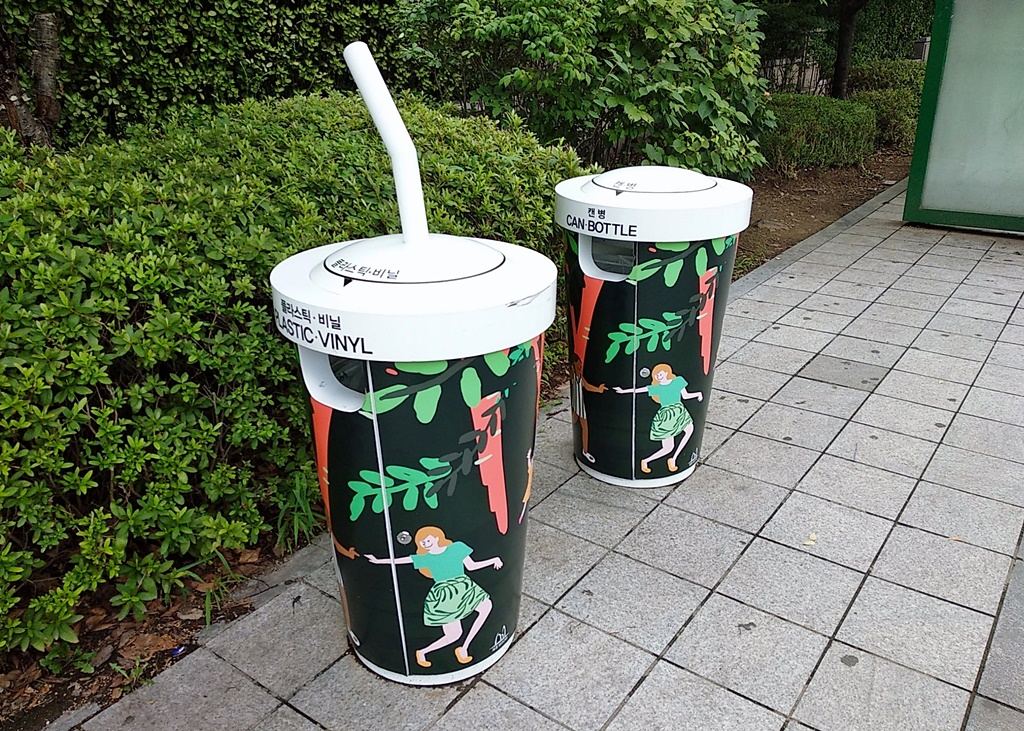
Since 5 September 2025 the environment ministry has run 분리배출.kr, a lookup that tells you how to put out about 730 items under your local rules. It is in Korean, but you can paste an item name and read the answer with a translation app.
Which nights: the part every district does differently
This is where newcomers get their first warning note. The rule is the same everywhere: after sunset, in front of your own building or shop, not at a corner or a lamppost. But the nights and hours differ by district:
| District | Nights | Hours | Notes |
|---|---|---|---|
| Mapo (Hongdae, Mangwon, Yeonnam) | Sunday–Thursday. Not Friday or Saturday | 19:00–24:00 (Apr–Oct), 18:00–24:00 (Nov–Mar); houses preferably before 22:00 | Clear PET and vinyl on Wednesday only |
| Yongsan (Itaewon, Haebangchon) | Sunday–Friday. Not Saturday or the day before a public holiday | Alleys 18:00–24:00; main roads 22:00–01:00 | Clear PET and vinyl on Thursday |
| Gangnam | Monday–Friday | 20:00–05:00 the next morning | — |
| Seocho | Set by neighbourhood | 18:00–01:00 the next morning | Check your dong's day |
Sources: each district's waste page (Mapo, updated April 2026; Yongsan; Gangnam; Seocho).
Apartments run their own schedule. Most complexes have a recycling area and set days, posted by the lift or the security office, and your management office is the place to ask. If you are in a villa or a one-room building, ask your landlord or a neighbour which nights the street is collected. In an Airbnb, the host's house manual should say. If it doesn't, ask before your first night: a bag left out on Friday in Mapo will sit there all weekend.
The fines: ₩100,000 is the usual one
The Wastes Control Act caps fines at ₩1,000,000, and its Enforcement Decree (Annex 8) sets the actual amounts:
| What you did | Fine |
|---|---|
| Household: wrong bag, food or recyclables mixed into the general bag, or put out on the wrong day or at the wrong time | ₩100,000 first time · ₩200,000 second · ₩300,000 third (within 12 months) |
| Dumping household rubbish in a plain plastic bag or wrapped in cloth | ₩200,000 |
| Dropping a cigarette butt or tissue | ₩50,000 |
| Dumping rubbish from a car or handcart | ₩500,000 |
| Burning household rubbish | ₩500,000 |
| Renovation debris not in the special sack (Mapo) | Up to ₩1,000,000 |
Honest mistakes can be cut in half. The decree lets the district reduce a fine by up to half for minor negligence that you fix straight away. If you get a warning sticker on a bag, re-sort it the same night.
Enforcement is real. Drop-off points often have CCTV, and neighbours are paid to report you: Mapo pays ₩10,000 per reported dumping case that leads to a fine, up to ₩200,000 per person a month. Of the 2,438 separate-discharge violations caught nationwide between 2019 and August 2023, 1,487 (61%) were in Seoul, and Seoul fined 1,480 of them. Those figures cover only sorting violations, not dumping.
Broken glass, big items and moving out
- Broken glass: wrap a small amount in newspaper and put it in the general bag. Larger amounts, plus ceramics, mirrors, plate glass and heat-resistant glass, go in the special non-burnable sack (특수규격 마대): 20 L ₩2,040, 50 L ₩5,100 in Mapo. Gangnam puts cat litter and shoes in the same sack.
- Large items (대형생활폐기물): book on your district's website or at the community centre, pay, write the booking number on the item and put it out on the given day. Gangnam's fees: chair ₩2,000, office chair ₩4,000, single mattress ₩5,000, double ₩8,000, 3-seat sofa ₩7,000. Book at least three days ahead.
- Fridges, washing machines, air conditioners and TVs are collected free by the national appliance service (1599-0903, or www.edtd.co.kr).
What to do in your first week
- Find your district (구) and neighbourhood (동) on your lease or Airbnb listing.
- Search "[district name] 쓰레기 배출 요일", for example "마포구 쓰레기 배출 요일", or ask your community centre, building manager or host which nights apply.
- Buy your district's 20 L bag (₩490) and food-waste bags at the nearest convenience store.
- Set up three containers at home: general, food, and a bag for recyclables. Keep clear PET bottles separate.
- Put everything out after sunset on the right nights, in front of your own building.
You might like: Living in Seoul for a Month, and for long stays, Korea's Digital Nomad Visa.
Frequently Asked Questions
Q: How much is a garbage bag in Seoul? A 20-litre general-waste bag (종량제봉투) costs ₩490 in all 25 Seoul districts, a price unchanged since January 2017. A 10 L bag is ₩250 and a 50 L bag ₩1,250. Food-waste bags are separate, about ₩190–200 for 2 litres.
Q: Can I use a garbage bag from another district? Bags are issued by each district under its own ordinance, so use your own district's bag. If you move, ask your new community centre. In Busanjin-gu, Busan, bags brought from outside Busan need a transfer sticker within a month of moving in.
Q: What day can I put out rubbish in Seoul? It depends on the district. Mapo collects Sunday to Thursday nights, Yongsan Sunday to Friday (not Saturday or the eve of a public holiday), and Gangnam Monday to Friday between 20:00 and 05:00. Always after sunset, in front of your own building. Apartments set their own days.
Q: Are eggshells and chicken bones food waste in Korea? No. In Seoul they go in the general bag, along with shells, fruit stones, onion skins, chili seeds and tea bags. The rule of thumb is "food waste is what an animal could eat," but those items are on the official list of exceptions.
Q: What is the fine for putting rubbish out wrong in Korea? For a household, ₩100,000 for a first offence of using the wrong bag, mixing or putting it out at the wrong time, rising to ₩200,000 and ₩300,000 for repeats within a year. Dumping a bag of rubbish is ₩200,000, and the legal maximum is ₩1,000,000. Districts may cut a fine by up to half for a minor mistake you fix at once.
Q: Will Seoul's garbage bag price go up in 2026? It has not yet. The landfill ban that began on 1 January 2026 has raised districts' costs, and bags were hoarded in March 2026, but Seoul held the 20-litre bag at ₩490. Any rise would need a change to each district's ordinance.
Sources
- Seoul Metropolitan Government, 생활폐기물 종량제봉투 가격 현황 (자치구별), September 2023: news.seoul.go.kr; Seoul's sorting standard, 6 August 2025: news.seoul.go.kr; food-waste standard, 25 March 2022: Seoul Media Hub; food-waste standard in 10 languages: news.seoul.go.kr.
- Mapo-gu waste page (prices, nights, fines, rewards), updated 24 April 2026: mapo.go.kr. Gangnam-gu food-waste page: gangnam.go.kr; large-item fees: clean.gangnam.go.kr. Seocho-gu fine table: seocho.go.kr. Busanjin-gu bag prices and transfer rule: busanjin.go.kr.
- Wastes Control Act, Articles 8, 15 and 68, and Enforcement Decree Annex 8 (fine schedule): law.go.kr.
- Ministry briefing on the capital-area landfill ban from 1 January 2026: korea.kr, 5 December 2025; private incineration costs: Financial News, 4 January 2026; March 2026 bag hoarding: News1, 25 March 2026.
- Separate-discharge fines 2019–2023: eToday.
You Might Also Like
Jeju Buses, Korea (2026): ₩1,150 a Ride, the 600 and 601 Airport Buses to Jungmun, Foreign Cards That Tap, and Getting Around Without a Rental Car
A Jeju bus ride still costs ₩1,150 by card: the fare rise was frozen again for 2026. Since August 2025 foreign Visa cards tap to pay, a first in Korea. And the 601, not the 600, drives into the Jungmun hotels. Fares, routes, times.

New Year Sunrise in Korea 2027: The 1 January Sunrise Times at Jeongdongjin, Homigot, Ganjeolgot, Haeundae, Seongsan and Seoul, and How to Get There Before 07:31
The first sunrise of 2027 reaches mainland Korea at 07:31 at Ganjeolgot, not famous Jeongdongjin (07:39). No Seoul train arrives in time any more, 300,000 people packed Gangneung last year, and on Jeju the sun usually hides. Times, crowds, trains and a plan.
Buying a Long Padded Coat (롱패딩) in Korea, Winter 2026: Real Prices from ₩49,900 to ₩469,000, Duck vs Goose Labels, Tax Refund and When You Actually Need One
Buying a long padded coat in Korea this winter: as of October 2026 a polyester one is ₩49,900, an 80/20 down bench parka ₩218,390, outdoor brands ₩279,000 to ₩329,000 after 30–40% cuts. How to read the label, the tax refund, sizes.