Korea Winter Electricity and Gas Bills (2026–27): Why January Costs More Than August, and What a Seoul Flat Pays
Last updated: 7 October 2026. Electricity rates come from KEPCO's own residential tariff page, the levy rate from the Enforcement Decree of the Electricity Business Act, gas from Seoul City's public-price page (1 September 2026), and district heating from Korea District Heating Corp.'s tariff (from 1 July 2024). The worked bills are our own arithmetic, and every assumption is stated next to it. The next rate decision covers January–March 2027 and is due in late December.
Your Korea winter electricity bill and your heating bill follow two different sets of rules, and most English guides only give you a range ("₩60,000 to ₩250,000") without explaining either. If you rent a one-room, an officetel or an apartment in Seoul, here is how both bills are built, using the official 2026 rates, so you can work out your own January bill before it arrives.
The detail that surprises people: Korea relaxes its electricity price tiers in July and August, but not in winter. So the electric mat, fan heater and dryer you run in January are priced on the stricter table. The same 300 kWh costs about 25% more in January than in August.
The Korean boiler dial shows water temperature, not the room: TempPro TP50 room thermometer on AmazonAffiliate link. As an Amazon Associate, EpicKor earns from qualifying purchases at no extra cost to you.
Quick Guide: Korea's winter utility bills, 2026–27
| Question | Answer |
|---|---|
| Electricity tiers in winter (전기요금 누진제) | 0–200 kWh at ₩120.0/kWh · 201–400 at ₩214.6 · over 400 at ₩307.3. Summer widens these to 300/450; winter does not |
| Extra winter rule | Over 1,000 kWh a month in December–February: ₩736.2/kWh (the "super-user" rate) |
| Same 300 kWh, January vs August | About ₩57,760 vs ₩46,320 (+25%) |
| Electricity rates for Oct–Dec 2026 | Frozen on 21 September 2026; fuel adjustment held at +₩5/kWh for an 18th quarter (KEPCO's formula said +₩7.3) |
| Seoul city gas (도시가스), homes | ₩22.5268 per MJ + ₩1,250 a month, VAT on top. Unchanged on 1 September 2026 |
| District heating (지역난방, KDHC) | ₩52.40 per m² a month + ₩112.32 per Mcal, VAT on top. Unchanged since July 2024 |
| What January 2026 did | Apartment heating cost per m² rose 13.0% (₩393 → ₩444) with no rate rise, because Seoul was colder |
| Cheapest heat per kWh | Gas or district heating (about ₩100–106). An electric heater costs ₩258–362 per kWh in winter |
Why the same electricity costs 25% more in January
Korean homes pay for electricity on a progressive tariff (누진제, nujinje): the more you use in a month, the higher the price of each extra kilowatt-hour, and the fixed base charge jumps too. KEPCO publishes two versions of the residential table:
- Summer, 1 July to 31 August: tier 1 up to 300 kWh, tier 2 up to 450 kWh, tier 3 above that.
- Every other month, including December, January and February: tier 1 up to 200 kWh, tier 2 up to 400 kWh, tier 3 above that.
The unit prices are the same in both: ₩120.0, ₩214.6 and ₩307.3 per kWh, with a monthly base charge of ₩910, ₩1,600 or ₩7,300 depending on which tier you end in. The summer table exists because of air-conditioning. There is no winter equivalent. The only winter-specific rule is a super-user rate of ₩736.2/kWh for anything above 1,000 kWh a month from 1 December to the end of February. The same 1,000 kWh rule also applies in July and August. A one-room or officetel never comes near 1,000 kWh, so in practice winter is simply the strict table.
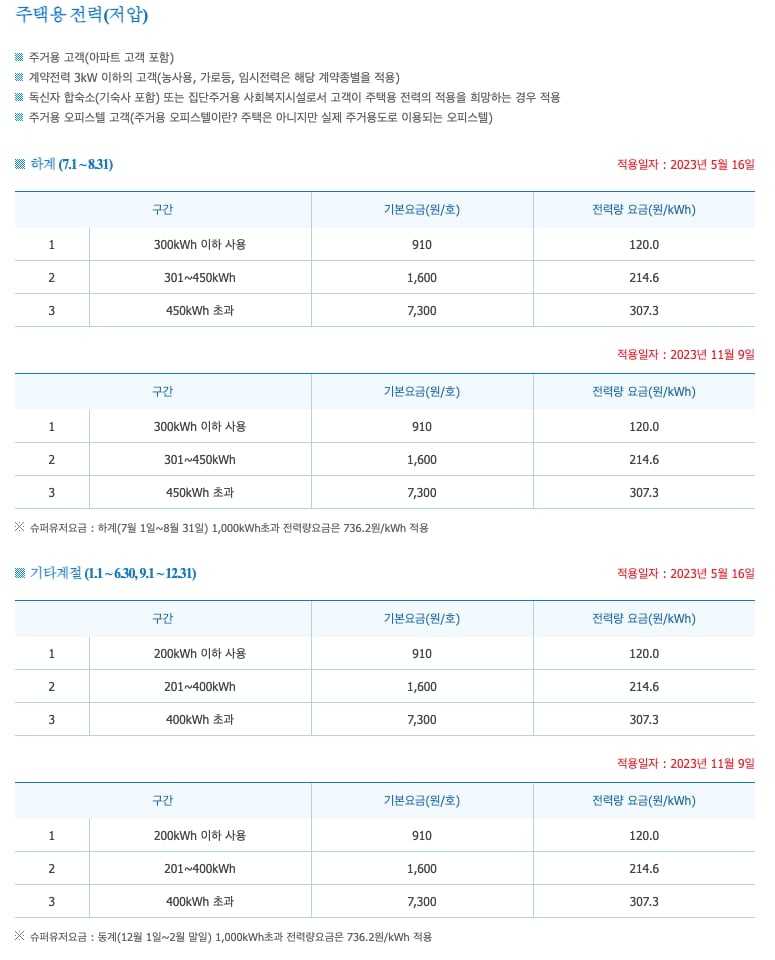
Here is what that does to real bills. We used KEPCO's tariff plus the charges every residential bill carries: the climate and environment charge (₩9/kWh), the fuel cost adjustment (+₩5/kWh in Q4 2026), 10% VAT and the 2.7% electricity industry fund levy, rounded down to the ₩10 as bills are.
| Monthly use | January bill | August bill | January costs |
|---|---|---|---|
| 200 kWh (studio, no heater) | ₩31,220 | ₩31,220 | the same |
| 300 kWh | ₩57,760 | ₩46,320 | +25% |
| 350 kWh | ₩70,640 | ₩59,980 | +18% |
| 450 kWh (studio + 2 kW heater, 4 h a day) | ₩108,050 | ₩85,740 | +26% |
| 600 kWh | ₩162,370 | ₩146,480 | +11% |
Our calculation, residential low-voltage rates, no welfare or family discounts. At 300 kWh in January: base ₩1,600 + (200 × ₩120.0) + (100 × ₩214.6) + climate ₩2,700 + fuel ₩1,500 = ₩51,260; plus VAT ₩5,126 and fund ₩1,380 = ₩57,760. In August all 300 kWh are tier 1: ₩41,110 + ₩4,111 + ₩1,100 = ₩46,320.
The jump is sharpest just past each line. In January, the 201st kWh costs nearly twice what the 200th did, and crossing 400 kWh lifts the base charge from ₩1,600 to ₩7,300. That is why the first heating decision for a renter on electricity is not which heater to buy. It is whether that heater pushes you over 400 kWh.
Smartwool Men's Classic Thermal merino base layer (also in a women's cut): the indoor layer that keeps you under 400 kWh In January most Koreans wear a thin thermal layer at home (내복) rather than heating the room hotter, and on electric heating that is what keeps a bill out of the third tier. One mid-weight merino crew does the same job: warm at 20°C indoors, not sweaty on a heated subway. Our honest note: if you are already in Korea, Uniqlo Heattech and market 내복 are cheaper; this is for people who want wool before they arrive. As an Amazon Associate, EpicKor earns from qualifying purchases at no extra cost to you.
See the Smartwool base layer on AmazonYou might like: How Much Is Rent in Seoul, Korea? The Official Numbers, where the management fee and the bills on top of rent start.
The rest of the electricity bill, and what changes in 2027
A KEPCO bill (전기요금 청구서) lists these lines. Knowing the Korean labels lets you check it line by line:
| Line on the bill | What it is | Rate, October 2026 |
|---|---|---|
| 기본요금 (base charge) | Set by the highest tier you reach | ₩910 / ₩1,600 / ₩7,300 |
| 전력량요금 (energy charge) | The tiered kWh price | ₩120.0 / ₩214.6 / ₩307.3 |
| 기후환경요금 (climate and environment charge) | Renewable and emissions costs, per kWh | ₩9/kWh |
| 연료비조정요금 (fuel cost adjustment) | Reset every quarter, capped at ±₩5 | +₩5/kWh |
| 부가가치세 (VAT) | On the subtotal (전기요금계) | 10% |
| 전력산업기반기금 (electricity industry fund) | A levy on the subtotal | 2.7% |
The 2.7% levy is now the legal rate. Article 36 of the Enforcement Decree of the Electricity Business Act, amended on 4 June 2024, sets the fund levy at 27/1,000 of the electricity charge. A transitional clause kept it at 3.2% from July 2024 to June 2025, and it was 3.7% before that. Older English guides still quote 3.7%.
Rates are frozen for October–December 2026. On 21 September 2026 the government kept the fuel cost adjustment at +₩5/kWh, the upper limit, for the 18th quarter in a row since Q3 2022. KEPCO's own formula said the figure should be +₩7.3, so the cap is holding the bill down. The decision for January–March 2027, the coldest bills of the winter, is normally announced around the 21st of the last month of the quarter, so expect it in late December. Base and energy rates for homes have not changed since the table dated 16 May 2023.
Two cases where your table is different:
- Some apartment complexes take power at high voltage. If yours does, the residential high-voltage table applies: ₩105.0, ₩174.0 and ₩242.3 per kWh with the same tier lines, which is about 12–21% cheaper per kWh. Your management office can tell you which table is used.
- Officetels used as homes qualify for the residential table. KEPCO's own eligibility list includes 주거용 오피스텔, an officetel that is actually lived in. If your officetel bill is calculated at a commercial rate, ask the landlord or management office about switching.
Which heating do you have? Check before you budget
Your January bill depends less on the weather than on which of three systems your home uses. They are billed in completely different ways.
| System | How to recognise it | Where the bill comes from |
|---|---|---|
| Individual gas boiler (개별난방) | A wall-mounted boiler on the balcony or in the utility room, with a gas pipe and its own gas meter | A city-gas bill in your name, or a 가스사용료 line in the management fee |
| District heating (지역난방) | No boiler in the flat. A distribution box with valves and a heat meter, often in a cupboard by the front door | 난방비 and 급탕비 lines on the apartment management fee, metered in Mcal or Gcal |
| Electric only | No boiler and no heat meter: system air-conditioner heat pump, panel heaters or electric floor film | Your KEPCO bill, on the tiered table above |
A few officetels and older blocks use a shared central boiler (중앙난방) and split the cost by floor area. In that case the 난방비 line is set by the building, and the dial in your flat has less effect than it does elsewhere.
Individual gas heating: the Seoul rate and a January bill
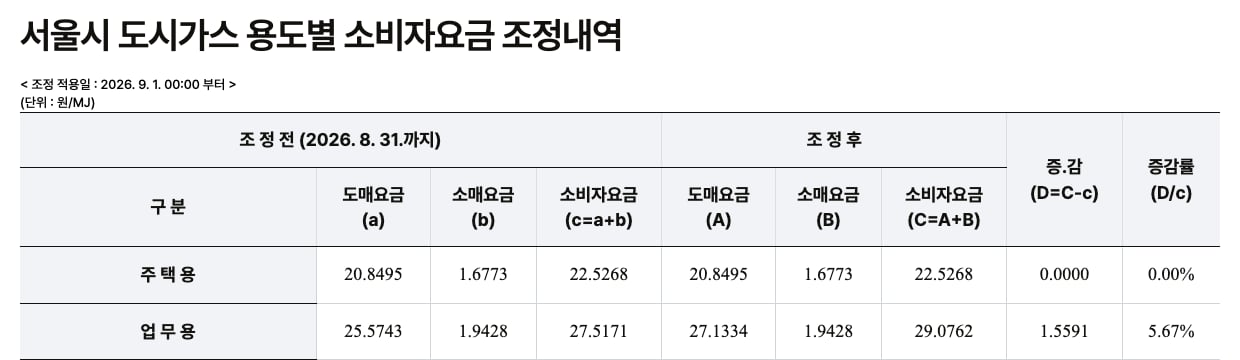
Gas has no progressive tiers. Seoul's residential city gas costs ₩22.5268 per MJ plus a ₩1,250 basic charge per household each month, and VAT is added on top. On 1 September 2026 Seoul raised commercial and industrial gas by about 5.7–6.8% but left the household rate unchanged at 0.00%.
Your meter counts cubic metres (m³). The bill converts them to megajoules using the month's heat value and a pressure and temperature correction, both printed on the bill. Natural gas in Korea carries roughly 42–43 MJ per m³ (the exact figure for the month is printed on your bill); we assumed 42.7 for these examples for these January examples:
| January use (illustrative) | Energy | Bill with VAT |
|---|---|---|
| 40 m³ (one-room, careful) | about 1,708 MJ | about ₩43,700 |
| 60 m³ (one-room, heated evenings) | about 2,562 MJ | about ₩64,900 |
| 100 m³ (two-room villa) | about 4,270 MJ | about ₩107,200 |
| 150 m³ (larger flat, family) | about 6,405 MJ | about ₩160,100 |
Our calculation: m³ × 42.7 MJ × ₩22.5268 + ₩1,250, then + 10% VAT. The usage levels are assumptions for illustration; your own bill shows last January's use, so ask the landlord for it.
Other cities have different retail margins, so a Busan or Daegu bill will not match exactly. How to set the boiler so the floor stays warm without wasting gas, including the 외출 (away) mode and why hot water is often the biggest gas cost, is in our Korean floor-heating and boiler dial guide. We will not repeat it here.
District heating: the KDHC rate and an 84 m² January
District heating (지역난방) pipes hot water from a plant to the whole complex. Korea District Heating Corp. (한국지역난방공사, KDHC) supplies much of Gangnam, Sangam and Mapo and the new towns around Seoul, including Bundang, Ilsan and Pangyo. Other areas, such as parts of Mokdong and Nowon, are served by different suppliers whose rates are close but not identical.
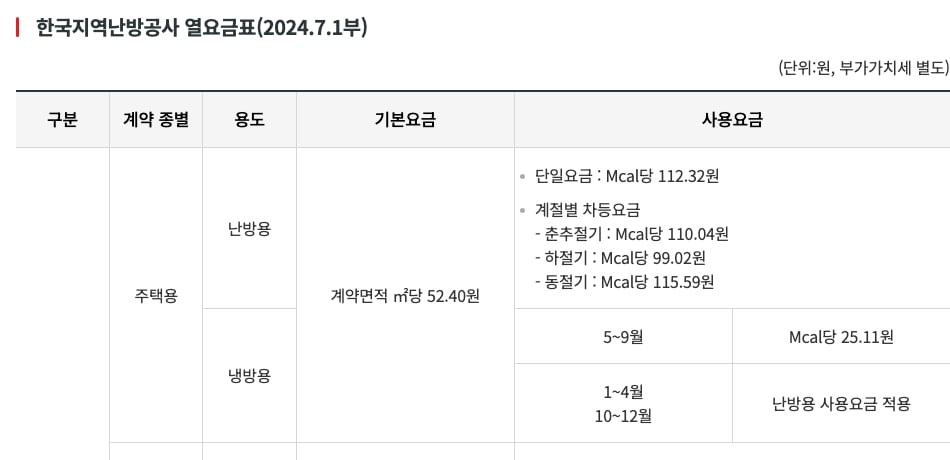
The bill has two parts. A base charge of ₩52.40 per m² of contract area every month, whether you heat or not. "Contract area" is your exclusive floor area plus any extended balcony and, under KDHC's rules, a share of common area, so the figure on your bill can be a little larger than your flat's size. Then a usage charge of ₩112.32 per Mcal read from your flat's heat meter. VAT is added to both. Here is an 84 m² flat, the standard Korean family size, at three January usage levels:
| January heat use, 84 m² (illustrative) | Base | Usage | Bill with VAT |
|---|---|---|---|
| 600 Mcal (mild, or rarely home) | ₩4,402 | ₩67,392 | about ₩79,000 |
| 1,000 Mcal (typical heated flat) | ₩4,402 | ₩112,320 | about ₩128,400 |
| 1,400 Mcal (cold month, 22°C+) | ₩4,402 | ₩157,248 | about ₩177,800 |
Our calculation from KDHC's published rates; usage levels are assumptions. Hot water (급탕비) is metered and billed separately on the same management fee.
The seasonal option (계절별 차등요금) charges ₩115.59 in December–February, ₩110.04 in spring and autumn and ₩99.02 in summer. It is chosen by the contract holder, which for an apartment is normally the complex, so as a tenant you just read which rate your 관리비 detail shows.
You might like: Korean Floor Culture: Shoes Off, Ondol On, and the Boiler Dial, the dial that drives the numbers above.
Electric heating: why a heater is the expensive way to stay warm
The question that matters for heating is the price of one kilowatt-hour of heat, and the three systems are very different:
| Source | Cost per kWh of heat, VAT incl. | How we got it |
|---|---|---|
| City gas boiler, Seoul | about ₩99 | 3.6 MJ × ₩22.5268 + VAT, assuming a 90%-efficient boiler |
| District heating, KDHC | about ₩106 | 0.86 Mcal × ₩112.32 + VAT |
| Electric heater, tier 1 (under 200 kWh) | about ₩151 | (₩120.0 + ₩9 + ₩5) × 1.127 |
| Electric heater, tier 2 (201–400 kWh) | about ₩258 | (₩214.6 + ₩14) × 1.127 |
| Electric heater, tier 3 (over 400 kWh) | about ₩362 | (₩307.3 + ₩14) × 1.127, before the base-charge jump |
Our calculation. 1 kWh = 3.6 MJ = 0.86 Mcal. The 1.127 factor is 10% VAT plus the 2.7% levy.
So in January, a fan heater costs roughly two and a half to nearly four times as much per unit of warmth as the floor. In a one-room that already uses 200 kWh, a 2 kW heater run four hours a night adds about 248 kWh and moves the bill from ₩31,220 to about ₩107,330. That is roughly ₩76,000 a month for one small heater.
Small loads are a different story. A heated mat that averages 100 W over eight hours a night uses about 25 kWh a month, around ₩6,000–6,500 if it lands in tier 2. Heating your bed rather than your room is the one electric option that makes sense in a Korean winter. Heating the whole room by electricity is not.
What January 2026 actually did to bills
The best evidence of how winter bills behave is last January, from Korea's official apartment management-fee system, K-apt (공동주택관리정보시스템, run by the Korea Real Estate Board). For January 2026:
| Per m² of floor area | January 2025 | January 2026 | Change |
|---|---|---|---|
| Total management fee | ₩3,206 | ₩3,343 | +4.3% |
| Heating (난방비) | ₩393 | ₩444 | +13.0% |
| – of which, the flat's own heating | ₩320 | ₩368 | +15.0% |
| Hot water (급탕비) | ₩118 | ₩125 | +5.9% |
| Electricity (전기료) | ₩718 | ₩740 | +3.1% |
Source: K-apt figures as reported by Herald Business, 3 March 2026, and YTN, 4 March 2026.
For an 84 m² flat, the average total came to ₩280,812, up from ₩269,304. None of this was a price rise. KDHC had kept its rates since July 2024 and household electricity rates were frozen. Seoul's average January low was −7.8°C, against −4.1°C a year earlier, and KDHC's heat sales in January rose 11.2% to 3,166,000 Gcal. People set the same temperature, the weather was colder, and the meters ran longer.
Read the per-m² heating figure as a trend, not as your bill. It is an average over every complex that reports, including those heated by individual gas boilers, whose heating mostly appears elsewhere. If your 84 m² flat is on district heating, the KDHC table above is the better guide.
How to cut the January bill without being cold
- Find out your system before you sign. Ask the agent "개별난방이에요, 지역난방이에요?" (individual or district heating?) and for last January's bill. Our Seoul rent guide covers how management fees must be itemised in listings.
- Watch the 200 and 400 kWh lines. KEPCO's app 한전ON shows your meter reading during the month. If you are near 400 kWh with a week to go, leave the dryer and the fan heater off.
- Heat the floor, not the air. Run the boiler on the floor (온돌) setting and use 외출 mode when you leave, rather than switching it off and reheating a cold slab. Our boiler dial guide explains the settings.
- Turn the hot water down. Long, very hot showers use more gas than the floor does in many homes.
- Insulate the windows and wear a layer. Window bubble wrap (뽁뽁이, ppokppogi) from Daiso or a supermarket on single-glazed windows, plus a thermal top indoors, lets you run the room at 20°C instead of 23°C. Wet the glass, press the bubble side on, peel it off in spring.
When the January bill does arrive, check the reading dates first. Meters are read on different days, so a "January" bill usually covers mid-December to mid-January. KEPCO applies the summer tiers in proportion to the days of a reading period that fall in July–August.
Frequently Asked Questions
Q: How much is the electricity bill in Korea in winter? For a one-room using 200 kWh, about ₩31,220 a month. At 300 kWh it is about ₩57,760 in January, against ₩46,320 for the same use in August. With a 2 kW heater run four hours a day (about 450 kWh) it rises to about ₩108,050. These include the climate charge, fuel adjustment, 10% VAT and the 2.7% fund levy.
Q: Does Korea relax electricity tiers in winter like it does in summer? No. KEPCO widens the tiers to 300 and 450 kWh only from 1 July to 31 August. From December to February the normal 200 and 400 kWh lines apply, plus a ₩736.2/kWh rate above 1,000 kWh a month.
Q: Will Korean electricity rates go up in 2027? Rates for October–December 2026 were frozen on 21 September 2026, with the fuel adjustment held at +₩5/kWh, the maximum, for the 18th quarter in a row. KEPCO's formula called for +₩7.3. The January–March 2027 decision is expected in late December.
Q: How much is gas heating in Seoul? Residential city gas is ₩22.5268 per MJ plus ₩1,250 a month, with 10% VAT. A one-room using 60 m³ in January pays about ₩64,900. A two-room villa using 100 m³ pays about ₩107,200. There are no progressive tiers on gas.
Q: How is district heating billed in Korea? KDHC charges ₩52.40 per m² of contract area each month plus ₩112.32 per Mcal of heat used, with VAT added. An 84 m² flat using 1,000 Mcal in January pays about ₩128,400 for heating, before hot water.
Q: Is it cheaper to heat with an electric heater or the ondol floor in Korea? The floor. Gas or district heating costs about ₩99–106 per kWh of heat. An electric heater costs about ₩258 per kWh once you pass 200 kWh a month, and about ₩362 above 400 kWh. A low-wattage heated mat for the bed is the only electric heating that stays cheap.
Sources
- KEPCO Cyber Branch, residential electricity tariff (주택용 전력 저압·고압), tables dated 16 May 2023 and 9 November 2023, with summer and winter super-user notes and the residential-officetel eligibility rule: cyber.kepco.co.kr, checked 7 October 2026.
- Enforcement Decree of the Electricity Business Act, Article 36 (levy at 27/1,000 of the electricity charge, amended 4 June 2024) and the 2024 transitional clause (32/1,000 until 30 June 2025): law.go.kr.
- Q4 2026 electricity rate freeze, fuel adjustment +₩5 for the 18th quarter, formula figure +₩7.3: Sidae, 21 September 2026; supple.kr. Climate and environment charge of ₩9/kWh (₩5.3 when it was introduced in 2021): eToday, 9 December 2025; the 21 September 2026 decision left it unchanged.
- Seoul Metropolitan Government, city gas consumer rates by use from 1 September 2026 (residential ₩22.5268/MJ, basic charge ₩1,250 per household): sftc.seoul.go.kr.
- Korea District Heating Corp., heat tariff from 1 July 2024 (residential ₩52.40/m², ₩112.32/Mcal; seasonal option; contract-area definition): kdhc.co.kr.
- K-apt January 2026 management fees, heating +13.0%, Seoul January lows: Herald Business, 3 March 2026; KDHC January heat sales 3,166,000 Gcal (+11.2%): YTN, 4 March 2026.
You Might Also Like
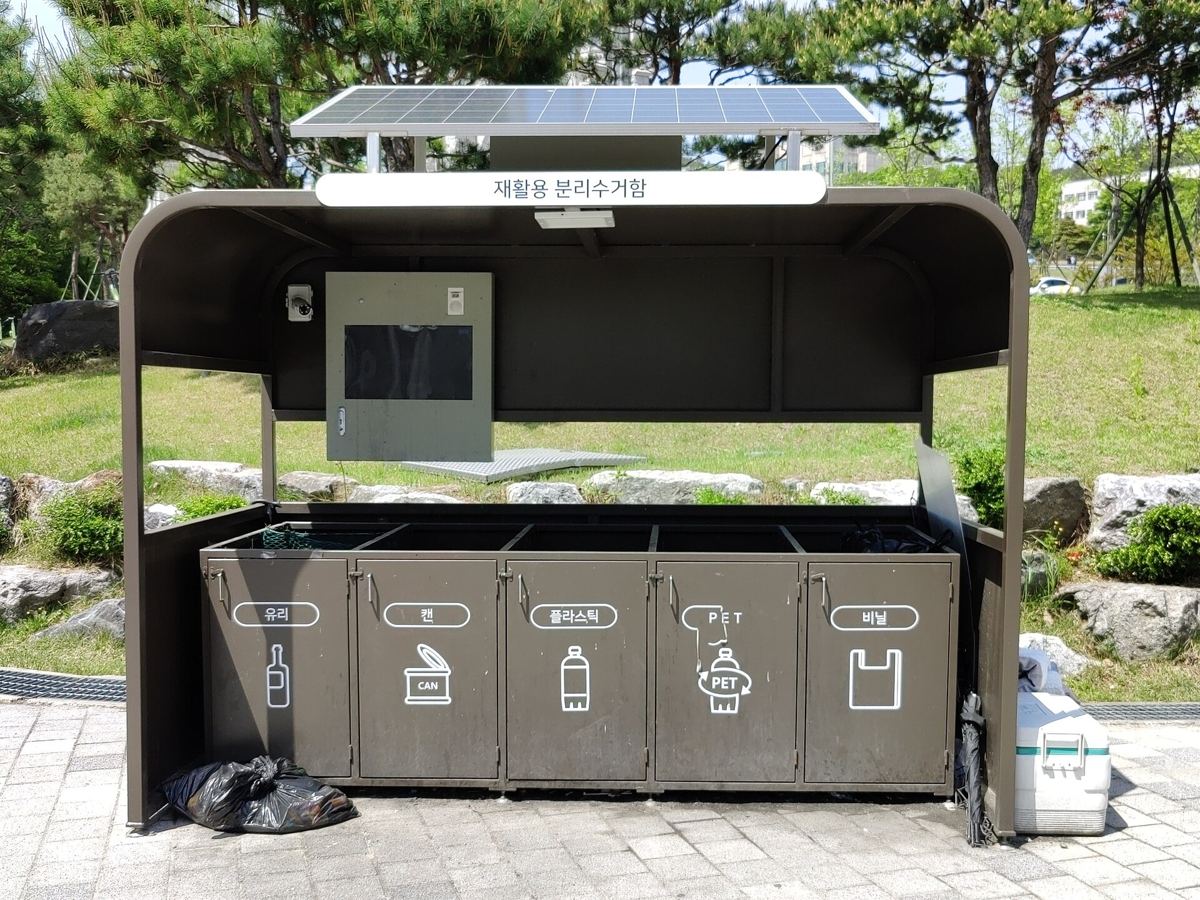
Korea Garbage Bags and Recycling (2026): The ₩490 Bag, Which Nights to Put Rubbish Out in Seoul, and the ₩100,000 Fine
A 20-litre rubbish bag costs ₩490 in every Seoul district, but the nights you may put it out don't match: Mapo bans Friday and Saturday, Gangnam takes Monday to Friday only. Wrong bag or wrong night: ₩100,000. Bags, sorting, food waste and fines for 2026.
Korea Hotel Tax Refund 2026: The 118 Hotels That Give Foreign Guests the VAT Back, Which Seoul Five-Stars Aren't on the List, and the 2027 Deadline
Only 118 hotels in Korea refund VAT on a foreign guest's room this quarter, and The Shilla, Lotte Hotel Seoul and Four Seasons are not among them. The full October 2026 list by city, who qualifies, how much comes back, and the plan to end it in June 2027.
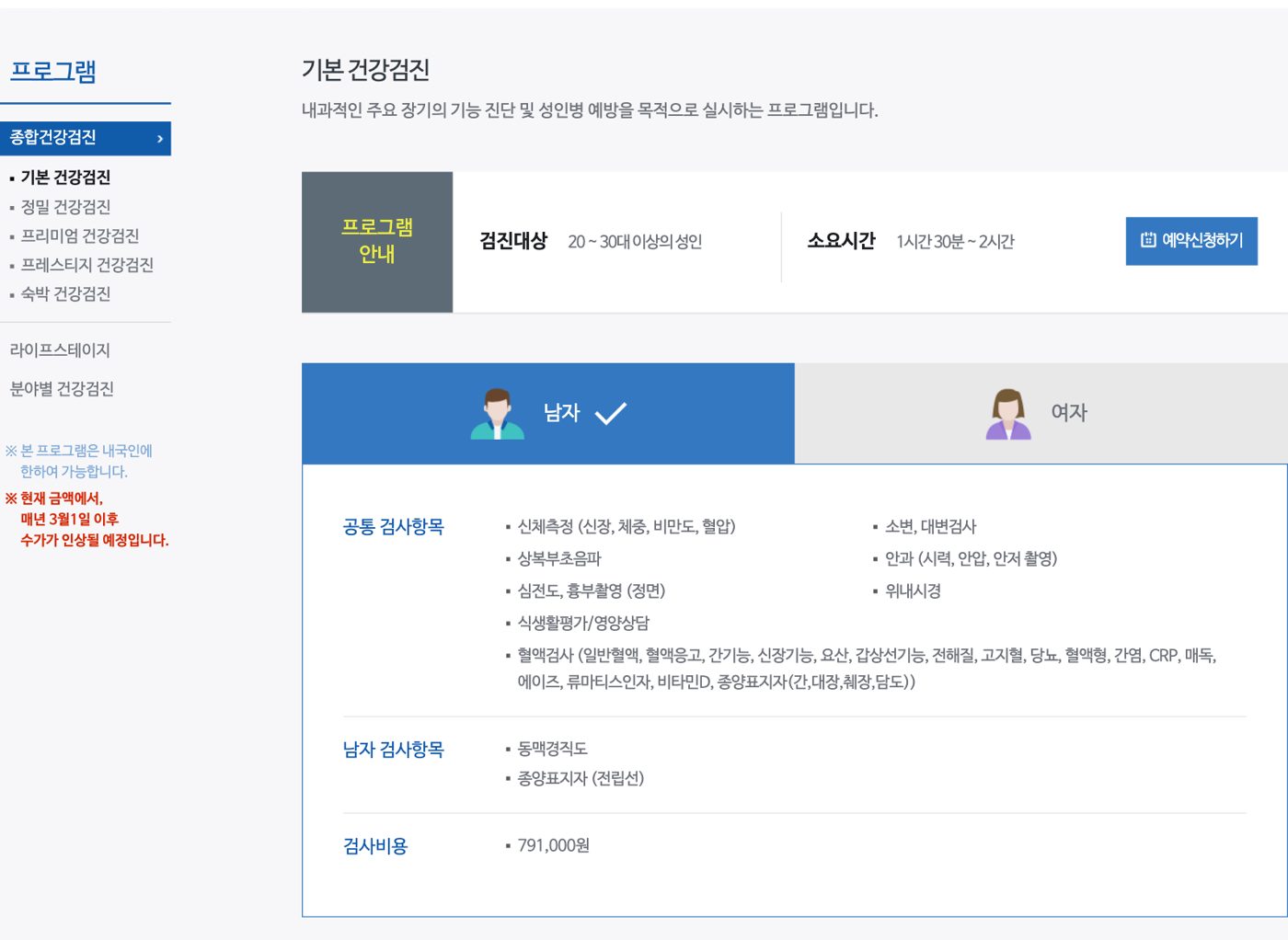
Health Checkup in Korea (2026): Hospitals Run Two Price Lists — ₩791,000 on Samsung's Korean Page, ₩1,874,000 on Its English One
Samsung Medical Center's Korean checkup page lists ₩791,000 "for Korean nationals only"; its English page lists ₩1,874,000. Severance charges foreigners without Korean insurance exactly 30% more. Both price lists, test by test, October 2026.