Renting a Car in Korea as a Foreigner (2026): Which Licences Work, Jeju's New 60 Percent Discount Cap and 28,300-Car Limit, What Incheon Airport Rentals Cost, the Hi-Pass Toll Unit, the Fines That Follow You Home, and Whether Tourists Can Use Socar
Last updated: September 2026. Licence rules are from the Korean National Police Agency and the Road Traffic Authority; rental conditions from Lotte Rent-a-Car's published FAQ; Jeju's quota and discount rules from Jeju Special Self-Governing Province's 2024 and 2026 decisions; accident figures from the province's May 2026 release; Socar's tourist product from the company's 2024 announcements and its current OTA listings. Fines are the 2026 schedule for a passenger car.
Korea is a country most visitors see by train and subway, and for Seoul that is right. The car question is really a Jeju question, and Jeju is where Korea has been quietly rewriting the rules. The island caps its rental fleet at 28,300 cars, a limit that runs to 20 September 2026, after cutting 3,829 cars; it has just passed a rule that forbids rental firms from discounting more than 60 percent off the listed daily rate, because a small car listed at ₩200,000 a day was going for ₩20,000–₩30,000 in the low season and the full ₩200,000 at peak; and its rental cars were in 2,414 crashes in five years, killing 26 people, a share of the island's accidents no other Korean region comes close to. None of that appears in the English "rent a car in Korea" guides, which stop at "bring an International Driving Permit."
The permit is where this guide starts too, because the licence rules decide whether you can drive at all. Then the rentals themselves: what the counters at Incheon and Jeju ask for, what the insurance words mean, and what a car costs in the seasons that matter. Then the road: the fines that arrive at the rental desk after you have flown home, the toll unit on the windscreen, and the three Korean rules that catch foreign drivers. And finally Socar, the car-sharing app every Korean uses, and the narrow door it has opened to tourists.
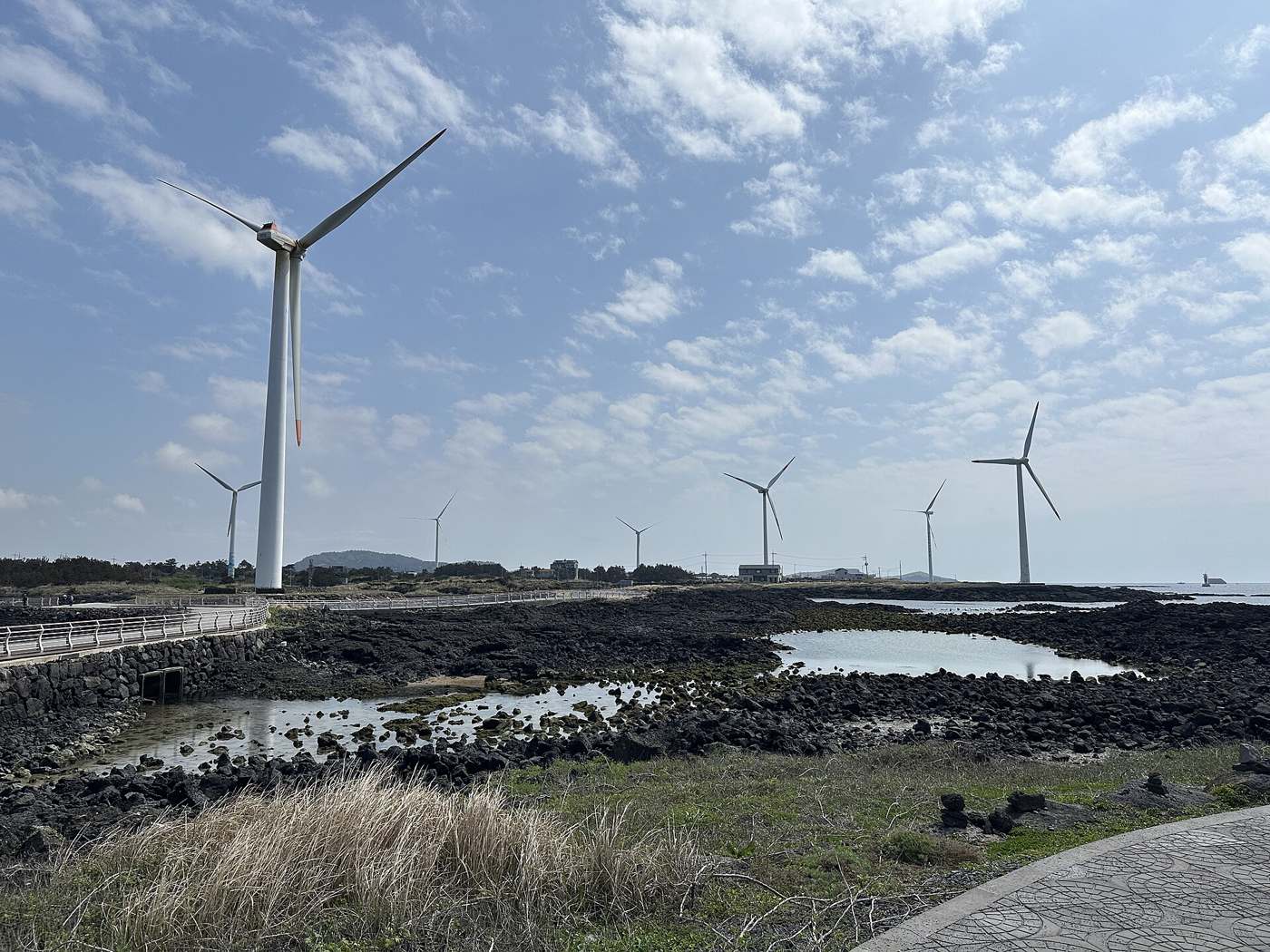
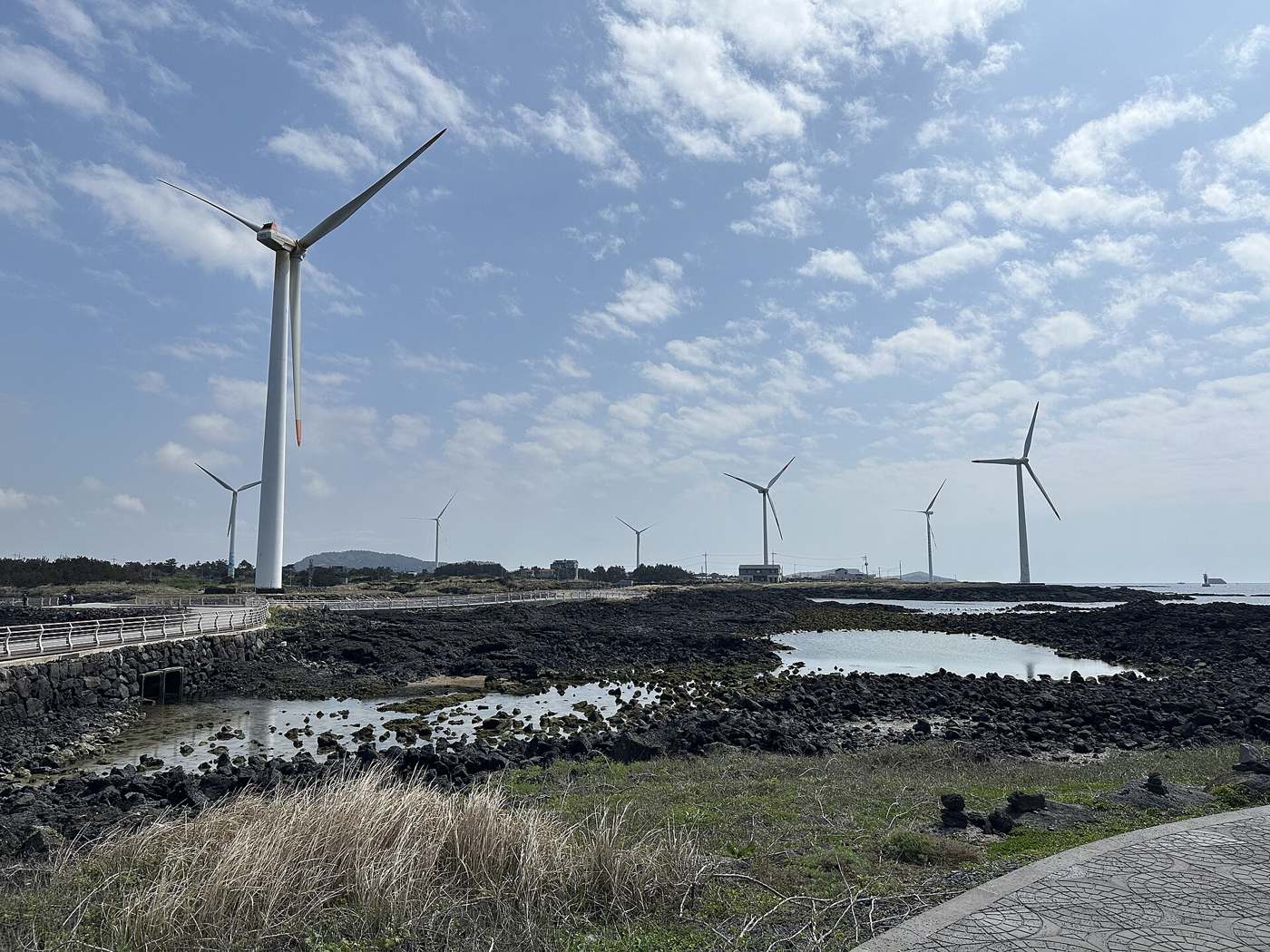
Sinchang Windmill Coastal Road, Jeju's west coast: the drive the rental car is for. Photo: Grapesurgeon, Wikimedia Commons, CC BY-SA 4.0 (2026).
Navigation in Korea is Naver Map, in English, on your own phone, because the car's built-in system is in Korean and Google Maps, cleared to use Korean road data only in February 2026, has not yet switched on driving directions here. Naver needs data for the whole drive, so install a South Korea eSIM (5 GB, 15 days) before you land rather than at the rental desk. As an Amazon Associate, EpicKor earns from qualifying purchases.
Quick Guide: can you drive, and what does it cost
| Question | Answer, 2026 |
|---|---|
| Which licence? | An International Driving Permit under the 1949 Geneva or 1968 Vienna convention, plus the home licence it is attached to, plus your passport. Valid for one year from the date you entered Korea. Taiwan and Vietnam have bilateral recognition; mainland China is in neither convention, so a Chinese licence alone does not work |
| Minimum age and experience | 21, with a licence held for at least a year (Lotte's published rule); younger drivers may pay a surcharge or be refused larger and imported models |
| What the counter checks | Passport (for the entry date), IDP, home licence, and a credit card in the driver's name; all four names must match |
| Where to rent | Lotte and SK counters in both Incheon Airport arrivals halls; in Jeju, every firm runs a free shuttle from the airport to its "rental car house" 10 to 20 minutes away |
| Typical price, compact (Avante/K3 class) | Jeju low season ₩30,000–₩60,000 a day with basic insurance; peak (late July–mid August, Chuseok, early October, Seollal) ₩100,000–₩250,000, a gap the island's new rule now limits to a 60 percent discount off the listed rate |
| Insurance words | 일반자차 (standard waiver): under Jeju's rule from 16 September 2026 it costs at most ₩10,000 a day for up to ₩5 million of cover; 완전자차 (premium waiver): at most ₩20,000 a day, covers body and frame, and drops the 휴차료 (loss-of-use fee). Under both, your own share is capped at ₩500,000 |
| Tolls | The car has a Hi-Pass unit; you drive through the blue lanes and the rental firm bills the tolls to your card after return |
| Fines | Speed and school-zone cameras post the fine to the rental firm, which charges your card plus a handling fee, weeks after you have left |
| Drink-driving limit | 0.03 percent blood alcohol, one glass; a criminal offence, and for a foreigner grounds for deportation |
| Socar for tourists? | Only in Jeju, booked through Klook, KKday or QeeQ with an IDP, collected with a physical key at Socar Station Jeju; the Korean app itself needs a Korean licence, phone and card |
Anker 10,000 mAh power bank — for the phone that is now the navigation Six hours of Naver Map on the dash drains a phone by lunch, and not every rental car has a working USB port. The Anker is the one Koreans keep in the door pocket. As an Amazon Associate, EpicKor earns from qualifying purchases.
See the Anker power bank on AmazonThe licence: what Korea actually recognises
Korea is a party to the 1949 Geneva Convention on Road Traffic and, since 2002, also honours permits issued under the 1968 Vienna Convention. That covers the IDPs issued in the United States, Canada, the United Kingdom, Australia, New Zealand, Japan, France, Germany and most of Europe and Southeast Asia. The permit is valid for one year from the day you entered Korea (the rental counter looks at the entry stamp or the e-Arrival record, which is why they ask for the passport and not only the licence), and it is only valid together with the home licence it translates; an IDP on its own is a booklet, not a licence. Taiwan and Vietnam have bilateral recognition agreements with Korea instead. Mainland China has signed neither convention, which is why Chinese visitors, the largest group in Korea, cannot rent a car on their home licence and why Jeju's rental firms will refuse one.
Two practical notes. The Korean police accept an IDP for driving, but the rental companies add their own floor: 21 years old and at least one year since the licence was issued at Lotte for ordinary cars, with surcharges or limits for younger drivers on larger and imported models. And the counter checks that the name is the same on the passport, the IDP, the home licence and the credit card, because a mismatch is how a stolen-card rental is caught; a card in a companion's name will not do.
Jeju: the quota, the price swing, and the rule that ends it
Jeju has had a rental-car quota since 2018: the province decided the island could absorb 28,500 cars, the supply committee set the ceiling at 28,300, and every firm's fleet has been frozen or cut since, 3,829 cars fewer than before the rule. The quota was renewed in September 2024 to 20 September 2026, and at the time of writing the province had not announced whether it will be extended. The point was congestion: Jeju's roads carry rental cars at a density no other Korean region has.
The quota created the price problem. With a fixed fleet and demand that peaks in August, rental firms listed a nominal daily rate and then "discounted" it by whatever the season allowed, so a small car listed at ₩200,000 a day went for ₩20,000–₩30,000 in quiet weeks and the full ₩200,000 in peak ones, a swing local broadcasters measured at up to twenty times between the emptiest and fullest weeks. In May 2026 the province announced, and over the summer promulgated, a rule on rental terms that caps the discount at 60 percent of the listed daily rate, requires the listed rate to be costed from the firm's own accounts, and standardises the insurance: the standard damage waiver may cost no more than ₩10,000 a day for ₩5 million of cover, the premium waiver no more than ₩20,000, and the renter's own share is capped at ₩500,000; rentals over ten days are exempt from the discount cap. Promulgated on 15 July, it takes effect on 16 September 2026. The practical effect for a visitor is that the low-season bargain gets less extreme and the peak-season quote becomes explicable.
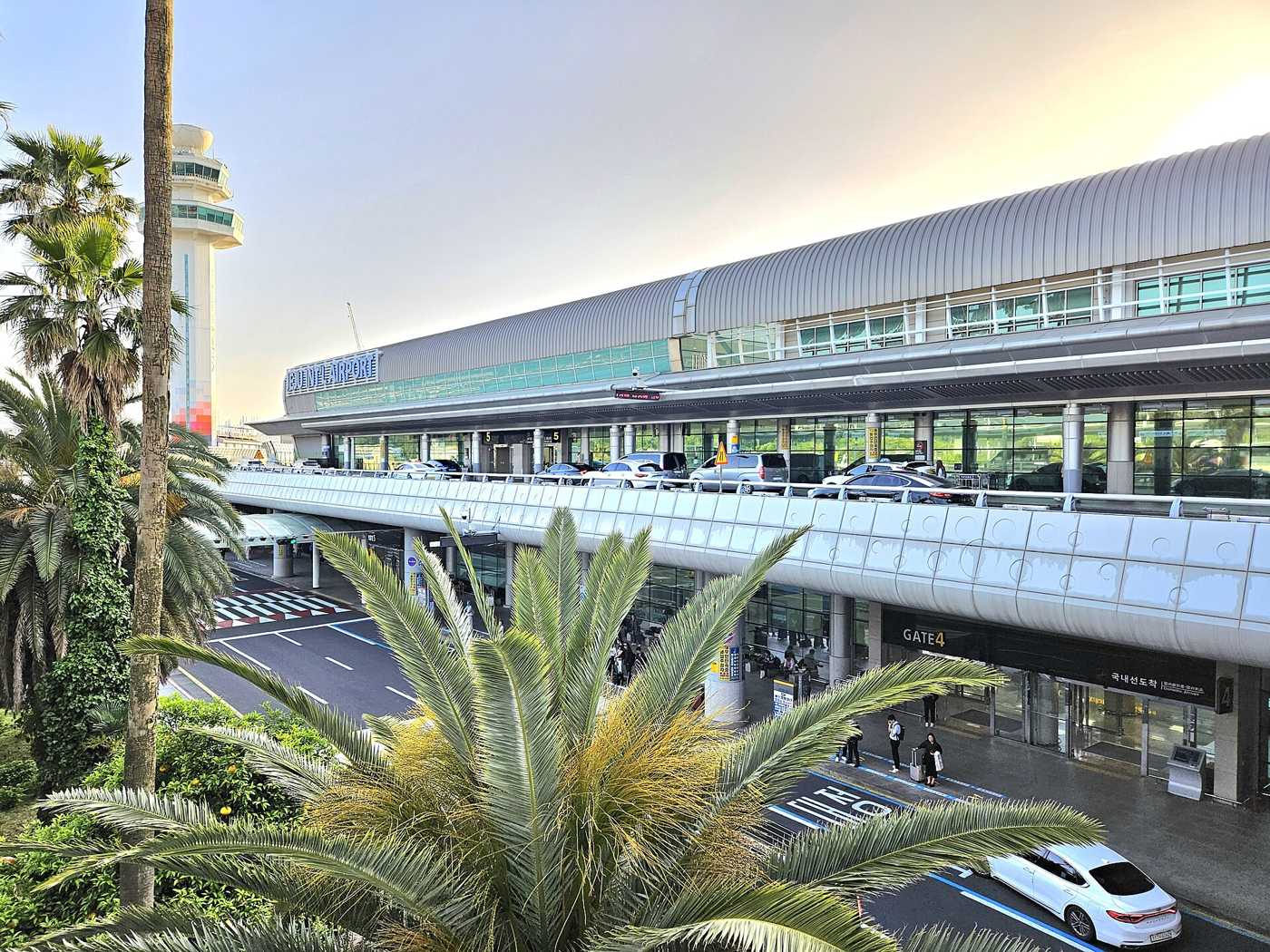
Jeju International Airport. The rental-car shuttles leave from the stop outside domestic arrivals to each company's "rental car house." Photo: Kimhs5400, Wikimedia Commons, CC BY 4.0 (2024).
Collecting the car. Jeju's rental firms are not in the terminal. You walk out of domestic arrivals to the shuttle stop, board the bus with your company's name on it, and ride 10 to 20 minutes to the firm's yard, where the contract, the walk-around inspection (photograph every scratch yourself) and the keys happen. Allow 45 minutes from landing to driving. Returning is the reverse, and the shuttle back is timed to flights, so return the car 90 minutes before departure.
The safety record, and what changed in 2026. Between 2021 and 2025 rental cars on Jeju were involved in 2,414 crashes, with 26 deaths and 4,032 injuries; rental cars are 11.4 percent of all Jeju collisions, the only Korean region in double digits. The province's May 2026 response was prevention rather than enforcement: rental firms are to verify licence age more strictly for drivers in their twenties and with under a year's experience, brief every renter on Jeju's roads (narrow, unlit, sharp coastal bends, farm vehicles), and check tyres and safety equipment before each hire. If a counter asks how long you have held your licence, that is why.
Incheon Airport and the mainland
For a Seoul trip, do not rent a car; the city's parking, bus lanes and cameras make it slower and dearer than the subway, and our first and last train guide and large-taxi guide cover the alternatives. A car earns its place for the mainland outside the KTX lines: the east coast, the temple country of the south-west, the ski resorts in winter. Lotte and SK have counters in the arrivals halls of both Incheon terminals with one-way returns to city branches, and prices run above Jeju's, ₩60,000 to ₩120,000 a day for a compact with full waiver in an ordinary week. For most routes the honest comparison is the KTX and SRT, which reach Busan in about 2 hours 15 minutes for ₩54,400 since the 1 September 2026 fare cut and need no parking at the other end.
The road: three rules, the cameras, and the toll unit
Korean traffic law is close to what most visitors know, with three exceptions that produce most of the fines.
Right turn on red is not free. Since 2023, a car turning right at a junction must stop before the crosswalk if the pedestrian signal is green or a pedestrian is about to cross, and stop fully at a red light before turning. Police enforce it; rolling through is a ₩60,000 ticket.
School zones are 30 km/h, and the cameras are everywhere. The yellow-signed 어린이보호구역 (child protection zones) cap speed at 30 km/h (some relax to 40–50 km/h late at night; the sign says when), and between 08:00 and 20:00 cameras post fines of ₩70,000 for up to 20 km/h over, rising to ₩160,000 above 60 km/h over, ₩30,000 more than the same offence elsewhere. Naver Map warns you with a chime; slow down when you hear it.
The drink-driving line is 0.03 percent. One glass of beer can reach it. It is a criminal charge, not a ticket, and for a foreign visitor a conviction can mean deportation and a visa ban; Korean police run random breath checkpoints at night, including on Jeju's coastal roads.
Then the cameras. Korea's speed and bus-lane cameras are fixed, signed and mapped, and Naver Map announces each one; the fine goes to the registered owner, which is the rental firm, which charges your card and adds a handling fee (₩10,000 to ₩30,000 is typical), sometimes a month after you have gone. The Gyeongbu Expressway's blue bus lane runs 07:00–21:00 every day (to Anseong on weekdays, to Sintanjin on weekends and holidays) and is for buses and vans of nine seats or more with six or more aboard; a rental sedan in it is a ₩60,000 penalty.
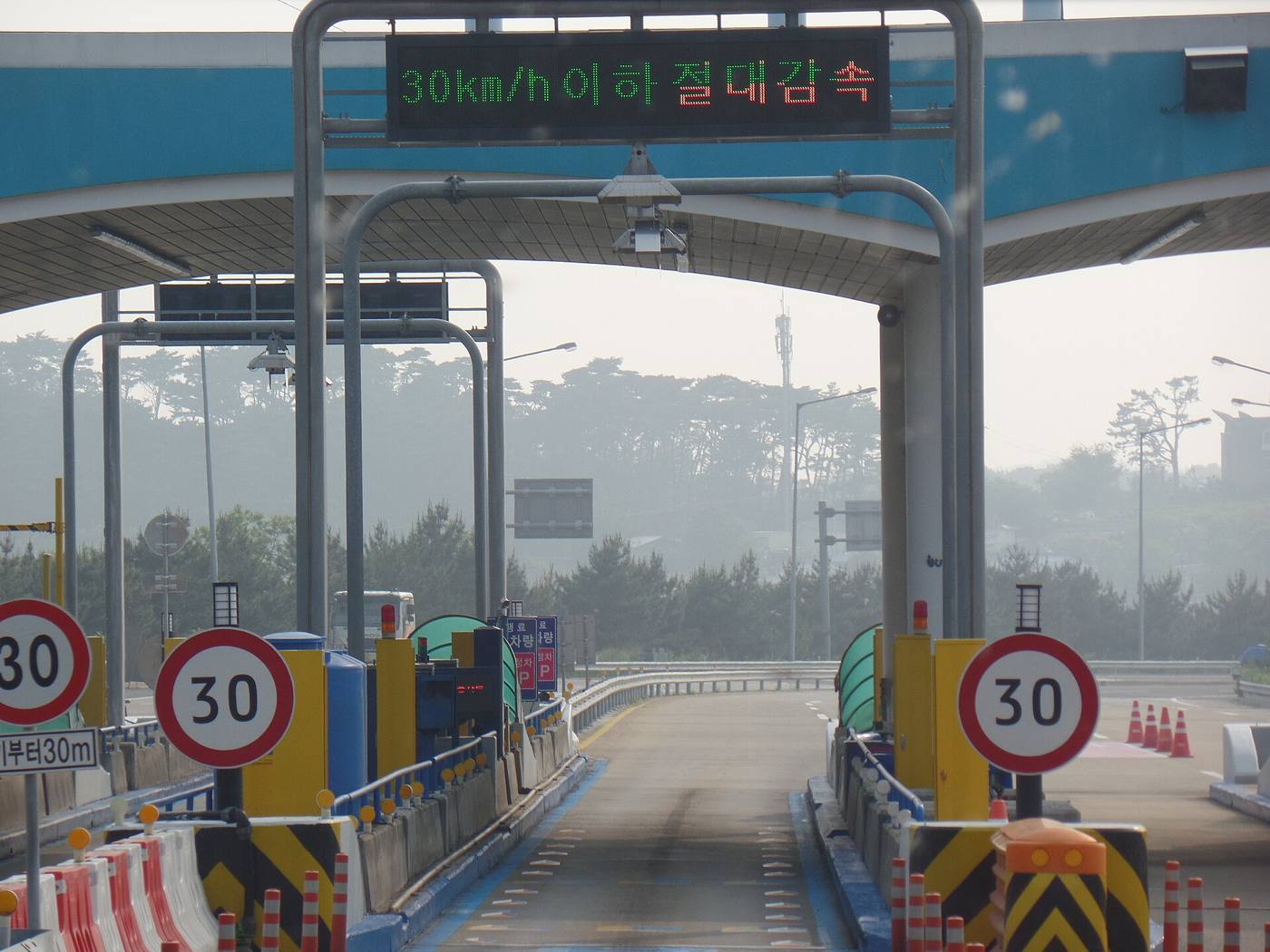
Hi-Pass lanes at a Seohaean Expressway toll gate. Rental cars carry the windscreen unit; drive through the blue lanes at the posted speed and the tolls are billed to your card after the car is returned. Photo: Jhcbs1019, Wikimedia Commons, CC BY-SA 4.0 (2016).
Tolls. Almost every rental car has a Hi-Pass unit on the windscreen. Use the blue Hi-Pass lanes, slow to the posted 30 km/h, and do not stop; the toll is recorded to the unit and the rental firm bills the total to your card after return, itemised. If the unit fails and you take a cash lane, the attendant takes cards. Jeju has no toll roads at all.
Parking. Public lots take cards at the exit machine; street parking in Seoul is metered by app or attendant; a car parked on a yellow-curbed street is towed within the hour and the fine (₩40,000 plus towing) again comes via the rental firm.
Fuel. Petrol averaged ₩1,859 a litre nationally in the second week of September 2026 (₩1,905 in Seoul), pumped by an attendant at many stations; say "gadeuk" (가득, full) or a won amount, and "hwibalyu" (휘발유) for petrol. Return the car at the same fuel level or pay the firm's inflated rate.
Socar: what it is, and the one way a tourist can use it
Socar (쏘카) is Korea's car-sharing app, with cars parked in "Socar zones" in every neighbourhood and at Incheon Airport, unlocked from the phone, rented by the hour. It is widely used by Koreans in their twenties, and "can I use Socar" is a common question from visitors. The plain answer is that the app is built around three things a visitor does not have: a Korean driver's licence, a Korean phone number and a Korean payment card, all in the same name. Foreign residents can register once they have all three; foreign students can, since May 2024, through a partner that walks them through exchanging the licence and opening the account, and even then only for the delivered-to-you "Socar Bureum" service rather than the zones.
For tourists there is a separate door, and it is narrow. In August 2024 Socar launched a product for foreign visitors in Jeju only, sold not in the app but through the travel platforms Klook, KKday and QeeQ: book online with an International Driving Permit, take the shuttle from the airport to Socar Station Jeju, sign an electronic contract at the counter, and drive off with a physical key rather than the app's smart key. The company said at launch that it would extend the product to Seoul and Incheon Airport in 2025 and build a global version of the app; check the Klook, KKday or QeeQ listing for where it runs before you plan around it. Treat Socar, for a visitor, as one more Jeju rental company with a good fleet and a booking flow in English, and compare its price on Klook against Lotte's and SK's for the same dates.
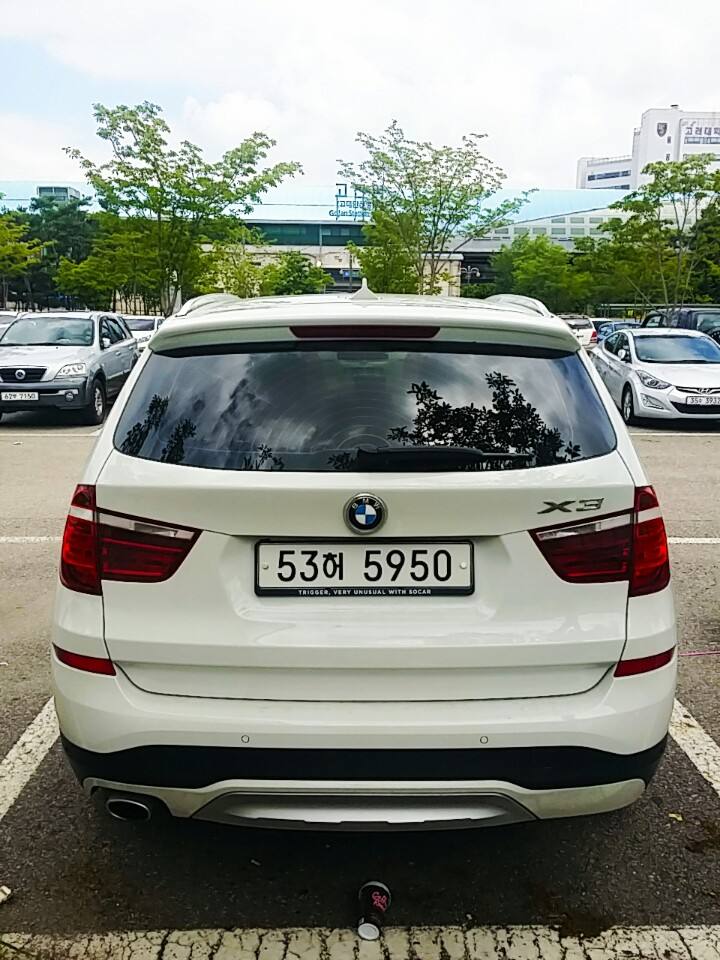
A Socar shared car. The app that unlocks it needs a Korean licence, phone and card; tourists reach the Jeju cars through Klook, KKday and QeeQ instead. Photo: Somde123, Wikimedia Commons, CC BY-SA 4.0 (2016).
Before you book: the checklist
- Get the IDP at home, in your country, before you fly; Korea does not issue them to visitors. Bring the home licence it belongs to.
- Book Jeju in advance for July, August, Chuseok and early October, when the 28,300 cars run out; our festival calendar shows which weeks the festivals fall.
- Read the waiver line, not the headline price: excess amount, repair cap, and whether the 휴차료 loss-of-use fee is included.
- Photograph the car at collection, all four sides and the wheels, and the fuel gauge.
- Expect a second bill: tolls and any camera fines arrive on the card after return; keep the card active for six weeks.
- Do not drink at all if driving, including the night before an early return.
- Consider not renting. Jeju's buses reach every major sight for ₩1,200 to ₩3,000 and airport limousine 600 runs to Jungmun and Seogwipo; Seoul is faster without a car; and between cities the KTX beats the expressway. The car is for the coast roads, the interior of Jeju, and families with luggage, which is also what our Kakao Venti guide is for at the airport end.
FAQ
Q: Can a foreigner rent a car in Korea? Yes, with an International Driving Permit under the Geneva or Vienna convention, the home licence it is attached to, a passport and a credit card in the same name. The permit is valid for a year from entry; major firms require age 21 and a year's driving history. A mainland Chinese licence is not recognised.
Q: Can tourists use Socar in Korea? Only in Jeju, and not through the app: since August 2024 Socar sells a tourist product on Klook, KKday and QeeQ, collected with a physical key at Socar Station Jeju with an IDP. The app itself requires a Korean licence, phone number and payment card.
Q: How much does a rental car cost in Jeju? Roughly ₩30,000–₩60,000 a day for a compact in the low season and ₩100,000–₩250,000 in peak weeks. Jeju's 2026 rule caps discounts at 60 percent of the listed rate and the standard waiver's price at ₩10,000 a day, from 16 September 2026, which narrows that gap.
Q: What happens if I get a speeding ticket in a rental car in Korea? The camera fine is sent to the rental company as the registered owner; it charges your card the fine plus a handling fee, often weeks after you have left. School-zone camera fines are ₩70,000 to ₩160,000 between 08:00 and 20:00.
Q: How do tolls work in a Korean rental car? Through the Hi-Pass unit on the windscreen: drive through the blue Hi-Pass lanes without stopping and the rental firm bills the tolls to your card after return. Jeju has no tolls.
Q: Is it worth renting a car in Seoul? No. Parking, bus lanes and cameras make it slower than the subway, and taxis and the KTX cover what a car would. Rent for Jeju, the east coast and the countryside beyond the rail lines.
Sources
- Korean National Police Agency and Road Traffic Authority (safedriving.or.kr; easylaw.go.kr), international driving permits recognised in Korea: Geneva 1949, Vienna 1968 (since 2002), one year from entry, with home licence; Ministry of Foreign Affairs (0404.go.kr) on bilateral recognition with Taiwan and Vietnam.
- Lotte Rent-a-Car FAQ (age 21, one year's licence, passport for the entry date).
- Jeju Special Self-Governing Province: rental-car quota extension to 20 September 2026 at 28,300 cars (September 2024; Nocut News, Headline Jeju); rental-terms rule with 60 percent discount cap and waiver price caps, promulgated 15 July and in force 16 September 2026 (27 May 2026, Sisa Journal; Kyunghyang 15 July 2026; Jnuri); rental-car accident figures 2021–2025 and prevention measures (13 May 2026, Jeju Ilbo, Seoul Shinmun).
- JIBS (19 June 2025), Jeju rental rates varying up to twenty-fold between seasons; Kyunghyang on the ₩200,000 listed rate and ₩20,000–30,000 low-season price.
- Road Traffic Authority school-zone fine schedule and night-time limits; Korea Expressway Corporation bus-lane rules; Opinet via Financial News (12 September 2026) petrol prices; Hankyung (31 August 2026) KTX fare cut; Jeju bus route 600; Ministry of Government Legislation on the 0.03 percent limit; Korean law-firm notes on deportation risk for foreign drink-drivers.
- Socar announcements via Digital Times, EBN, Asia Economy (August 2024) and TechM, Digital Daily (May 2024): Jeju tourist product on Klook, KKday and QeeQ; student programme; Incheon Airport zone; expansion plans.
You Might Also Like
Seoul Bike Rental for Tourists (2026): Ttareungi Takes a ₩1,000 Pass and No Korean Phone — Shared E-Scooters Need a Moped Licence Most Visitors Don't Have
Seoul's Ttareungi bikes take a ₩1,000 tourist pass on an overseas card, no Korean phone needed. Shared e-scooters need a moped category on your permit, Lime and Swing's Seoul scooters are gone, and scooter-free streets grow on 30 September.
What You Cannot Bring Into Korea: Beef Jerky, Sausage, Mango, Adderall and CBD Are Banned, Sleeping Pills Need a Permit, the Fine Is ₩1 Million to ₩10 Million, and the Souvenirs Korea's Customs Take Most (2026)
Korea bans all meat and fresh fruit from hand luggage, fines undeclared jerky or sausage ₩1–10 million, refuses Adderall even on prescription, and needs a 10-day online permit for sleeping pills. The souvenirs customs take most, and how to declare.
18.9 Million Visitors Told Korea What They Couldn't Find: Transport, Restaurants, Money and Festivals in Korea's Official Exit Survey, and the Answers to All Four
Korea's exit survey: half of 2025's visitors lacked nothing; the rest named transport (16.8%), restaurants (12.9%), money (11.7%) and festivals (11.5%). What 18.9 million visitors did, spent and loved, by passport, and the guide for each gap.