Hallasan, Jeju, Korea This Winter: Gwaneumsa Reopened 24 September 2026, the 11:30 Summit Cutoff From 1 October, 1,500 Places a Day and the No-Show Ban
Last updated: September 2026. The reopening, quotas, booking rules, no-show penalty and entry times are from the Hallasan reservation system (visithalla.jeju.go.kr: notices of 18 September 2026, 19 June 2026, 5 June 2026, 24 October 2025 and 23 April 2025, the booking guide and the FAQ) and from the Hallasan National Park office's pages on jeju.go.kr, including its 2026 safe-hiking guideline, read on 25–26 September 2026. Repair details are from News N Jeju, Jejupod, Asia Economy and Seoul Shinmun (18 September 2026); the parking-fee change is from Newsis (9 December 2025); visitor numbers are from the park's own statistics to 31 August 2026. Sources are listed at the end.
Hallasan (한라산), the 1,950 m volcano in the middle of Jeju, is South Korea's highest mountain, and only two of its trails reach the crater at the top. One of them was shut for most of August and September. The Gwaneumsa trail's Samgakbong-to-summit section closed on 1 August 2026 for rockfall-fence and deck repairs and reopened at 05:00 on Thursday 24 September, six days earlier than announced. Bookings reopened at 09:00 on 21 September.
It was the second autumn in a row the section closed for rockfall work. English guides mostly say only that Hallasan "closes often", and several still give the old three-season cutoff table (12:00 at the Jindallaebat shelter in winter), which Jeju replaced in July 2024. From 1 October to 31 March the checkpoints on both summit trails close at 11:30, and you must leave the summit by 13:30. Here are the current times, the daily quotas, how a foreign visitor books, and the no-show rule.
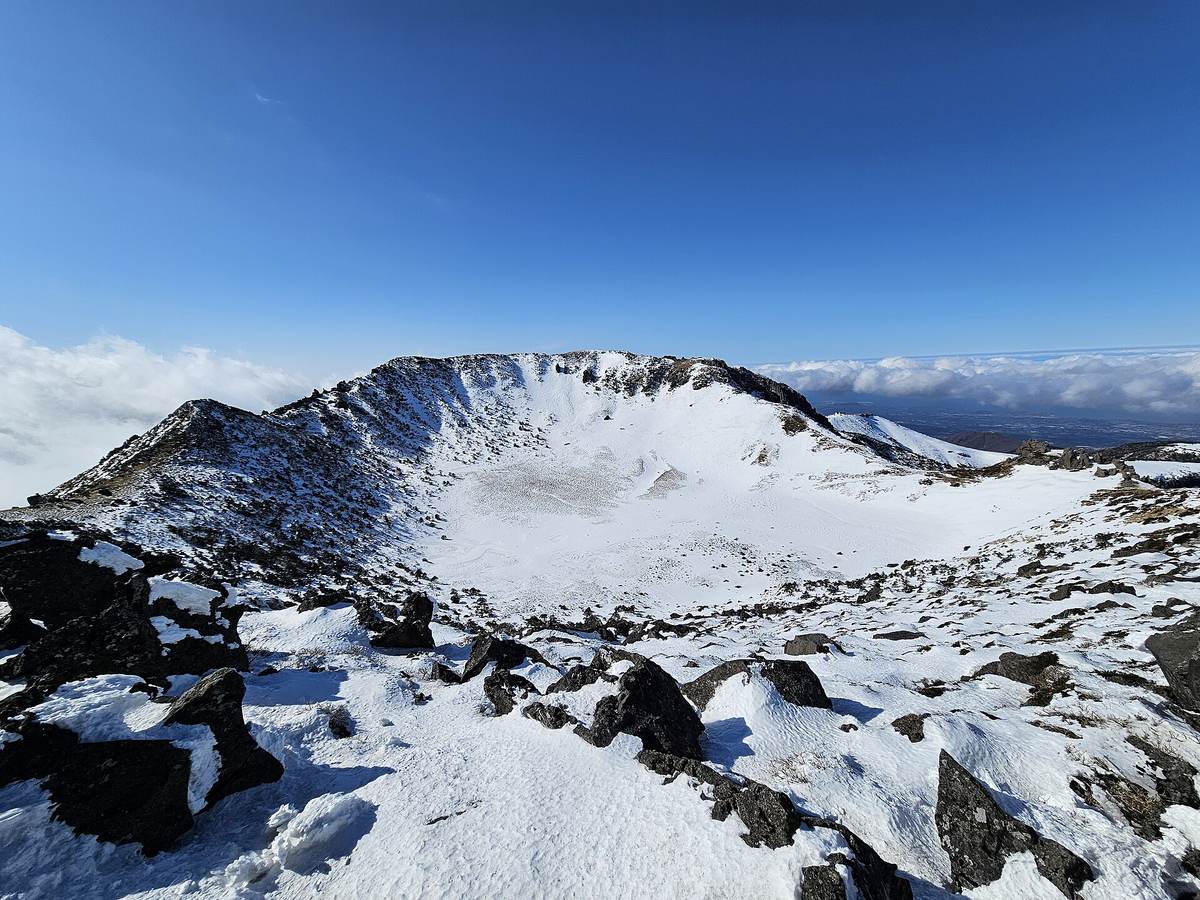
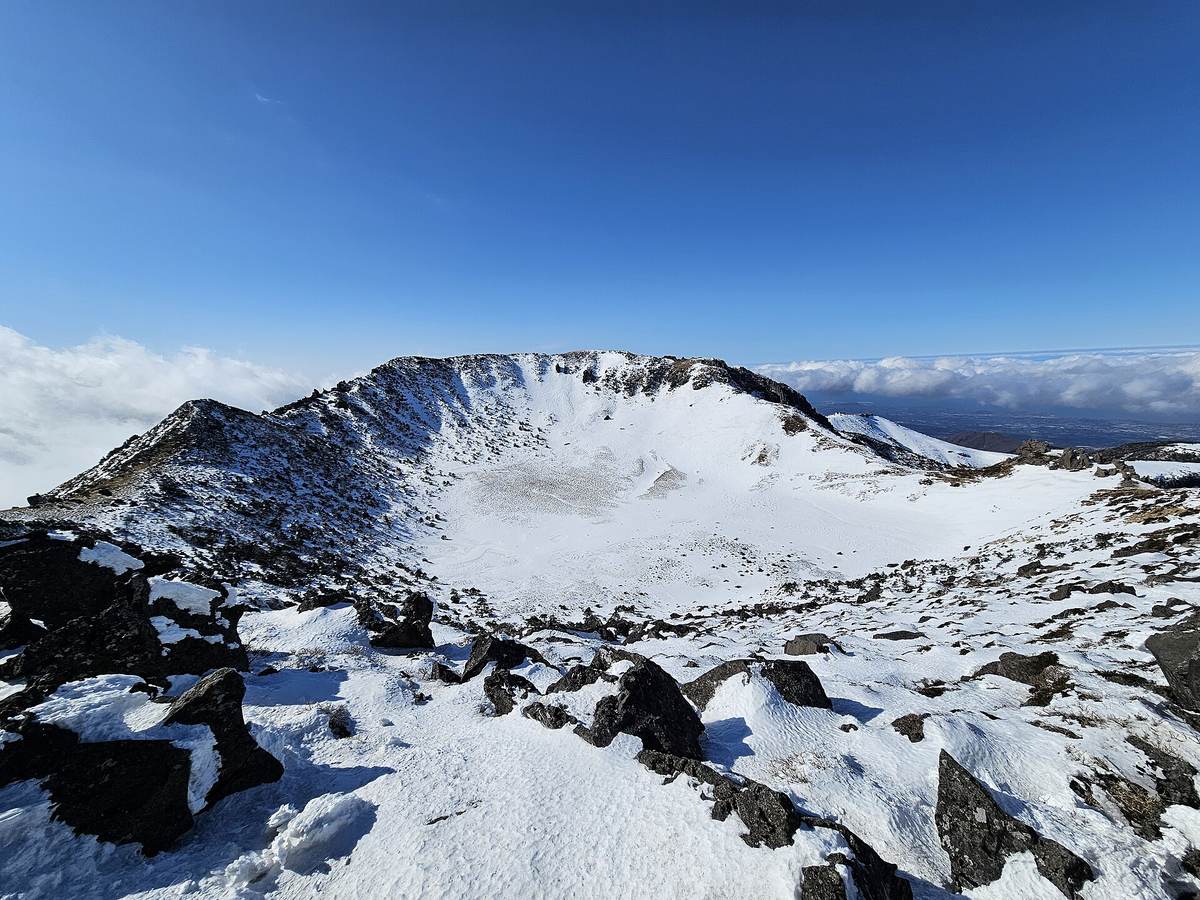
Baengnokdam (백록담), the crater at Hallasan's summit, on 4 January 2025. Snow fills the crater floor. Photo: Sadopaul, Wikimedia Commons, CC BY 4.0.
On ice and snow, Hallasan's rules require crampons, and Korean hikers carry chain spikes from late autumn: Kahtoola MICROspikes stretch over ordinary hiking boots and pack small for the bus. As an Amazon Associate, EpicKor earns from qualifying purchases at no extra cost to you.
Quick Guide: Hallasan's summit this winter
| Question | Answer |
|---|---|
| Is the Gwaneumsa trail open to the summit? | Yes, since 05:00 on 24 September 2026, after closing on 1 August for rockfall-fence and deck repairs |
| Which trails reach the summit? | Only Seongpanak (성판악, 9.6 km) and Gwaneumsa (관음사, 8.7 km) |
| Last entry, 1 Oct–31 Mar | 11:30 at the trailhead and at the Jindallaebat or Samgakbong checkpoint (12:30 from April) |
| Leave the summit by | 13:30 (14:30 in summer) |
| Daily places | Seongpanak 1,000, Gwaneumsa 500 |
| When bookings open | 09:00 on the first working day of the month before; up to 4 people per booking, once a week |
| At the gate | Your own QR code and your passport or ID |
| No-show without cancelling | 3-month booking ban; a second one, 1 year |
| Entry fee | None; car parks charge by time since 1 January 2026 (up to ₩13,000 a day) |
| Crampons | Required on ice and snow |
Black Diamond Spot 400-R headlamp — a rechargeable 400-lumen headlamp for a 05:00 start In winter the gates open at 05:00, long before sunrise, and the forest trail is dark for the first hour; this one charges by USB and has a red mode that will not dazzle the walker behind you. As an Amazon Associate, EpicKor earns from qualifying purchases at no extra cost to you.
See the Black Diamond Spot 400-R on AmazonWhat reopened on 24 September, and why it closed
The Gwaneumsa trail climbs from the north, past the Tamna Valley (탐라계곡) to the staffed Samgakbong shelter (삼각봉대피소) at 6 km. The last 2.7 km, past the peak of Samgakbong (삼각봉), down into the Yongjingak valley (용진각) and up the rock of Wanggwanneung (왕관릉, "crown ridge"), is the steepest part of either summit route, and it is the section that closed.
Jeju Province's World Heritage Office (세계유산본부), which runs the park, posted the closure on 19 June: from 1 August to 30 September 2026 nobody went beyond Samgakbong, so the summit was reachable only from Seongpanak. Crews repaired the damaged rockfall-prevention fence and replaced the ageing decks; a final safety check followed on 15 and 16 September. The work is part of a five-year trail plan with ₩2.5 billion for five districts.
The park's visitor counts show the closure: 1,283 walkers on the Gwaneumsa trail in August 2026, against 6,062 in August 2025. Samgakbong's rock has shut the route before: from 15 September to 31 October 2025 for similar work, and after a rockfall in May 2015 it stayed shut until 1 October 2016.
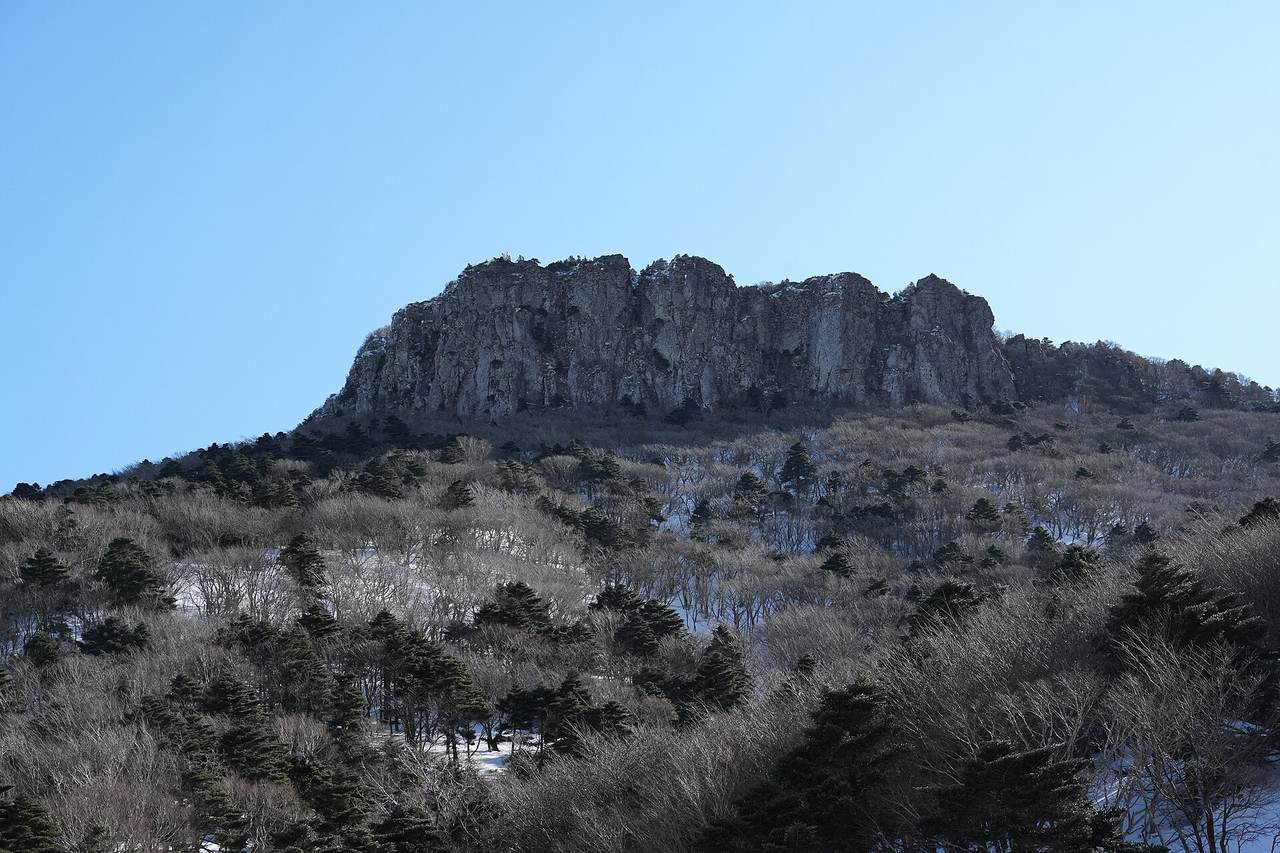
The cliffs of Wanggwanneung (Wanggwanbong), the "crown" rocks on the section between Samgakbong and the summit that reopened on 24 September. Photographed in January 2025. Photo: Sadopaul, Wikimedia Commons, CC BY 4.0.
You might like: Korea National Park Trail Closures, Autumn 2026 (15 Nov–15 Dec): Which Seoraksan, Jirisan and Bukhansan Trails Shut
Only two trails reach the summit
Hallasan has seven marked trails, but only two reach the crater. Eorimok (어리목) and Yeongsil (영실) stop at the Witse-oreum shelter (윗세오름대피소, 1,700 m) and the Nambyeok junction (남벽분기점) below the south wall. You can go up one summit trail and down the other; book the one you climb.
| Seongpanak (성판악) | Gwaneumsa (관음사) | |
|---|---|---|
| Length to the summit | 9.6 km, about 4 h 30 one way | 8.7 km, about 5 h one way |
| Checkpoint on the way | Jindallaebat shelter (진달래밭대피소), 7.3 km, about 3 h | Samgakbong shelter (삼각봉대피소), 6 km, about 3 h 20 |
| Character | Long, mostly gentle forest walk | Deep valley, steep rock after Samgakbong |
| Food on the trail | No shop anywhere | A private rest stop at the entrance only |
| Car park | 156 spaces, full very early | 192 spaces |
| Office phone | 064-725-9950 | 064-756-9950 |
The park's advice is blunt: the round trip takes nine to ten hours, and walkers with heart conditions or no recent hiking should take Eorimok or Yeongsil to 1,700 m instead.
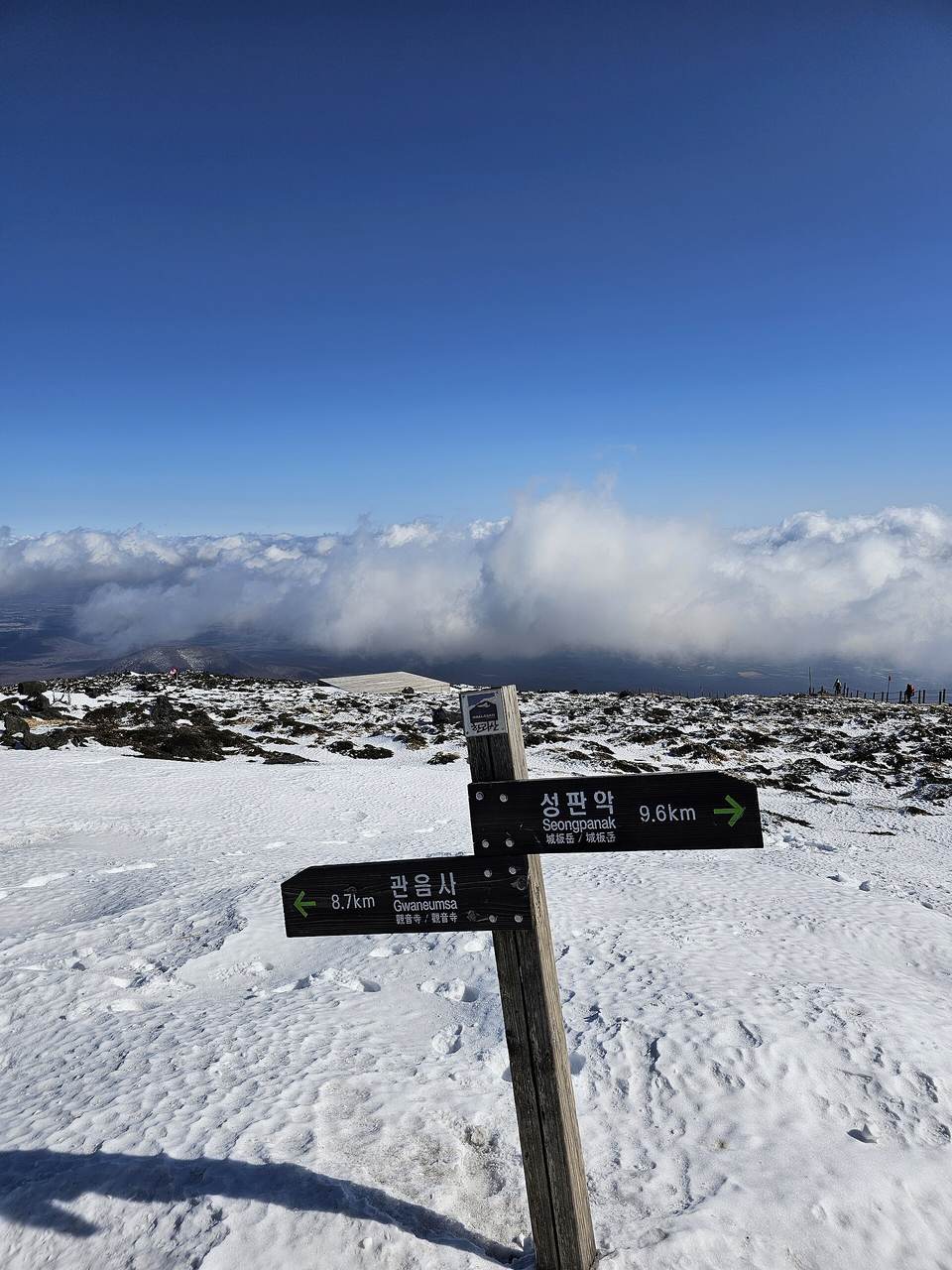
The signpost at the summit: Gwaneumsa 8.7 km one way, Seongpanak 9.6 km the other. They are the only two routes up. January 2025. Photo: Sadopaul, Wikimedia Commons, CC BY 4.0.
The winter cutoffs, 1 October to 31 March
Hallasan has two seasons for its entry times, not three: winter from October to March, summer from April to September. This table has been in force since 1 July 2024 and is repeated in the park's 2026 guideline. Trails open at 05:00 all year.
| Checkpoint | Winter (Oct–Mar) | Summer (Apr–Sep) |
|---|---|---|
| Last entry | ||
| Seongpanak trailhead (성판악 탐방로 입구) | 11:30 | 12:30 |
| Jindallaebat checkpoint (진달래밭통제소) | 11:30 | 12:30 |
| Gwaneumsa trailhead (관음사 탐방로 입구) | 11:30 | 12:30 |
| Samgakbong checkpoint (삼각봉통제소) | 11:30 | 12:30 |
| Eorimok trail checkpoint (어리목) | 12:00 | 15:00 |
| Yeongsil trail checkpoint (영실) | 12:00 | 15:00 |
| Witse-oreum checkpoint, toward the south wall (윗세오름통제소) | 13:00 | 14:00 |
| Donnaeko information post (돈내코) | 10:00 | 11:00 |
| Leave by | ||
| Summit, east rim (동릉 정상) | 13:30 | 14:30 |
| Nambyeok junction (남벽분기점) | 14:00 | 15:00 |
| Witse-oreum (윗세오름) | 15:00 | 17:00 |
| Jindallaebat and Samgakbong shelters | 15:30 | 16:30 |
The time that catches people is the checkpoint, not the trailhead: both close at 11:30, and the checkpoint is three hours or more up the trail. From Seongpanak, be walking by about 08:00, earlier in snow; from Gwaneumsa, by 08:00. Late walkers are turned back, and breaking the entry times brings a fine under the Natural Parks Act. (The booking site's guide page still shows the old table further down, with 12:00 at Jindallaebat; the table above it, the 2024 notice and the 2026 guideline all say 11:30.)
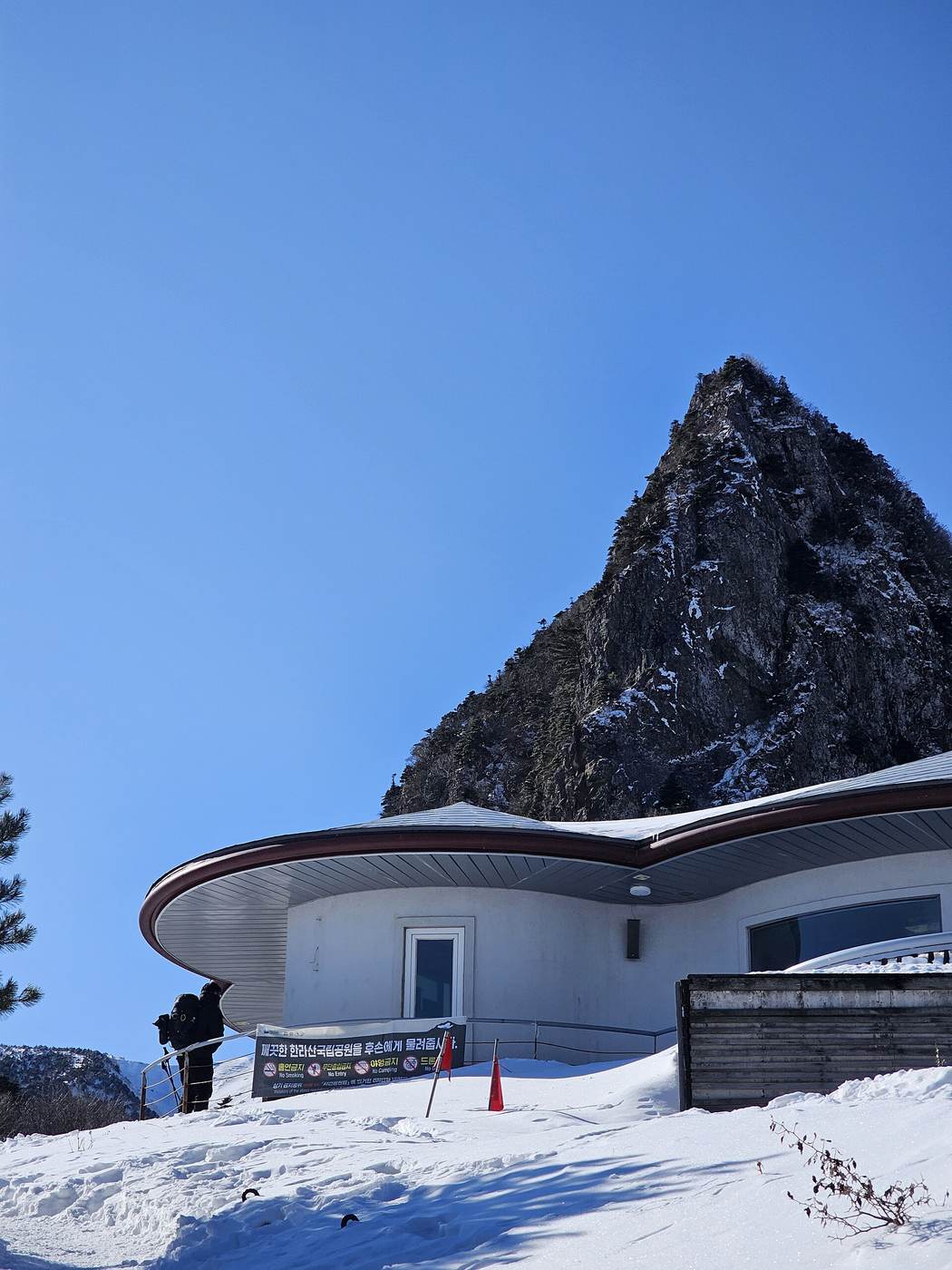
The Samgakbong shelter, the checkpoint for the Gwaneumsa summit section, with Samgakbong behind it. In winter no one passes here after 11:30. January 2025. Photo: Sadopaul, Wikimedia Commons, CC BY 4.0.
How to book, and the no-show ban
You book on the Hallasan reservation system, visithalla.jeju.go.kr (한라산탐방 예약시스템), which has an English page. Since spring 2025 only the sections above Jindallaebat and above Samgakbong need a booking: you can walk up to either shelter without one. Eorimok, Yeongsil, Donnaeko, Seokguram and Eoseungsaengak need no booking at all.
The quotas. Since 1 December 2025 there are two entry slots a day:
| Entry slot | Seongpanak | Gwaneumsa |
|---|---|---|
| 05:00–08:00 | 800 | 400 |
| 08:01–11:30 | 200 | 100 |
| Total per day | 1,000 | 500 |
When. Each month goes on sale at 09:00 on the first working day of the month before: December on Monday 2 November, January 2027 on Tuesday 1 December. Expect a virtual queue on opening day. There is no waiting list.
The rules. One booking covers up to four people; each person can book once a week, and not both summit trails on the same day. Names and dates of birth cannot be changed later. Each person gets a QR code; foreign visitors receive it by email from "visithalla".
How a foreign visitor logs in. Use Kakao login or the non-member email check on the foreign-language pages, which the site recommends for foreigners without Korean real-name verification. Always log in the same way: a booking made with the email check does not show up under Kakao, and you cannot cancel what you cannot see.
At the gate. Staff check one QR code per person and a photo ID, usually a passport. A name that does not match the QR code means no entry and a one-year ban, as does buying or selling a code.
Cancel before your slot ends. You can cancel until the end of your booked slot, so until 11:30 for the 08:01–11:30 slot. After that, an unused booking is a no-show: one no-show bars you from booking for three months, a second for a year. If the park closes the summit for weather, it messages everyone booked; you still have to cancel and rebook yourself.
You might like: Jeju Lava Tubes in 2026: Manjanggul Reopened, How Foreigners Book Geomunoreum
Snow, wind and crampons: when the summit closes
The park's 2026 safe-hiking guideline sets the winter rules:
- Crampons (아이젠) are required on ice and snow; you may walk a frozen trail only wearing them. Gaiters are advised.
- A heavy-snow advisory (대설주의보) closes the summit and Donnaeko; a strong-wind advisory (강풍주의보) closes the summit. A warning of either, or two advisories at once, closes the whole mountain.
- Trails also close when 30 cm or more of snow hides the trail or leaves it unbroken, or when fog or blizzard cuts visibility to 20 m.
- Sleds, skis, tents, sleeping bags and stoves are not allowed on the trails.
A snowy winter can keep the top shut for weeks. In 2025 the summit reopened on 18 March, with the first groups led by park staff, and the Gwaneumsa summit section only on 1 April, because of snow walls and avalanche risk near Samgakbong. Both times, walkers had to wear crampons and gaiters and carry poles. Check the park's live trail page (jeju.go.kr/hallasan, "실시간탐방로 정보") before you catch the bus.
All year, alcohol, smoking, cooking and disposable lunch boxes are banned (kimbap and burgers are allowed), with fines of up to ₩2 million.
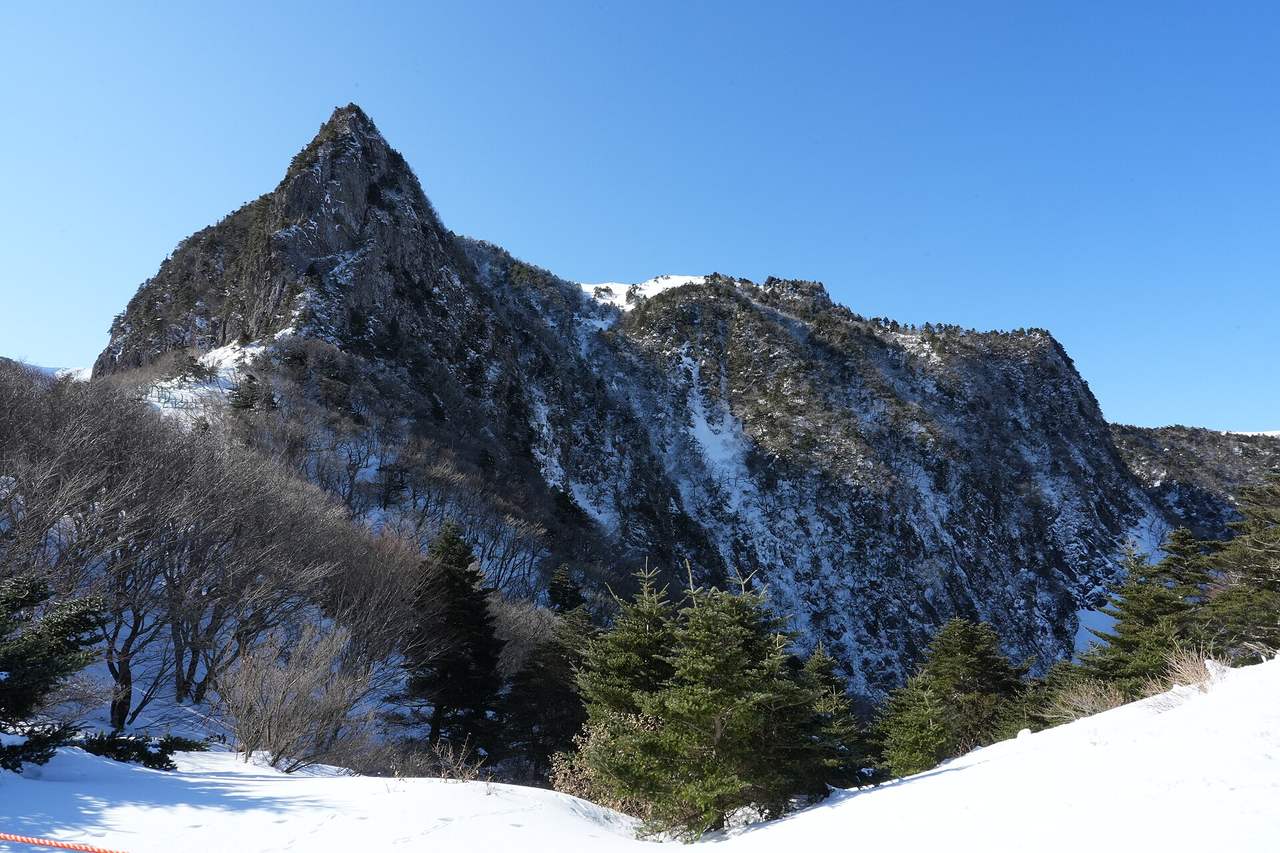
Samgakbong ("triangle peak") from the Gwaneumsa trail in January 2025. The section that closed from August to September climbs from here to the summit. Photo: Sadopaul, Wikimedia Commons, CC BY 4.0.
Getting there: buses and the new parking fees
Seongpanak. Bus 281 runs from Jeju Bus Terminal along the 5.16 road from 06:00, every 10–14 minutes, about 45 minutes to the trailhead. Express 181 from Jeju airport takes about 35 minutes (first bus 06:10). The 156-space car park fills very early; a free 199-space lot near Jeju International University takes the overflow, and roadside parking is fined.
Gwaneumsa. Take the 281 to Sancheondan (산천단) and change at the Korea Polytechnic (West) stop to bus 475 (06:20–19:45, every 45–90 minutes, about 7 minutes).
Eorimok and Yeongsil. Bus 240 runs along the 1100 road, about 35 minutes to Eorimok and 50 to Yeongsil. Last winter the province added the Halla Snow-Flower Buses (한라눈꽃버스) 1100 and 1100-1; check this winter's timetable on bus.jeju.go.kr.
Fees. Since 1 January 2026 the car parks charge ₩1,000 for the first hour, then ₩500 per 20 minutes, up to ₩13,000 a day, instead of the old flat ₩1,800. There is no entry fee: a 2016 working group proposed about ₩20,000 and a 2018 study ₩26,000–35,000, but the fee table on the reservation site is still blank.
Stay in Jeju City for a 05:00 start — Agoda's Jeju hotel list The first 281 leaves Jeju Bus Terminal at 06:00 and the 181 from the airport at 06:10, so a room near either makes the 11:30 checkpoint far easier than a base in Seogwipo. Check taxes, cancellation terms and the final price for your dates. EpicKor may earn a commission from qualifying bookings at no extra cost to you.
Compare Jeju City hotels on AgodaWhen not to aim for the summit
- Pick Eorimok or Yeongsil if you are not a regular hiker. No booking, 1,700 m at the Witse-oreum shelter in about two hours (Eorimok) or an hour and a half (Yeongsil), a later 12:00 cutoff, and a plateau walk to the foot of the crater's south wall. Most winter walkers choose them: in January 2026 Yeongsil had 64,235 visitors and Eorimok 42,890, against 24,651 at Seongpanak and 12,301 at Gwaneumsa.
- Skip the summit when an advisory is forecast. The top closes; the lower trails often stay open.
- Do not book "just in case". An unused, uncancelled booking is the three-month ban.
- Do not start late. Miss 11:30 at the checkpoint and you are turned back with the long walk down still ahead.
- Choose Seongpanak for a first winter ascent. Gwaneumsa has half the places and the steep, rebuilt section after Samgakbong; many walkers go up Seongpanak and down Gwaneumsa.
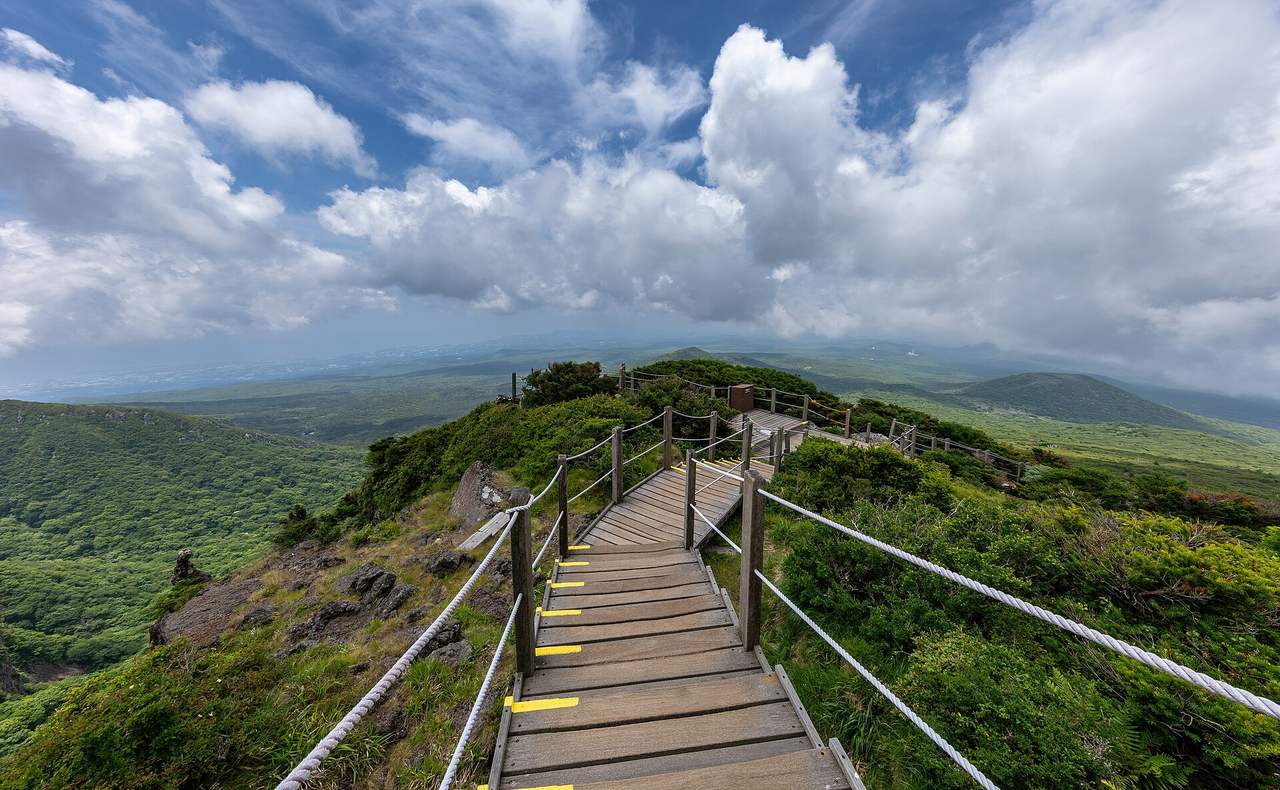
The Yeongsil trail in June 2024, one of the routes to 1,700 m that need no booking. In winter these slopes are under snow. Photo: Basile Morin, Wikimedia Commons, CC BY-SA 4.0.
If you do reach the top, you can get the official summit certificate the same day: since 1 September 2026 as a PDF from the reservation site (no kiosk queue), using your booking number and a summit photo.
You might like: Renting a Car in Korea as a Foreigner (2026): Jeju's New Discount Cap and Car Limit
FAQ
Q: Is the Gwaneumsa trail to Hallasan's summit open now? Yes. The Samgakbong-to-summit section closed on 1 August 2026 for rockfall-fence and deck repairs and reopened at 05:00 on 24 September 2026. Book on visithalla.jeju.go.kr.
Q: What time must I pass the checkpoint in winter? From 1 October to 31 March, 11:30 at the Seongpanak and Gwaneumsa trailheads and the Jindallaebat and Samgakbong checkpoints; leave the summit by 13:30. From April to September it is 12:30 and 14:30.
Q: How many people can climb Hallasan each day? 1,000 from Seongpanak and 500 from Gwaneumsa, in a 05:00–08:00 slot and an 08:01–11:30 slot. Eorimok and Yeongsil have no quota.
Q: Can foreigners book Hallasan? Yes, on the English page with the email check or Kakao login. The QR code comes by email; bring your passport to the gate.
Q: What happens if I miss my Hallasan reservation? If you neither use nor cancel it before your slot ends, you cannot book for three months; a second no-show means a year.
Sources
- Hallasan reservation system (visithalla.jeju.go.kr): notices of 18 Sep 2026 (reopening), 27 Aug 2026, 19 Jun 2026 (closure), 5 Jun 2026 (QR and ID, parking, buses), 24 Oct 2025 (quotas), 30 Jul 2025, 23 Apr 2025 (booking rules), March 2025 and 22 Feb 2024 (entry times); booking guide, fee page, trail pages, login page, FAQ; read 25–26 September 2026.
- Hallasan National Park office (jeju.go.kr/hallasan): reopening notice (21 Sep 2026); 2026 safe-hiking guideline (entry times, crampons, weather closures, closure history); parking-fee rule from 1 Jan 2026; banned-activities notice; trail and directions pages; visitor statistics to 31 Aug 2026.
- News N Jeju, Jejupod, Asia Economy and Seoul Shinmun (18 September 2026): repairs, 15–16 September inspection, ₩2.5 billion five-year plan.
- Newsis (9 December 2025): new parking fees and the former ₩1,800 flat fee.
- Hankyung (15 December 2016) and Hankook Ilbo (21 June 2018): entry-fee proposals.
You Might Also Like
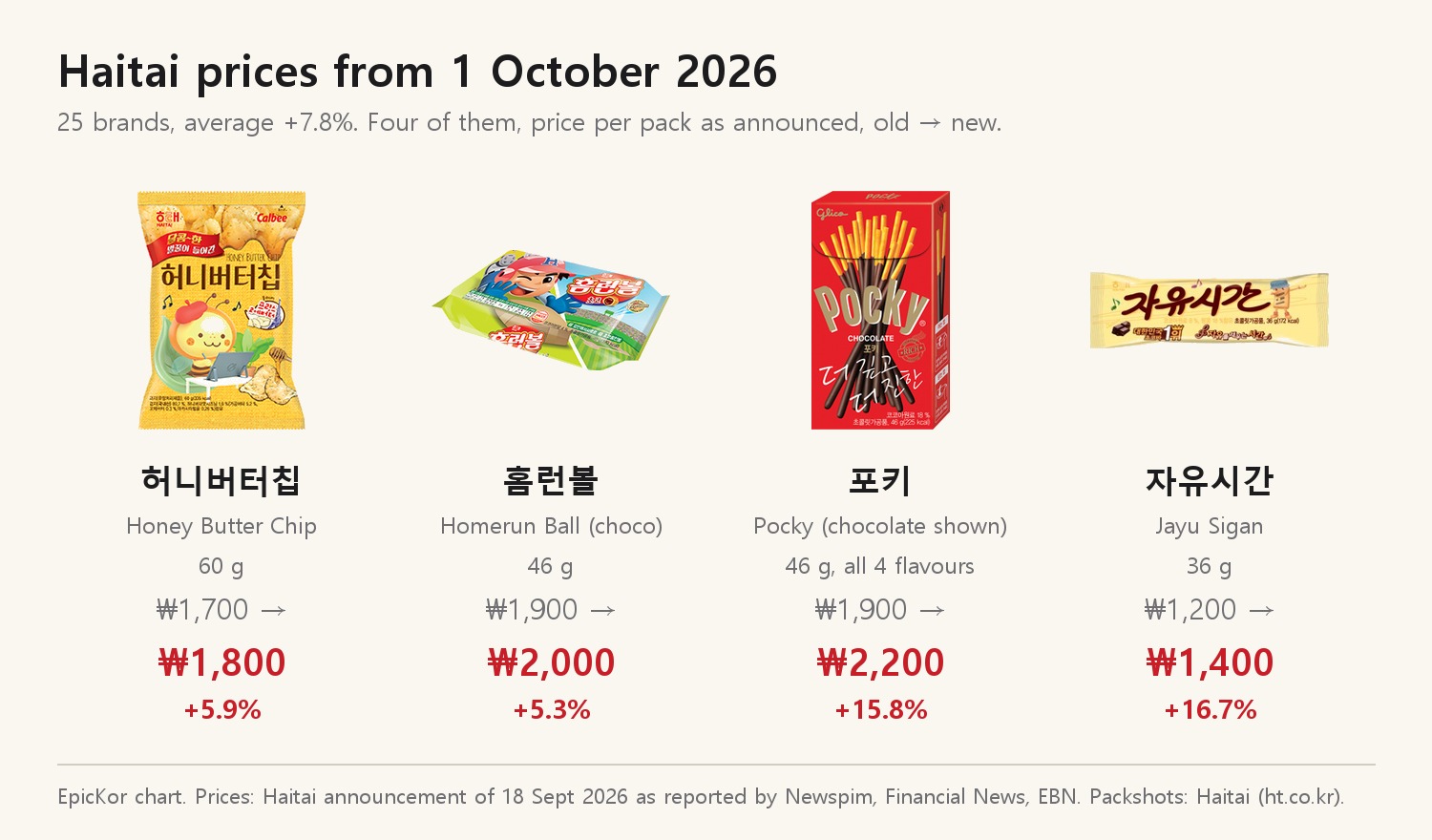
Korean Snack Prices From 1 October 2026: Haitai Raises 25 Brands by 7.8%, Pocky Jumps 15.8%, and 14 Packs Shrink Instead
Pocky goes from ₩1,900 to ₩2,200 in Korea on 1 October 2026, and Honey Butter Chip is on both of Haitai's lists: the 60 g bag rises ₩100 while other packs shrink instead. Every new price, the shrink list, and Ottogi's 20% rice rise.
Flu in Korea (2026): The Advisory Came on 11 September, a Rapid Flu Test Costs ₩30,000 and a Flu Shot ₩30,000–₩40,000 Without Korean Insurance, and Short-Term Visitors Cannot Get the Free One
Korea declared its 2026–27 flu advisory on 11 September, the earliest date in KDCA's records back to 2011. Uninsured, a rapid flu test's median posted price is ₩30,000 and a shot ₩30,000–₩40,000. Visitors staying under 3 months get no free vaccine.
LASIK Cost in Korea (2026): The Government's Price Data Says ₩2.5 Million for Both Eyes, LASEK ₩1.6 Million, and SMILE Is Hiding Inside the LASIK Number
Korea's official fee data puts LASIK at a national median of ₩2,500,000 for both eyes, not one, and LASEK at ₩1,600,000. SMILE has no line of its own, and the ₩7.7 million top price is one clinic's SmilePro. How to check any Korean clinic.