Korea Departure Tax (2026): The ₩24,000 Already Inside Every Ticket Out of Incheon, Who Pays Nothing, and the Rise Waiting in Parliament
Last updated: 7 October 2026. Amounts come from the Enforcement Decree of the Tourism Promotion and Development Fund Act (in force from 2 January 2026), Korea's Aeronautical Information Publication and the airlines' October 2026 fuel-surcharge notices. Bill details come from the National Assembly record and Korean press reports up to 29 September 2026.
If you came here looking for the VAT you get back on an Olive Young or Daiso receipt, that is a different refund with its own counters and rules: see our Korea Tax Refund Guide. This page is about the money you paid for the act of leaving Korea, which is already inside your plane ticket.
Many travellers searching for Korea departure tax expect a desk at Incheon where they pay before boarding. There is no such desk. Korea puts two government charges on every international ticket from a Korean airport, and the airline passes them on. From Incheon or Gimpo they add up to ₩24,000 per adult (As of October 2026). Most people never notice them, because they sit in the "taxes and fees" line next to a fuel surcharge that is usually two to fifteen times larger.
Planning the trip in and out: Lonely Planet Korea (latest edition) on AmazonAffiliate link. As an Amazon Associate, EpicKor earns from qualifying purchases at no extra cost to you.
Quick Guide: What leaving Korea costs, October 2026
| Question | Answer (As of October 2026) |
|---|---|
| Is there a departure tax to pay at the airport? | No. Both charges are built into the ticket price |
| Departure levy (출국납부금, chulguk nappugeum) | ₩7,000 by air, ₩1,000 by sea. Since 1 July 2024 (was ₩10,000) |
| Airport charge (여객공항이용료), international | ₩17,000 at Incheon and Gimpo, ₩12,000 at other airports, ₩10,000 for transfer passengers |
| Total government charges from Incheon or Gimpo | ₩24,000 per adult (₩19,000 from Busan, Jeju and other regional airports) |
| Children | Under 12: no departure levy. Under 2: no airport charge either |
| The old ₩1,000 disease-fund charge | Abolished from 1 January 2025. Guides quoting ₩25,000 or ₩28,000 are out of date |
| Fuel surcharge (유류할증료), not a tax | October 2026 is stage 23: Korean Air ₩49,000 to ₩362,600 one way, Asiana ₩53,400 to ₩301,200 |
| Will the levy go up? | Two bills in the National Assembly: ₩20,000 (Jo Gye-won, Dec 2025) and a ₩30,000 ceiling (Lee Jae-jung, Aug 2026). Neither has passed |
| Unused ticket? | Ask the airline to return the ₩24,000. There is no statutory 5-year claim right yet; that bill is still in committee |
The ₩24,000: two charges, two laws, two collectors
The number is the sum of two unrelated charges that happen to be collected the same way.
The departure levy, ₩7,000. This is a charge for the Tourism Promotion and Development Fund (관광진흥개발기금), managed by the Ministry of Culture, Sports and Tourism (문화체육관광부). Article 2(3) of the fund's law says everyone leaving through a Korean airport or port pays an amount "within ₩10,000" set by presidential decree. The decree, Article 1-2(2), is short. In the Korean original it reads: "납부금은 7천원으로 한다. 다만, 선박을 이용하는 경우에는 1천원으로 한다" (the levy is ₩7,000; for those leaving by ship, ₩1,000). That wording dates from an amendment of 4 June 2024, which took effect on 1 July 2024 and cut the levy from the ₩10,000 it had been since 1997.
Legally it is a budamgeum (부담금), a public charge earmarked for a fund, not a tax. The fund lends to hotels and pays for tourism marketing. The law even gives you 60 days to file an objection with the Culture Minister.
The airport charge, ₩17,000. This one is a fee for using the airport, charged under Article 32 of the Airport Facilities Act (공항시설법) by whoever runs the airport: Incheon International Airport Corporation (인천국제공항공사) at Incheon, and Korea Airports Corporation (한국공항공사) at Gimpo and the other state-run airports. Each operator files its fee with the transport ministry. The ladder looks like this:
| Departing from | International | Transfer passenger | Domestic |
|---|---|---|---|
| Incheon (ICN) | ₩17,000 | ₩10,000 | ₩5,000 |
| Gimpo (GMP) | ₩17,000 | ₩10,000 | ₩4,000 |
| Gimhae (Busan), Jeju, Cheongju, Daegu and other airports | ₩12,000 | ₩10,000 | ₩4,000 |
Sources: Korea Office of Civil Aviation, AIP Korea GEN 4.1; Korea Airports Corporation fee page; transport ministry figures reported in September 2024.
So a flight from Gimhae to Osaka carries ₩19,000 of Korean government charges (₩12,000 + ₩7,000), while the same flight from Incheon carries ₩24,000. If you are choosing between airports for other reasons, our guide to Korea's other international airports lists which ones actually fly abroad.
Here is the part you will not find on a passenger-facing price page: we could not find the ₩17,000 anywhere on Incheon Airport's passenger pages, in Korean or English. The amount is published in Korea's aeronautical information publication, which airlines read, and on Korea Airports Corporation's Korean-only fee page. Most travellers see it only as a line on their receipt.
Valante family travel document organizer (RFID): one place for passports and e-ticket receipts If you ever need to claim back the ₩24,000 on a ticket you didn't use, the airline will ask for the ticket number and the itinerary receipt, not the boarding pass. A zipped organizer with slots for several passports and folded printouts keeps a family's receipts together until the trip is over. We found no product that changes what you pay in charges, so this is the only box on this page. As an Amazon Associate, EpicKor earns from qualifying purchases at no extra cost to you.
See the Valante organizer on AmazonYou might like: Incheon Airport to Seoul Guide: AREX, Bus, Taxi, for the trip in the other direction.
Who pays less, or nothing
The two charges have different exemption lists, which is why a child can pay one and not the other.
| Passenger | Airport charge (₩17,000 / ₩12,000) | Departure levy (₩7,000) |
|---|---|---|
| Adult, 12 and over | Pays | Pays |
| Child aged 2 to 11 | Pays | Exempt (since 1 July 2024; before that only under-2s were) |
| Infant under 2 | Exempt | Exempt |
| Transfer passenger at Incheon | ₩10,000 transfer rate | Exempt if you left the transit area only because your flight couldn't leave, the airport closed or the plane diverted, or for a sightseeing trip and came back within 24 hours |
| Diplomatic passport holder | Exempt | Exempt |
| Airline crew on duty | Not a passenger | Exempt |
| Deported at state expense | Exempt | Exempt |
| Refused entry at the border | Not on the exemption list | Exempt |
Sources: Enforcement Decree of the Tourism Promotion and Development Fund Act, Article 1-2(1); AIP Korea GEN 4.1.
So a family of two adults and two children aged 5 and 9 flying out of Incheon pays ₩82,000 in Korean charges: ₩24,000 for each adult and ₩17,000 for each child. Before July 2024 the same family paid ₩112,000: ₩28,000 each, because only under-2s were exempt from the levy and the old ₩1,000 disease-fund charge still applied.
The 24-hour rule is the one that matters to layover passengers. Incheon runs free transit tours, and the decree specifically exempts transit passengers who leave the bonded area "for sightseeing" and come back within 24 hours. The decree makes the airline file the exemption with the collector at least an hour before the flight leaves. Our Incheon Airport layover guide covers whether leaving the airport is worth it.
Leaving by ferry: ₩1,000
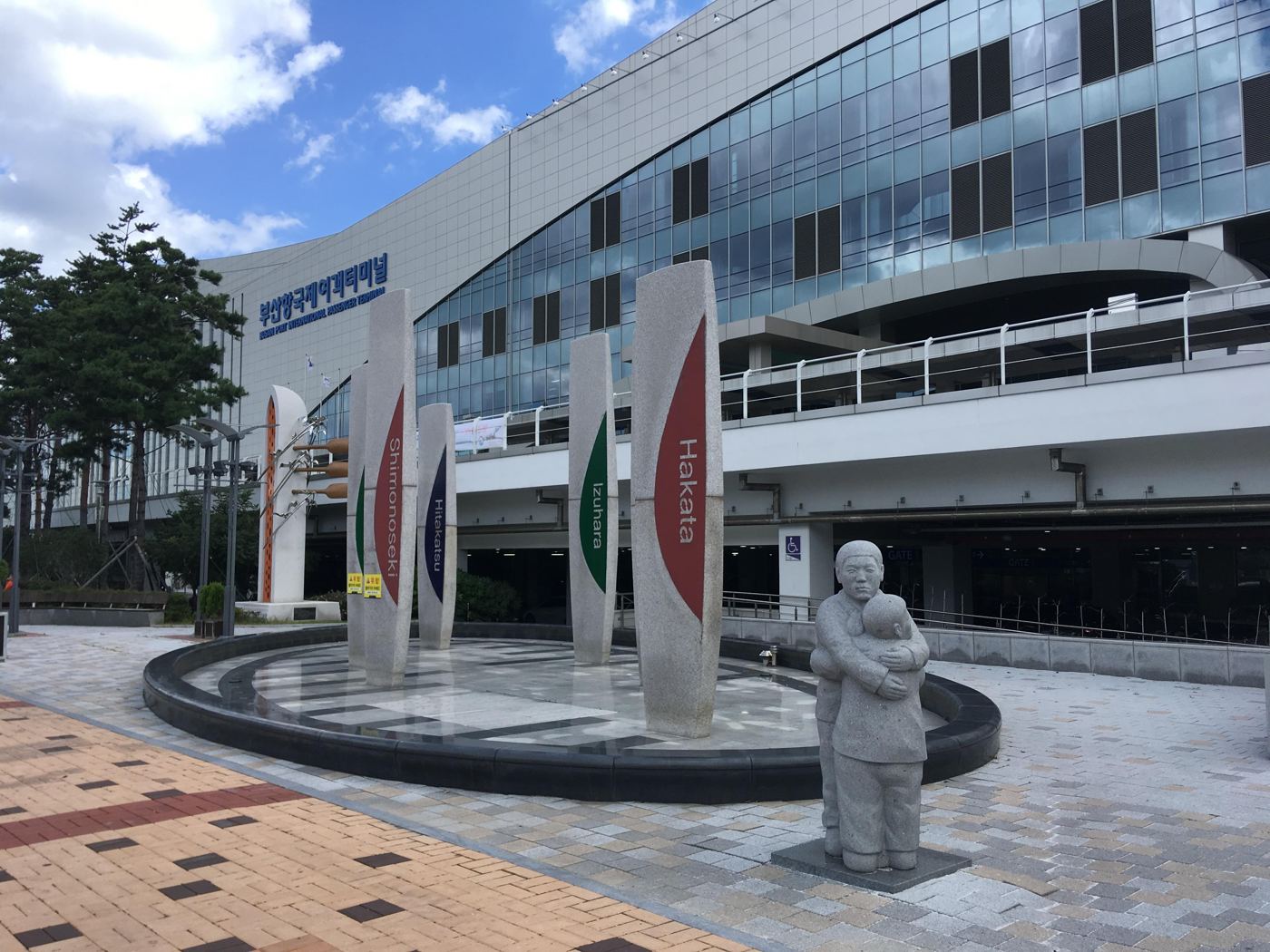
The levy is not only for flights. If you leave on a ferry to Japan from Busan Port International Passenger Terminal (부산항국제여객터미널), the decree sets it at ₩1,000. Ferry operators collect it with the fare, alongside their own surcharges. The 2024 amendment cut only the air rate; the sea rate stayed at ₩1,000.
The ₩1,000 that disappeared, and why old guides say ₩28,000
From 2007 until the end of 2024, a third Korean charge sat on every international ticket: a ₩1,000 contribution that began as an international poverty-relief levy and, from 2017, went to the International Disease Eradication Fund (국제질병퇴치기금), which paid for AIDS, malaria and tuberculosis programmes abroad. The National Assembly voted to repeal the fund's law on 10 December 2024. The repeal took effect on 1 January 2025, so the charge is no longer collected.
That gives three different "right answers" depending on when a guide was written:
| Period | Airport charge | Departure levy | Disease fund | Total from Incheon |
|---|---|---|---|---|
| Until 30 June 2024 | ₩17,000 | ₩10,000 | ₩1,000 | ₩28,000 |
| 1 July to 31 December 2024 | ₩17,000 | ₩7,000 | ₩1,000 | ₩25,000 |
| From 1 January 2025 (now) | ₩17,000 | ₩7,000 | — | ₩24,000 |
If you see ₩8,000 quoted as the levy (₩7,000 plus the disease fund's ₩1,000), the writer is using pre-2025 numbers. Some Korean news stories still do.
You might like: Incheon Airport Money Exchange in Korea, the other place where leaving Korea quietly costs you money.
The fuel surcharge is the big number, and it is not a tax
On most tickets the largest extra line is the fuel surcharge (유류할증료, yuryu haljeungnyo). It is set by the airline, not the government, though airlines must file it with the transport ministry. Korean carriers use a 33-stage scale linked to the average price of Singapore jet fuel (MOPS) from the 16th of the month before last to the 15th of last month.
For October 2026, the average was US$158.57 a barrel, up 6.22% from US$149.29, which put tickets at stage 23, two stages above September's 21. The October one-way surcharges on flights from Korea are:
| Airline | Shortest routes (e.g. Fukuoka) | Longest routes (e.g. New York) |
|---|---|---|
| Korean Air (대한항공) | ₩49,000 | ₩362,600 (New York, Dallas, Boston) |
| Asiana Airlines (아시아나항공) | ₩53,400 | ₩301,200 |
Sources: Korean Air notice for October 2026 international fuel surcharges; SBS Biz, 16 September 2026.
Two details catch people out. The surcharge follows the issue date, not the flight date: a ticket bought on 20 October for a December trip carries October's surcharge, with nothing added or refunded later. And the return leg follows the departure country's rules, so doubling the Korean one-way figure is wrong. The November 2026 table was not out when we checked on 7 October; airlines usually announce it in mid-month, after the fuel window closes on the 15th. If the stage is about to fall, wait; if it is rising, buy before the 1st.
For scale, October's Korean Air surcharge to New York is about 15 times the ₩24,000 of government charges.
The rise waiting in the National Assembly
The ₩7,000 levy may not last. Two amendments to the Tourism Promotion and Development Fund Act are pending:
- Jo Gye-won (조계원), Democratic Party, December 2025: set the levy in the law itself at ₩20,000 for airports and ₩1,000 for ports, instead of leaving it to decree. It was placed on the agenda of the Culture, Sports and Tourism Committee in February 2026.
- Lee Jae-jung (이재정), Democratic Party, committee chair, 18 August 2026: raise the legal ceiling from ₩10,000 to ₩30,000, leaving the exact amount to decree.
The argument is money: Korean press reports put the fund's levy income at ₩262.4 billion in 2025, down from ₩335.8 billion in 2024. In December 2025 President Lee Jae-myung said the cut had "seriously worsened" the fund and the levy should at least return to ₩10,000. A Culture Ministry projection reported on 29 September 2026 assumes a ₩20,000 levy from the second quarter of 2027, which would more than double collections to about ₩736.7 billion, but only if the law passes. Neither bill had passed a committee vote as of 7 October 2026.
What it would mean per adult ticket from Incheon, assuming the airport charge stays at ₩17,000:
| Scenario | Departure levy | Total Korean charges |
|---|---|---|
| Now | ₩7,000 | ₩24,000 |
| Back to the pre-2024 level | ₩10,000 | ₩27,000 |
| Jo Gye-won bill | ₩20,000 | ₩37,000 |
| Lee Jae-jung bill, if the decree uses the full ceiling | ₩30,000 | ₩47,000 |
Japan has already done this. Japan's International Tourist Tax (国際観光旅客税), a real national tax, went from ¥1,000 to ¥3,000 per departure on 1 July 2026, its first rise since it began in January 2019. Japan let tickets bought before the change, with a fixed travel date, keep the old ¥1,000. Korea's bills don't yet say how they would treat tickets bought before a rise; in the 2024 cut, the issue date decided which rate applied.
You might like: 18.9 Million Visitors Told Korea What They Couldn't Find, Korea's official exit survey, and where the tourism fund's money is supposed to help.
Getting the ₩24,000 back on a ticket you didn't use
Both charges exist because you leave Korea. If you never fly, the airport was not used and you did not depart, so the money should come back. In practice it works like this:
- If you cancel before departure, the refund rules of your fare decide what happens to the fare itself, but most airlines return government charges with the refund, even on fares marked non-refundable, because they were collected for a departure that did not happen. Ask for the "taxes and fees" to be refunded specifically.
- If you simply didn't show up, request the refund of the taxes from the airline, or from the travel agency if you booked through one, with the ticket number. This is currently the airline's own customer-service practice, not a legal right with a fixed deadline.
The honest catch. In September 2024 the transport ministry proposed giving no-show passengers a legal right to reclaim the airport charge for five years from the scheduled flight date, with unclaimed money going to a public fund rather than staying with airlines. A bill along the same lines (Kang Dae-sik, 강대식, August 2024) was sent to a subcommittee of the transport committee in November 2024. It has not become law. The Airport Facilities Act in force since 27 February 2026 has no such clause. Some English and Korean pages describe the five-year right as if it already exists; it does not. Also check the fine print before you claim through a booking site: some charge a processing fee that can be larger than the ₩24,000 you would get back.
The other refund covers only old tickets. People who bought tickets by 30 June 2024 for flights on or after 1 July 2024 had paid the old ₩10,000. They can claim the overpayment on Incheon International Airport Corporation's refund site (tour-refund.kr): ₩3,000 for anyone 12 or over, ₩10,000 for children aged 2 to 11. About 1.8 million people had applied by the end of July 2025, and foreign passport holders were reported eligible. It does not apply to anyone leaving Korea now.
How to read the charges on your e-ticket receipt
Your e-ticket receipt splits the price into the fare, the carrier-imposed surcharge (the fuel surcharge, often coded YQ or YR, which is airline money) and taxes, fees and charges (government and airport money, each with a two-letter code). The codes for the Korean charges vary between booking systems, so look for the amounts in won: KRW 17,000 and KRW 7,000, or a single combined KRW 24,000, on a ticket from Incheon or Gimpo. Children aged 2 to 11 should show only the airport charge. On a round trip that starts abroad, the Korean charges sit on the return leg and the foreign country's charges on the outbound one. If you see an extra KRW 1,000 on a ticket issued after 1 January 2025, ask the airline about it: the disease fund charge no longer exists.
You might like: Korea e-Arrival Card vs K-ETA, the other paperwork question before you fly.
Frequently Asked Questions
Q: How much is the departure tax in Korea? Korea has no departure tax that you pay at the airport. Each international ticket includes a ₩7,000 departure levy (출국납부금) and an airport charge of ₩17,000 at Incheon and Gimpo or ₩12,000 at other airports. From Incheon the total is ₩24,000 per adult as of October 2026. Leaving by ferry, the levy is ₩1,000.
Q: Do children pay the Korea departure levy? No, not under 12. Since 1 July 2024, children under 12 have been exempt from the ₩7,000 levy; before that only children under 2 were. Children aged 2 to 11 still pay the airport charge. Infants under 2 pay neither.
Q: Is the Korea departure tax going up? Possibly. Two bills are in the National Assembly: one would set the levy at ₩20,000 and the other would raise its ceiling to ₩30,000. A ministry projection assumes the second quarter of 2027 as the earliest start, but as of 7 October 2026 neither bill had passed.
Q: Can I get the departure tax back if I don't fly? Yes, in practice. Ask the airline or agency to refund the taxes and fees on the unused ticket. Korea has not yet made this a legal right with a five-year deadline. That bill is still in committee.
Sources
- Tourism Promotion and Development Fund Act (관광진흥개발기금법), Article 2(3)–(5), and its Enforcement Decree (시행령), Articles 1-2 and 1-3, version in force from 2 January 2026: law.go.kr. Ministry of Culture, Sports and Tourism notice on the July 2024 cut, 28 June 2024: mcst.go.kr.
- Airport Facilities Act (공항시설법), Article 32, version in force from 27 February 2026: law.go.kr. Korea Office of Civil Aviation, AIP Korea GEN 4.1 (passenger service charges): aim.koca.go.kr. Korea Airports Corporation fee page (Korean): airport.co.kr.
- Repeal of the International Disease Eradication Fund Act, passed 10 December 2024, in force 1 January 2025: Future Chosun; repeal record on law.go.kr.
- October 2026 fuel surcharge: Korean Air notice; SBS Biz, 16 September 2026.
- Levy bills: Jo Gye-won bill and fund revenue, Herald Economy, 29 March 2026 and 22 June 2026; Lee Jae-jung bill, Asia Economy, 26 August 2026; government timing, Wikitree, 29 September 2026; President Lee's remarks, Insight, 17 December 2025.
- No-show airport-charge refund proposal: Korea JoongAng Daily, 19 September 2024; Kang Dae-sik bill no. 2202744 and its committee status: National Assembly legislation portal.
- 2024 overpayment refund (tour-refund.kr): Herald Economy, 4 August 2025.
- Japan's International Tourist Tax at ¥3,000 from 1 July 2026: Japan Tourism Agency leaflet mlit.go.jp; National Tax Agency Q&A: nta.go.jp.
You Might Also Like
Jeju Buses, Korea (2026): ₩1,150 a Ride, the 600 and 601 Airport Buses to Jungmun, Foreign Cards That Tap, and Getting Around Without a Rental Car
A Jeju bus ride still costs ₩1,150 by card: the fare rise was frozen again for 2026. Since August 2025 foreign Visa cards tap to pay, a first in Korea. And the 601, not the 600, drives into the Jungmun hotels. Fares, routes, times.
Jeju Lava Tubes in 2026, Korea: Manjanggul Reopened After Two and a Half Years, How Foreigners Book Geomunoreum, and the Closed Caves That Open 4–18 October
Jeju's Manjanggul lava tube reopened on 30 May 2026 after a rockfall closure. Geomunoreum takes 50 people per slot, closes on Tuesdays and lets foreigners book with a Google login. The fees, buses and festival-only caves, from Jeju's own pages.
Korea Winter Electricity and Gas Bills (2026–27): Why January Costs More Than August, and What a Seoul Flat Pays
In Korea the same 300 kWh costs about 25% more in January than in August, because KEPCO widens its price tiers in summer and never in winter. Worked January bills for gas, district heating and electric heaters in Seoul, from official 2026 rates.