Korea National Pension Refund for Foreigners: 50 Countries Qualify, China and Japan Don't — Unless You Worked on an E-9 or H-2 Visa
Last updated: 23 October 2026. Rules read that day on the National Pension Service (국민연금공단) Korean and English pages and in the National Pension Act (국민연금법) as amended on 20 October 2026, on law.go.kr. Country list: NPS, as of May 2026 (Korean page) and 15 June 2026 (English page), identical. ₩1,334 = US$1 (Federal Reserve, 16 October 2026). A guide, not legal advice; sources at the end.
The Korea national pension refund for foreigners is called 반환일시금 (banhwan ilsigeum), the "lump-sum refund". When you leave Korea for good, the National Pension Service (NPS) can pay back every won paid into the pension in your name, your 4.75% and your employer's 4.75% in 2026, plus interest. Most foreign workers assume it is automatic. It is not. Whether you get it depends on two things you cannot change on the day you leave: your passport and the visa you held while you paid in.
The law, Article 126(5) of the National Pension Act, starts from "no refund for foreigners", then lists exceptions. On the NPS's current list, nationals of 50 countries qualify on any visa (nine of them only after 6–12 months of membership). Anyone who paid in on an E-9 (Employment Permit System) or H-2 (Visiting Employment) visa qualifies whatever their nationality. Everyone else, including Chinese, Japanese, British, Vietnamese and Mongolian nationals on other visas, pays in and gets nothing back on leaving.
Airport refund day takes passport, claim receipt, payment order and exchange slip, in that order. A zipped Valante document folio keeps them together. See it on AmazonAffiliate link. As an Amazon Associate, EpicKor earns from qualifying purchases at no extra cost to you.
Quick Guide: Korea's pension refund for foreigners, October 2026
| Question | Answer |
|---|---|
| What it is | 반환일시금 (lump-sum refund): your pension contributions plus your employer's, plus interest, paid once when you leave Korea for good (National Pension Act Art. 77) |
| Who gets it | Nationals of 24 social-security-agreement countries and 26 reciprocity countries (50 in all), on any visa (nine need 6–12 months of membership); and anyone, any nationality, for the months they paid in on E-9 or H-2 (or the old E-8 training-employment status) |
| Who does not | Everyone else. Not on the list: China, Japan, the UK, Vietnam, Mongolia, Uzbekistan, New Zealand, Italy, Spain, Ireland, Russia, among many others. Also not: the seasonal-worker E-8 (계절근로) visa, introduced after 24 December 2019 |
| Interest | The 3-year time-deposit rate for each year; NPS uses 2.2% for 2026 |
| When | After you have left, or before you leave if you show a ticket for a flight within one month |
| Where | Any NPS branch (지사); from abroad by post, through an agent in Korea, or for six countries through their own social security agency |
| Cash at the airport | Yes, at Incheon, on weekdays, in 16 foreign currencies (never won), if you applied at a branch within a month of the flight |
| Deadline | 5 years from the day the right arises. After that, a second chance within 10 years of turning 60 |
| Phone | NPS customer centre 1355 |
The rest of this guide explains each row, the reasons behind the list, and the mistakes that leave money unclaimed.
Sooez 13-pocket expanding file folder — one place for every Korean work document. The refund is easy only if you can show the paperwork: passport, residence card, a bank statement, your employer's resignation report, the claim receipt. An A4 accordion file keeps a contract, payslips and pension papers in order through the last month. As an Amazon Associate, EpicKor earns from qualifying purchases at no extra cost to you.
See the Sooez file folder on AmazonThis is the only product box here, alongside the passport-pouch link above. No product changes the amount the NPS pays you.
The three routes to a refund, and the 50 countries on the list
Article 126(5) of the National Pension Act says the lump-sum refund rules (Articles 77 to 79) do not apply to foreign members, with three exceptions:
- Reciprocity (상호주의). Your country's law pays a Korean national leaving it a lump sum based on the contributions they paid. The NPS calls this "상응성 인정", recognised equivalence.
- A social security agreement (사회보장협정) that covers the refund. Article 127 lets an agreement override the Act.
- Your visa. A worker under the Act on the Employment of Foreign Workers, which is the E-9 Employment Permit System, or the old industrial-training status. The NPS reads this as E-8 (training employment), E-9 and H-2, paid since 11 May 2007.
The NPS turns that into one table. This is the current list, unchanged between the Korean page (May 2026) and the English page (15 June 2026):
| Route | Countries or visas | Minimum time enrolled |
|---|---|---|
| Visa, any nationality | E-9 비전문취업 (non-professional employment), H-2 방문취업 (visiting employment), old E-8 연수취업 (training employment) | None. Only the months on these visas count |
| Social security agreement (24) | Germany, United States, Canada (incl. Quebec), Czech Republic, Hungary, Australia, France, Belgium, Bulgaria, Poland, Slovakia, Romania, Austria, India, Türkiye, Switzerland, Brazil, Peru, Luxembourg, Slovenia, Croatia, Uruguay, the Philippines, Argentina | None |
| Reciprocity (1) | Belize | 6 months |
| Reciprocity (8) | Grenada, Jordan, Saint Vincent and the Grenadines, Zimbabwe, Cameroon, Thailand, Bhutan, Laos | 1 year |
| Reciprocity (17) | Ghana, Sri Lanka, Bermuda, Malaysia, El Salvador, Indonesia, Kenya, Kazakhstan, Hong Kong, Trinidad and Tobago, Sudan, Colombia, Vanuatu, Tunisia, Uganda, Cambodia, Solomon Islands | None |
Two traps sit in that table. First, the Korean page's caption says "22 countries" for the agreement column while the column lists 24. The table is what the NPS applies; the caption is a leftover. Second, "E-8" now means two different visas. The old E-8 training-employment status qualifies. The seasonal-worker E-8 (계절근로) introduced after 24 December 2019 does not, and the NPS says so in a footnote. Seasonal farm workers pay in and, unless their passport is on the list, get nothing back.
Why China, Japan, the UK and Vietnam are not on it
The most common misunderstanding is "my country has a social security agreement with Korea, so I get the refund". Not necessarily. The NPS's own agreement page lists 40 partner countries plus Quebec, including China, Japan, Mongolia, Vietnam, Uzbekistan, the UK, Italy, Spain, the Netherlands, Ireland, the Nordic countries, Chile and New Zealand. None of those is on the refund list. Their agreements deal with other things, such as sparing workers sent on assignment from paying into two systems. They do not include a lump-sum refund clause.
Reciprocity fails for a similar reason. Under Article 126(5)1, the question is whether your country's law pays a Korean leaving it a lump sum based on contributions. The NPS has not recognised that for China, Japan or the UK, so their nationals are not on the list. (We have not examined each country's law. The NPS list is the only answer that counts at the branch.)
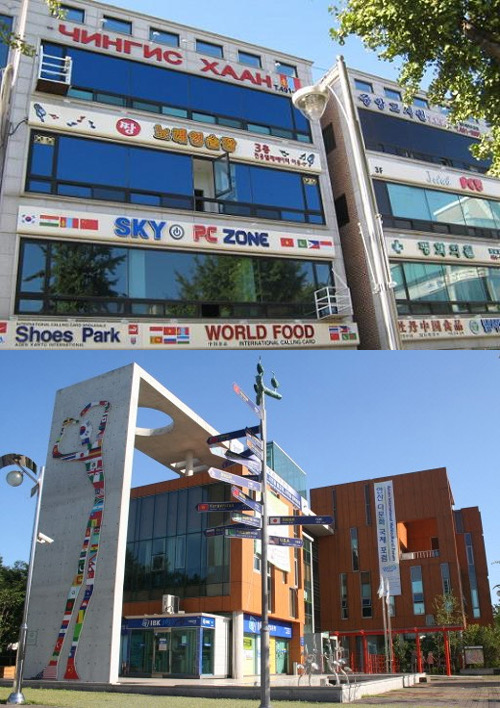
So do Chinese and Mongolian workers get nothing? Not quite. The visa route ignores nationality:
- Chinese nationals on H-2 or E-9 get the refund for those months. H-2 is the visa for ethnic Koreans from China and the former Soviet states, so this covers a large group. A 2025 fact-check by Newstapa (뉴스타파) counted 15,151 Chinese nationals who received the lump sum in 2023, out of 194,241 Chinese NPS members.
- The same people on other visas do not. A Korean-Chinese worker who moves from H-2 to F-4 (재외동포, overseas Korean) keeps the refund for the H-2 months only; the F-4 months stay in the system. The NPS English page states the visa route applies "for an insured period" on E-8, E-9 or H-2.
- Mongolian, Vietnamese and Uzbek E-9 workers get the refund too. Mongolia and Uzbekistan have also signed an agreement with the NPS that lets a returned worker claim through their own social security agency (below).
- A Chinese engineer on E-7, a Japanese teacher on E-2, a Vietnamese specialist on E-7, a British manager on D-8: they all pay in every month and get nothing on leaving. Their contributions only come back as a Korean old-age pension if they reach ten years of membership and pension age, or through a future agreement.
So the claim that "Chinese and Mongolian workers can't get a refund" is true for most visas and false for E-9 and H-2. Of the 41,094 foreigners who took a lump sum in 2024 (NPS figure reported by Chosun Biz, up from 34,056 in 2020), Newstapa's count gives one scale for China alone: 15,151 Chinese recipients in 2023.
You might like: Korea Minimum Wage 2027: ₩10,700 an Hour — What Foreign Workers Are Owed and What They Actually Earn
Who never pays in at all
The refund question only arises if you were enrolled. Article 126(1) makes foreigners aged 18 to 59 working or living in Korea compulsory members, unless their own country does not cover Koreans in its pension system. The NPS keeps a separate list for that (136 countries, as of 19 March 2026), and it is not the same as the refund list:
| Enrolment status | Examples (NPS list, 19 March 2026) | What it means |
|---|---|---|
| Workplace and individual, compulsory (79) | China, Japan, UK, US, Germany, Uzbekistan, Russia, the Philippines, Hong Kong, Australia, Canada | You pay as an employee and, if self-employed or not working, as an individual member |
| Workplace only (37) | Vietnam (since 1 January 2022), Mongolia, Indonesia, Thailand, India, Cambodia, Malaysia (again since 15 January 2026), Taiwan, Mexico | You pay through an employer; not as an individual member |
| Not covered (20) | Nepal, Myanmar, Bangladesh, Pakistan, Singapore, Saudi Arabia, South Africa, Nigeria, Kazakhstan, Iran (by agreement) | No pension deduction, so nothing to refund (Kazakhstan is on the refund list, but its nationals are only enrolled, and so only refunded, when they work on E-9 or H-2) |
Some visas are excluded whatever the passport: D-2 students, D-3 and D-4 trainees, C-3 short visits, F-1 and F-3 family visas, A-1 diplomats and a few more (NPS visa table, 1 April 2024). E-2 teachers, E-7 professionals, D-10 job seekers, E-9, H-1, H-2, F-2, F-4, F-5 and F-6 are all covered. A worker sent from an agreement country who hands over their home country's certificate of coverage is also exempt.
Put the two lists together and you see the real losers. Compulsory member, not on the refund list, not on E-9 or H-2: a Chinese, Japanese, British, Vietnamese or Uzbek national on a professional or long-stay visa. That is the group whose contributions stay in Korea. Older reports that Vietnam and Mongolia "cannot join" are out of date: both now pay through their employers.
How much you get back: both halves, plus interest
Article 77(2) sets the amount: the contributions paid "including the employer's share", plus interest set by presidential decree. For an employee, that is the full rate on your payslip base, not just your half.
Contribution rates. 9% of monthly earnings until 2025 (4.5% each), 9.5% in 2026 (4.75% each) and 10% in 2027, rising 0.5 points a year to 13% in 2033 (2025 reform, Addendum Art. 4).
Interest. Each month's contribution earns interest from the month after you paid until the month your membership ends, at that period's 3-year time-deposit rate, averaged across Korea's nationwide banks on 1 January each year. The NPS uses 2.2% for 2026. For contributions before 16 April 2015, the 3-year rate applies only from April 2015.
Worked example (EpicKor estimate). An E-9 factory worker earning ₩2,500,000 a month, enrolled from January 2024 to December 2026 and leaving at the end of 2026:
| Item | Amount |
|---|---|
| 2024–2025: 9% × ₩2,500,000 × 24 months | ₩5,400,000 |
| 2026: 9.5% × ₩2,500,000 × 12 months | ₩2,850,000 |
| Contributions, both halves | ₩8,250,000 (≈ US$6,180) |
| Of which the worker paid | ₩4,125,000 |
| Interest, if every year were at 2.2% | ≈ ₩260,000 |
| Refund before tax | ≈ ₩8.5 million (≈ US$6,380) |
The worker gets back about twice what came off their payslips. That is why claiming matters. We used 2.2% for all three years because we only read the 2026 rate; the NPS calculates the exact amount with each year's rate.
Tax: the refund counts as retirement income
Since 2002, employee pension contributions have been deductible from income tax. In return, the refund is taxed as retirement income (퇴직소득), and the NPS withholds the tax when it pays (Income Tax Act Arts. 22 and 127, per the NPS tax page). Refunds paid because of death are tax-free.
The taxable amount is the post-2002 contributions, employer share included, plus interest. Retirement income gets large deductions, so the tax is small. On the worked example above, we estimate about ₩90,000 (≈ US$70) including local income tax, roughly 1% of the refund. That is our calculation, not an NPS figure.
If you used the 19% flat tax, you can get that money back. Workers who elected Korea's flat tax for foreigners got no deduction for their pension contributions, so taxing the refund on those years taxes them twice. The NPS's own rule: if some post-2002 contributions were never deducted, you can ask for the withheld tax back. Get a "연금보험료 등 소득·세액 공제확인서" (certificate of pension-contribution deductions) from your tax office or Hometax, then apply at an NPS branch in person, by post or by fax. For contributions paid in the year of the refund, this is possible only from July of the following year. Our guide to the flat tax for foreigners explains who elected it.
How to claim: before you fly, at the airport, or from abroad
The trigger for a foreigner is "국외이주", leaving Korea to live abroad. A holiday, a posting or study abroad does not count, however long. Since 29 August 2007 the NPS pays only once your departure is confirmed. It will take the claim before you go if you show a flight ticket for a date within one month.
Option 1: at an NPS branch before you leave. Any NPS branch or counselling centre in Korea takes the claim (except the Incheon Airport centre, which only pays out). Bring:
- the refund application (반환일시금 지급청구서, available at the branch);
- your passport and residence card (외국인등록증);
- a copy of your bank account details, Korean or overseas;
- proof you leave within a month: the flight ticket.
Phone and fax claims are not accepted from foreigners, or for any claim based on leaving Korea.
Option 2: cash at Incheon Airport on the day (공항지급). File the claim at a branch as above and ask for airport payment. You get a receipt (접수증). Conditions:
- you fly from Incheon to your home country within one month;
- your employer has reported your loss of membership (사업장가입자 상실신고) by the day before you fly. If it has not, there is no airport payment. Ask the company in writing, and early;
- the flight leaves on a weekday, not a weekend, public holiday or the last working day of December, and between 10:30 and 24:00 from Terminal 1 or 11:00 and 24:00 from Terminal 2;
- you also give a Korean or overseas bank account, for when airport payment fails or a top-up is due later.
On the day, three stops:
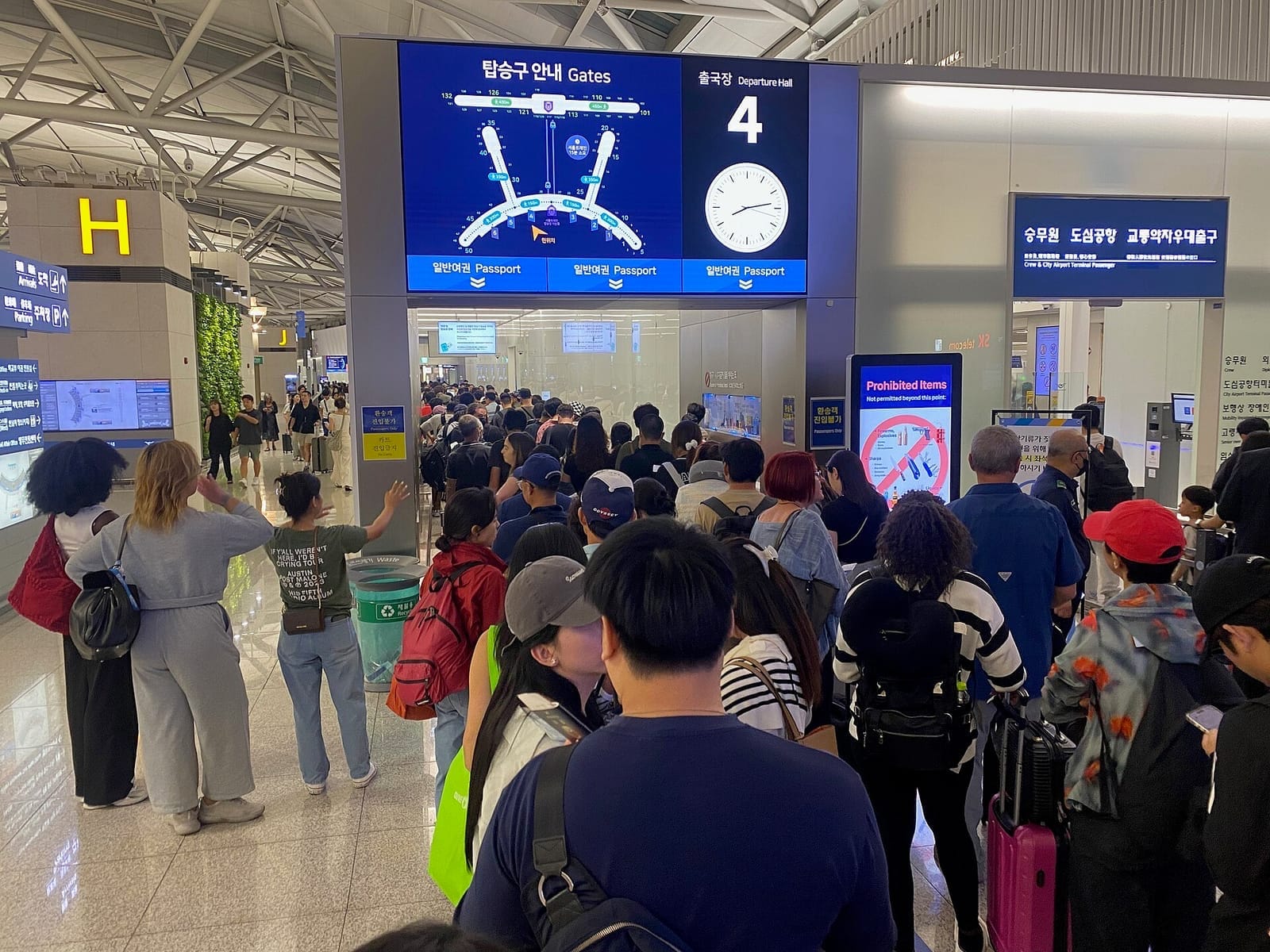
- NPS Incheon Airport desk, Terminal 1, 1st floor, booths 7–8 between exits 1 and 2, 09:00–18:00. Bring passport and claim receipt. You receive the payment decision and a payment order (지급지시서). The English page says everyone goes to this Terminal 1 desk, even if they fly from Terminal 2.
- Woori Bank (우리은행), before passport control, with passport and payment order. Under US$10,000: the 3rd-floor exchange counter near check-in row H (Terminal 1) or row A (Terminal 2), 09:00–21:00. US$10,000 or more: the basement branch, open only 09:00–16:00. You receive an exchange receipt.
- Woori Bank, after passport control, with passport and exchange receipt: near gate 11 (Terminal 1) or gate 250 (Terminal 2), 09:00–21:00. You collect the cash.
The money comes in one of 16 currencies, including US dollars, euros, yen and yuan. Never won.
Option 3: from abroad, after you have left. Post the application with your passport copy, bank details and an overseas-remittance form, or appoint an agent in Korea to file it with a power of attorney and the agent's ID. Documents issued abroad need consular attestation, or an apostille in Apostille Convention countries. Private documents also need notarising, and anything in a foreign language needs a notarised Korean translation. The embassy route can replace notarisation if your country's embassy in Korea verifies the papers.
Option 4: through your own country's agency. The NPS has agreements with six partners to take refund claims from returned workers, without notarisation: Mongolia (Social Insurance General Office), Uzbekistan (Ministry of Labour and Social Protection), Thailand (Ministry of Labour), Sri Lanka (Ministry of Foreign Employment Promotion and Welfare), Kyrgyzstan (Social Fund) and Indonesia (BPJS Ketenagakerjaan). This only helps people who are already entitled, which for Mongolians and Uzbeks means the E-9 or H-2 months.
Deadlines: five years, and a second chance at 60
The right to a refund on leaving lapses five years after it arises (Art. 115). That is five years from when you leave, not from pension age. If you miss it, Article 116 gives a second chance: once you turn 60, you can claim again, and the NPS English page gives 10 years after reaching 60 for that claim. Survivors have five years after a death.
Do not count on the second chance. Few people remember a Korean pension 30 years later, and nobody will remind you.
You might like: Korea Health Insurance for Foreigners (2026): At Least ₩158,630 a Month After Six Months
Common mistakes that cost the refund
- Assuming an agreement means a refund. China, Japan, the UK, Vietnam and Mongolia all have agreements with Korea, and none is on the refund list.
- Confusing the two E-8s. Seasonal-worker E-8 (introduced after 24 December 2019) does not qualify; the old training E-8 did.
- Changing from H-2 or E-9 to another visa and expecting the whole period back. Only the E-9 or H-2 months qualify for a non-listed national.
- Leaving it to the employer. The company must file your loss of membership. If it has not done so by the day before your flight, airport payment fails. Branch or post payment still works, just later.
- Flying on a weekend. No airport payment on Saturdays, Sundays, public holidays or the last working day of December.
- Going to the wrong desk. The NPS airport desk is in Terminal 1, and the bank for large amounts closes at 16:00.
- Claiming for a long trip. A posting or study abroad is not "leaving to live abroad". The NPS will refuse, and if you work in Korea again you are a member again.
- Missing the five years. The clock starts when you leave.
Coming back to Korea after a refund
Taking the refund wipes out those years of membership. If you later rejoin the pension in Korea, Article 78 lets you pay the refund back with interest (반납금) to restore them, which matters only if you might reach ten years and pension age.
A related route, paying for past uncovered months (추납, "post-payment"), drew political attention: NPS data given to Kim Kyo-heung (김교흥), a member of the National Assembly's Health and Welfare Committee, showed foreign applications rising from 530 in 2023 to 1,517 in 2025, and 994 in the first half of 2026 alone (Segye Ilbo, 1 September 2026). The 20 October 2026 amendment (Art. 126(6)) now limits post-payment for foreigners to nationals of countries whose own law gives Koreans the same option, plus a group to be set by decree from 21 April 2027. The lump-sum refund rule itself is unchanged: it was renumbered to Article 126(5) when the new paragraphs were added, with the same three routes.
The honest part: what this guide cannot settle
- The list changes. Malaysia moved in and out of compulsory coverage twice (2014 and 2026). New agreements add countries. Check the NPS table, or call 1355, before you plan around it.
- We did not test each country's law. Why Japan or the UK is not on the reciprocity list is the NPS's decision, not ours; we report the list as published.
- Your exact amount depends on each year's earnings base and interest rate. The NPS's 내연금 (My Pension) website and its app 내 곁에 국민연금 show your contribution record, but the branch calculates the refund.
- The refund is not your only money. Severance pay (퇴직금) is a separate claim from the pension. For E-9 workers it is paid through the employer's departure-guarantee insurance (출국만기보험) — within 14 days of leaving, with a three-year claim limit (Act on the Employment of Foreign Workers, Art. 13). This guide covers only the pension.
- The headline numbers are press figures. 41,094 recipients in 2024 and 34,056 in 2020 are NPS data as reported by Chosun Biz (8 September 2025); 15,151 Chinese recipients in 2023 is from Newstapa (15 April 2025). We could not find them in an NPS publication.
FAQ
Q: Can foreigners get their Korean national pension back when they leave Korea?
A: Only some. You get the lump-sum refund (반환일시금) if your nationality is one of the 50 countries on the NPS list (24 by social security agreement, 26 by reciprocity; nine need 6–12 months of membership), or for the months you paid in on an E-9, H-2 or old training E-8 visa. Everyone else pays in and gets no refund on leaving.
Q: Do Chinese workers get the Korean pension refund?
A: Chinese nationals on H-2 or E-9 visas do, for those months; in 2023, 15,151 did. China is not on the country list, so Chinese nationals on other visas, such as E-7, D-10 or F-4, do not get a refund when they leave.
Q: Do Americans, Canadians and Australians get the refund?
A: Yes. The United States, Canada (including Quebec) and Australia are among the 24 agreement countries, so their nationals get the refund on any covered visa, including E-2 teaching visas. The UK, Ireland and New Zealand are not on the list.
Q: How much is the Korean pension refund?
A: Everything paid in your name, your share and your employer's (9.5% of earnings in total in 2026), plus interest at the 3-year time-deposit rate (2.2% for 2026). For an E-9 worker earning ₩2.5 million a month for three years, we estimate about ₩8.5 million (≈ US$6,380), before a small retirement-income tax.
Q: Can I get the pension refund in cash at Incheon Airport?
A: Yes, in foreign currency, if you file the claim at an NPS branch within a month of a weekday flight home from Incheon, ask for airport payment, and your employer has reported your departure from the company by the day before you fly. Pick it up via the NPS desk in Terminal 1 and two Woori Bank counters.
Sources
- National Pension Act (국민연금법), Act No. 22096, amended 20 October 2026: Art. 77 (lump-sum refund and amount, employer share included), Art. 78 (repayment), Art. 79, Art. 88 and Addendum Art. 4 of the 2025 reform (contribution rates 2026–2032), Art. 115 and 116 (time limits), Art. 126 (foreigners: enrolment, refund exceptions, new post-payment limit) and Art. 127 (social security agreements), National Law Information Center (law.go.kr), read 23 October 2026.
- NPS, 외국인에 대한 급여 (benefits for foreigners): refund conditions, country list as of May 2026, interest, claim methods, airport payment service. Read 23 October 2026.
- NPS English, Foreigners and Lump-sum Refund: country list dated 15 June 2026, documents for claims from abroad, MOU countries, airport steps ("All applicants must visit the Terminal 1 center"), time limits. Read 23 October 2026.
- NPS, 반환일시금 (lump-sum refund): required documents, "국외이주" definition, no phone or fax claims for foreigners, 2.2% rate for 2026.
- NPS, 외국인가입자 (foreign members), with the attached country list "외국 연금제도 조사 내용" (19 March 2026, 136 countries) and visa table "외국인 체류자격별 가입대상 여부" (1 April 2024).
- NPS, 사회보장협정 (social security agreements): list of agreement partners.
- NPS, 연금·일시금에 대한 과세 (tax on pensions and lump sums): refund taxed as retirement income, tax-refund procedure where contributions were not deducted. Worked-example tax is EpicKor's calculation.
- Newstapa (뉴스타파), [팩트체크] 국민연금이 중국 등 외국인 노동자들의 노후 대책?, 15 April 2025 (Chinese recipients in 2023).
- Chosun Biz via Daum, 年 수십억원… 받지도 못할 국민연금 내는 외국인 근로자·고용주, 8 September 2025 (34,056 recipients in 2020, 41,094 in 2024, NPS data).
- Segye Ilbo (세계일보), report of 1 September 2026 on foreigners' post-payment (추납) applications, NPS data via Rep. Kim Kyo-heung's office (530 in 2023, 848 in 2024, 1,517 in 2025, 994 in January–June 2026).
- Exchange rate: Federal Reserve H.10 via FRED (DEXKOUS ₩1,334.03), 16 October 2026.
The short version: Korea gives foreigners their pension back, both halves plus interest, only if their passport is one of 50 on the NPS list or they paid in on an E-9 or H-2 visa. Check your country and visa first. Then make sure your employer files your departure, and claim at a branch within a month of a weekday flight from Incheon, or by post within five years of leaving.
You Might Also Like
Flat Tax for Foreigners in Korea: 19% Becomes 21% in 2027 (Proposed), the New 2029 Deadline and Who Should Still Elect It
Korea's optional flat tax for foreign workers is 19% (20.9% with local tax) on gross pay, no deductions. The 2026 tax revision would make it 21% (23.1%) from January 2027 and let new arrivals use it until 2029. Who gains, who loses, and how to elect.
Tongyeong Oysters, Korea: First-Auction Price per 10 kg, the Season and Where to Eat Them
Tongyeong's first oyster auction of 2026, on 22 October, cleared ₩80,000–90,000 per 10 kg of shucked oysters, about ₩8,000–9,000 a kilo. Korean shops charged ₩23,992 a kilo that day. Season, markets, menus and buses.
Teeth Cleaning in Korea: One Insured Scaling a Year, About ₩18,000
Korean health insurance covers one teeth cleaning a year for adults 19+, reset every 1 January. The 2026 fee is ₩43,950; at a local clinic you pay about ₩18,000. Who qualifies, what tourists pay.