Annual Leave in Korea: 15 Days a Year, One a Month in Year One
Last updated: 27 October 2026. Law read that day on law.go.kr: the Labor Standards Act (근로기준법) in the version in force from 8 October 2026, and its Enforcement Decree (시행령) in force from 23 October 2025. ₩1,334 = US$1 (Federal Reserve, 16 October 2026). A guide, not legal advice; sources at the end.
Korea annual leave is set by one article of one law. Article 60 of the Labor Standards Act (근로기준법) says an employee who has worked a year and turned up on at least 80% of working days gets 15 paid days off (연차유급휴가, yeoncha). In the first year, before that, you earn one paid day for each full month you work, up to 11. From the third year the 15 grows by one day every two years, and it stops at 25.
Those are the legal minimums, and they apply to Korean and foreign employees alike. Article 6 of the same law bans worse working conditions because of nationality, so an E-7 engineer, an E-9 factory worker and a Korean colleague in the same company get the same days off. Two catches matter more than the numbers. First, the article does not apply at a workplace with fewer than five employees. Second, unused days lapse after 12 months. Whether you are paid for them then depends on whether your employer followed a written procedure in Article 61 that most English-language guides never mention.
This guide covers how many days you get each year, what happens in year one, who is left out, when you can take leave, and what unused days are worth in won and dollars. It also covers how annual leave differs from Korea's public holidays.
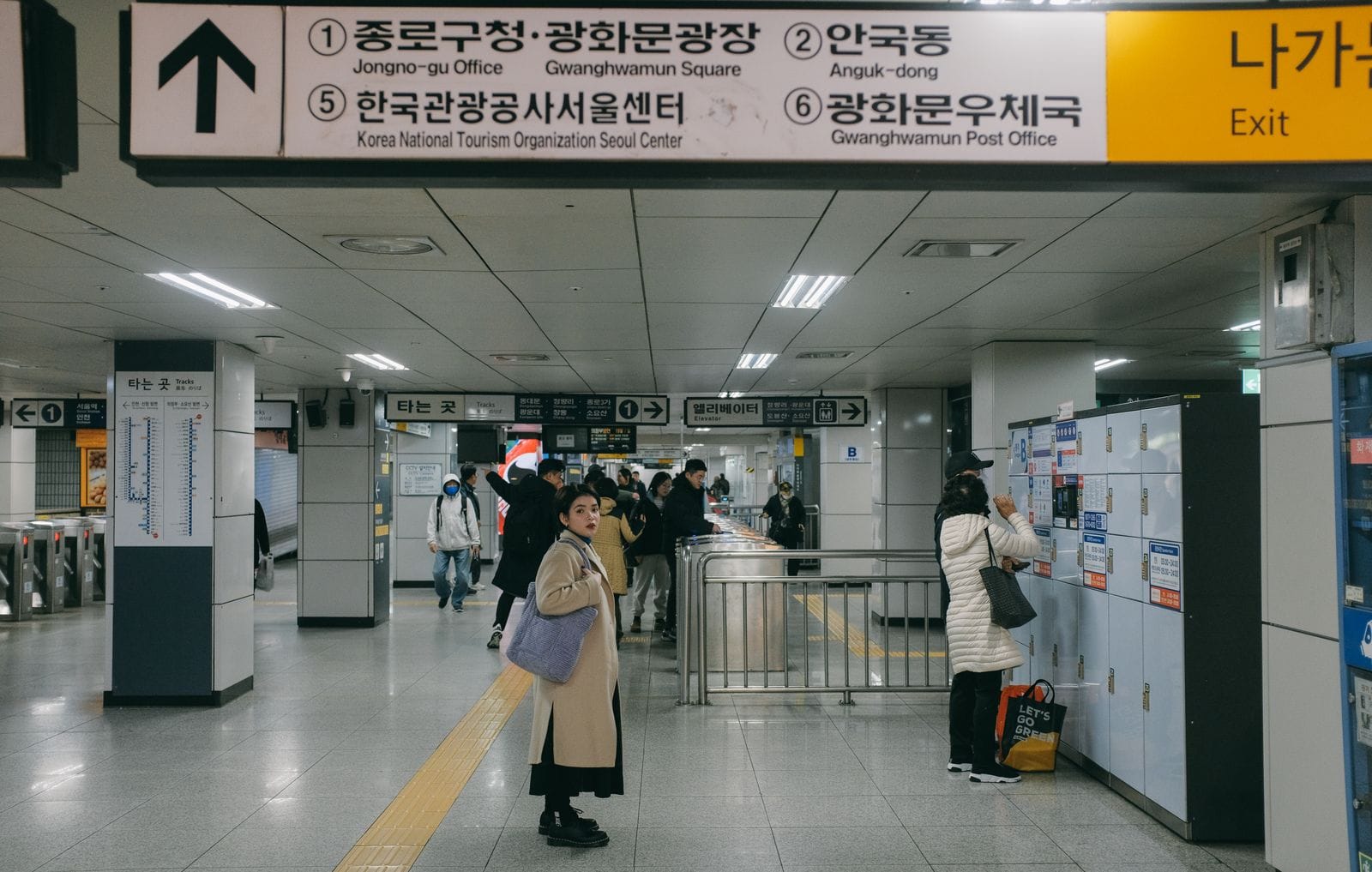
Fifteen days of leave is a real trip inside Korea. Lonely Planet Korea covers Jeju, Gyeongju and the east coast as well as Seoul. See it on AmazonAffiliate link. As an Amazon Associate, EpicKor earns from qualifying purchases at no extra cost to you.
Quick Guide: annual leave in Korea, October 2026
| Question | Answer (Labor Standards Act in force 27 October 2026) |
|---|---|
| How many days after one year? | 15 paid days, if you came to work on 80% or more of working days (Art. 60(1)) |
| In the first year? | 1 paid day per full month worked without absence, up to 11 (Art. 60(2)) |
| Does it grow? | From 3 years' service, +1 day for every 2 years after the first year (Art. 60(4)) |
| Maximum | 25 days a year, reached after 21 years |
| Who chooses the dates? | You do. The employer can move them only if your dates would cause "serious disruption" to the business (Art. 60(5)) |
| When do days expire? | After 1 year unused (Art. 60(7)). Year-one days expire when the first year ends |
| Paid for unused days? | Yes, unless the employer sent the written reminders in Art. 61 and you still did not use them |
| Who is not covered? | Workplaces with 4 or fewer employees (Art. 11, Enforcement Decree Table 1); people working under 15 hours a week (Art. 18(3)) |
| Foreign employees? | Same rules as Koreans, on any work visa (Art. 6) |
| Public holidays | Separate. Paid days off at workplaces of 5+, and they do not count against your annual leave |
| Employer refuses leave? | A crime: up to 2 years in prison or a ₩20,000,000 fine (about US$15,000) (Art. 110) |
Most disputes over leave come down to paper: when the contract started, how many days the payslip shows, and whether the company's reminders were in writing. Keep those documents together from day one.
Sooez 13-pocket expanding file — contract, payslips and leave notices in one A4 folder. If you ever have to claim unused-leave pay, the start date on your contract and the company's written reminders (or the lack of them) decide the case. A labelled accordion file keeps a year of payslips and notices in order. As an Amazon Associate, EpicKor earns from qualifying purchases at no extra cost to you.
See the Sooez expanding file on AmazonHow many annual leave days in Korea: the table by years of service
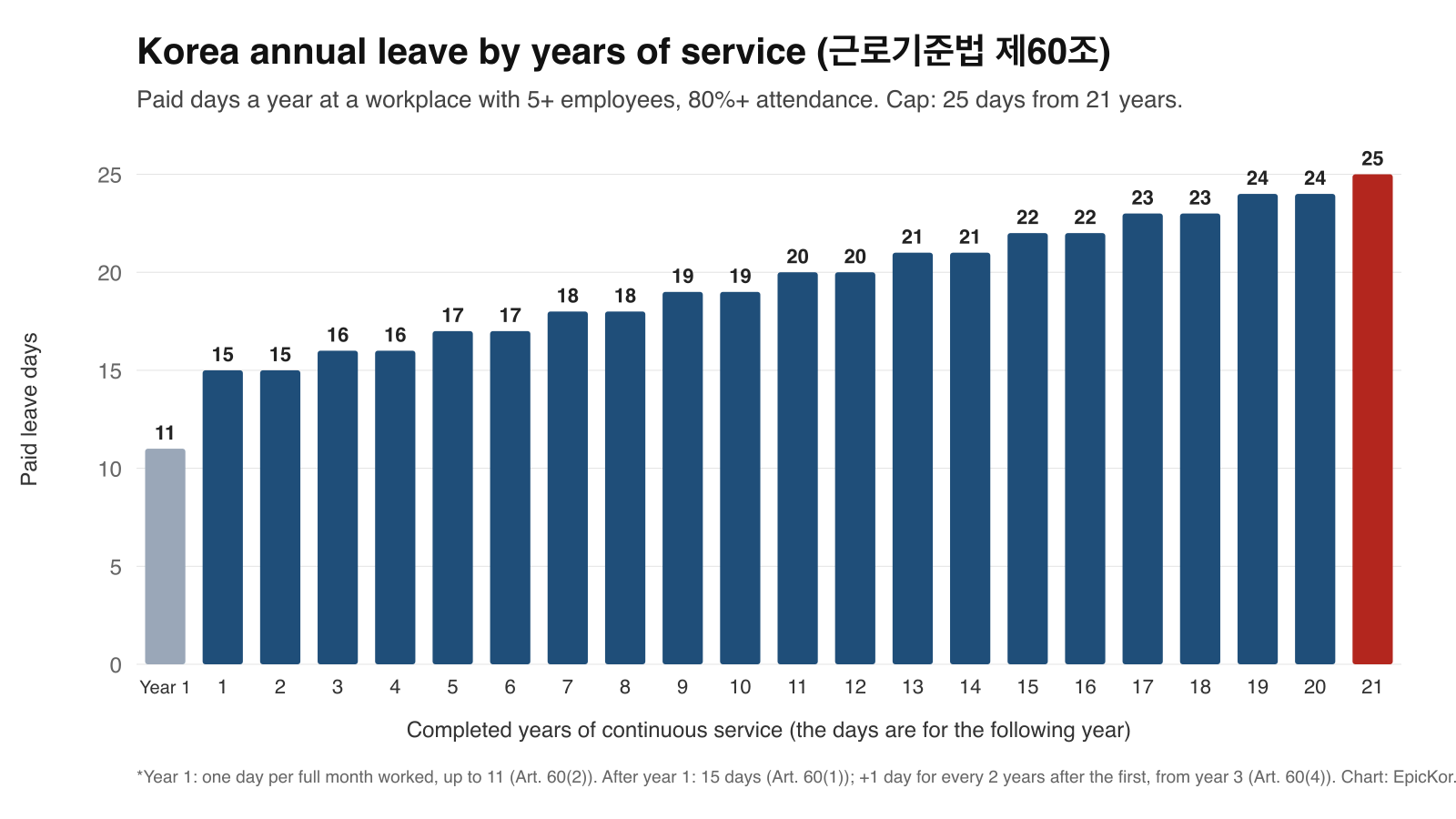
Article 60 builds the number in three steps. Paragraph 1 gives 15 days to anyone with a year of 80%-plus attendance. Paragraph 4 adds a day "for every two years of continuous service beyond the first year" once you have worked three years, and caps the total, extra days included, at 25. Paragraph 2 covers everyone else: anyone in their first year, or anyone whose attendance fell below 80%, earns one day per full month worked.
Days are earned for a year of work and used in the year that follows. So "after 5 years" in the table means the leave you get on your fifth work anniversary, to use in year six.
| Continuous service completed | Paid leave days for the next year | Legal basis |
|---|---|---|
| Under 1 year | 1 per full month, up to 11 | Art. 60(2) |
| 1 year | 15 | Art. 60(1) |
| 2 years | 15 | Art. 60(1) |
| 3 years | 16 | Art. 60(4) |
| 5 years | 17 | Art. 60(4) |
| 7 years | 18 | Art. 60(4) |
| 10 years | 19 | Art. 60(4) |
| 15 years | 22 | Art. 60(4) |
| 20 years | 24 | Art. 60(4) |
| 21 years or more | 25 (cap) | Art. 60(4) |
The arithmetic for any year is 15 plus the number of whole two-year blocks after year one. After 9 years that is 15 + 4 = 19; after 10 years it is still 19, because the fifth block is not complete until year 11. These are minimums. Your contract or the company's work rules (취업규칙) can give more, for example extra company leave, but never less.
What counts towards the 80%
Attendance is measured over the year, and paragraph 6 lists periods that count as days worked even though you were absent. They are time off for an injury or illness caused by work, maternity leave (출산전후휴가), parental leave (육아휴직), and hours cut under the childcare or pregnancy reduced-hours schemes. A worker who spends three months of the year on parental leave still gets the full 15. Unexcused absence that is not on the list can pull you under 80%. Then you fall back to one day per full month instead of 15.
Part-time workers get leave in hours
If you work at least 15 hours a week but fewer than a full-time colleague, Table 2 of the Enforcement Decree converts your leave into hours, in proportion to your contracted hours. The formula is: full-time days × (your weekly hours ÷ full-time weekly hours) × 8. Someone on 20 hours a week where full-time is 40 gets 15 × 20/40 × 8 = 60 hours of paid leave after a year. If your contract is under 15 hours a week on a four-week average, Article 18(3) switches off both weekly paid holidays and annual leave. That can catch students on D-2 and D-4 visas, whose part-time hours are capped. Our Korea minimum wage guide covers the hourly pay those jobs owe.
You might like: Korea Minimum Wage 2027: ₩10,700 an Hour, ₩2,236,300 a Month — What Foreign Workers Are Owed and What They Actually Earn
Year one: one day a month, and why the 366th day matters
New employees do not wait a year for their first day off. Under Article 60(2), every calendar month you complete without an unexcused absence earns one paid day. Start on 1 March, complete March with no absences, and from 1 April you have one day of leave. By the end of month eleven you have 11 days. The twelfth month completes the first year, and what it unlocks is the 15-day entitlement under paragraph 1, not a twelfth monthly day.
The first-year days follow their own clock. Article 60(7) says they lapse when the first year of work ends, not 12 months after each day was earned. So a day earned in month eleven can be gone a month later if you do not use it. Article 61(2) gives employers a matching first-year procedure, with written reminders three months before the year ends. The next section explains what those reminders do.
The one-year contract and the 26-day question
For years, foreign teachers and contract workers argued over this case: you sign a one-year contract, work all 365 days, and leave. Do you get the 11 monthly days plus the 15 for the year, 26 in all?
Korea's Supreme Court answered on 14 October 2021 (case 2021다227100): no, 11 at most. The court held that the right to the 15 days arises on the day after the year of work ends, so a worker whose job ends with the year never acquires them. The Ministry of Employment and Labor, whose earlier guidance had said 26 days, changed it to match from 16 December 2021. In practice, the employment relationship must still exist on day 366 for the 15 days to become yours. Someone who works exactly one year and leaves can claim pay for unused first-year days, up to 11. Someone who stays even one more day earns the 15 as well.
If you are negotiating a contract end date, this is worth knowing. A contract that ends on the anniversary and one that ends the day after can differ by 15 days' pay.
Who is not covered: small workplaces, short hours, and what the visa does not change
Fewer than five employees
Article 11 applies the whole Labor Standards Act to workplaces that "regularly employ five or more workers." For smaller ones, paragraph 2 lets a presidential decree pick which articles still apply, and the decree's Table 1 is the list. For working hours and rest, it keeps only Article 54 (breaks), Article 55(1) (one paid day off a week) and Article 63 (exemptions). Articles 60 to 62 are not on it. At a café, small academy (hagwon) or family restaurant with four or fewer staff, the law requires no annual leave at all. Any leave you get there comes from your contract.
The headcount is not a guess. Article 7-2 of the decree averages the number of employees over the month before the question arises, counting part-timers and fixed-term staff, and for the 15-day annual leave it looks at the whole previous year (first-year monthly leave uses the one-month average). A workplace that employed five or more every month for the past year is covered. If the number hovers around five, the contract and payslips are your evidence.
Visa type does not matter, but your employer does
The law attaches to the job, not the passport. E-1 to E-7 professionals, E-9 non-professional workers, H-2 visit workers, F-visa residents and English teachers on E-2 visas at private academies are all covered if the workplace has five or more employees. Article 6 forbids worse working conditions because of nationality. What sits outside the Act is work that is not employment. Freelance or "3.3%" contractor arrangements are the common example, where a company withholds 3.3% business-income tax instead of treating you as an employee. Whether you are really an employee is decided by how you work, not by the label. If in doubt, the ministry's counsellors below can tell you.
Health insurance follows similar rules for foreign employees; see our guide to Korea health insurance for foreigners.
You might like: Korea Health Insurance for Foreigners: At Least ₩158,630 a Month After Six Months — Students, Workers, and What Happens If You Don't Pay
When you can take leave, and when your employer can say no
Article 60(5) puts the choice of dates with the employee: the employer "must grant the leave at the time the worker requests." The only exception is when granting those dates would cause serious disruption to the operation of the business (사업 운영에 막대한 지장). Even then the employer can only change the dates, not cancel the leave. "We are busy this month" is not the same as serious disruption. A refusal that leaves you no leave at all is a violation of Article 60. Article 110 punishes it with up to 2 years in prison or a ₩20,000,000 fine (about US$15,000).
Leave days are paid at your ordinary wage (통상임금) or average wage (평균임금), whichever the work rules specify. Article 33 of the decree says that pay is due on the payday before the leave or the first payday after it.
Company-wide leave days: Article 62
Many Korean companies close on a "bridge day" between a holiday and a weekend, or for a week at the end of the year, and take those days out of everyone's annual leave. Article 62 allows this only under a written agreement with the employee representative (근로자대표, a majority union or a representative chosen by a majority of staff). A manager's announcement is not enough. If your company deducts shutdown days from your leave, ask to see the agreement.
Why unused days disappear after 12 months, and when they still have to be paid
Article 60(7) says leave not used within a year "lapses" (소멸된다). Read alone, that sounds like use it or lose it. But the same paragraph adds a proviso: the rule does not apply if you could not use them for a reason attributable to the employer (사용자의 귀책사유). And Article 61 is written as an exception to a "duty to compensate" (보상할 의무) for unused days. Courts and the labour ministry therefore treat lapsed leave as a cash claim, unused-leave pay (연차미사용수당), unless the employer can show it followed the procedure to get you to use the days.
Article 61 sets out how the employer shows that. It is a written procedure with two employer steps, and only if both are done does the employer escape paying for the lapsed days.
| Step | Regular leave (Art. 61(1)) | First-year leave (Art. 61(2)) |
|---|---|---|
| 1. Written reminder | Within 10 days of the point 6 months before the leave year ends, the employer tells each worker in writing how many days are left and asks them to choose dates | Within 10 days of the point 3 months before the first year ends (for days earned after that reminder, within 5 days of the point 1 month before) |
| 2. Your reply | You have 10 days to tell the employer when you will use them | Same: 10 days |
| 3. Employer sets dates | If you do not reply, the employer must set the dates and notify you in writing at least 2 months before the year ends | At least 1 month before the first year ends (10 days before, for the later days) |
| Result | If all steps were done and you still did not take the days, they lapse with no pay owed. If any step was skipped or was not in writing, the unused days must be paid | |
So the honest answer to "do unused days disappear in Korea?" is: the days always disappear after the leave year, but the money disappears only if your employer did the paperwork. The article requires notice in writing, so a verbal "use your leave" does not count. If your company does send the formal notices, use the days, because the pay will not come.
What unused leave is worth: examples in won and dollars
Unused-leave pay is your daily ordinary wage multiplied by the unused days. For a full-time worker on an 8-hour day, the daily wage is the hourly rate times eight.
| Example | Daily wage (8 hours) | 11 unused days | 15 unused days |
|---|---|---|---|
| 2026 minimum wage, ₩10,320/hour | ₩82,560 (≈US$62) | ₩908,160 (≈US$681) | ₩1,238,400 (≈US$928) |
| 2027 minimum wage, ₩10,700/hour (from 1 Jan 2027) | ₩85,600 (≈US$64) | ₩941,600 (≈US$706) | ₩1,284,000 (≈US$962) |
| Salary of ₩3,000,000/month on 209 hours | ₩114,833 (≈US$86) | ₩1,263,158 (≈US$947) | ₩1,722,488 (≈US$1,291) |
Our calculations from the hourly rates; the 209-hour month is the standard full-time divisor explained in our minimum wage guide. Allowances that count as ordinary wage raise the daily figure. Before tax and social insurance.
When you leave the job
Leaving converts every unused day into money, because you can no longer take it. Article 36 requires the employer to pay all wages and other money owed within 14 days of your last day, unless you both agree to a later date. Unused-leave pay is part of that final settlement. If it is missing from your last payslip, ask for it in writing before you leave Korea. Article 49 gives you 3 years to claim unpaid wages. Leaving Korea does not cancel the claim, but it is much harder to pursue from abroad. Our national pension refund guide covers the other money foreign workers can claim on departure.
Public holidays vs annual leave in Korea
They are two different entitlements, and in Korea one does not eat into the other.
| Public holidays (공휴일) | Annual leave (연차유급휴가) | |
|---|---|---|
| Source | Labor Standards Act Art. 55(2) and Decree Art. 30(2), which borrow the government holiday regulation's list | Labor Standards Act Art. 60 |
| Who picks the day | The calendar: Seollal, Chuseok, Hangul Day and the rest, plus substitute days | You, subject to the serious-disruption exception |
| Workplaces under 5 | Not required (only one paid day off a week is) | Not required |
| If you work that day | Holiday premium: +50% for up to 8 hours, +100% beyond (Art. 56(2)) | It simply stays unused |
| Can the employer swap it? | Only with a written agreement with the employee representative (Art. 55(2) proviso) | Only with the same kind of written agreement (Art. 62) |
The practical upshot: at a workplace of five or more, a public holiday falling on a weekday is a paid day off in addition to your 15. Annual leave is what you add around holidays to make a longer break. Hangul Day in 2027 is an example: 9 October falls on a Saturday, so the law gives a substitute day off on Monday 11 October. One day of leave on Friday 8 October then makes a four-day weekend; see our Hangul Day guide for that date. Labour Day (1 May) comes from a separate law, 노동절 제정에 관한 법률, which makes it a paid holiday under the Labor Standards Act; it is generally read as applying at small workplaces too, though the 50% holiday-work premium of Article 56 does not apply under five employees. Check your contract if you work in one.
You might like: Hangul Day in Korea: October 9, the 2027 Monday Off, and What Closes
If your employer refuses leave or does not pay for unused days
- Check the facts first. Your start date, your number of employees, your weekly hours and whether you received written Article 61 notices decide almost every case.
- Ask in writing. An email to HR stating the unused days and the pay you are owed creates a record.
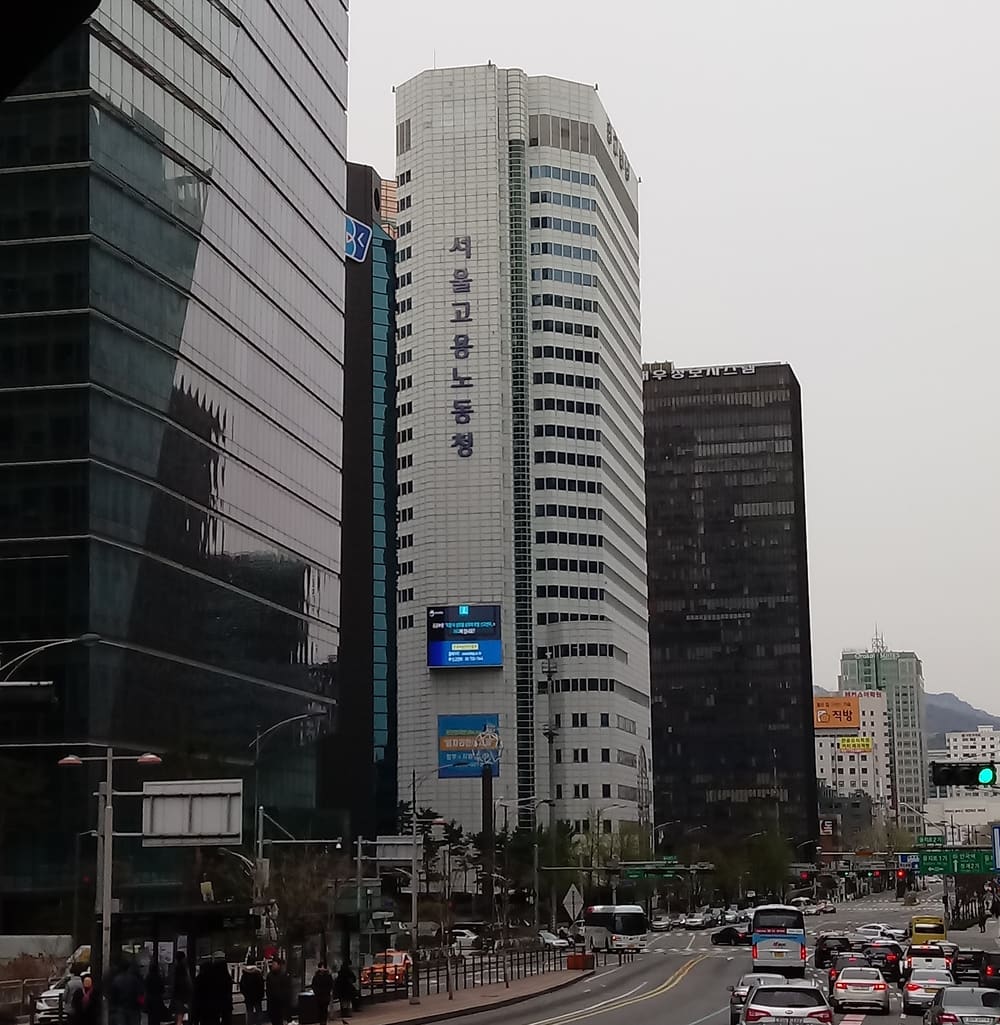
- Call for advice. The Ministry of Employment and Labor's customer centre on 1350 answers labour-law questions, mainly in Korean. E-9 and H-2 workers can use the Foreign Workforce Counseling Center on 1577-0071, which has counsellors in the main sending-country languages.
- File a complaint (진정). You can file online through the ministry's labour portal (labor.moel.go.kr) or at the regional employment and labour office for your workplace. A labour inspector investigates and can order payment. Refusing leave is a criminal offence under Article 110; not paying wages due on departure breaks Article 36.
The honest part: what this guide cannot tell you
- Your company's rules. The law sets the floor. Many employers count leave by calendar year (1 January) rather than by your start date, for everyone at once. This is common, but the Act does not describe it. When you leave, the total must not come out lower than counting by your start date; check how your company reconciles it.
- Whether your workplace has five employees. We cannot count them for you, and the decree's averaging rule can produce surprises in a business with many part-timers.
- Whether you are legally an employee. Freelance, 3.3% contractor and "intern" arrangements are decided case by case.
- Collective agreements. A union agreement can give more leave than the law. It cannot give less.
- What happens in practice. Korea's legal minimum is generous on paper, but whether people actually take all their days varies by company. That is a culture question this guide does not try to measure.
FAQ
Q: How many days of annual leave do you get in Korea?
A: 15 paid days after one year of work with at least 80% attendance, under Labor Standards Act Article 60(1). In the first year you get one day per full month worked, up to 11. From three years' service you gain one more day every two years, up to a maximum of 25.
Q: Do foreigners get the same annual leave as Koreans?
A: Yes. The Labor Standards Act applies to every employee at a workplace of five or more, whatever the visa, and Article 6 bans worse working conditions because of nationality.
Q: Is annual leave in Korea use-it-or-lose-it?
A: The days lapse 12 months after they are granted (Art. 60(7)), and year-one days lapse when the first year ends. But you are owed pay for the unused days unless your employer sent the written reminders and date notices required by Article 61 and you still did not use them.
Q: I worked exactly one year and quit. Do I get 26 days' pay?
A: No. The Supreme Court ruled on 14 October 2021 (2021다227100) that the 15-day entitlement arises only on the day after the year ends, and the ministry applies this from 16 December 2021. If you leave when the year ends, you can claim pay for up to 11 unused first-year days. If your employment continues to day 366, you earn the 15 as well.
Q: Do public holidays count as annual leave in Korea?
A: No. At workplaces with five or more employees, public holidays and substitute holidays are separate paid days off under Article 55(2). Your employer can swap them for other days only with a written agreement with the employee representative.
Q: Does a small business in Korea have to give annual leave?
A: Not if it regularly employs four or fewer people. Enforcement Decree Table 1 leaves Articles 60 to 62 off the list of rules that apply to them. Leave there depends on your contract.
Q: My job is part-time. Do I get annual leave?
A: If you work 15 hours a week or more, yes, converted into hours in proportion to a full-time schedule (Decree Table 2). Under 15 hours a week on a four-week average, the law gives no annual leave (Art. 18(3)).
Sources
- Labor Standards Act (근로기준법), Act No. 21533 promulgated 7 April 2026, version in force from 8 October 2026 (MST 285279): Art. 2 (definitions, average wage), Art. 6 (equal treatment, nationality), Art. 11 (five or more employees), Art. 18(3) (under 15 hours a week), Art. 36 (settlement within 14 days), Art. 49 (3-year limitation), Art. 55 (holidays), Art. 56(2) (holiday premium), Art. 60 (annual paid leave, paragraphs 1, 2, 4, 5, 6 and 7), Art. 61 (promotion of leave use), Art. 62 (substitution by written agreement), Art. 110 (penalty), National Law Information Center (law.go.kr), read 27 October 2026.
- Enforcement Decree of the Labor Standards Act (근로기준법 시행령), in force from 23 October 2025 (MST 270551): Art. 7 and Table 1 (rules applying to workplaces of four or fewer), Art. 7-2 (counting employees; paragraph 3 for annual leave), Art. 30 (public holidays as paid holidays), Art. 33 (when leave pay is due), Table 2 item 4 (part-time leave in hours), law.go.kr, read 27 October 2026.
- Supreme Court of Korea, judgment of 14 October 2021, case 2021다227100 (one-year contract: at most 11 days; the right arises on the day after the year of work), summary via korea.legal; Ministry of Employment and Labor change of interpretation from 16 December 2021, reported via Newsis, 16 December 2021, and Weekly Kyunghyang, 26 July 2024.
- Minimum wage 2026 (₩10,320) and 2027 (₩10,700): Ministry of Employment and Labor notice of 5 August 2026, as set out in our minimum wage guide.
- Exchange rate: Federal Reserve H.10 via FRED (DEXKOUS ₩1,334.03 per US$), 16 October 2026. Dollar figures are rounded.
The short version: in Korea, a year of work earns 15 paid days, the first year earns one a month, and long service adds a day every two years up to 25. You choose the dates. Unused days vanish after a year, but the pay for them vanishes only if your employer sent the written notices. At a workplace of five or more, public holidays come on top.
You Might Also Like
Korea Severance Pay for Foreigners: 30 Days' Pay for Each Year Worked
Korea's severance law gives every worker, any nationality, 30 days' average wage per year once they pass one year at 15+ hours a week. Leave at 11 months and the law owes you nothing. Payment is due in 14 days; late money earns 20% a year.
Korea National Pension Refund for Foreigners: 50 Countries Qualify, China and Japan Don't — Unless You Worked on an E-9 or H-2 Visa
Korea refunds national pension contributions to foreigners who leave only if their country is one of 50 on the NPS list or they paid in on an E-9 or H-2 visa. China, Japan, the UK and Vietnam are not on it. Both halves come back, plus 2.2% interest.
Flat Tax for Foreigners in Korea: 19% Becomes 21% in 2027 (Proposed), the New 2029 Deadline and Who Should Still Elect It
Korea's optional flat tax for foreign workers is 19% (20.9% with local tax) on gross pay, no deductions. The 2026 tax revision would make it 21% (23.1%) from January 2027 and let new arrivals use it until 2029. Who gains, who loses, and how to elect.