Korea ARC Fee: ₩35,000 and Every Immigration Fee in One Table
Last updated: 9 November 2026. Every fee below was read that day in the original Korean text on law.go.kr: Article 72 (fees), Article 73 (how to pay) and Article 74 (exemptions and online discounts) of the Enforcement Rule of the Immigration Act (출입국관리법 시행규칙), in the version in force from 23 October 2026. Deadlines come from the Immigration Act (in force from 2 October 2026), penalties from Table 7 of the Rule (revised 23 January 2026) and Table 2 of the Enforcement Decree. ₩1,334 = US$1 (Fed H.10 rate for 30 Oct 2026). A guide, not legal advice; sources at the end.
How much does an ARC cost in Korea? The fee for issuing an alien registration card, the residence card officially called the 외국인등록증 (oegugin deungnokjeung), is ₩35,000 (about US$26). A replacement costs the same. The amount is set in one line of a Ministry of Justice ordinance, Article 72, item 10 of the Enforcement Rule of the Immigration Act, and the next article says how to pay it at an immigration office: cash, or proof that you paid cash, where most permit fees there are paid with a revenue stamp or electronic payment. An amendment to that payment article has already been published and takes effect around mid-September 2027, so check the payment method again after that date.
The card is the cheap part. The expensive parts are the permissions around it: ₩60,000 to extend your stay, ₩100,000 to change your status, ₩120,000 for a permit to work outside your status. They are all on the same page of the same rule. Online applications for some of them are 20% cheaper.
This guide puts all 19 numbered items and sub-items of that article in one table, in won and dollars. It explains the 90-day registration rule that decides whether you need a card at all, and lists the fines for missing it, with the base amounts from the penalty tables.
Your ARC and passport go to every immigration appointment, and you have to carry them both under Korean law. A slim holder keeps them together: FINTIE slim RFID passport holderAffiliate link. As an Amazon Associate, EpicKor earns from qualifying purchases at no extra cost to you.
Quick Guide: Korea ARC fee and the 90-day rule, November 2026
| Question | Answer (law in force on 9 November 2026) |
|---|---|
| ARC fee | ₩35,000 (about US$26), first card or replacement. Paid in cash for now (Rule Art. 72 item 10, Art. 73; Art. 73 amendment due around September 2027) |
| Who must register | Anyone who will stay in Korea more than 90 days from the day they entered (Act Art. 31) |
| Deadline | Within 90 days of entry, at the immigration office for the area where you live. If you change status or are granted one inside Korea, you register at that moment |
| Late registration | Crime under Act Art. 95(7): up to 1 year in prison or ₩10 million. In practice a fine, base ₩200,000 (about US$150) if under a month late, rising with time (Rule Table 7) |
| Extension of stay | ₩60,000 (about US$45); ₩30,000 for F-6 marriage migrants. 20% off online |
| Change of status | ₩100,000 (about US$75); ₩200,000 to change to F-5 permanent residence. 20% off online |
| Moved house? | Report within 15 days of moving in (Act Art. 36). Late: base fine from ₩100,000 |
| Leaving Korea | Hand the card back at departure unless you hold a re-entry permit, are a multiple-entry visa holder or national of a re-entry-exempt country leaving temporarily, or hold a refugee travel document (Act Art. 37(1)) |
| Help line | 1345, the Immigration Contact Center (외국인종합안내센터): Monday to Friday 09:00–22:00, not on public holidays, paid call (HiKorea) |
Valante travel document organizer: passport, ARC application, lease and receipts in one zipped wallet. A registration appointment asks for your passport, the application form, a photo, proof of address such as your lease, the documents for your status, and the fee. If one is missing, you go home and book another appointment. As an Amazon Associate, EpicKor earns from qualifying purchases at no extra cost to you.
See the Valante document organizer on AmazonEvery fee in Rule Article 72, in one table
Article 87 of the Immigration Act says anyone who receives a permit under the Act pays a fee set by Ministry of Justice ordinance. Article 72 of the Enforcement Rule is that ordinance. It was last amended on 24 December 2024 and was unchanged in the version in force from 23 October 2026. Here it is, item by item, with the online discount from Article 74(2) applied where the rule allows it.
| What you are applying for | Korean name | Fee at the office | Online (−20%) | Art. 72 item |
|---|---|---|---|---|
| Alien registration card, first issue or replacement | 외국인등록증 발급·재발급 | ₩35,000 (≈ US$26) | No discount | 10 |
| Permanent residence card (F-5) replacement | 영주증 재발급 | ₩35,000 (≈ US$26) | No discount | 10-2 |
| Extension of stay | 체류기간 연장허가 | ₩60,000 (≈ US$45) | ₩48,000 (≈ US$36) | 6 |
| Extension of stay, F-6 marriage migrant | 체류기간 연장허가 (F-6) | ₩30,000 (≈ US$22) | ₩24,000 (≈ US$18) | 6 |
| Change of status | 체류자격 변경허가 | ₩100,000 (≈ US$75) | ₩80,000 (≈ US$60) | 5 |
| Change of status to F-5 permanent residence | 체류자격 변경허가 (F-5) | ₩200,000 (≈ US$150) | ₩160,000 (≈ US$120) | 5 |
| Grant of status (born in Korea, lost Korean nationality) | 체류자격 부여 | ₩80,000 (≈ US$60); F-6 ₩40,000 (≈ US$30) | No discount | 4 |
| Permit for activity outside your status | 체류자격 외 활동허가 | ₩120,000 (≈ US$90) | No discount | 2 |
| Part-time work permit for D-2 and D-4 students (and other cases the Minister allows) | 시간제 취업 등 | ₩20,000 (≈ US$15) | No discount | 2 |
| Change or addition of workplace | 근무처 변경·추가 허가 | ₩120,000 (≈ US$90) | ₩96,000 (≈ US$72) | 3 |
| Single re-entry permit | 단수재입국허가 | ₩30,000 (≈ US$22) | ₩24,000 (≈ US$18) | 7 |
| Multiple re-entry permit | 복수재입국허가 | ₩50,000 (≈ US$37) | ₩40,000 (≈ US$30) | 8 |
| Extension of a re-entry permit (abroad) | 재입국허가기간 연장허가 | The won equivalent of US$20 | n/a | 9 |
| K-ETA electronic travel authorisation | 사전여행허가서 발급 | ₩10,000 (≈ US$7.50) | n/a | 1-2 |
| Entry permit issued by an immigration office | 입국허가·외국인입국허가서 | ₩50,000 (≈ US$37); ₩100,000 in the multi-entry case in Decree Art. 10(4) | n/a | 1 |
| Certificate of entry and exit records | 출입국에 관한 사실증명 | ₩2,000 (≈ US$1.50) per copy | Free if issued electronically (Art. 74(1)4) | 11 |
| Certificate of alien registration | 외국인등록 사실증명 | ₩2,000 per copy; viewing ₩1,000 | Free if issued electronically (Art. 74(1)4) | 12 |
| Refugee travel document, issue or replacement | 난민여행증명서 | ₩10,000 (≈ US$7.50) | n/a | 13 |
| Refugee travel document, validity extension | 난민여행증명서 유효기간 연장 | The won equivalent of US$5 | n/a | 14 |
| Viewing a foreigner residence confirmation (the names and move-in dates of foreigners registered at a building, for owners, tenants and others listed in Act Art. 88-3) | 외국인체류확인서 열람 | ₩300 (≈ US$0.20) per viewing | n/a | 14-2 |
| Copy of a foreigner residence confirmation | 외국인체류확인서 교부 | ₩400 (≈ US$0.30) per copy; ₩500 (≈ US$0.40) when requested under Act Art. 88-3(2)3, e.g. by auction bidders, credit-check or appraisal firms, lenders or court bailiffs | n/a | 14-3 |
| Registration for automated immigration clearance (the e-gates) by foreigners covered by Decree Art. 15(4)1(b) | 자동출입국심사 등록 | An amount set by the Minister of Justice; the Rule gives no figure | n/a | 15 |
Source: 출입국관리법 시행규칙 Art. 72 (fees), Art. 74(2) (20% off online applications for change of workplace, change of status, extension of stay and re-entry permits), in force from 23 October 2026, read on law.go.kr on 9 November 2026. Dollar figures at ₩1,334 = US$1 and rounded.
Three things in that table are easy to miss.
The online discount is in the rule, not a promotion. Article 74(2) cuts the fee by two-tenths when you apply online for a change of workplace, a change of status, an extension of stay or a re-entry permit. On a ₩60,000 extension, that is ₩12,000 saved. The ARC itself and the activity permit are not on the discount list.
The ARC is paid differently. Article 73 says fees paid at an immigration office are paid with a revenue stamp (수입인지, suipinji) for the amount, or by electronic payment. Item (a) of the same article makes the ARC fee an exception: cash, or a slip showing that you paid cash. It is not the only exception: the e-gate registration fee is paid in a way the Minister sets, and fees paid at a city or district office or at an embassy follow their own rules. Ministry of Justice Ordinance No. 1125 (15 September 2026) amends Article 73, and its addendum says that change takes effect one year after promulgation, around mid-September 2027. The amended text is not yet in force, so this guide uses the current rule.
Some people pay nothing. Article 74(1)3 exempts A-1 to A-3 diplomatic, official and treaty statuses and D-8 corporate investors from the fees. HiKorea's list of registration documents says the same about D-8: "수수료 (단, 기업투자(D-8)은 면제)", or "fee (D-8 is exempt)". A replacement card is also free when the office made the mistake on the first one (Art. 74(1)7).
A separate, narrower exemption, Article 74(1)2, covers D-1, D-2 and D-4 holders who were invited by the Korean government or a state-funded research institute that pays their tuition and living costs. It waives only the fees for a change of status, an extension of stay or a re-entry permit, not the ARC fee.
The 90-day rule: who needs an ARC and by when
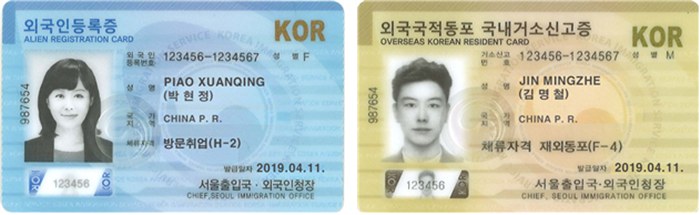
The whole system starts with one sentence in Article 31(1) of the Immigration Act: a foreigner who wants to stay in Korea for more than 90 days from the date of entry must register with the immigration office that covers the place they live, within 90 days of entering.
Three points follow from that wording.
The clock starts at the border, not at your visa. It runs from the date of entry stamped or printed on your entry record, not from the day your visa was issued. A student who arrives on 20 February for a March semester has 90 days counted from 20 February; day 90 is 21 May in a non-leap year such as 2027 (20 May in a leap year). Do not aim for the last day.
Visitors who stay 90 days or less never register. A visa-free tourist, a K-ETA holder or a C-3 short-term visitor leaves before the line, so there is no card and no fee. That is also why a tourist cannot "get an ARC" to stay longer. What a tourist needs is an extension, and those are covered in our overstay guide.
If your status changes inside Korea, you register at once. Article 31(3) and (4): a person granted a status in Korea, or allowed to change status, who will then pass 90 days from entry must register at the time of that permission, not 90 days later. HiKorea gives the example of a Canadian who entered as B-2, stayed five months and then applied to change status: the registration happens with the change application.
The exemptions are narrow:
- embassy and consulate staff and international-organisation staff, with their families (Act Art. 31(1)1);
- people with diplomatic-type privileges under an agreement with Korea, with their families (Art. 31(1)2);
- people the Ministry exempts for diplomatic, industrial or defence reasons (Art. 31(1)3, Rule Art. 45);
- Canadian citizens staying under six months for D-1, D-6, F-1, F-3 or G-1 activities, according to HiKorea's registration page.
Children under 17 are not exempt from registering. What Article 33(1) allows is for the office not to issue them a card; the registration itself still happens. A child who was registered without a card must apply for one within 90 days of turning 17 (Art. 33(2); HiKorea).
What to bring
HiKorea lists the common documents for registration: passport (with copies of the photo page and the visa page), the application form, one colour photo 3.5 × 4.5 cm, the fee, and proof of where you live, such as a lease, a letter from your accommodation provider or a utility bill. Then each status adds its own papers: a certificate of enrolment for D-2 students, a business registration copy for most work statuses, and for E-2 language teachers a health check with a drug test from a hospital designated by the Ministry. HiKorea says supporting documents are valid for three months from issue.
You might like: Studying in Korea (2026): tuition, foreign student numbers and what it costs
What happens if you register late
Missing the 90-day line is not a paperwork slip. Under Article 95, item 7 of the Act, breaking the registration duty in Article 31 is a crime, punishable by up to one year in prison or a fine of up to ₩10 million (about US$7,500).
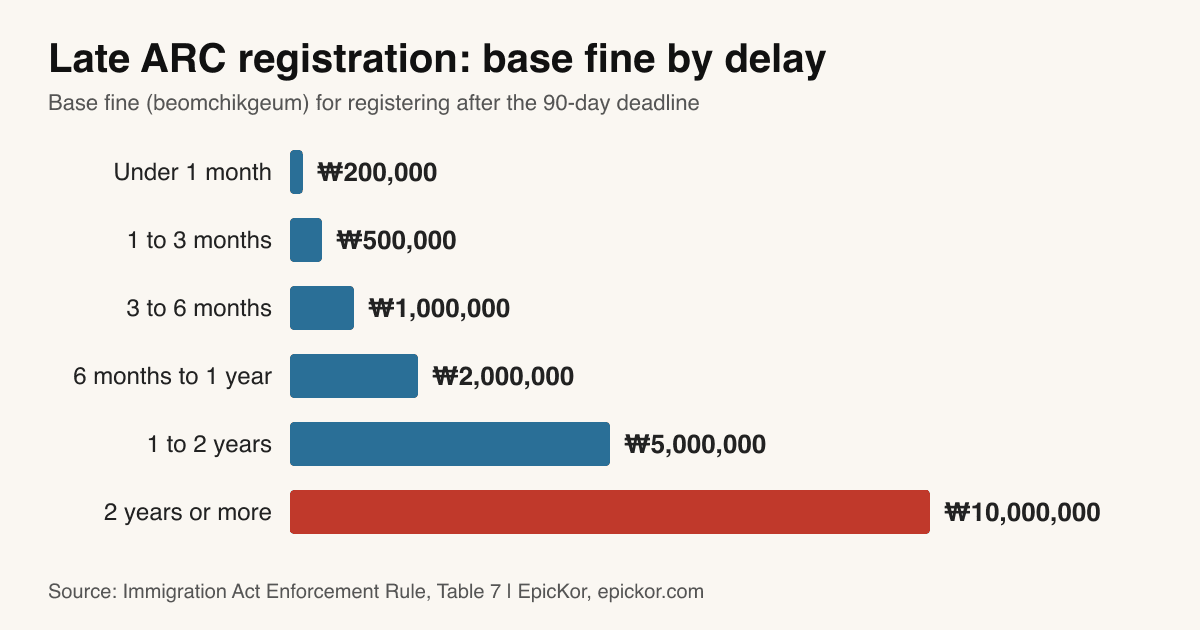
As with overstaying, the case can be settled by a beomchikgeum (범칙금), a fine-like payment the office can impose under Article 102 without a court case. You must pay it within 15 days of receiving the notice (Act Art. 105). Table 7 of the Rule, row 보, sets the base amount by how late you are:
| How late you registered | Base fine (범칙금) | In US dollars |
|---|---|---|
| Under 1 month | ₩200,000 | ≈ US$150 |
| 1 to 3 months | ₩500,000 | ≈ US$375 |
| 3 to 6 months | ₩1,000,000 | ≈ US$750 |
| 6 months to 1 year | ₩2,000,000 | ≈ US$1,500 |
| 1 to 2 years | ₩5,000,000 | ≈ US$3,750 |
| 2 years or more | ₩10,000,000 | ≈ US$7,500 |
Source: 출입국관리법 시행규칙 Table 7 (범칙금의 양정기준, revised 23 January 2026), row 보, "법 제31조의 등록의무를 위반한 사람", read on law.go.kr on 9 November 2026.
These are base amounts. Rule Article 86(2) lets the office cut or raise the amount by up to half, considering your age and circumstances, why it happened, what came of it, your ability to pay and any earlier offences. Act Article 103(2) lets the Minister waive the notice entirely. The cheapest fix is the boring one: book the appointment in your first month, not your third.
After you have the card: the 15-day reports and their fines
Registration is not a one-off. The Act sets three more duties for card holders, each with its own deadline and its own penalty table.
| Duty | Deadline | Legal maximum | Base amount if late |
|---|---|---|---|
| Report a new address (체류지 변경신고, Act Art. 36) | 15 days from moving in, to the new city, county or district office (or its community centre) or the immigration office | Fine up to ₩1,000,000 (Act Art. 98(2)) | Under 3 months ₩100,000 · 3–6 months ₩300,000 · 6–12 months ₩500,000 · 1–2 years ₩700,000 · 2 years+ ₩1,000,000 (Table 7, row 조) |
| Report changed details (외국인등록사항 변경신고, Act Art. 35): name, sex, date of birth, nationality, new passport, and items the Rule adds, such as a new school or employer for some statuses | 15 days, to the immigration office | Administrative fine up to ₩1,000,000 (Act Art. 100(2)) | Under 3 months ₩100,000 · 3–6 months ₩300,000 · 6 months–1 year ₩500,000 · 1 year+ ₩1,000,000 (Decree Table 2, row 사) |
| Return the card (Act Art. 37) | When you leave Korea, to the officer at departure, unless one of the three exceptions in Art. 37(1) applies; also within 30 days of resident registration if you become a Korean national (HiKorea) | Administrative fine up to ₩1,000,000 (Act Art. 100(2)) | 1st time ₩100,000 · 2nd ₩300,000 · 3rd ₩500,000 · 4th+ ₩1,000,000 (Decree Table 2, row 아) |
The passport line catches people. Renewing your passport at your embassy in Seoul changes a registered detail, so the 15 days start the day you get the new passport. You do not need a new ARC for a new passport number. A change of name, sex, date of birth or nationality is different: the office reissues the card (Decree Art. 42(1)5), and the replacement fee applies.
Article 37(1) lists three cases in which you keep the card when you leave:
- you have a re-entry permit and will come back within its period;
- you hold a multiple-entry visa, or are a national of a country exempt from re-entry permits, and are leaving temporarily to come back within your permitted stay;
- you hold a refugee travel document and will come back within its validity.
Separately, Rule Article 44-2 exempts most registered foreigners from needing a re-entry permit for a trip of under one year (two years for F-5), which is why the re-entry permit is a fee many people never pay. Act Article 37-2 refers to that exempt period when it sets out when registration can be cancelled. The Act does not spell out how the Article 44-2 exemption lines up with the card-return exceptions above, so if you plan to leave and come back on the same card, confirm with the departure officer or 1345 before you go.
You might like: Do You Have to Carry Your Passport in Korea? Yes — the ₩100,000 Rule
Re-entry permits: the fee most ARC holders never pay
The table lists ₩30,000 for a single re-entry permit and ₩50,000 for a multiple one. Under the current rule, most registered foreigners do not need one.
Rule Article 44-2 exempts these people from the re-entry permit:
- F-5 permanent residents returning within two years of leaving;
- holders of every status from A-1 to F-3 and from F-6 to G-1 (students, workers, working-holiday makers, family members and most others) returning within one year, or within their remaining period of stay if that is shorter.
The exemption does not apply to people barred from entry under Act Article 11 or to the cases listed in Rule Article 10. If your trip will run past a year, or past your stay date, ask about a permit before you fly. Coming back after the exempt period has ended lets the office cancel your registration (Act Art. 37-2).
How these fees add up in real cases
Fees stack. Here is what Article 72 adds up to in four common cases, office price first, online price where the discount applies. Only the law's fees are counted; health checks, criminal record certificates, translation and photo costs are extra.
| Case | What you pay for | Total at the office | Using online where allowed |
|---|---|---|---|
| D-2 student, first year | ARC ₩35,000 + part-time work permit ₩20,000 | ₩55,000 (≈ US$41) | Same (neither is discounted) |
| D-2 student, second year | Extension ₩60,000 | ₩60,000 (≈ US$45) | ₩48,000 (≈ US$36) |
| D-4 language student moving to a D-2 degree in Korea | Change of status ₩100,000 + new ARC ₩35,000 | ₩135,000 (≈ US$101) if a new card is issued | ₩115,000 (≈ US$86) if a new card is issued |
| E-7 worker changing employer | Change of workplace ₩120,000 | ₩120,000 (≈ US$90) | ₩96,000 (≈ US$72) |
The D-4 to D-2 totals apply only if a new card is issued. Decree Article 42(1)4 lists a change of status as a ground for reissue, and Article 74(1)7 of the Rule waives the ₩35,000 only when the office caused the reissue. Ask the office whether it will charge you for the new card.
Two notes on the work rows. The ₩120,000 change-of-workplace fee applies only to statuses that need permission to change employer under Act Article 21. And working outside your status without the ₩120,000 permit is not a fee problem at all: it is the offence covered in our overstay and illegal work guide, with fines from ₩2,000,000.
Here on a working holiday? See Korea's working holiday visa (H-1): the 30 countries, quotas and age limits.
Extensions: apply before the date, not after
An extension is the fee that saves the most money, because the alternative is a fine. Decree Article 31(1) says the application must be filed before your period of stay ends. File one day late and you are no longer someone paying ₩60,000. You are an overstayer, and the base fine for under a month on Table 7, row 고, is ₩500,000 (about US$375).
Two related rules from the same Enforcement Rule:
- Leaving after your status ends is free. Rule Article 32 lets the office extend your stay so you can leave if you are registered and have finished the activity of your status and want to travel in Korea for a while, or if there is no flight or ship or another unavoidable reason stops you leaving. Article 32(3): no fee. Stays over 30 days need the Minister's approval.
- Unpaid health insurance can shorten an extension. Registered foreigners with national health insurance arrears can be given a shorter extension until the debt is cleared; the rules are in our health insurance guide.
If the office refuses an extension or a change of status, Decree Article 33 says the refusal notice must set a departure deadline of no more than 14 days from the notice. For a refused change of status, the office can instead let you stay on your current status.
You might like: Korea Health Insurance for Foreigners: At Least ₩158,630 a Month After Six Months
The honest part: what this table cannot tell you
- Whether a private agency is worth it. Licensed immigration agencies (출입국민원 대행기관) can file for you, and their service charge comes on top of every fee above. The law fixes the Ministry's fee, not theirs. If your case is simple and you can use HiKorea, the online route is both cheaper and discounted.
- The mobile ARC. Act Article 33(6) allows a mobile alien registration card with the same legal effect as the plastic one. HiKorea explains how to get it, by tapping an IC card in the government's mobile ID app or by scanning a QR code at the office, and lists no fee. Article 72 has no separate line for it either. We could not confirm from a primary source whether a fee applies when you visit the office for one.
- The card's chip version. HiKorea's mobile ARC page refers to IC-chip cards as well as ordinary ones. Article 72 has one price for "issue and reissue" and does not distinguish card types, so ₩35,000 is the figure the law supports.
- Approval. Paying the fee does not mean the permit is granted. Extensions and changes of status are discretionary, and the fee is not refunded if you are refused.
FAQ
Q: How much is the ARC fee in Korea in 2026?
A: ₩35,000 (about US$26) to issue or replace an alien registration card, under Article 72, item 10 of the Enforcement Rule of the Immigration Act. Article 73 says it is paid in cash or with proof of a cash payment; an amendment to Article 73 takes effect around September 2027. A-1 to A-3 holders and D-8 investors are exempt (Art. 74(1)3).
Q: Are government-scholarship students exempt from immigration fees?
A: Partly. Rule Article 74(1)2 waives the fees for a change of status, an extension of stay or a re-entry permit for D-1, D-2 and D-4 holders invited by the Korean government or a state-funded research institute that pays their tuition and living costs. It does not waive the ₩35,000 ARC fee.
Q: When do I have to apply for an ARC?
A: Within 90 days of the day you entered Korea, if you will stay longer than 90 days (Act Art. 31). If you change status or are granted a status inside Korea and will pass 90 days, you register when that permission is given.
Q: What is the fine for registering late?
A: Registering late is an offence under Act Article 95(7), with a maximum of one year in prison or ₩10 million. It can be settled by a beomchikgeum fine: base ₩200,000 if under a month late, ₩500,000 for one to three months, up to ₩10,000,000 after two years (Rule Table 7). The office can raise or cut it by half.
Q: How much does a visa extension cost in Korea?
A: ₩60,000 at the office, ₩48,000 online through HiKorea (Rule Art. 72 item 6, Art. 74(2)). F-6 marriage migrants pay ₩30,000, or ₩24,000 online. Apply before your period of stay ends; after that you are overstaying.
Q: How much does it cost to change visa status in Korea?
A: ₩100,000 at the office, ₩80,000 online. A change to F-5 permanent residence costs ₩200,000, or ₩160,000 online (Rule Art. 72 item 5).
Q: Do I need a re-entry permit to leave Korea for a holiday?
A: Usually not. Rule Article 44-2 exempts most registered foreigners who come back within one year (or before their stay ends, if sooner), and permanent residents who come back within two years. Outside those limits, a single permit costs ₩30,000 and a multiple one ₩50,000.
Q: What if I lose my ARC?
A: Apply for a replacement at the immigration office for your area, with your passport, the application form, a document explaining the loss and a colour photo if your last one is over six months old. The fee is ₩35,000 (Decree Art. 42, Rule Art. 72 item 10).
Sources
- Enforcement Rule of the Immigration Act (출입국관리법 시행규칙), Ministry of Justice Ordinance No. 1172, in force from 23 October 2026: Art. 72 (fees, all items; last amended 24 December 2024), Art. 73 (payment methods: revenue stamp or electronic payment; ARC fee in cash), addendum to Ordinance No. 1125 of 15 September 2026 (Art. 73 amendment in force one year after promulgation), Art. 74 (exemptions; 20% online reduction), Art. 10, Art. 32 (free extension to leave), Art. 44-2 (re-entry permit exemption), Art. 45 (registration exemptions), Art. 86 (fine standards, half up or down), Table 7 (범칙금의 양정기준, revised 23 January 2026: rows 보, 조, 고), National Law Information Center (law.go.kr), read 9 November 2026.
- Immigration Act (출입국관리법), Act No. 21857, in force from 2 October 2026: Art. 30 (re-entry permits), Art. 31 (registration within 90 days), Art. 33 (card issue, under-17 rule, mobile ARC), Art. 35 (15-day change report), Art. 36 (15-day address report), Art. 37 (returning the card), Art. 37-2 (cancellation of registration), Art. 87 (fees), Art. 95(7), Art. 98(2), Art. 100(2), Arts. 102, 103, 105, law.go.kr, read 9 November 2026.
- Enforcement Decree of the Immigration Act (출입국관리법 시행령), in force from 2 October 2026: Art. 10(4), Art. 31 (extension before the period ends), Art. 33 (14-day departure deadline after refusal), Art. 40 (registration), Art. 42 (card reissue), Art. 102 and Table 2 (과태료의 부과기준, rows 사 and 아), law.go.kr, read 9 November 2026.
- HiKorea, Ministry of Justice: 외국인등록 대상 및 시기 (who registers and when), 외국인등록시 제출서류 (documents; D-8 fee exemption), 외국인등록증 발급/재발급 (replacement), 외국인등록사항 변경신고 (15-day change report), 모바일 외국인등록증 발급 (mobile ARC), and the HiKorea page footer for the 1345 hours, read 9 November 2026. HiKorea marks the registration-target, replacement and change-report pages as last updated 13 April 2021 and the mobile ARC page 4 October 2024; the documents page shows only a 2013 creation date. Card return: HiKorea 외국인등록증 반납 (last updated 14 April 2021) and Enforcement Decree Art. 43(2)1 (return within 30 days of resident registration after becoming a Korean national).
- Exchange rate: US Federal Reserve H.10, South Korean won per US dollar, 30 October 2026: ₩1,333.99, via FRED (DEXKOUS), read 9 November 2026.
You Might Also Like
Korea Visa Overstay: What Happens, Fines by Length, How to Leave
Overstaying in Korea is a crime under Immigration Act Art. 94: up to 3 years or ₩30 million. In practice it is a fine set by length, ₩500,000 to ₩2,000,000 for under a month depending on the row applied, then a departure order. Illegal work: same scale.

Ice Skating in Seoul, Korea: Lotte World vs Mokdong vs Taereung vs Seoul Plaza Rinks
Lotte World Ice Rink costs ₩21,000 (US$15.44) with skates on a weekday; Seoul's public rinks at Mokdong and Taereung charge about ₩8,000 and open all year. The winter rink on Seoul Plaza, ₩1,000 last season, reopens 18 December 2026.
Incheon Airport to Busan, Korea: Direct Bus, AREX + KTX or a Flight to Gimhae — Fares, Hours and the Last Departure
Yes, a direct bus runs from Incheon Airport to Busan: 18 a day, the last at 23:50, ₩53,900 to ₩91,300, from 4 h 41 min. AREX + KTX costs about ₩67,400 and reaches Busan Station faster. Flights to Gimhae, the last departures and late landings, compared.