Flight Delay Compensation in Korea: 10–30% Back, US$600 If Bumped
Last updated: 20 October 2026. The compensation table was read in Korean on the official legislation site (law.go.kr) on 20 October 2026: the Fair Trade Commission's 소비자분쟁해결기준 (Notice No. 2025-14, in force since 18 December 2025), the Ministry of Land, Infrastructure and Transport's 항공교통이용자 보호기준 (Notice No. 2026-116) and the Aviation Business Act (항공사업법), Articles 61 and 61-2. Delay statistics are labelled with their source. Sources are at the end.
Flight delay compensation in Korea exists, it is written down, and it is more generous than most English-language guides suggest. Those guides usually say "Korea has no EU261" and stop at a line about international percentages. That is half the picture. As of October 2026, Korea's official consumer dispute standard sets compensation for domestic flights from just one hour late, gives a fixed US dollar amount if you are bumped from an international flight, and puts the burden on the airline: weather, airport problems and safety checks only excuse a delay if the airline proves them.
Below: the full Fair Trade Commission (공정거래위원회) table, worked examples in won, the Ministry rule on bumped passengers, and how to claim, step by step.
Delays mean hours of checking airline texts and photographing boards: an Anker 10,000mAh power bank keeps your phone, and your evidence, alive. See it on AmazonAffiliate link. As an Amazon Associate, EpicKor earns from qualifying purchases at no extra cost to you.
Quick Guide: Korea's official flight delay compensation table
What the airline owes you under the Fair Trade Commission's 소비자분쟁해결기준 (Consumer Dispute Settlement Standard), Notice No. 2025-14, as of October 2026. "Fare" means the fare for the delayed leg only, not your whole round trip.
| Situation | Domestic flight (국내선) | International flight (국제선) |
|---|---|---|
| Delay, band 1 | 1–2 hours late: 10% of the fare | 2–4 hours late: 10% of the fare |
| Delay, band 2 | 2–3 hours late: 20% | 4–12 hours late: 20% |
| Delay, band 3 | 3 hours or more: 30% | More than 12 hours: 30% |
| Not covered | Under 1 hour | Under 2 hours |
| Bumped (overbooking, lost reservation), replacement flight given | Replacement leaving 1–3 hours later: 20% of the fare; more than 3 hours later: 30% (a replacement means one within 12 hours, on any airline) | Flight up to 4 hours (3,500 km): US$200 if the replacement leaves 2–4 hours later, US$400 if later than that. Longer flights: US$300 / US$600 |
| Bumped, no replacement | Refund of that leg plus a ticket or voucher for the same route | Refund of that leg plus US$600 |
| Meals and hotel | "Reasonable" food and lodging costs if you have to stay over (체재필요 시 적정 숙식비). For international bumping, the US$ amounts are ceilings that include these costs (적정숙식비 등 경비 포함) | |
| Airline is excused if it proves | Aircraft maintenance under MOLIT-approved maintenance standards (국토교통부 항공기 점검), weather, airport conditions, a knock-on delay from the previous flight, or an unforeseeable safety measure | |
Three details in the original Korean text matter more than the percentages:
- The excuses only work if the airline proves them. Every exemption is worded "다만 … 증명한 경우에는 제외", meaning except where the airline proves the cause. "Weather" announced at the gate is not proof.
- The domestic table defines "fare" as what you paid minus fuel surcharge, airport fees and other charges (유류할증료, 공항이용료, 기타 수수료 제외). The international rows do not repeat this definition, so expect the airline to calculate on the base fare there too.
- Domestic delays are measured at the destination (목적지 도착 기준), so a flight that leaves 70 minutes late but makes up time in the air and lands 50 minutes late is not covered.
Cabeau Evolution S3 travel pillow — memory foam that clips to your seat or carry-on. A 4–12 hour delay pays 20% of the fare, but you still spend those hours in a gate chair or on the plane; this is the pillow that makes a re-timed overnight departure bearable. As an Amazon Associate, EpicKor earns from qualifying purchases at no extra cost to you.
See the Cabeau Evolution S3 on AmazonThe numbers in won: two worked examples
Percentages are easier to judge with real money. The figures below are illustrative; use the fare breakdown on your own e-ticket receipt.
| Example | What you paid | Base for the calculation | Delay | Compensation |
|---|---|---|---|---|
| Gimpo → Jeju, one way | ₩80,000 total, of which ₩10,000 fuel surcharge and ₩4,000 airport fee (illustrative) | ₩66,000 | Lands 2 h 15 m late | 20% = ₩13,200 |
| Incheon → Bangkok, round trip | Outbound leg base fare ₩320,000 (illustrative) | ₩320,000 (outbound only) | 5 hours late | 20% = ₩64,000 |
| Incheon → Los Angeles, bumped | Any fare | Fixed amount | Replacement flight leaves 6 hours later | US$600 (flight over 4 hours) |
A delay on a cheap domestic ticket pays about a meal and a taxi. Being bumped from a long international flight pays a fixed US$600, whatever the ticket cost.
You might like: Korean Airlines: Which to Fly, What Happens to Asiana Miles, and Which Names Vanish
Bumped from a flight out of Korea? The airline must pay the top of the range
The Fair Trade Commission table says the US dollar amounts for denied boarding are ceilings ("보상기준 금액은 최고한도임"), and the same note says the ceiling includes reasonable meals and lodging. On its own that would let an airline offer, say, US$150 instead of US$200.
A second rule closes that gap. The Ministry of Land, Infrastructure and Transport's 항공교통이용자 보호기준 (Air Transport User Protection Standard, Notice No. 2026-116), Article 4, applies to every flight departing an airport in Korea, and it names foreign airlines (외국인 국제항공운송사업자) as well as Korean ones. When a flight is overbooked, the airline must first look for volunteers. Anyone still bumped against their will must be told about the compensation standard and paid "the maximum of the compensation amount" (보상기준 금액의 최고한도를 배상).
In practice:
- If you are bumped because a flight leaving Incheon, Gimpo, Gimhae or Jeju was overbooked, you are owed the full US$200/400/300/600 figure in the table (or the full 20%/30% on a domestic flight), not a discount voucher.
- Volunteering is a negotiation. If you give up your seat voluntarily, you agree the terms with the airline yourself. Article 4 only governs people bumped involuntarily. Ask for cash or bank transfer terms in writing before you agree.
- Arriving at the counter after check-in closes disqualifies you. The international table excludes anyone who reaches check-in after the airline's own deadline.
- If you refuse the replacement flight offered on an international route, you get a refund of that leg plus compensation calculated on when the first replacement could have left.
The rules that apply while you're stuck on the plane
Delays on the ground with passengers on board fall under the Aviation Business Act, Article 61-2 (이동지역에서의 지연 금지), which is law rather than a guideline:
- An airline may not keep passengers on board on the apron or taxiway for more than 3 hours on a domestic flight or 4 hours on an international flight. Exceptions apply where the authorities or the captain decide disembarking is unsafe or would cause serious disruption.
- The crew must update passengers on the cause and progress every 30 minutes.
- Once the wait passes 2 hours, the airline must provide suitable food and drink and report the delay to the Ministry.
The MOLIT standard (Article 8) also requires the airline, if it has your contact details, to text, email or call you "without delay" when a flight departing Korea is delayed by 30 minutes or more or cancelled. That message is evidence. Keep it.
How often Korean flights are actually late enough to pay
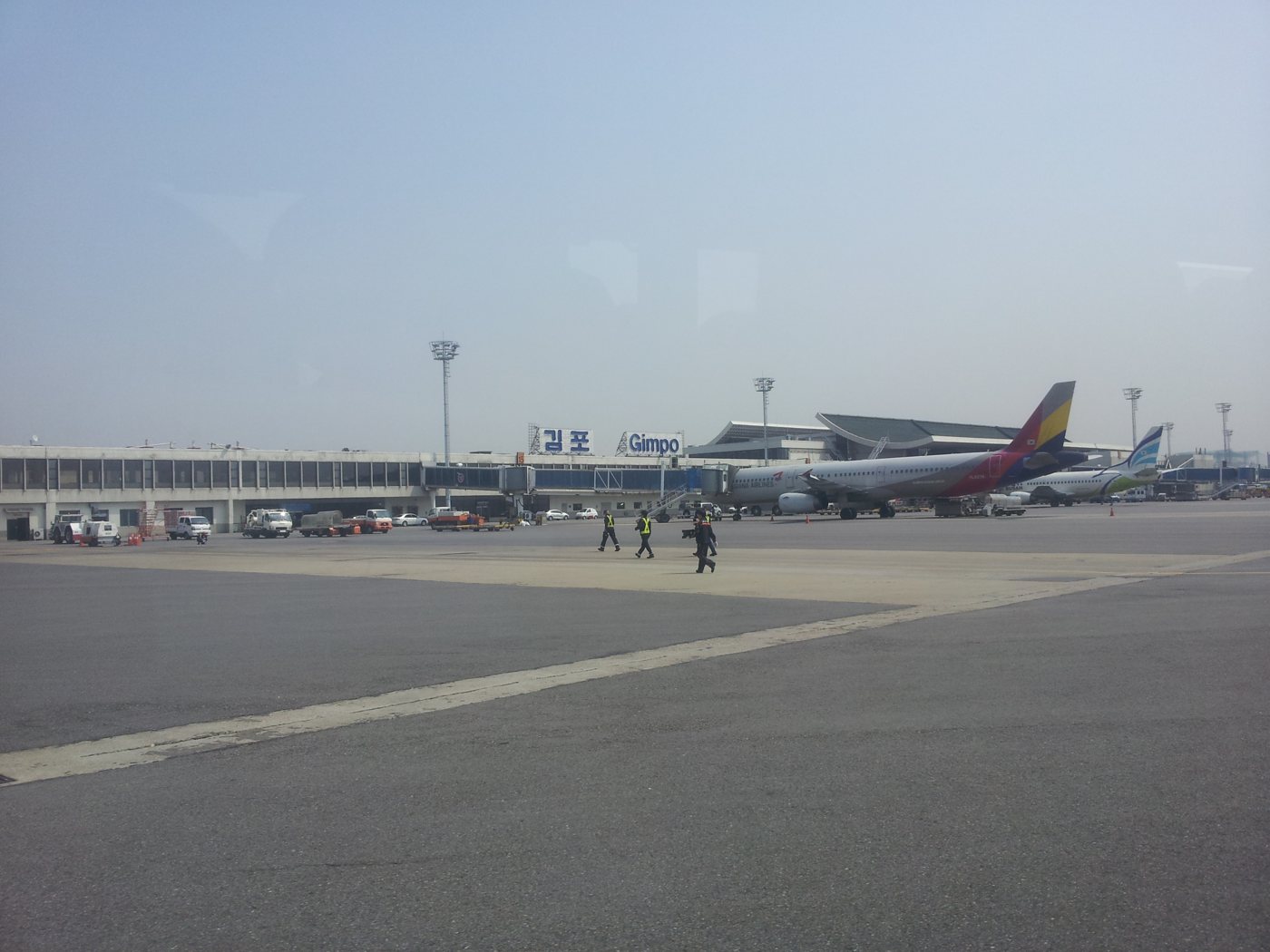
Most delays in Korea are short, which is why few travellers ever claim. The clearest recent breakdown is for domestic flights at the airports run by Korea Airports Corporation (한국공항공사), which excludes Incheon. It covers January to June 2026 and was released by the office of lawmaker Kim Jong-yang. The source is press coverage of data the corporation submitted to the National Assembly (MTN, 23 September 2026), not a published government table.
| Domestic flights, H1 2026 (excluding Incheon) | Flights | Compensation band |
|---|---|---|
| Scheduled domestic passenger flights | 171,710 | — |
| Delayed (all) | 28,628 (16.7%) | — |
| 15–30 minutes late | 17,304 | None |
| 30–60 minutes late | 8,330 | None |
| 1–2 hours late | 2,557 | 10% |
| 2 hours or more | 437 | 20–30% |
So 89.5% of domestic delays never reach the one-hour line; only about 1.7% of all flights did.
The Ministry's own annual airline scorecard points the same way. In its 2025 Air Transport Service Evaluation, published on 17 April 2026, the punctuality score gives 50% weight to the share of long delays: 1 hour or more domestic, 2 hours or more international. Those are exactly the compensation thresholds. Korean Air received the top A+ for operational reliability. Aero K (에어로케이) received C, largely because of long domestic delays. These grades come from press reports of the Ministry release (Herald Business, 16 April 2026); we have not read the Ministry's own score sheet.
You might like: Incheon Airport Layover Guide: Getting Around ICN, Leaving the Airport for Seoul, AREX Last Trains, Night Buses, Rest and Food
How to claim: airline first, then the consumer agency, then court
The Korean table is a settlement standard. Its first article describes it as the basis for "agreement or recommendation" (합의 또는 권고의 기준). It is not paid automatically. You ask, and the system is built to back you up when the airline says no.
| Step | Where | Deadline or rule | What to send |
|---|---|---|---|
| 1. Airline damage-relief claim (피해구제 신청) | The airline's customer centre or website "피해구제" page; every airline must publish a relief plan | Airline must answer within 14 days, or 60 days with a stated reason such as translation (Aviation Business Act, Art. 61) | Booking reference, e-ticket receipt with fare breakdown, the delay text, photo of the departures board, actual arrival time, receipts for meals and hotel |
| 2. Korea Consumer Agency (한국소비자원) | Phone 1372 or the 1372 Consumer Counseling Center website | If the airline cannot settle within its deadline, or if you ask, the airline must forward your claim to the agency itself (Art. 61(5)) | The airline's written reply, plus everything from step 1 |
| 3. Dispute mediation | Consumer Dispute Mediation Commission inside the agency | The commission applies the Fair Trade Commission table as its yardstick | Nothing new; the agency moves the file |
| 4. Small claims court (소액사건) | Korean district court, or the online e-court | Claims up to ₩30 million use the simplified small-claims procedure | The same evidence, filed in Korean |
Two tips from the wording of the rules:
- Ask for the cause in writing. The MOLIT standard's own sample messages name causes precisely: "strong wind," "late arrival of the previous aircraft," "bird strike." A vague "operational reasons" is not on the exemption list, and maintenance only counts when the airline shows it was done under its MOLIT-approved maintenance standards.
- A knock-on delay (항공기 접속관계) is an exemption, but the first delay still has to be proven. If the earlier flight was late for a reason the airline cannot prove, push back.
TOPBAG RFID passport wallet — one sleeve for passport, boarding pass and receipts. Claims are won on paper: the boarding pass, the airline's delay text, and the meal and hotel receipts. This keeps them together until the airline answers. As an Amazon Associate, EpicKor earns from qualifying purchases at no extra cost to you.
See the TOPBAG passport wallet on Amazon
When EU261 or the Montreal Convention pays more
Korea's table is not the only rulebook that can apply to your flight. Check these two before you settle.
EU261 (Regulation (EC) No 261/2004) covers every flight departing an EU airport, on any airline, and flights arriving in the EU on an EU airline. For a Korea route (over 3,500 km), arriving 3 hours or more late is worth up to €600, or €300 for a delay of 3 to 4 hours, unless the airline proves "extraordinary circumstances." That gives three cases:
| Flight | EU261 applies? | Korean rules? |
|---|---|---|
| Korean Air, Paris → Incheon | Yes (departs the EU) | Can be used in a Korean dispute with a Korean airline, but EU261 lets the airline deduct other compensation paid for the same delay |
| Korean Air, Incheon → Paris | No (non-EU airline flying into the EU) | Yes: this is the flight where the Korean table is your main tool |
| Air France, Incheon → Paris | Yes (EU airline arriving in the EU) | The MOLIT overbooking rule applies (the flight leaves Korea), but EU261 normally pays more for a delay |
On a long-haul flight the EU amount is usually larger than 20–30% of one leg's base fare, so claim under EU261 where it applies. The UK has kept its own copy (UK261) for flights out of the UK. The EU reached a political agreement on a reform of the regulation in June 2026. The reported text keeps the three-hour trigger, but it applies only once it is published in the Official Journal and takes effect, so check the current rule when you claim.
The Montreal Convention (1999) covers international flights between countries that have joined it, Korea included. Under Article 19 the airline is liable for actual, provable losses caused by delay, such as a non-refundable hotel night you missed or a new ticket for a connection the airline would not rebook. It escapes only by showing it took all reasonable measures, or that such measures were impossible. The cap for delay is 6,303 Special Drawing Rights per passenger under the limits ICAO revised from 28 December 2024. The MOLIT standard defines the Convention as having the same force as Korean domestic law (Article 2). Use Montreal for real losses and the Korean table for the flat percentage.
You might like: Korea Departure Tax (2026): The ₩24,000 Already Inside Every Ticket Out of Incheon, Who Pays Nothing, and the Rise Waiting in Parliament
When not to bother, and when to push
The honest picture, so you spend your time on the claims that pay:
- Don't bother for a 70-minute domestic delay on a ₩30,000 sale fare: 10% is a few thousand won.
- Don't bother when the cause is real and documented, such as a typhoon that closed Jeju Airport. The airline can prove the exemption.
- Push when you were bumped: fixed amounts, top of the range, and overbooking is the airline's own choice.
- Push when the reason was vague and the delay crossed 2 hours domestic or 4 hours international, or when the flight left an EU airport.
- Travel insurance may cover hotels and missed tours after a weather delay. That depends on your policy, not Korean law.
FAQ
Q: Does Korea have a flight delay compensation law like EU261?
A: Not a single regulation like EU261, but it has an official table. The Fair Trade Commission's 소비자분쟁해결기준 (Notice No. 2025-14) sets 10/20/30% of the delayed leg's fare for international delays of 2–4, 4–12 and 12+ hours, and for domestic delays of 1–2, 2–3 and 3+ hours. It also sets US$200–600 for being bumped from an international flight. It is a settlement standard that the Korea Consumer Agency applies, so you have to claim; it is not paid automatically.
Q: How much compensation do I get for a delayed Korean Air or Jeju Air flight?
A: It depends on the delay and the base fare of that leg. A domestic flight arriving 2 hours 15 minutes late earns 20% of the base fare (fare minus fuel surcharge and airport fee); on a ₩66,000 base that is ₩13,200. An international flight 5 hours late earns 20% of that leg's fare. If the airline proves weather, airport conditions, a knock-on delay or a mandated inspection caused it, nothing is owed except reasonable meals and lodging.
Q: What do I get if I am bumped from an overbooked flight in Korea?
A: On an international flight up to 4 hours (3,500 km), US$200 if your replacement leaves 2–4 hours later and US$400 if later. On longer flights, US$300 or US$600. With no replacement, a refund of that leg plus US$600. For flights departing Korea, the Ministry's protection standard requires the airline to pay the maximum amount when you are bumped because of overbooking; that maximum includes reasonable meals and lodging. On domestic flights the figure is 20% or 30% of the fare.
Q: How long does the airline have to answer my claim?
A: 14 days from receiving it under Article 61 of the Aviation Business Act, or 60 days if it gives a specific reason such as translation. If it cannot settle in time, or if you ask, it must forward your claim to the Korea Consumer Agency (phone 1372).
Sources
- Compensation table: 소비자분쟁해결기준, Fair Trade Commission Notice No. 2025-14 (in force 18 December 2025), Annex 2: 항공(국내여객) and 항공(국제여객), National Law Information Center (law.go.kr), read 20 October 2026.
- Overbooking and delay notices: 항공교통이용자 보호기준, MOLIT Notice No. 2026-116 (in force 18 March 2026), Arts. 2–4 and 8 and Annex 2, law.go.kr, read 20 October 2026.
- Claims deadline and tarmac delay rule: 항공사업법 (Aviation Business Act), Arts. 61 and 61-2, law.go.kr, read 20 October 2026.
- Domestic delay breakdown, January–June 2026 (Korea Airports Corporation data submitted to Rep. Kim Jong-yang; press report): MTN, 23 September 2026.
- 2025 Air Transport Service Evaluation, MOLIT (press report of the 17 April 2026 release): Herald Business, 16 April 2026.
- Montreal Convention limits: ICAO, 2024 Revised Limits of Liability under the Montreal Convention of 1999.
- EU261: Regulation (EC) No 261/2004, EUR-Lex.
The short version: a delay in Korea is worth claiming once it crosses 1 hour domestic or 2 hours international. Being bumped from a flight out of Korea is worth claiming every time. Ask for the cause in writing, keep the airline's text, claim from the airline first, and if it says no or goes quiet for 14 days, call 1372.
You Might Also Like
Jeju in Winter, Korea: Tangerine Picking and Camellia Gardens — Prices, Seasons and Which Farms by Bus
Camellia Hill now charges ₩12,000. Hueree adds ₩8,000 picking to a ₩13,000 ticket, while a Jeju City farm lets you take 2 kg home for ₩11,000. Per-kg costs, bloom months, closures and the buses that reach each one.
Andong Hahoe Village from Seoul, Korea: KTX-Eum, Mask Dance, Hanok Night
Winter hours already apply at Andong Hahoe Village: last entry 4:30 p.m. from 1 October. The KTX-Eum from Cheongnyangni is ₩27,700, 9–10 trains a day, and the free mask dance is 2 p.m. Tuesday to Sunday. Plus the 33 village minbak.
Where to Stay in Jeju Without a Car: Korea's Five Best Bases by Bus
57.5% of Jeju's rooms are in Jeju City and Seogwipo, yet 82.7% of its rural guesthouses sit in the outer villages, where buses are far sparser. Five car-free bases compared by bus line, airport fare and the last bus home.