CERAGEM Deep Dive: The Korean Company That Sold Wellness by Giving It Away Free
CERAGEM's real invention was not the thermal massage bed but the free café where you lie on one — 5.72 million people in five years. A public-information deep dive on the Korean company, including why revenue has almost halved since 2022.
Heat plus jade, the two ingredients of a CERAGEM bed, in a small far-infrared heating padAffiliate link. As an Amazon Associate, EpicKor earns from qualifying purchases at no extra cost to you.
Quick Answer
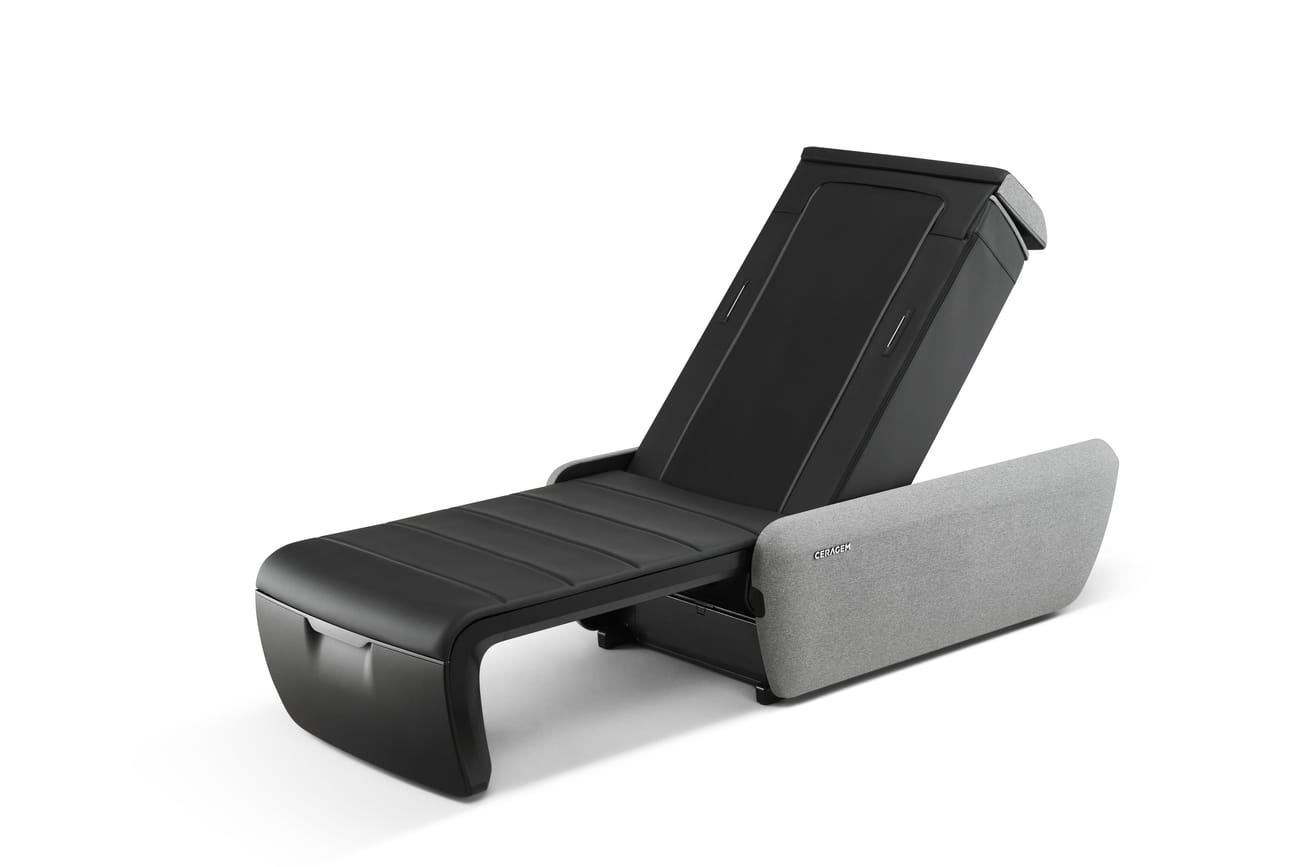
Search "thermal massage bed" in the United States and you will find a black reclining device called a CERAGEM, cleared by the FDA as a Class II medical device, priced on the company's own American store at $9,999 for the current Master V9. Almost nobody buying one can tell you what CERAGEM is or where it comes from.
CERAGEM Co., Ltd. (주식회사 세라젬) is a Korean company founded in July 1998 and headquartered in Cheonan, about an hour south of Seoul. It is unlisted. It operates in more than 70 countries, and roughly 90 percent of its revenue comes from two product lines: spinal thermal devices and massage chairs.
But the device is not the interesting part of this company, and it is not what made it large.
CERAGEM's actual innovation was a retail format. Starting in 2019 it opened cafés — real cafés, with coffee — where anyone can walk in and lie on a thermal massage bed for free, no appointment, no salesperson hovering, no purchase expected. In five years those stores put 5.72 million people onto the product. That is the company.
And here is the part a serious reader needs: it is not working any more. Revenue peaked at about ₩750.1 billion in 2022 and was roughly ₩381.2 billion in 2025, with an operating loss. The company has been closing overseas subsidiaries. This is a deep dive into a company on the way down from a genuine peak, which is more instructive than another success story.
The Company at a Glance
| Detail | |
|---|---|
| Official name | CERAGEM Co., Ltd. (주식회사 세라젬) |
| Founded | July 1998 |
| Founder / Chairman | Lee Hwan-sung (이환성) |
| CEO | Lee Kyung-soo (이경수) |
| Headquarters | Cheonan, South Chungcheong |
| Listing status | Unlisted |
| Core products | Spinal thermal massage devices and massage chairs — together about 90% of revenue |
| Markets | 70+ countries; overseas subsidiaries reduced from 21 to 19 in 2025 |
| Retail format | Well Café / Well Lounge — free experience stores; about 500 experience locations in Korea |
| Experience footfall | 5.72 million cumulative visitors in the five years from 2019 |
| Revenue peak | ₩750.1 billion (2022) |
| Recent revenue | ₩584.6 billion (2023) · about ₩381.2 billion (2025), with an operating loss of roughly ₩3.2 billion |
| Overseas revenue | ₩244.8 billion, up 32.7% year on year (FY2024), led by China at +36.4% |
| US pricing | Master V9 $9,999 · Pause M10 massage chair $13,999 · MediSpa Pro $3,999 (company's own US store, August 2026) |
Large jade and tourmaline heating pad — the cheap way to test this category A ten-thousand-dollar bed is not the entry point for most readers. Find out whether you actually like sustained heat on your back first; if you do, go and lie on the real thing before you buy it. CERAGEM's own devices are listed on Amazon but currently unavailable there. As an Amazon Associate, EpicKor earns from qualifying purchases at no extra cost to you.
See the jade heating pad on AmazonThe Origin Is a Hospital Bed
Founder Lee Hwan-sung built the company from an observation rather than a technology. In the late 1990s he looked at the powered medical beds used in Japanese hospitals and asked whether the underlying idea — a heated surface with rollers that travel the length of the spine — could be made as a consumer product for the home.
That framing has stayed with the company ever since, and it is why CERAGEM occupies an unusual category. It is not a furniture company that added heat, and it is not a massage-chair company. Its central product is a bed you lie on flat while a jade-tipped roller assembly moves along the spine under thermal heat, and the company positions it as a home healthcare device rather than a relaxation product. In the United States that positioning is formalised: the V-series is cleared by the FDA as a Class II medical device, which is a regulatory classification, not a claim of efficacy.
The Real Product Was the Store
Here is the problem CERAGEM faced, and it is a genuinely hard one. It sells a large, expensive device whose entire value proposition is a physical sensation. You cannot describe the sensation in an advertisement. You cannot photograph it. Nobody is going to spend the equivalent of several thousand dollars on a machine they have never lain on.
The industry's traditional answer in Korea was door-to-door and demonstration selling — the salesperson brings the device to your home or invites you to a rented room. It works, and it also carries a reputation problem that clings to the whole category: pressure, elderly customers, and the general atmosphere of a sales pitch you cannot leave politely.
CERAGEM's answer was to invert it. In 2019 it opened the first Well Café (웰카페) in Mokdong, Seoul: a genuine café where the thermal massage beds sit in the back and anyone may use one for free, for a set session, without buying anything. No appointment. Have a coffee. Lie down. Leave.
By the five-year mark, 5.72 million people had experienced the product that way. The company now runs roughly 500 experience locations across Korea including department-store counters, and has been converting about 110 Well Cafés into a revised format called Well Lounge with structured wellness programmes.
Read as a retail decision, this is elegant. It solves the demonstration problem without the demonstration pressure, it converts a distribution cost into a brand asset, and it turns the thing that made the category distrusted — you have to try it — into the reason to visit. For an overseas operator studying Korean consumer companies, this is the transferable idea in the entire company, and it has nothing to do with heat or rollers.
Then the Numbers Went the Other Way
Between 2022 and today the company has lost roughly half its revenue.
| Year | Revenue | Note |
|---|---|---|
| 2022 | ₩750.1bn | peak |
| 2023 | ₩584.6bn | down about 22% |
| 2025 | about ₩381.2bn | operating loss of roughly ₩3.2bn |
Korean coverage attributes the decline to conditions rather than a single mistake: the end of the pandemic period, inflation, higher interest rates and weakened consumer sentiment. A ₩10 million device in the home is exactly the purchase a household defers when rates rise, and CERAGEM had grown through a period when people were at home with money they were not spending on travel.
Two structural facts make the decline harder to reverse.
The concentration. About 90 percent of revenue comes from spinal devices and massage chairs. The company has been visibly trying to broaden into a general home appliance and wellness business, and Korean trade press covering that effort in 2024 summarised the result plainly: everything outside the two core lines still accounts for only about 10 percent. Diversification has been attempted; it has not yet arrived.
The retreat abroad. In 2025 CERAGEM cut its overseas subsidiaries from 21 to 19, describing it as concentrating sales and marketing on higher-growth regions. That is a reasonable move and it is also a contraction.
The counterweight, and it is real: overseas revenue reached ₩244.8 billion in FY2024, up 32.7 percent year on year, with China up 36.4 percent and India and Vietnam growing. CERAGEM entered India in 2005 and by 2019 ran roughly 530 offline experience centres there. In Indonesia it has been recognised as a leading brand in its category. The international business is doing what the domestic business is not.
The Honest Risks
This is a shrinking company, and the article should not pretend otherwise. Revenue is down roughly 49 percent from the 2022 peak and the most recent full year carried an operating loss. Any partner, distributor or supplier evaluating CERAGEM should build their model on the current trajectory rather than the peak-year figures that still circulate in older coverage.
The category has a reputation problem, and it is not imaginary. Thermal massage devices and massage chairs are sold in many markets through demonstration, home visits and referral networks, and the sector has attracted regulatory and press attention accordingly — particularly around elderly customers and health claims. CERAGEM's café format is a deliberate move away from that model, and it deserves credit for it, but the category context follows the product across borders. A Western buyer encountering the brand for the first time should evaluate it on the FDA classification and the physical product, not on wellness language.
It is unlisted, so the paper trail is thinner. CERAGEM files no public annual report of the kind a KOSPI or KOSDAQ company must produce. The figures in this article come from Korean business press and corporate data aggregators, which are reliable but secondary. Anyone doing real diligence should request audited statements directly rather than relying on the numbers here — including ours.
Diversification is unproven. The company has invested outside its core, including a reported ₩27 billion investment in the medical device firm Ybrain, and has restructured its retail formats. None of that has yet moved the 90/10 revenue split.
What Overseas Operators Can Take From This
When the product cannot be advertised, the store is the advertisement. CERAGEM's café is the sharpest example in Korean retail of solving a demonstration problem structurally. Any company selling something that must be felt — mattresses, chairs, audio, wellness devices — should study the format rather than the device.
Free trial at scale is a distribution cost, and it should be measured as one. 5.72 million experiences over five years is a marketing number that most companies would report as reach. For CERAGEM it is closer to a sales funnel with a physical footprint, and the interesting question is what it costs per conversion. That figure is not public, and its absence is part of why the current downturn is hard to read from the outside.
A high-ticket domestic product is exposed to interest rates in a way exports are not. The clearest signal in CERAGEM's recent numbers is that overseas revenue grew 32.7 percent in the same period the overall business fell. If you are assessing a Korean consumer-durables company, separate the two before forming a view.
Consolidating from 21 subsidiaries to 19 is information. Companies rarely announce retreats as retreats. Read subsidiary counts, not press-release adjectives.
What to Watch Next
Whether the 90/10 split moves. Everything the company says about its future depends on non-core lines growing. That ratio is the single number that tells you whether the strategy is working, and Korean trade press reports it.
Whether overseas growth outruns the domestic decline. Overseas was ₩244.8 billion against a total that has fallen toward ₩381.2 billion. If the international business keeps compounding at over 30 percent while Korea contracts, this becomes an export company with a Korean headquarters — a different investment case entirely.
Whether the Well Lounge conversion changes anything. Converting about 110 cafés into a programme-led format is a bet that the experience needs to be deeper rather than merely free. The result will show up in conversion, not footfall.
FAQ About CERAGEM
Q: Is CERAGEM a Korean company?
A: Yes. CERAGEM Co., Ltd. was founded in July 1998 and is headquartered in Cheonan, South Chungcheong Province, Korea. It is unlisted and was founded by Chairman Lee Hwan-sung, with Lee Kyung-soo as chief executive. It operates in more than 70 countries through a network that stood at 19 overseas subsidiaries in 2025.
Q: What does CERAGEM actually make?
A: Two things account for roughly 90 percent of revenue: spinal thermal massage devices — the reclining bed with a heated roller assembly that travels along the spine — and massage chairs. The remaining tenth covers other home wellness and appliance products the company has been trying to grow.
Q: What is a CERAGEM Well Café?
A: A company-operated café in Korea where visitors can use a thermal massage bed free of charge, without an appointment or an obligation to buy. The first opened in Mokdong, Seoul, in 2019, and 5.72 million people had used the format within five years. CERAGEM runs about 500 experience locations in Korea and has been converting roughly 110 cafés into a revised Well Lounge format.
Q: How much does a CERAGEM cost?
A: On the company's own US store in August 2026, the Master V9 thermal massage bed is listed at $9,999, the Pause M10 massage chair at $13,999, and the MediSpa Pro at $3,999, with refurbished units listed lower. Prices vary by market and change; treat these as a reference point rather than a quote.
Q: Is CERAGEM financially healthy?
A: Not at present. Revenue peaked at about ₩750.1 billion in 2022, fell to about ₩584.6 billion in 2023, and was around ₩381.2 billion in 2025 with an operating loss of roughly ₩3.2 billion. Overseas revenue is the bright spot, reaching ₩244.8 billion in FY2024 and growing 32.7 percent year on year. The company is unlisted, so anyone doing commercial diligence should request audited statements directly.
Q: Is the device FDA approved?
A: It is FDA cleared as a Class II medical device in the United States, which is a regulatory classification indicating the device is substantially equivalent to an existing marketed device. That is not the same as FDA approval of a health claim, and it should not be read as one.
Related Reading
- Glasslock Deep Dive: The Korean Company Behind the Glass Container in Your Costco Cart — another Korean maker whose product is known and whose name is not.
- Winix Deep Dive: America's Favorite Budget Air Purifier Is a 50-Year-Old Korean Company — the same anonymity pattern in home appliances.
- Cuckoo Deep Dive: The Korean Rice Cooker That Outlived LG, Its Own Client — a Korean home-appliance maker that solved a different distribution problem.
- How to Find Suppliers in Korea — the practical starting point for sourcing from Korean manufacturers.
- Korean Jjimjilbang Guide: Sauna Etiquette and Tips — the Korean bathhouse culture that makes a heated-bed product feel ordinary at home.
Last Updated: 24 August 2026. CERAGEM is unlisted and files no public annual report; the financial figures here come from Korean business press and corporate data aggregators, dated where cited, and should be treated as secondary sources. US prices were read from the company's own American online store in August 2026 and change without notice. EpicKor has no commercial relationship with CERAGEM. Nothing in this article is medical advice.
More Business Guides
Kovea Deep Dive: The Korean Burner Maker That Took Apart a Swedish Stove — and Now Builds for MSR
Look at the box your Snow Peak LiteMax came in and it says Made in Korea. Kovea started in 1982 when its late founder took apart a Swedish SVEA burner, now supplies MSR and Decathlon, and still earned a 21% operating margin after Korea's camping market halved.

Mooto Deep Dive: Korea Still Dresses Taekwondo — Spain Makes the Part That Scores the Points
World Taekwondo recognises Mooto in six equipment categories. The two it is absent from are the electronic ones — and the scoring system at Tokyo 2020 and Paris 2024 came from Barcelona. A look at the Korean company that dresses the sport Korea exported.
Aurora World Deep Dive: The Korean Company Behind the Plush Toy on Your Shelf
Aurora's plush sits in zoo shops, bookstores and Target aisles worldwide, and its own American website never mentions Korea. A public-information deep dive on the Seoul company that owns its factories, built Palm Pals, and bought a 90-year-old Vermont brand.