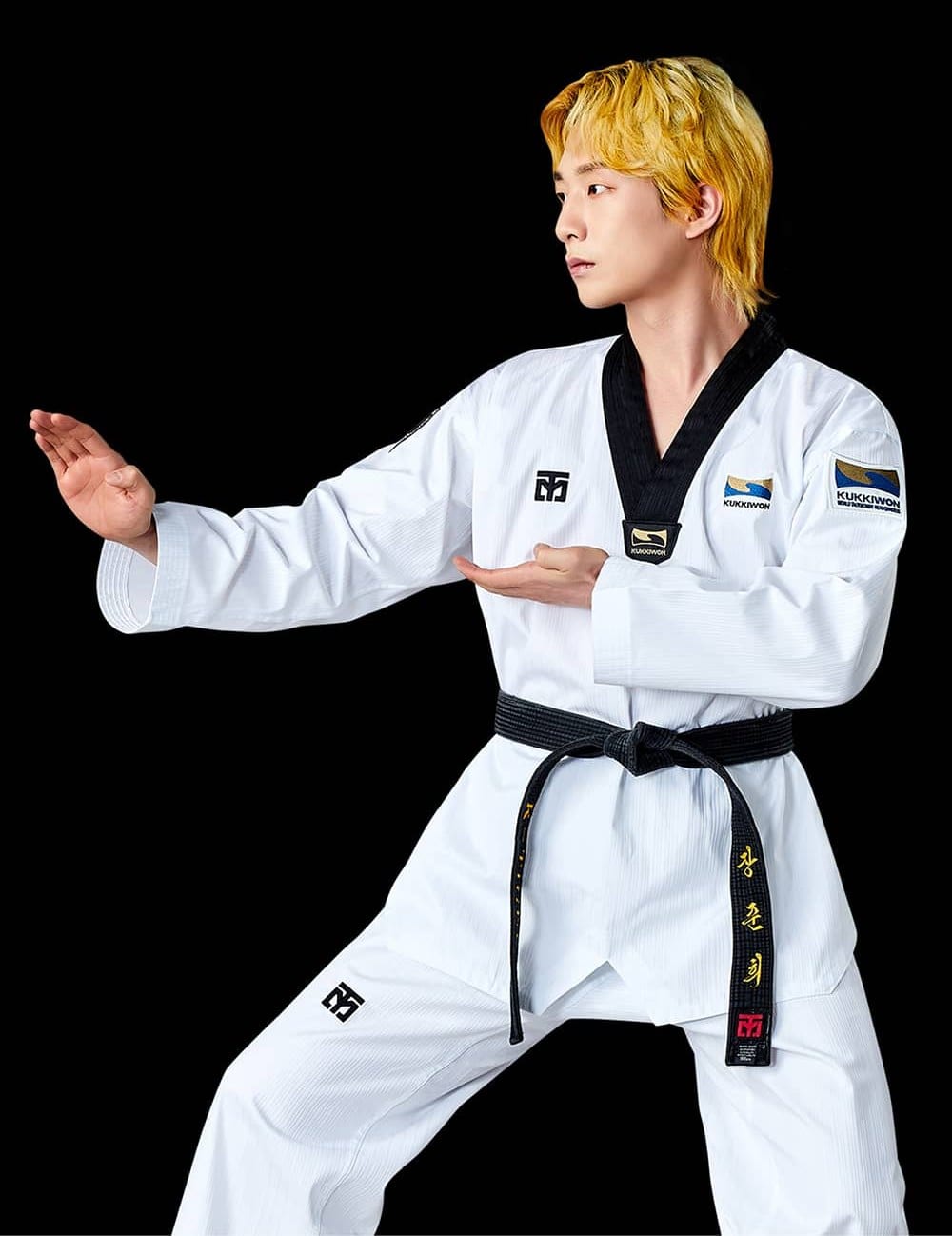
Mooto Deep Dive: Korea Still Dresses Taekwondo — Spain Makes the Part That Scores the Points
World Taekwondo recognises Mooto in six equipment categories. The two it is absent from are the electronic ones — and the scoring system at Tokyo 2020 and Paris 2024 came from Barcelona. A look at the Korean company that dresses the sport Korea exported.
Quick Answer
Korea invented taekwondo, exported it to 215 national associations, and got it into the Olympics. So it is reasonable to assume Korean companies supply the sport. Mostly, they do.
Then you look at the one category that decides who wins.
World Taekwondo publishes a Recognised Brand Chart — the list of manufacturers whose equipment may be used in sanctioned competition. The current edition, 2026_v3, dated 29 May 2026, has eight product categories. Mooto (무토), Korea's best-known taekwondo brand, appears in six of them: kyorugi uniforms, poomsae uniforms, training doboks, head and trunk protectors, limb protectors, and mats.
The two it is absent from are PSS — the Protector & Scoring System, the electronic body armour that registers points — and poomsae scoring systems. Only four brands are recognised for PSS at all. The one that supplied the Olympic Games at Tokyo 2020 and Paris 2024, and that was also sole mat supplier in Paris, is Daedo — founded in Barcelona in 1983.
Korea still makes the uniform. A Spanish company makes the thing that counts the kick.
Mooto Co., Ltd. (주식회사 무토) is the company inside that story. Founded in 1999 and incorporated as Culture Maker in 2000, it sits in the Paju Book City complex in Gyeonggi-do, is unlisted, and is controlled by its CEO Lee Seung-hwan (이승환), who holds 73.86%. It is also, unusually, the owner of the sport's leading Korean-language news outlet.
| Item | Detail |
|---|---|
| Company | Mooto Co., Ltd. (주식회사 무토), Paju Book City, Gyeonggi-do — unlisted |
| Founded | 1999; incorporated as Culture Maker Co., Ltd. in 2000 with venture certification |
| Control | CEO Lee Seung-hwan 73.86%, Lee Dong-wook 13.48%, Nam Se-woo 4.18% — founder-controlled, Korean |
| Group | MOOTO (teamwear and equipment) · MOOKAS 무카스 (martial-arts media portal) · a Mooto-run taekwondo dojang |
| WT status | Recognised in 6 of 8 categories on the 2026_v3 chart. Not in PSS or poomsae scoring |
| Reach | Company copy says 25 countries in one place and "30-odd" in another; Amsterdam warehouse since 2021; E-Mart domestically |
| Registry class | Shirt and blouse manufacturing (셔츠 및 블라우스 제조업) |
| Where it is made | Spot-checked on Mooto's own US store: Korea, Myanmar and China depending on the model — see below |
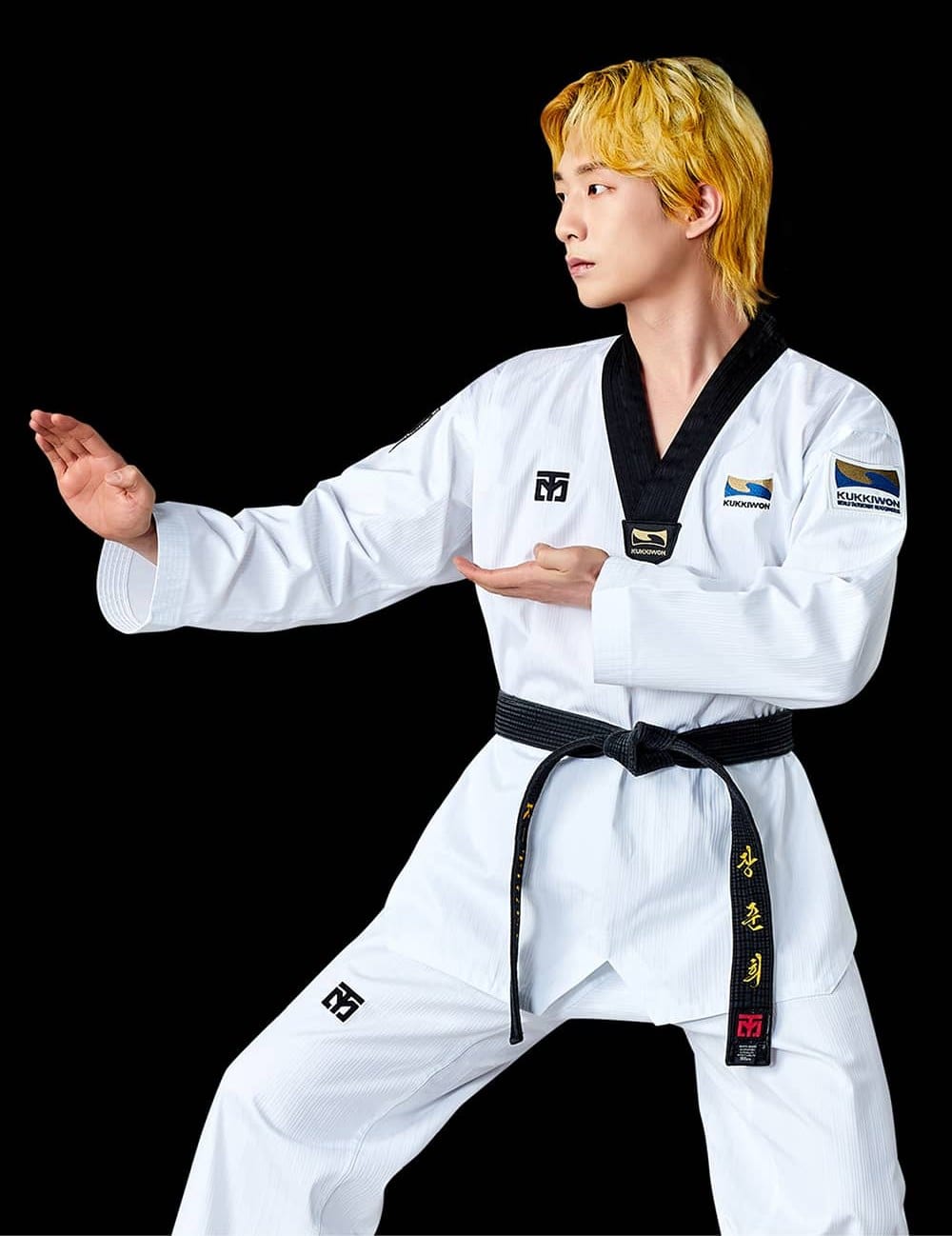
The Company That Sells the Uniforms Also Runs the Newsroom
Start with the structure, because it is the genuinely unusual thing here and most profiles skip it.
Mooto did not begin as a clothing company. In 1999 it launched an online taekwondo media platform, which became MOOKAS (무카스) — registered as an internet newspaper on 3 May 2007 and now describing itself as Korea's leading taekwondo and martial-arts culture channel. MOOKAS runs news, video, a job board for instructors, a marketplace for buying and selling dojangs, and a shop. The corporate name adopted in 2000, Culture Maker, says what the founders thought they were building: not a garment business, a culture business.
The equipment brand came after the audience did. MOOTO grew up beside the media property and is now the group's commercial engine, and the group also operates its own taekwondo dojang.
This is vertical integration into attention, not into supply. Compare it to Win&Win, the other Korean company built around an Olympic sport Korea dominates: Win&Win's founder was a national coach who went and learned carbon fibre, and its moat is 46 patents and a materials laboratory. Mooto's moat is that it owns where Korean instructors read the news.
An honest desk has to name the obvious tension in that. A company that publishes the sport's leading Korean-language coverage also sells the sport's uniforms and protectors. We found no reporting alleging that MOOKAS has misused the position, and the two brands are openly presented as one group rather than concealed. But readers evaluating Mooto through MOOKAS coverage should know they are reading the manufacturer's own outlet, and buyers should not treat that coverage as independent verification.
What World Taekwondo Actually Recognises
The Recognised Brand Chart is the single most useful public document about this industry, and almost nobody outside it reads the chart as a map of who owns what.
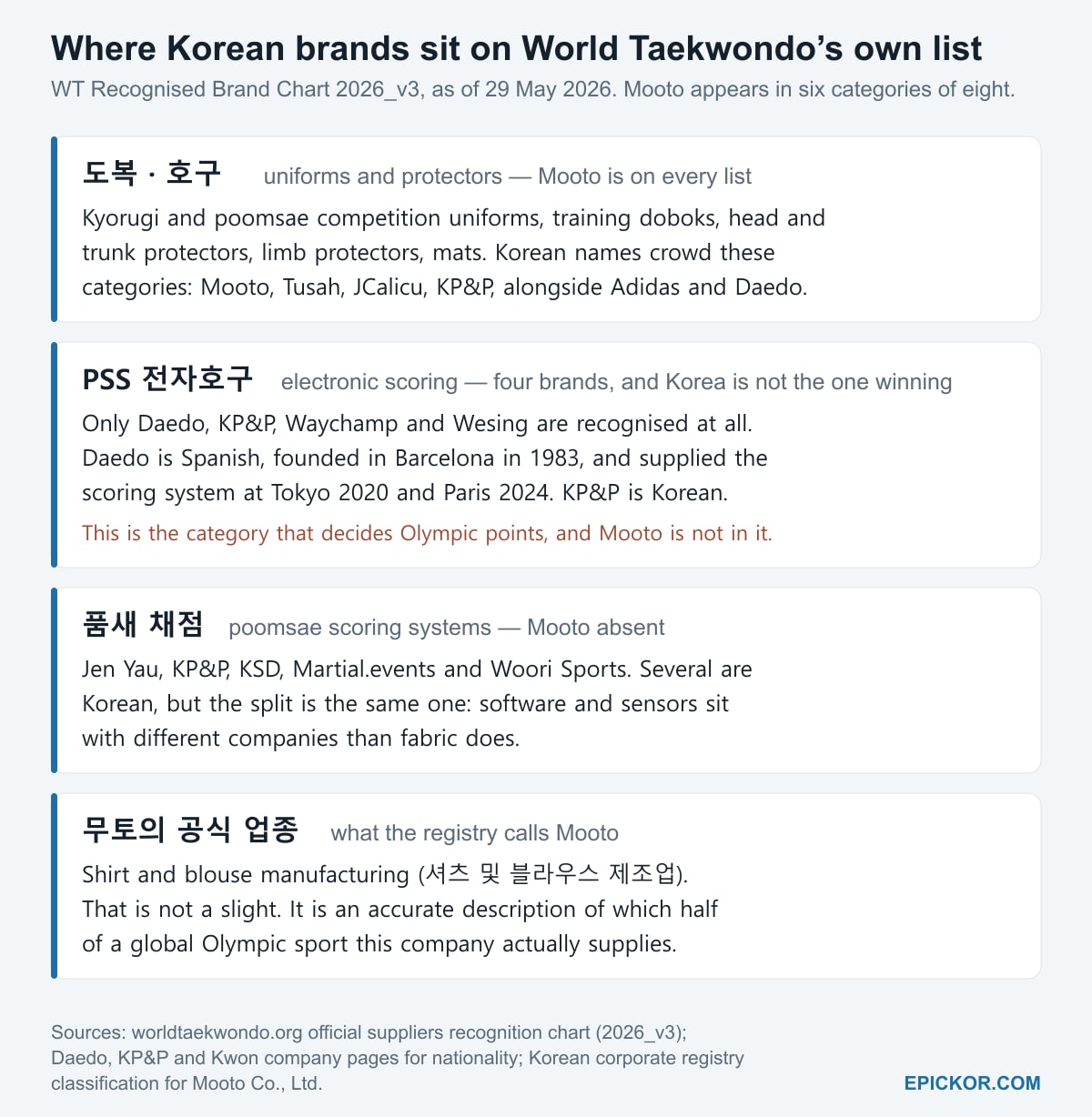
Read the fabric categories and Korea looks dominant: Mooto, Tusah, JCalicu and KP&P are all Korean, sharing the lists with Adidas and Kwon of Germany, Daedo of Spain, and Chinese entrants including Anta, Taishan and Wesing.
Read the PSS category and the picture inverts. Four brands are recognised: Daedo (Spain), KP&P (Korea), Waychamp and Wesing (China). Daedo's system is in use in 165 countries and has held the Olympic contract through Tokyo and Paris.
And the choice is not neutral. Daedo's system is electromagnetic; KP&P's uses RFID. Comparative technical-tactical work on elite athletes has found the two register hits differently — Daedo recording higher hit volumes and rewarding more linear attacking styles, KP&P demanding a higher power threshold and favouring reactive, circular technique. The vendor of the armour partly determines which fighting style wins medals. That is an extraordinary amount of influence to sit with an equipment supplier, and it is the influence Mooto does not have.
If you want the uniform this article is about: As an Amazon Associate, EpicKor may earn from qualifying purchases at no extra cost to you. The Mooto BASIC 4.5 Kukkiwon dobok is the Korea-made model pictured above, 65% polyester and 35% cotton, sold with the Kukkiwon badge already on it; its Amazon US listings are currently unavailable, so check Mooto's own dealers. Two honest notes: Kukkiwon-badged uniforms sell in white-neck and black-neck versions that signal different grades, so check which your school requires, and sizes run by height in centimetres rather than S/M/L.
Where Mooto's Uniforms Are Actually Made
Here is the finding that surprised us, and it comes from Mooto's own English-language storefront rather than anywhere hostile. We spot-checked four uniforms on 3 September 2026:
| Product | Price (US store) | Country of origin |
|---|---|---|
| BASIC 4.5 KUKKIWON Uniform, black neck | $36.29 (list $51.11) | South Korea |
| BASIC 6 Standard Uniform, black neck | $43.70 | Myanmar |
| TAEBEK 3 POOMSAE Uniform, high dan | $58.51 | Myanmar |
| Extera Pro 3 Kyorugi Uniform, black neck | $147.40 | China |
The gradient runs backwards from the one everyone assumes. The cheapest uniform in the set is the Korean-made one. The $147 flagship competition uniform is made in China, and the mid-range poomsae and standard lines are made in Myanmar.
Nor is there much of an export markup. On Mooto's Korean store, the nearest domestic equivalent — the 베이직 4 국기원 도복 (Basic 4 Kukkiwon dobok), black neck — lists at ₩66,000 and sells at ₩49,000 as of September 2026, which is roughly $35 at current rates against $36.29 for the Basic 4.5 abroad. The grades are not identical, so treat it as an indication rather than a like-for-like comparison; the point is that this is not a brand charging foreigners a premium for Koreanness. (A Kukkiwon name tag, if you want one, is ₩15,000.)
This is not a scandal and we are not presenting it as one — it is ordinary apparel economics, disclosed by the company on the product page in English, which is more than many brands do. But it does dismantle a specific assumption that overseas buyers and practitioners carry: that a Korean taekwondo brand means a Korean-made uniform. It means a Korean brand with Korean design authority and Kukkiwon relationships. Where the sewing happens is a separate question, and Mooto answers it honestly if you look.
It is the same lesson as Kovea, where some canisters carrying the brand are made by a different company entirely: the name on the label describes who is responsible for the product, not who stitched it.
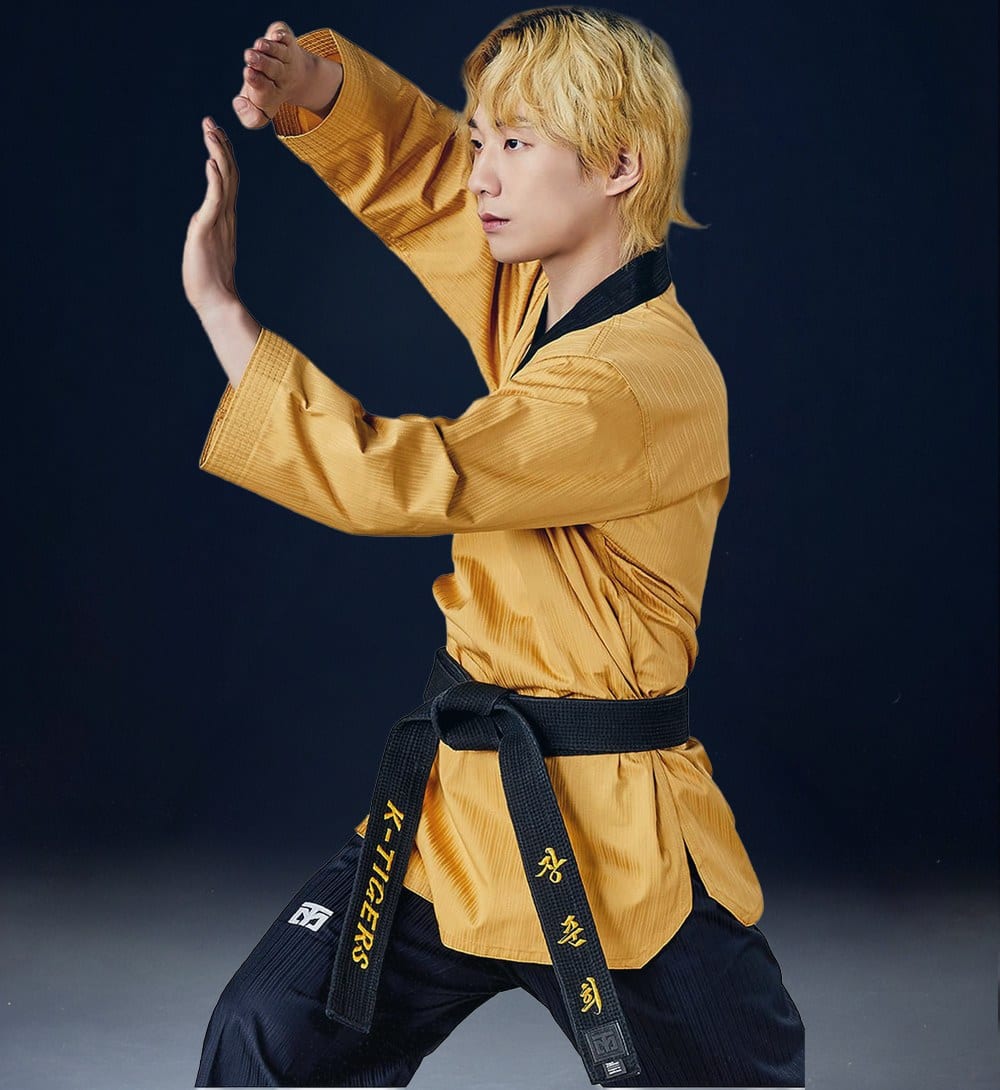
What a Dobok Company Sells That Is Not Cloth
If the sewing can be moved offshore and the electronics belong to somebody else, it is fair to ask what Mooto is actually selling. Three answers, and the first one is delightful.
It sells the sound. Mooto sews a woven label into the Taebek line reading 氣 / KI SOUND APPROVED, and its product copy treats the crack a uniform makes when a technique snaps as an engineered property — "강력한 도복 사운드", a clear ki sound that sharpens concentration. Fabric weight, weave and starch behaviour determine it. No Western sportswear category has an equivalent claim, and it is a precise piece of evidence that this is a specialist product rather than a white shirt with a badge.
It sells the badge. The Kukkiwon marks at chest and shoulder are the difference between a garment and a permitted one. Getting onto the WT chart and holding a Kukkiwon relationship — Mooto has been an official sponsor since the 2010s — is the actual barrier to entry. That is why the registry classification of shirt and blouse manufacturing is funny but not wrong: the manufacturing is commodity, the recognition is not.
It sells fit for a specific movement. The competition lines are built around kicking mechanics — Mooto's DMC pattern, stretch panels, and a fit-control system that keeps the jacket and trousers from separating mid-technique. A judo gi or a karate gi will not do it, which is why the sport supports specialist suppliers at all.
The Honest Risks
The financials are not public. Mooto is unlisted with no regulatory filing obligation, so revenue and headcount cannot be verified from a primary source. We can confirm the shareholder split and the industry classification from Korean corporate records; we could not confirm turnover, and we are not going to publish an aggregator's estimate as though it were audited. Any scale claim about this company — including its own — is currently unverifiable.
The company's own reach figures disagree with each other. One Mooto page says dealers in 25 countries; another says "30-odd." Both are the company speaking. Treat either as approximate.
Media ownership is a real conflict, even if unexercised. See above. It is the single thing a buyer or journalist should hold in mind when using MOOKAS as a source about the industry Mooto competes in.
The growth categories are the ones it is not in. Electronic scoring, video review, and poomsae scoring software are where taekwondo's equipment spend is heading, and Mooto is recognised in none of them. Fabric is a mature, offshore-able, price-competitive business; sensors are not.
Stock depth is thin on some lines. The Korea-made BASIC 4.5 we checked had only its largest size in stock. If you are equipping a school, availability rather than price is likely to be the binding constraint.
What This Means If You Are Sourcing From Korea
Mooto is a clean worked example of a supplier type that overseas buyers repeatedly misjudge: the brand whose value is regulatory and cultural rather than industrial.
Three practical readings:
1. Ask what the certification actually attaches to. A WT or Kukkiwon mark attaches to a company's relationship and its approved specification, not to a factory address. If country of manufacture matters to your buyers, ask per SKU — as this article shows, the answer varies inside one catalogue.
2. Read the governing body's supplier list before the company's brochure. The WT chart told us more in one page than any amount of marketing copy: which categories a company is in, who its actual peers are, and — by omission — where it is not competing.
3. Separate the brand's media from the brand. In a niche sport, the trade press and the manufacturers are often closer than they look. That is not unique to Korea, but it is easy to miss from outside.
The mechanics of finding and verifying suppliers of this kind are in our guide to finding suppliers in Korea. And if you want the broader picture of how seriously Korea takes the sports it exports, our Korean baseball guide is the accessible version and our soft-power icons piece is the map.
Comparing brands on the same WT list: As an Amazon Associate, EpicKor may earn from qualifying purchases. The instructive exercise is to put a Mooto dobok beside its recognised competitors — Adidas taekwondo uniforms and Daedo uniforms — because they are competing on cut, weave and weight rather than on approval status, which they all already have. Check the WT chart for the current edition before buying for competition; recognition is revised and a brand's status can change between chart versions.
What to Watch Next
Whether Mooto ever enters the electronics categories. It has the brand, the dealers and the governing-body relationships, and none of the sensor engineering. Buying or partnering into PSS is the obvious move and it has not made it.
Whether the Olympic PSS contract moves. Daedo has held it through two Games and has certified a new GEN3 system. KP&P — Korean — is the only recognised alternative with Olympic-scale ambitions. A change there would be the biggest shift in this industry in a decade.
Whether the media arm stays inside the group. MOOKAS is an asset with obvious independent value and an equally obvious conflict. Separating it would be the strongest possible signal about how the group sees its next ten years.
FAQ
Q: Is Mooto a Korean company? A: Yes, and it is unusually clearly so. It is unlisted and founder-controlled — CEO Lee Seung-hwan holds 73.86% of the shares, with two other individuals holding 13.48% and 4.18%. There is no private-equity or foreign holding on record.
Q: Are Mooto uniforms made in Korea? A: Some are. Checking Mooto's own US storefront on 3 September 2026, the BASIC 4.5 Kukkiwon uniform is listed as made in South Korea, the BASIC 6 and TAEBEK 3 as Myanmar, and the $147 Extera Pro 3 competition uniform as China. The company discloses this on each product page.
Q: Is Mooto approved by World Taekwondo? A: Yes, in six of the eight categories on the WT Recognised Brand Chart 2026_v3 (29 May 2026): kyorugi uniforms, poomsae uniforms, doboks, head/trunk protectors, limb protectors, and mats. It is not recognised for PSS electronic scoring or poomsae scoring systems.
Q: Who makes the electronic scoring system used at the Olympics? A: Daedo, founded in Barcelona, Spain in 1983. It supplied the PSS at Tokyo 2020 and Paris 2024 and was sole mat supplier in Paris. The only other Olympic-scale recognised PSS maker is the Korean company KP&P.
Q: Does the scoring system really change how matches are fought? A: Comparative analysis of elite competition indicates it does. Daedo's electromagnetic system and KP&P's RFID system register hits differently — the former associated with higher hit volumes and linear attacking, the latter with a higher power threshold and reactive circular technique. Athletes and coaches prepare differently depending on which system an event uses.
Q: What is the Kukkiwon and why is it on the uniform? A: The Kukkiwon is taekwondo's headquarters institution in Seoul and the body behind internationally recognised dan certification. A Kukkiwon-marked dobok signals an officially sanctioned uniform, and the right to carry that mark is a commercial relationship — which is a large part of what a brand like Mooto is selling.
Q: What is MOOKAS? A: The martial-arts media portal owned by the same group — registered as an internet newspaper on 3 May 2007, running news, video, an instructor job board and a dojang marketplace. It is a genuine outlet, and it is also the manufacturer's own, which is worth knowing when you read it.
Sources
- World Taekwondo official suppliers recognition chart, WT Recognised Brand Chart 2026_v3, as of 29 May 2026 — the category-by-category brand lists used throughout, including Mooto's presence in six categories and absence from PSS and poomsae scoring.
- Mooto / Culture Maker official company pages (mooto.com Korean and US editions) — legal entity 주식회사 무토, CEO Lee Seung-hwan, business registration 119-81-36140, Paju Book City address, the 1999→2000→2006→2016→2022 milestone timeline, affiliate structure, and the Amsterdam warehouse and UK national-team sponsorship.
- Mooto US storefront product records, retrieved 3 September 2026 — prices, stock, fabric composition (65% polyester / 35% cotton on the BASIC 4.5), and the country-of-origin fields for the four uniforms tabled above.
- Korean corporate records via business-data aggregators — shareholding (Lee Seung-hwan 73.86%, Lee Dong-wook 13.48%, Nam Se-woo 4.18%) and the industry classification 셔츠 및 블라우스 제조업. No filed financial statements exist for this company.
- MOOKAS (mookas.com) — internet-newspaper registration of 3 May 2007 and the scope of its news, jobs, dojang-trading and shopping operations.
- Daedo company materials and taekwondo trade press — founding in Barcelona in 1983, PSS deployment in 165 countries, selection for Tokyo 2020 and Paris 2024, sole mat supply at Paris 2024, and GEN3 certification.
- Peer-reviewed comparison of the KP&P and Daedo protection scoring systems through technical-tactical analysis of elite athletes — the basis for the statement that the two systems reward different styles.
A note on the reach figure. Mooto's own materials give both "25 countries" and "30-odd countries" for its dealer network in different places. We have reported both rather than choosing the larger one.
EpicKor Business is an editorial desk. This spotlight uses public information only. Mooto is not a client, was not consulted, and supplied no material for it.
More Business Guides
Kovea Deep Dive: The Korean Burner Maker That Took Apart a Swedish Stove — and Now Builds for MSR
Look at the box your Snow Peak LiteMax came in and it says Made in Korea. Kovea started in 1982 when its late founder took apart a Swedish SVEA burner, now supplies MSR and Decathlon, and still earned a 21% operating margin after Korea's camping market halved.
Aurora World Deep Dive: The Korean Company Behind the Plush Toy on Your Shelf
Aurora's plush sits in zoo shops, bookstores and Target aisles worldwide, and its own American website never mentions Korea. A public-information deep dive on the Seoul company that owns its factories, built Palm Pals, and bought a 90-year-old Vermont brand.
CERAGEM Deep Dive: The Korean Company That Sold Wellness by Giving It Away Free
CERAGEM's real invention was not the thermal massage bed but the free café where you lie on one — 5.72 million people in five years. A public-information deep dive on the Korean company, including why revenue has almost halved since 2022.