Kovea Deep Dive: The Korean Burner Maker That Took Apart a Swedish Stove — and Now Builds for MSR
Look at the box your Snow Peak LiteMax came in and it says Made in Korea. Kovea started in 1982 when its late founder took apart a Swedish SVEA burner, now supplies MSR and Decathlon, and still earned a 21% operating margin after Korea's camping market halved.
Quick Answer
If you own a lightweight upright canister stove, there is a reasonable chance it was made in a factory in Incheon by a company whose name is not on it.
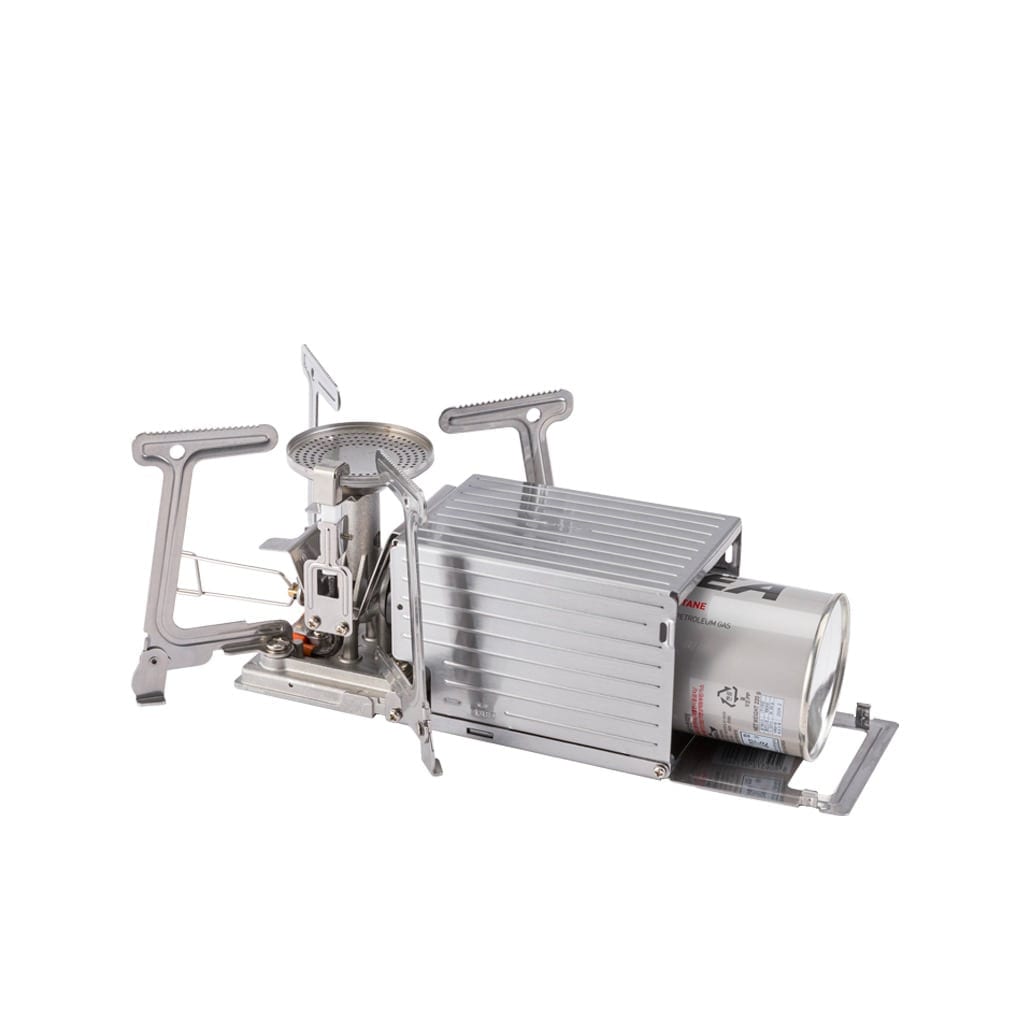
The clearest example is printed on the box. Snow Peak is a Japanese company, and its LiteMax titanium stove says Made in Korea. Gear writers who have handled both side by side describe the LiteMax and the Kovea SupaLite (KB-0707) as the same stove with cosmetic differences. Korean business press goes further and reports the arrangement directly: Kovea "is cooperating on an OEM basis with the American outdoor brand MSR and France's Decathlon."
Kovea (코베아) was founded in 1982. Its late founder, Kim Dong-sook (김동숙), reportedly began by taking apart a Swedish SVEA burner — then the benchmark object in the category — to work out how to build one in Korea. Forty-four years later the group runs three companies out of an industrial estate in Gyeyang-gu, Incheon, exports to about 60 countries, and takes roughly 45% of revenue from exports.
The part that makes it interesting as a business is what happened next. Korea's camping market roughly doubled during the pandemic, then fell back hard — reporting in 2026 describes an eight-trillion-won market cut in half. Kovea's own revenue went from ₩45.7 billion in 2021 to ₩20.2 billion in 2024. And yet operating profit in that shrunken year was ₩4.2 billion — about a 21% operating margin. A company selling tents into a hype cycle does not post that. A company that makes certified burners for other people's brands can.
| Item | Detail |
|---|---|
| Company | Kovea Co., Ltd. (주식회사 코베아), Gyeyang-gu, Incheon — unlisted |
| Founded | 1982, by the late Kim Dong-sook (김동숙); current chairman Kang Hye-geun (강혜근) |
| Group | Kovea (gas appliance manufacturing) · Vision Kovea (2001, distribution) · Trango (1987, Korea's first climbing-gear company) |
| People | Over 110 across Kovea and Vision Kovea |
| Exports | About 60 countries; roughly 45% of revenue |
| Revenue | Kovea alone: ₩45.7bn (2021) → ₩20.2bn (2024). Operating profit ₩13.0bn → ₩4.2bn. Group about ₩60bn in 2024 per company statements |
| OEM | Korean press names MSR and Decathlon; gear documentation adds Snow Peak, Markill, Vaude and Edelrid |
| Certification | CE (Europe), AGA (Australia), and JIA under Japan's gas safety law — the first Korean company to pass it |
A Swedish Burner, Taken Apart
Every good manufacturing story in Korea has the same opening scene, and it is almost never invention. It is disassembly.
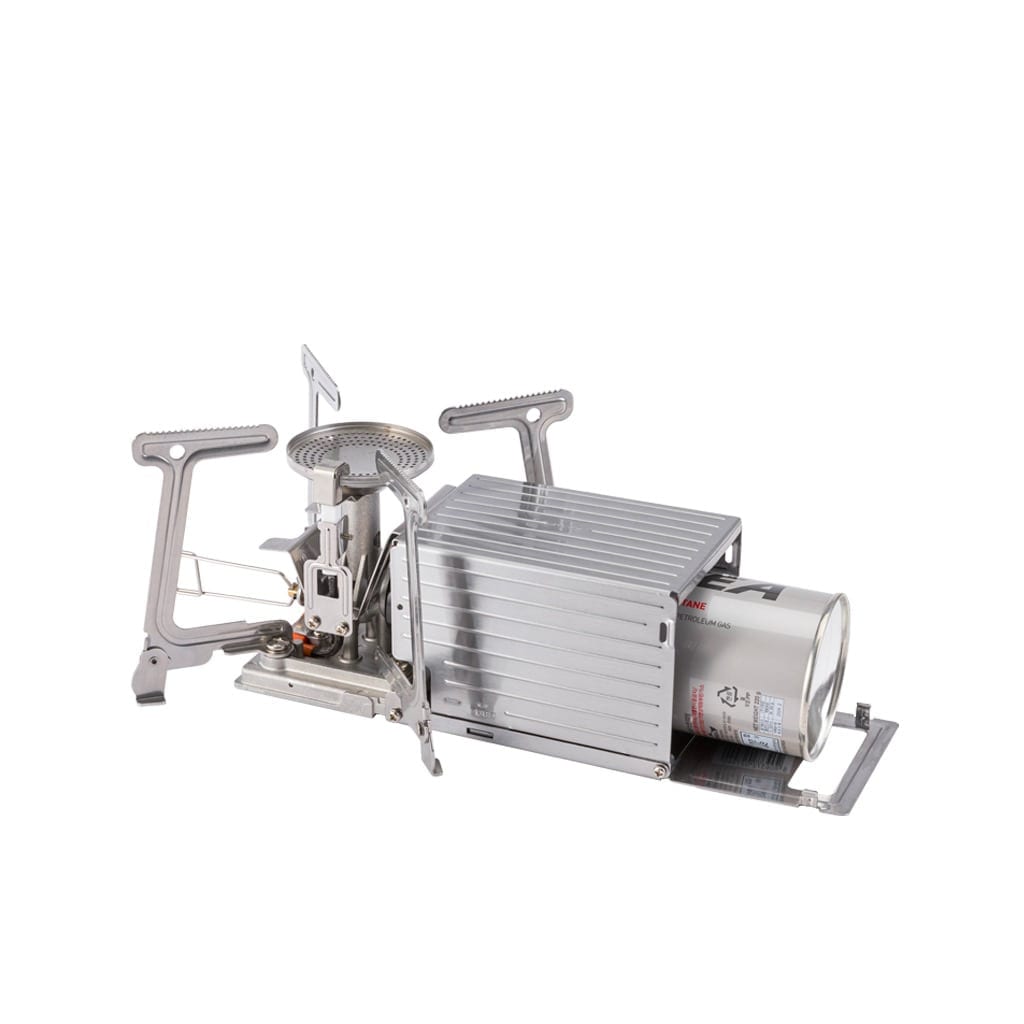
In 1982 there was no Korean camping-stove industry to join. The reference object was the SVEA, the brass Swedish burner that backpackers had carried for decades. Korean accounts of Kovea's founding describe Kim Dong-sook taking one apart and working backwards from it toward something that could be built domestically. What came out was not a copy of the SVEA but the thing Korea actually needed first: portable butane burners, the everyday appliance that Korean households and restaurants still set on the table.
This is the same shape as Win&Win in archery, where a national-team coach spent two years learning carbon before he could beat the American bows his own athletes were shooting. It is worth saying plainly, because the alternative telling — lone genius invents category — is the one companies prefer and it is usually false.
What separates Kovea from the hundreds of firms that also started by reverse-engineering something is that it stayed in the narrow part. Forty-four years later the company still makes burners. The tents, coolers and fans in its catalogue belong to a distribution business that grew around the manufacturing one, not a replacement for it.
What Kovea Actually Is: Three Companies, Not One
Overseas buyers routinely get this wrong, because the English-language web presents "Kovea" as a single outdoor brand. It is three legal entities with different jobs.
| Entity | Founded | What it does |
|---|---|---|
| Kovea Co., Ltd. (㈜코베아) | 1982 | Manufactures gas appliances — burners, stoves, torches, heaters. This is the entity that does OEM work. |
| Vision Kovea (㈜비젼코베아) | 2001 | Imports and distributes camping goods. Runs the consumer catalogue and carries outside brands including Nature Hike and Lodge. |
| Trango (㈜트랑고) | 1987 | Korea's first climbing and mountaineering equipment company, later brought into the group. |
The distinction matters if you are sourcing. The revenue figures that circulate for "Kovea" are not one number. Kovea Co., Ltd. filed ₩20.2 billion for 2024; the chairman has described group revenue of roughly ₩60 billion for the same year. Both are true and they describe different things — and if you are assessing supplier scale, the manufacturing entity is the one that matters, not a group total that includes distributing someone else's tents.
The head office and plant sit in the Seoun Industrial Complex in Gyeyang-gu, Incheon, moved there in 2020 from Bucheon Technopark.
The OEM Question, and How Confident to Be About It
This is the reason most overseas readers arrive at an article like this, so it is worth separating what is confirmed from what is documented.
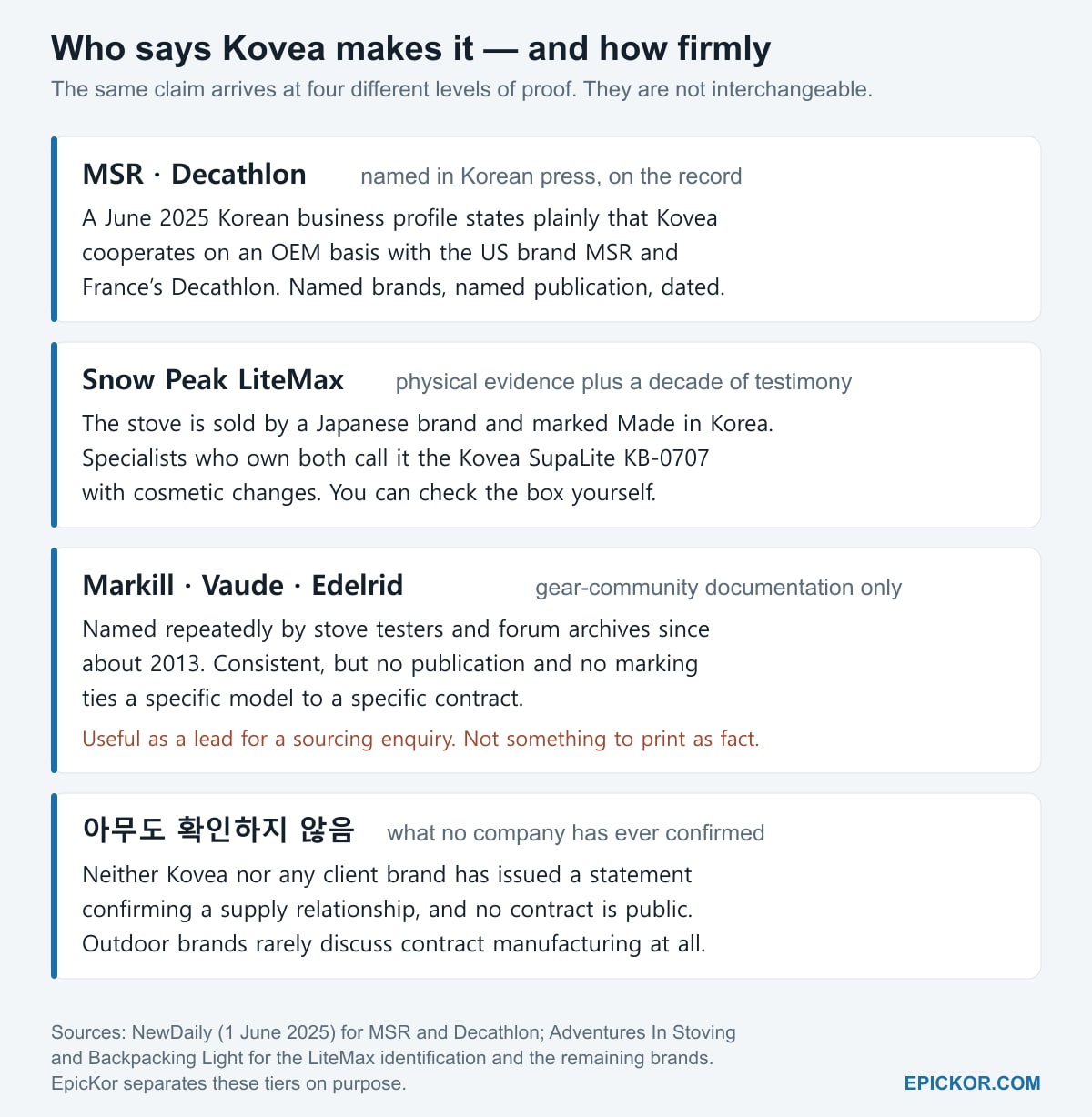
Reported by Korean press, on the record. A June 2025 profile states that Kovea "is cooperating on an OEM basis with the American outdoor brand MSR and France's Decathlon." That is a named, published claim about named brands.
Documented by the gear community, not by either company. Writers who test stoves for a living have said for over a decade that Kovea manufactures for others. The most-cited case is the Snow Peak LiteMax, sold by a Japanese brand and stamped Made in Korea; specialists describe it and the Kovea SupaLite KB-0707 as effectively the same stove. The same writers name Markill, Vaude and Edelrid in the same breath.
What nobody has published. Neither Kovea nor Snow Peak has issued a statement confirming a specific supply relationship, and no contract is public. So the honest position is this: the MSR and Decathlon relationships come from Korean reporting; the Snow Peak identification rests on physical evidence — a country-of-origin marking and two products that match — plus a decade of consistent testimony from people who own both.
Checking this kind of claim rather than repeating it is the whole job. We have had to go the other way before: JMW's dryer is in every Korean salon, and the "aircraft motor" line attached to it turned out to be marketing, not engineering. The Dorco case is the closer parallel to Kovea — a Korean manufacturer whose blades reached American bathrooms under a brand that did not make them.
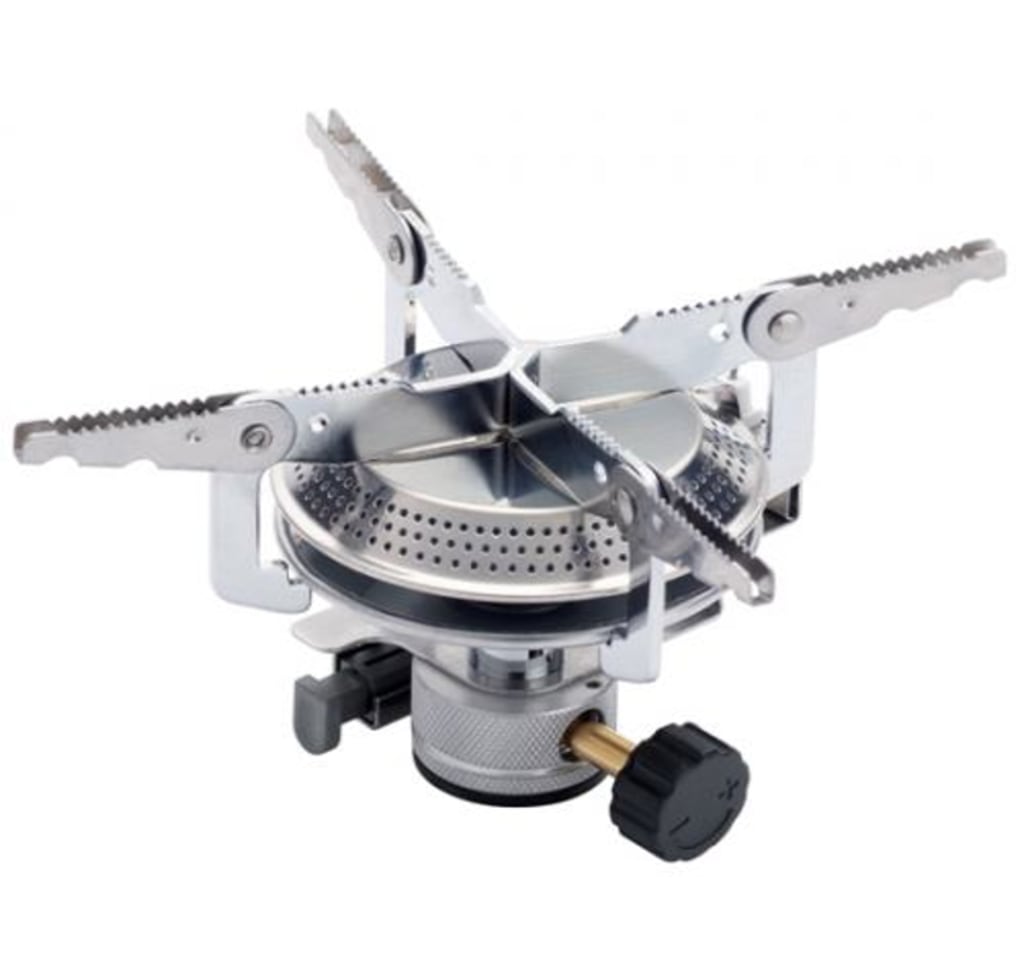
If you want to hold the evidence: As an Amazon Associate, EpicKor may earn from qualifying purchases at no extra cost to you. The cheapest way to test the claim in this section is to put the Kovea SupaLite Titanium next to the Snow Peak LiteMax — same burner head, same weight class, and the country-of-origin line printed on both boxes. The honest warning: Kovea's US listings go in and out of stock because distribution is thin, and in late September 2026 both the SupaLite and the Kovea K1 — pictured below — showed as currently unavailable on Amazon US. Check back, or look for Kovea at an outdoor retailer, if you want the stove rather than the argument.
The Numbers: A Boom Kovea Survived Better Than Its Market
Korea's camping industry is the clearest boom-and-bust in recent Korean consumer manufacturing, and Kovea's filings show the whole arc.
| Year | Kovea Co., Ltd. revenue | Operating profit | Korean camping-goods market |
|---|---|---|---|
| 2019 | — | — | ₩3.07 trillion |
| 2021 | ₩45.7bn | ₩13.0bn | rising |
| 2022 | — | — | ₩6.3 trillion — roughly double 2019 |
| 2024 | ₩20.2bn | ₩4.2bn | falling; 2026 reporting describes the market cut in half |
Revenue fell by more than half. That is the headline, and taken alone it reads like decline.
The margin is the more useful number. ₩4.2 billion of operating profit on ₩20.2 billion of revenue is about 21% — for a hardware manufacturer, in the worst year of a market collapse, that is a strong result. Compare it to Korean camping retail generally, where 2026 reporting describes tents that once carried a premium now failing to sell at a discount, and where cross-border direct-buying platforms have pushed price competition onto domestic brands.
Kovea has a structural reason to hold up better than a tent brand: a burner is a certified gas appliance, and a tent is fabric. Passing Japan's gas safety law to earn JIA certification — which Korean reporting says Kovea was the first Korean company to do — plus CE in Europe and AGA in Australia is years of work a low-cost entrant cannot skip. That is also precisely why an American or French brand would rather buy a burner from Incheon than certify its own.
There is an earlier peak worth noting for scale. In 2013, Money Today reported the company had passed ₩100 billion including Vision Kovea, and that Kovea reinvested 5% of revenue in R&D each year. Korea's first camping boom crested around then too. This is a company that has now been through the cycle twice.
The Honest Risks
A spotlight is not much use if it only lists strengths. Four things an overseas buyer or researcher should weigh.
Not everything with the name on it is made by them. Korean reference sources note that some Kovea-branded portable fuel canisters are manufactured and supplied by Daeryuk Can (대륙제관), a separate canister specialist. If you are sourcing, ask which SKUs are made in-house and which are contracted — the answer is not uniform across the catalogue.
The company has walked away from OEM volume before. Money Today reported that Kovea gave up an indoor-heater OEM programme for Japan worth over ₩5 billion as of 2011. Read that either way: as discipline about which contracts are worth taking, or as a reminder that a supplier who can drop a large programme can drop yours.
Domestic demand is genuinely shrinking. The camping-goods market roughly doubled to ₩6.3 trillion by 2022 and is now described as having halved. An export share around 45% cushions this; it does not remove it.
The brand-origin story is repeated wrongly, including by Korean media. Multiple Korean articles explain the name as "Korea with the K changed to a V." Set the two words next to each other and that is not what happened: KOREA → KOVEA changes the R. It is a trivial error, but it is a clean demonstration of how company-supplied copy travels through the press unchecked — which is exactly the reflex to bring to the OEM claims above, and to any supplier's own marketing.
What This Means If You Are Sourcing From Korea
Kovea is a useful worked example of a category of Korean supplier that overseas buyers systematically miss: the certified component or appliance manufacturer that is invisible because its output ships under other names.
The pattern to look for is the one in this article. A company that is small by revenue but old by category. A narrow product line it has never left. Certifications in three regulatory regimes that took years and that a new entrant cannot buy. And a consumer brand at home that is really a distribution business wrapped around a factory.
The corollary is worth stating too: the name on a product tells you who is responsible for it, not who built it. That cuts both ways here — Kovea makes stoves that ship under other logos, and some canisters wearing the Kovea logo are made by someone else. Our Mooto deep dive is the same lesson in apparel, where one Korean brand's catalogue turns out to be made in Korea, Myanmar and China depending on the model.
If that is the kind of supplier you are trying to find, the mechanics of reaching them are in our guide to finding suppliers in Korea — the official platforms, what to verify, and how first contact usually goes.
And if you are visiting rather than sourcing: the burner is genuinely part of how Koreans use the outdoors. It turns up at the top of city mountains — see our Seoul hiking guide — and under the aluminium ramyun pot that is the single most Korean object you can put on a flame.
Before a first supplier meeting: As an Amazon Associate, EpicKor may earn from qualifying purchases. Two things repay their cost — Euny Hong's The Birth of Korean Cool for why companies this size ended up exporting at all, and a Korean phrasebook, because at a plant in Gyeyang-gu the engineer who knows the burner-head tooling usually does not work in English.
What to Watch Next
Whether the OEM share rises as domestic demand falls. A manufacturer with 21% margins and a shrinking home market has an obvious move, and it is the one that would make Kovea more visible abroad and less visible at home.
Whether Trango and Vision Kovea stay inside the group. The distribution and climbing businesses were built for a domestic market that is no longer growing.
Whether any brand ever confirms the supply relationships. Outdoor brands are unusually quiet about contract manufacturing, and Kovea has no reason to force the issue. Absent that, the evidence stays where it is: Korean reporting for MSR and Decathlon, and a country-of-origin stamp for the rest.
FAQ
Q: Is the Snow Peak LiteMax really made by Kovea?
A: Snow Peak has not said so, and neither has Kovea. What is verifiable is that the LiteMax is marked Made in Korea despite Snow Peak being Japanese, and that specialist gear writers who own both describe it and the Kovea SupaLite KB-0707 as the same stove with cosmetic differences. Treat it as strongly documented rather than officially confirmed.
Q: Which OEM relationships are actually confirmed? A: A June 2025 Korean press profile states that Kovea works on an OEM basis with MSR (US) and Decathlon (France). That is the firmest public sourcing available. Markill, Vaude, Edelrid and Snow Peak come from gear-community documentation rather than company statements.
Q: Is Kovea Korean-owned? A: Yes. It is unlisted, founded in 1982 by the late Kim Dong-sook and currently chaired by Kang Hye-geun, with no private-equity sale on record. That is worth checking for any Korean consumer brand — several well-known ones are now foreign-owned.
Q: How big is Kovea, really? A: Kovea Co., Ltd. filed ₩20.2 billion in revenue for 2024 with ₩4.2 billion in operating profit. The chairman has described group revenue including Vision Kovea and Trango at around ₩60 billion. Headcount across Kovea and Vision Kovea is over 110. By Korean classification this is a small-to-mid-sized manufacturer, not a conglomerate.
Q: Can you buy Kovea outside Korea? A: Yes, but unevenly. Kovea sells through outdoor specialists and marketplaces in the US and Europe, and several models have been discontinued or run out of stock at major retailers. Distribution is the weak link, not the product.
Q: Why does a camping burner need certification at all? A: Because it is a pressurised gas appliance, not camping fabric. Kovea holds CE in Europe and AGA in Australia, and Korean reporting says it was the first Korean company to pass Japan's gas safety law for JIA certification. This is the barrier that makes contract manufacturing worth buying rather than replicating.
Sources
- Kovea official company pages (kovea.com, kovea.co.kr) — founding year 1982, Vision Kovea 2001, Trango 1987, subsidiary structure, current product catalogue, and the ₩120,000 Container Stove price as of September 2026.
- NewDaily, 1 June 2025 — founder Kim Dong-sook, chairman Kang Hye-geun, 2024 group revenue of about ₩60 billion, the Gyeyang-gu plant, the three-entity structure, and the statement that Kovea cooperates on an OEM basis with MSR and Decathlon.
- Money Today, 11 April 2013 — R&D at 5% of revenue, group revenue passing ₩100 billion with Vision Kovea, exports to about 40 countries at the time, CE/AGA/JIA certification and the first-Korean-company claim for JIA, and the abandoned Japanese indoor-heater OEM programme worth over ₩5 billion as of 2011.
- Money Today, 14 February 2026 — Kovea revenue ₩45.7bn (2021) → ₩20.2bn (2024), operating profit ₩13.0bn → ₩4.2bn, and the Korean camping-goods market at ₩3.07 trillion (2019) → ₩6.3 trillion (2022) with the subsequent contraction.
- Adventures In Stoving and Backpacking Light — independent documentation that the Snow Peak LiteMax is made in Korea and matches the Kovea SupaLite KB-0707, and that Markill, Vaude, MSR and Snow Peak upright canister stoves have been Kovea-built.
- Namuwiki (코베아) — export towers from 1996, the 2020 move to the Seoun Industrial Complex, and the note that some Kovea-branded portable fuel canisters are supplied by Daeryuk Can (대륙제관).
A note on the export towers. Korean sources disagree. Some record a US$1 million export tower in 1996 followed by a US$10 million tower in 2000, while the 2025 NewDaily profile dates the ten-million tower to 2020. We have kept the 1996 figure in the text and flagged the discrepancy rather than quietly picking one.
EpicKor Business is an editorial desk. This spotlight uses public information only. Kovea is not a client, was not consulted, and supplied no material for it.
More Business Guides
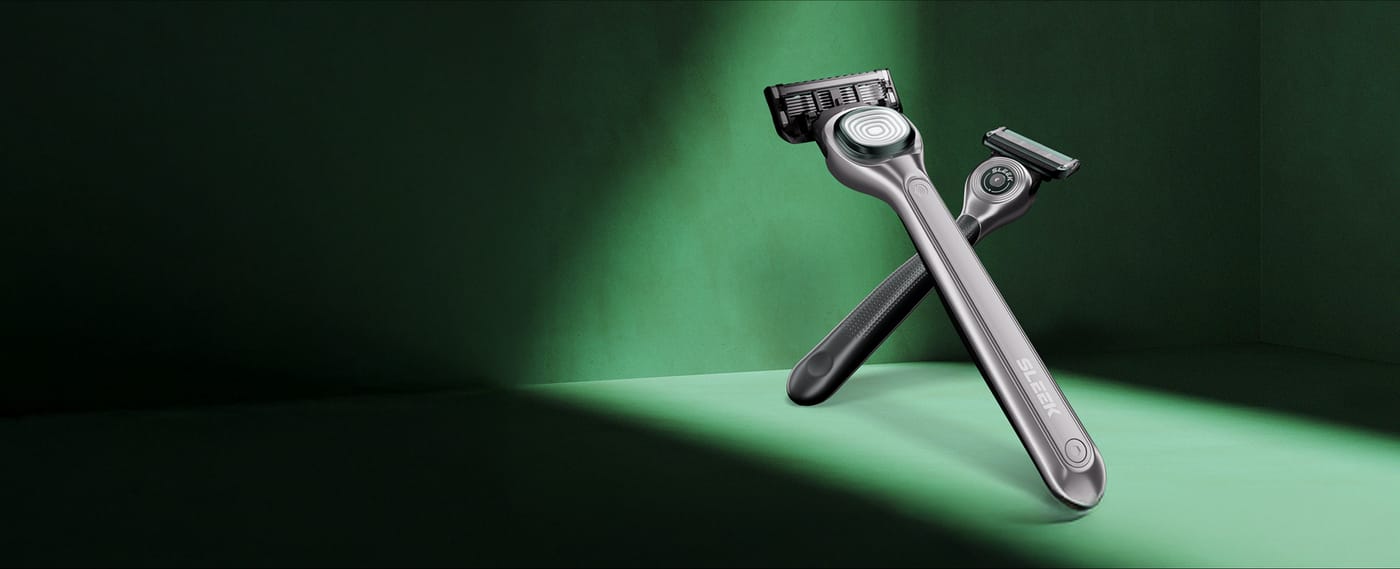
Dorco Deep Dive: The Korean Company That Made Dollar Shave Club's Blades — and Outlived the Hype
Millions of Americans shaved with Korean blades and never knew. Dorco made Dollar Shave Club's razors while DSC sold to Unilever for $1 billion — then DSC faded and the 70-year-old Korean blade maker grew 26% with a 20% margin. Koreans think it is Japanese.
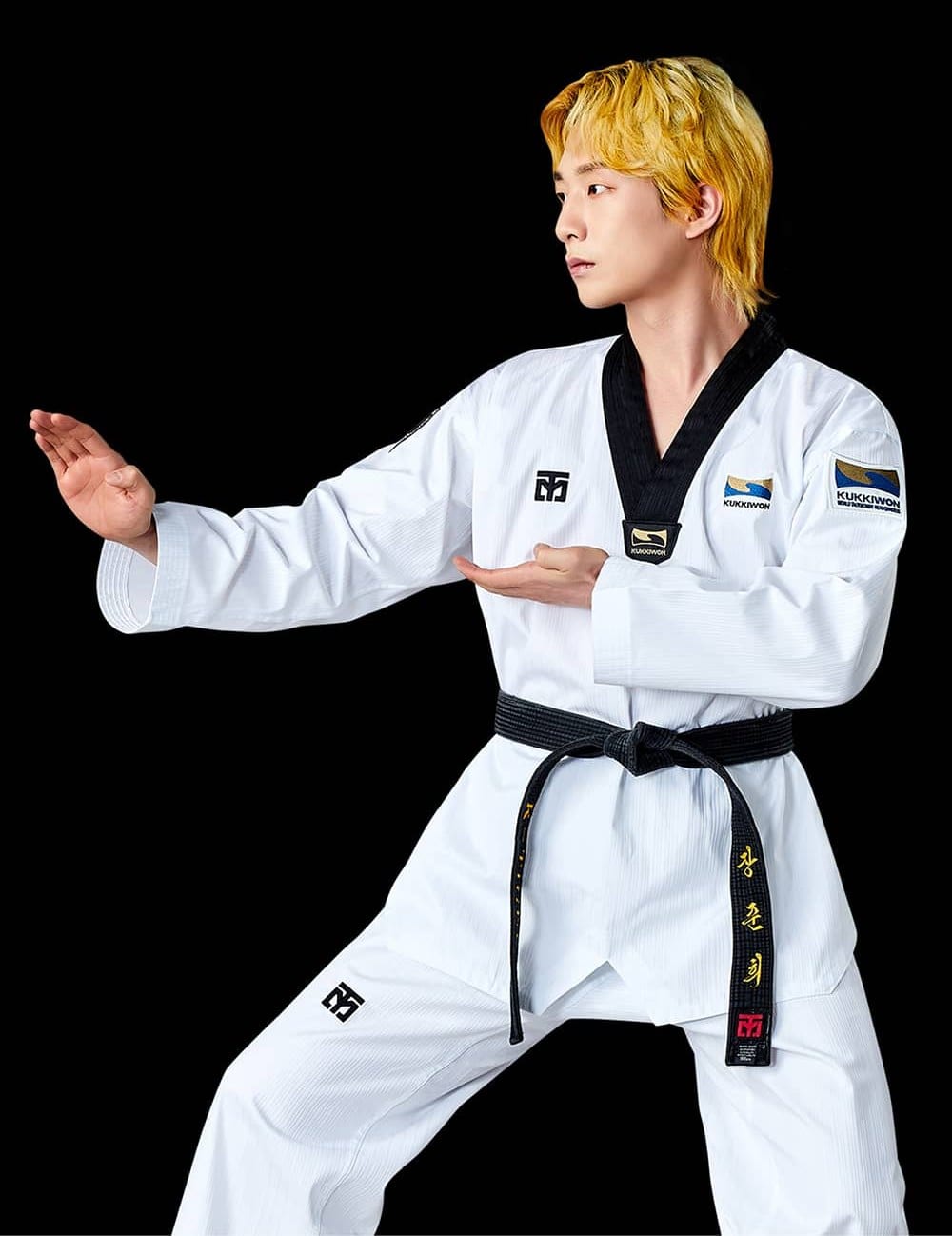
Mooto Deep Dive: Korea Still Dresses Taekwondo — Spain Makes the Part That Scores the Points
World Taekwondo recognises Mooto in six equipment categories. The two it is absent from are the electronic ones — and the scoring system at Tokyo 2020 and Paris 2024 came from Barcelona. A look at the Korean company that dresses the sport Korea exported.
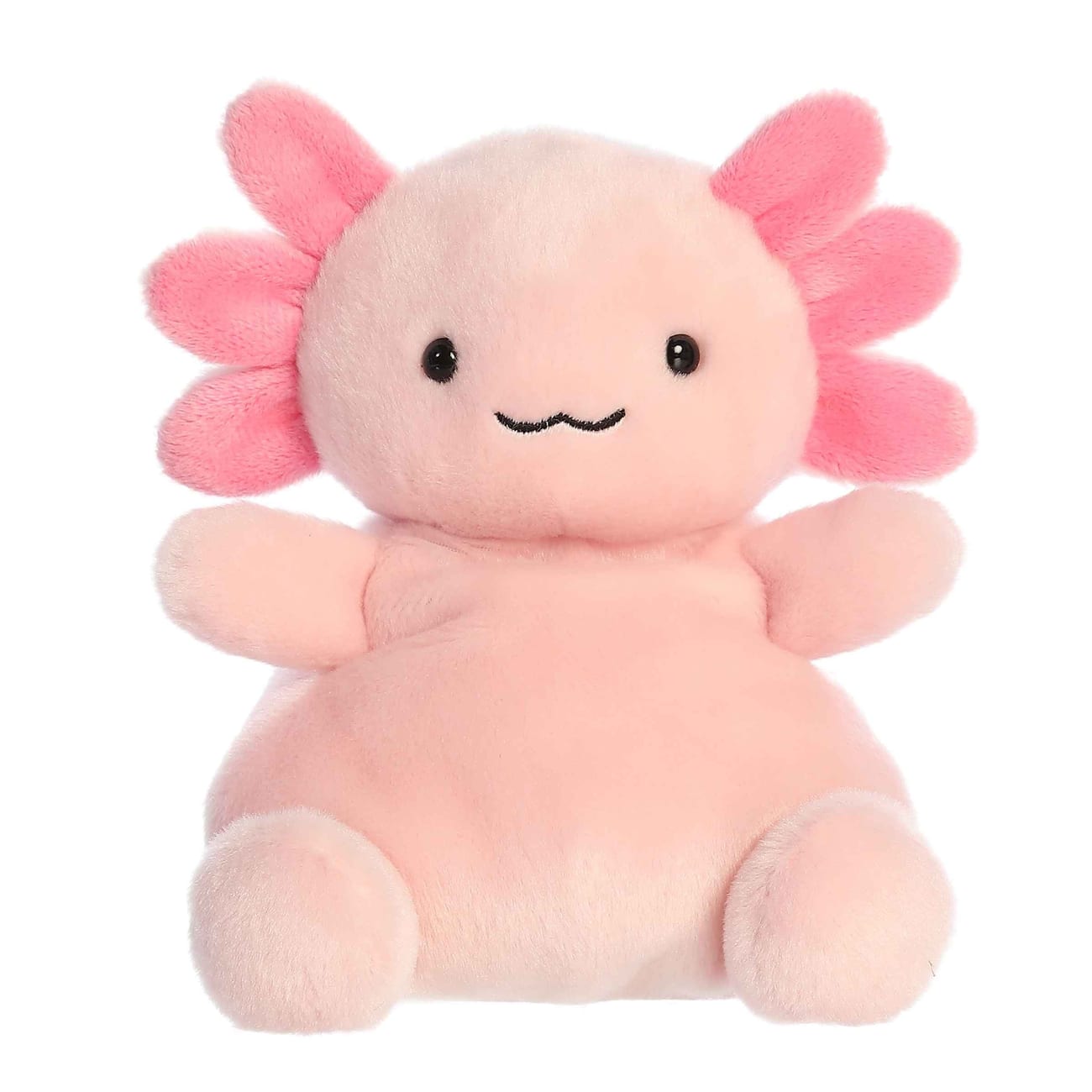
Aurora World Deep Dive: The Korean Company Behind the Plush Toy on Your Shelf
Aurora's plush sits in zoo shops, bookstores and Target aisles worldwide, and its own American website never mentions Korea. A public-information deep dive on the Seoul company that owns its factories, built Palm Pals, and bought a 90-year-old Vermont brand.