Aurora World Deep Dive: The Korean Company Behind the Plush Toy on Your Shelf
Aurora's plush sits in zoo shops, bookstores and Target aisles worldwide, and its own American website never mentions Korea. A public-information deep dive on the Seoul company that owns its factories, built Palm Pals, and bought a 90-year-old Vermont brand.
Quick Answer
Somewhere in your house, or your child's, there is probably a plush animal with a small satin tag reading Aurora. It came from a zoo gift shop, an airport, a bookstore checkout counter, a hospital gift stand, or a Target aisle. You did not choose it for the brand. Nobody does.
Aurora World Corporation (주식회사 오로라월드) is a Korean company, founded in September 1981 in Seoul, that designs and manufactures those toys. It owns its own factories in China and Indonesia. It sells in roughly 80 countries. About 70 percent of its revenue comes from outside Korea, according to its own Korean annual report. It is listed on the KOSDAQ under ticker 039830, and its founder still holds 46.51 percent of it.
Here is the part that makes this worth writing down. Aurora's American website has an "About Us" page. It says the company was founded in 1981, that it owns all its own factories, and that its address is 8820 Mercury Ln, Pico Rivera, CA 90660. Checked in August 2026, that page does not mention Korea anywhere. Neither did the US trade-press coverage when Aurora bought a 90-year-old American toy company in 2024.
So the company is not hiding. It is simply not being described. This article describes it.
The Company at a Glance
| Detail | |
|---|---|
| Official name | Aurora World Corporation (주식회사 오로라월드) |
| Founded | September 1981, as Aurora Trading Company (오로라무역상사) |
| Incorporated | 25 September 1985 |
| Listed | KOSDAQ, 29 December 2000 — ticker 039830 |
| Founder / Chairman | Noh Hee-yeol (노희열) |
| CEO | Noh Jae-yeon (노재연), the founder's eldest son |
| Largest shareholder | Noh Hee-yeol, 46.51% (as of 31 December 2024) |
| Headquarters | Gangnam-gu, Seoul, with an R&D office in Pangyo, Seongnam |
| Own factories | China (Junan) · Indonesia (Jakarta, Cianjur) |
| Sales subsidiaries | USA (Los Angeles) · UK · Hong Kong · Germany |
| FY2024 revenue | ₩275.7 billion (consolidated), up 18.5% from ₩232.6 billion |
| FY2024 operating profit | ₩31.0 billion |
| FY2024 net profit | ₩4.2 billion — see the risks section below |
| Overseas share of sales | ~70%, across roughly 80 countries |
| Own brands | Palm Pals, Miyoni, Eco Nation, YooHoo & Friends |
| Acquired brand | Mary Meyer (Vermont, founded 1933) — acquired June 2024 |
Figures above are from Aurora's Korean annual report for the year ended 31 December 2024, filed through the Korea Exchange. Later quarters are cited separately below with their dates.
The Part Nobody Writes Down
There is a category of Korean company that is genuinely global and genuinely anonymous. Navien sells more tankless water heaters in North America than anyone, and American plumbers who install them daily could not tell you the company is Korean. Winix is the default budget air purifier recommendation on Reddit, and the same applies. Aurora is the plush version of that story, and it is the most extreme case of the three, because plush toys are bought for the animal, not the maker.
The evidence is easy to check yourself.
Aurora's US consumer site, auroragift.com, has an About page. It leads with "Aurora®, founded in 1981, is a revered leader in plushies, toys, and high-quality gift products," notes "over 40 years" in the industry, states that the company "owns all of our own factories," and gives a California address. It never says the company is Korean, and it does not name Seoul.
In June 2024, Aurora acquired Mary Meyer, a plush company founded in 1933 in Townshend, Vermont, and run by the third generation of the founding family. The American toy trade press covered it — The Toy Book, Gifts & Decorative Accessories, Gift Shop Magazine, Stationery Trends. Reading The Toy Book's report in August 2026, the article quotes Aurora's chief executive, describes the strategic fit, explains that Mary Meyer will keep operating as an independent brand with Kevin Meyer staying on as president — and does not mention Korea at all.
That is a Korean company buying a 90-year-old piece of American manufacturing heritage, reported without the nationality of the buyer appearing in the story. Whatever else it is, it is a gap in the record.
What Aurora Actually Sells, and to Whom
The word "toy company" is misleading here. Aurora's business is closer to a design-and-manufacturing house with an unusually wide retail footprint.
Its own materials describe supplying over 45,000 retail outlets worldwide — and the list of channel types is the informative part: zoos, aquariums, theme parks and other tourist attractions, department stores, toy stores, gift chains, and garden centres. That is the "impulse gift near the exit" business. It is enormous, fragmented, and almost invisible as a brand category, which is exactly why the maker's name never surfaces.
Two structural facts separate Aurora from most companies that sell soft toys.
It owns the factories. Aurora's Korean annual report lists production subsidiaries in Junan, China, and two in Indonesia — Jakarta and Cianjur. Most Western plush brands are design-and-marketing operations that place orders with contract manufacturers. Aurora designs in Seoul, makes it in its own plants, and sells through its own subsidiaries in Los Angeles, the UK, Hong Kong and Germany. For a buyer evaluating supply chains, that vertical integration is the whole point of the company.
It sells under its own brand. This is rarer among Korean manufacturers than it sounds. Korean industry press has repeatedly described Aurora as the only Korean character-toy company to have taken its own brand into world markets rather than manufacturing under other companies' labels. Korea has produced many excellent contract manufacturers. It has produced very few consumer brands that Americans buy without knowing they are buying Korean, which is a strange kind of success: commercially complete, reputationally invisible.
Palm Pals: the Brand That Changed the Numbers
Aurora has had own-brand characters before. YooHoo & Friends, its big-eyed endangered-animal line, dates to the late 2000s and later became an animated series distributed internationally.
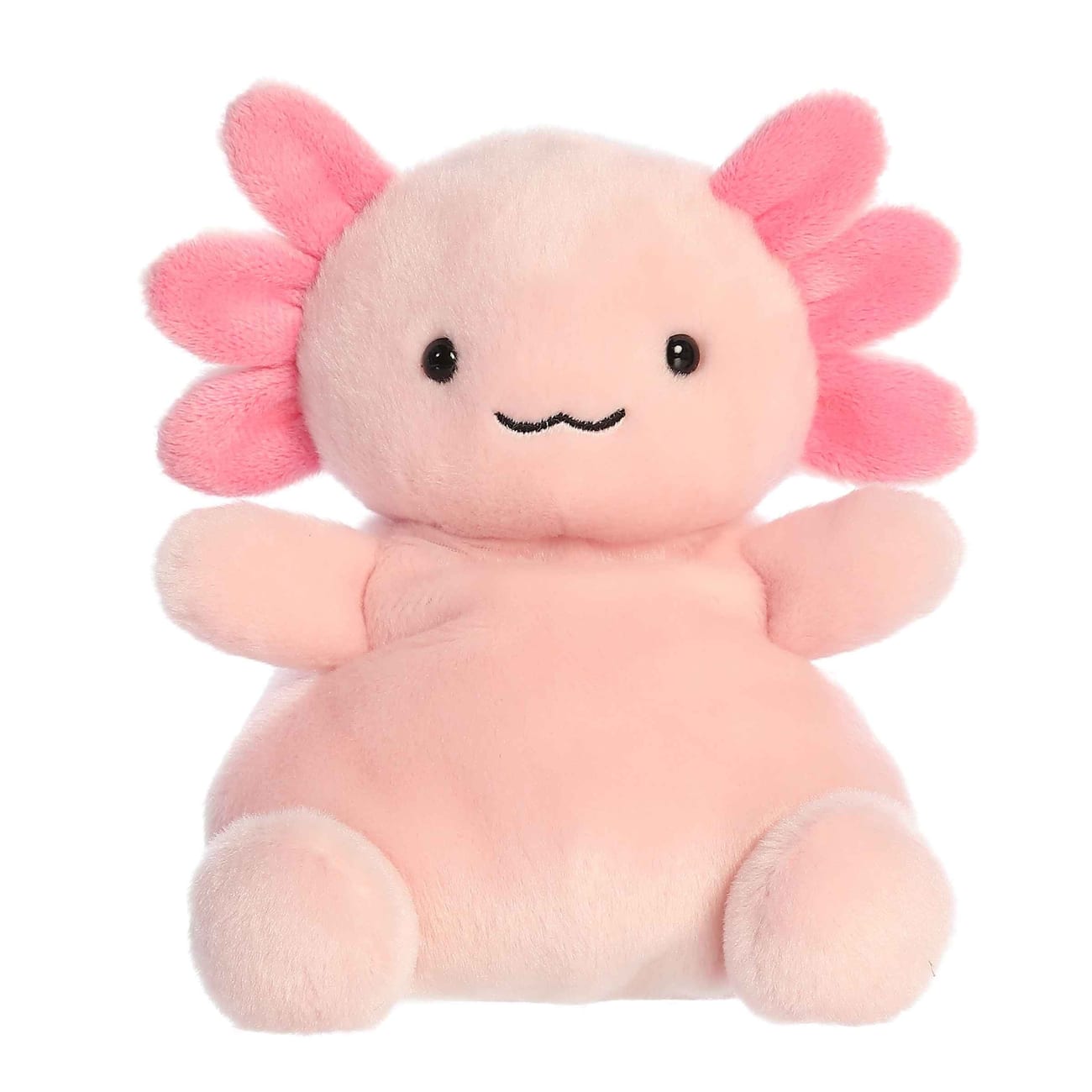
But the brand that actually moved the company's financials is Palm Pals — small, rounded, palm-sized plush of animals, fruits and vegetables, priced as an impulse buy and collected in sets. The name means what it says: friends that fit in your palm.
Korean coverage describes Palm Pals compound annual growth of roughly 78 percent between 2021 and 2025, which the company frames as the fastest brand growth in its history. Korean business media have taken to calling it "the Korean Labubu" — a comparison to Pop Mart's collectible phenomenon — because the mechanics are the same: low unit price, high character count, collection behaviour, and social media doing the marketing. Aurora's own Palm Pals accounts have drawn tens of thousands of followers on TikTok and Instagram, and Korean coverage credits a boost in domestic recognition to NewJeans member Hanni being seen with one. Analysts quoted in Korean press put Aurora's share of the US character-toy market at around 7 percent — an estimate, not a company figure.
The financial trace is visible quarter by quarter:
| Period | Consolidated revenue | Operating profit | Note |
|---|---|---|---|
| FY2023 | ₩232.6bn | ₩28.4bn | audited |
| FY2024 | ₩275.7bn (+18.5%) | ₩31.0bn | audited |
| Q1 2025 | ₩79.7bn (+31%) | ₩9.7bn (+40%) | reported |
| Q3 2025 | ₩87.8bn (+7.5%) | ₩16.6bn (+26%) | reported |
| Q1 2026 | ₩97.4bn (+22.2%) | ₩14.2bn (+45.9%) | reported |
Korean coverage through 2025 expected the company to pass ₩300 billion in annual revenue for the first time, and management has publicly targeted roughly ₩400 billion for 2026 with an operating margin moving from about 13.6 percent toward 15 percent. Treat the 2025 full-year figure and the 2026 target as expectations rather than results; the audited number this article relies on is FY2024.
The geography matters as much as the growth. Korean analysis of the FY2024 results put US revenue at ₩179.9 billion, up 25.6 percent year on year — roughly two-thirds of the company's total. Aurora is a Korean company whose largest single market, by a wide margin, is the United States.
If you want to see one in person: As an Amazon Associate, EpicKor may earn from qualifying purchases at no extra cost to you. Aurora's own-brand line is easiest to browse as Palm Pals plush — a search rather than a single link, because the range runs to hundreds of characters and no one item is canonical. For contrast, a Korean character plush that is sold as Korean is Kakao Friends' official merchandise (its plush coin purse is currently unavailable on Amazon US). Holding the two side by side is the fastest way to understand the difference between exporting a brand and exporting a product.
The Honest Risks
A growth story with no counterweight is a press release. Aurora's counterweight is on the balance sheet, and it was laid out in detail by the Korean outlet BizWatch in its Governance Watch column on 15 August 2025, under a title that translates as "the light and shadow of global toy maker Aurora World."
Three things in it deserve an overseas reader's attention.
Debt has grown much faster than the business. Net borrowings rose from ₩121 billion at the end of 2020 to ₩319 billion by March 2025 — an increase of about 164 percent. Borrowing dependency went from 49.3 percent to 63.3 percent, and the debt-to-equity ratio reached 265.9 percent, above the 200 percent level commonly treated in Korea as a caution threshold.
Interest is eating the profit. This is the sharpest number in the whole company. In FY2024 Aurora earned ₩31.0 billion in operating profit and reported ₩4.2 billion in net profit — less than one-seventh of it. The main reason was roughly ₩17.7 billion of interest expense. A company can be growing 18 percent a year at the top line and still be handing most of the result to its lenders, and that is what the audited 2024 figures show.
The borrowing did not all go into toys. BizWatch points to two capital commitments outside the core business: a golf course development begun in late 2021, described as a long-held ambition of the chairman dating to 2007, and a ₩61.7 billion Pangyo R&D property purchased in 2021. Reasonable people can disagree about a headquarters building. A golf course is harder to connect to plush manufacturing.
There is also an unresolved succession question. Chairman Noh Hee-yeol was 68 at the time of that reporting and still holds 46.51 percent. His eldest son, Noh Jae-yeon, has been chief executive for more than four years without an equity transfer having taken place. For a founder-controlled Korean company, that combination — ageing controlling shareholder, operating heir, no share transfer — is the standard setup for a disruptive inheritance-tax event later.
None of this makes Aurora a bad company or an unreliable supplier. Its factories are its own, its brands are growing, and its most recent reported quarter (Q1 2026) was its strongest yet. But a buyer doing diligence should know that the group carries meaningful leverage, that the interest burden is large relative to operating profit, and that some of the capital went somewhere unrelated to the product.
What Overseas Operators Can Take From This
Vertical integration is the differentiator, and it is checkable. If you are sourcing plush and comparing suppliers, "we own our factories" is a claim you can verify against a company's public filings rather than its sales deck. Aurora's Korean annual report names its production subsidiaries and their locations. Most brand-side competitors cannot produce an equivalent document because they do not own plants.
Brand invisibility is a choice with consequences. Aurora localised so thoroughly that its American face reads as an American company. That is good for shelf acceptance and bad for everything that depends on being known — recruitment, licensing negotiations, sovereign-brand halo, and the ability to charge for provenance the way Japanese and Scandinavian design brands do. Korean firms entering Western consumer markets keep facing this trade-off, and Aurora is the clearest worked example of taking one side of it all the way.
Read the interest line, not just the growth line. For any Korean mid-cap you are evaluating as a partner, the gap between operating profit and net profit is where the real condition of the business shows up. Aurora's FY2024 gap was about seven-fold. That single ratio told you more about the company than the 18.5 percent revenue growth did.
Character IP and character manufacturing are different businesses. Aurora makes things and has been trying to own characters. Other Korean firms own characters and license the making to others — the clearest domestic contrast is ICONIX, where broadcasting is under 10 percent of revenue and licensing is the rest. Same country, same shelf, opposite models.
If you are studying how Korean consumer brands travel: As an Amazon Associate, EpicKor may earn from qualifying purchases. Euny Hong's The Birth of Korean Cool is the readable account of the deliberate part of that export push, and it is useful precisely because Aurora is the counter-example — a company that went global without any of the soft-power machinery. For broader background, browse Korean culture and history books before committing to one.
What to Watch Next
Whether Mary Meyer changes the model. Aurora has spent forty years being the unnamed maker behind other people's shelves. Mary Meyer is a named, heritage American brand with its founding family still in place. If Aurora runs it as a separate label and leaves it alone, this was a distribution acquisition. If Aurora starts using it as the front for a branded strategy in the US, the anonymity thesis in this article stops being true.
Whether Palm Pals is a franchise or a moment. Collectible plush cycles are fast. Palm Pals has grown at a rate the company has never seen, and the comparison Korean media reach for — Labubu — is a reminder that these cycles can also reverse quickly. The 2026 revenue target of about ₩400 billion effectively assumes the line holds.
Whether the balance sheet gets fixed. Deleveraging would show up as a shrinking gap between operating profit and net profit. That is a single number, published quarterly, and it is the cleanest possible test of whether the 2021–2025 capital decisions are being unwound.
Whether the shares move. The succession has not started. When it does, it will be visible in the disclosure record, and it will tell you a great deal about the company's next decade.
FAQ About Aurora World
Q: Is Aurora World a Korean company?
A: Yes. Aurora World Corporation was founded in Seoul in September 1981 as Aurora Trading Company, incorporated in September 1985, and listed on Korea's KOSDAQ market in December 2000. Its Korean headquarters is in Gangnam-gu, Seoul, and its founder Noh Hee-yeol holds 46.51 percent of the company as of the end of 2024. Its American subsidiary is based in Pico Rivera, California, which is the address most US customers encounter — and that subsidiary's About page does not mention Korea.
Q: Who makes Aurora plush toys?
A: Aurora does, in its own plants. Its Korean annual report lists wholly owned production subsidiaries in Junan, China, and in Jakarta and Cianjur, Indonesia. Design work is done in Korea. This is unusual: most plush brands outsource manufacturing to third-party factories.
Q: What is Palm Pals, and why is it compared to Labubu?
A: Palm Pals is Aurora's own-brand line of palm-sized plush animals, fruits and vegetables, sold at impulse-purchase prices and designed to be collected. Korean media compare it to Pop Mart's Labubu because both rely on low unit prices, a large cast of characters, collecting behaviour and social-media discovery rather than advertising. Korean coverage puts Palm Pals' compound growth at roughly 78 percent a year between 2021 and 2025.
Q: Did Aurora World buy Mary Meyer?
A: Yes. Aurora announced the acquisition of Mary Meyer in June 2024. Mary Meyer was founded in 1933 in Townshend, Vermont, and had been run by the founding family for three generations; it holds more than 400 products including Marshmallow Zoo and Taggies. The purchase price was not disclosed. Mary Meyer continues to operate as an independent brand, with Kevin Meyer remaining as president.
Q: How big is Aurora World?
A: For the year ended 31 December 2024, consolidated revenue was ₩275.7 billion (about US$200 million at prevailing rates), with operating profit of ₩31.0 billion and net profit of ₩4.2 billion. Roughly 70 percent of sales come from outside Korea, across about 80 countries. Reported quarters since then have been higher; Q1 2026 revenue was ₩97.4 billion, up 22.2 percent year on year.
Q: Is Aurora World financially healthy?
A: It is growing and profitable at the operating line, but it carries significant debt. Korean governance reporting in August 2025 put net borrowings at ₩319 billion as of March 2025, up 164 percent from the end of 2020, with a debt-to-equity ratio of 265.9 percent. In FY2024, roughly ₩17.7 billion of interest expense reduced ₩31.0 billion of operating profit to ₩4.2 billion of net profit. Anyone evaluating Aurora as a supplier or partner should look at that gap directly rather than at revenue growth alone.
Related Reading
- ICONIX and Pororo: How a Korean Studio Turned One Penguin Into a Licensing Company — the opposite model: own the character, license the manufacturing.
- Winix Deep Dive: America's Favorite Budget Air Purifier Is a 50-Year-Old Korean Company — the same anonymity pattern in home appliances.
- Navien: The Korean Company Behind America's Tankless Water Heaters — a Korean brand that American tradespeople know without knowing where it is from.
- How to Find Suppliers in Korea — the practical starting point if this article made you want to source from Korean manufacturers.
- MU:DS Guide: How to Buy Korea's National Museum Souvenirs and Get Them Home — the museum and attraction gift-shop channel from the shopper's side, which is exactly where Aurora's plush ends up.
- Korean Souvenir Guide: What to Buy and What to Skip — what is actually made in Korea versus what is merely sold there.
Last Updated: 24 August 2026. Financial figures are drawn from Aurora World's Korean annual report for FY2024 filed through the Korea Exchange, and from Korean business press for later quarters, each dated where cited. Quarterly and forward-looking figures change; verify current numbers against the company's latest Korean disclosure before relying on them for a commercial decision. EpicKor has no commercial relationship with Aurora World.
More Business Guides
Kovea Deep Dive: The Korean Burner Maker That Took Apart a Swedish Stove — and Now Builds for MSR
Look at the box your Snow Peak LiteMax came in and it says Made in Korea. Kovea started in 1982 when its late founder took apart a Swedish SVEA burner, now supplies MSR and Decathlon, and still earned a 21% operating margin after Korea's camping market halved.
Mooto Deep Dive: Korea Still Dresses Taekwondo — Spain Makes the Part That Scores the Points
World Taekwondo recognises Mooto in six equipment categories. The two it is absent from are the electronic ones — and the scoring system at Tokyo 2020 and Paris 2024 came from Barcelona. A look at the Korean company that dresses the sport Korea exported.
CERAGEM Deep Dive: The Korean Company That Sold Wellness by Giving It Away Free
CERAGEM's real invention was not the thermal massage bed but the free café where you lie on one — 5.72 million people in five years. A public-information deep dive on the Korean company, including why revenue has almost halved since 2022.