Legal Age in Korea: Adult at 19, Drinking From 1 January of the Year You Turn 19, Voting at 18 — Every Age Limit in Korean Law
Last updated: September 2026. Every age below is taken from the current text of the Korean statute on the National Law Information Center (국가법령정보센터, law.go.kr), read on 29 September 2026, with the article number so you can check it yourself. This is a plain-English guide to the rules, not legal advice.
Ask "what is the legal age in Korea?" and English answers give you one number, usually 19, and sometimes a note that Korea "switched to international age in 2023". Both are true and both mislead. Korean law does not have one legal age. It has at least a dozen, and they are not all counted the same way.
The one that trips visitors up is drinking. Under the Civil Code (민법) you become an adult on your 19th birthday. But the Youth Protection Act (청소년 보호법), which controls alcohol, cigarettes, bars and clubs, counts by birth year: its definition of a minor excludes anyone who has "reached 1 January of the year in which they turn 19". So everyone born in 2007 could legally buy soju from 1 January 2026, including people who were still 18. The 2023 age-unification law did not change that. Voting, driving and marriage start at 18; criminal responsibility at 14; the age of consent is 16. Here is each age, the law behind it, and the counting rule it uses.
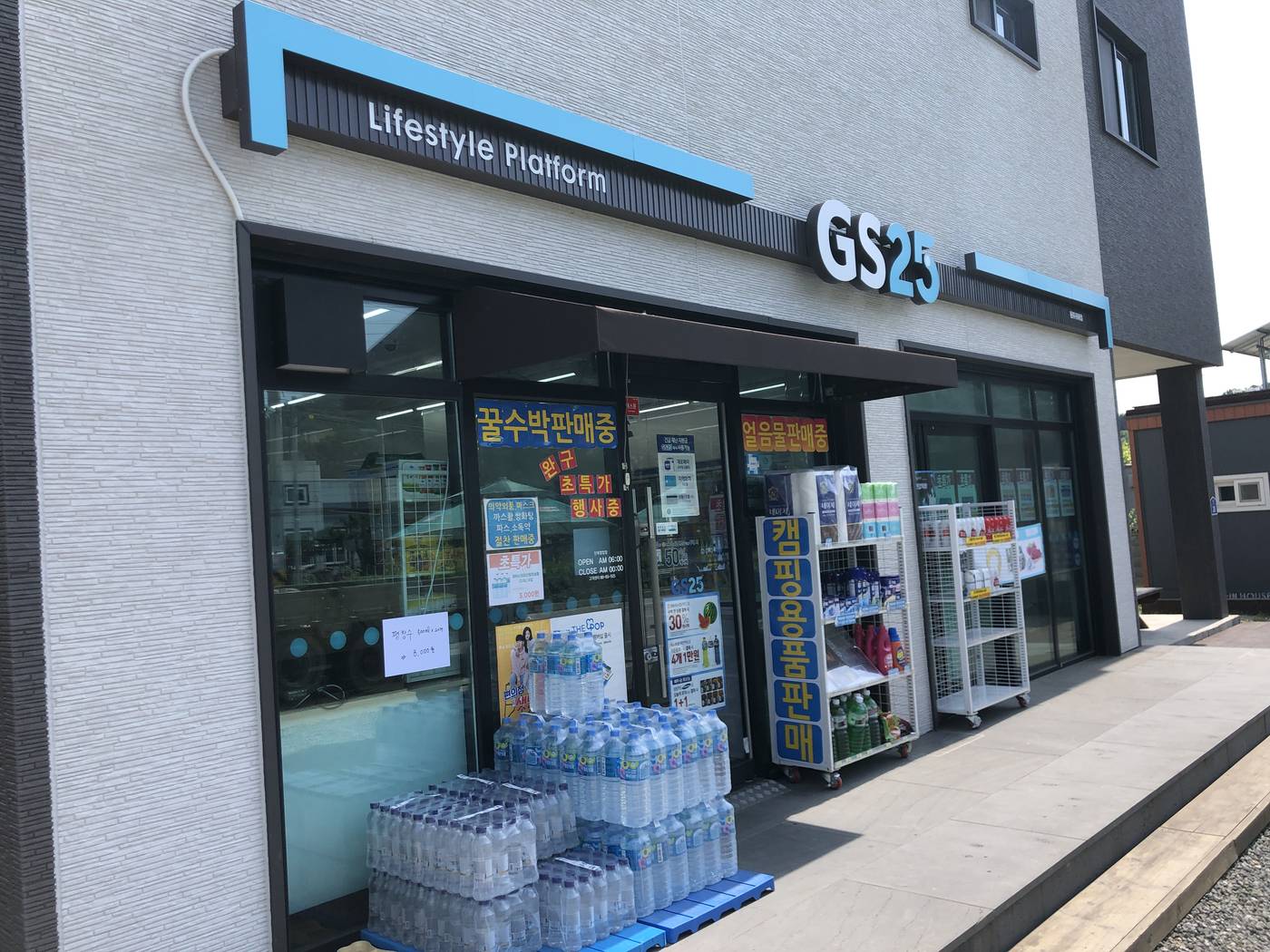
A GS25 convenience store in a small Korean town in 2020, open from 6 a.m. to midnight according to the notice on its door. Korean convenience stores sell soju, beer and cigarettes, and the clerk is the one liable for checking the buyer's birth year. Photo: Choi Kwang-mo, Wikimedia Commons, CC0.
Korean clerks and doormen check a foreigner's age on the passport — a slim cover to carry it on a night out: FINTIE Slim RFID Passport HolderAffiliate link. As an Amazon Associate, EpicKor earns from qualifying purchases at no extra cost to you.
Quick Guide: every legal age in Korea, with the law
| What you want to do | Legal age | Law and article | How it is counted |
|---|---|---|---|
| Buy alcohol or cigarettes; be served alcohol | From 1 January of the year you turn 19 (born 2007 → from 1 Jan 2026) | Youth Protection Act (청소년 보호법) Art. 2 No. 1, Art. 28(1); Food Sanitation Act (식품위생법) Art. 44(2) | Birth year (연 나이) |
| Enter a nightclub or entertainment bar (유흥주점), a karaoke bar that serves alcohol (단란주점), an adult game arcade | From 1 January of the year you turn 19 | Youth Protection Act Art. 2 No. 5, Art. 29(2); Enforcement Decree Art. 5 | Birth year |
| Stay in a PC bang or noraebang after 10 p.m. without a guardian | From 1 January of the year you turn 19 | Game Industry Act (게임산업진흥에 관한 법률) Decree Art. 16; Music Industry Act (음악산업진흥에 관한 법률) Art. 22 and Decree Art. 8 | Birth year |
| Legal adult: sign contracts, rent, open accounts without a parent | 19 | Civil Code (민법) Art. 4, 5 | Actual age (만 나이) |
| Vote in presidential, National Assembly and local elections | 18 on election day | Public Official Election Act (공직선거법) Art. 15, 17 | Actual age |
| Stand for the National Assembly or local office / for president | 18 / 40 | Public Official Election Act Art. 16 | Actual age |
| Join a political party | 16 | Political Parties Act (정당법) Art. 22 | Actual age |
| Get a car licence (1st/2nd class ordinary) | 18 | Road Traffic Act (도로교통법) Art. 82(1) | Actual age |
| Ride a moped or e-scooter (원동기장치자전거 licence) | 16 | Road Traffic Act Art. 82(1)1 | Actual age |
| Large or special vehicle licence (1종 대형·특수) | 19, plus one year of driving | Road Traffic Act Art. 82(1)6 | Actual age |
| Marry | 18, with both parents' consent until 19 | Civil Code Art. 807, 808 | Actual age |
| Age of sexual consent | 16 if the partner is 19 or over; 13 in all cases | Criminal Act (형법) Art. 305 | Actual age |
| Criminal responsibility | 14 | Criminal Act Art. 9 | Actual age |
| Work a job | 15 (younger only with a labour-ministry permit) | Labour Standards Act (근로기준법) Art. 64 | Actual age |
| Enter a casino | 19 | Tourism Promotion Act (관광진흥법) Art. 28(1)8 | Actual age |
| Military service registration (Korean men) | From 1 January of the year you turn 18 | Military Service Act (병역법) Art. 8, 2(2) | Birth year |
"Actual age" means age counted from your birthday, the way most countries count. "Birth year" means the rule switches on for everyone born in the same year on the same day, 1 January — which is how one Korean class of school-leavers can walk into a bar together.
TOPBAG Family Passport Holder — one zip case for every passport in the family If you travel with a teenager, their passport is the ID a Korean clerk, PC bang or noraebang will ask for after 10 p.m., and the rules below turn on the birth year printed in it. A family case keeps all of them in the adult's bag. As an Amazon Associate, EpicKor earns from qualifying purchases at no extra cost to you.
See the TOPBAG family passport holder on AmazonWhen are you an adult in Korea? At 19 — on your birthday
Article 4 of the Civil Code is one sentence: "사람은 19세로 성년에 이르게 된다" — a person becomes an adult at 19. Article 5 says a minor needs the consent of a legal representative, usually a parent, for any legal act, and a contract signed without it can be cancelled. That is why Korean phone shops, banks and landlords ask an under-19 for a parent's consent form.
Since 28 June 2023 that 19 is counted from your birthday. The "age unification law" (만 나이 통일법) was two amendments promulgated on 27 December 2022: Civil Code Article 158, which says age is counted "출생일을 산입하여 만(滿) 나이로" — from the date of birth, in full years — and Article 7-2 of the Framework Act on Public Administration (행정기본법), which applies the same rule to government. Our guide to the Korean age system explains the old "Korean age" it replaced.
Adulthood can also arrive early. Civil Code Article 826-2 says a minor who marries "is regarded as an adult" for civil-law purposes — contracts, not drinking.
Drinking and smoking: the 1 January rule
The Youth Protection Act defines a youth (청소년) in Article 2, item 1, as "a person under 19. However, a person who has reached 1 January of the year in which they turn 19 is excluded." Article 28(1) then forbids anyone to sell, lend or give "harmful drugs" to a youth, and the list in Article 2, item 4, begins with alcohol (under the Liquor Tax Act) and tobacco. So:
| Born in | Can buy alcohol and cigarettes, enter bars | Legal adult under the Civil Code | Can vote (18 on election day) |
|---|---|---|---|
| 2006 or earlier | Yes | Yes (19th birthday was in 2025 or earlier) | Yes |
| 2007 | Yes, since 1 January 2026 | From the 19th birthday, during 2026 | Yes |
| 2008 | From 1 January 2027 | From the 19th birthday, during 2027 | From the 18th birthday, during 2026 |
| 2009 | From 1 January 2028 | During 2028 | From the 18th birthday, during 2027 |
The rule applies to the seller, not the drinker. Selling alcohol or cigarettes to a youth carries up to two years in prison or a ₩20 million fine (Youth Protection Act Article 59, item 6), and letting a youth into a bar or club that bars them carries the same maximum (Article 59, item 8); employing one there, up to three years or ₩30 million (Article 58, item 4). A restaurant that serves a youth also breaks the Food Sanitation Act, Article 44(2)4, and can have its licence suspended; since the Act's amended Article 75, a shop fooled by a forged, altered or borrowed ID, or forced by violence or threats, can be spared that suspension. That is why clerks card young-looking customers hard.
What ID works. Article 29(4) lets a venue ask for a resident registration card (주민등록증), including the mobile version, "or other ID that can confirm age", and refuse entry to anyone who will not show one. The law names no other document, so for a foreigner the safe choices are a passport or an alien registration card; whether a foreign driving licence is accepted is up to the person at the door. Clubs and bars may also set a house rule stricter than the law.
You might like: Korean Drinking Culture: Hoesik, Choice and Safety
The 2023 "international age" law did not change the drinking age
This is the confusion behind most of the English answers. When Korea unified age counting in June 2023, the government said plainly that laws with their own rule keep it until those laws are amended. The Ministry of Government Legislation (법제처), announcing the change, named the birth-year exceptions — the Youth Protection Act and the Military Service Act among them — and said switching them would need separate amendments after review. As of September 2026 the Youth Protection Act still carries the 1 January proviso, in a version in force since 1 July 2026.
So three birth-year rules survive:
- Youth protection — alcohol, tobacco, bars, clubs, and the 10 p.m. cut-off for PC bangs and noraebangs (their laws borrow the Youth Protection Act's definition).
- Military service — the Military Service Act counts "from age 18" as "from 1 January of the year in which that age is reached" (Article 2(2)). Korean men enter the reserve pool (병역준비역) from that date (Article 8) and take the conscription medical in the year they turn 19 (Article 11). This matters for dual nationals and Korean-heritage men holding Korean nationality, not for tourists.
- School entry — the Elementary and Secondary Education Act (초·중등교육법) Article 13 sends a child to primary school on 1 March of the year after the year they turn 6, so every child born in 2020 starts in March 2027.
PC bangs and noraebangs: out by 10 p.m.
Families get caught by this one. Under Article 16 of the Game Industry Act's Enforcement Decree, PC bangs (인터넷컴퓨터게임시설제공업) may admit youths only between 9 a.m. and 10 p.m., unless a parent, guardian, teacher or similar supervisor is with them. Noraebangs (노래연습장) follow the same hours under Article 22(1)2 of the Music Industry Act and Article 8 of its Enforcement Decree, with the exception widened to a parent or guardian who comes along or signs a written consent, an adult relative, or a teacher. The Youth Protection Act's decree (Article 5(3)) also keeps youths out of noraebangs except in rooms registered as youth rooms (청소년실). Both laws define "youth" by the Youth Protection Act — the birth-year rule again — and both now let the owner ask for ID and turn away anyone who refuses (added in October 2024).
In practice: a 17-year-old on a family trip can sing alone in a noraebang's youth room until 10 p.m., and after that only with you in the room. A noraebang may not sell alcohol to anyone (Music Industry Act Article 22(1)3); the ones that do are licensed differently and closed to youths entirely.
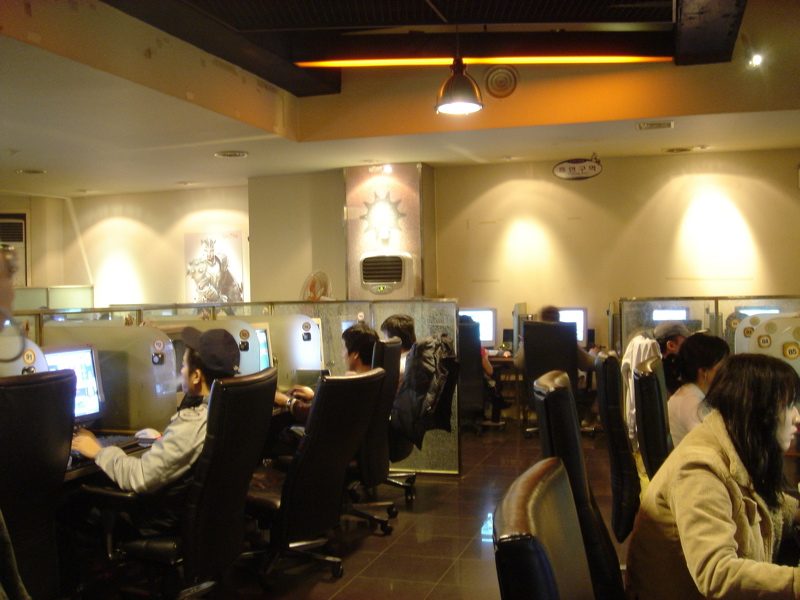
A PC bang in Seoul, photographed in 2006. Players under the birth-year cut-off have to leave at 10 p.m. unless a parent or guardian is with them. Photo: Hachimaki, Wikimedia Commons, CC BY-SA 2.0.
You might like: How Many PC Bangs Are in Korea? Count, Prices, and Rules
Voting at 18 — and the foreigners who can vote
Article 15 of the Public Official Election Act gives the vote to citizens aged 18 or over, and Article 17 fixes the age "as of election day". The age was lowered from 19 by an amendment passed in December 2019 and promulgated on 14 January 2020; the April 2020 National Assembly election was the first held under it. Since a 2022 amendment, 18-year-olds can also stand for the National Assembly, local councils and local government head posts (Article 16(2)–(3)); the presidency still requires 40 and five years' residence. Political parties can take members from 16 (Political Parties Act Article 22), though under-18s must file a parent's consent form (Article 23(1)).
Foreigners do not vote in national elections. There is one exception people rarely know: a foreign permanent resident (F-5) aged 18 or over, three years after gaining permanent residence and entered on the local foreigner register, votes in local elections — mayor, governor, local councils (Article 15(2)3).
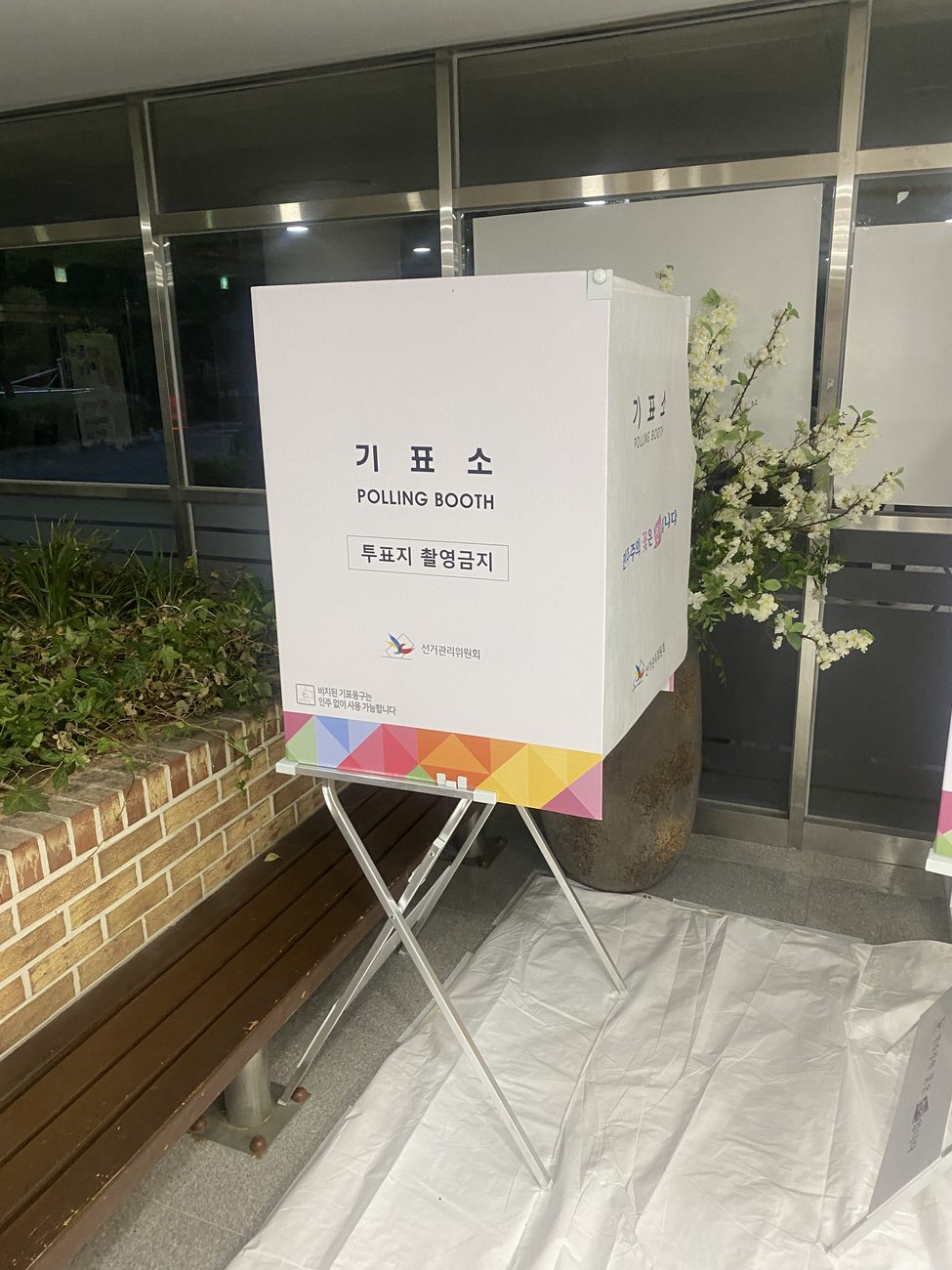
A polling booth (기표소) used in the 21st presidential election, 3 June 2025. The notice reads "no photographing the ballot". Photo: revi, Wikimedia Commons, CC BY-SA 2.0 KR.
Driving at 18: the licence classes
Article 82(1) of the Road Traffic Act bars anyone under 18 from a driving licence — under 16 for a moped-class licence (원동기장치자전거), which also covers e-scooters. The large-vehicle and special licences (1종 대형, 1종 특수) require 19 and at least one year of driving experience (Article 82(1)6). The same article, point 7, adds a rule for foreigners: you cannot be issued a Korean licence unless you have done alien registration or a domestic residence report.
Visitors usually drive on an International Driving Permit, valid for one year from entry under Article 96. The law's 18 is not what the rental desk uses: our guide to renting a car in Korea found Lotte Rent-a-Car's floor is 21, with a licence held for a year.
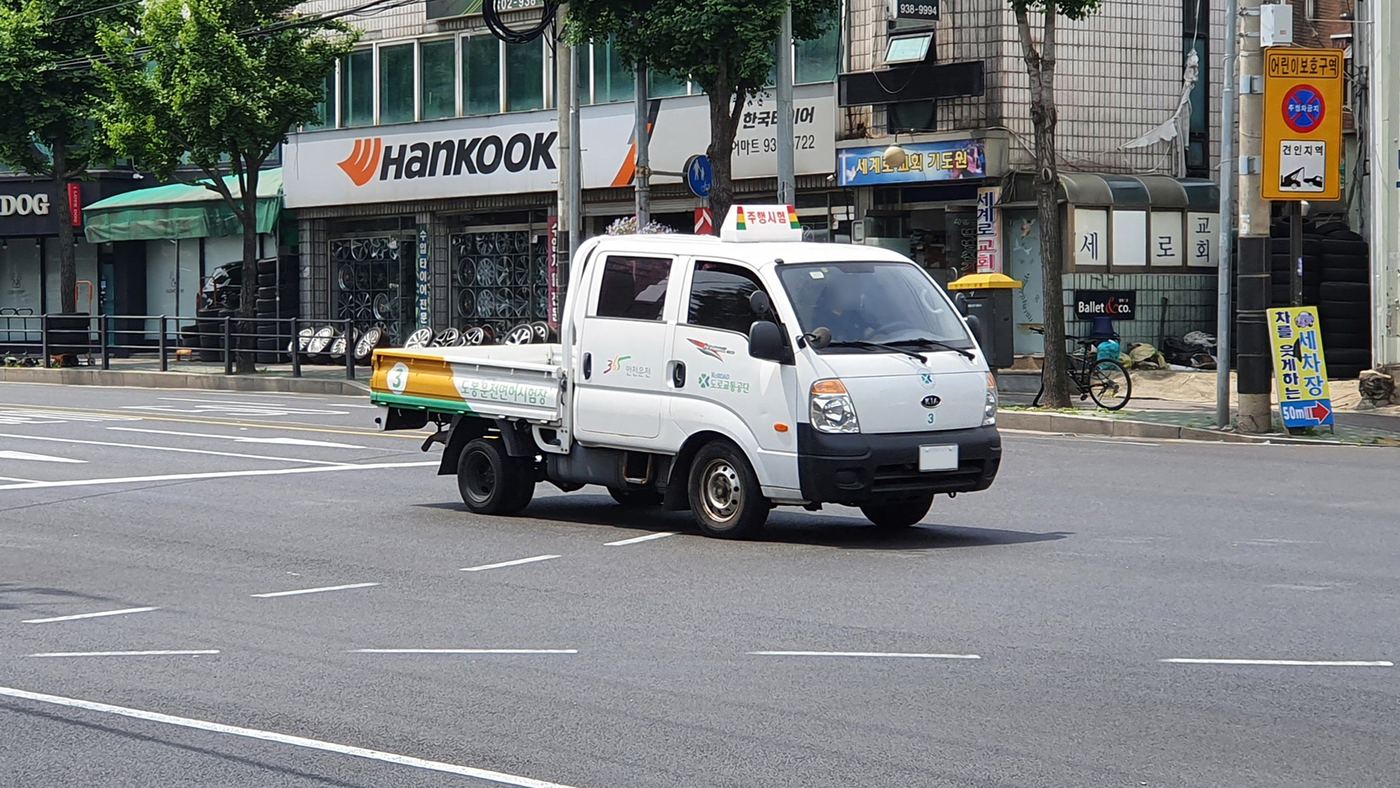
A Kia Bongo used for the 1st-class ordinary (1종 보통) road test, the licence that also covers small trucks, in Dobong, Seoul, in 2021. Minimum age: 18. Photo: Ox1997cow, Wikimedia Commons, CC BY-SA 3.0.
Marriage at 18, and the age of consent at 16
Marriage. Civil Code Article 807: "a person who has turned 18 may marry" (amended December 2022). Until 19, Article 808 requires the consent of both parents, or of one if the other cannot give it, or of a guardian. Engagement follows the same rule (Article 801).
Age of consent. Since a 2020 amendment to Article 305 of the Criminal Act, sexual intercourse or indecent acts with anyone under 13 are punished as rape or indecent assault in every case, and with a person aged 13 to 15 they are punished the same way when the other person is 19 or older. Before May 2020 the line was 13. Separately, the Act on the Protection of Children and Youth Against Sex Offences (아동·청소년의 성보호에 관한 법률) protects everyone under 19 — and it counts actual age, with no 1 January exception. Any sexual content involving, or payment for sex with, a person under 19 is a serious crime in Korea.
Work, casinos and tattoos
Part-time work. Article 64 of the Labour Standards Act forbids employing anyone under 15, or anyone still in middle school under 18, without an employment permit (취직인허증) from the Minister of Employment and Labour. For workers aged 15 to 17 the employer must keep a family-relations certificate and a parent's written consent (Article 66); hours are capped at 7 a day and 35 a week, extendable by one and five hours by agreement (Article 69); and night work between 10 p.m. and 6 a.m. or holiday work needs the worker's consent and the ministry's approval (Article 70). A parent cannot sign the employment contract for the teenager (Article 67). Working at all in Korea as a foreigner depends on your visa, which is a different rule.
Casinos. Korea's casinos licensed under the Tourism Promotion Act — the foreigner-only ones — may not admit anyone under 19 (Tourism Promotion Act Article 28(1)8). Because the law has no birth-year proviso, that 19 is counted from your birthday.
Tattoos. Korea's Tattooist Act (문신사법), promulgated on 28 October 2025, takes effect on 29 October 2027. Article 22 bans tattooing a minor without the consent of a parent or guardian and lets the tattooist demand ID. Until then, Korean courts treat tattooing as a medical act that only a licensed doctor may perform. Cosmetic procedures have no separate age law: a minor needs a parent's consent under the Civil Code's general rule, and clinics ask for it.
The honest part: where the numbers mislead
- Your home country's drinking age does not travel. A 20-year-old American can drink in Korea; an 18-year-old from Germany or the UK can drink only if born in 2007 or earlier, even though it is legal at home.
- Being able to drink is not being an adult. Someone born in December 2007 could buy beer on 1 January 2026, but cannot sign a phone contract alone until their birthday in December.
- The birth-year rule cuts both ways. A person born on 1 January 2008 is one day younger than someone born on 31 December 2007, yet cannot buy alcohol until 1 January 2027, a full year later.
- ID checks read the birth year, not your face. Carry a passport or alien registration card; the law speaks of showing an ID document, and a clerk may refuse a photo of one on your phone.
- Laws change. The government said in 2023 that it would review the birth-year exceptions; as of September 2026 the Youth Protection Act still uses the 1 January rule. Check the date at the top of this page.
You might like: Hongdae vs Itaewon vs Gangnam: Seoul Nightlife Guide
FAQ
Q: What is the legal age in Korea? A: There is no single legal age. You become an adult at 19 on your birthday (Civil Code Article 4); you can buy alcohol and cigarettes from 1 January of the year you turn 19 (Youth Protection Act Article 2); you can vote, drive and marry with parental consent at 18; and the age of consent is 16.
Q: What is the drinking age in Korea in 2026? A: Anyone born in 2007 or earlier can legally buy and drink alcohol in Korea in 2026. The rule turns on for a whole birth year on 1 January of the year you turn 19, so people born in 2008 can buy alcohol from 1 January 2027.
Q: Did Korea's switch to international age in 2023 change the drinking age? A: No. The June 2023 law made actual age (만 나이) the default, but laws with their own counting rule kept it. The Youth Protection Act still uses the 1 January birth-year rule, and so does the Military Service Act.
Q: At what age are you considered an adult in South Korea? A: At 19, counted from your birthday. Under Civil Code Article 5 a minor needs a parent's consent for contracts; a minor who marries is treated as an adult for civil-law purposes.
Q: Can foreigners under 19 go to a PC bang or noraebang at night in Korea? A: Only until 10 p.m. unless a parent or guardian is with them. The hours (9 a.m. to 10 p.m.) apply to everyone covered by the Youth Protection Act's definition, whatever their nationality.
Sources
- National Law Information Center (국가법령정보센터, law.go.kr), current statute texts read on 29 September 2026:
- 청소년 보호법 (Youth Protection Act), in force 1 July 2026: Articles 2, 28, 29, 58, 59; 청소년 보호법 시행령 Article 5.
- 민법 (Civil Code): Articles 4, 5, 158, 801, 807, 808, 826-2.
- 행정기본법 (Framework Act on Public Administration): Article 7-2.
- 공직선거법 (Public Official Election Act): Articles 15, 16, 17. 정당법 (Political Parties Act): Article 22.
- 도로교통법 (Road Traffic Act): Articles 80, 82, 96.
- 형법 (Criminal Act): Articles 9, 305. 아동·청소년의 성보호에 관한 법률: Article 2.
- 근로기준법 (Labour Standards Act): Articles 64, 66, 67, 69, 70.
- 게임산업진흥에 관한 법률 Articles 2, 28 and 시행령 Article 16; 음악산업진흥에 관한 법률 Articles 2, 22 and 시행령 Article 8.
- 식품위생법 (Food Sanitation Act): Articles 44, 75. 관광진흥법 (Tourism Promotion Act): Article 28.
- 병역법 (Military Service Act): Articles 2, 8, 11. 초·중등교육법: Article 13.
- 문신사법 (Tattooist Act), promulgated 28 October 2025, in force 29 October 2027: Article 22.
- Ministry of Government Legislation (법제처) via 대한민국 정책브리핑 (korea.kr), "만 나이 통일법 시행" (June 2023), on the birth-year exceptions that remain.
- EpicKor, Renting a Car in Korea as a Foreigner, for the rental-company age floor (Lotte Rent-a-Car's published rule).
You Might Also Like

Korea Health Insurance for Foreigners (2026): At Least ₩158,630 a Month After Six Months — Students, Workers, and What Happens If You Don't Pay
Foreigners in Korea are enrolled in national health insurance after six months and billed at least ₩158,630 a month in 2026. Students pay half, ₩79,320. A month behind and most foreigners lose cover until they pay; immigration shortens the visa extension.
How Much Is Rent in Seoul (2026)? Officetels Average ₩949,000 a Month — Jeonse vs Wolse, Deposits, and What Foreigners Need
Seoul officetels average ₩949,000 a month on a ₩22.85 million deposit (Korea Real Estate Board, June 2026); villa one-rooms ₩670,000, apartments ₩1.64 million. Jeonse vs wolse, the 5% conversion cap, agent fees and protecting a deposit.
Korea Minimum Wage 2027: ₩10,700 an Hour, ₩2,236,300 a Month — What Foreign Workers Are Owed and What They Actually Earn
Korea's 2027 minimum wage is ₩10,700 an hour, ₩2,236,300 a month on 209 hours (2026: ₩10,320). It covers every visa. The government's own survey: 36.9% of foreign wage workers earn ₩3 million+ a month, half earn ₩2–3 million.