Smoking and Vaping in Korea: Where It's Banned and the ₩100,000 Fine
Last updated: 28 October 2026. Laws read that day on law.go.kr: the National Health Promotion Act (국민건강증진법) in force from 30 April 2026, its Enforcement Decree (in force 19 March 2026) and Enforcement Rule (2 October 2025); the Tobacco Business Act (담배사업법) in force from 24 April 2026; the Seoul ordinance in force from 1 October 2026 and the Gangnam-gu ordinance in force from 17 April 2026. ₩1,334 = US$1 (Federal Reserve, 16 October 2026). A guide, not legal advice; sources at the end.
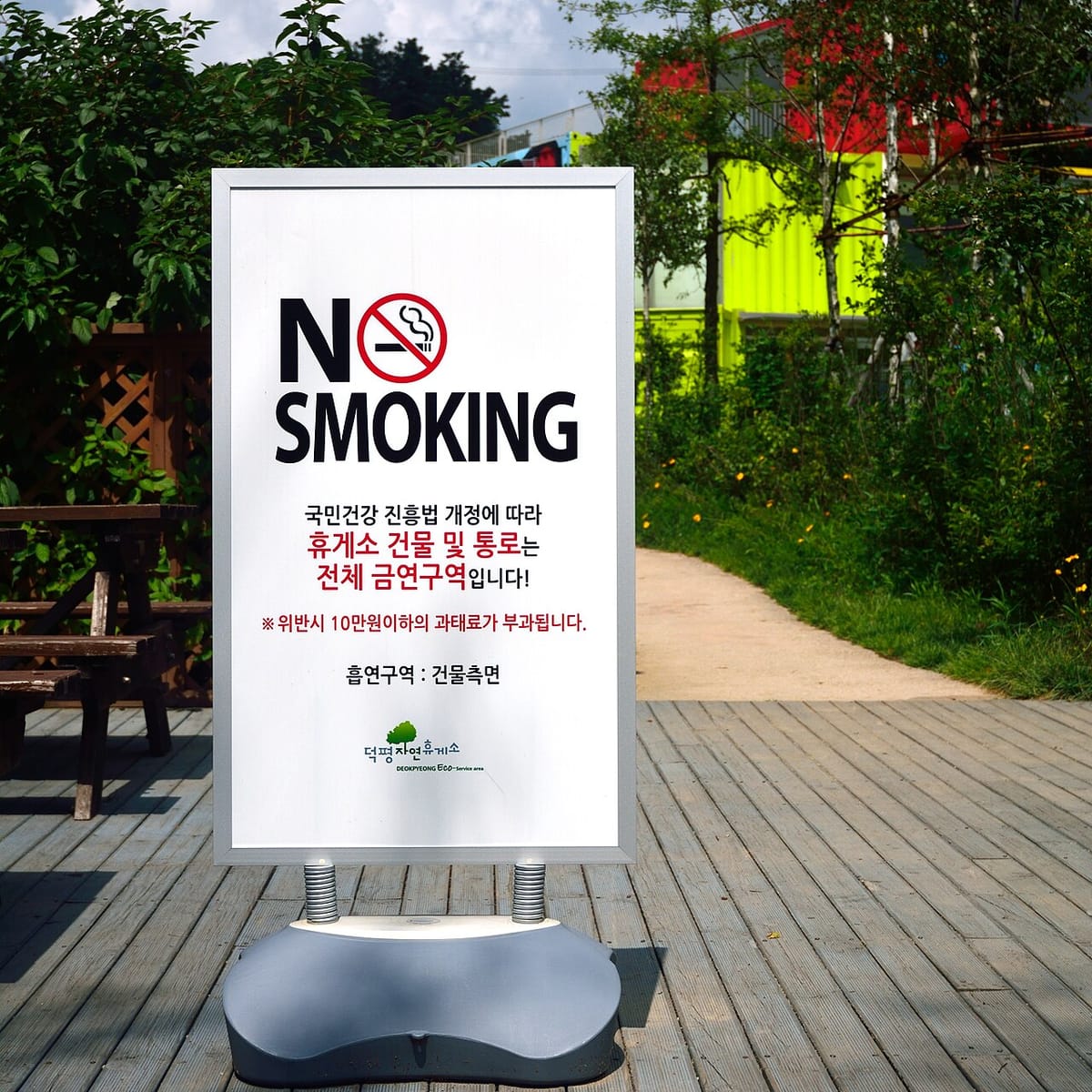
Is it illegal to smoke in Korea? No. Adults can buy and smoke cigarettes, heated tobacco and e-cigarettes. What Korea does instead is ban smoking almost everywhere indoors and in a growing list of outdoor places. Light up in one of them and the Korea smoking fine is ₩100,000 (about US$75), set by Article 34(3) of the National Health Promotion Act (국민건강증진법). The list of no-smoking places is Article 9(4) of the same act: every restaurant, café and bakery of any size, PC bangs, hotels, stations, airport waiting areas, schools, hospitals and office buildings of 1,000 m² or more. Cities and districts add streets, bus stops, parks and subway exits by local ordinance.
For vaping in Korea, one date matters: 24 April 2026. On that day an amendment to the Tobacco Business Act (담배사업법) changed the legal definition of tobacco from things made from "the leaf of tobacco" to things made from "tobacco or nicotine". Liquid e-cigarettes using synthetic nicotine, which had sat outside the definition, became tobacco in law. A vape in a no-smoking zone is now plainly a smoking offence.
This guide covers where you can and cannot smoke, how the fine is issued and how to have it halved or waived, the Seoul and Gangnam street rules, airports, trains and flights, apartments, buying age, and what you can bring through customs.
Seoul streets have few bins, and dropping a butt is its own ₩50,000 fine. A lidded steel pocket ashtray that clips to your bag solves both. See it on AmazonAffiliate link. As an Amazon Associate, EpicKor earns from qualifying purchases at no extra cost to you.
Quick Guide: smoking and vaping rules in Korea, October 2026
| Question | Answer | Law |
|---|---|---|
| Is smoking legal? | Yes, from 1 January of the year you turn 19 (born 2007 or earlier in 2026) | Youth Protection Act Art. 2(1), 28 |
| Fine for smoking in a no-smoking zone | ₩100,000 (US$75), the same for a first or third offence | National Health Promotion Act Art. 34(3); Decree Schedule 5 |
| Apartment corridors, stairs, lifts, car parks (where designated) | ₩50,000 (US$37) | Art. 9(5); Decree Schedule 5 |
| Streets, bus stops, subway exits, parks | Up to ₩100,000, set by each city or district. Seoul city and Gangnam-gu: ₩100,000 | Art. 9(7); local ordinances |
| Do vapes count? | Yes. Synthetic-nicotine liquid has been tobacco in law since 24 April 2026 | Tobacco Business Act Art. 2(1) |
| Restaurants, cafés, pubs | All no-smoking regardless of size since 1 January 2015 | Art. 9(4)24; Rule Art. 6(1) |
| PC bangs, hotels, stations, airport waiting areas | No-smoking; sealed smoking rooms allowed | Art. 9(4)14, 19, 23 |
| On a train | ₩300,000, then ₩600,000, then ₩900,000 | Railway Safety Act Art. 47, 82(4) |
| On a plane in flight | A crime: fine up to ₩10 million (US$7,496) | Aviation Security Act Art. 23, 50(7) |
| Dropping a cigarette butt | ₩50,000 (US$37) | Waste Control Act Decree Schedule 8 |
| Duty-free into Korea | 200 cigarettes, or 20 ml of nicotine liquid, or 200 heated sticks: one type only | Customs Act Rule Art. 48(3) |
Nicorette Nicotine Gum 4mg, Original — over-the-counter nicotine replacement. The one place in this guide where a puff is a crime rather than a fine is a plane in flight, and a nonstop flight to Seoul from Western Europe takes about 11 to 12 hours. Gum is one legal way through it; check the pack's own guidance on which strength fits you, and note that a 110-piece box is more than one trip needs. As an Amazon Associate, EpicKor earns from qualifying purchases at no extra cost to you.
See Nicorette gum on AmazonIs it illegal to smoke in Korea?
No. Tobacco is a legal, licensed product, sold by designated retailers (소매인, soemaein) under Article 12 of the Tobacco Business Act. The rules that matter to a visitor are about who may buy and where they may smoke.
Who. The Youth Protection Act (청소년 보호법) treats you as an adult for tobacco from 1 January of the year you turn 19, so in 2026 anyone born in 2007 or earlier can buy, including people still 18. The seller must check age and identity (Article 28(4)), so carry your passport or residence card. Our drinking-age guide covers the birth-year rule and the seller's penalty, up to two years in prison or a ₩20 million fine.
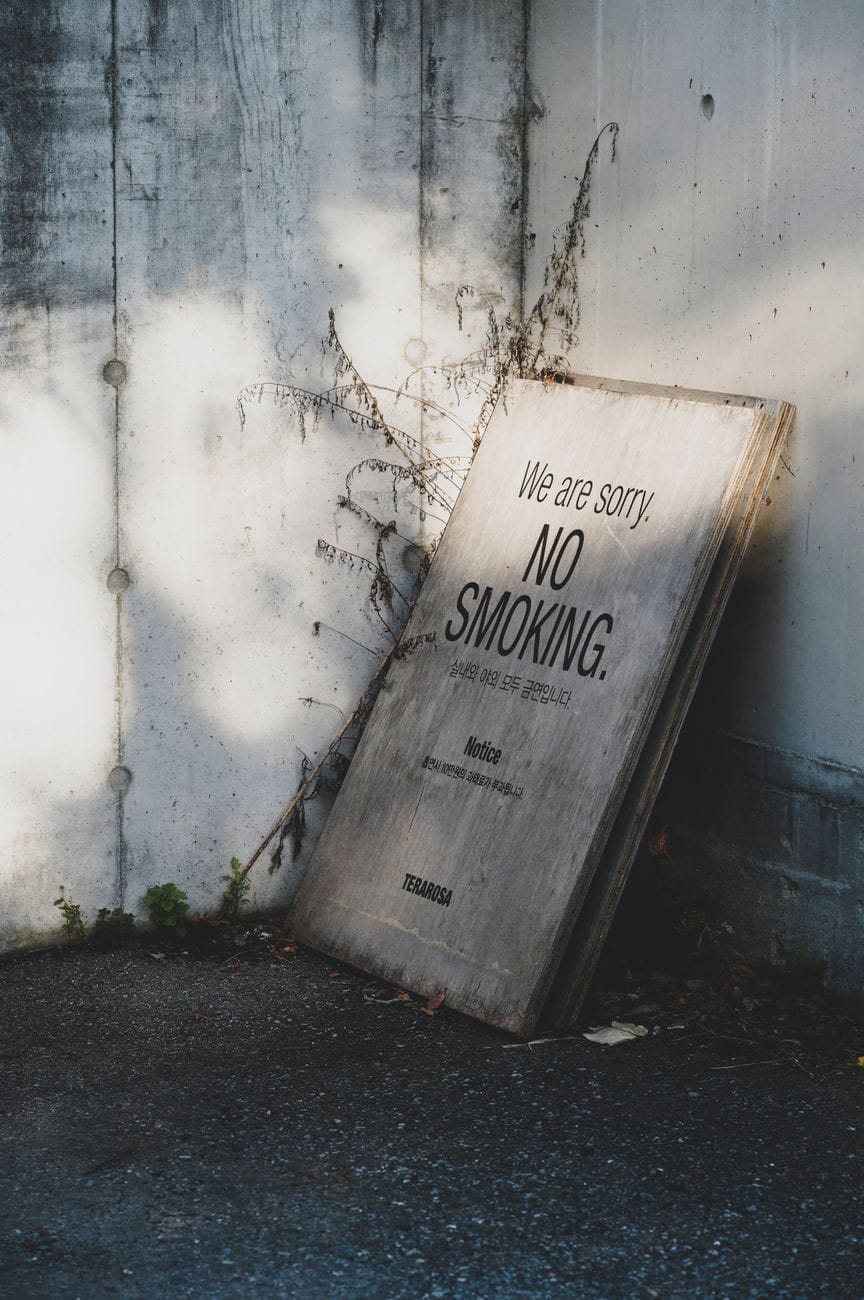
Where. The National Health Promotion Act does not ban smoking in general. It lists places that must be no-smoking, and it lets local governments add more. Anywhere not on a list, such as most open pavements outside designated streets, is legal, even if locals frown. Article 9(8) carries the ban itself: "No one may smoke in a no-smoking area designated under paragraphs 4 to 7."
Where smoking is banned in Korea: the national list
Article 9(4) has 26 numbered items (1 to 26, plus 6-2) listing kinds of public facility whose owners must make the whole facility a no-smoking zone, put up a sign, and optionally build a smoking room. A visitor meets these most often:
| Place | Rule (Art. 9(4) item) | Note |
|---|---|---|
| Restaurants, cafés, bakeries (휴게음식점·일반음식점·제과점) | Item 24: whole premises, every size since 1 January 2015 (Rule Art. 6(1)) | Covers ordinary pubs, soju bars and chicken-and-beer places, which hold restaurant licences |
| PC bangs and game arcades | Item 23 | A PC bang may have a sealed smoking room; like every smoking room, it may hold an ashtray but no computers or tables (Rule Schedule 2) |
| Tourist hotels and resort condos (관광숙박업) | Item 19 | Rooms included. Motels, guesthouses, hanok stays and Airbnbs are not on the list; their own house rules and your booking terms decide |
| Airports, ferry terminals, stations, bus terminals | Item 14: waiting rooms and platforms, underground walkways, and any paid vehicle with 16+ seats | Covers city and express buses; taxis (under 16 seats) are not covered. Smoking on subway and other trains is also banned by the Railway Safety Act, Art. 47 |
| Office, factory and mixed-use buildings of 1,000 m² or more | Item 16 | Covers most commercial towers |
| Department stores, malls and other large stores (대규모점포); underground shopping arcades | Item 18 | Station underground arcades included |
| Kindergartens, schools (whole grounds), universities (buildings) | Items 6, 7 | Plus a 30 m zone around kindergartens, childcare centres and schools (Art. 9(6)) |
| Hospitals, clinics, public health centres | Item 8 | Smoking rooms must be outdoors, 10 m from the entrance |
| Saunas and bathhouses (목욕장) | Item 22 | Jjimjilbangs included |
| Indoor sports facilities, stadiums of 1,000+ seats, theatres of 300+ seats | Items 17, 20 | Stadium smoking areas are the venue's designated spots |
| Expressway rest areas, including petrol stations | Item 26; Rule Art. 6(3) | Open-air corridors and stairs count too |
| Government, court and public-agency buildings, libraries, playgrounds | Items 1–5, 11, 12 |
Two gaps in the list surprise people. It names restaurant, café and bakery licences, not the entertainment-bar licences (유흥주점, yuheung jujeom, and 단란주점, danran jujeom) that some nightclubs and hostess bars hold, and it does not name singing rooms (노래연습장, noraebang). Whether you can smoke there depends on the building and any local rule; our reading is that a noraebang inside an office or mixed-use building of 1,000 m² or more falls under item 16. A smoke-filled room is not proof that the law allows it. And in a restaurant that hands you an ashtray, the fine for smoking still falls on you; the owner's separate duty is to designate the zone and post the sign, with fines of up to ₩5 million for ignoring an order to do so.
The Korea smoking fine: how much, and how to cut it
The act sets a ceiling and the Enforcement Decree, Schedule 5, sets the amount:
| Where you smoked | Fine (1st, 2nd, 3rd+ offence) | In US dollars |
|---|---|---|
| A facility on the Art. 9(4) list (restaurant, station, PC bang…) | ₩100,000 each time | $75 |
| A 30 m zone around a kindergarten, childcare centre or school (Art. 9(6)) | ₩100,000 | $75 |
| A designated apartment corridor, stair, lift or underground car park (Art. 9(5)) | ₩50,000 | $37 |
| A street, park or stop designated by local ordinance (Art. 9(7)) | The ordinance's figure, up to ₩100,000 | up to $75 |
| Owner who fails to designate the zone or put up the sign and ignores an order | ₩1.7 million, ₩3.3 million, ₩5 million | $1,274 / $2,474 / $3,748 |
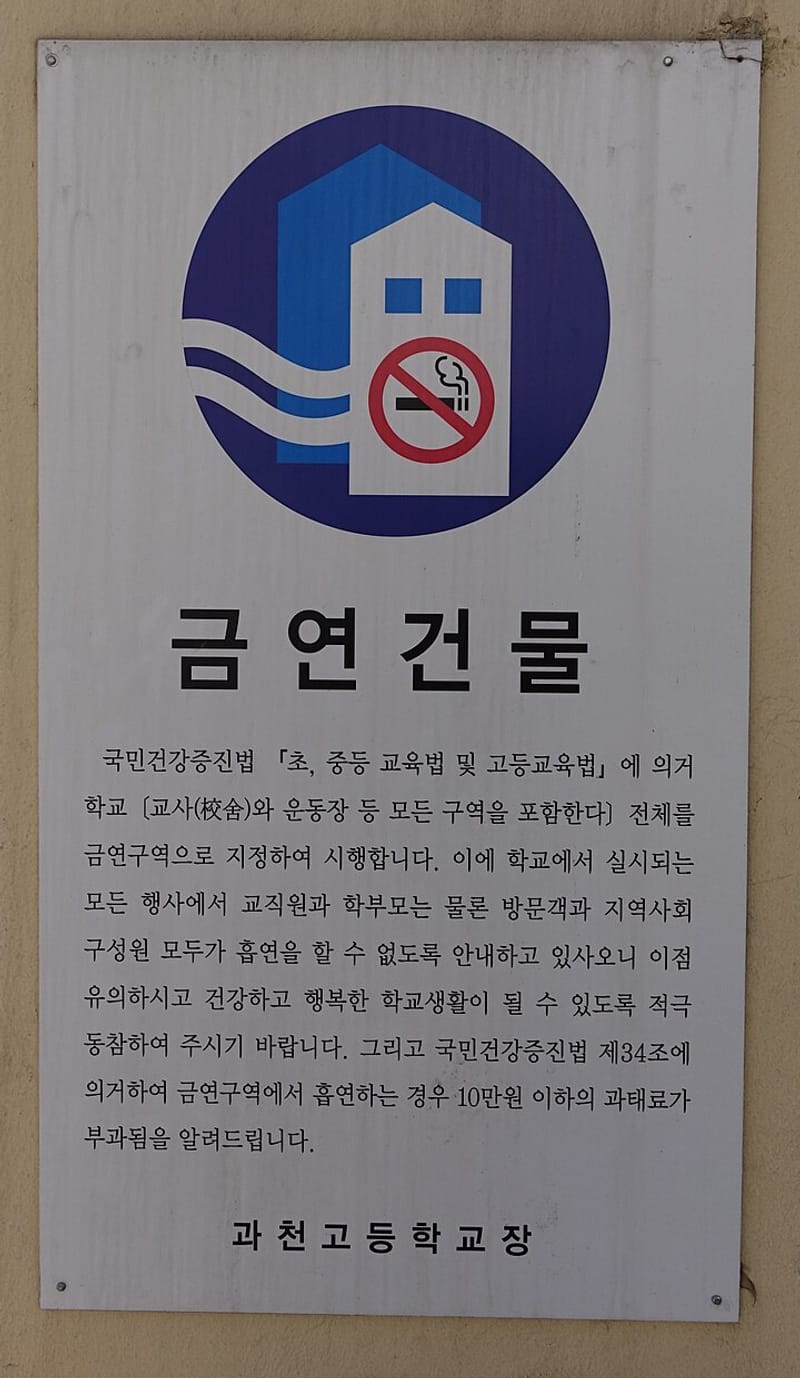
The fine is an administrative fine (과태료, gwataeryo), not a criminal record. It is issued by the district office or city that owns the zone, usually after a no-smoking inspector (금연지도원, geumyeon jidowon) takes your details on the spot. Under the Act on the Regulation of Violations of Public Order (질서위반행위규제법), you get a prior notice and at least 10 days to object, and paying within that window can cut it by up to 20% (Article 18; Decree Article 5), so ₩100,000 becomes ₩80,000 (US$60).
There is a better deal. Article 34(5) of the Health Promotion Act, with Decree Article 34, lets you apply, before the objection deadline, for one of two programmes instead (you cannot apply for both, Decree Art. 34(2)), after which the district office may reduce the fine (Art. 34(4)):
- A smoking-cessation education course: the fine can be halved. You get one month to finish it.
- A cessation support service (금연지원 서비스: counselling or treatment at a public health centre): the fine can be waived in full. You get six months.
You cannot use either if you owe unpaid fines, or if you already had a fine cut this way twice in the past two years. The 50% education discount cannot be combined with the 20% early-payment discount. Get caught smoking in a no-smoking zone during the deferral and the full fine is issued at once.
Vaping in Korea: why liquid e-cigarettes count since April 2026
Until April 2026, Korean law defined tobacco in Article 2(1) of the Tobacco Business Act as products made "from the leaf of tobacco (연초의 잎)". Liquid e-cigarettes using synthetic nicotine were not made from the leaf, so they fell outside it. The government's own reason for the amendment says that left them free of the limits on advertising and online sales, the ban on vending machines, and tobacco taxes and levies, and blames that gap for "rising youth smoking rates".
Act No. 21216, promulgated on 23 December 2025 and in force four months later, on 24 April 2026, rewrote the definition. It now reads: "'Tobacco' means a product made using tobacco or nicotine as all or part of its raw material, in a state suitable for smoking, sucking, inhaling as vapour, chewing or sniffing." Medicines and quasi-drugs under the Pharmaceutical Affairs Act, such as nicotine gum and patches, are excluded. Heated-tobacco sticks (the IQOS and lil type) were always covered, because they contain tobacco leaf.
What changed for you:
- No-smoking zones: all tobacco products, synthetic-nicotine vapes included, are banned in them. The Ministry of Health and Welfare ran a two-month grace period to 23 June, and fining began on 24 June 2026 with an intensive inspection drive to 15 July; Jongno-gu in Seoul recorded 214 smoking violations of all kinds in the first five days (24–28 June); 3 were waived after the offender showed the liquid pre-dated 24 April, according to Herald Economy (헤럴드경제, 2 August 2026).
- Shops: sellers of synthetic-nicotine liquid now need a tobacco retailer licence, and retailers may not sell by mail or online (Article 12(4)). So a Korean shop may no longer sell you nicotine liquid online.
- Price: the National Health Promotion Levy now applies, at ₩525 per millilitre of nicotine liquid, halved until 23 April 2028 for products not made from tobacco (Health Promotion Act Art. 23(1) and the 30 April 2026 addendum).
One loophole is real. The new definition applies to products shipped from the factory or cleared through customs on or after 24 April 2026 (Addendum Article 2). The Ministry of Health and Welfare's Q&A says someone fined for a liquid shown to pre-date that can contest it afterwards, and Herald Economy reported that Jongno-gu waived 3 fines on that basis. It is a narrow, paperwork-heavy defence for old stock, not a reason to vape indoors in 2026.
Some district ordinances write e-cigarettes in expressly. Gangnam-gu's defines smoking as "every act of using a tobacco product so as to cause direct or second-hand smoking, such as burning tobacco or switching on an electronic cigarette" (Article 2(1)).
Seoul's street rules: subway exits, bus stops and no-smoking streets
The national list covers buildings. Outdoor bans come from Article 9(7), which lets each local government designate "places where many people gather or pass" by ordinance. In Seoul there are two layers: the city and its 25 districts (구, gu).
Seoul city. Article 5 of Seoul's ordinance (서울특별시 금연환경 조성 및 간접흡연 피해방지조례) lets the mayor designate city parks, riverside footpaths, school protection zones, bus stops and taxi stands, anywhere within 10 m of a subway station entrance, designated streets, and, since 1 October 2026, the swimming pools and water-play areas in Han River parks plus a 10 m margin around them. The subway-exit zone was designated on 1 May 2016, with fines from that September, and the 10 m line is marked by a no-smoking pictogram painted on the pavement. The city's own page also lists Seoul Plaza, Cheonggye Plaza, Gwanghwamun Plaza, the central bus-lane stops and 24 city parks including Namsan, Seoul Forest and Yeouido Park. Article 10 sets the fine: ₩100,000. The ordinance also counts holding a lit cigarette as smoking, so "I wasn't puffing" does not help.
Seoul's districts. Each gu adds its own zones. Seoul's health page says district fines are ₩50,000 or ₩100,000 depending on the gu. Gangnam-gu's ordinance sets ₩100,000 and covers parks and playgrounds, school zones, bus stops and taxi stands, designated streets, petrol and gas stations, and public car parks. Its public health centre counted, as of 31 July 2026, 1,097 outdoor no-smoking zones in the district, including 544 bus stops, 196 subway exits, 147 parks, 36 petrol and gas stations and 12 no-smoking streets such as Gangnam-daero, Yeongdong-daero by COEX and the Daechi-dong academy street.
Outside Seoul the structure is the same and the numbers differ, so read the sign. Korean no-smoking signs almost always print the fine.
Where you can smoke in Korea
Three kinds of place stay legal:
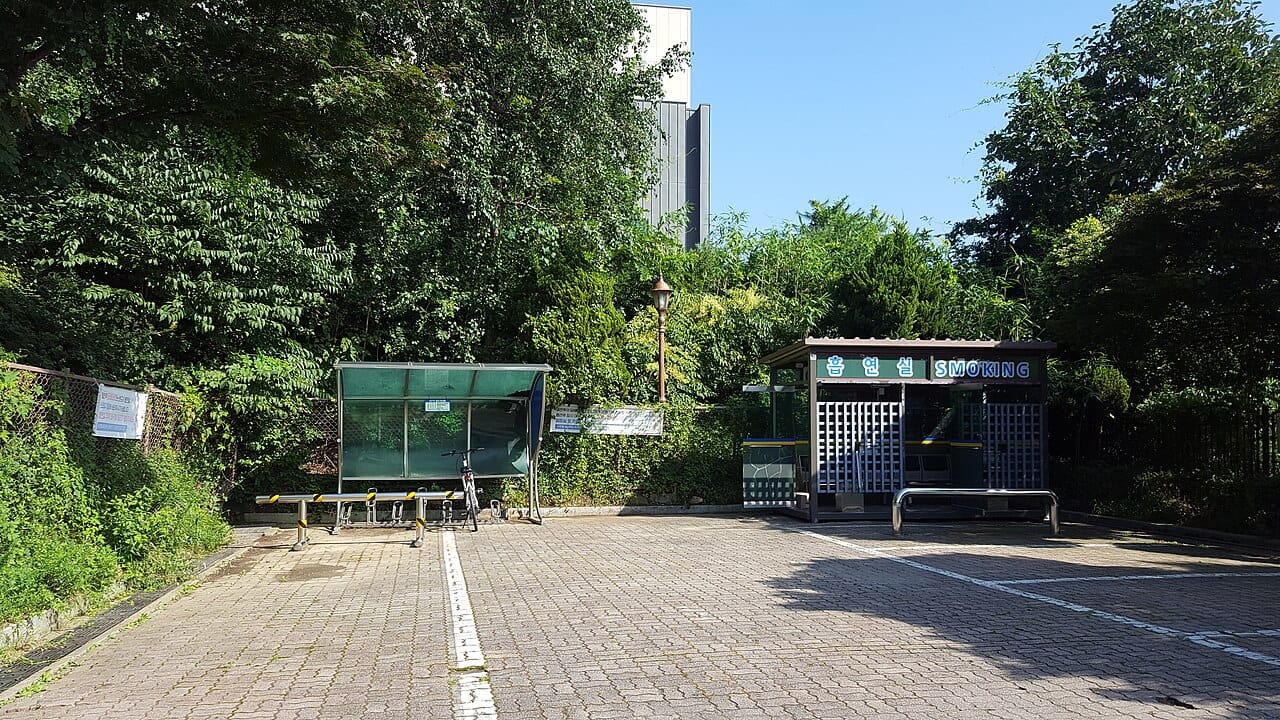
- Designated smoking rooms and areas (흡연실, heubyeonsil; 흡연구역, heubyeon guyeok). The Enforcement Rule, Schedule 2, says an indoor smoking room must be a sealed room with its own extractor, and may not be a shared office, toilet, corridor or stairwell. Schools, kindergartens, hospitals, childcare centres, youth facilities, libraries, playgrounds and children's buses may only have outdoor smoking areas, on the roof or at least 10 m from the entrance.
- Street smoking booths that some districts install near busy stations. Seoul's health page is candid that the city puts reducing smoking ahead of adding smoking areas, so there are fewer than smokers would like.
- Ordinary outdoor space that no one has designated. It is legal, but stand away from doorways, bus stops and subway exits, and take your butt with you.
Leaving the butt is a separate offence. Dropping a cigarette butt or tissue you were carrying is a ₩50,000 (US$37) fine under the Waste Control Act Enforcement Decree, Schedule 8, and our guide to Korea's missing bins explains why you may walk a long way to find one.
Airports, trains and flights
Airports. Waiting rooms and gate areas are no-smoking under item 14, but airports may build sealed smoking rooms. Incheon International Airport Corporation told Business Hankook in December 2020 that it ran 21 indoor smoking rooms around the clock: six airside on Terminal 1's third floor, four on the third floor of the Concourse, four landside on Terminal 2's first floor, four airside and three landside on Terminal 2's third floor. Check the airport map for the current list. Our Incheon layover guide covers getting around the terminals.
Packing a vape. The Korea Airports Corporation, which runs Korea's regional airports (Incheon has its own operator), reminded travellers in July 2026 that e-cigarettes, power banks and lighters may not go in checked baggage and must be carried by the passenger, and that each passenger may carry one lighter in the cabin. Whether you may charge a device on board is your airline's rule; check it before you fly.
On the plane. The Aviation Security Act (항공보안법), Article 23(1), bans smoking on board, and Article 50 makes it a crime: a fine of up to ₩10 million (US$7,496) in flight and up to ₩5 million on the ground. The act says "smoking" without defining it; treat a vape as covered, as airlines do, and do not test it.
On trains. Article 47(1) of the Railway Safety Act (철도안전법) bans smoking on passenger trains, KTX included. The fine under Article 82(4) and its decree is ₩300,000 for a first offence, ₩600,000 for a second and ₩900,000 after that (US$225, $450, $675). Station platforms are already covered by item 14.
Apartments, officetels and your Airbnb
An apartment's common areas become a no-smoking zone only if at least half the households ask the district office to designate the corridors, stairs, lifts or underground car park (Health Promotion Act Art. 9(5)). A sign at the entrance tells you if yours has done it, and the fine there is ₩50,000. The 30 m school zone and the rest of the national list still apply around the building.
Inside the flat, on the balcony or in the bathroom, there is no fine. Article 20-2 of the Apartment Housing Management Act (공동주택관리법) only says residents "must try" not to bother neighbours with smoke from inside their home, and lets the management office ask a smoker to stop and check the flat. In practice, the building's management rules and your rental contract matter more: many Korean short-term rentals forbid smoking indoors and charge cleaning fees.
Buying cigarettes and vapes in Korea
- Age: 19 by birth year, with ID checked by the seller, so carry your passport or residence card when you buy.
- Licensed sellers only: only a designated retailer may sell tobacco to consumers (Tobacco Business Act Art. 12(2)), and not by mail or online (Art. 12(4)). Since 24 April 2026 that covers nicotine-liquid shops too.
- Vending machines are allowed only in places set by decree and must have an adult-verification device (Health Promotion Act Art. 9(2), (3)).
- Cost structure: every pack of 20 carries a ₩841 health-promotion levy (US$0.63) on top of tobacco taxes (Art. 23(1)).
Bringing cigarettes and vapes into Korea
The duty-free tobacco allowance is in Article 48(3) of the Enforcement Rule of the Customs Act, and it is separate from the US$800 general allowance:
| Type | Duty-free per adult |
|---|---|
| Cigarettes | 200 sticks (one carton) |
| Cigars | 50 |
| Heated-tobacco sticks | 200 |
| E-cigarette nicotine liquid | 20 ml |
| Other e-cigarette types | 110 g |
| Other tobacco | 250 g |
Two conditions catch people. If you bring more than one type, the allowance covers one type only, so a carton of cigarettes plus 20 ml of liquid means paying duty on one of them. And travellers under 19 by birth year get no tobacco allowance at all. Over the limit, declare it: our customs guide explains the 30% self-declaration reduction and the 40% penalty for not declaring.
FAQ
Q: Is it illegal to smoke in Korea?
A: No. Smoking is legal from 1 January of the year you turn 19. It is banned in the places on the National Health Promotion Act's list (all restaurants, cafés, PC bangs, hotels, stations, schools and large buildings) and in streets, stops and parks that local governments designate, with a ₩100,000 (US$75) fine.
Q: Can you vape in Korea?
A: Yes, where smoking is allowed. Since 24 April 2026 synthetic-nicotine liquid is tobacco under the Tobacco Business Act, so vaping in a no-smoking zone brings the same ₩100,000 fine as a cigarette. Local governments began enforcing it on 24 June 2026.
Q: What is the fine for smoking in Korea?
A: ₩100,000 in a listed facility or school zone, ₩50,000 in a designated apartment common area, and up to ₩100,000 on streets set by local ordinance (Seoul city and Gangnam-gu: ₩100,000). Pay within the notice period for up to 20% off, or join a cessation programme to have it halved or waived.
Q: Can I smoke at Incheon Airport?
A: Only in the indoor smoking rooms. The airport's 2020 count was 21: fourteen airside (Terminal 1, the Concourse and Terminal 2) and seven landside in Terminal 2, none landside in Terminal 1 in that count. Gate areas and waiting rooms are no-smoking zones.
Q: Can I bring a vape to Korea?
A: Yes, in your hand luggage, not your checked bag, and duty-free up to 20 ml of nicotine liquid. If you also bring cigarettes, only one type is duty-free. Do not vape on the plane: smoking in flight is a crime with a fine of up to ₩10 million.
Q: Can you smoke in Korean bars?
A: Not in ordinary pubs, soju bars and chicken-and-beer places, which hold restaurant licences and have been fully no-smoking since 2015. Entertainment-bar licences are not on the national list, but the building rule (1,000 m² or more) and local ordinances may still cover them.
Sources
- National Health Promotion Act (국민건강증진법, MST 285763, in force 30 April 2026): Art. 9(4)–(8) no-smoking zones, Art. 9(2)–(3) vending machines, Art. 23(1) levy and the 30 April 2026 addendum, Art. 34(3) and (5) fines and reductions. law.go.kr.
- Enforcement Decree of the same act (in force 19 March 2026): Art. 33 and Schedule 5 (fine amounts), Art. 34 (education and cessation-service reductions). Enforcement Rule (in force 2 October 2025): Art. 6(1)–(3) and Schedule 2 (restaurant size thresholds, expressway rest areas, smoking-room standards).
- Tobacco Business Act (담배사업법, Act No. 21216, promulgated 23 December 2025, in force 24 April 2026): Art. 2(1) definition, Art. 12, Addendum Arts. 1–3, and the Ministry of Government Legislation's statement of reasons. law.go.kr.
- Seoul Metropolitan Government, 금연환경 조성 및 간접흡연 피해방지조례 (in force 1 October 2026), Arts. 2, 5, 10; Seoul health page on second-hand smoke and no-smoking zones (news.seoul.go.kr, updated 1 April 2026); Seoul Media Hub, 29 April 2016, on the subway-exit zone (designated 1 May 2016, fines from September 2016, pictograms at the 10 m line).
- Gangnam-gu, 금연환경 조성 및 간접흡연 피해방지 조례 (in force 17 April 2026), Arts. 2, 5, 10; Gangnam-gu Public Health Centre, no-smoking zone counts as of 31 July 2026 (health.gangnam.go.kr).
- Act on the Regulation of Violations of Public Order, Arts. 16 and 18, and Decree Art. 5 (20% early-payment reduction).
- Railway Safety Act Arts. 47 and 82(4) and Decree fine schedule; Aviation Security Act Arts. 23 and 50; Apartment Housing Management Act Art. 20-2; Waste Control Act Enforcement Decree Schedule 8; Enforcement Rule of the Customs Act Art. 48(3). All law.go.kr.
- Ministry of Health and Welfare notice, 23 June 2026 (mohw.go.kr/board.es?act=view&bid=0027&list_no=1490975&mid=a10503010100), 「합성니코틴 전자담배도 금연구역에서는 금연입니다」: two-month grace period from 24 April to 23 June 2026, intensive inspections 24 June–15 July 2026.
- Herald Economy (헤럴드경제), 2 August 2026 (biz.heraldcorp.com/article/10827501), on synthetic-nicotine enforcement from 24 June 2026 in Jongno, Guro and Yeongdeungpo and the Ministry of Health and Welfare's Q&A on pre-24-April stock.
- Asia Economy, 28 July 2026, reporting the Korea Airports Corporation's summer advisory on e-cigarettes, power banks and lighters.
- Business Hankook (비즈한국), 16 December 2020, quoting Incheon International Airport Corporation on its 21 indoor smoking rooms.
You Might Also Like
Seoul Climate Card: Tourist Pass Prices After the 30-Day Pass Ended
Seoul's Climate Card 30-day pass is gone: last top-up 31 August, last ride 29 September 2026. Visitors can still buy 1- to 7-day passes for ₩5,000–₩20,000 (US$3.75–$15). Residents move to the K-Pass based Climate Pass.
Drunk Driving in Korea: 0.03% Covers Bikes and E-Scooters Too
Korea's 0.03% drink limit covers bikes and e-scooters: ₩30,000 (US$22) on a Ttareungi, ₩100,000 on a scooter, up to ₩20 million for a first offence in a car.
Korea Visa Overstay: What Happens, Fines by Length, How to Leave
Overstaying in Korea is a crime under Immigration Act Art. 94: up to 3 years or ₩30 million. In practice it is a fine set by length, ₩500,000 to ₩2,000,000 for under a month depending on the row applied, then a departure order. Illegal work: same scale.