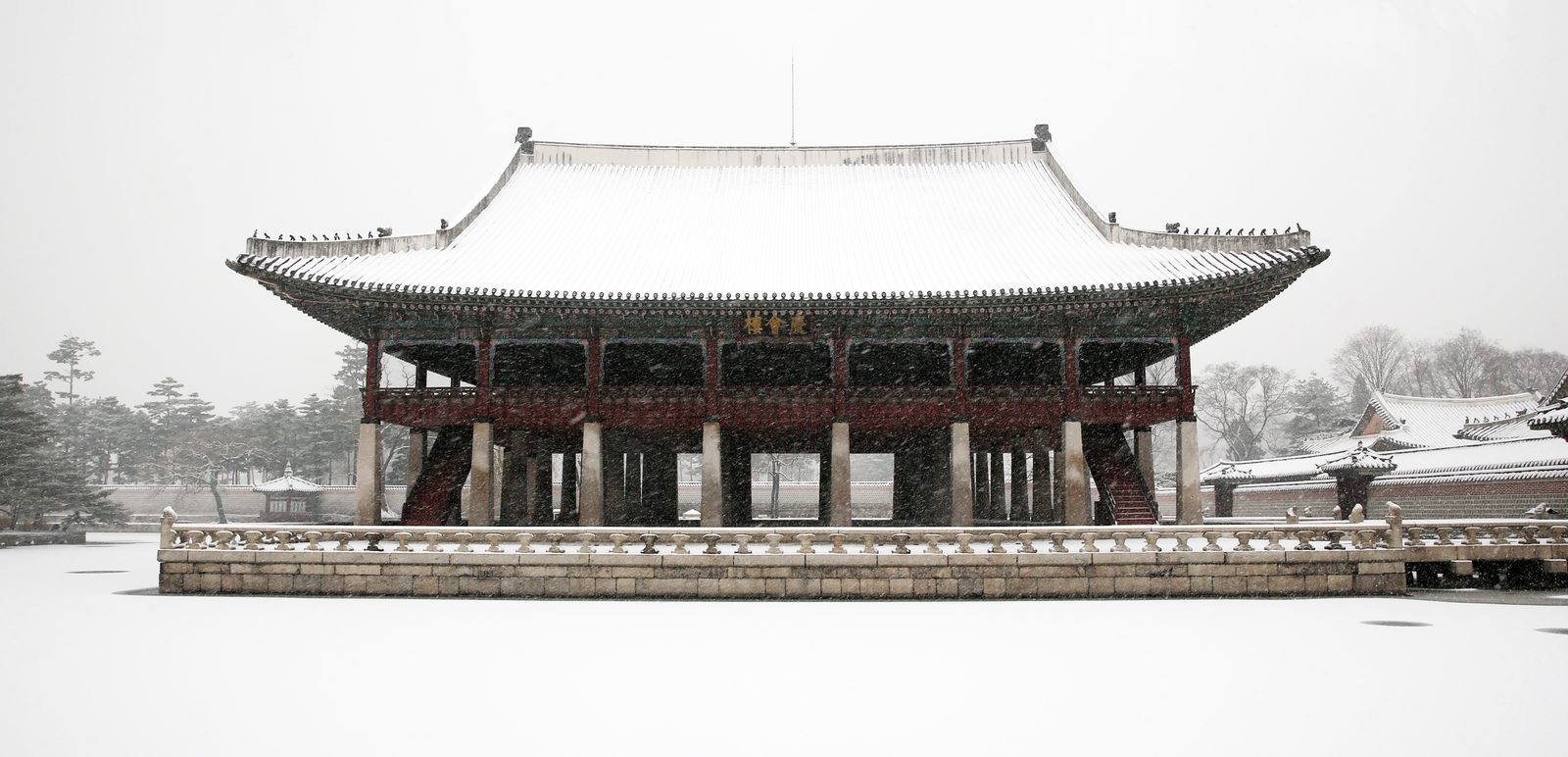
When Does It Snow in Korea? The Official First-Snow Dates by City (Seoul 20 November) and What the Forecast Says for Winter 2026
Last updated: September 2026. Normal dates are the Korea Meteorological Administration's (기상청, KMA) 1991–2020 climate normals; last winter's dates are from KMA's winter reports of 4 March 2026 and its regional offices; the outlook is KMA's three-month forecast of 23 September 2026. Sources are listed at the end.
If you want to see snow in Seoul, the date to know is 20 November. That is the official normal first-snow date (첫눈 평년값) for Seoul, the average of the thirty winters from 1991 to 2020 as kept by the Korea Meteorological Administration.
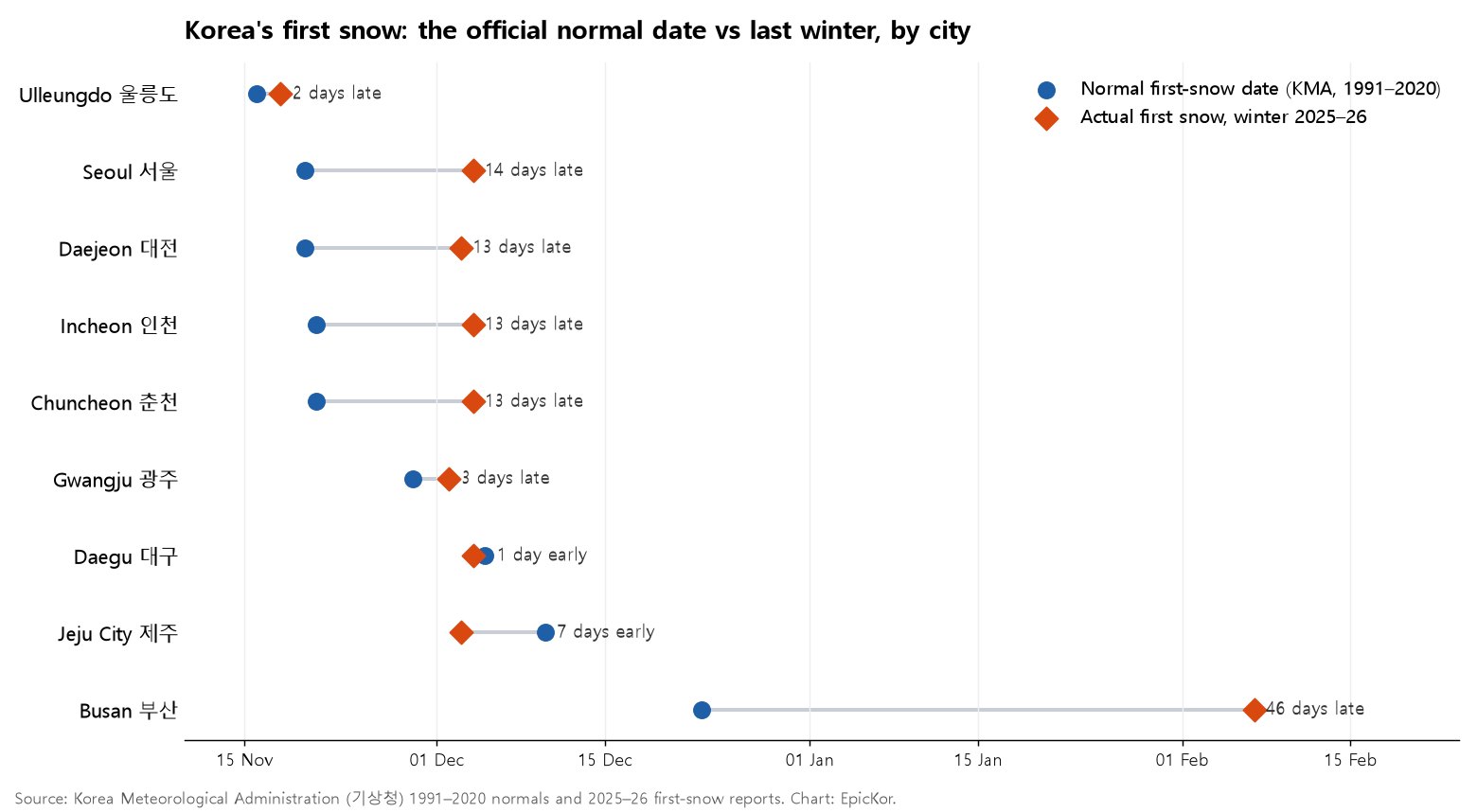
Last winter it did not come close. Seoul's first snow was logged on 4 December 2025, 14 days late. Incheon and Chuncheon were 13 days late. Busan, where the normal date is 23 December, saw its first flakes on 7 February 2026, and they melted before anything could be measured. Jeju City, meanwhile, was a week early.
English guides usually say only "it snows in Seoul from December". Here is the official number for each city, what the weather agency actually counts as first snow, where you see white before any city does, and KMA's forecast for November and December 2026.
For palace paths and hill streets after a freeze: Yaktrax Walk traction cleats, which stretch over ordinary shoes, on AmazonAffiliate link. As an Amazon Associate, EpicKor earns from qualifying purchases at no extra cost to you.
Quick Guide: Korea's official first-snow dates by city
| City / station | Normal first snow (1991–2020) | Winter 2025–26 | Winter 2024–25 | Source |
|---|---|---|---|---|
| Ulleungdo (울릉도) | 16 Nov | 18 Nov 2025 (+2 days) | 18 Nov 2024 | KMA Daegu office, 18 Nov 2025 |
| Seoul (서울, Songwol-dong) | 20 Nov | 4 Dec 2025 (+14) | 26 Nov 2024 | KMA climate page; KMA winter report, 4 Mar 2026 |
| Daejeon (대전) | 20 Nov | 3 Dec 2025 (+13) | 27 Nov 2024 | KMA climate page; KMA winter report |
| Incheon (인천) | 21 Nov | 4 Dec 2025 (+13) | late Nov 2024 | KMA Seoul-area winter report, 4 Mar 2026 |
| Chuncheon (춘천) | 21 Nov | 4 Dec 2025 (+13) | 27 Nov 2024 | KMA Gangwon office, 4 Dec 2025 |
| Suwon (수원) | 23 Nov | 4 Dec 2025 (+11) | — | KMA Seoul-area winter report |
| Gwangju (광주) | 29 Nov | 2 Dec 2025 (+3) | 27 Nov 2024 | KMA Gwangju office, 3 Dec 2025 |
| Daegu (대구) | 5 Dec | 4 Dec 2025 (−1) | 27 Nov 2024 | KMA winter report, 4 Mar 2026; KMA Daegu office, 27 Nov 2024 |
| Jeju City (제주, coast) | 10 Dec | 3 Dec 2025 (−7) | 18 Dec 2024 | KMA Jeju office, 3 Dec 2025 |
| Busan (부산) | 23 Dec | 7 Feb 2026 (+46) | 7 Jan 2025 | KMA Busan office, 7 Jan 2025; Busan Ilbo, 7 Feb 2026 |
| Seoraksan summit area (설악산) | no official normal | 20 Oct 2025 | 19 Oct 2024 | Seoraksan National Park office |
| Hallasan (한라산), Jeju uplands | no official normal | 18 Nov 2025 | 26 Nov 2024 | Jeju office via Yonhap, 18 Nov 2025 |
"+14" means 14 days after the normal date. A dash means we found no primary source. Gangneung (강릉) is left out: KMA's Gangwon climate page gives no 1991–2020 first-snow normal for it, and we would rather leave a gap than print an older figure.
The pattern is simple. Mid-to-late November in the capital region and the centre of the country, late November to early December in the southwest and Daegu, December on Jeju's coast, and late December or later in Busan. The mountains are a month or more ahead of all of them.
Smartwool Classic Thermal Merino Base Layer Crew — a mid-weight wool first layer A late-November or December trip is packed for the cold and the wait, not the snow: KMA's 1991–2020 normal for Seoul in December is a mean of 0.2°C with nights around −3.4°C, and the heating inside the subway, cafés and palaces is strong, so one thin wool layer you can keep on beats a thick jumper you have to carry. There is also a men's cut of the same crew. As an Amazon Associate, EpicKor earns from qualifying purchases at no extra cost to you.
See the Smartwool merino crew on AmazonWhat counts as "first snow" in Korea (it is less than you think)
Korea's first snow is a single observation, and how it is made explains most of the surprises in the table.
- Seoul's first snow is whatever the observer at the Seoul weather station in Songwol-dong, Jongno-gu (종로구 송월동 서울기상관측소) sees. Snow in Gangnam does not count if none falls on Songwol-dong. Other cities work the same way: Busan's station is in Daecheong-dong, Jeju's in Geonip-dong.
- It is a visual observation, and sleet counts. KMA defines it as snow or sleet (진눈깨비) confirmed by eye at the station. Snow pellets count too: Jeju's 2025 first snow was 싸락눈 (graupel) at 14:10 on 3 December.
- Nothing has to settle. Of Chuncheon's last ten first snows (2015–2024), KMA counts six that left no measurable depth at all, most of them sleet. Daegu's 2025 first snow fell for about forty minutes and recorded no depth.
- It often happens at night. Gwangju's came late on the night of 2 December 2025, Daejeon's at about 01:50 on 3 December, Daegu's at about 23:30 on the 4th. A sleeping traveller would have missed all three.
So when a Korean news alert says "첫눈 관측" (first snow observed), read it as "a few flakes were seen at the official station", not a promise of a white street. Koreans follow it anyway because first snow is a romantic marker, a K-drama staple, reported the way other countries report the first cherry blossom.
Seoul: six first snows in six winters, 30 days apart
The normal is an average; Seoul's recent winters show the spread around it:
| Winter | Seoul's first snow | Against the 20 Nov normal |
|---|---|---|
| 2020–21 | 10 December 2020 | 20 days late |
| 2021–22 | 10 November 2021 | 10 days early |
| 2022–23 | 29 November 2022 | 9 days late |
| 2023–24 | 17 November 2023 | 3 days early |
| 2024–25 | 26 November 2024 (night) | 6 days late |
| 2025–26 | 4 December 2025 | 14 days late |
Two things follow for planning. First, the earliest and latest of these six are exactly 30 days apart (10 November and 10 December). Second, four of the six came after the normal date, so if your whole trip is before about 25 November, treat snow in Seoul as a bonus.
Two of those first snows were real snowfalls, not flakes. The 2024 one turned into Seoul's heaviest November snow on record: 16.5 cm on the ground at the Jongno station on 27 November 2024, beating the November record of 12.4 cm set on 28 November 1972 in a series that goes back to 1907. Last winter's first snow on 4 December 2025 came with a heavy-snow advisory (대설주의보) for Seoul and left 5.1 cm at the station that evening.
Where snow shows up first: the mountains, Ulleungdo and Jeju's uplands
If you just want to see snow, go up, not north.
Seoraksan (설악산) is where Korea's season starts. In 2025 the national park office recorded the first snow at the summit area, around Daecheongbong (대청봉, 1,708 m) and the Socheong and Jungcheong shelters, early on 20 October: about 1 cm, with the thermometer at −1°C. The top of Seoraksan is white a month before Seoul's normal date, often while the valleys are still in autumn colour.
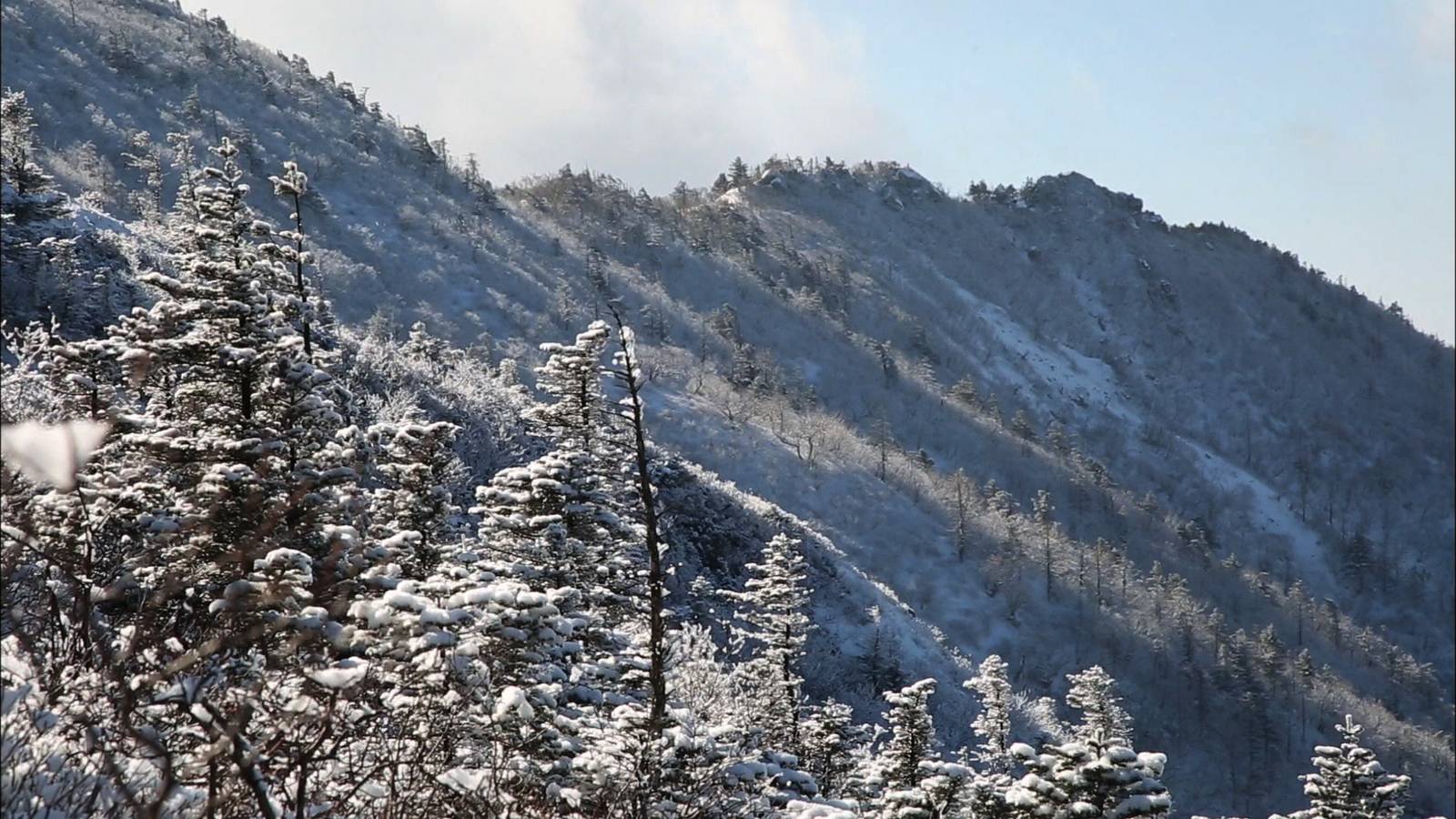
The catch: from 15 November to 15 December, wildfire-season closures shut the high routes to Daecheongbong; which trails stay open is in our national park closure guide.
Ulleungdo (울릉도), the island in the East Sea, has the earliest official normal of any place in our table, 16 November, and last year it arrived on 18 November, on the same date as the year before. Winter ferries are often cancelled in heavy swell, so it is a gamble for a short trip.
Hallasan (한라산) on Jeju is the other early place, and the reason Jeju has two answers. The mountain saw its first snow of the 2025 season early on 18 November, at Eorimok and Yeongsil. On the coast, Jeju City's official first snow was not until 3 December. If you plan to climb it in winter, the booking rules, the 11:30 checkpoint and the crampon requirement are in our Hallasan winter guide.
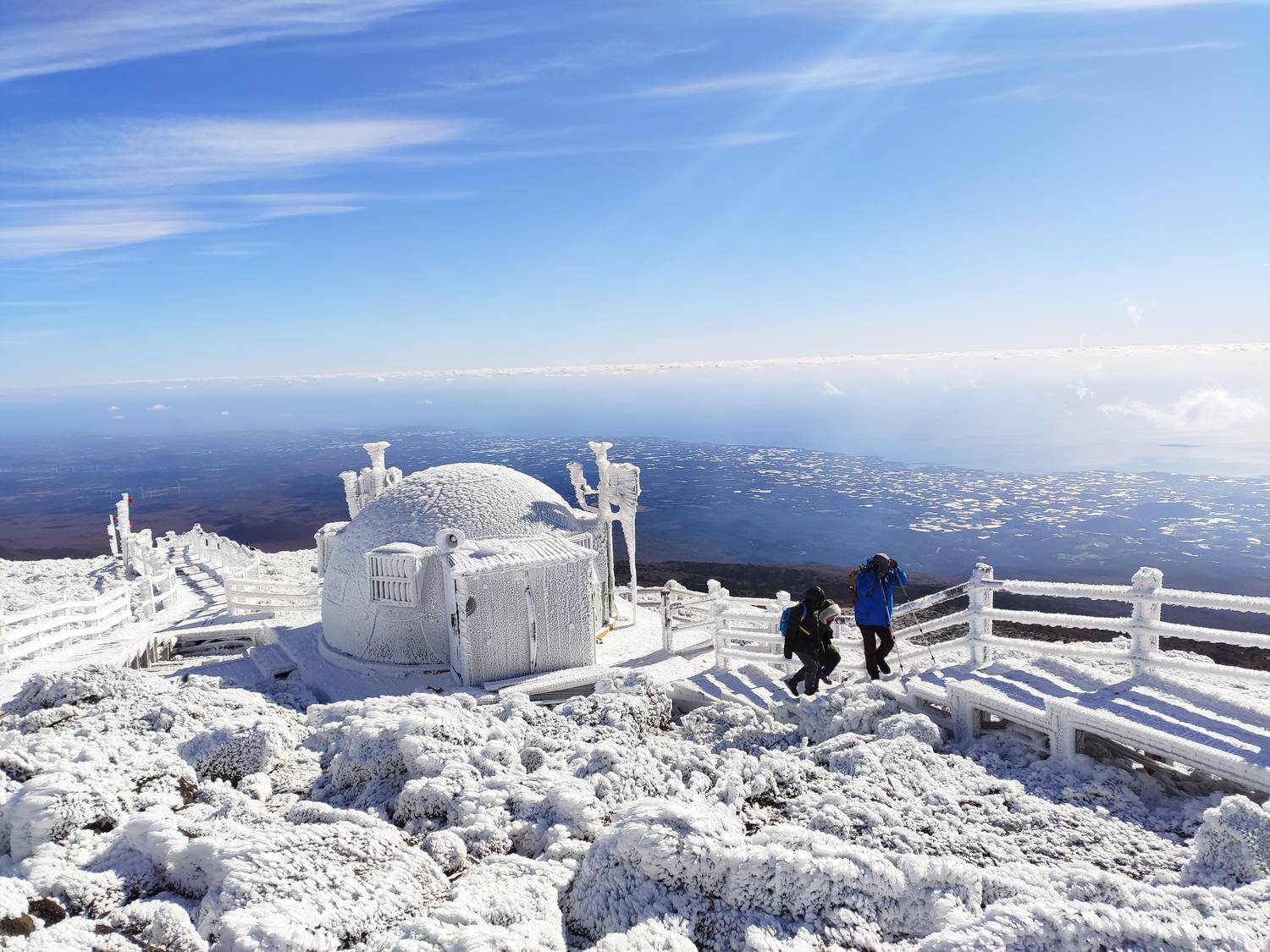
That caption is a useful warning: rime (상고대), frozen fog on branches and rocks, turns Korea's high mountains white in November and looks like snow on social media. It does not mean the trails are under snow, or that the city below has had its first snow.
The south: Busan, Daegu, Gwangju and Jeju City
- Busan: normal first snow 23 December, the latest of any major city. In winter 2024–25 it came on 7 January 2025, 15 days late; in 2025–26 it came on 7 February 2026, as flakes that melted on contact; KMA records 0.0 cm of snow in Busan for the whole winter. Don't go to Busan for snow.
- Daegu: normal 5 December; last winter it was one day early.
- Gwangju: normal 29 November; 2 December last winter. The southwest coast is the exception: cold air over the warmer Yellow Sea builds snow clouds that dump on the Jeolla coast. Last winter Mokpo received 61.7 cm, 19.4 cm above normal and the only one of KMA's 13 visual-observation stations to beat its normal.
- Jeju City: normal 10 December; 3 December last winter, 15 days earlier than 2024's 18 December.
First snow is not a white city: what last winter actually delivered
The real question is whether snow will be on the ground, and last winter the answer was: not much.
- Across KMA's 13 stations with visual snow observation, the average number of snow days in December 2025 to February 2026 was 14.5, close to the normal 15.9.
- But the total new snow averaged 14.7 cm, against a normal of 26.4 cm, about half.
- Seoul had 21.6 cm over the whole winter, 0.9 cm below normal, spread over seven days with a measurable depth: 4, 13 and 14 December, 12, 19 and 23 January and 2 February. The largest single day was 6.2 cm on 2 February 2026.
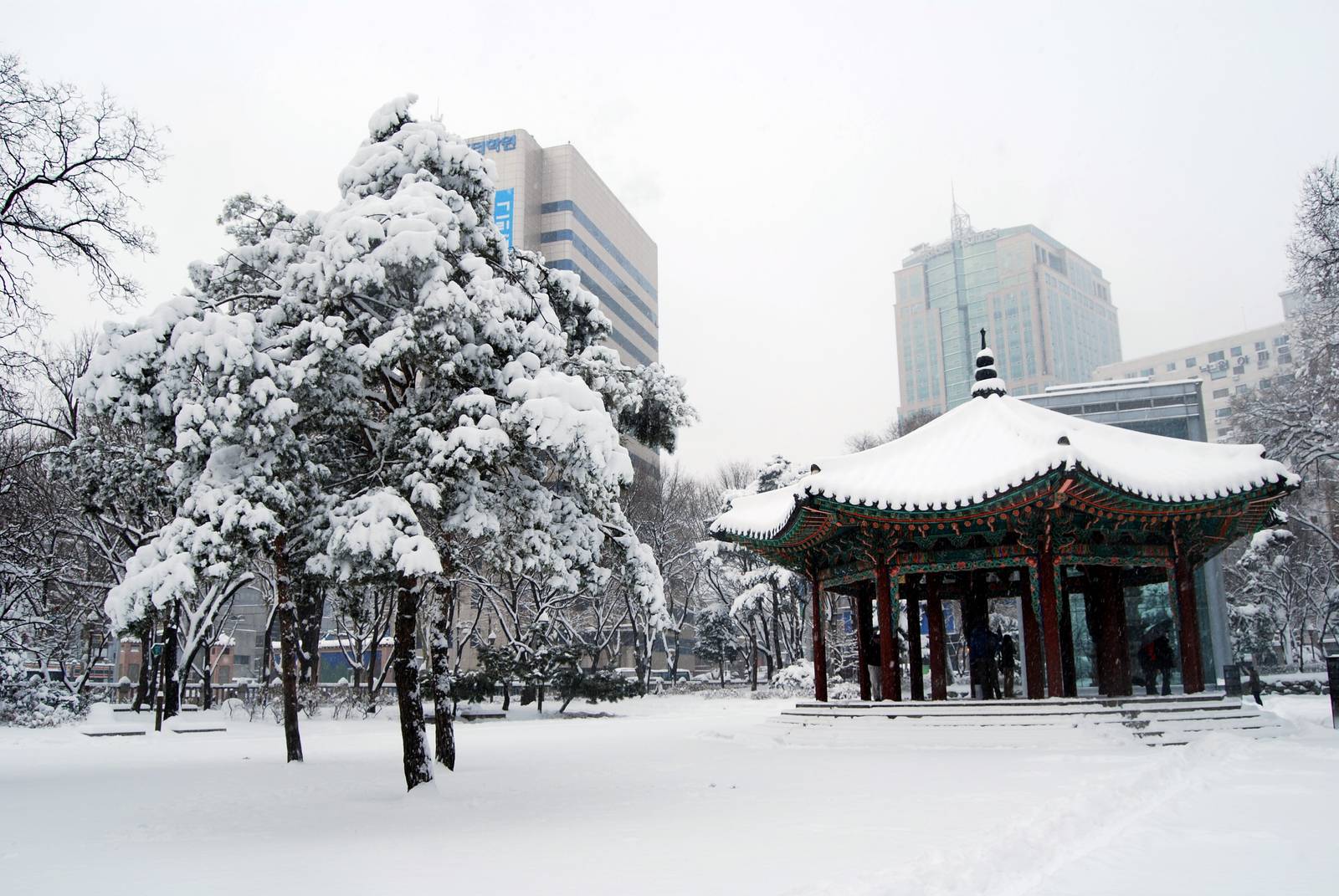
In a typical Seoul winter you get a handful of days with snow on the ground, and warm pavements clear most of it within hours; palace roofs, lawns and Namsan hold it longest. What stays is ice: shaded lanes, hill neighbourhoods such as Bukchon and Ihwa, and palace flagstones are slick the morning after.
What KMA's outlook says for November and December 2026
KMA's three-month outlook issued on 23 September 2026 says — and this is a forecast, not a record:
| Month | Temperature | Precipitation | Normal range, nationwide |
|---|---|---|---|
| October 2026 | Above normal (50% probability) | Normal or above (40% / 40%) | 13.9–14.7°C |
| November 2026 | Above normal (50%) | Above normal (50%) | 7.0–8.2°C; 30.7–55.1 mm |
| December 2026 | Above normal (50%) | Normal or above (40% / 40%) | 0.5–1.7°C; 19.8–28.6 mm |
KMA's reasoning: an El Niño is under way (June–August sea-surface anomaly +1.8°C) and is likely to continue as a strong El Niño through December, strengthening a high east of Korea that brings in warm, humid air. But for both November and December it adds that low sea ice in the Barents–Kara Sea will let cold air break through at times, and temperatures will drop sharply on occasion.
Our reading, not KMA's: a warm month makes an early first snow less likely, while a wet month with sudden cold outbreaks is the setup for one heavy snowfall rather than several light ones, as in November 2024. The next three-month outlook is due around 23 October 2026, and a one-month outlook comes every Thursday.
How to plan a November–December trip around snow
- You want to see snow, any snow, in November: go to the mountains. Seoraksan's high ground from late October, Hallasan's uplands and the 1100 Highland road (1100고지) from mid-November. Check the trail rules in our closure guide and Hallasan guide first.
- You want snow on Seoul's palaces: your odds improve from the last week of November and through December, but a single visit day is a coin toss. With a week in December, keep one morning free for Gyeongbokgung or Changdeokgung the day after a snowfall.
- You want guaranteed snow underfoot: book a ski resort. Korean slopes run on machine-made snow, which is why they can open in late November regardless of the city's first snow; last season Yongpyong and Phoenix opened on 21 November 2025. Our ski resort guide has the season-pass prices and the opening dates as they are announced.
- You are in Seoul for Christmas and New Year's Eve: Seoul Winter Festa, the umbrella for the Cheonggyecheon lanterns and the Gwanghwamun market, is scheduled for 14 December 2026 to 31 January 2027 (each programme sets its own dates within that), snow or no snow; see our Seoul Winter Festa guide.
- You are going to Busan or Jeju City: plan for cold, wind and rain, not snow.
Pack for wet as well as cold: much of what falls in Seoul in late November and December is sleet or wet snow near 0°C, and Koreans meet it the way they meet rain, under an umbrella.
Windproof compact travel umbrella — an auto-folding umbrella built for wind Sleet on a windy December evening at Gwanghwamun or on the Han River bridges is what actually soaks visitors, and this is the kind of umbrella you see Seoul commuters carry through it; it folds small enough for a day bag. As an Amazon Associate, EpicKor earns from qualifying purchases at no extra cost to you.
See the windproof travel umbrella on AmazonHow to check on the day
- KMA Weather Nuri (날씨누리, weather.go.kr): the official forecast and heavy-snow advisories (대설주의보) and warnings (대설경보), with an English version.
- Search "서울 첫눈" or "부산 첫눈" in Korean news: each regional office announces its city's first snow the same day.
- Watch advisories, not first-snow headlines. An advisory closes Hallasan's summit and mountain roads; a "first snow observed" headline changes nothing.
FAQ
Q: When does it usually snow in Seoul? A: The official normal first-snow date in Seoul is 20 November (KMA, 1991–2020). In the last six winters the first snow came between 10 November and 10 December, and four of the six were after 20 November. Snow that stays on the ground is more likely in December to February.
Q: Does it snow in Busan? A: Rarely. Busan's normal first-snow date is 23 December, the latest of Korea's big cities, and in winter 2025–26 the first flakes did not come until 7 February 2026 and left no measurable snow. KMA recorded 0.0 cm for the whole winter.
Q: Where can I see snow in Korea in November? A: On the high mountains. The summit area of Seoraksan had its first snow on 20 October 2025, and Hallasan's uplands on 18 November 2025. Ulleungdo's normal first snow is 16 November. Among the big cities, Seoul, Daejeon, Incheon and Chuncheon have normal dates of 20–21 November.
Q: Does "first snow" mean there will be snow on the ground? A: No. KMA's first snow is the first time an observer at the official station sees snow, sleet or snow pellets fall. Nothing has to settle; Daegu's and Busan's first snows last winter left no measurable depth.
Q: Will winter 2026 be snowy in Korea? A: KMA's forecast of 23 September 2026 gives a 50% probability that November and December will be warmer than normal and leans wetter than normal, with a strengthening El Niño, but warns of occasional sharp cold outbreaks. It does not forecast snowfall or first-snow dates. The next three-month outlook is due around 23 October 2026.
Sources
- KMA regional climate pages (weather.go.kr, 한국 지역별 기후특성): 1991–2020 first-snow normals, read 28 September 2026. The Seoul-area page lists Incheon as 23 November and Suwon as 21 November; KMA's own 2025–26 comparisons (Incheon 13 days late, Suwon 11 days late on 4 December) imply 21 and 23 November, and we use those.
- KMA Seoul Metropolitan Office, "서울 첫눈 관측" (10 November 2021): the Songwol-dong standard; 2021 and 2020 first snows.
- KMA, "2025년 겨울철 기후특성" (4 March 2026) and KMA Seoul Metropolitan Office, "2025년 수도권 겨울철 기후특성" (4 March 2026): 2025–26 first snows and differences from normal, snow days, snow totals, Seoul's daily depths.
- KMA regional offices: Gangwon (Chuncheon, 4 Dec 2025, incl. the first-snow definition), Gwangju (3 Dec 2025), Jeju (3 Dec 2025), Daegu on Ulleungdo (18 Nov 2025) and on Daegu (27 Nov 2024), Busan (7 Jan 2025).
- KMA three-month outlook, October–December 2026, issued 23 September 2026.
- MBC (4 Dec 2025): Seoul first snow 14 days after normal, 8 after 26 Nov 2024. Busan Ilbo and Yonhap (7 Feb 2026): Busan's first snow. Kyunghyang Shinmun (20 Oct 2025): Seoraksan. Yonhap (18 Nov 2025): Hallasan. Newsis (27 Nov 2024): Seoul's 16.5 cm November record. Edaily (17 Nov 2023) and YTN (30 Nov 2022): Seoul's 2023 and 2022 first snows. DGMBC and Sisa Journal (Dec 2025): Daegu and Gwangju observation times.
You Might Also Like
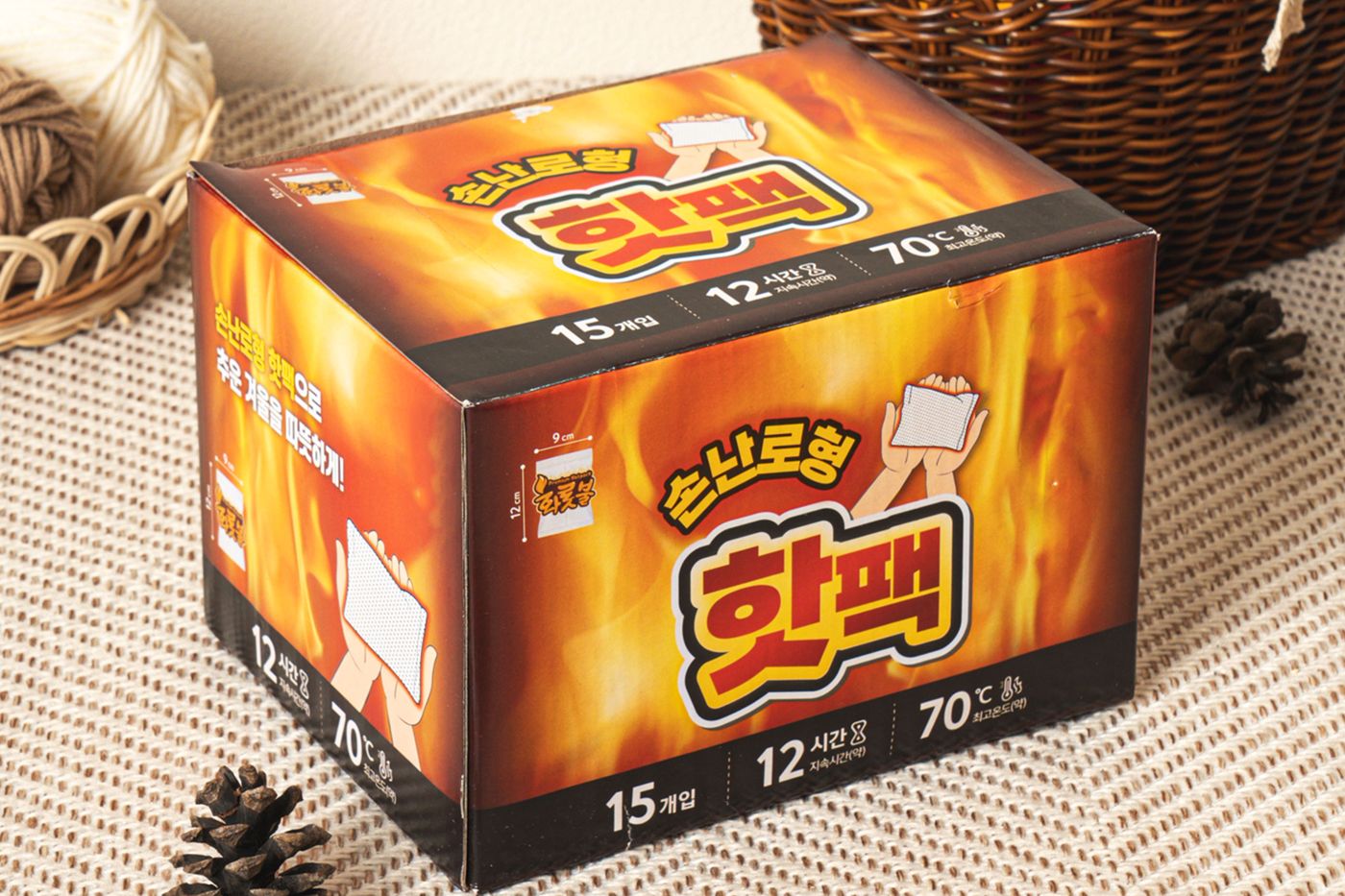
Korean Hot Packs (핫팩) This Winter: Korea's 70°C Legal Limit, What They Cost at Daiso, CU and GS25, and Which Ones You Can Fly With
Korea's safety standard caps a hot pack at 70°C, and a consumer-agency survey once caught two packs labelled 75°C. Daiso sells them from ₩1,000, stick-on packs stop at 63°C, and Korean airlines ban rechargeable warmers with built-in batteries.
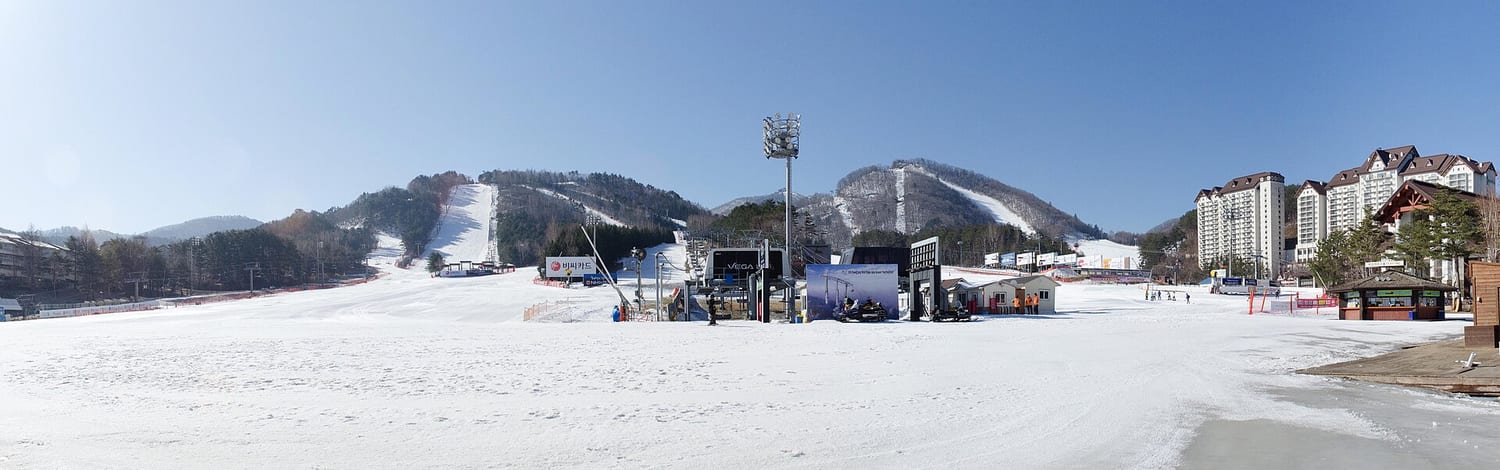
Korean Ski Resorts 2026–27: Season-Pass Prices, the Rounds Closing This Month, and Why Konjiam's English Page Says ₩42,000 When Its Korean Page Says ₩72,000
Konjiam's English page quotes ₩42,000 for a two-hour lift ticket. Its Korean page says ₩72,000 — and that there is no on-site ticket window at all. Verified 26/27 season-pass prices and round deadlines for Muju, Konjiam, X6+, Phoenix and Yongpyong.
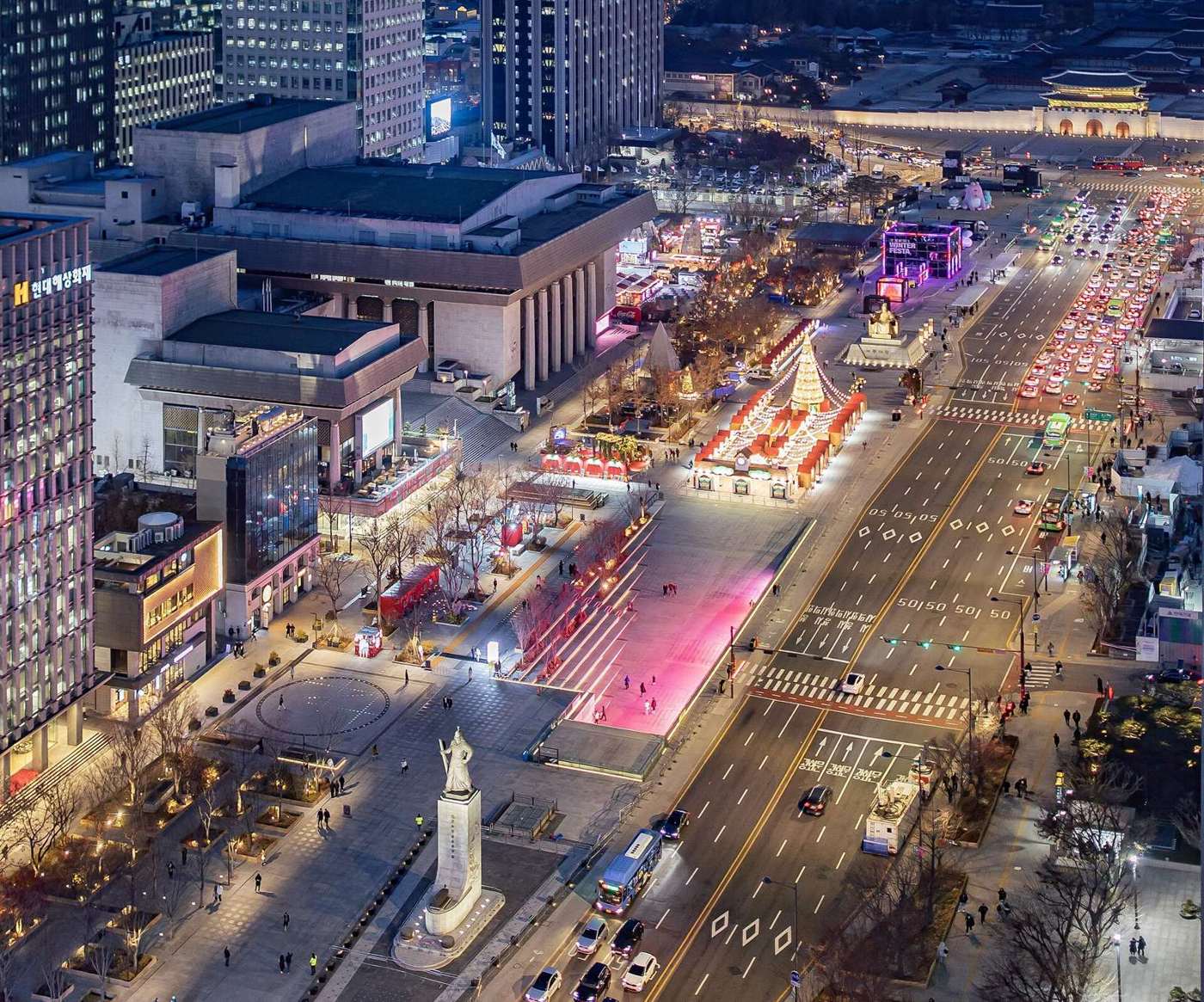
Seoul Winter Festa 2026 Dates Confirmed (14 December 2026 to 31 January 2027): Seoul Lantern Festival on Cheonggyecheon, Gwanghwamun Christmas Market Hours, the ₩1,000 Seoul Plaza Skating Rink, and New Year's Eve at Bosingak
Seoul's official calendar fixes Winter Festa 2026 at 14 December to 31 January, twice last year's run. What 2025 actually ran: lantern hours on Cheonggyecheon, the free Gwanghwamun market, the ₩1,000 skating rink, and the subway to 2 a.m. on New Year's Eve.