Why Is Fruit So Expensive in Korea? The Country That Has Never Imported an Apple, and How to Buy Fruit Anyway
Last updated: September 2026
Every foreigner who lives in Korea for more than a month has the same moment. It happens in a supermarket, in front of a single apple wrapped in a foam net with a price tag that says ₩5,000, or a watermelon at ₩30,000, or a box of twelve pears at ₩120,000 with a ribbon on it. The reaction is always the same: is that a mistake? It is not. In March 2024 the price-comparison site Numbeo put Korean apples at $6.82 a kilo, the most expensive in the world, ahead of the United States in fourth place and Japan in seventh. Korean bananas were the most expensive in the world. So were Korean oranges and Korean potatoes. The Bank of Korea, in its own report, found that Korean apples were the priciest in the OECD and that Korean food, clothing and housing cost 55 percent more than the OECD average once income is accounted for.
Koreans know this. They complain about it at every holiday, and every time they travel abroad they come back with photographs of foreign fruit stands the way other tourists photograph cathedrals. What they usually cannot tell you is why, because the answer is not one thing. It is a quarantine law that has kept every fresh apple and pear out of the country since 1948, a distribution chain that takes half of every won you spend, orchards the size of a suburban garden run by farmers in their seventies, a climate that is pushing apples north at a rate the maps cannot keep up with, and a gift culture that turns a fruit into a ₩120,000 object twice a year.
This post is the whole answer, and then the useful part: what Korean fruit actually costs at the market, the fridge and the department store, which fruits are cheap in which month, what the Shine Muscat crash means for you, and the three ways Koreans themselves buy fruit without paying the sticker price.
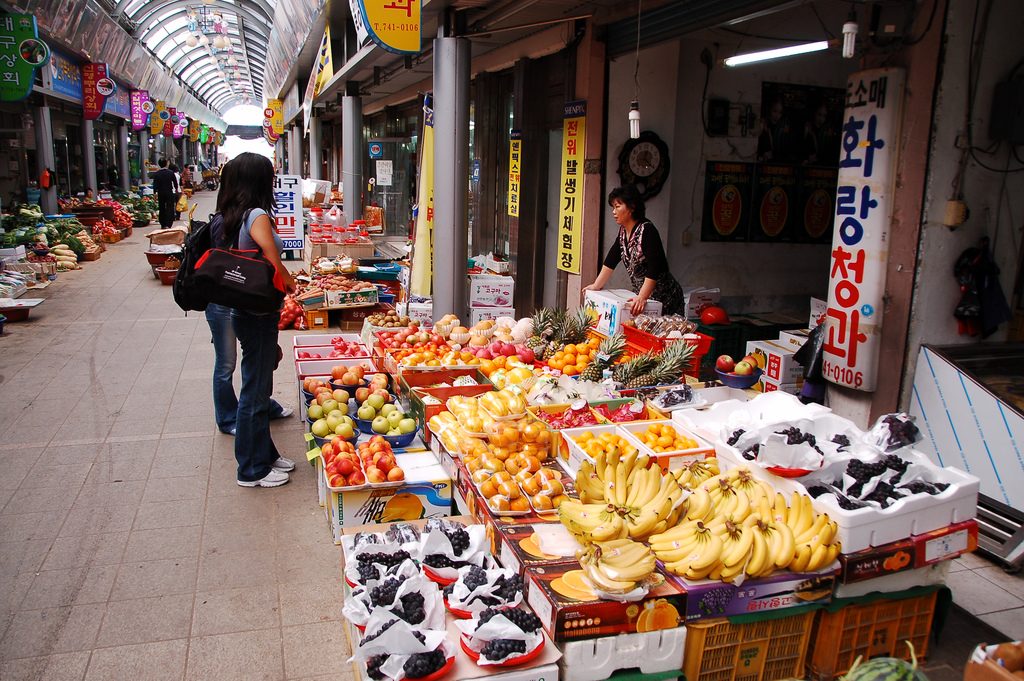
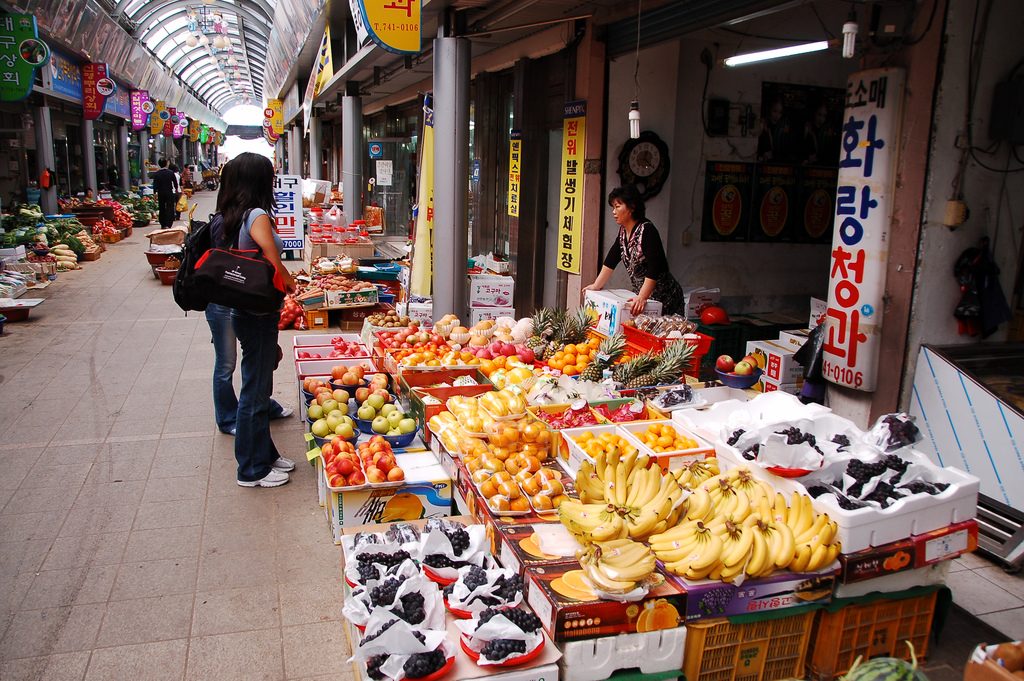
A fruit shop at Seongdong Market, Gyeongju. Traditional markets are where Koreans buy fruit when they want to pay 30 percent less than the supermarket. Photo: CC BY-SA 2.0, via Wikimedia Commons.
The Korean fruit that ships: Cheongdo dried-persimmon chews are the one Korean fruit you can buy on Amazon that tastes like the thing itself, from Cheongdo, the county Koreans associate with persimmons. As an Amazon Associate, EpicKor earns from qualifying purchases.
Watch the 6-minute episode: Why Fruits Are Expensive in Korea (and Why Korea Won't Import Apples) — the same story on screen: why one apple in a Seoul market can cost about ₩5,000, and why it is not a tourist price.
Quick Guide: what fruit costs in Korea, September 2026
| Fruit | Typical price now | Season | Notes |
|---|---|---|---|
| Apple (Fuji, 사과) | ₩2,000 to ₩3,500 each at a mart; wholesale ₩21,000 to ₩31,000 per 10 kg | October to November, stored all year | Was ₩5,000 each in March 2024. Never imported |
| Watermelon (수박) | ₩24,500 for a whole 8 kg melon (Aug 2026, down 25% on 2025) | June to August | Korea's favourite fruit since 2024. Never imported |
| Korean pear (배) | ₩3,000 to ₩5,000 each; gift boxes ₩50,000 to ₩120,000 | September to October | Huge, crisp, the size of a grapefruit. Never imported |
| Chamoe (참외, Korean melon) | ₩1,500 to ₩3,000 each | May to July | The fruit foreigners have never seen; most of the crop comes from one county, Seongju |
| Strawberries (딸기) | ₩8,000 to ₩15,000 per 500 g | December to April | A winter fruit in Korea, greenhouse-grown |
| Jeju mandarins (감귤) | ₩5,000 to ₩10,000 per kilo bag | November to February | The one genuinely cheap Korean fruit, in season |
| Shine Muscat (샤인머스캣) | ₩16,500 per 2 kg (down 41% on 2023) | August to October | The luxury grape that stopped being a luxury |
| Bananas (imported) | ₩3,000 to ₩4,500 a bunch | All year | Tariff cut to 0 to 5 percent since 2024; still the world's priciest |
Prices are September 2026 mart and market prices in Seoul from the Korea Rural Economic Institute, Garak Market and the Korea Consumer Agency's price service, and they swing hard with the weather. For the wider grocery picture, our August 2026 food-price post covers what else moved.
The year of the ₩5,000 apple
The reason this question is being asked in 2026 and not 2016 is a single fruit in a single year. In March 2024 Statistics Korea reported that apple prices were 88.2 percent higher than a year earlier, the biggest jump for any item in the index since 1980. A single Fuji apple was ₩5,000 at a supermarket and over ₩15,000 at a department store. The country gave it a name, geumsagwa, "gold apple," and it became the symbol of a cost-of-living election. Farm-gate wholesale prices, normally around ₩40,000 for a 10 kg box, were ₩84,646 in June 2024.
What had happened was weather. In 2023 the apple belt of North Gyeongsang, which grows 58 percent of the country's apples, had a March 3.6 degrees warmer than normal, so the trees flowered early, and then an April frost killed the blossom. Production fell 30 percent. In a normal market a 30 percent supply cut does not produce a 90 percent price rise; it did in Korea because there was nowhere else to get an apple. That is the sentence this whole post turns on, and it needs its own section.
Korea has never imported a fresh apple
Not one. Not a pear either, or a peach, or a watermelon. Since the founding of the republic in 1948, no fresh apple has legally entered South Korea, and the reason is not a tariff. It is plant quarantine.
To sell fresh fruit to Korea, an exporting country has to pass an eight-step import risk analysis run by the Ministry of Agriculture: application, initiation, preliminary risk assessment, pest-by-pest risk assessment, a risk-management plan, draft import conditions, public notice, and final publication. The Korean press calculates the average time to get through it at eight years, and for the fruits Koreans care about most it is much longer than that. Japan applied to export apples to Korea in 1992 and, as of 2025, is at step five. Germany is at step four. Belgium and Portugal are at step five for pears. New Zealand is at step four for peaches. Myanmar entered step one for watermelons recently. The ministry's position, stated plainly to reporters, is that no country is currently pushing hard to export apples to Korea, and that the process exists because a single imported pest can wipe out an industry: fire blight, which has been killing Korean apple and pear trees since 2015, is believed to have arrived on apple saplings smuggled in from the United States.
Jayone Honey Hallabong Tea — Jeju's hallabong citrus as a honey preserve, in a 2.2 lb jar Hallabong preserve stirred into hot water is how most Koreans meet Jeju's signature citrus outside the winter season, and it is the closest thing to a Korean fruit you can get delivered abroad. As an Amazon Associate, EpicKor earns from qualifying purchases at no extra cost to you.
See Hallabong tea on Amazon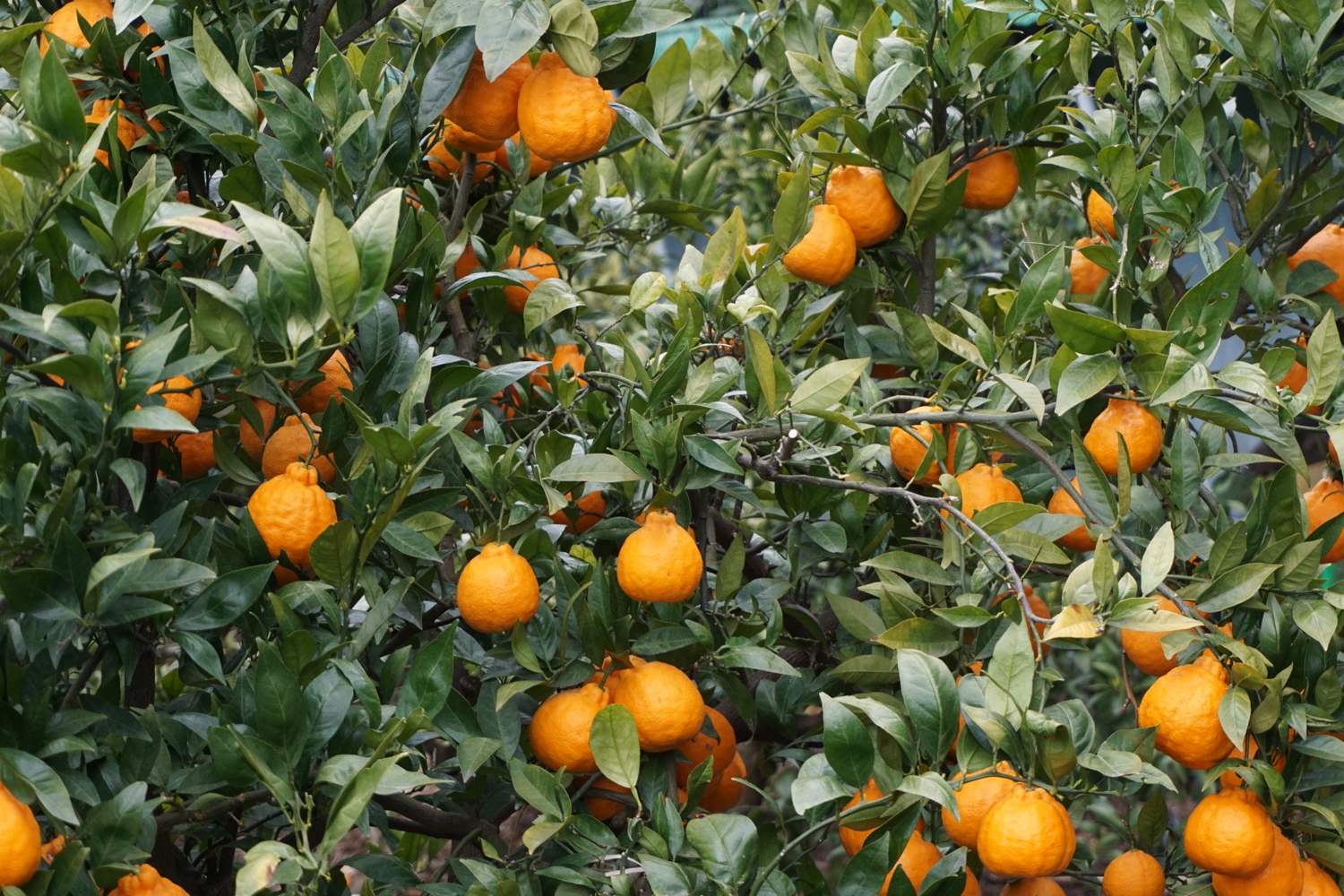
Hallabong on Jeju. Korea grows its own citrus and imports mandarins from only three countries; the apple has no import route at all. Photo: Matt Kieffer, CC BY-SA 2.0, via Wikimedia Commons.
What does get in is a short list. Mandarins from the United States, Japan and New Zealand. Persimmons from Japan and New Zealand. Grapes from the United States (not Texas or Hawaii), Japan and New Zealand. Mangoes from Taiwan, the Philippines, Thailand and Australia. Cherries, kiwis, bananas, pineapples, oranges and avocados from their usual sources. When the 2024 apple crisis hit, the government's response was to cut tariffs on the fruit it could import: bananas, pineapples, mangoes, grapefruit and avocados went from 30 percent duty to zero for the first half of 2024, oranges from 50 to 10 percent, and the cut was extended into 2025 at 5 percent. It did not touch apple prices, because you cannot substitute a banana for an apple at a Korean ancestral rite, and it left Korea's bananas the most expensive in the world anyway.
So the first answer to "why is fruit so expensive" is: for the fruits Koreans eat most, there is exactly one supplier, Korea, and when its harvest fails the price has no ceiling.
Where the money goes: half of every won is distribution
The second answer is the chain between the orchard and you. In 2024 the average distribution cost ratio for Korean farm produce was 49.2 percent, according to the government's own agricultural marketing study: of every ₩1,000 you spend, ₩492 pays for moving, sorting, auctioning, wholesaling and retailing, and ₩508 reaches the farmer. The retail stage alone takes 25.6 percent, wholesale 14.2, shipping 9.4. For mandarins the ratio is 58.1 percent. For some vegetables it passes 75 percent, and the newspaper that ran the figures found spring onions auctioned at ₩570 a kilo and sold to consumers the same day at ₩2,732.
The mechanism is Garak Market in south-east Seoul, the largest wholesale produce market in the country, through which most Korean fruit passes. Farmers or shippers consign to one of a handful of licensed wholesale corporations, which auction the fruit to licensed middlemen, who sell it on to supermarkets and market stalls. Each layer is legal, licensed and takes a cut, and the government has been promising to shorten it for twenty years; the current plan aims to cut distribution costs by 10 percent through an online wholesale market. The fruit shop in the photograph at the top of this post is three steps from the tree, and its prices show it.
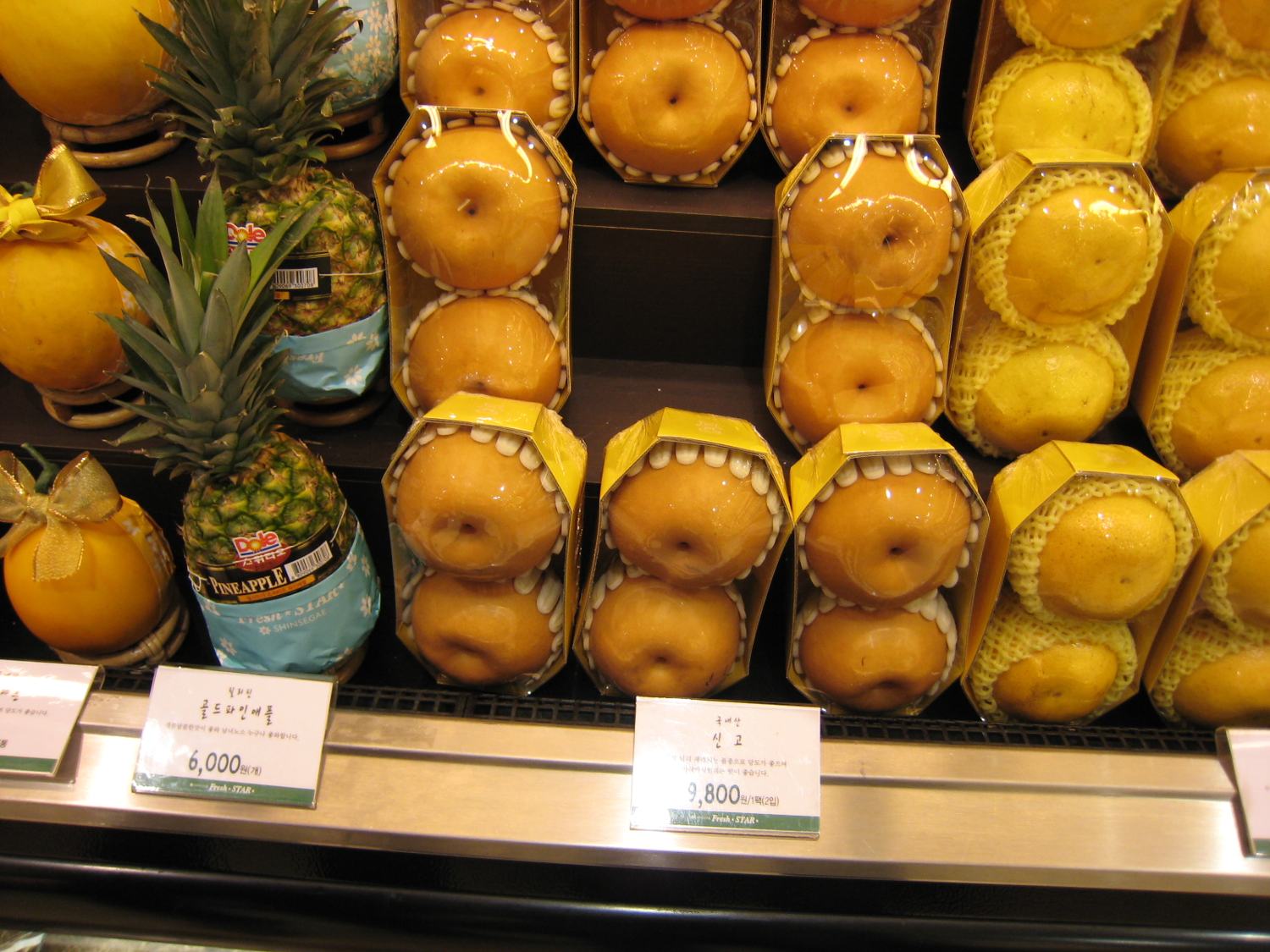
Singo pears in a Seoul department store, ₩9,800 for a pack of two (the ₩6,000 tag on the left is for a pineapple). This photograph is from 2007, which is the point: the price has always been the price. Photo: CC BY 2.0, via Wikimedia Commons.
Why the farms cannot grow more
The third answer is the farm. More than half of Korean apple farms, 52.9 percent, are under half a hectare, about the size of a football pitch, and another fifth are under one hectare. There is no Korean equivalent of a Washington State apple company with a thousand hectares and a packing line. Fruit farming is a family holding on a hillside, and the family is old: 64.2 percent of Korean fruit-farming households were headed by someone over 65 in 2024. Korea's total fruit acreage fell from 172,090 hectares in 2000 to 158,830 in 2022, and the six staple fruits, apples, pears, mandarins, persimmons, grapes and peaches, lost a quarter of their land and their output fell from 2.25 million tonnes to 1.91 million. Nobody young is taking over an orchard that small.
Then there is the climate. Korean apples have grown in North Gyeongsang for a century because the province had cold nights; it no longer reliably does. Gyeongbuk's apple output fell 25 percent in the ten years to 2025, while Gangwon, the mountainous province on the east coast that barely grew apples at all, went from 4,472 tonnes in 2015 to 22,699, a fivefold rise. The Rural Development Administration's projection is that by the 2050s only the Gangwon highlands will be suitable for apples, and by the 2070s only parts of them, while mandarins, now a Jeju monopoly, will grow on the mainland as far north as Gangwon. Add the March 2025 wildfires, which burned 3,386 hectares of Gyeongbuk orchards, a tenth of the national apple area, and you have an industry that cannot expand and is slowly moving house.
The people who stopped buying
All of this shows up in one number Koreans find genuinely sad. Per-capita fruit consumption peaked at 67.9 kilograms a year in 2007 and was 55.0 in 2022, a fall of 19 percent. For the six staple fruits it is worse: 47.7 kilograms in 2000, 34.9 in 2018. When the Korea Rural Economic Institute asks people why they do not eat more fruit, price is the first answer. And in 2024, for the first time in the institute's survey, the apple lost its place as Korea's favourite fruit, to the watermelon, 12.8 percent to 12.6; in 2019 the apple had 16.2 percent and was not close to losing. Among teenagers the apple is fourth, behind strawberries, watermelon and grapes. A country that has grown apples for a hundred years is raising a generation that thinks of them as expensive and old.
The Shine Muscat lesson
If you want to see the whole system in one fruit, look at the Shine Muscat, the seedless green grape that Korea imported from Japan as a variety in the mid-2010s and turned into a luxury. In 2019 the trade press called it "the Hermès of grapes," sold by the single bunch at department-store prices, and every grape farmer in the country saw the price and planted it. By 2024 it was 43 percent of Korea's grape acreage and 48 percent of the grapes passing through Garak Market. Supply did what supply does. The retail price of a 2 kilo box fell from ₩28,113 in September 2023 to ₩16,572 in September 2026, a 41 percent drop; the wholesale price per kilo fell 45 percent in three years; and because farmers rushed to pick before the holidays, the sugar content fell too, so the cheap Shine Muscat is also a worse one. North Gyeongsang now imposes a minimum of 16 Brix and a bunch weight of 400 to 1,000 grams to be allowed to ship under the province's name.
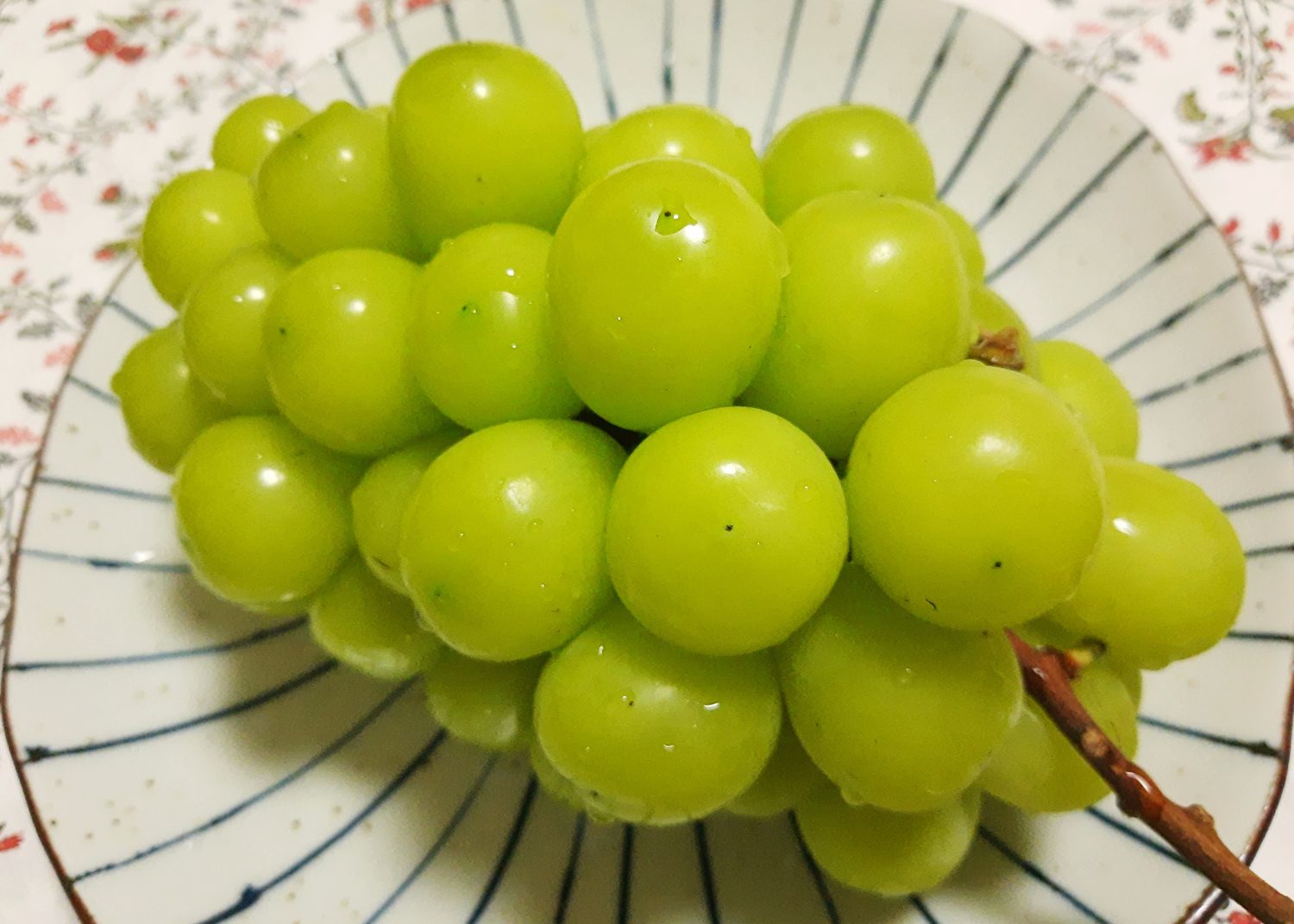
Shine Muscat: ₩30,000 a bunch in 2019, ₩16,500 for two kilos in 2026. The one Korean fruit whose price fell, and why. Photo: CC BY-SA 4.0, via Wikimedia Commons.
For a visitor this is simply good news: Shine Muscat is the best-value fruit in Korea in September and October, and the boom-and-bust is the reason. For Korean farmers it is a warning about the only tool they have. Because imports are closed and land is fixed, the one way to make money in Korean fruit is to find the next premium variety before everyone else does, and the market punishes everyone who arrives second.
The gift economy: why a fruit costs ₩120,000
The fourth answer is cultural, and it is the one the price tags cannot explain on their own. Twice a year, at Lunar New Year and at Chuseok in autumn, Koreans give fruit as gifts, and the gift is not a bag of fruit; it is a box. Twelve identical apples or pears, each the size of a fist, each in a foam net, in a padded box with a ribbon, sold at the department store for ₩120,000 to ₩130,000. In 2026 Lotte Department Store's apple-and-pear set was ₩124,000 and its apple-mango mixed set ₩132,000; the supermarkets sell certified sets at ₩30,000 to ₩50,000, and E-Mart's pre-contracted apple set was ₩49,800. The Korea Agro-Fisheries Trade Corporation's survey found fruit and beef to be the two most wanted Chuseok gifts and the average gift budget around ₩160,000.
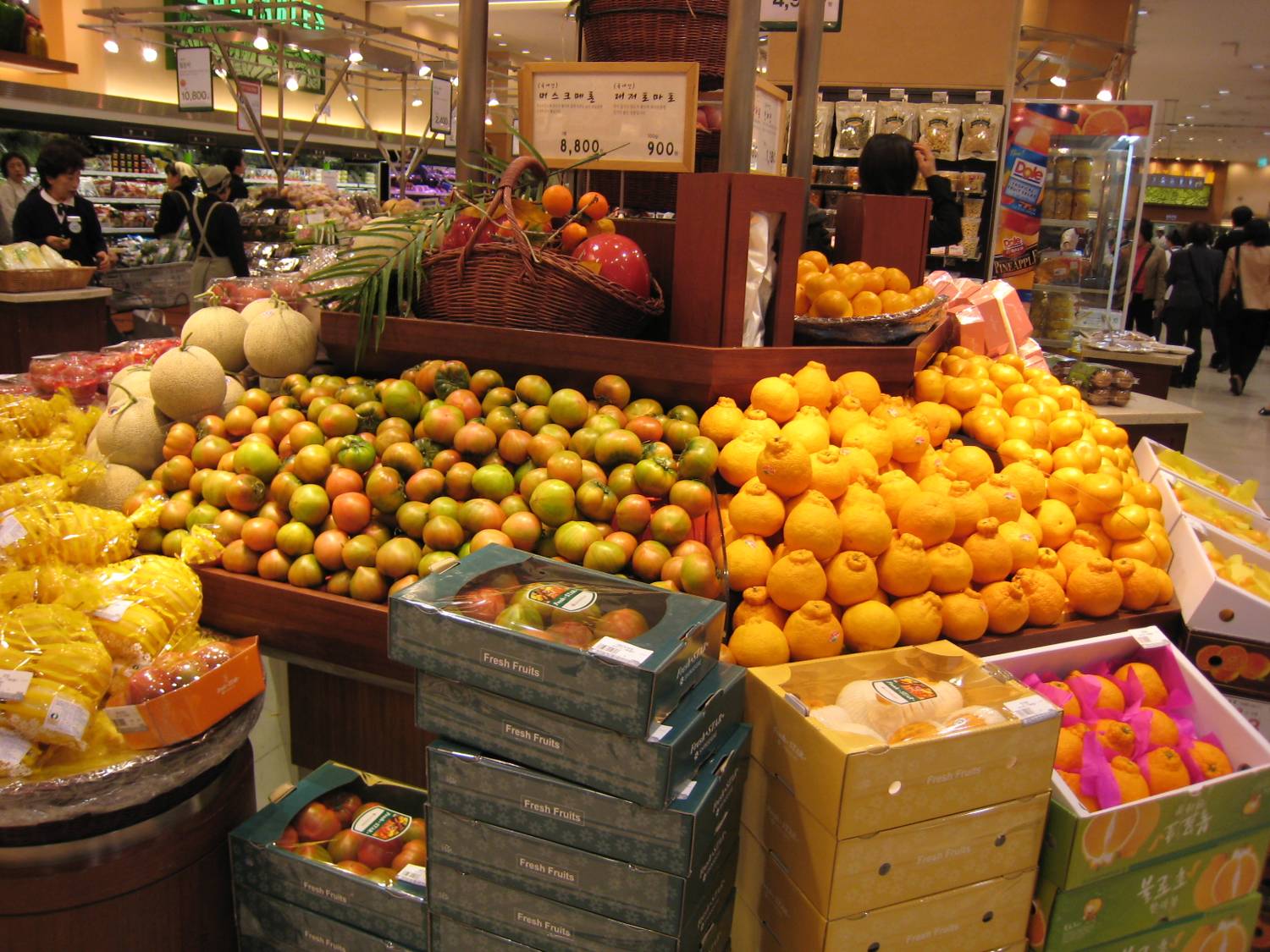
Fruit as an object: hallabong and boxed gift sets in a Seoul department store. The box is the product. Photo: CC BY 2.0, via Wikimedia Commons.
This matters for prices all year, not just at the holidays, because the gift market sets the top of the grading system. The biggest, most uniform, most blemish-free fruit goes into the boxes at the top price, and the pricing of everything below it is anchored to that. A Korean apple is not graded by taste; it is graded by whether it could go in a gift box. The same logic runs the ancestral rites, jesa, where the apples and pears on the table are chosen to be large and perfect, and it is why Chuseok is the one week a year when Korean fruit prices make the evening news.
The seasonal calendar, which is the actual money-saving trick
Korean fruit is expensive out of season and often reasonable in it, and the seasons are not the ones a Western shopper expects. The single most useful thing to know is that Korean strawberries are a winter fruit, greenhouse-grown from December to April, cheapest and best in January and February, and nearly absent in summer.
| Month | Buy this | Why |
|---|---|---|
| December to February | Jeju mandarins (감귤), strawberries (딸기) | Mandarins are the cheapest fruit in Korea by the kilo in winter; strawberries peak in January |
| March to April | Hallabong, cheonhyehyang (Jeju premium citrus), late strawberries | The pricier Jeju citrus comes in as the ordinary mandarins finish |
| May to July | Chamoe (참외), cherries, early watermelon | Chamoe is the fruit to try: yellow, crisp, faintly like a pear, about ₩2,000 each, nearly all from Seongju |
| July to August | Watermelon (수박), peaches (복숭아), plums | Whole watermelons drop below ₩25,000 in August; peaches are ₩1,800 each |
| September to October | Shine Muscat, Campbell grapes, Korean pears (배), figs | Grape prices collapse in September; pears are best just after Chuseok |
| October to November | Apples (사과), persimmons (감), dried persimmons (곶감) | New-crop Fuji arrives; the cheapest apples of the year are in November |
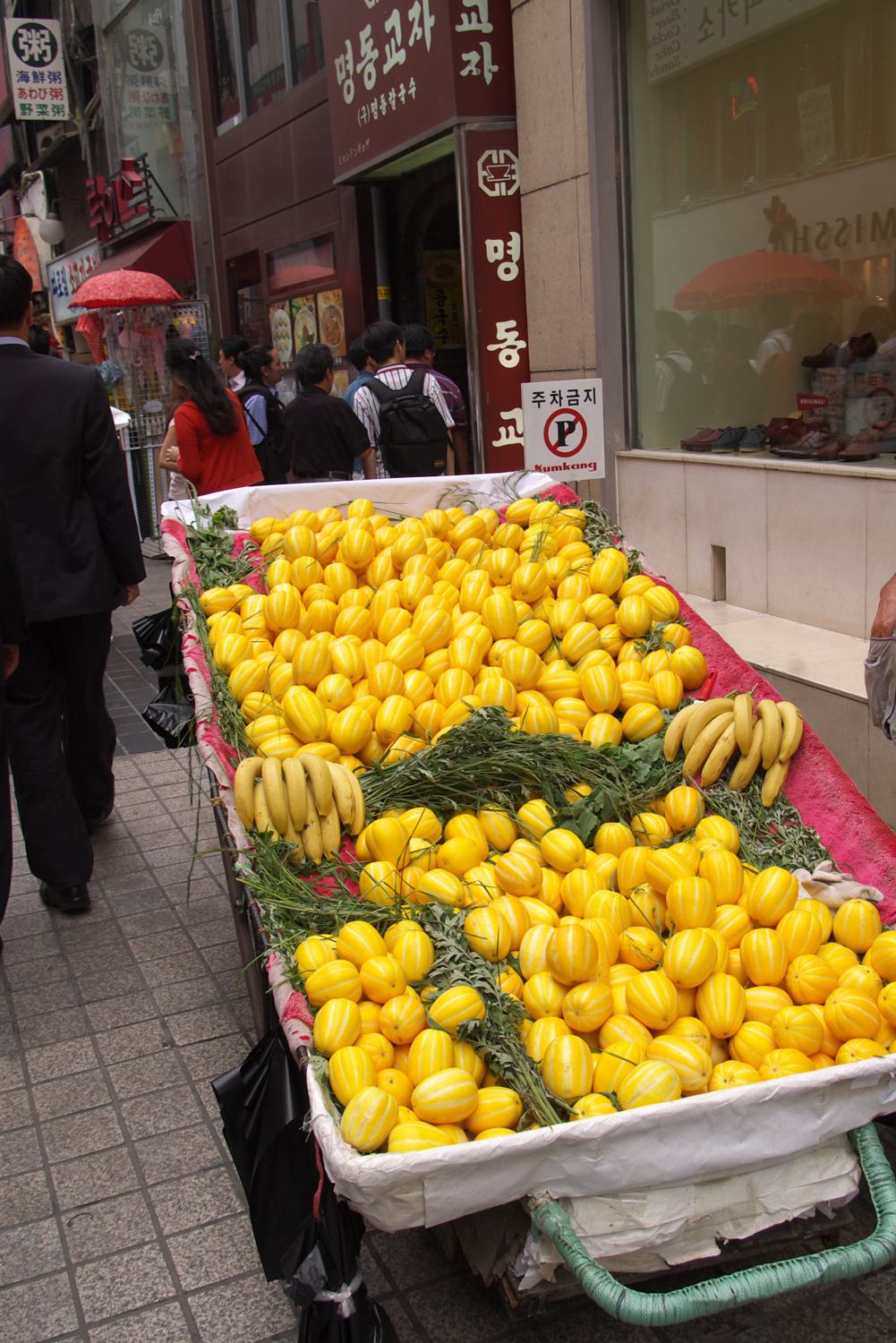
Chamoe from a street cart in Myeong-dong. Most of Korea's crop comes from one county, Seongju in North Gyeongsang, and almost none of it leaves the country. Photo: CC BY-SA 2.0, via Wikimedia Commons.
You might like: Korean Food Prices in August 2026: What Already Rose, and What Changes on the 25th
How Koreans actually buy fruit
Nobody in Korea pays the department-store price for everyday fruit. Three habits do the work.
The traditional market. A market stall is one or two steps closer to Garak than a supermarket and does not pay for foam nets, and fruit there runs 20 to 30 percent below the mart. Go late; the stalls discount what is left after 6 pm. In Seoul, Mangwon Market and Gyeongdong and the markets around it are where locals go, and Namdaemun has a fruit section that tourists walk past on their way to the socks.
B-grade fruit. Since the 2024 price shock, the supermarkets have started selling what the trade calls mot-nan-i, "ugly" fruit: slightly small, slightly blemished, the fruit that could never go in a gift box. Lotte Mart's ugly-fruit line sold 180 percent more in the first seven months of 2024 than the year before; Homeplus sells it at 30 percent off in 134 stores; and there is an app, Mot-nan-i Market, that ships it from the farm. It tastes the same. It was always going to.
The convenience store cup. Korea's answer to the ₩5,000 apple was to sell a fifth of one. Every CU and GS25 now has a chilled cup of cut fruit, apple, pineapple, watermelon or mixed, at ₩3,000 to ₩4,000, which is how a great many people in Seoul who live alone eat fruit at all. It is not cheap per kilo. It is cheap per decision.
And one honest note against buying: do not buy fruit in Korea in the two weeks before Chuseok or Lunar New Year unless you are buying a gift, because that is when the whole chain prices for the box. The week after each holiday is the cheapest fruit of the season, as the unsold sets come apart.
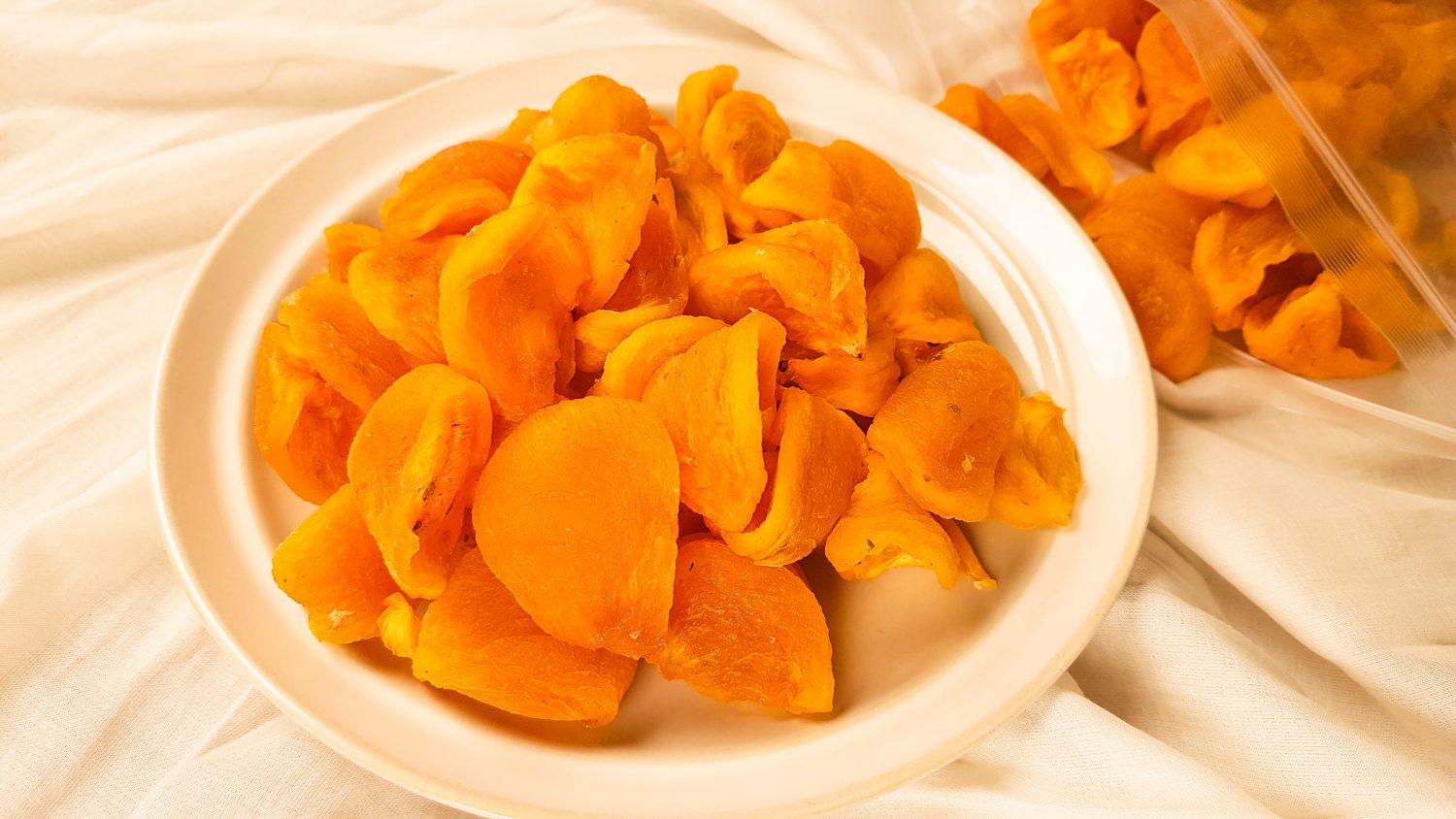
Gotgam, dried persimmons: the Korean fruit that keeps, and the one fruit gift a foreigner can take home. Photo: CC0, via Wikimedia Commons.
Damtuh Korean Honey Citron (Yuja) Tea — the winter fruit tea, in the standard jar Yuja is a Korean citron that is never eaten as a fruit, only sliced into honey and drunk as tea from November to February. This is the jar in every Korean office kitchen; a spoonful in hot water, or on toast. If you liked the citrus in Korea and cannot import it, this is what Koreans send abroad instead. As an Amazon Associate, EpicKor earns from qualifying purchases.
See Yuja tea on AmazonFAQ
Q: Why is fruit so expensive in Korea? Four reasons stacked on each other: Korea imports no fresh apples, pears, peaches or watermelons at all, so a bad harvest has no substitute; distribution takes 49 percent of the retail price; farms are tiny (half of apple farms are under half a hectare) and run by farmers over 65; and a gift culture grades all fruit against the ₩120,000 box. Bad weather in 2023 and wildfires in 2025 turned a structural problem into a headline.
Q: Has Korea really never imported an apple? Not a fresh one, since 1948. Apples, pears, peaches and watermelons have never cleared Korea's eight-step quarantine review. Japan has been applying to export apples since 1992 and is at step five. Processed apple products and juice are imported; whole fresh fruit is not.
Q: What is the cheapest fruit in Korea? In season, Jeju mandarins in winter, chamoe in early summer, watermelon in August and Shine Muscat in September. Bananas are the cheapest all-year fruit but still the priciest bananas in the world. Out of season, nothing is cheap.
Q: Where is fruit cheapest, the supermarket or the market? The traditional market, by 20 to 30 percent, and by more after 6 pm. Supermarket "ugly fruit" lines are 30 percent off the regular shelf. Department stores are for gifts.
Q: What Korean fruit should I try that I cannot get at home? Chamoe, the yellow Korean melon, in May to July. Singo pears in autumn. Jeju hallabong in March. Dried persimmons, gotgam, in November, which are also the only Korean fruit gift that survives a flight.
Bottom Line
Korean fruit is expensive because the country decided, for reasons of pest control and food sovereignty, to grow its own and let no one else in, and then let the farms get small and old and the middlemen multiply, and then built a gift culture on top that prices every apple against a ribboned box. None of that is changing soon. What you can change is when and where you buy: mandarins in January, chamoe in June, watermelon in August, grapes in September, apples in November, from a market stall after six, or from the ugly-fruit shelf. The ₩5,000 apple is real. So is the ₩1,500 one, three weeks later, at the stall down the street.
You might like: Korean Food Prices in August 2026 and Chuseok 2027 in Korea: 14–16 September.
Sources
- Numbeo price comparison as reported by the Korea Economic Daily, Munhwa Ilbo and Financial News (30-31 March 2024); Bank of Korea, "Characteristics of Korea's price level and implications" (2024).
- Statistics Korea, Consumer Price Trends, March 2024; Food Today on the KREI 2024 Food Consumption Behaviour Survey (23 June 2025); MBC and KBC on per-capita fruit consumption (March 2024).
- Business Watch, "Why there are no imported apples or watermelons" (14 June 2025); Korea Economic Daily and Economy Chosun on apple quarantine (2024); Asia Economic Daily and Kookmin Ilbo on the 2024-2025 fruit tariff quotas.
- News2day on the 2024 distribution-cost ratio (6 August 2026); Ministry of Agriculture, "Agricultural distribution structure improvement plan" (15 September 2025).
- Statistics Korea 2025 cultivation area survey; Kyunghyang Shinmun and Herald Economy on fruit-farm ageing (2026); Daum/Yonhap on apple production moving north (12 November 2025); Rural Development Administration climate projections via E2 News.
- Korea Economic Daily on the Shine Muscat price collapse (2 September 2026); Farmers' Newspaper on acreage and quality (3 November 2025); Financial News and Yonhap on August 2026 watermelon and peach prices; Garak Market price data.
- Shinsegae, Lotte and Emart 2026 Chuseok gift-set listings; Asia Economic Daily on gift-set prices (September 2025); Edaily on B-grade fruit sales (2024).
You Might Also Like
Korean Bathhouse Prices: What a Mogyoktang Costs in Every Region
A Korean neighbourhood bathhouse (mogyoktang) now costs ₩11,000 in Seoul, the highest in Korea, and ₩8,100 in Gwangju. Government prices for September 2026 by region, what the ticket covers, scrub prices, the age-4 rule and how to use one.
Gisa Sikdang in Seoul: Where Korean Taxi Drivers Eat, What to Order and What It Costs
Seoul's taxi-driver diners aren't cheap any more: the pork bulbaek Yeonnam-dong's 24-hour Gamnamujip sold for ₩9,000 in 2019 is listed at ₩13,000 now. Where gisa sikdang still cluster, what to order, and how they work.
Korean Lottery for Foreigners: Lotto Price, Toto Prizes, Tax, and the Casino Rule That Flips for Tourists
Yes, a foreigner can buy and win Korea's Lotto: at least 25 have taken first prize. ₩1,000 a game, a 22 to 33 percent tax, first prize paid only at NH Bank in Seoul, how Sports Toto prizes are split, and why casinos admit you but not Koreans.