Korean Food Prices in August 2026: What Already Rose, and What Changes on the 25th
There is a line Korean newspapers have been running all year: 편의점에서 1,000원으로 살 게 없다 — there is nothing left you can buy for ₩1,000 at a convenience store. As of August 2026 that is simply true, and four major food makers have raised prices within three weeks of each other to make it truer.
Most English guides to Korea quote a price and leave it there. This one gives you the dates. One of these increases has not happened yet — Paris Baguette's lands on 25 August 2026 — which means for a few more days there is something you can actually do about it.
The Short Answer
| Company | What is affected | When | How much |
|---|---|---|---|
| 풀무원 (Pulmuone) | 30 items across 7 product groups | 13 August 2026 — done | avg 6.7% |
| 농심 (Nongshim) | Major cup noodles and snacks | August 2026 — done | 6% cup noodles, 5.5% snacks |
| 파리바게뜨 (Paris Baguette) | 127 items: 86 breads, 41 cakes and desserts | 25 August 2026 — upcoming | avg 5.0% |
| 삼립 (Samlip) | About 50 breads | September 2026 | about 9% |
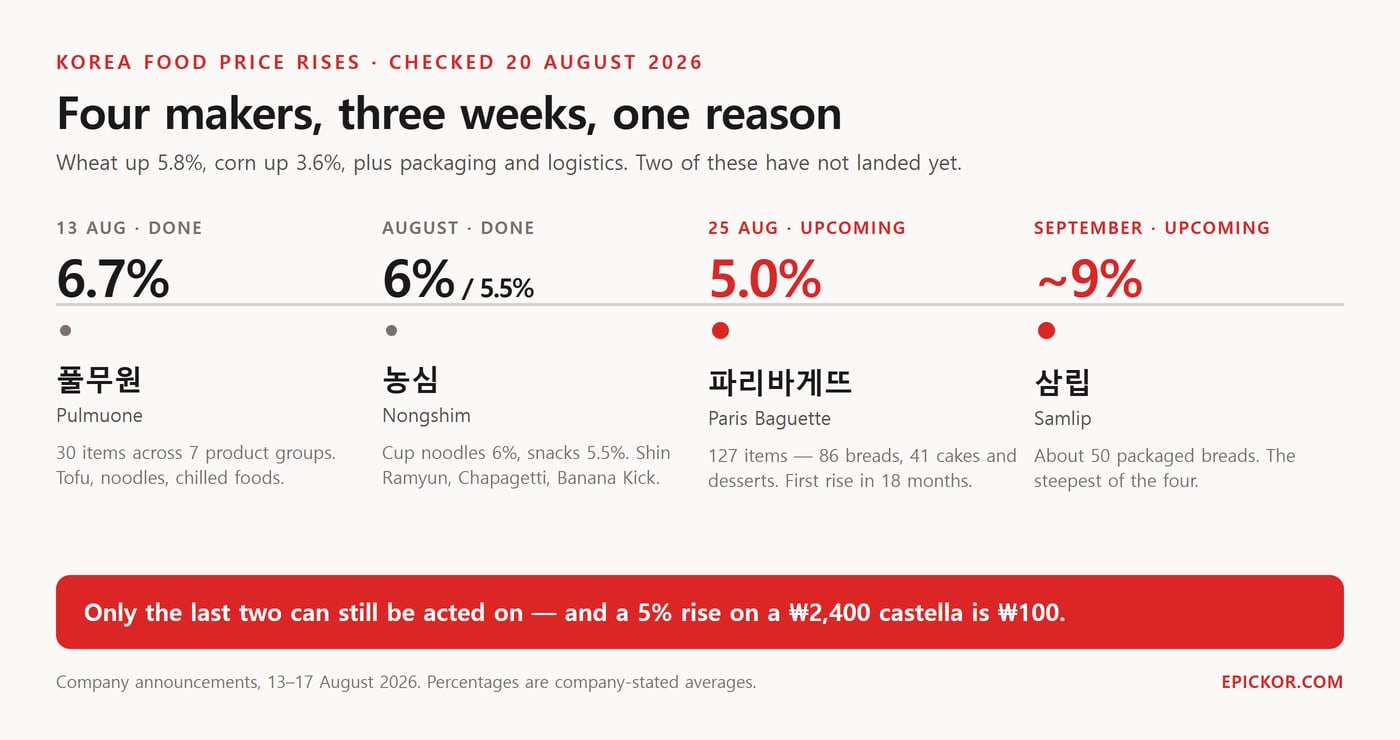
The single most useful line in that table: Samlip's roughly 9% is the largest of the four, and it has not landed yet either.
What Has Already Happened
농심 (Nongshim) moved first, raising major cup noodle lines by an average of 6% and snacks by 5.5% during August. Nongshim is the company behind Shin Ramyun, Chapagetti and Banana Kick, so this is the increase most likely to touch something you were going to buy anyway.
If you want the longer version of what happened to Korean instant noodles specifically, EpicKor's guide to why a packet of Korean ramyun now costs ₩1,900 covers the premiumisation story that set the stage for this.
풀무원 (Pulmuone) raised 30 items across 7 product groups by an average of 6.7% on 13 August. Pulmuone is a tofu, noodle and chilled-foods company rather than a snack brand, so this one shows up in a supermarket basket rather than at a convenience store counter.
You might like: Gooun Gamja: What Korea's Baked Potato Snack Is Actually Made Of
You might like: Hetbahn: What Korea's Instant Rice Is Made Of, and How to Heat It Without a Microwave
You might like: Korean McDonald's: Why the Burgers Are Named After Farm Counties, and What to Order Now
What Changes on 25 August
파리바게뜨 (Paris Baguette) announced on 14 August that it would raise 127 products by an average of 5.0% starting 25 August 2026 — 86 breads plus 41 cakes and desserts. It is the chain's first increase in a year and six months, the last one having been in February 2025.
The company published example figures, which is unusually specific and worth reproducing exactly:
| Item | Korean | Before | From 25 Aug | Change |
|---|---|---|---|---|
| Sangmijong sourdough loaf | 상미종 생식빵 | ₩3,900 | ₩4,100 | +5.1% |
| Castella | 카스테라 | ₩2,400 | ₩2,500 | +4.2% |
| My Number One cake | 마이 넘버원 케이크 | ₩35,000 | ₩36,000 | +2.9% |
Paris Baguette is the most visible bakery chain in Korea and one of the first Korean food brands most visitors interact with, usually at an airport or a station. If a bakery run is on your list and you are in Korea before the 25th, that is the window.
삼립 (Samlip) follows in September, raising about 50 breads by roughly 9% — the steepest of the four increases. Samlip is the packaged-bread company whose products sit on convenience store shelves rather than in a bakery, so this is the one that changes the price of a bread you grab on the way somewhere.
Why All Four at Once
The companies gave the same reasons, and the underlying numbers are public: international wheat prices are up 5.8% and corn 3.6%, on top of higher packaging and logistics costs.
That combination explains the pattern in the table. Bread makers move first and hardest because wheat is most of the input cost — hence Samlip's 9% and Paris Baguette's 127 items. Snack makers move less because a bag of crisps is more air, seasoning and packaging than grain.
The outlook is the part worth internalising if you are planning a trip. Korean industry coverage expects cost pressure to persist into the first half of 2027, because packaging prices lag the raw-material market on the way back down even when conditions ease. In other words, this is not a one-month blip you can simply wait out.
Why Korean Price Rises Arrive in Waves
Here is the part that does not translate, and it is the reason four companies moved within three weeks of each other rather than at four unrelated moments.
Paris Baguette's own stated reason for this increase is worth reading closely. The company explained it as readjusting prices it had previously lowered in order to align with the government's price-stability stance after flour costs fell. That sentence describes a mechanism most visitors have never heard of.
Korean food prices are not set purely by the market. When consumer prices become politically sensitive, the government applies informal pressure on major food manufacturers to hold or roll back increases, and the companies generally comply — publicly, and framed as participation rather than compliance. It is not price control in the legal sense. There is no statute being enforced. But the effect is real, and Korean consumers understand the ritual perfectly well.
The consequence is that suppressed increases do not disappear, they queue. Cost pressure builds while prices are held flat, and when the political weather changes, the backlog releases at once. That is why Korean food price news arrives as a cluster of announcements in the same fortnight rather than as a steady drift, and why a Korean reader seeing four companies move in August 2026 reads it as one event rather than four coincidences.
For a visitor, the practical implication is counter-intuitive: a long flat stretch in Korean food prices is not evidence of stability. It may be evidence of a queue. Prices you find quoted from a quiet period can be further from current reality than the length of the gap suggests.
Worth checking before you assume Korea is cheaper: As an Amazon Associate, EpicKor earns from qualifying purchases at no extra cost to you. For the shelf-stable items — ramyun multipacks, snack boxes, gim — it is worth comparing the import price against what you would actually pay in a Korean convenience store now, because the gap has narrowed.
Compare Korean pantry items on AmazonWhat a Korean Snack Actually Costs Now
Prices below are the current convenience store shelf as of August 2026. They are what these increases are landing on top of.
₩1,700 is the standard bag tier. That is what you pay for most of the famous ones: 꼬깔콘 (Kkokkalcorn), 포카칩 (Poca Chip), 꼬북칩 (Turtle Chips), 빠다코코낫, 꽃게랑, 먹태깡, 바나나킥 (Banana Kick), 양파링 and 에이스.
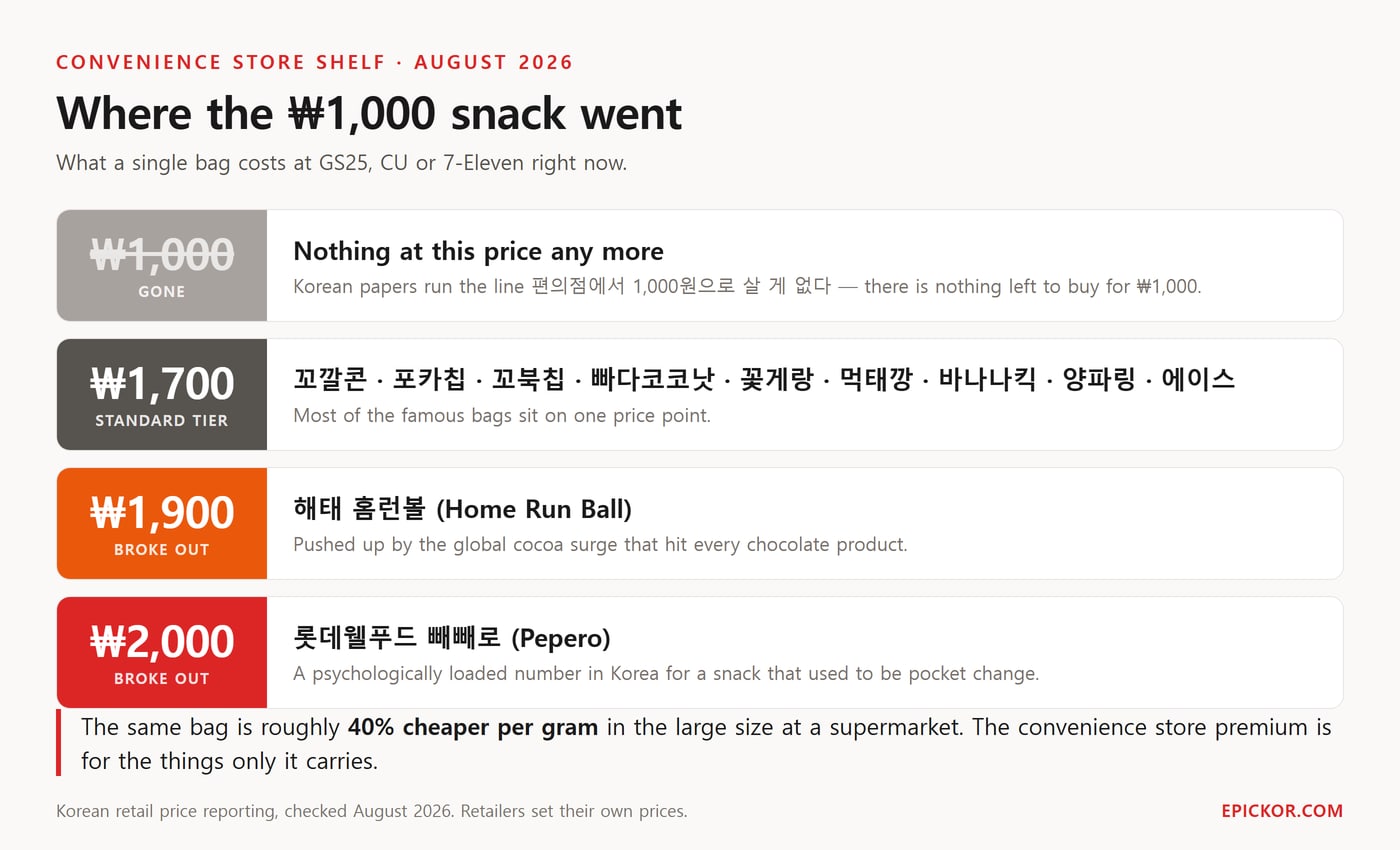
Two have already broken out of it:
- 해태 홈런볼 (Haitai Home Run Ball) is now ₩1,900, pushed up by the cocoa price surge that hit every chocolate-containing product worldwide.
- 롯데웰푸드 빼빼로 (Pepero) has reached ₩2,000 — a psychologically loaded number in Korea for a snack that used to be pocket change.
For the full picture of what else sits on that shelf and what Koreans think is worth the money, see EpicKor's Korean convenience store food guide. For a current example of the exclusivity pricing that runs alongside all this, the Kkokkalcorn chain-exclusive flavours show what the convenience store premium buys you.
You might like: Korean Seaweed Snacks: Gim Is Called the Black Semiconductor, and the Price Doubled
You might like: Why Is Fruit So Expensive in Korea? The Country That Has Never Imported an Apple, and How to Buy Fruit Anyway
What This Actually Means If You Are Visiting
Here is the honest version, because it cuts both ways.
In absolute terms, none of this is much. A 5% rise on a ₩2,400 castella is ₩100. A 6% rise on a cup noodle is roughly ₩100 to ₩150. If you are on a two-week trip, the entire set of August 2026 increases will cost you the price of one coffee across the whole holiday. Anyone telling you Korea has become expensive because of this month is selling you something.
What it does change is the mental model. Korea's reputation among travellers is built on a decade-old idea that convenience store food is trivially cheap. That is now half true. A convenience store meal is still good value against a restaurant, but it is no longer automatically the cheapest hot food available, and the ₩1,000 snack has effectively disappeared.
And it changes where you buy. Because the increases hit branded packaged goods hardest, the gap between a convenience store and a supermarket has widened. On the same product, buying the large bag at an E-Mart or Lotte Mart instead of the 67g bag at a GS25 can be 40% cheaper per gram. That was always true; it is now worth acting on.
What a day of convenience store eating costs now
If you want the number rather than the percentages, here is what a full day of convenience store food comes to at August 2026 prices:
| Meal | Typical choice | Price |
|---|---|---|
| Breakfast | 삼각김밥 (triangle gimbap) + 바나나맛 우유 | about ₩3,000 |
| Lunch | 도시락 (lunch box), standard line | ₩4,500–6,700 |
| Afternoon | one ₩1,700 snack bag + coffee | about ₩3,000 |
| Dinner | 컵라면 (cup noodle) + 김밥 | about ₩4,000 |
That is roughly ₩14,000 to ₩17,000 a day, or about the price of one mid-range restaurant dinner. The comparison is the useful part: convenience store food has not stopped being good value against eating out. It has stopped being the near-free option that a lot of older travel writing still describes, and this month's increases push it a little further in that direction.
If you want the detail on which lunch boxes are worth the money and the two pieces of Korean slang locals use to judge them, that is all in the convenience store food guide.
Three practical moves:
- If you want a Paris Baguette haul, go before 25 August. After that the same basket is 5% more.
- Buy snacks by the large bag at a supermarket, and use convenience stores for the things only they carry.
- Do not stockpile against September. A 9% rise on a ₩1,500 bread is ₩135. It is not worth reorganising a trip around.
Building a Korean pantry at home instead? As an Amazon Associate, EpicKor earns from qualifying purchases at no extra cost to you. A mixed snack box is the cheapest way to work out which Korean brands you actually want before committing to a case of any one of them.
Compare snack boxes on AmazonYou might like: Korean Snack Prices From 1 October 2026: Haitai Raises 25 Brands by 7.8%, and 14 Packs Shrink Instead
FAQ About Korean Food Prices in 2026
Q: How much did Korean food prices go up in August 2026?
A: It depends on the company. Pulmuone raised 30 items by an average of 6.7% on 13 August, Nongshim raised cup noodles 6% and snacks 5.5% during the month, Paris Baguette raises 127 items by an average of 5.0% on 25 August, and Samlip raises about 50 breads by roughly 9% in September. There was no single across-the-board increase — four separate company decisions landed within weeks of each other.
Q: Why are Korean food prices rising?
A: International wheat prices are up 5.8% and corn 3.6%, and packaging and logistics costs have risen alongside them. Bread makers are affected most because grain is the bulk of their input cost, which is why Samlip's roughly 9% is the largest of the four.
Q: Is it still cheap to eat at a Korean convenience store?
A: Cheaper than a restaurant, yes. Trivially cheap, no longer. The ₩1,000 item has effectively disappeared, a standard snack bag is ₩1,700, and a convenience store lunch box now commonly sits around ₩6,000. It remains good value; it has stopped being the automatic cheapest option.
Q: Should I buy Korean groceries before the price increases?
A: Only for the Paris Baguette increase on 25 August, and only if you were going anyway. The absolute amounts are small — ₩100 to ₩200 on most items — so this is worth a few minutes of timing, not a change of plans.
Q: Will Korean food prices keep rising in 2027?
A: Korean industry coverage expects cost pressure to continue into the first half of 2027, because packaging costs come down more slowly than raw material prices even when the underlying market eases. Treat any price you read about Korea, including the ones on this page, as needing a date attached.
The Bottom Line
Four companies, three weeks, one shared reason. The two increases that have not happened yet — Paris Baguette on 25 August and Samlip in September — are the only ones you can still act on, and only one of them is worth acting on at all.
The larger point is the one worth carrying: prices in Korea now need a date next to them. A figure from a travel guide written two years ago is not slightly out of date, it is wrong. Every price on EpicKor carries the month it was checked, and this is why.
Sources checked: Money Today, 17 August 2026, on the combined increases and the grain and packaging cost drivers; Newspim, Financial News, Hankyung and Herald Business, 14 August 2026, on the Paris Baguette 127-item increase, its effective date and its published example prices; Korean retail price reporting for the current convenience store snack tier. All prices checked August 2026 and set by individual retailers.
You Might Also Like
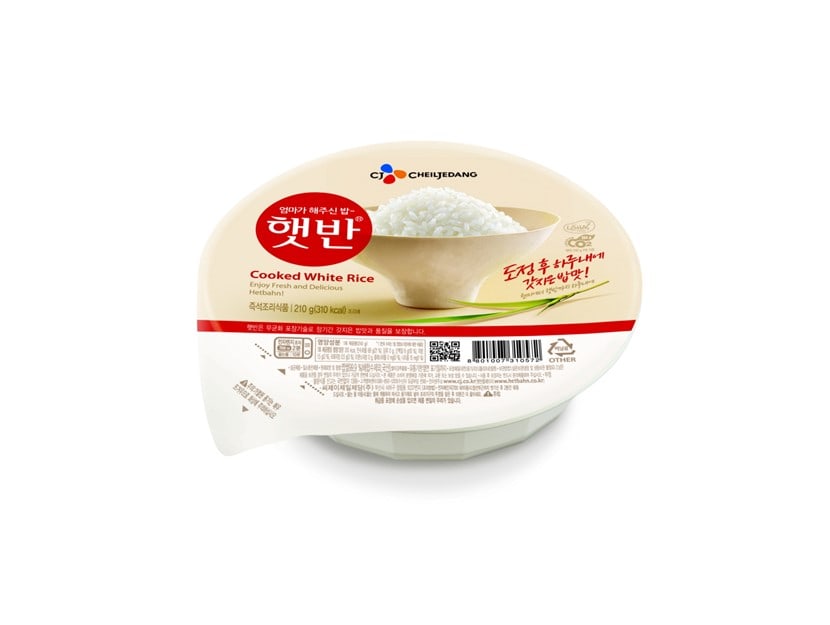
Hetbahn: What Korea's Instant Rice Is Made Of, and How to Heat It Without a Microwave
햇반 is 99.9% Korean rice and water plus 0.1% rice bran extract, sealed in a room cleaner than a hospital ward. The lid prints three cooking times and one of them needs no microwave at all. Prices, varieties, and the mistake almost everyone makes with the film.
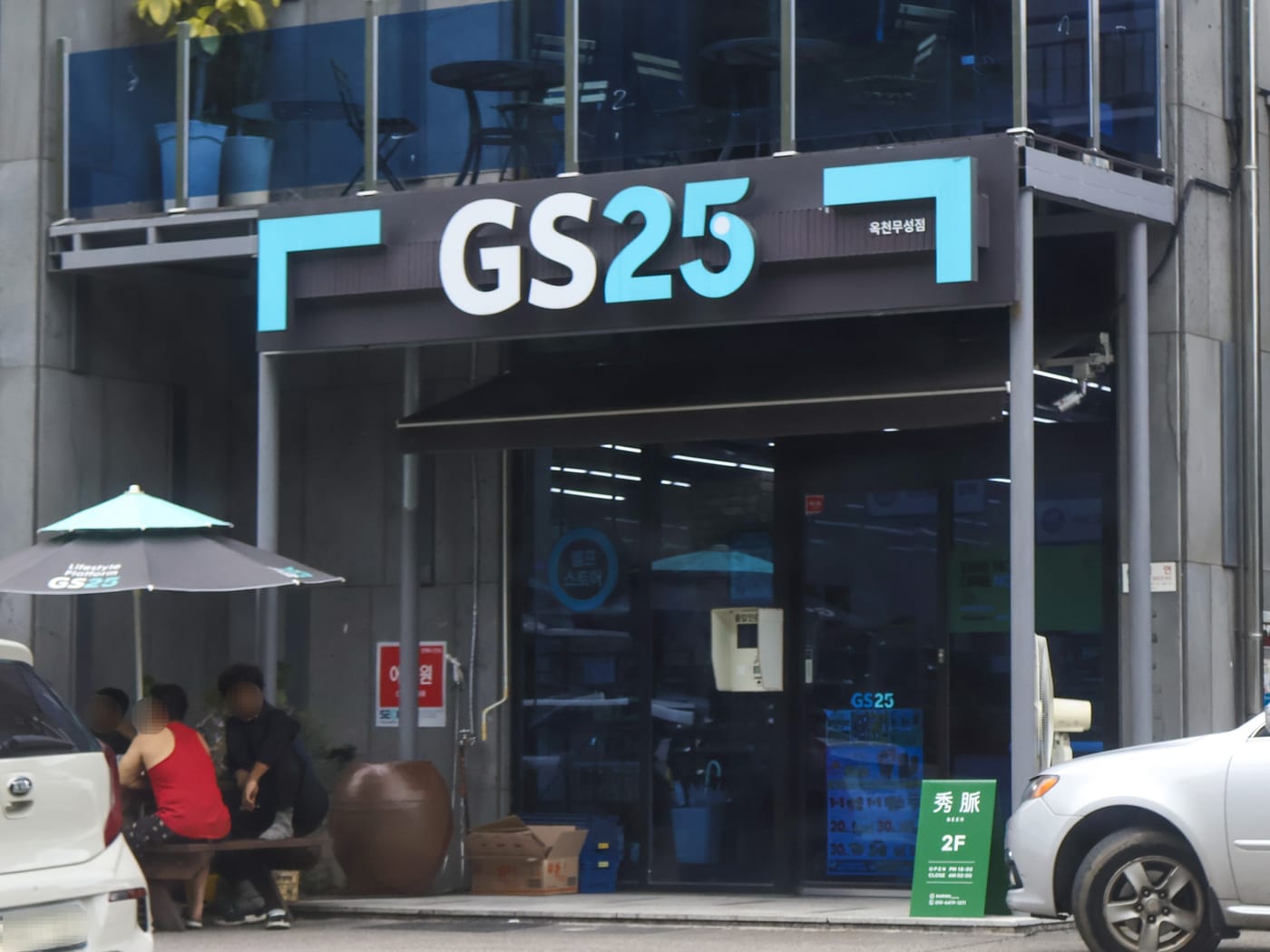
Kkokkalcorn: Korea's Cone Snack, and Why Each Convenience Store Has a Different Flavor
Lotte split one snack across three convenience store chains on purpose, and Koreans started touring stores to collect all four flavors. Which chain has which, what 꼬깔콘 costs in August 2026, and why the convenience store is the worst value per gram.
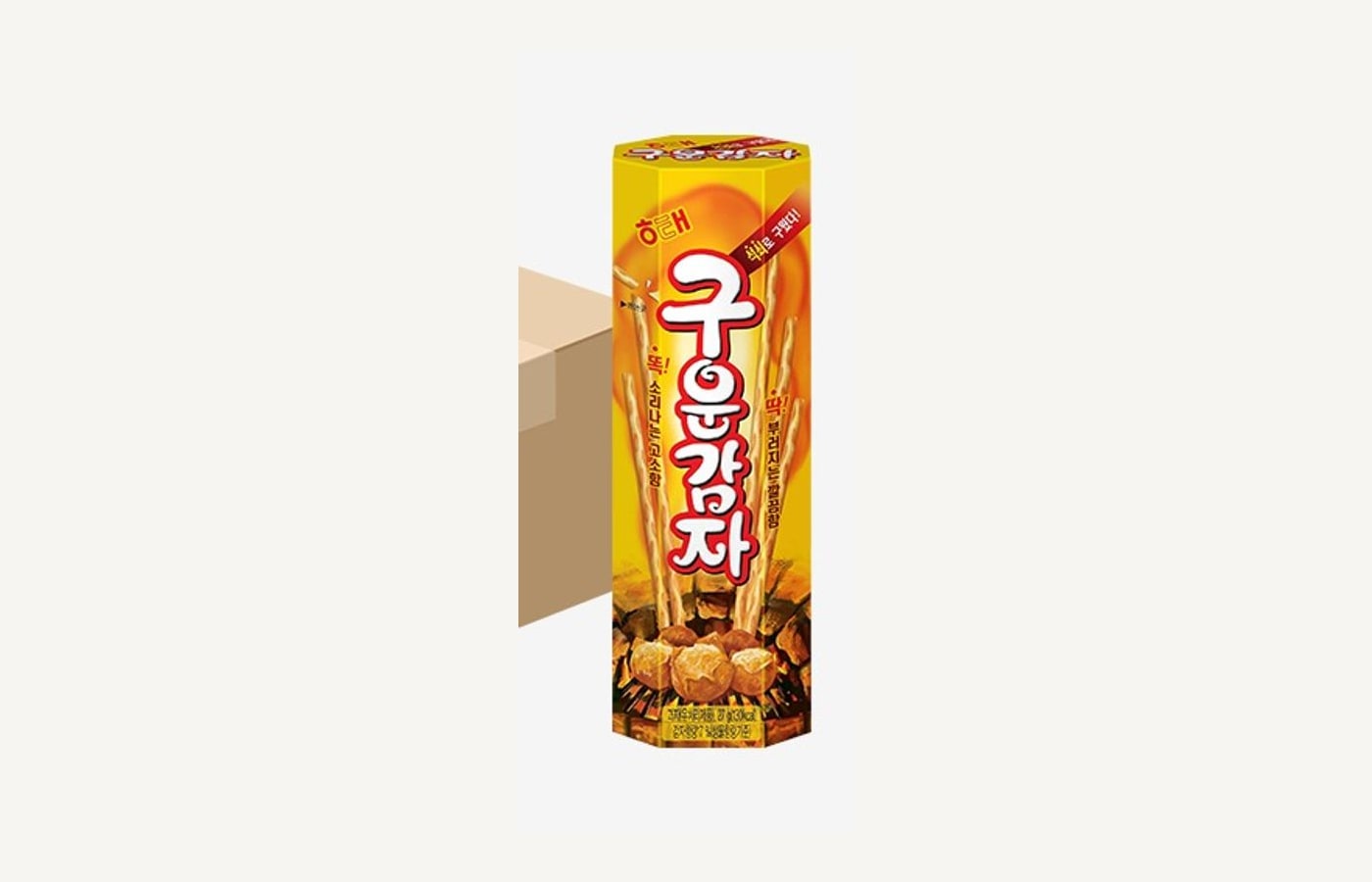
Gooun Gamja: What Korea's Baked Potato Snack Is Actually Made Of
구운감자 means baked potato and the label says 32.6% potato starch, 5.2% dried potato powder, palm oil and margarine. Haitai has been extending the word 구운 since 1997 — through sweet potato, corn and soy milk. Here is what baked buys you.