Mangwon-dong, Seoul: The Market Neighbourhood Locals Go To Instead of Hongdae
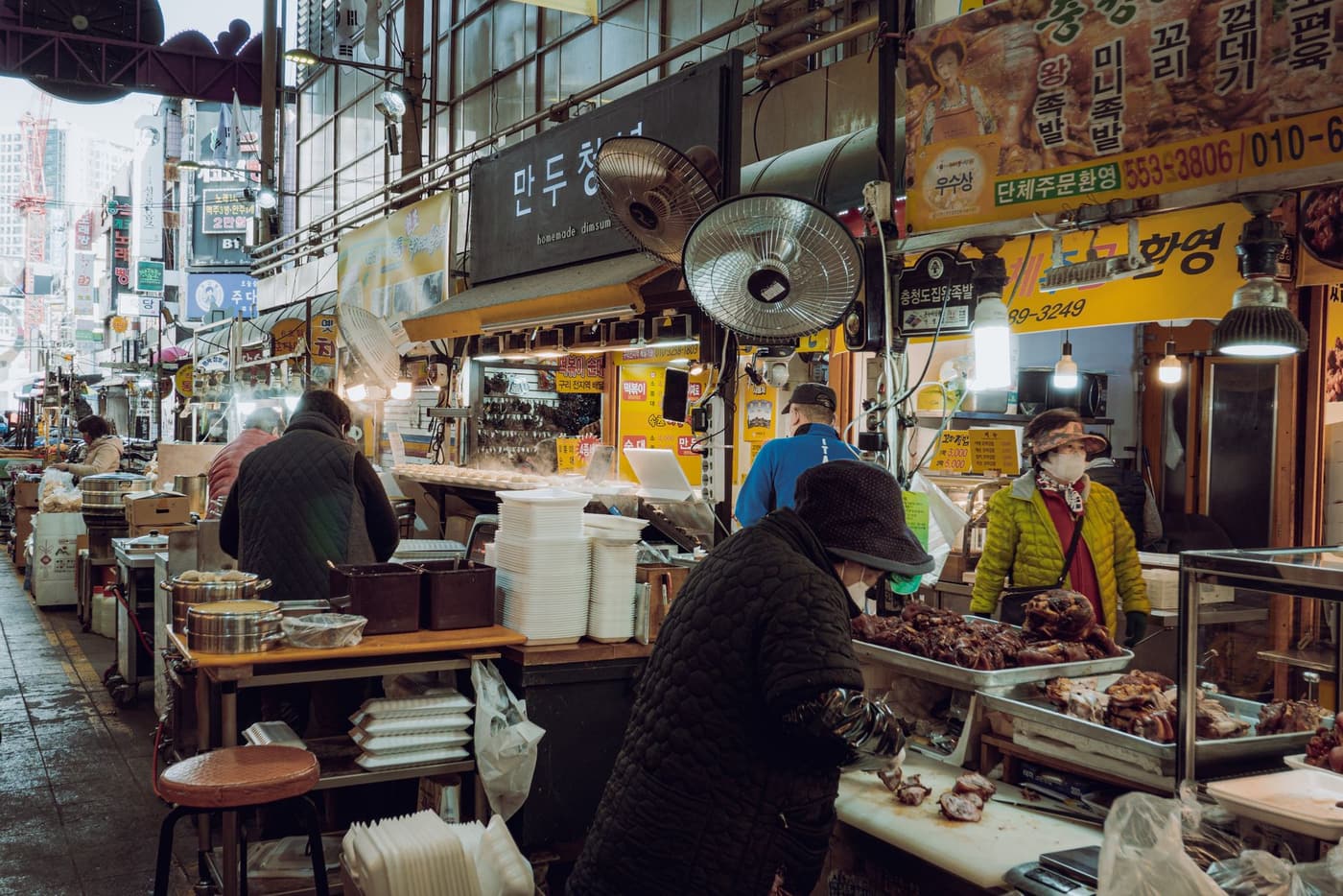
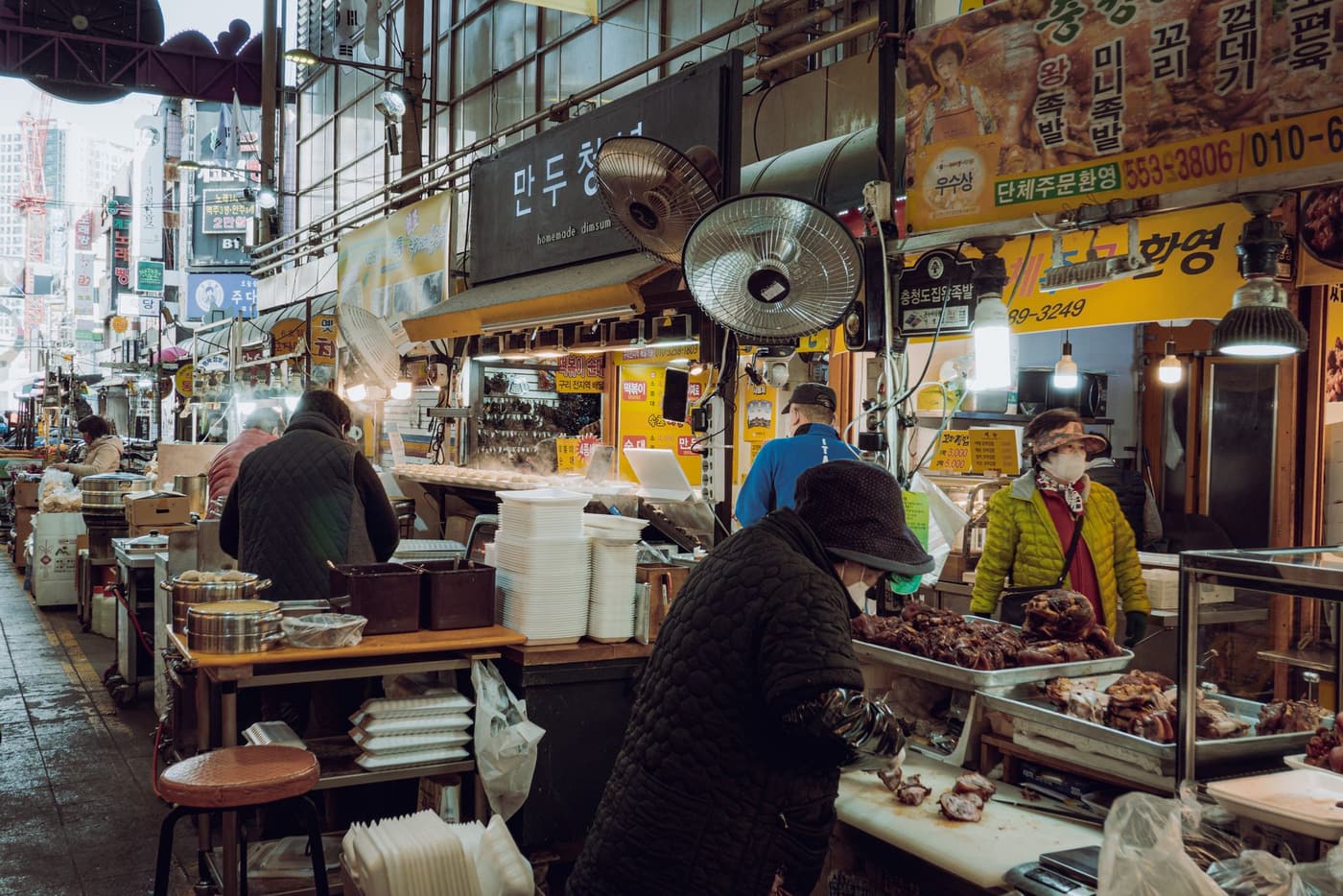
A working Korean neighbourhood market. Mangwon Market is this kind of place first, and a tourist destination a distant second. Photo by Yena Kwon, Pexels.
Mangwon-dong is two stops from Hongdae on Line 6, and the two neighbourhoods have almost nothing in common.
Hongdae is a nightlife district that absorbed a university. Mangwon-dong (망원동) is a residential neighbourhood in Mapo-gu with a covered grocery market at its centre, a stretch of small shops running off it, and the Han River at the bottom of the hill. Nobody built it to be visited. That is the entire appeal, and it is also the reason a lot of visitors arrive, walk down one street, and leave confused.
Here is what is actually there, what the name means — which is a 600-year-old story most Korean residents do not know either — and, importantly, when this is the wrong neighbourhood for you.
The Short Answer
| Question | Answer |
|---|---|
| Where is it? | Mapo-gu, western Seoul, on the north bank of the Han River |
| Getting there | Mangwon Station (망원역), Line 6 — one stop from Hapjeong, two from Hongik University |
| What is the draw? | Mangwon Market (망원시장) — a working covered market, not a tourist one |
| What is Mangnidan-gil? | 망리단길 — the shop street beside the market. The name is borrowed, see below |
| The river | Mangwon Hangang Park, about a 10-minute walk south |
| Best time | Late afternoon into early evening, when the market is busiest |
| Skip it if | You want nightlife, landmarks, or English signage |
| Cash or card? | Cards are widely taken, but carry some cash for individual market stalls |
ZAZE waterproof picnic mat — on AmazonAffiliate link. As an Amazon Associate, EpicKor earns from qualifying purchases at no extra cost to you.
The Name Is 600 Years Older Than the Neighbourhood
Start here, because it is the one fact that reframes the whole area.
망원 (望遠) means "to see far." It comes from 망원정 (Mangwonjeong), a pavilion on the bluff above the Han River, and the story is specific.
The pavilion was built in 1424 as a villa for Grand Prince Hyoryeong (효령대군), a son of King Taejong and the elder brother of King Sejong. Its original name was not Mangwonjeong at all — it was 희우정 (喜雨亭), the "Pavilion of Welcome Rain." Korean records give the reason plainly: the king came out to inspect the state of the farming, climbed the new pavilion, and while he was up there it rained, soaking the fields. He was delighted, and named the building after the rain.
In 1484 the pavilion passed to Grand Prince Wolsan (월산대군), King Seongjong's elder brother. He repaired it and renamed it 망원정 — because from up there, you could see a long way.
The site is designated Seoul Monument No. 9. So the neighbourhood is named after a viewpoint, by way of a rainstorm that pleased a fifteenth-century king. Nothing in the modern district announces this, which is exactly why it is worth knowing.
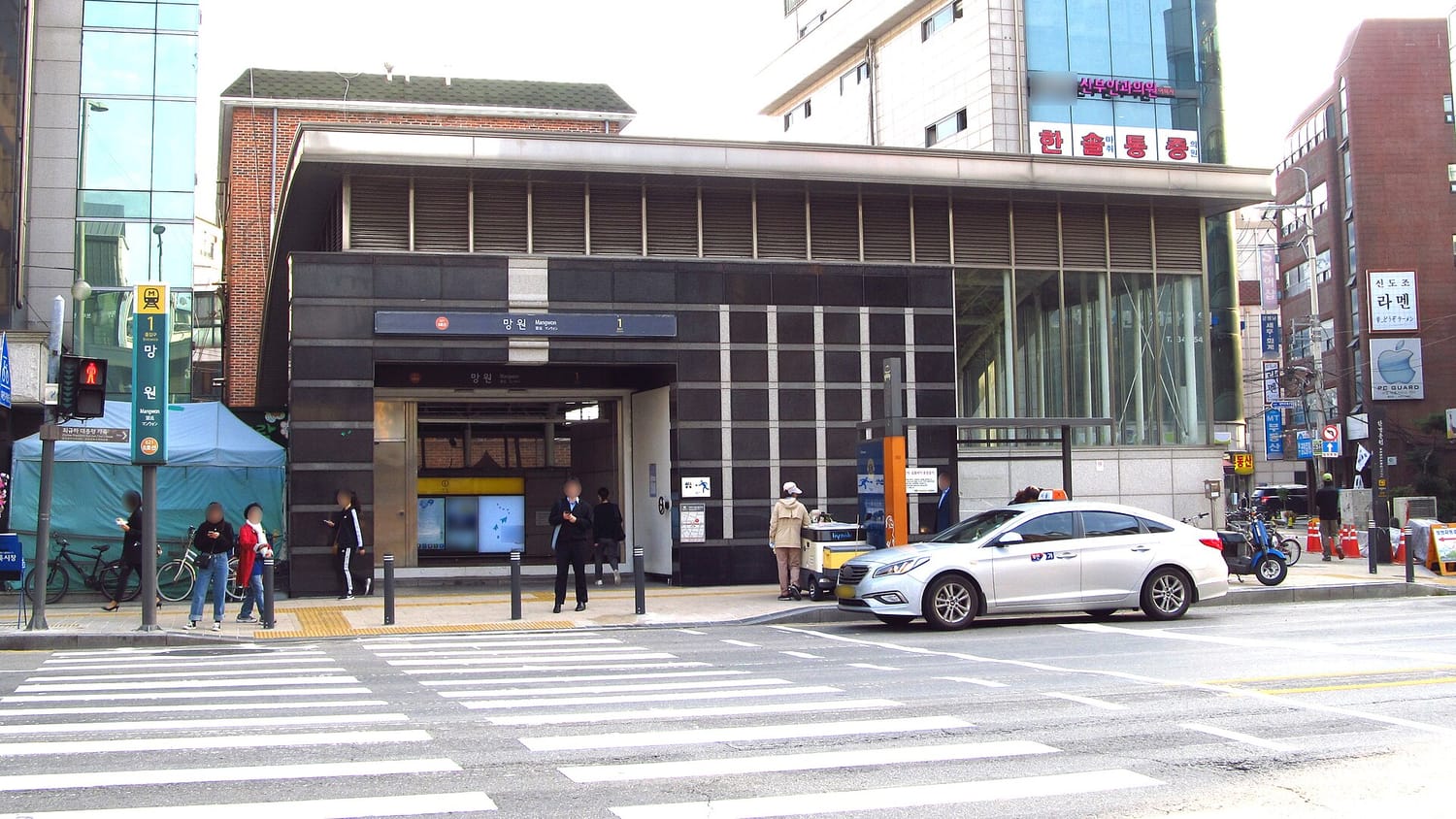
Mangwon Station, Line 6. One stop from Hapjeong, two from Hongik University — which is why the neighbourhood absorbed the overflow. Photo by LERK, CC BY-SA 4.0.
Mangwon Market Is a Grocery Market, and That Changes How You Use It
망원시장 is a covered sijang running through the middle of the neighbourhood. The important thing to understand is what it is for: this is where people who live in Mangwon-dong buy vegetables, fish, side dishes and rice cakes. It is not a food-court market built for visitors.
What follows from that:
- The prices are local prices. You are buying at the same rate as the person in front of you in the queue, which is not true in Seoul's more famous markets.
- Portions assume a household. Many stalls sell quantities meant to feed a family for several days. If you are a solo traveller, the fried-food and snack stalls are your section; the produce stalls mostly are not.
- The best hours are domestic hours. It fills up in the late afternoon as people finish work and shop for dinner. Midday is quiet and slightly flat.
- It closes earlier than you expect. This is not a night market. Individual stalls set their own hours and many wind down in the evening rather than pushing into the night.
- Some stalls take cash only. Card acceptance is broad in Korea and this market is no exception, but individual vendors vary. A few ten-thousand-won notes remove the problem.
What to eat, practically: the jeon (savoury pancake) and fried-snack stalls, tteokbokki, croquettes, and whatever the queue is longest for. The rule that works in every Korean market applies here — join the line that has Korean people in it, not the one with the English sign.
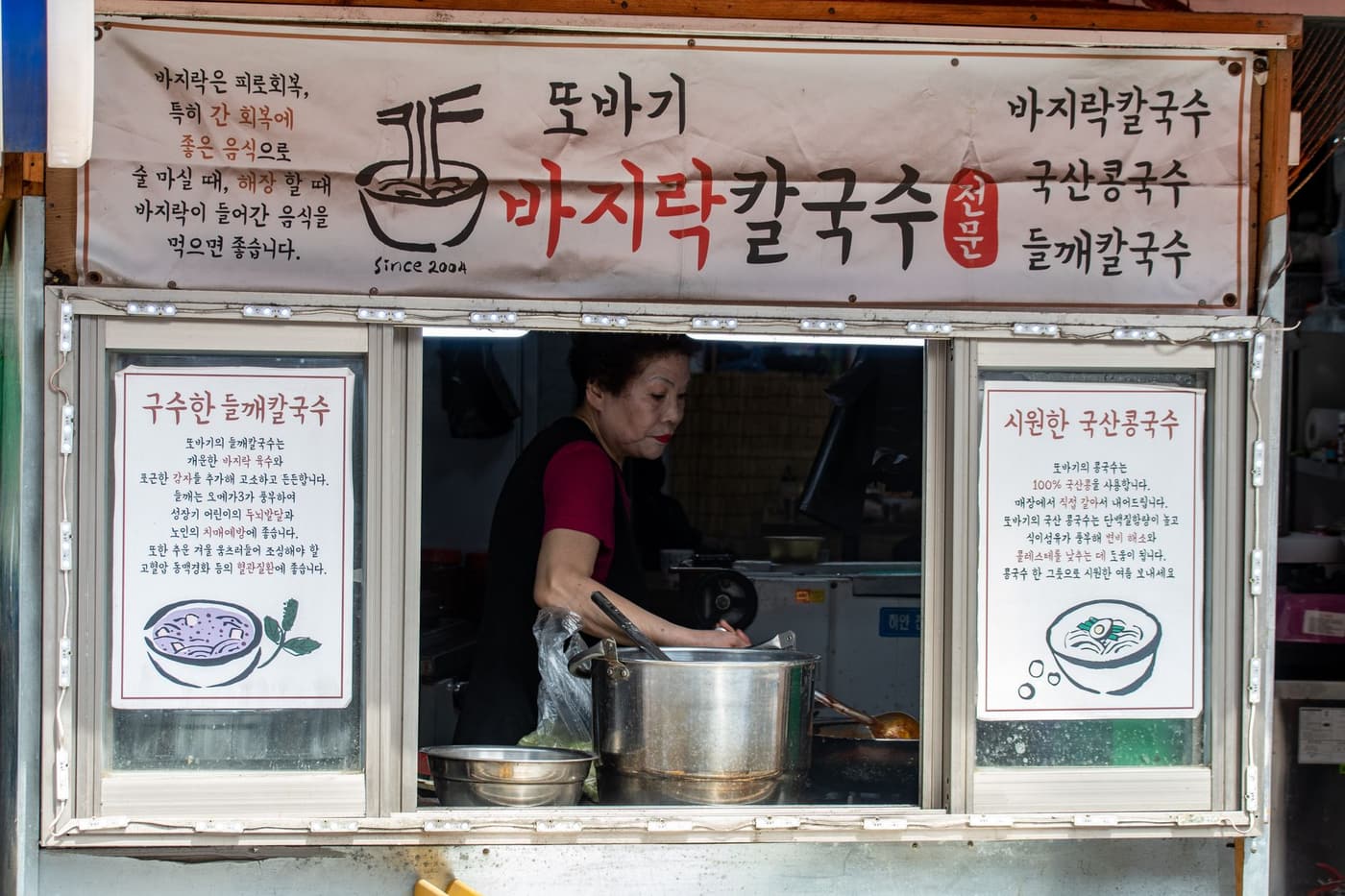
Market food in Korea is cooked in front of you, at a counter, for immediate eating. There is no seating culture to plan around. Photo by wal_ 172619, Pexels.
You might like: Korean Convenience Store Food Guide: Dosirak and Snacks
"Mangnidan-gil" Is a Borrowed Name, and Locals Have Opinions
The shop street running alongside the market is widely called 망리단길 (Mangnidan-gil). If you are trying to work out what that means, you will not get there from Korean, because it is not really a Korean word.
It is a portmanteau: 망원동 + 경리단길. Gyeongnidan-gil (경리단길) is a specific street in Itaewon, named after the military finance corps building at its top, which became Seoul's defining hip-shop street in the early 2010s. When other neighbourhoods started developing the same pattern — small independent cafés and shops on a residential street — Korean media and internet users began attaching -리단길 to them as a suffix meaning "our version of Gyeongnidan-gil."
Seoul now has a lot of these. Mangnidan-gil in Mangwon, and the same construction applied to neighbourhoods across the country.
Two things worth knowing about that:
First, some local residents dislike the name. There is a real thread of Korean commentary arguing that "-ridan-gil" flattens a neighbourhood into a copy of somewhere else and, more practically, that it precedes rent increases and the displacement of the ordinary shops that made the street pleasant. If you use the term with a resident, you may get a wry response.
Second, Gyeongnidan-gil itself declined. The original went through a boom, a rent spike, and a hollowing-out. That arc is the standing warning in Korean urban commentary about what happens to a neighbourhood after it gets a nickname — and it is worth holding in mind when you read a two-year-old article about which street is currently hot.
The River, Which Is the Actual Reason to Come in Summer
Mangwon Hangang Park (망원한강공원) sits at the bottom of the neighbourhood, about ten minutes' walk south of the market, past the flood wall.
This is one of the string of parks along the Han River, and it functions the way all of them do: grass, a paved riverside path, convenience stores, and a large population of Seoulites doing nothing in particular. In the warm months it is one of the better cheap evenings in the city — buy food at the market or the convenience store, walk down, sit on the grass, watch the river.
The practical sequence that makes this neighbourhood work as a trip:
- Arrive at Mangwon Station in the late afternoon
- Walk the market while it is at its busiest, and eat there
- Cut through Mangnidan-gil for coffee or a shop or two
- Walk down to Mangwon Hangang Park for the evening
- Take Line 6 back, or walk east along the river toward Hapjeong
That is a half-day, it costs almost nothing, and it is close to how people who live there actually spend a Saturday.
Evenings on the Han River: As an Amazon Associate, EpicKor may earn from qualifying purchases. The local version of this is a mat, food from the market, and a few hours on the grass — compare foldable picnic mats if you are travelling in spring or autumn.
Compare on Amazon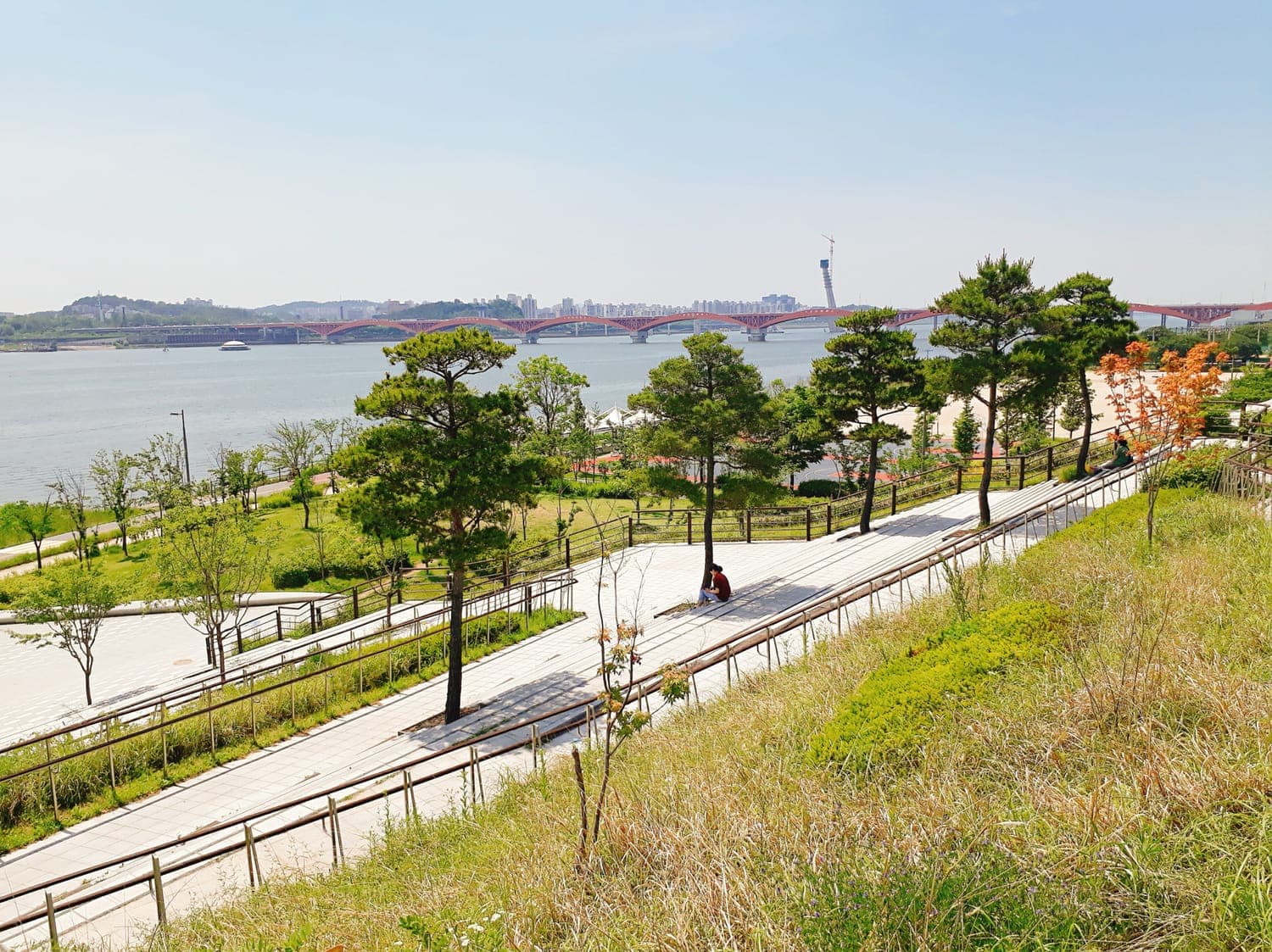
Mangwon Hangang Park. The riverside parks are free, open late, and the single most-used public space in Seoul. Photo by Brit in Seoul, CC BY-SA 4.0.
Ordering at a market stall: Mangwon Market runs on Korean signage and the stallholders have no particular reason to have learned English — compare Korean phrasebooks if you would rather point at words than at a screen.
Compare on AmazonWhen to Skip Mangwon-dong
This is a genuinely good neighbourhood and it is the wrong choice for a lot of trips. Being honest about that is more useful than another list of cafés.
Skip it if you have three days in Seoul. On a short first trip, the palaces, one major market, and one busy district will serve you better. Mangwon rewards people who already have the obvious things covered.
Skip it if you want nightlife. The market winds down in the evening and this is a residential area. Hongdae is two stops away and does that job.
Skip it if you need English. Signage and menus are substantially Korean, and the market stalls are run by people with no particular reason to have learned English. A translation app handles it, but it is friction.
Skip it in bad weather. The market is covered; the walk to the river and the shop street are not. In heavy rain or deep winter this neighbourhood loses most of what makes it good.
And do not come specifically for a café you read about. The turnover on these streets is fast, and a recommendation from an article eighteen months old has a real chance of pointing at a closed shopfront. Come for the market and the river, which do not close, and treat whatever café you find as a bonus.
Mangwon Compared to Its Neighbours
| Neighbourhood | Line 6 / walking | Character | Go for |
|---|---|---|---|
| Mangwon-dong | Mangwon Stn | Residential, market-centred | A working market and the river |
| Yeonnam-dong | 15 min walk NE | Park-centred, café-dense | The linear park and brunch |
| Hongdae | 2 stops | Nightlife, youth retail | Music, bars, late hours |
| Hapjeong | 1 stop | Mixed retail, transit hub | Convenience and connections |
The useful way to think about it: Hongdae is where you go out, Yeonnam is where you sit, and Mangwon is where you buy dinner. All three are within a twenty-minute walk of each other, which is why treating them as one afternoon rather than three destinations is the better plan.
FAQ About Mangwon-dong
Q: How do I get to Mangwon-dong from Hongdae?
A: Take Line 6 westbound from Hongik University Station — Mangwon is two stops, via Hapjeong. It is also a walk of roughly 25 to 30 minutes if the weather is good.
Q: What does "Mangwon" mean?
A: 망원 (望遠) means "to see far," from Mangwonjeong, a pavilion built in 1424 for Grand Prince Hyoryeong and renamed in 1484 by Grand Prince Wolsan for its long views over the Han River. It is Seoul Monument No. 9.
Q: What is Mangnidan-gil?
A: 망리단길 is the shop street beside Mangwon Market. The name combines 망원동 with Gyeongnidan-gil in Itaewon, and "-ridan-gil" has become a general suffix for any neighbourhood shop street. Some residents dislike it.
Q: Is Mangwon Market worth visiting?
A: Yes, if you want a market Koreans actually shop in rather than one built for visitors. Go in the late afternoon, eat at the fried-food and pancake stalls, and do not expect a night market.
Q: Do I need cash at Mangwon Market?
A: Cards are widely accepted in Korea and most of the market takes them, but individual stalls vary. Carrying a few ten-thousand-won notes removes any friction.
Q: How far is the Han River from Mangwon Station?
A: About a ten-minute walk south to Mangwon Hangang Park, through the neighbourhood and past the flood wall.
Q: Is Mangwon-dong good for a first trip to Seoul?
A: Not really. On a first short trip the palaces, a major market and one busy district give you more. Mangwon is a second-trip neighbourhood, or a good half-day once the obvious things are done.
The One Thing to Remember
Mangwon-dong is named after a pavilion where a king watched it rain in 1424, and the thing to do there in 2026 is buy dinner in a covered market and eat it by the river.
The nickname on the shop street is borrowed from Itaewon, the cafés on it will have turned over by the time you visit, and none of that matters — because the market and the Han River are the parts that were never built for you, and they are the parts that will still be there.
Sources
- Seoul city cultural records and Korean local-history material on 망원정 (Mangwonjeong) — 1424 construction for Grand Prince Hyoryeong, the original name 희우정, the 1484 transfer to Grand Prince Wolsan and renaming, and its designation as Seoul Monument No. 9
- Korea Tourism Organization listings for 망원시장 and 망원한강공원
- Korean commentary on the -리단길 naming convention and its origin in Itaewon's 경리단길, including local objections to the term
Mangwon-dong is one of the neighbourhoods compared in EpicKor's Seoul neighbourhood guide — character, nearest station, whether it is worth staying in, and how long each actually takes.
Next in the series: Ikseon-dong and Yeonnam-dong.
You Might Also Like
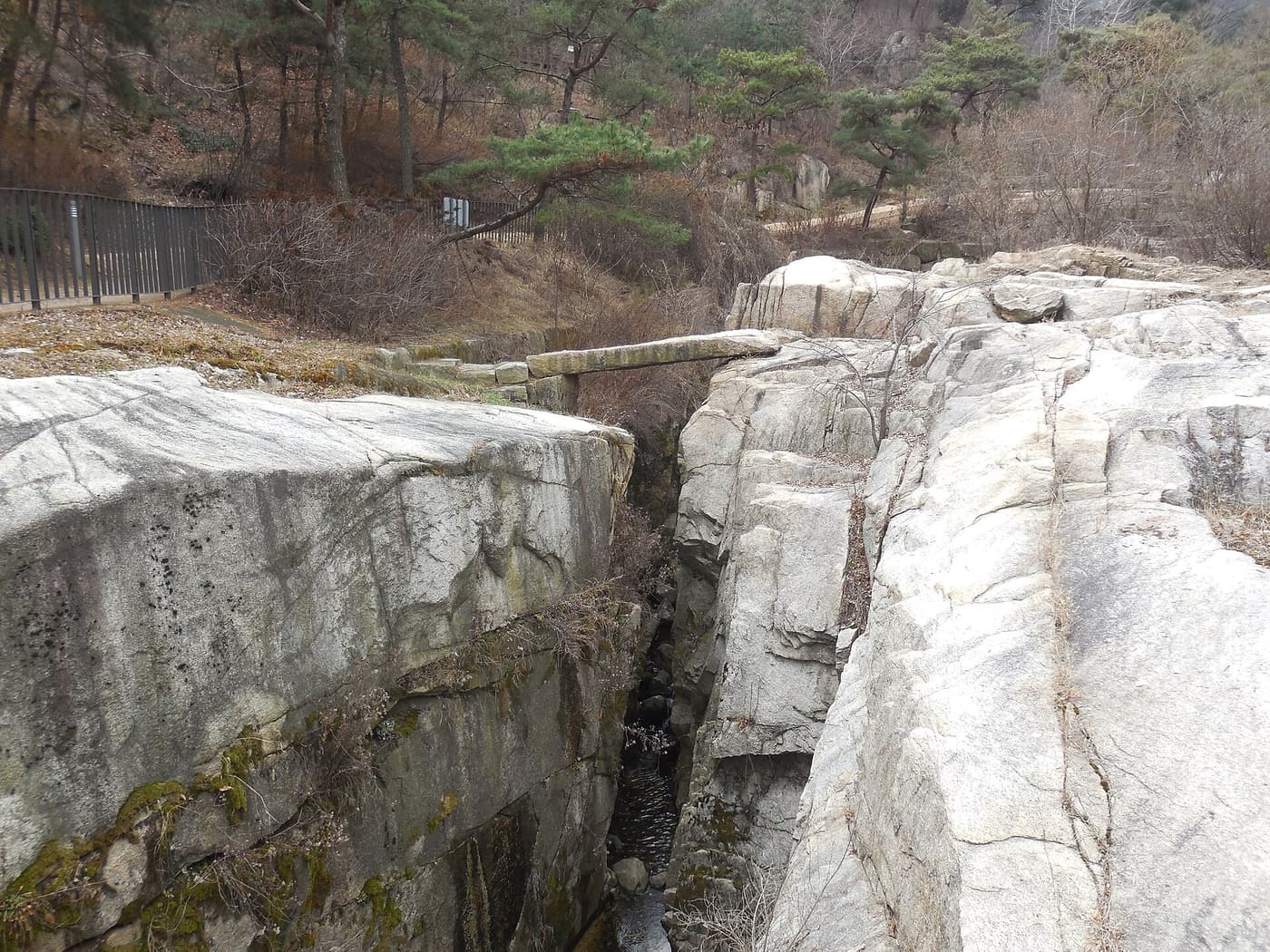
Seochon, Seoul: The Valley Restored From a 300-Year-Old Painting
Seoul demolished a 1971 apartment block in Seochon and rebuilt the valley underneath using an 18th-century painting as the reference. The stone bridge in the painting was still there. Plus the brass-coin lunchbox at Tongin Market, from ₩5,000.

Korean McDonald's: Why the Burgers Are Named After Farm Counties, and What to Order Now
McDonald's Korea has bought 459.2 tonnes of named Korean produce since 2021 and prints the county on the burger — Changnyeong garlic, Jindo spring onion, Jinju pepper. 24 million sold, ₩61.7 billion of measured regional value. Here is what is on the menu now.
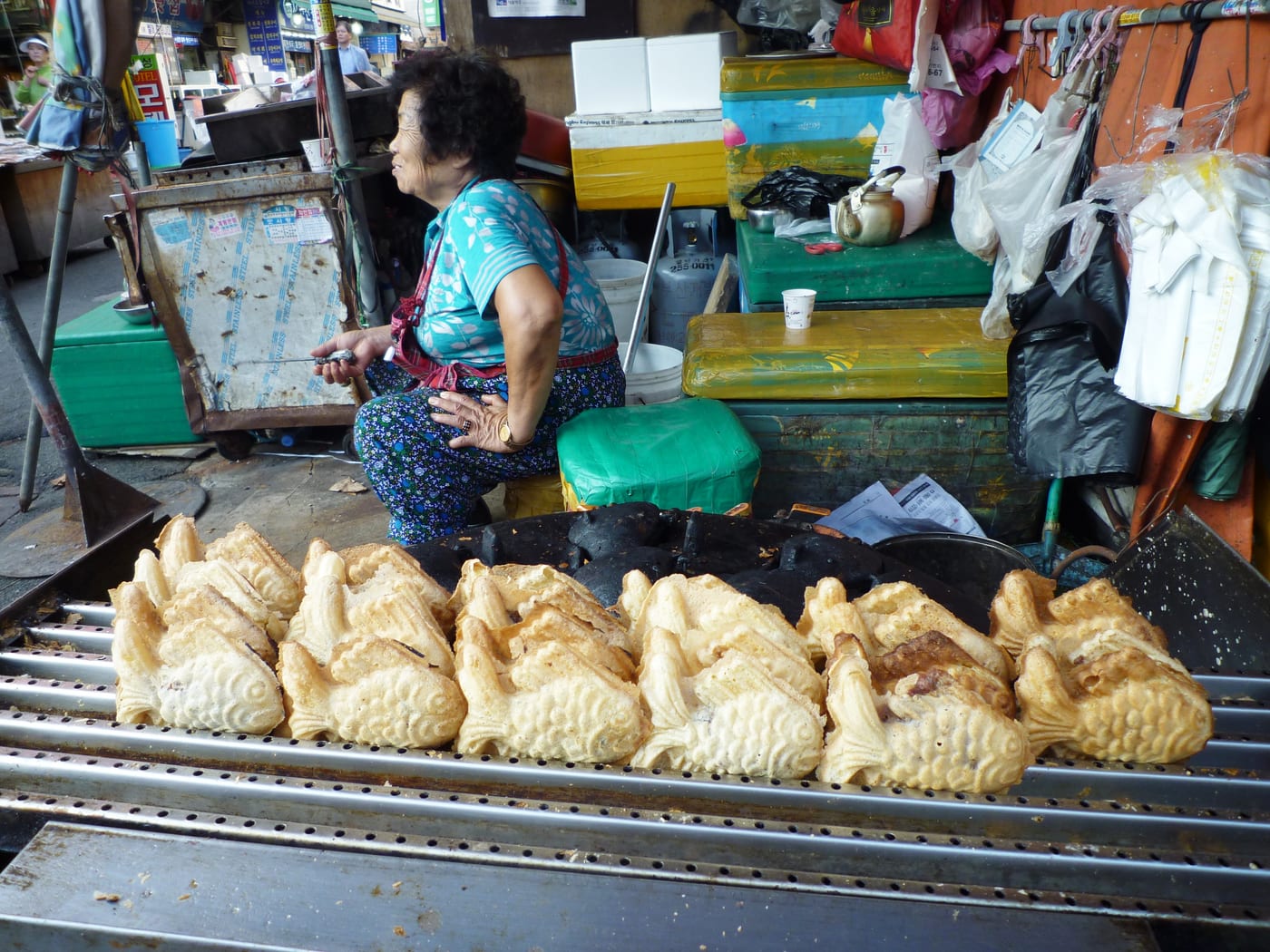
Cham Bungeoppang: The Korean Fish Snack That Is Four Different Fish Abroad
붕어빵 is a winter street food you have to find a cart for. Orion boxed it in 2011, released it in May on purpose, and sold 640 million packs — then renamed it after a different fish in China, Vietnam and Russia.