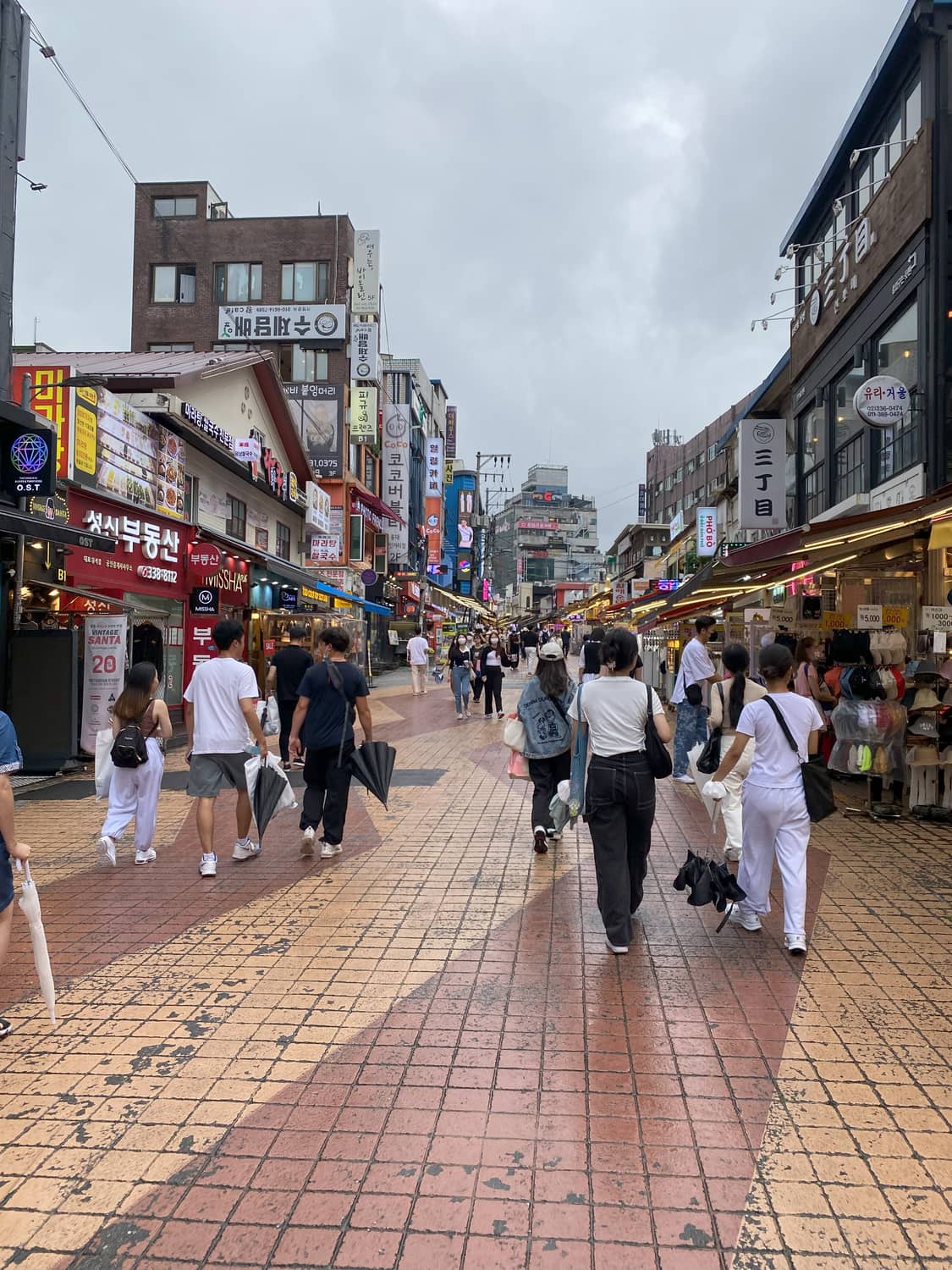
Do Koreans Speak English? Ask Someone Under 35 — What Actually Happens on a Seoul Street
The forum answer to "do Koreans speak English?" has not changed in fifteen years: not really, learn some Korean, download a translator. It was true once. In 2026 it is mostly wrong, and it is wrong in a specific, useful way.
Stop a Korean in their twenties or thirties on a Seoul street and ask a direct question in English, and you will almost always get an answer. Not a perfect one, sometimes a shy one, but a real one, often with the person walking you to the corner to make sure. Ask a shopkeeper in his sixties the same thing and you may get an apologetic wave.
That is the whole picture: it is a question of who you ask, not whether Koreans can. The line runs by age, and it has moved a long way in the last ten years. This guide explains where the line is, why it sits there, and how to put yourself on the right side of it — on the street, in the subway, in a taxi, and outside Seoul.
Lonely Planet Korean Phrasebook — for the conversations outside the age lineAffiliate link. As an Amazon Associate, EpicKor earns from qualifying purchases at no extra cost to you.
Quick Guide
| Question | Short answer |
|---|---|
| Do Koreans speak English? | Under 35, in a city: yes, enough to help you. Over 50: often not, and they will tell you so |
| Who to ask on the street | Anyone who looks like a student. Cafe and convenience-store staff. Hotel and department-store staff. Not the taxi driver |
| Why the age line | English became a compulsory primary-school subject in 1997. Everyone born from about 1988 started at age nine; their parents started at thirteen, from grammar books |
| How to ask | Skip "do you speak English?" Ask the actual question, short, with the map on your phone. Expect "a little" followed by a full answer |
| Where English is built in | Subway signs and announcements, AI interpretation windows at 11 stations, the 1330 tourist line (24 hours, 8 languages), tourist information centres, big-hospital international clinics |
| Outside Seoul | Busan and Daegu are fine in the centre. Small towns: the age line is the same but the young people have left, so carry Papago and the address in Korean |
| Best app | Papago (네이버 파파고) for Korean, not Google Translate. Camera mode for menus, conversation mode for a taxi |
What actually happens when you ask
Here is the experiment, run more times than we can count in Seoul.
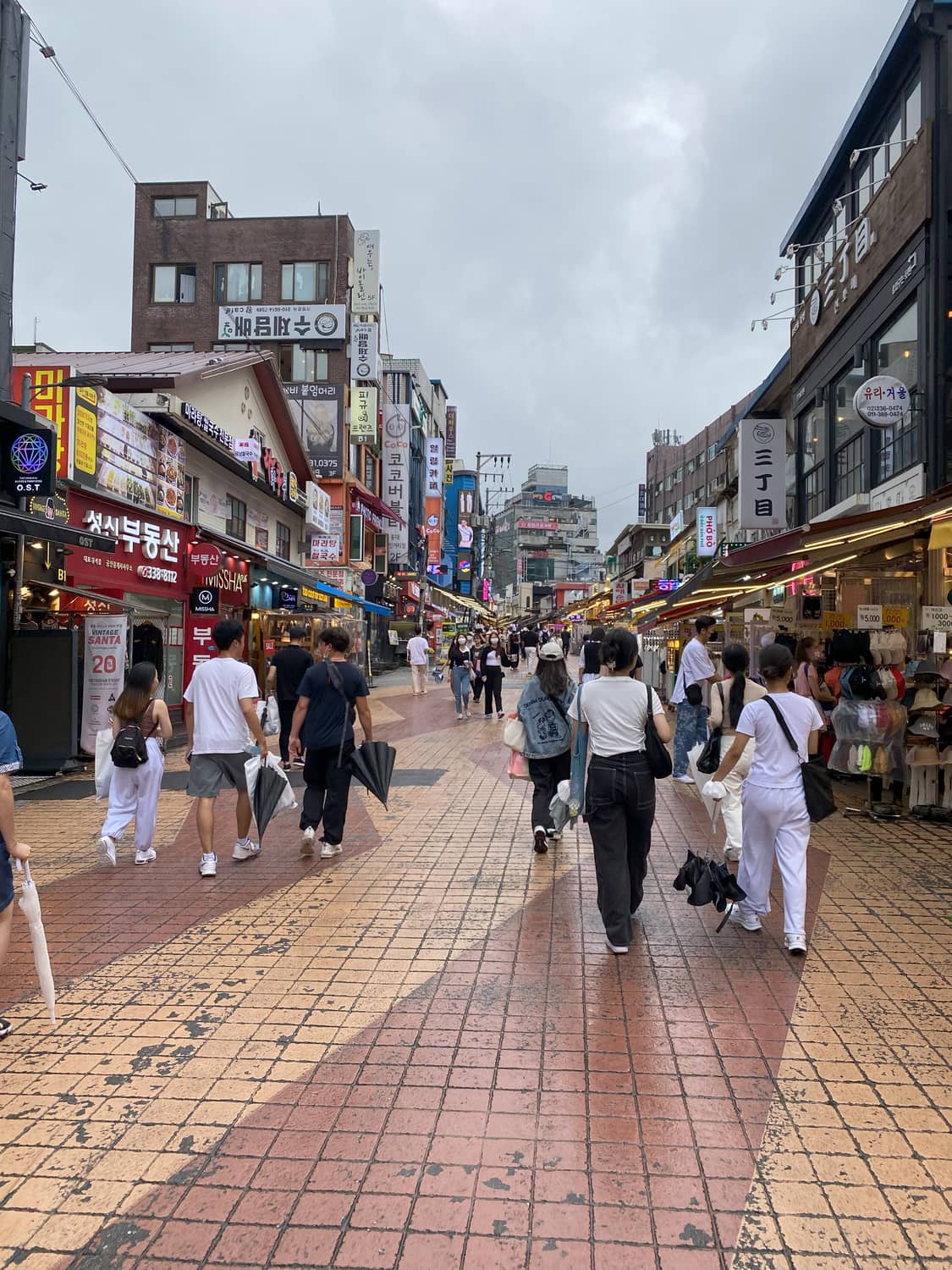
Stand outside a subway exit in Hongdae, Sinchon, Gangnam or Seongsu with your phone open and ask the nearest person in their twenties, in plain English, "Excuse me — which way to Gyeongbokgung?" What you get back, nine times out of ten, is one of three things:
- A direct answer in English, sometimes hesitant, usually correct.
- "Ah — a little", followed by an answer that is considerably more than a little.
- A walk. They gesture follow me and take you to the corner, or the platform, or the door, because explaining it felt harder than doing it.
What you almost never get from that age group is a refusal. The refusals — the apologetic wave, the "no English, sorry", the pointing at someone else — come from a different group: shopkeepers and taxi drivers in their fifties and sixties, market vendors, security guards, the older staff in a neighbourhood restaurant. They are not being unfriendly. They genuinely did not learn to speak it, and they know it.
So the forum advice is half right. Koreans over fifty mostly do not speak English. Koreans under thirty-five mostly do, at least enough to get you where you are going. The mistake is treating the country as one group. For a few of the reasons why Koreans of any age can seem reserved with strangers at first, see our guide to why Koreans seem cold to foreigners — it is not about language.
Why the line runs by age
The generational split is not a stereotype. It has a date.
English became a compulsory subject in Korean primary schools in March 1997, starting in the third grade, at age nine. Before that, Korean children met English at thirteen, in middle school, and what they met was grammar and translation: a textbook, a blackboard, and a teacher who had learned it the same way. Nobody spoke. The exam did not test speaking, so the classroom did not teach it.
Do the arithmetic and the line falls in a predictable place. A child in third grade in 1997 was born around 1988. In 2026 that person is 38. Everyone younger started English at nine with a curriculum that, from the start, included listening and speaking; everyone older started at thirteen with one that did not. That is the age line you meet on the street, and it explains why "under 35" is a safe rule and "under 45" is a coin toss.
Three other things pushed the same generation further:
- They grew up with English on the screen. YouTube, Netflix, Marvel, and the entire online life of anyone born after 1995 runs partly in English. Their parents' did not.
- They travel. Koreans made a record 29.55 million overseas trips in 2025, and the biggest single group was people in their thirties — 5.33 million trips. Ordering coffee in Da Nang, Osaka and Los Angeles is a language class of its own.
- They went to the academy. Private tutoring reaches about three quarters of Korean schoolchildren, and English is one of the two subjects it is spent on. Most twenty-somethings have had far more contact hours with English than most Europeans.
The one honest caveat comes from the international tests. On the EF English Proficiency Index for 2025, Korea sits at 48th globally, and among the four skills its speaking score is the lowest — reading 540, listening 518, writing 509, speaking 489. Read that the wrong way and it says Koreans cannot speak. Read it the right way and it says what every visitor notices: a young Korean understands almost everything you say and is a little slower to reply, because the reply is the part that risks a mistake. That gap is confidence, not competence, and the way you ask can close most of it.
How to ask so it works
Because the hesitation is about confidence, most of what helps is on your side of the conversation.
- Do not open with "Do you speak English?" It asks the person to grade themselves before they know what you want, and a modest Korean will say no to that question and then answer your real one in English. Ask the real one.
- Ask something short and concrete. "Which exit for Gyeongbokgung?" beats "I'm trying to get to the palace, is it far, should I take the subway or walk?" One question, one answer.
- Hold up the map. A phone showing Naver Map with the destination pinned turns a language problem into a pointing problem. Our guide to Naver Map, Kakao T and why Google Maps still lags covers getting the app set up before you land.
- Use the Korean name of the place. "Gyeongbokgung" lands; "the big palace" does not. "Gangnam-yeok" (역 = station) beats "Gangnam Station". The Korean subway names and etiquette guide has the ones you will use most.
- Pick your person. A student with a backpack, the person behind a cafe counter, the part-timer at a convenience store, anyone in a department store or a hotel lobby. These are the people under 35 who deal with the public all day.
- Give them a second. The pause after your question is not confusion. It is someone assembling an English sentence they have never said out loud. Fill it and you will get "a little" again.
- Say thank you in Korean. 감사합니다 (gamsahamnida) is the one word that reliably changes the temperature of the exchange, and it is the only one you need. If you want to go further, our honest guide to learning Korean says how far a week of effort actually gets you.
What not to do is the mirror image: do not slow-shout, do not switch to the sort of pidgin English people use on tourists, and do not read a refusal from an older person as rudeness. They would help if they could. Ask the next person, who is probably twenty years younger and already looking over. (If the older person is looking at you rather than away, that is curiosity, not refusal — our guide to why Koreans stare explains where it happens and what to do with it.)
The device is for the other side of the age line. As an Amazon Associate, EpicKor earns from qualifying purchases at no extra cost to you. You will not need a translator with a student in Hongdae. You will want one with a taxi driver in Gyeongju, a pharmacist in a small town, or a landlady at a countryside guesthouse — the places where the young people have moved to Seoul. Papago on your phone does most of it; a two-way pocket translator is worth it if you are travelling outside the cities for more than a few days, and a small Korean phrasebook is the thing you can hand across a counter when the phone battery dies.
Where English is already built in
Even where the people around you do not speak it, Korea has spent a decade wiring English into the places a visitor actually gets stuck. It is worth knowing which ones, because they are more reliable than any stranger.
| Place | What is there | How reliable |
|---|---|---|
| Seoul subway | Every sign, map and announcement in Korean, English, Chinese and Japanese. Numbered exits. Ticket machines with an English button | Total. You can cross Seoul reading no Korean |
| AI interpretation windows | Two-way screens at the staff booth in 11 stations — Myeongdong, Gangnam, Hongik Univ., City Hall, Euljiro 1-ga, Gyeongbokgung, Gwanghwamun, Itaewon, Gongdeok, Jongno 5-ga, Gimpo Airport — in 13 languages | High. Speak into it; the staff read the Korean, you read the English |
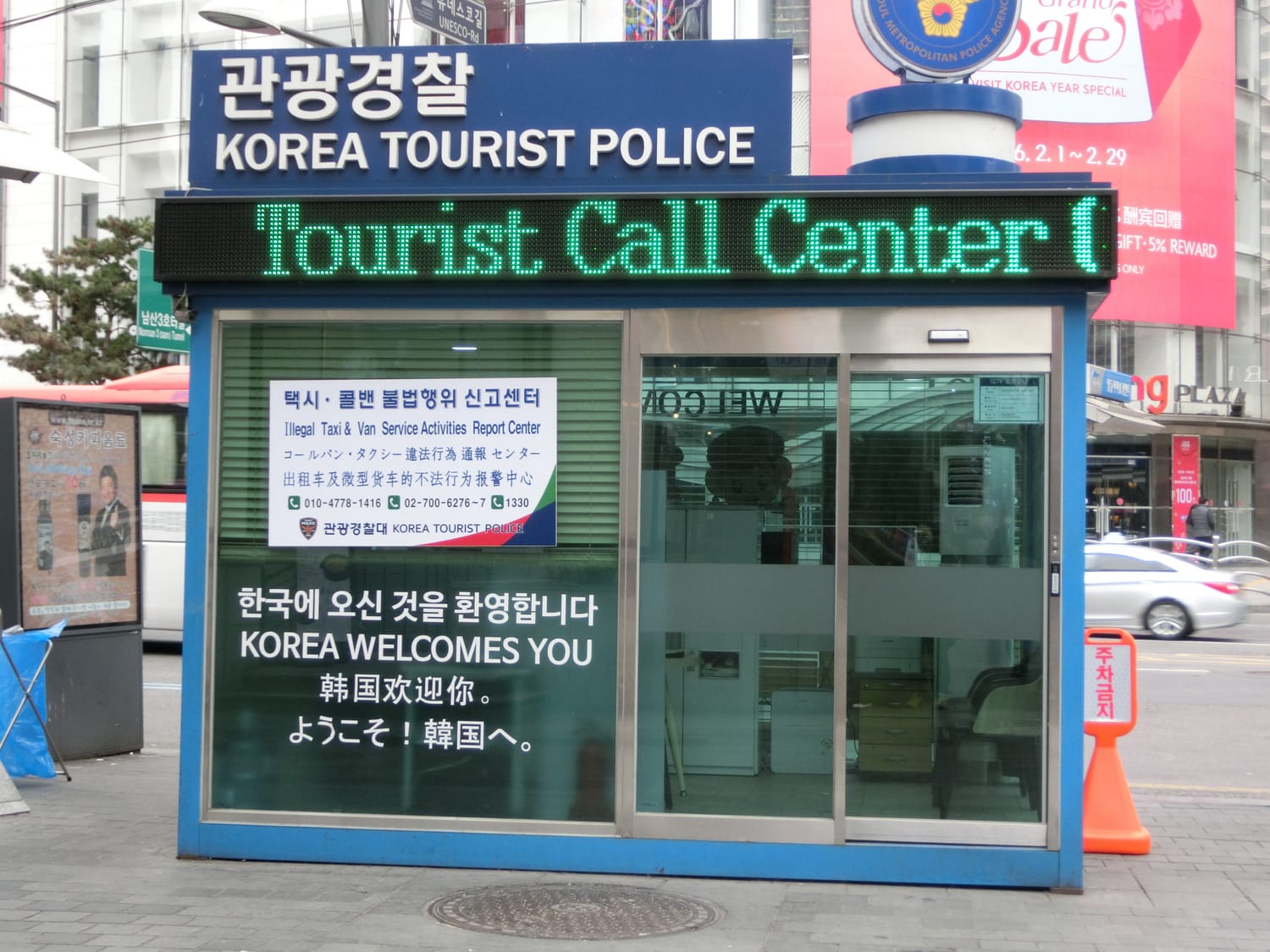
| 1330 tourist line | Korea Tourism Organization's phone and chat service: English, Japanese, Chinese 24 hours, plus Russian, Vietnamese, Thai and Malay/Indonesian. Dial 1330 from any Korean phone; +82-2-1330 from abroad. Also a text-chat service | High, and free. They will interpret three-way between you and a taxi driver or a shop |
| Tourist Information Centres | Staffed desks at Myeongdong, Gwanghwamun, the airports and the main stations. The Myeongdong one is also the Tourist Police base | High during opening hours |
| Hotels, department stores, chain cafes | Front desks and information counters staffed by exactly the under-35 group | High in Seoul and Busan |
| Big hospitals | International clinics at Severance, Asan, Samsung, Seoul National University Hospital and others, with English-speaking coordinators | High — see our guide to seeing a doctor in Korea |
| Taxis | Kakao T shows the destination to the driver in Korean; you never have to say it | The app is the English. The driver mostly is not |
| Payment | Card terminals need no words. See what actually works to pay in Korea | Total |
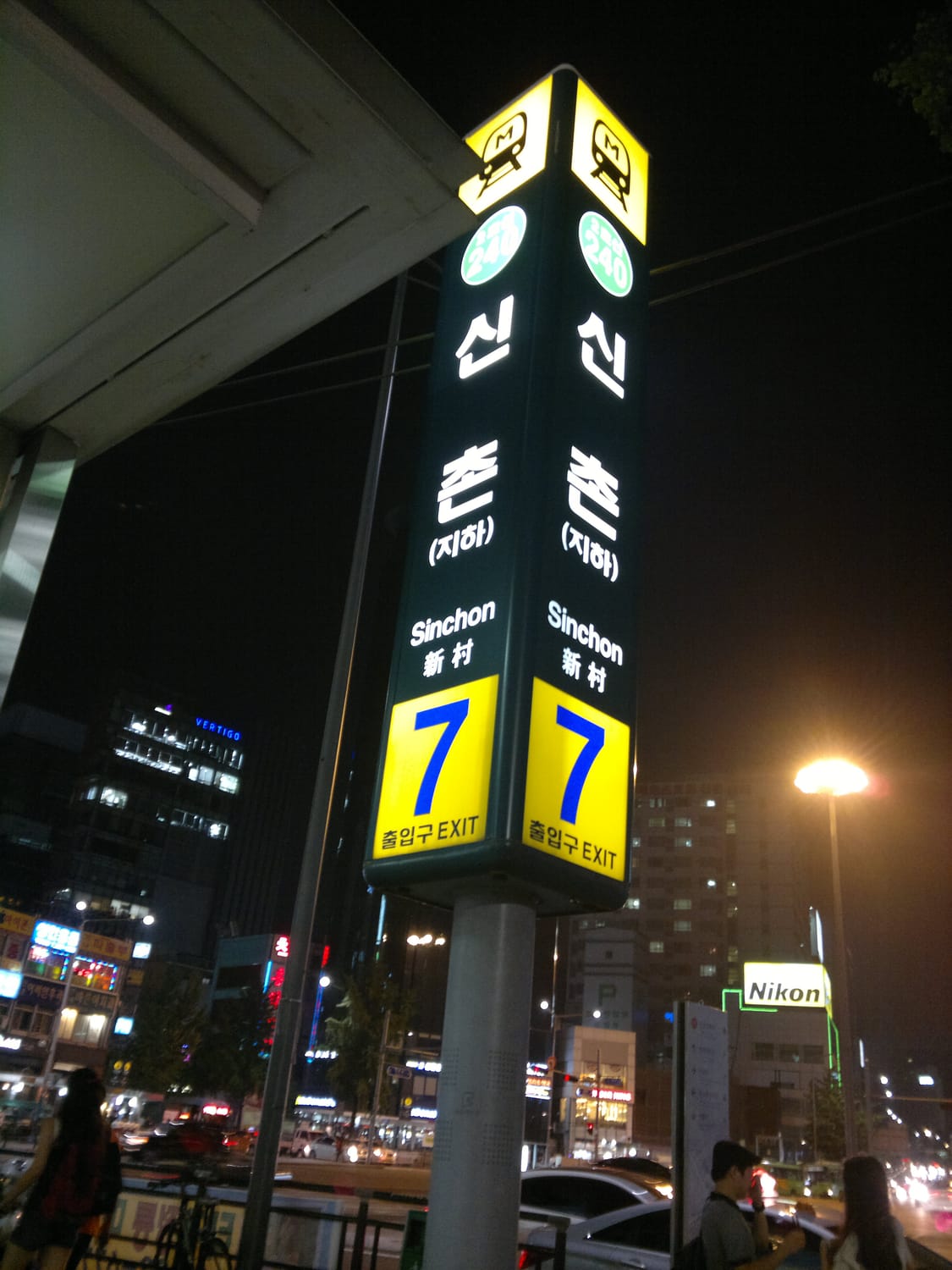
The subway is the point worth repeating. Seoul's system has been layered with English for two decades: station numbers on every platform, exits numbered so that "exit 7" means the same thing to everyone, four-language announcements, and an app, 또타지하철, that runs in Korean, English, Chinese and Japanese. You do not need a single Korean speaker to get across the city. The people come in when you leave the station.
Outside Seoul
The age line holds everywhere in Korea. What changes outside the capital is who is standing on the street.
Busan, Daegu, Daejeon and Incheon are cities full of universities and the young people who go to them; ask the same way and you get the same result, and on the EF index Seoul (550) and those cities (520–536) are close. Suwon, oddly, scores lower (493) — a reminder that a satellite city full of factories is a different population from a university district, even thirty minutes from Seoul.
In a small town or the countryside, the arithmetic turns against you: the twenty-somethings have moved to the cities, and the person running the guesthouse, the bus counter and the pharmacy is sixty. Three things carry you there:
- The address in Korean, on your phone, large. Every Korean address has a Korean form; screenshot it from Naver Map before you go anywhere without signal.
- Papago's conversation mode, phone held between you and the other person. It is markedly better than Google Translate at Korean, and older Koreans are used to being handed a phone — it happens to them with their grandchildren.
- The 1330 line. Call it, say what you need, and hand the phone over. The interpreter talks to the pharmacist; the pharmacist talks back; you get the answer. It is the single most under-used tool a visitor has.
The seven phrases that unlock the rest
You do not need Korean to be helped in Korea. But these seven phrases, said badly, change how every conversation goes — because effort in the language is read as respect, and respect is what turns "a little" into "let me show you".
| Say | Korean | Roughly | When |
|---|---|---|---|
| Excuse me | 저기요 | jeo-gi-yo | To get anyone's attention — a waiter, a stranger. See what to call a stranger in Korea |
| Thank you | 감사합니다 | gam-sa-ham-ni-da | Every time. It is the one that matters |
| Where is …? | … 어디예요? | eo-di-ye-yo | Put the place name first: "Gyeongbokgung eodiyeyo?" |
| This one, please | 이거 주세요 | i-geo ju-se-yo | Pointing at a menu, a shelf, a photo |
| How much? | 얼마예요? | eol-ma-ye-yo | Markets, taxis without a meter, street food |
| Do you speak English? | 영어 할 수 있어요? | yeong-eo hal su iss-eo-yo | Only when you must — and expect "조금" (a little) |
| Sorry / excuse me (bumping past) | 죄송합니다 | joe-song-ham-ni-da | Crowded subway, tight restaurant aisles |
Pronounce them however they come out. Nobody will correct you, and everybody will notice.
Frequently Asked Questions
Q: Do Koreans speak English?
Younger Koreans do. Anyone born from about 1988 onwards — under 38 in 2026 — started English at age nine when it became compulsory in primary school in 1997, and grew up with it on screens and on holidays. Ask a Korean in their twenties or thirties a direct question on a city street and you will almost always get an answer. Koreans over fifty largely learned it from grammar books and will usually tell you honestly that they cannot.
Q: Can I travel in Korea with only English?
Yes, comfortably in Seoul and the big cities. The subway, signage, ticket machines, Kakao T taxis and card payments need no Korean at all, and the 1330 tourist line will interpret for you 24 hours a day. In small towns you will lean on Papago, a written Korean address and 1330, because the young people who speak English have moved to the cities.
Q: Why do Koreans say "a little" and then speak good English?
Because "a little" is the polite Korean answer to any question about your own ability, and because the pause before replying is someone assembling a sentence they rarely say out loud. Korea's speaking score on the EF index is its lowest of the four skills, which describes confidence more than competence. Ask your real question instead of asking whether they speak English, and give them a second.
Q: Is Papago better than Google Translate for Korean?
For Korean, yes, clearly. Papago is built by Naver for Korean–English and handles Korean grammar, honorifics and menus better. Use camera mode on menus and signs and conversation mode with a phone held between you and the other person. Keep Google Translate for languages Papago does not cover.
Q: What is the 1330 number?
The Korea Tourism Organization's tourist information and interpretation line. Dial 1330 from any Korean phone, or +82-2-1330 from abroad; English, Japanese and Chinese run 24 hours, and Russian, Vietnamese, Thai and Malay/Indonesian are also offered. It is free apart from the call, has a text-chat service, and will interpret three-way between you and a driver, a shop or a pharmacy.
Q: Do taxi drivers speak English?
Mostly not — taxi drivers skew older. You do not need them to: book with Kakao T and the destination appears to the driver in Korean, or show the address in Korean on your phone. If something goes wrong mid-ride, call 1330 and hand the phone over.
Bottom Line
"Do Koreans speak English?" is the wrong question, because Korea is not one group. Draw a line at about 35 and the answer is yes on one side and mostly no on the other, and the line has a date on it: March 1997, when nine-year-olds started English and their parents' generation did not.
So ask the person under 35. Ask the real question, short, with the map up. Give them a second, and say 감사합니다 at the end. And for everything else — the subway, the taxi, the pharmacy in a small town — Korea has already built the English in; you only need to know that 1330 exists.
Sources
- Ministry of Education, Republic of Korea — English introduced as a compulsory subject in the 6th national curriculum from primary grade 3, applied from March 1997 (grades 3–6 phased in through 2000).
- EF English Proficiency Index 2025, South Korea fact sheet — global rank 48, score 522; reading 540, listening 518, writing 509, speaking 489; Seoul 550, Daejeon 536, Daegu 532, Incheon 532, Busan 520, Suwon 493.
- Korea Tourism Organization, 2025 tourism statistics (provisional) — 29.55 million Korean overseas trips in 2025, a record; 5.33 million by people in their thirties.
- 국가데이터처·교육부, 2025년 초중고 사교육비조사 — private-education participation 75.7%.
- Seoul Metro (서울교통공사) — two-way AI interpretation system at 11 stations in 13 languages; 또타지하철 app in Korean, English, Chinese and Japanese.
- Korea Tourism Organization, 1330 Korea Travel Hotline — Korean, English, Japanese, Chinese 24 hours since 1999; Russian, Vietnamese, Thai and Malay/Indonesian added; text-chat service.
You Might Also Like
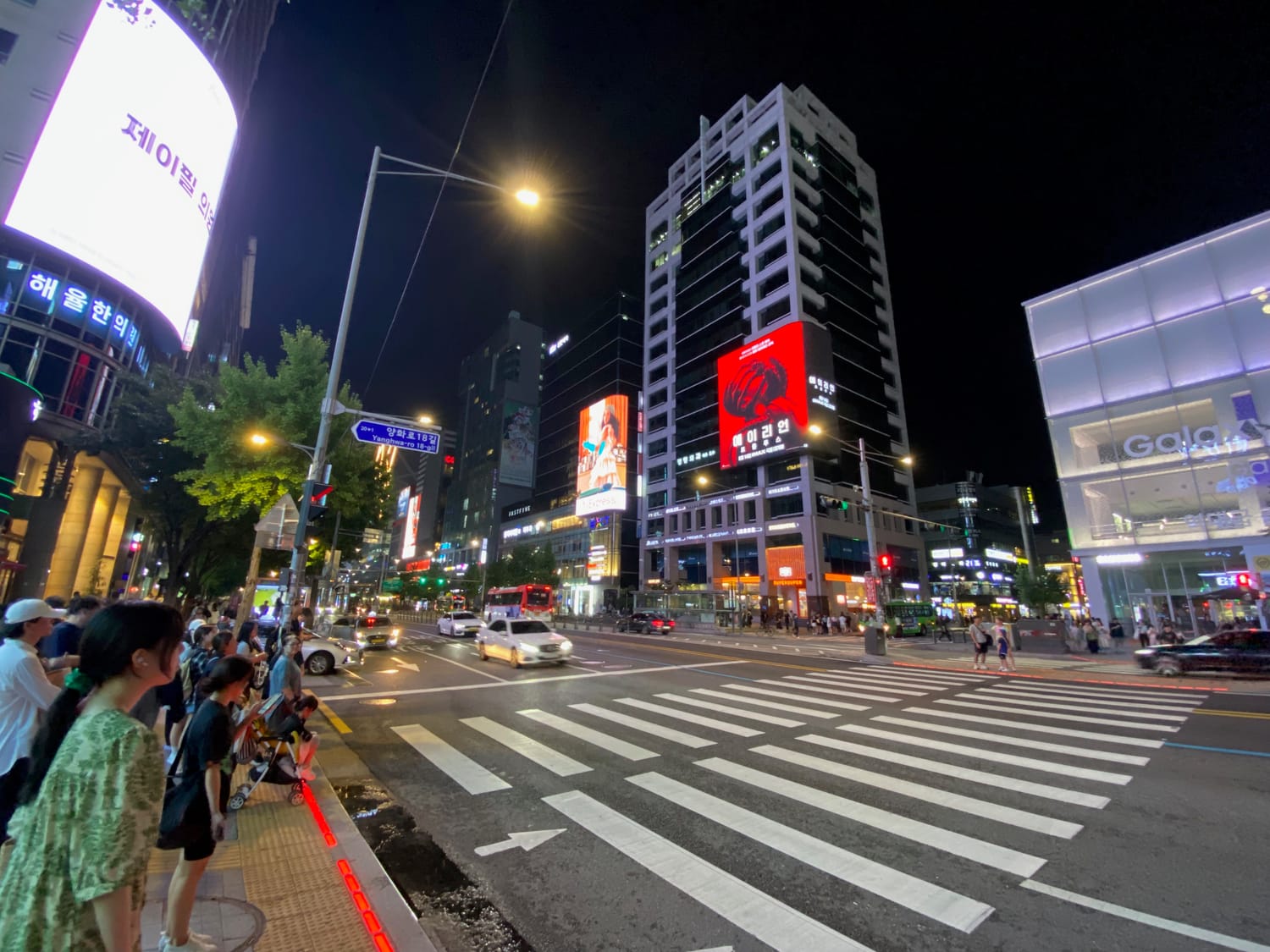
Korean Stare Meaning: Why Koreans Stare at Foreigners, and How to React
The Korean stare almost always means curiosity, not hostility: outside central Seoul a non-Asian face is still rare. Sometimes it means you broke a quiet public rule. How to tell which, and the nod and 안녕하세요 that end it.
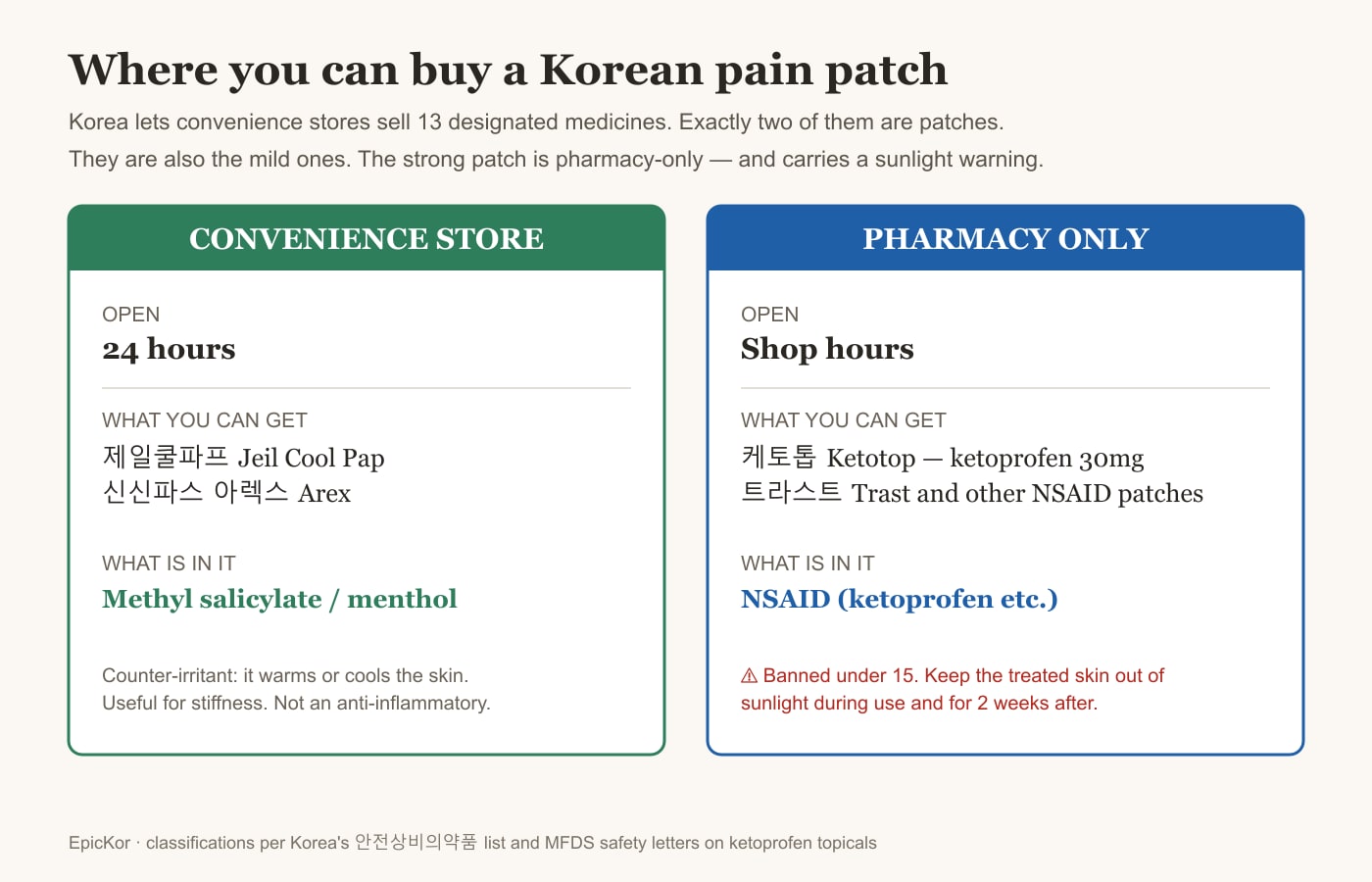
Korean Pain Patches: Only Two Are Sold Outside a Pharmacy
Korea lets convenience stores sell 13 designated medicines and exactly two are pain patches, both mild. The one everyone recommends — Ketotop, 30mg ketoprofen — is pharmacy-only and warns you to keep the treated skin out of sunlight for two weeks.
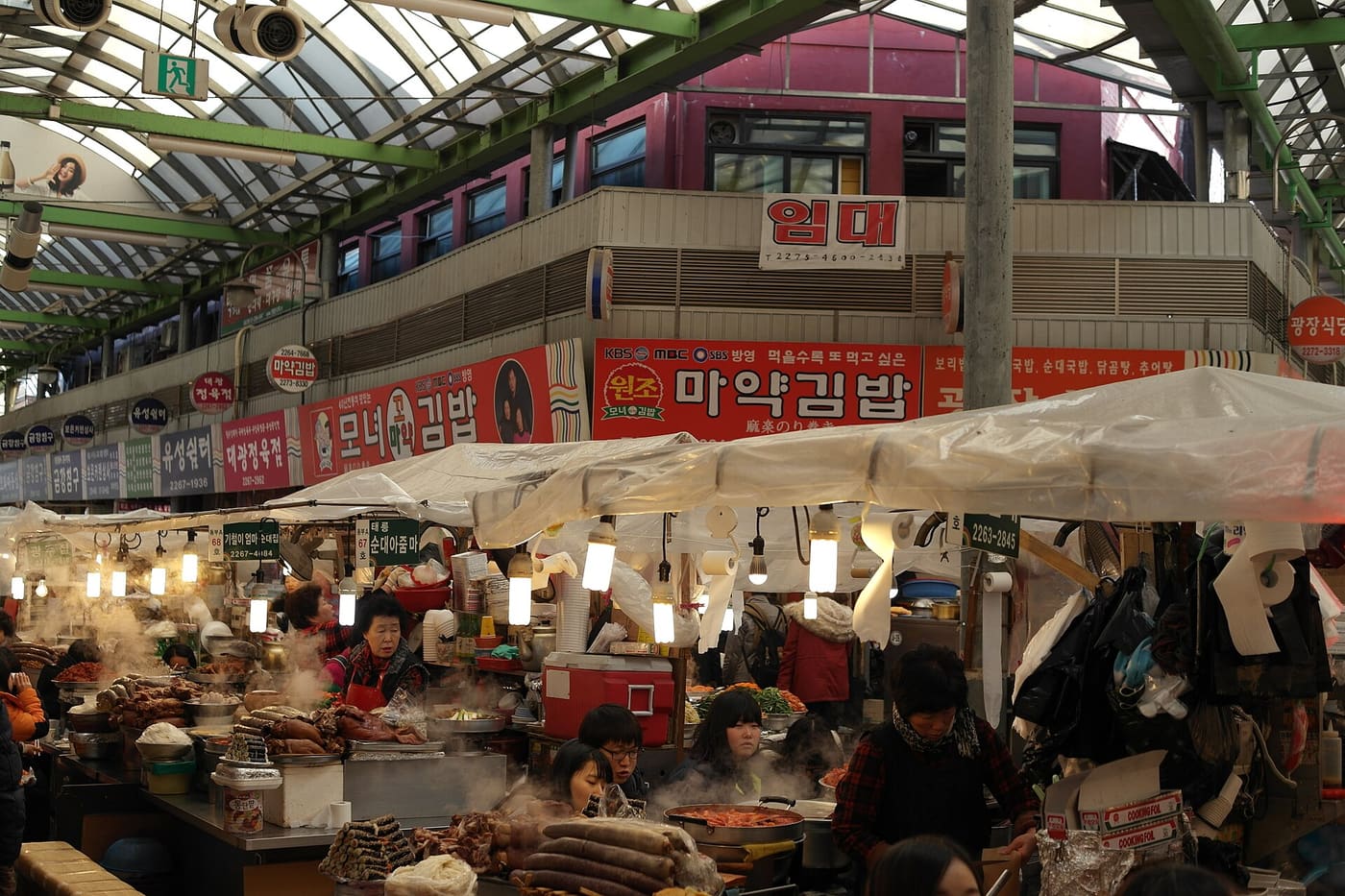
Gwangjang Market's Second Floor: Seoul's Vintage Arcade, and the One Day It's Shut
Everyone knows Gwangjang for the food alley that never closes. Above it is a vintage arcade signed 수입구제 where most items run under ₩20,000 — and it shuts every Sunday, which is exactly when visitors turn up.