Korean Pain Patches: Only Two Are Sold Outside a Pharmacy
You walked 24,000 steps around Seoul, your shoulder has seized up, and it is 11pm. Every guide to Korean pharmacies tells you to buy 파스 (pas) — the medicated patches Koreans stick on everything from a stiff neck to a twisted ankle — and most of them name Ketotop (케토톱), because it is the market leader.
Two things nobody tells you until you are standing there.
The pharmacy is shut. Korean pharmacies mostly keep shop hours; the neighbourhood ones close around 8 or 9pm, and the 24-hour ones are rare enough to need looking up.
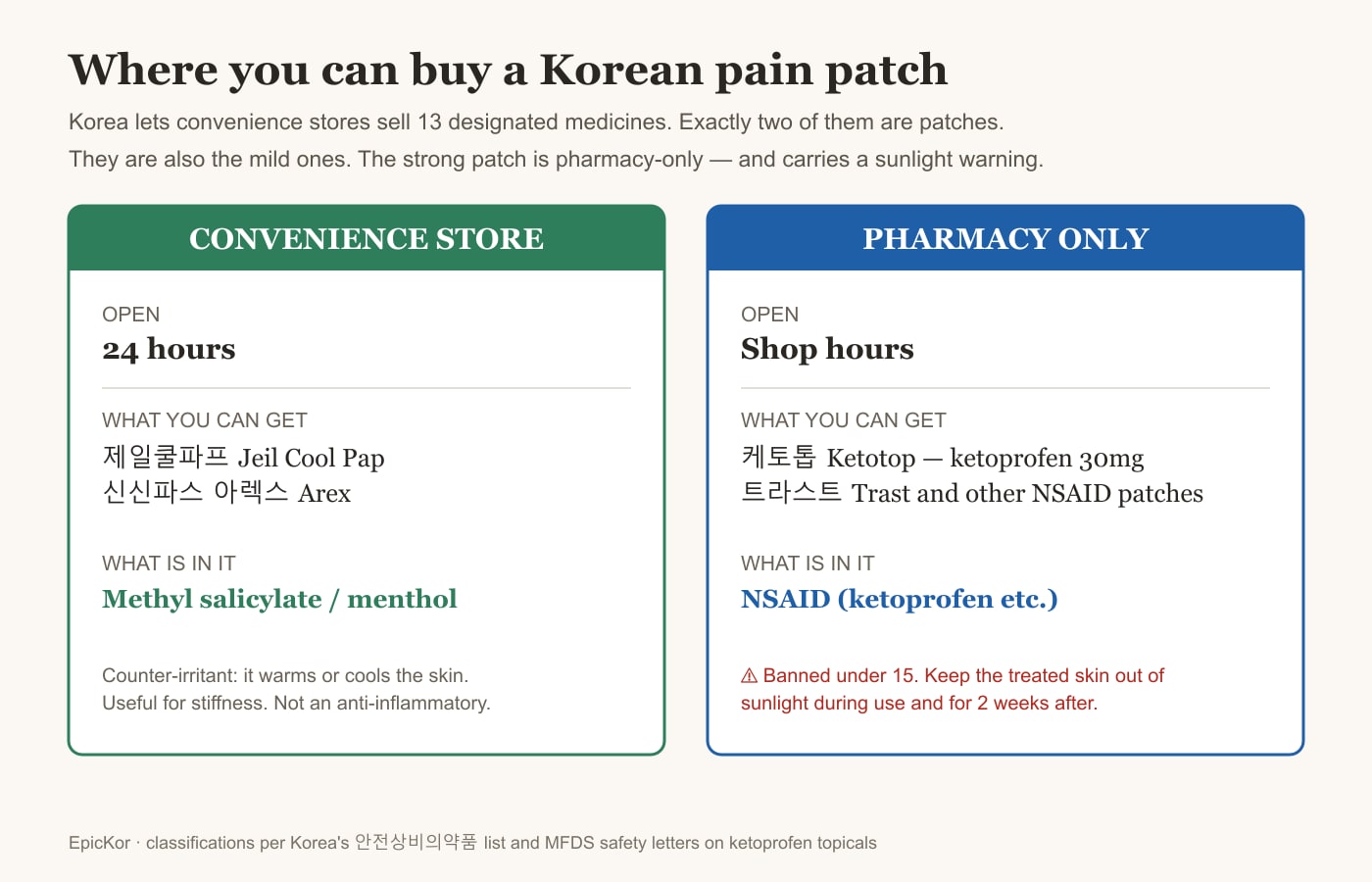
And the convenience store cannot sell you Ketotop. Korea allows convenience stores to sell a fixed list of 13 designated medicines, and exactly two of them are patches. Both are the mild kind. The strong one is pharmacy-only — and it comes with an official warning that no English listicle seems to mention: keep the patched skin out of sunlight, during use and for two weeks after you stop.
This article is that decision, made properly.
Quick Guide
| Question | Short answer |
|---|---|
| Can I buy a patch at 3am? | Yes — 제일쿨파프 or 신신파스 아렉스, the only two on Korea's convenience-store list |
| What is in those? | Methyl salicylate and menthol — a counter-irritant, not an anti-inflammatory |
| What is the strong one? | 케토톱 Ketotop — ketoprofen 30mg per patch, an NSAID |
| Where do I get that? | A pharmacy (약국), during shop hours. It is 일반의약품, over-the-counter but pharmacy-only |
| The catch | Ketoprofen patches: banned under 15, and keep the skin out of sun for 2 weeks after use |
| Price (Sept 2026) | Ketotop 40 patches ≈ ₩9,900; 신신파스 아렉스 10 ≈ ₩2,500 |
| Do I need Korean? | No. Point at the sore spot and say 파스 (pas) |
Korean-made menthol coin patches (120 count) — read the ingredient label first, as this guide saysAffiliate link. As an Amazon Associate, EpicKor earns from qualifying purchases at no extra cost to you.
Korea's convenience-store medicine list is a fixed 13 items
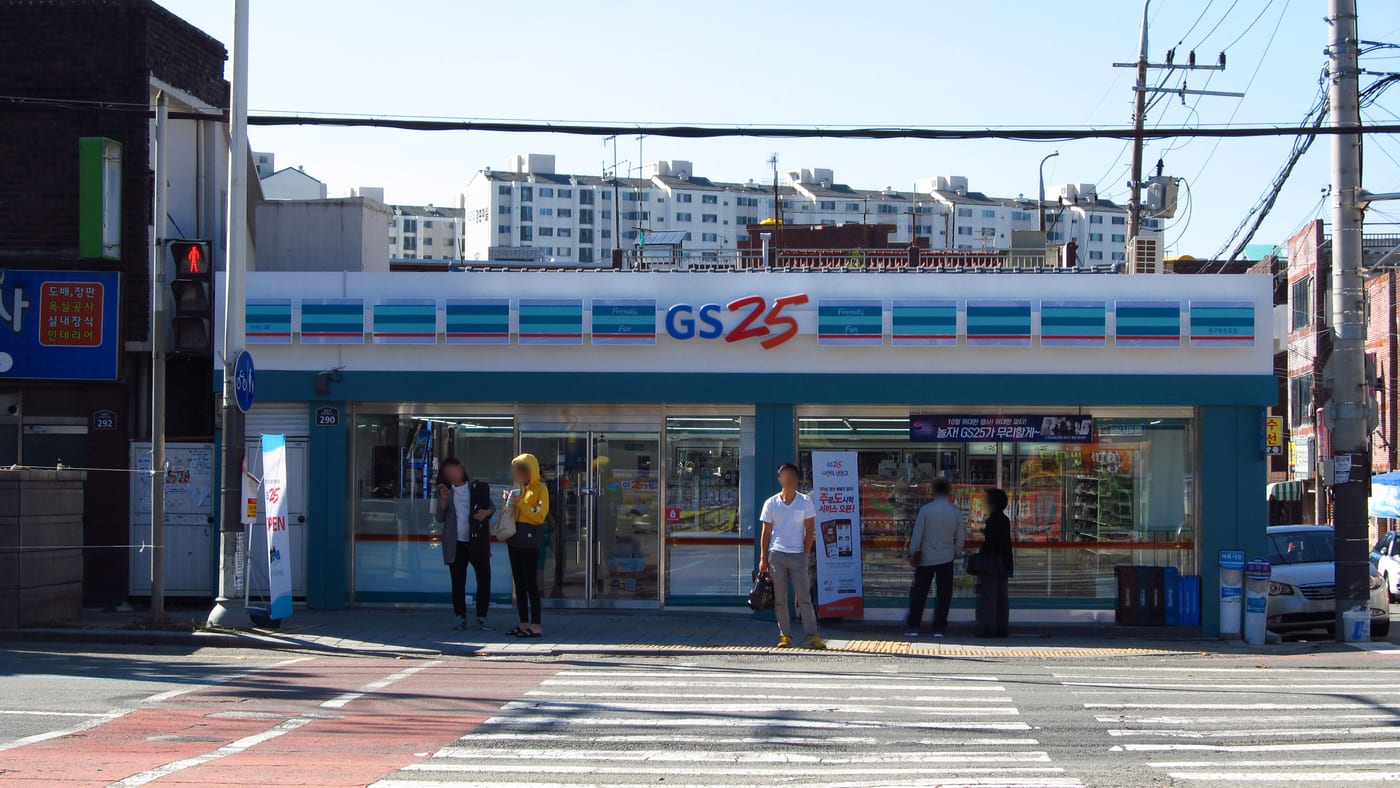
Most countries let a supermarket sell basic painkillers. Korea does not. Pharmacy dispensing is tightly protected, and the exception is a scheme called 안전상비의약품 — "safe household medicines" — under which a named list of 13 products may be sold in convenience stores outside pharmacy hours.
The list is not a category. It is specific products:
| Group | Count | Examples |
|---|---|---|
| Fever and pain | 5 | Tylenol 500mg (타이레놀정 500㎎) |
| Digestive | 4 | 베아제정, 훼스탈골드정 |
| Cold remedies | 2 | 판콜에이 내복액, 판피린티정 |
| Patches (파스) | 2 | 제일쿨파프, 신신파스 아렉스 |
Two details make this sharper than it looks.
The list has not changed in 14 years. It was set when the scheme launched and has been frozen since, which is why a 2026 debate about expanding it to around 20 items — adding things like anti-diarrhoeals — has been running, with the pharmacists' association opposed.
And the real number is 11, not 13. Two of the five painkillers on the list — Tylenol 160mg and children's Tylenol 80mg — have been discontinued, so they remain on paper but cannot be bought. If you are counting on children's paracetamol from a Korean convenience store at midnight, that is the gap to know about.
What is actually in each one, and why it matters
The two categories do genuinely different things, and this is the part that decides whether the patch helps you.
Convenience-store patches are counter-irritants. 제일쿨파프's active ingredients are in the methyl salicylate and menthol family. That produces a strong cooling or warming sensation that competes with the pain signal and feels good on a stiff shoulder. What it does not do is meaningfully reduce inflammation in the tissue underneath. For a long walking day and a tight neck, that is often all you want.
Pharmacy patches are NSAIDs. Ketotop's active ingredient is ketoprofen, 30mg per patch, printed on the front of the pack. Trast (트라스트) and others in that group work the same way — a non-steroidal anti-inflammatory delivered through the skin to the joint or muscle. That is a real drug doing real pharmacology, which is exactly why it is restricted to pharmacies.
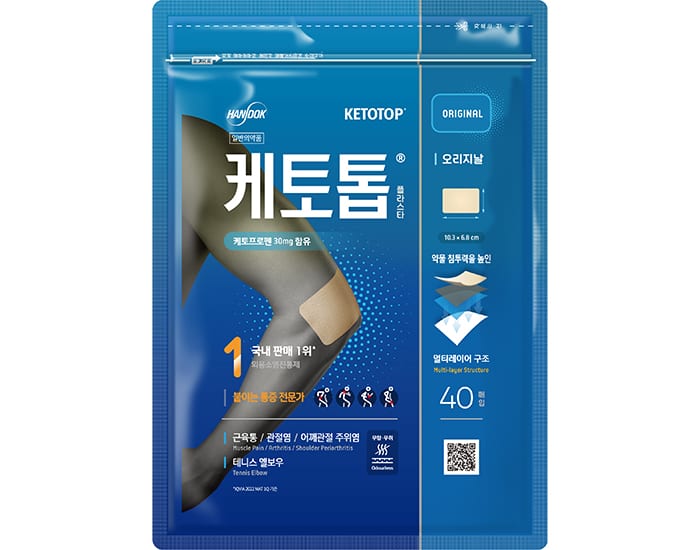
Ketotop launched in 1994 as Korea's first arthritis pain patch and has been the country's best-selling over-the-counter product in that category since. The indications printed on the box are specific: 퇴행성관절염 (osteoarthritis), 어깨관절주위염 (frozen shoulder), tendinitis, 상완골상과염 (tennis elbow), muscle pain, and post-injury swelling. Apply twice a day.
The sunlight warning, which is the reason this article exists
Korea's Ministry of Food and Drug Safety reviewed adverse-event reports for topical ketoprofen — a sweep covering 118 products from 73 companies — and tightened the usage rules after finding photosensitivity reactions.
Three restrictions came out of it:
- Not for anyone under 15. Ketoprofen patches and gels are contraindicated in children.
- Not for anyone with a history of photosensitivity or hypersensitivity to the ingredient.
- Cover the treated area. While using the patch, and for two weeks after you stop, sunlight or UV on the treated skin can produce hives, blistering and rash.
Read that third one again in the context of a trip. You patch your shoulder in the evening, and the next day you spend six hours at Gyeongbokgung in full sun in a short-sleeved shirt. The reaction is not to the sun alone and not to the drug alone — it is the combination, and it can appear on skin that has already stopped being treated.
This is not a reason to avoid the patch. It is a reason to put it somewhere your clothes cover, or to use it at night and keep that patch of skin out of the sun. Millions of Koreans use these without incident precisely because the warning is printed in Korean on the leaflet in the box. If you cannot read the leaflet, you were not going to get the warning at all — which is the whole gap this section fills.
If you would rather have them before you land: As an Amazon Associate, EpicKor earns from qualifying purchases at no extra cost to you. Korean-made patches ship internationally, and the Korean pain patch listings are worth comparing on one thing above all: read the active ingredient, not the brand styling. A ketoprofen or flurbiprofen patch is a different product from a menthol one at a similar price, and overseas listings often bury that in the description. If you are packing for a walking-heavy trip, a reusable hot/cold gel pack covers the same job for the nights you would rather not medicate at all.
What this costs in Korea, September 2026
| Product | Pack | Price | Where |
|---|---|---|---|
| 케토톱 플라스타 오리지날 | 40 patches | ≈ ₩9,900 | Pharmacy (price-comparison, July 2026) |
| 신신파스 아렉스 중형 | 10 patches | ≈ ₩2,500 | Pharmacy (May 2026); also convenience store |
| 제일쿨파프 | 5 patches | ≈ ₩5,480–5,600 | Online; also convenience store |
Two things to take from that. Korean pharmacy prices are not fixed, so the same box genuinely differs between shops — the figures above come from price-comparison services rather than a single counter. And the strong patch is not the expensive one per patch: Ketotop works out around ₩250 each in the 40-pack, against roughly ₩1,100 each for a five-patch convenience-store pack. Convenience is what you pay for at 3am, not potency.
How to buy one without speaking Korean
Walk into anything with a green cross and the sign 약국 (yakguk). Then:
- Say "파스" (pas) and point at the sore spot. That single word does almost all the work; it is the everyday Korean term and the pharmacist will take it from there.
- If you want the strong one, say the brand: "케토톱" (Ketotop). Brand names travel better than ingredient names in a Korean pharmacy.
- Answer one question honestly: the pharmacist may ask whether the pain is a fresh injury or an ongoing ache, because that changes cool versus hot and mild versus NSAID.
- Ask for the leaflet in the box if the patch is a ketoprofen one, and take the sunlight warning seriously even though you cannot read it.
Korea's most famous digestive, Hwalmyungsu, works the same way — the pharmacy bottle and the convenience-store look-alike are different registrations. The other thing that counter sells constantly is wound ointment, and it has the same shape of trap — Fucidin vs Madecassol explains why one of those brand names is two different tubes, one of which you can buy in Daiso. For everything else about Korean pharmacies, hospital access and what to do in an actual emergency, our Korea healthcare guide for tourists covers the system end to end. If the patch is for feet rather than shoulders, that is usually a shoe problem, and the Korea tourist shopping route has where to solve it.
One boundary worth stating plainly: this is a guide to what Korean shops are allowed to sell you and what the labels say, not medical advice. If pain is severe, persistent, or follows a real injury, see a doctor rather than a shelf.
FAQ About Korean Pain Patches
Q: Can I buy Korean pain patches at a convenience store?
Yes, but only two specific products: 제일쿨파프 (Jeil Cool Pap) and 신신파스 아렉스 (Shinshin Pas Arex). They are the only patches on Korea's 13-item 안전상비의약품 list, which is what allows convenience stores to sell any medicine at all. Both are methyl salicylate and menthol counter-irritants, not anti-inflammatories.
Q: Is Ketotop available without a prescription?
Yes — it is 일반의약품, which is over-the-counter in Korea, but that still means pharmacy-only. No prescription is needed, but a convenience store cannot legally sell it, so you are bound by pharmacy opening hours.
Q: What is in Ketotop?
Ketoprofen, 30mg per patch, declared on the front of the pack. It is a non-steroidal anti-inflammatory absorbed through the skin. The patch measures 10.3 × 6.8cm and the instructions say twice daily.
Q: Why does Ketotop have a sunlight warning?
Korea's Ministry of Food and Drug Safety reviewed adverse-event data across 118 topical ketoprofen products and found photosensitivity reactions. The rules now say to keep the treated skin covered from sunlight and UV during use and for two weeks afterwards, and the product is not for anyone under 15 or with a history of photosensitivity.
Q: How much do Korean pain patches cost?
As of September 2026, roughly ₩9,900 for a 40-patch box of Ketotop Original and about ₩2,500 for ten 신신파스 아렉스. Pharmacy prices vary between shops in Korea, so treat these as the going rate rather than a fixed price.
Q: What is the Korean word for pain patch?
파스, pronounced roughly "pas". It comes from the German Pflaster by way of Japanese and is the word every Korean uses, in a pharmacy or a convenience store.
Q: Are cool and hot patches different?
Yes, and Koreans pick deliberately. Cool (쿨) is for fresh strains, sprains and swelling. Hot (핫) is for chronic stiffness, where warmth and blood flow help. Several brands, Ketotop included, sell both.
Bottom Line
The Korean pain patch is one of the genuinely good things to bring home from a trip, and one of the easiest to buy wrong at the exact moment you need it.
If it is late and the shoulder just needs to stop shouting, take the convenience-store patch and know it is a counter-irritant. If you want the anti-inflammatory, you need a pharmacy, the brand name 케토톱, and the discipline to keep that square of skin out of the sun for a fortnight afterwards. The strong option and the available option are not the same product — plan for which one you will actually be able to reach.
Sources: Korea's 안전상비의약품 designated-product list and the 2026 debate on expanding it, as reported in Korean national press; 케토톱 플라스타 product information from Handok's official product page, including the ketoprofen 30mg declaration, classification and indications; 제일쿨파프 product information from Korea's pharmaceutical information database; Ministry of Food and Drug Safety safety letters on topical ketoprofen covering 118 products from 73 companies, including the under-15 contraindication and the two-week post-use sunlight precaution; retail prices from Korean pharmacy price-comparison services, May–July 2026. Prices and product listings change — confirm at the counter, and this article is not medical advice.
You Might Also Like
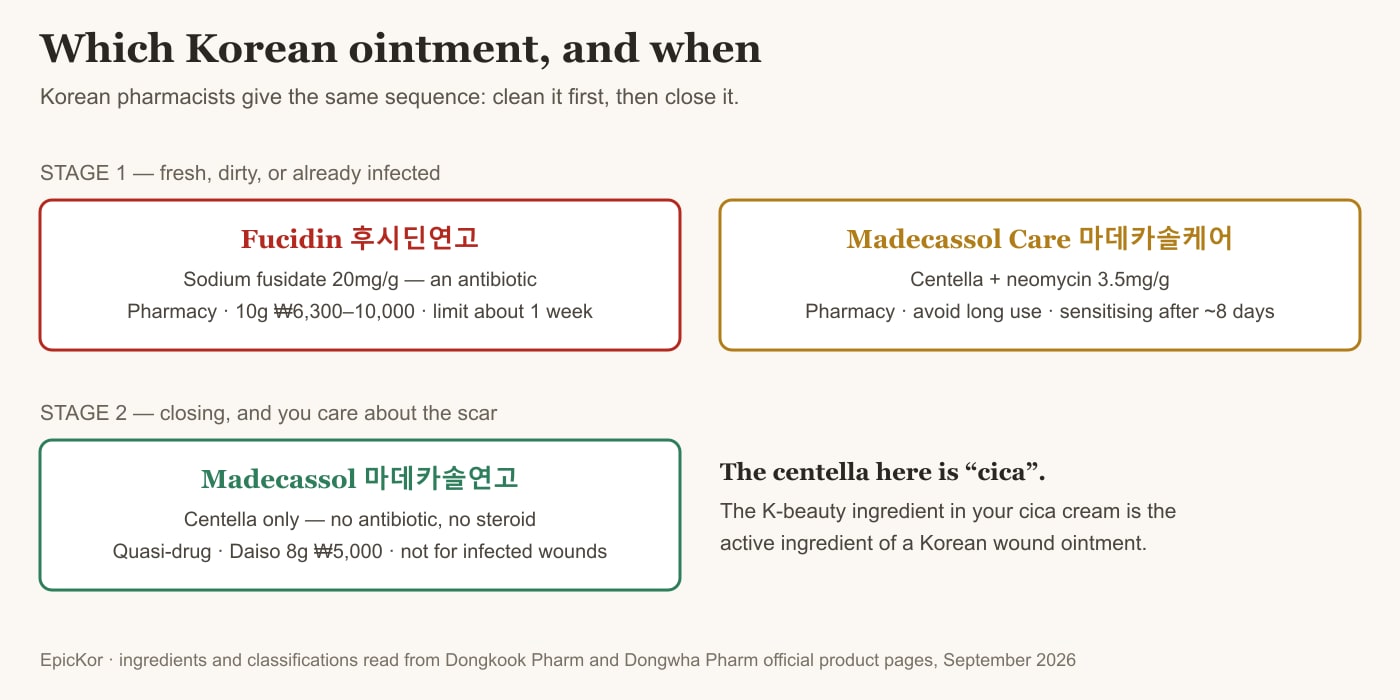
Fucidin vs Madecassol: Which Korean Ointment for Which Wound
Korea's two famous wound ointments are a sequence, not rivals: Fucidin (fusidic acid) while the wound is dirty, Madecassol (centella) once it closes. And Madecassol is two tubes — one contains an antibiotic, and their labels say opposite things.
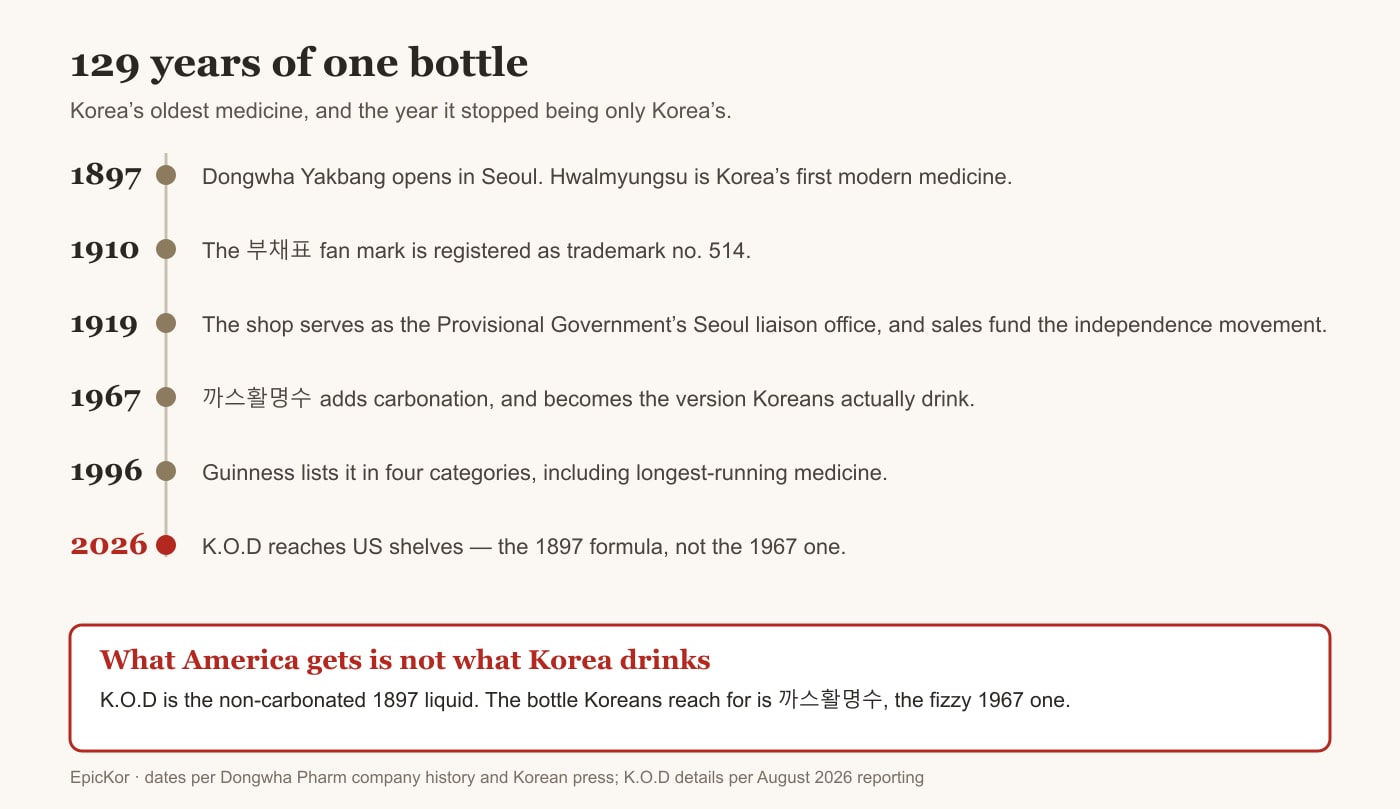
Hwalmyungsu: Korea's Oldest Medicine Reaches America Without the Fizz
Hwalmyungsu is 129 years old, Korea's first modern medicine, and it lands on US shelves this month as K.O.D. The version America gets is the non-carbonated 1897 one — not 까스활명수, the fizzy 1967 bottle Koreans actually reach for.
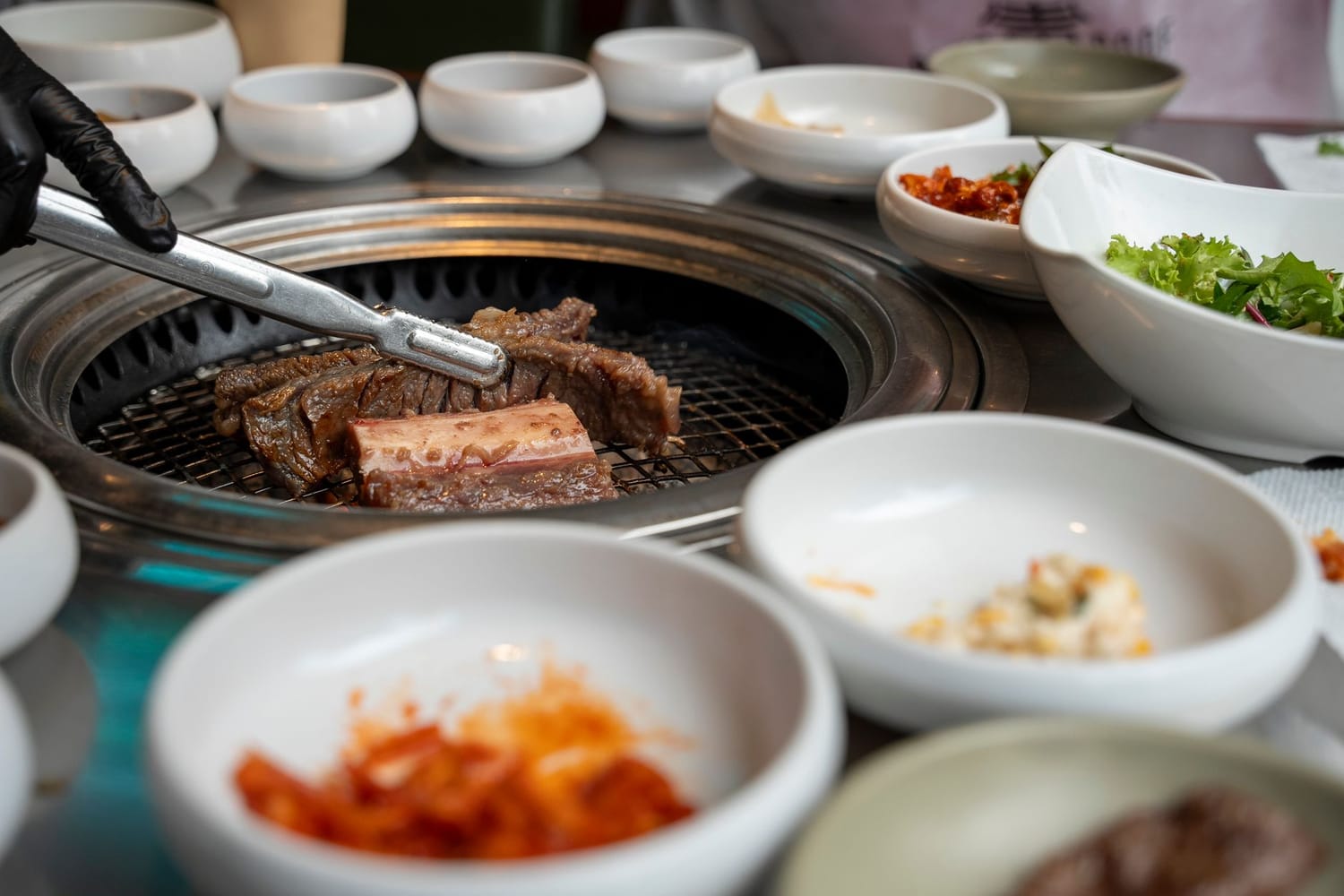
Korean Kitchen Scissors: Why Koreans Cut Meat and Noodles at the Table, and Why It Is Not an Office Scissor
Scissors on a restaurant table look wrong to most of the world and normal to every Korean. The tool is not a desk scissor: thick blades, one serrated edge, big rings, often detachable, built for galbi and cold noodles. Where it came from, and which one to buy.