Seoul Subway Etiquette: Korea Just Reversed the Escalator Rule, and Two of Those Seats Aren't Yours
Most Seoul subway etiquette advice is soft: be quiet, be considerate, watch what locals do. Useful, but you cannot check any of it, and it leaves out the three things that are actually specific to Korea right now.
One: every travel guide tells you to stand on the right and leave the left for walkers. In April 2026 the Korean government restarted the two-line standing campaign it gave up on in 2015 — so the official position is now the opposite of what you have been told.
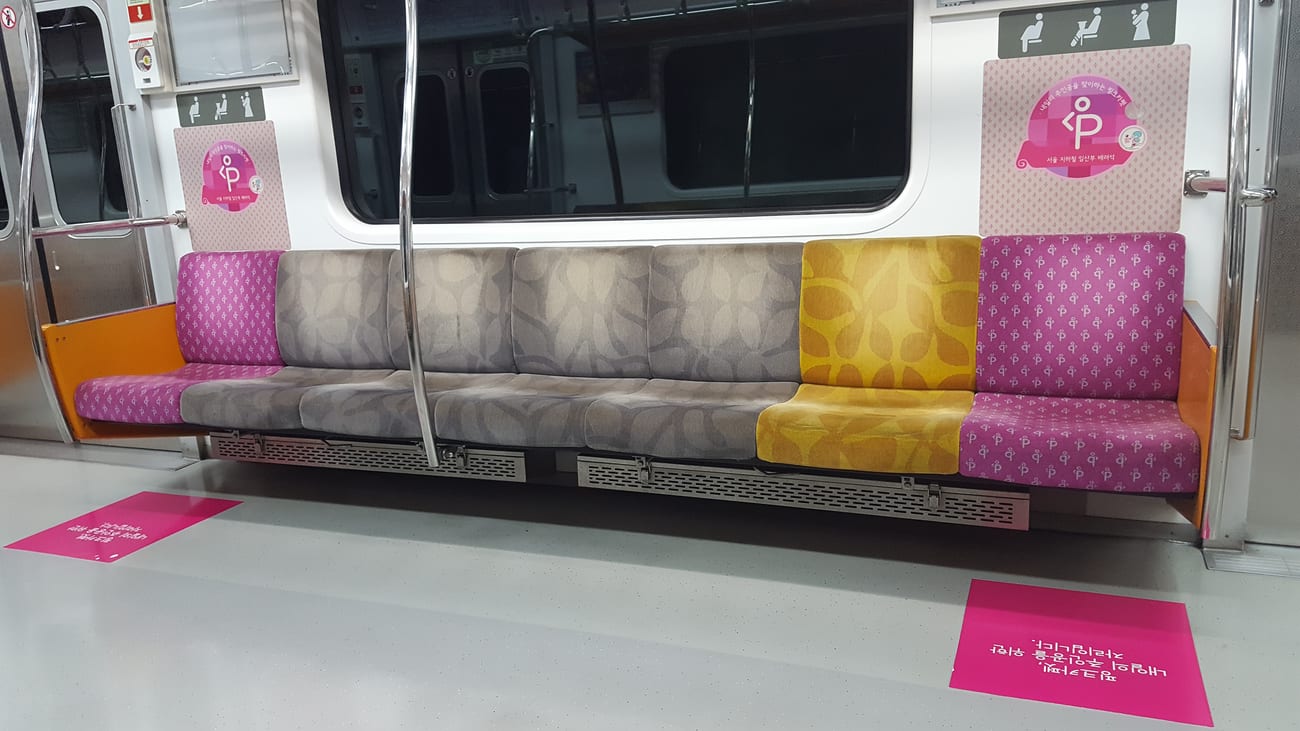
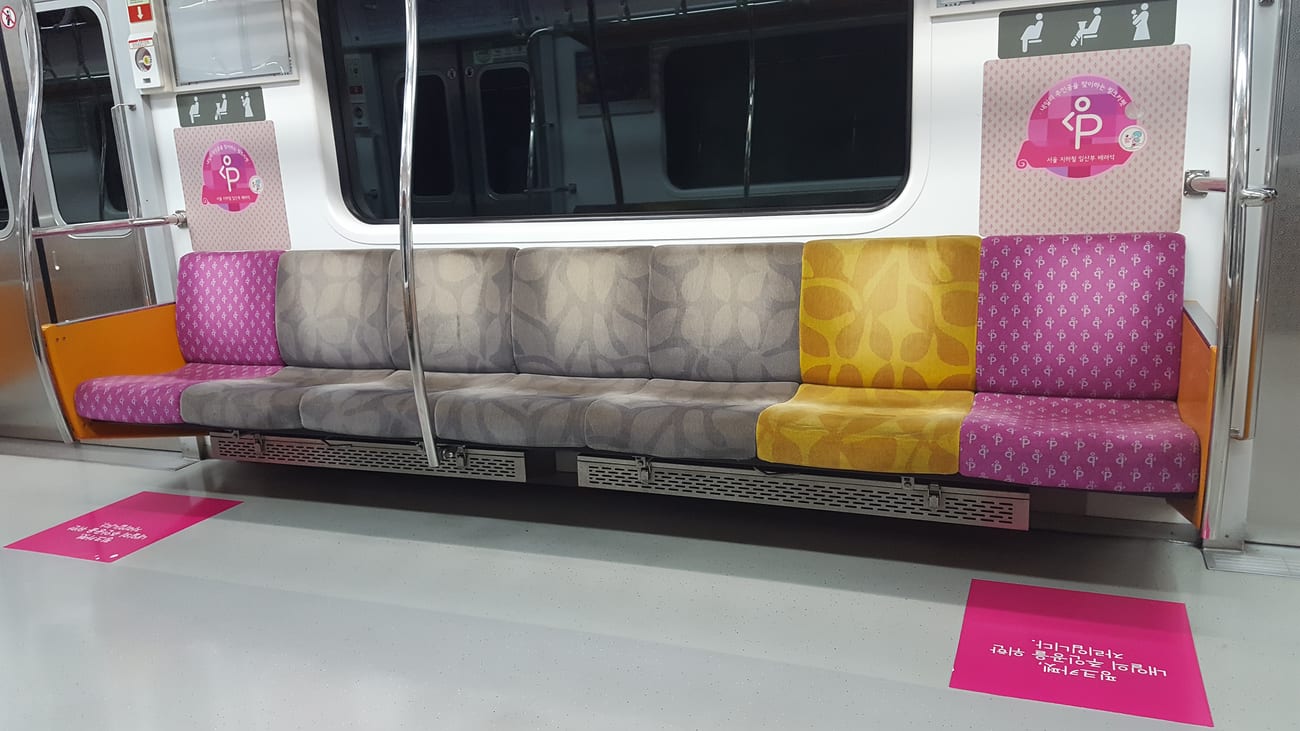
Two: the coloured seats are not one category. Yellow and pink mean different things, and the pink ones are the seats visitors sit in by mistake.
Three: getting the fare wrong is not a small fine. Fare evasion carries the fare plus 30 times the fare as a surcharge.
Everything else is the social rhythm, which matters too. But start with the parts that have numbers attached.
a Korea plug adapter — on AmazonAffiliate link. As an Amazon Associate, EpicKor earns from qualifying purchases at no extra cost to you.
Worth comparing: As an Amazon Associate, EpicKor may earn from qualifying purchases. A practical comparison page for small Korea-trip essentials such as adapters, pouches, tissues, and compact travel items. The one nobody thinks about until the first night is power: Korea runs 220V on Type F sockets, so a US plug will not fit at all. Start with a Korea plug adapter.
See a Korea plug adapter on AmazonThe Escalator Rule Just Flipped Back
Here is the sequence, because the internet is still carrying the 2015 version.
Korea ran a two-line standing campaign (두 줄 서기) for years — stand on both sides, nobody walks. In 2015 the government dropped it. A survey found 65.5% of people preferred one-line standing against 34.5% for two, and officials concluded that walking on escalators was not a direct cause of accidents. One-line standing became the de facto norm, and that is the version every travel article has repeated since.
In April 2026 it came back. The Ministry of the Interior and Safety (행정안전부) and the Korea Elevator Safety Corporation (한국승강기안전공단) built two-line standing into the 1st Basic Plan for Elevator Safety Management (2026–2030) as a headline task. Two reasons were given:
- Falls. Seoul Metro recorded 597 fall incidents inside stations between 2020 and 2024, and 46% of them involved stairs and escalators.
- Cost. Concentrating everyone's weight on one side wears the machinery unevenly and raises maintenance spending.
What this means for you, honestly: nothing is enforced. Officials explicitly said the approach is to build a culture where standing in two lines does not attract social pressure — not to police it. In practice, in August 2026, most Seoul escalators still run one-line with people walking up the left.
So the practical rule is: do not walk up the left if it is crowded, and do not glare at someone standing on the left. The country is mid-argument with itself, and you are not going to be corrected either way. But if you read "always stand right in Korea" somewhere, that advice is now behind the official policy.
You might like: Getting Around Korea in 2026: Subway Fares, Last Trains, KTX Booking, Bus Prices and Which App to Use
The Seats: Yellow Is Not Pink
This is the etiquette mistake visitors make most, and it is easy to avoid once you know there are two categories rather than one.
노약자석 (priority seating) sits at the ends of each car, usually 7 seats, marked yellow and with pictograms for elderly, disabled and injured passengers. The cultural rule is stronger than the sign: these seats stay empty even when the car is packed. A Korean commuter standing in a crush next to three empty priority seats is not being polite for show — that is simply the norm. Sitting there as a healthy adult tourist is the single most visible thing you can do wrong.
임산부 배려석 (designated seating for pregnant passengers) is different. Introduced on Seoul's subway in 2013 (buses got it in 2009), it is marked pink and occupies the two end positions of that priority bank, plus pink floor decals. It exists because early pregnancy is not visible, so a woman who needs the seat cannot rely on someone offering it.
Two things follow that catch people out:
- A pregnant passenger may not look pregnant. Seoul distributes a pink bag charm (임산부 배려 가방고리) reading 임산부 먼저 — "pregnant women first." If you see that charm, that is the signal.
- It is 배려석, not 전용석 — a consideration seat, not legally exclusive. But the social norm treats it as leave-it-empty, and the practical instruction for a visitor is identical: do not sit there.
If you need to sit for a medical reason, sit. Nobody will interrogate you. The advice is about the default, not about denying anyone a seat they need.
Fare Evasion Costs 30 Times the Fare
Not etiquette exactly, but it belongs here because most cases are accidents rather than intent.
Under the operator's passenger tariff, fare evasion is charged the original fare plus a surcharge of 30 times that fare. With the base fare at ₩1,550 in 2026, a single evasion resolves at roughly ₩48,000.
The stated logic is blunt: catching one evader at 30× recovers the revenue lost to roughly 30 who were not caught. Seoul's transport authority also notes that the largest single category of fare evasion — around 80% — is misuse of concession cards, the discounted cards issued to seniors and people with disabilities.
For a visitor, the risk is not deliberate cheating. It is using a card that is not yours, tapping through on someone else's transit card, or riding a section your ticket does not cover. Buy your own card, tap in and out, and this never becomes a conversation.
Related and much friendlier: if you tap in and then realise the toilet is outside the gates, Seoul Metro waives the fare if you tap back in within 10 minutes at the same station on the same line. The full conditions are in EpicKor's public toilets in Korea guide.
Rule 1: Keep Your Voice Low
The first thing visitors notice is the quiet. A rush-hour car can be full and still feel almost silent.
That is not unfriendliness. It is a lot of people commuting, studying, or protecting a small pocket of calm in a long day. Talk with your friend, but softly. Take a call, but keep it short — phone calls are not banned, despite what some guides claim, and Koreans do take them. Long, loud calls are what draws attention, not the fact of a call.
Use headphones for anything with sound. If your voice is the loudest thing in the car, bring it down.
Rule 2: Let People Exit First
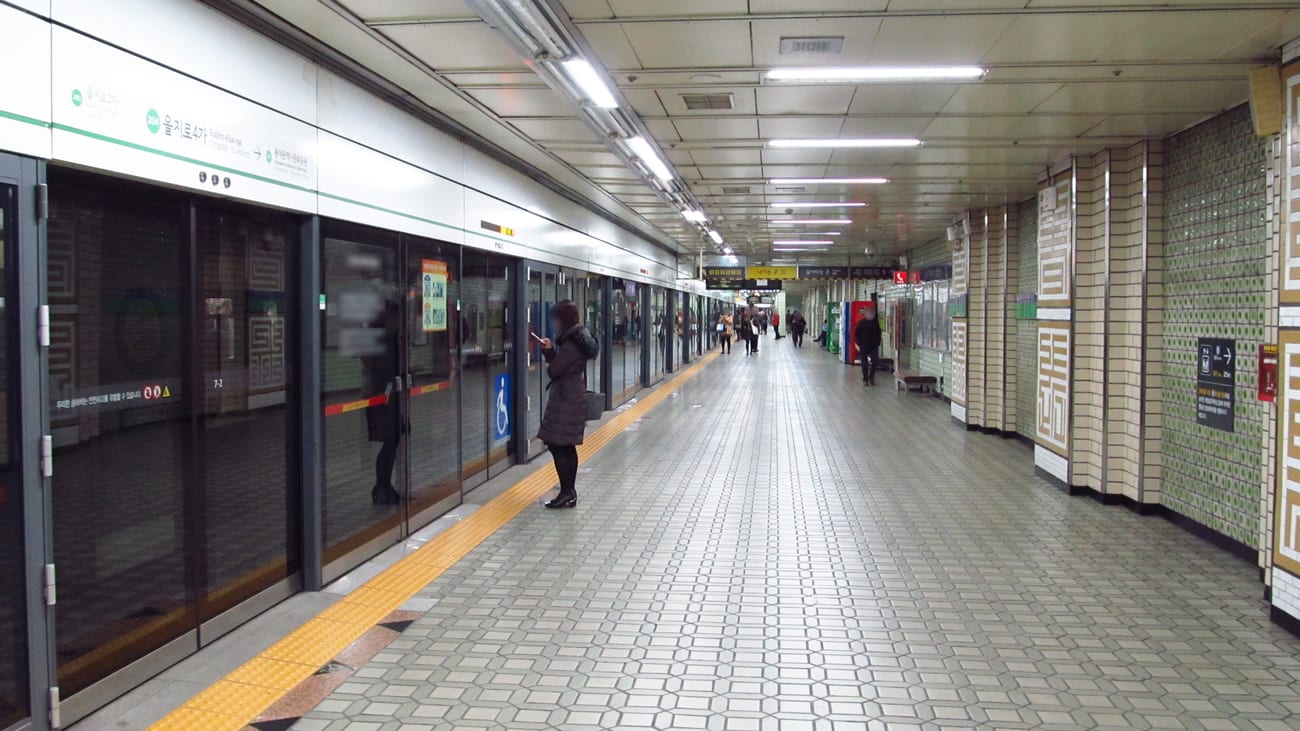
Look at the floor near the platform screen doors. The markings show where to wait and where the exiting stream needs space: stand to the sides, leave the centre open.
Tourists stand directly in front of doors because they are anxious about missing the train. It creates friction in both directions. Wait to the side, let the car empty, then board and move inward rather than stopping in the doorway.
This matters most at the big transfer stations — Sindorim, Express Bus Terminal, Hongdae, Seoul Station, Gangnam, Jamsil, Sadang. The crowd there has direction, and cutting across it slows everyone.
Rule 3: Bags Come Off Your Back
In a crowded car, a backpack worn on your back occupies a person's worth of space that you cannot see.
Take it off and hold it low, or put it on the overhead rack. Rolling luggage goes beside you against a wall or in the space at the car ends, not in the aisle and not where the doors open.
If you are moving between Incheon and the city with large cases, consider the Incheon Airport to Seoul guide — at certain hours the AREX express or a bus is genuinely easier than dragging suitcases through a transfer station.
Rule 4: Food Is About Smell, Not Rules
Seoul's subway has no blanket food ban of the Singapore variety, and you will occasionally see someone drinking coffee. But the working norm is about smell and mess, not calories.
A sealed drink is fine. Hot, aromatic food is not — fried chicken, tteokbokki, anything that fills a car with its own weather. Convenience-store food belongs in the store's seating area or at your destination.
Rule 5: Move With Rush Hour
Weekday mornings roughly 07:30–09:00 and evenings 18:00–19:30 are dense. That is not the time to consult a map in the middle of a transfer corridor or take photos on a platform.
If your schedule is flexible, avoid those windows entirely. If it is not, keep your route decided before you enter the station, stand right of the corridor flow while you check your phone, and step aside rather than stopping mid-stream.
Rule 6: Ask for Help — the System Expects It
Seoul stations are staffed, and station customer centres deal with lost cards, wrong exits, and confused travellers all day. Using the intercom on the platform is normal, not an imposition.
Useful, in order of usefulness:
- 저기요 (jeogiyo) — "excuse me," to get someone's attention
- 화장실 어디예요? (hwajangsil eodiyeyo) — "where is the restroom?"
- 이거 맞아요? (igeo majayo) — "is this the right one?", pointing at your map
Station staff and most riders under 40 will manage some English. The phrase that actually helps is 저기요, because starting the interaction politely does most of the work.
Common Mistakes, Ranked by How Much Anyone Notices
| Mistake | How visible | Fix |
|---|---|---|
| Sitting in a pink or yellow seat | Very — people notice immediately | Stand, or use a grey seat |
| Blocking the door centre | High — causes visible friction | Stand to the side of the markings |
| Loud group conversation | High, especially at rush hour | Lower the volume, not the fun |
| Backpack on in a crush | Medium — felt more than seen | Bag off, held low |
| Strong-smelling food | Medium to high | Eat before or after |
| Walking up the escalator left | Low — still the norm in practice | Stand if it is crowded |
| Taking a short phone call | Low — this is allowed | Keep it brief and quiet |
The ranking matters because visitors often worry about the wrong things. People agonise over whether they can take a call, then sit down in a pink seat.
What Changes and What Does Not
Two of the three specifics above are moving. The escalator campaign has flipped once already and could flip again; the fare rises periodically, and with it the 30× surcharge. The seat colours and the norm around them have been stable for over a decade and are the safest thing to rely on.
The underlying logic does not move at all: Seoul's subway is a shared space that a very large number of people use every day for something other than sightseeing. Almost every rule here is downstream of that. Keep your footprint — sound, space, smell — smaller than you would at home, and you will not have to memorise anything else.
Small things that help: a TOPBAG travel wallet keeps the T-money card in its quick-access front pocket, so you can tap without unpacking a bag at the gate — digging for a card is the single most common cause of a queue behind you.
See TOPBAG travel wallet on AmazonSources Checked
- YTN, government re-promotes two-line escalator standing (April 2026) for the 1st Basic Plan for Elevator Safety Management 2026–2030, the agencies involved, the 597 in-station falls from 2020–2024 with 46% on stairs and escalators, and the stated culture-not-enforcement approach.
- Background on Korea's one-line standing debate for the 2015 policy withdrawal and the 65.5% / 34.5% survey split.
- Korea.kr policy briefing on 임산부 배려석 for the 2013 Seoul subway introduction, the pink-versus-yellow distinction, the position of the seats within the priority bank, and the 임산부 배려 bag charm.
- Seoul city transport explainer on the 30× fare-evasion surcharge for the rule and its rationale.
- Seoul Economic Daily on Seoul subway fare evasion for the share attributable to concession-card misuse.
- Visit Seoul practical information for official visitor guidance on transport manners.
FAQ
Q: Should I stand on the right on Korean escalators?
A: That is the current practice, but not the current policy. Korea dropped its two-line standing campaign in 2015 and restarted it in April 2026 under the 1st Basic Plan for Elevator Safety Management. Nothing is enforced, so stand right if people are walking, and do not treat standing on the left as rude.
Q: What do the pink seats on the Seoul subway mean?
A: They are 임산부 배려석, designated for pregnant passengers, introduced on the subway in 2013. They are the two end positions of the priority bank and are marked pink, along with pink floor decals. Do not sit in them.
Q: What is the difference between the yellow and pink seats?
A: Yellow is 노약자석 — general priority seating for elderly, disabled and injured passengers. Pink is specifically for pregnant passengers. Both are treated as leave-empty by local norm, even on a packed train.
Q: Can I take a phone call on the Seoul subway?
A: Yes. Calls are not banned and Koreans take them. Keep it short and quiet. Long or loud calls are what draws attention.
Q: Can I eat on the Seoul subway?
A: There is no blanket ban, but the working norm is about smell and mess. A sealed drink is fine; hot aromatic food is not.
Q: What happens if I get the fare wrong?
A: Fare evasion is charged the fare plus a surcharge of 30 times the fare — around ₩48,000 at the 2026 base fare of ₩1,550. Most cases involve misusing a concession card rather than deliberate evasion, so use your own card and tap in and out.
Q: Do I need to give up my seat to older passengers?
A: In general seating it is appreciated but not obligatory, and many older riders will decline. The stronger rule is simply not to occupy the priority and pink seats in the first place.
Q: Is the Seoul subway hard to use without Korean?
A: No. Signs, announcements, and station numbering are in English, and exits are numbered consistently. The etiquette, not the navigation, is the part worth reading ahead about.
You Might Also Like

Korean McDonald's: Why the Burgers Are Named After Farm Counties, and What to Order Now
McDonald's Korea has bought 459.2 tonnes of named Korean produce since 2021 and prints the county on the burger — Changnyeong garlic, Jindo spring onion, Jinju pepper. 24 million sold, ₩61.7 billion of measured regional value. Here is what is on the menu now.
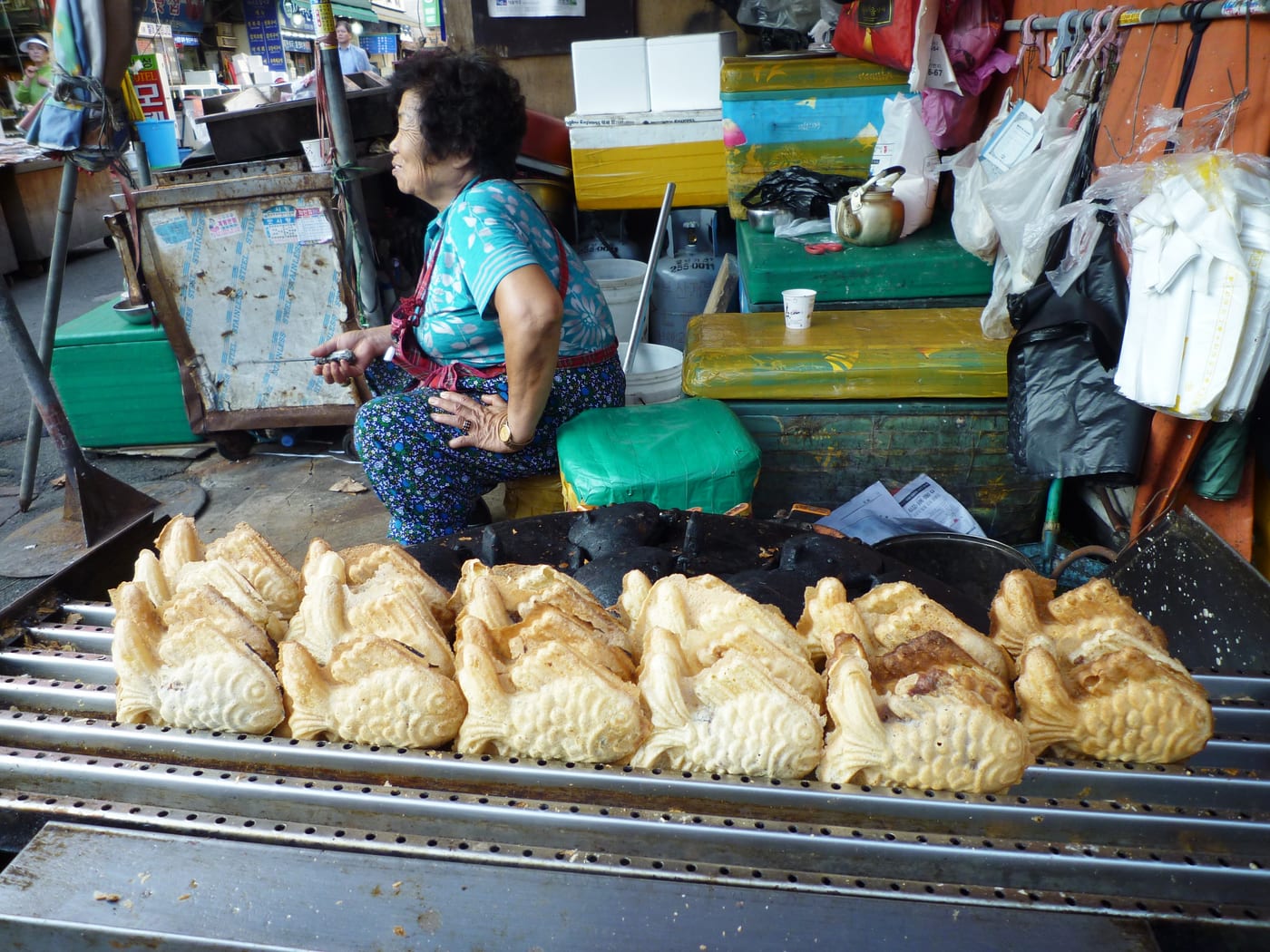
Cham Bungeoppang: The Korean Fish Snack That Is Four Different Fish Abroad
붕어빵 is a winter street food you have to find a cart for. Orion boxed it in 2011, released it in May on purpose, and sold 640 million packs — then renamed it after a different fish in China, Vietnam and Russia.
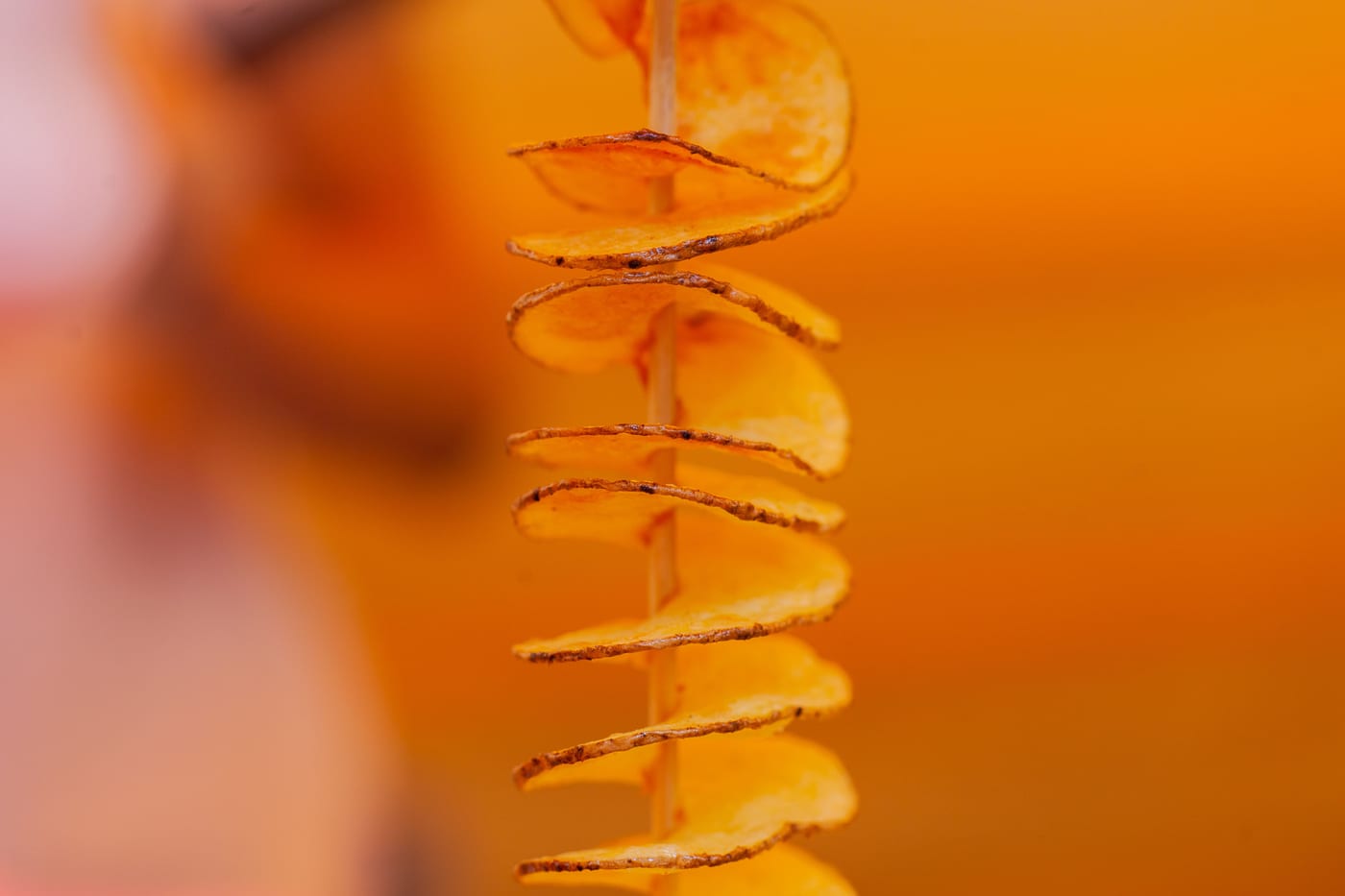
Tornado Potato: The Korean Invention Everybody Thinks Is Generic Fair Food
The spiral potato on a stick has a named inventor, a debut date in Myeongdong, and patents in six jurisdictions. 회오리감자 was designed in Korea in 2006, and the word itself is a trademark — which is why Korean vendors write 스프링감자 instead.