Badacoconut: The Korean Biscuit That Survived by Spelling Its Own Name Wrong
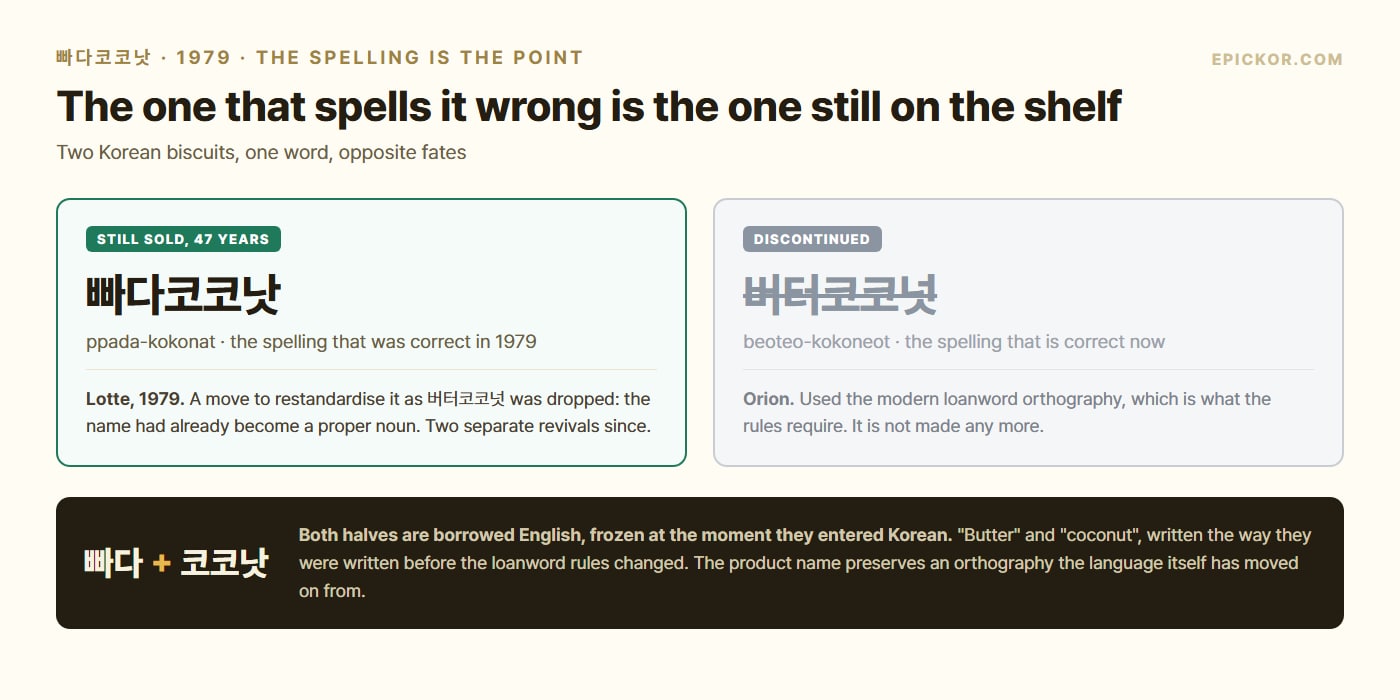
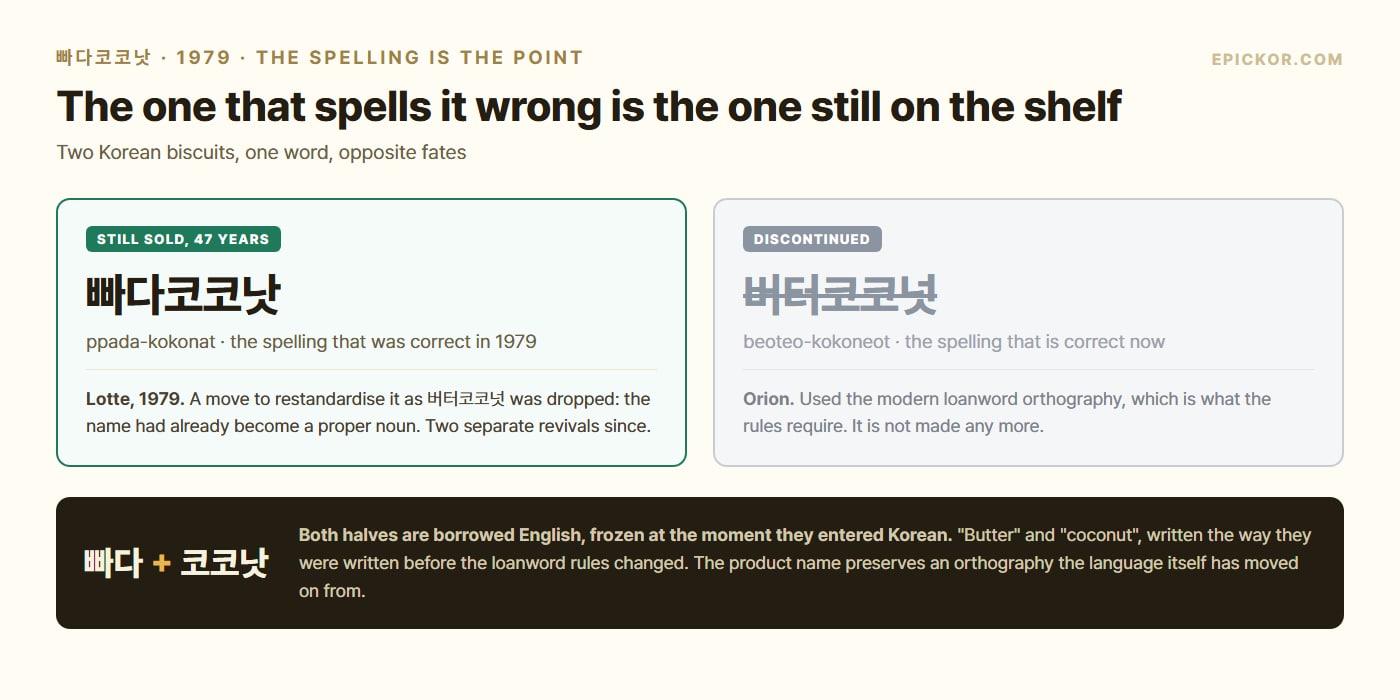
On the shelf of any Korean supermarket there is a long silver packet of pale, ridged, rectangular biscuits called 빠다코코낫. Ask a Korean what it means and you will get a small pause, because the honest answer is that it means butter coconut — but it does not say butter coconut. It says something closer to "ppada koconat."
That is not a typo, and it is not a brand-name pun. It is what those two English words looked like in Korean in 1979, before the loanword rules were tightened. The biscuit has simply refused to update.
And here is the part that makes it worth an article: Orion once sold the same kind of biscuit under the modern, correct spelling — 버터코코넛 — and it is discontinued. The one that got it wrong is 47 years old and has had two separate national revivals.
| Korean name | 빠다코코낫 |
|---|---|
| What it means | Butter + coconut, in pre-standard loanword spelling |
| Standardised form | 버터코코넛 — never adopted for this product |
| Maker | Lotte (now Lotte Wellfood) |
| Launched | 1979 |
| What it is | Rectangular butter biscuit with minced coconut, a starch-syrup glaze, stamp-style scalloped edges and roughly 17–18 holes |
| Current box | 78 g, 395 kcal · 가당볶음코코넛분말 6.7% · 버터 1%, 프랑스산 |
| Price | ₩1,700 for the 100 g pack at Emart24, listed as a 2+1 promo item (Korean convenience-store price tracker, 2026) |
| Eat it with | Coffee. This is not optional advice — see below |
The Spelling Is the Whole Story
Butter Coconut biscuits (빠다코코넛), 2 packs — on AmazonAffiliate link. As an Amazon Associate, EpicKor earns from qualifying purchases at no extra cost to you.
Korean writes borrowed words by rule, and the rules have changed. Modern standard Korean writes English butter as 버터 and coconut as 코코넛. In 1979 the accepted rendering was different, and 빠다코코낫 was simply how you wrote it.
Then the rules moved and the product did not. Korean reference sources record an attempt to restandardise the name to 버터코코넛 during a push for correct orthography — and it was dropped, because by then 빠다코코낫 had stopped being a description and become a proper noun. Renaming it would have thrown away the only thing a 40-year-old biscuit has.
So the packet is now a small piece of preserved language: two English words, written the way Korea wrote them at a specific moment, kept alive commercially long after the spelling died everywhere else.
Orion's version demonstrates the cost of being right. Orion sold a 버터코코넛 using the current standard orthography. It is no longer made.
You might like: Nunettine: The Korean Snack Whose Real Name Is Italian
What You Are Actually Eating
It is a butter biscuit with coconut in it, and the details are specific enough to check against the packet in your hand.
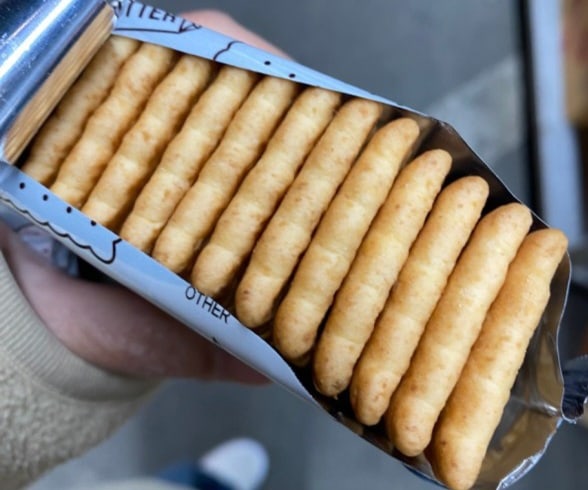
The shape is a rectangle with scalloped edges — Korean descriptions compare it to the perforated border of a postage stamp — and the face carries roughly 17 to 18 holes, docked to stop the dough puffing in the oven.
The surface is glazed with 물엿, starch syrup, which is why it looks faintly wet and catches the light. Mixed into the dough is finely minced coconut flesh, not just coconut flavouring, and the butter is laid on heavily.
Two consequences follow, and Korean commentary is blunt about both. It is noticeably sweeter than Ace, Korea's other national plain biscuit. And it makes you thirsty — Koreans rank it with 버터링 as one of the two great thirst-inducing biscuits, which is why the standing advice is to eat it with coffee rather than alone.
It is also a fixture of Korean military life, for the same practical reason as most snacks that end up there: it is dry, dense and does not fall apart.
Korea Was the Fourth Stop, Not the First
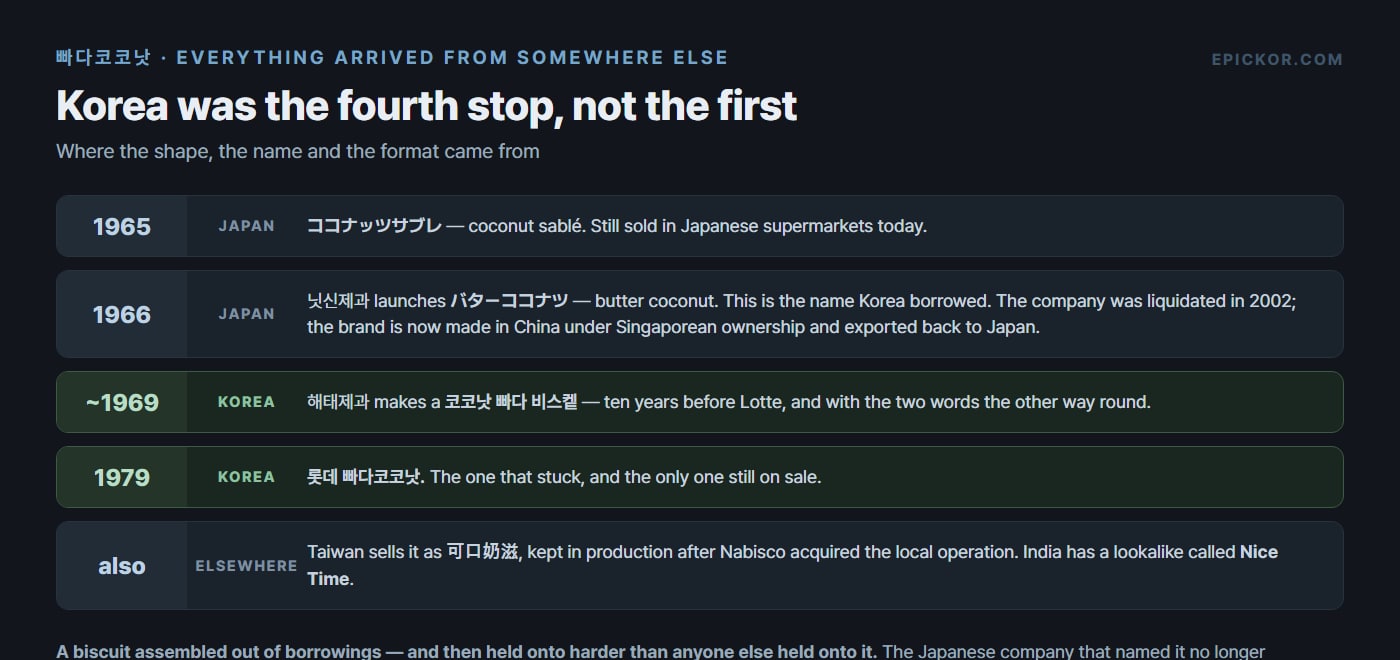
The name is borrowed English. The biscuit itself is borrowed too, and Korean reference sources are matter-of-fact about it.
The format traces to Japan. A coconut sablé — ココナッツサブレ — appeared in 1965, and the following year 닛신제과 (Nisshin Seika) launched バターココナツ, "butter coconut." That is the name Korea took. The Japanese company expanded hard, opening plants in Taiwan and China, and was liquidated in 2002; the brand passed to a Singaporean owner and is now produced in China and exported back into Japan's hundred-yen shops.
In Korea, Lotte was not even first. Around 1969, ten years before 빠다코코낫, 해태제과 made a 코코낫 빠다 비스켙 — the same two loanwords, in the other order.
The biscuit spread further than either. Taiwan sells it as 可口奶滋, kept in production after Nabisco acquired Nisshin's local operation, and India has a near-identical biscuit called Nice Time.
So the object in your hand is a Japanese format with an English name, arrived in Korea second-hand, in a spelling that was already on its way out. And it has outlived the company that named it.
You might like: Korean Custard Cake: Lotte Invented It, Orion Copied It
Lotte sells it abroad as Butter Coconut — the name is romanised out of existence, which is its own small joke given that this article is about how the product survived by spelling itself wrong. Worth tasting against the Japanese and British biscuits it descends from before deciding which one you actually want in the cupboard. The in-stock listing is an importer's two-pack under the Korean name 빠다코코넛; check the pack weight on the listing. As an Amazon Associate, EpicKor earns from qualifying purchases at no extra cost to you.
Butter Coconut biscuits (빠다코코넛), 2 packs, on Amazon
See Butter Coconut (빠다코코넛) on Amazon앙빠: How a Biscuit for Dads Got 20-Somethings Back
By the 2010s 빠다코코낫 had the demographic problem every legacy snack has: the people who loved it were the people who had always loved it. Korean commentary called it 아재 입맛 — a middle-aged man's taste.
Then 앙빠 happened, and it happened without Lotte.
Korea had been in the middle of an 앙버터 craze — 앙금 (sweetened red bean paste) plus a slab of cold butter, sandwiched in bread, sold in cafés everywhere. Someone swapped the bread for a 빠다코코낫. The biscuit's snap works better against cold butter than soft bread does, the size is right for a single dessert, and it keeps far longer. It started as a menu item in a handful of Seoul cafés, moved to social media as a recipe, and turned into thousands of posts.
The commercial result, reported in August 2018: 빠다코코낫 sales up 30% over three months year on year, and the large packs up more than 50%.
Lotte's response is the interesting bit. The company caught the spike through an AI trend-analysis system it calls 엘시아 (LCIA), made 앙빠 content on its own channels, and then did something a manufacturer rarely does — printed the 앙빠 recipe on the back of the packet. A Lotte representative said the effect was to pull the eating demographic down toward women in their twenties and thirties.
If that pattern sounds familiar, it should. Eight years later the same company caught a different viral recipe with a different trend system and shipped a Dubai-style Chaltteok Pie in about three months. Lotte has now done this twice, with two legacy products, and it is clearly no longer improvising.
What It Costs, and How Koreans Actually Eat It
The 100 g pack runs ₩1,700 at Emart24, where a Korean convenience-store price tracker lists it as a recurring 2+1 promotion item — which brings the effective unit price to about ₩1,133. Supermarkets carry larger boxes and a 78 g size exists as well. This has never been an expensive biscuit and it is not one now.
It has been reformulated more than once, and the current box declares different things from the one people remember.
In 2016 Lotte released a new빠다코코낫 with the processed-butter content raised from 2.9% to 3.3% and the coconut powder from 4.6% to 5.0%, with the recommended retail price moving from ₩1,200 to ₩1,400.
The box on shelves now has moved again. The 78 g pack states 395 kcal and declares 가당볶음코코넛분말 6.7% — sweetened roasted coconut powder, itself 69% dried coconut — and 버터 1%, with a 프랑스산 버터 flash on the corner: French butter, called out as a selling point.
Two things to take from that. The coconut is no longer a flavouring percentage in the low single digits but a named 6.7% roasted-and-sweetened preparation. And the butter is now real butter, declared at 1% and sourced abroad, rather than the processed butter of the 2016 formula. If you remember this biscuit tasting different at some point, you are not imagining it.
Three ways Koreans eat it:
With coffee, plain. The default. The thirst issue is real and coffee solves it.
As 앙빠. Red bean paste and a cold slice of butter between two biscuits. The recipe is on the back of the packet.
Dunked, briefly. The starch-syrup glaze means it holds together longer in hot liquid than a dry biscuit would, but not indefinitely.
Honest Notes
It is genuinely sweet and genuinely rich, and that limits how many you can eat. Korean reviewers describe getting sick of it quickly when eating it alone, which is unusual candour about a snack people are fond of. Buy the small pack first.
The "correct" name would be 버터코코넛. If you are learning Korean, do not take this packet as a spelling guide — it is a historical artefact, and writing 빠다 for butter in any other context will read as either dated or dialectal.
It has almost no coconut aroma when cold and stale. The coconut is minced flesh in the dough rather than a top note; a packet that has been open for a week loses most of it. Reseal it properly.
The 2018 sales figures are the manufacturer's own and cover a three-month window against the same period a year earlier, during a viral trend. They show a real effect, not a permanent level.
Lotte has leaned on the brand outside biscuits — an apparel collaboration with a Korean fashion label, and a 빠다코코낫 doughnut with Krispy Kreme. If you see the name on something that is not a biscuit, that is why.
To try 앙빠 properly you need the red bean paste, and the sweetened Korean and Japanese pastes are not interchangeable with plain cooked beans — the sugar is doing structural work against the cold butter.
FAQ
Q: What does 빠다코코낫 mean? A: Butter coconut. Both words are borrowed English, written in the loanword orthography that was standard when the biscuit launched in 1979. The modern spelling would be 버터코코넛.
Q: Why is it spelled the old way? A: There was a push to restandardise it and it was abandoned, because the name had already become a proper noun. Orion's correctly spelled 버터코코넛 is discontinued.
Q: Is it a Korean invention? A: No, and Korean sources say so plainly. Japan had a coconut sablé in 1965 and Nisshin Seika's バターココナツ in 1966; Haitai made a Korean version around 1969, a decade before Lotte's.
Q: What is 앙빠? A: Red bean paste and cold butter sandwiched between two 빠다코코낫 — the 앙버터 café dessert with the bread swapped out. It drove a 30% sales rise in 2018 and the recipe is now printed on the packet.
Q: How much is it? A: About ₩1,700 for the 100 g pack at Emart24, frequently on 2+1, per a Korean convenience-store price tracker in 2026.
Sources Checked
- Korean-language reference sources for the 1979 Lotte launch, the composition of the name from 버터 and 코코넛 in the orthography current at launch, the abandoned attempt to restandardise it as 버터코코넛, Orion's discontinued 버터코코넛, the starch-syrup glaze and minced coconut flesh, the comparison with Ace and 버터링, the military-canteen popularity, Japan's 1965 ココナッツサブレ and 닛신제과's 1966 バターココナツ together with that company's 2002 liquidation and the brand's later Chinese production under Singaporean ownership, 해태제과's 코코낫 빠다 비스켙 around 1969, the Taiwanese 可口奶滋 under Nabisco, India's Nice Time, and the 2016 new빠다코코낫 reformulation from 2.9% to 3.3% processed butter and 4.6% to 5.0% coconut powder with the recommended price moving from ₩1,200 to ₩1,400.
- The current product box for the 78 g / 395 kcal declaration, 가당볶음코코넛분말 6.7% (건조코코넛분말 69%), 버터 1%, and the 프랑스산 버터 flash.
- Korean Wikipedia for the rectangular form with scalloped stamp-style edges and roughly 17–18 holes.
- Korean food trade press (30 August 2018) for the 앙빠 phenomenon: its origin as a café menu item, the swap from 앙버터 bread to the biscuit, the roughly 30% three-month year-on-year sales rise with large packs above 50%, Lotte's 엘시아 (LCIA) AI trend-analysis system detecting the buzz, the decision to print the recipe on the back of the pack, the shift in eating demographic toward women in their twenties and thirties, and the Jill by Jill Stuart apparel and Krispy Kreme doughnut collaborations.
- Korean convenience-store price tracking for the ₩1,700 Emart24 price on the 100 g pack and its recurring 2+1 promotion.
Korean snack prices vary by channel and promotion. Verified August 2026.
You Might Also Like
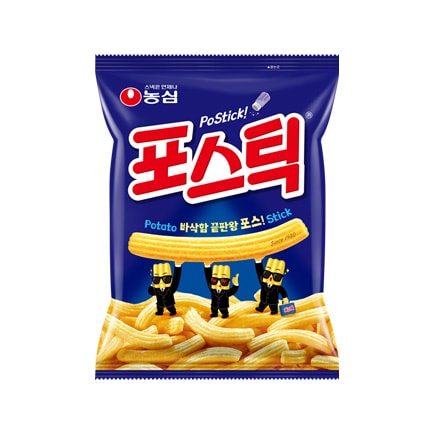
Postick: The Korean Snack That Used to Come With a Ketchup Packet
Postick (포스틱) has been on Korean shelves since 1980, it is only 23% potato, and it shipped with a ketchup sachet until the sachet got too expensive. What it costs now, and the ramyun-powder trick Koreans use on it.
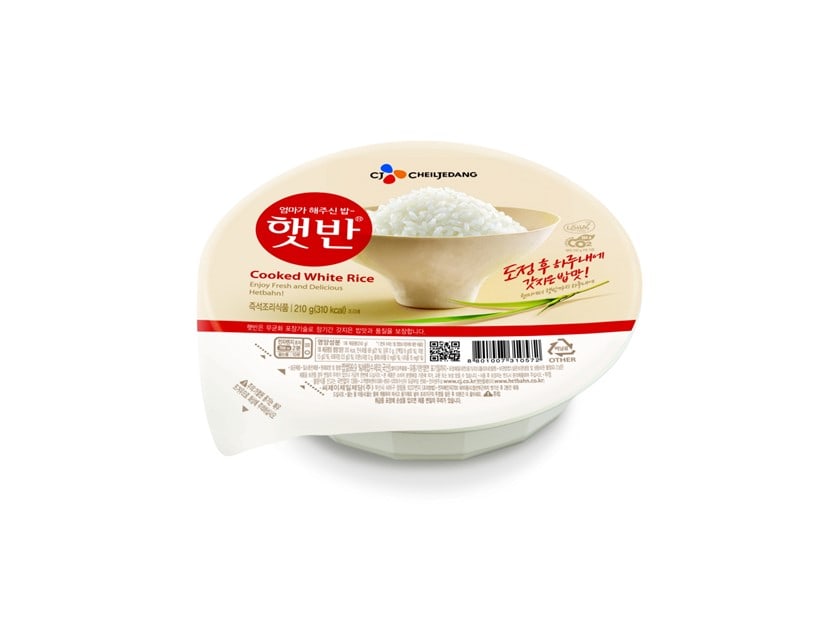
Hetbahn: What Korea's Instant Rice Is Made Of, and How to Heat It Without a Microwave
햇반 is 99.9% Korean rice and water plus 0.1% rice bran extract, sealed in a room cleaner than a hospital ward. The lid prints three cooking times and one of them needs no microwave at all. Prices, varieties, and the mistake almost everyone makes with the film.
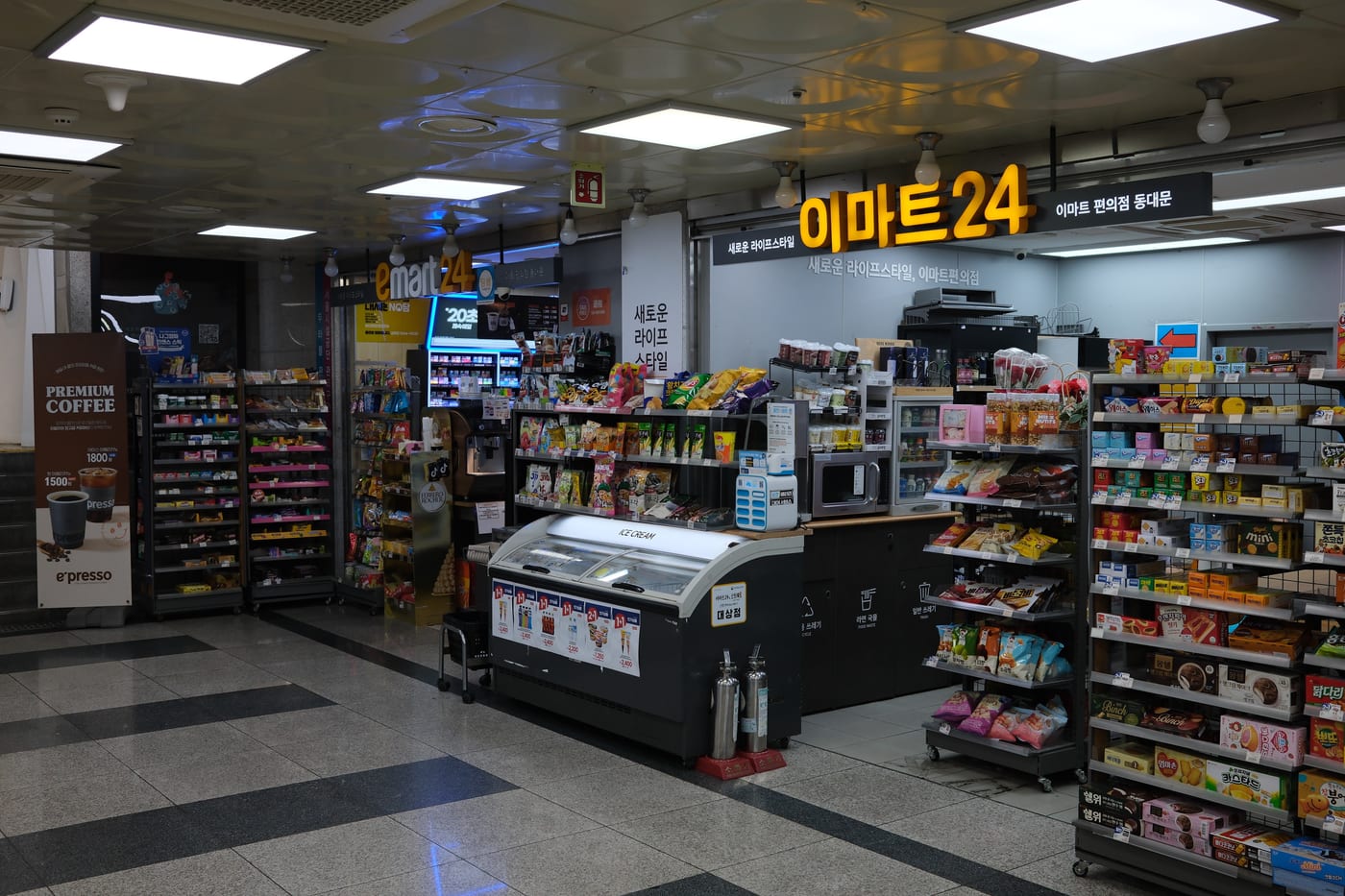
Korean Food Prices in August 2026: What Already Rose, and What Changes on the 25th
Four Korean food makers raised prices within three weeks, and Paris Baguette's 127-item increase lands on 25 August. The exact brands, dates and won amounts, why wheat and corn are behind it, and what it actually changes for a visitor.