Nunettine: The Korean Snack Whose Real Name Is Italian
Last updated: 19 August 2026
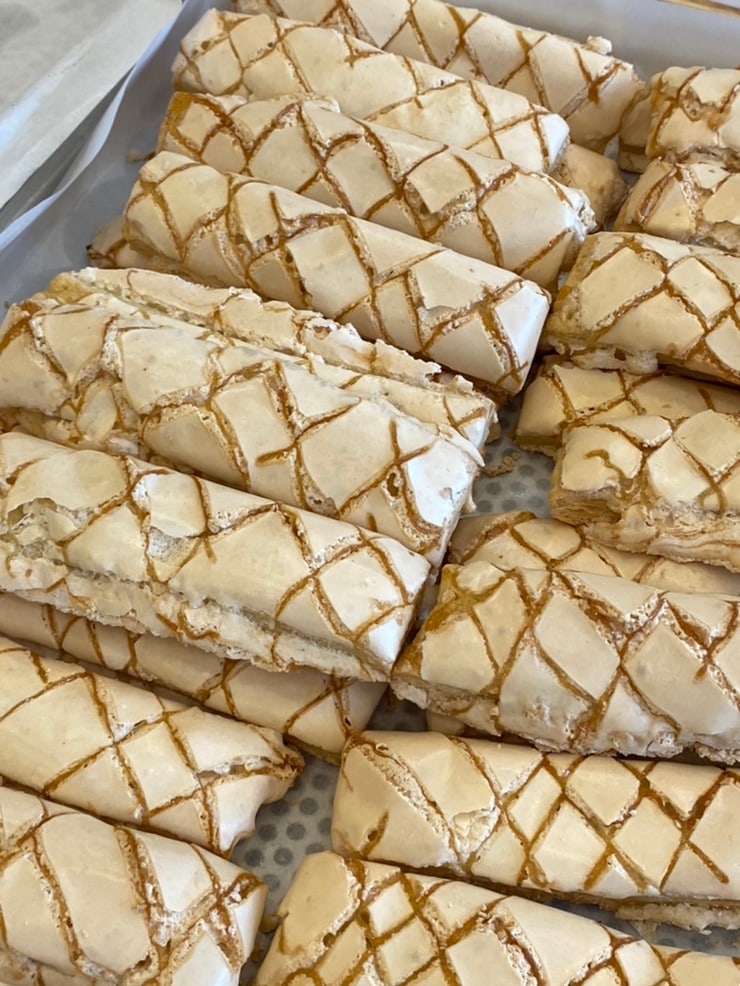
There is a Korean snack in every supermarket, every convenience store and most bakery aisles that almost nobody in Korea can explain the name of. It is a flat rectangle of puff pastry, glazed white on top, with thin caramel-coloured lines piped across it in a lattice.
It is called 누네띠네 (Nunettine), and the name is doing two things at once in two different languages.
Half of it comes from sfogliatine glassate, an Italian pastry the product is directly modelled on. The other half is 눈에 띄네 (nun-e ttwi-ne) — Korean for "it catches the eye." Say the product name out loud and you are saying both.
Korean media periodically runs the fact as a surprise — one headline put it as "90% of Koreans don't know" — which tells you how well the joke is hidden. Here is the original, the pun, and what to do with it in a shop.
| Detail | |
|---|---|
| Korean name | 누네띠네 (Nunettine) |
| Maker | SPC 삼립 (Samlip), since August 1992 |
| What it is modelled on | Sfogliatine glassate — small glazed Italian pastries |
| The Italian original | Puff pastry, meringue on top, apricot jam piped in lines, baked |
| The pun | 스폴리아티네 (sfogliatine) + 눈에 띄네 ("it catches the eye") |
| Calories | 61 kcal per 12 g piece — a 100-piece box is 6,100 kcal |
| Typical price | Around ₩6,000 for a 100-piece box on open markets |
| What is in it | Essentially palm oil, wheat flour and sugar |
| The odd part | The brand name is now the generic term in Korea |
If you only remember one line: it is an Italian pastry wearing a Korean pun, and the pun is why nobody questions it.
The Italian Original Is the Same Object
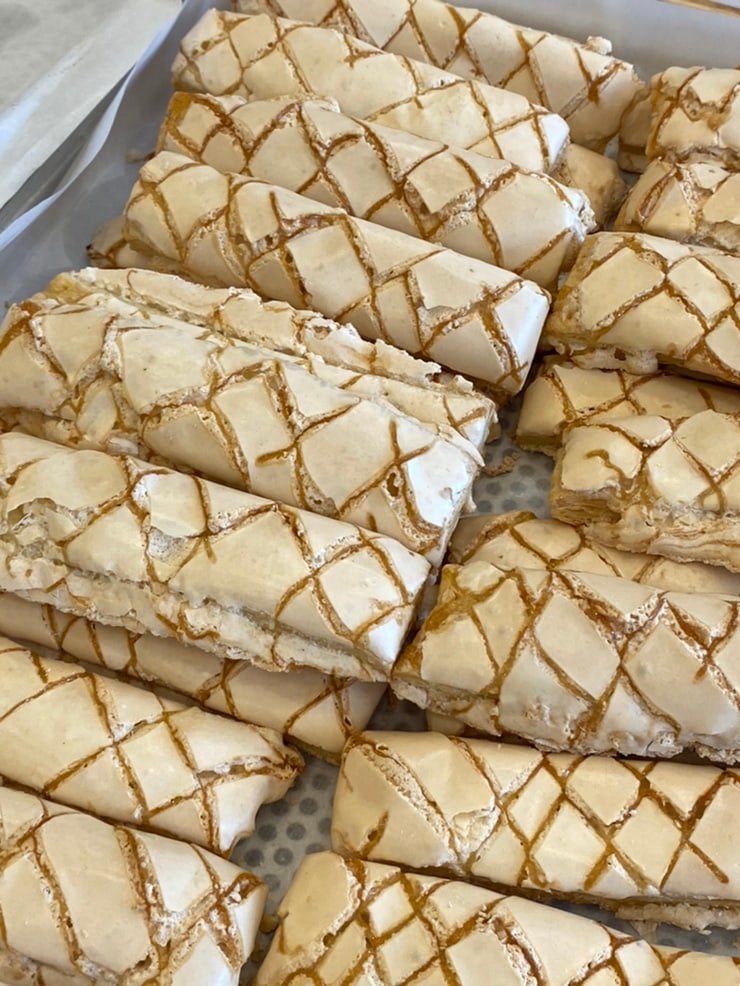
Look at the photo above and then at a bag of 누네띠네 and the argument makes itself.
Sfogliatine glassate breaks down cleanly in Italian. Sfoglia is a sheet of pastry; sfogliatine is the diminutive — small pastries made of layered sheets. Glassate means glazed, finished so the surface is smooth like ice. Put together: small glazed layered pastries.
The construction is puff pastry with meringue spread over the top and apricot jam piped across it in lines before baking. That lattice you see on every Korean one is not decoration invented in Seoul in 1992. It is the Italian recipe.
So the honest framing of this product is not "Korean snack" in the way 새우깡 is a Korean snack. It is a European pastry industrialised for the Korean shelf — shelf-stable, individually wrapped, and sold in a 100-count box.
The Name Is a Bilingual Pun
This is the part worth the article.
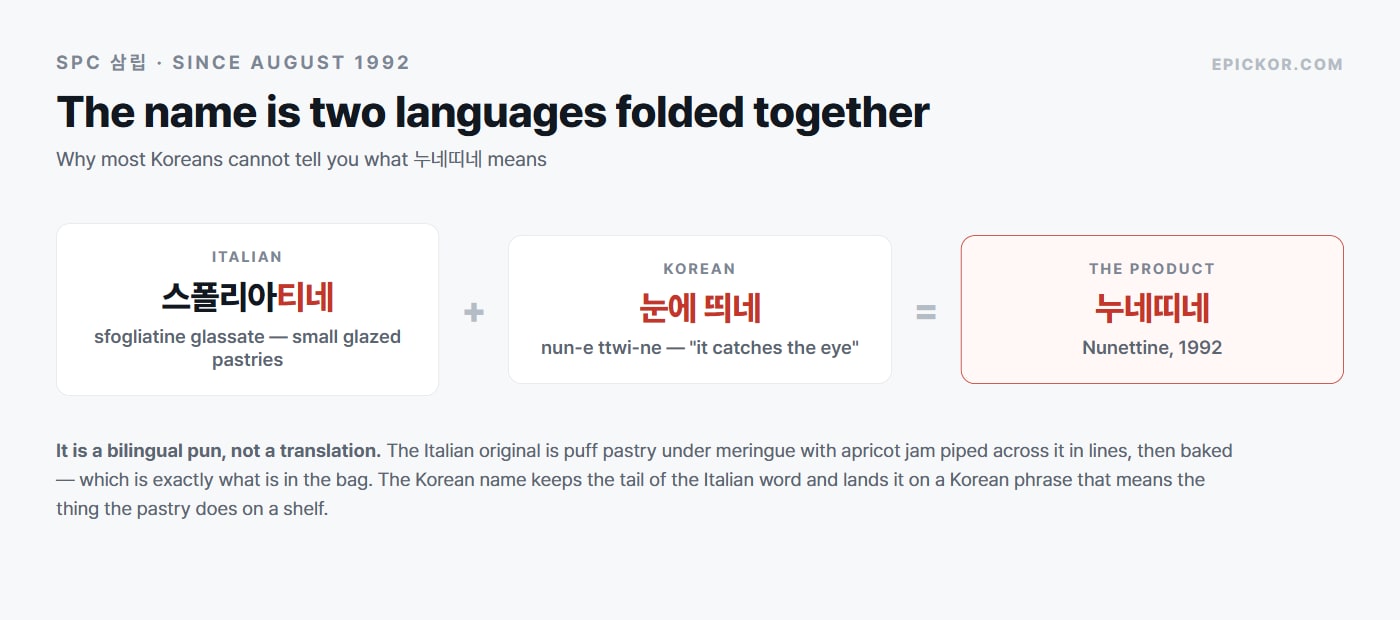
Take 스폴리아티네 — the Korean transliteration of sfogliatine — and keep the tail, 티네. Then take the Korean sentence 눈에 띄네, which any Korean says without thinking and which means it stands out, it catches the eye. Twist the two together and you get 누네띠네.
It is a genuinely good piece of naming, and its cleverness is exactly why it disappears. A Korean shopper hears something that sounds like a foreign confectionery word and something that sounds like an ordinary Korean remark, and the brain accepts it as a brand without asking further. Thirty-four years later most people have never separated the two halves.
Which is also why the English-language internet has almost nothing on it. The name is not translatable — half of it only works in Korean, and the other half only works if you know the Italian.
It Became the Word for the Whole Category
There is a second story here, and it rhymes with Kimbap Cheonguk.
In Korea, every pastry of this type is now called 누네띠네, whoever made it. CU and GS25 both sell private-label versions. Paris Baguette sells a long 108-layer stick that is an OEM version of the same idea. None of them is the Samlip product, and Koreans call all of them 누네띠네 anyway.
That is what genericisation looks like: the brand won so completely that it stopped being a brand and became the noun. It is a commercial triumph and a trademark problem in the same fact — the same shape as the 김밥천국 story, arrived at from the opposite direction. One name could never be owned; this one was owned and then dissolved into the language.
For a shopper the practical effect is simple. If somebody tells you to buy 누네띠네, they may not mean the Samlip bag. They mean the thing.
You might like: Kimbap Cheonguk: Korea's Most Common Restaurant Name Belongs to Nobody
Why an Italian Pastry, in 1992
The date explains more than the recipe does.
Korea in 1992 was four years past the Seoul Olympics and in the middle of deciding that foreign food was aspirational rather than suspicious. Confectioners were combing European bakery cases for things that could survive being made by a machine and sitting in a warehouse — which is a narrow filter. Cream fails it. Chocolate fails it in a Korean summer. Layered pastry under a hard sugar glaze passes it easily, because the glaze is a seal and the pastry has almost no water in it.
So sfogliatine glassate was close to an ideal candidate: it looked European, it read as a bakery item rather than a factory snack, and it happened to be built out of the three cheapest stable inputs in the industry.
What Samlip added was the name, and the name is the reason it stuck rather than being one more forgettable import. A product called 스폴리아티네 글라사테 would have sat on the shelf being unpronounceable. A product called 누네띠네 sounds like it is already Korean, and slightly like a compliment.
That is the whole trick, and it is why this snack is a better story than its ingredients deserve. The pastry is Italian and industrial. The product is the pun.
What It Costs and What Is In It
| Figure | |
|---|---|
| One piece | 12 g, about 61 kcal |
| A 100-piece box | roughly ₩6,000 on open markets |
| Calories in that box | 6,100 kcal |
| Main ingredients | Palm oil, wheat flour, sugar |
| Convenience-store single pack | Higher per gram than the box, as always |
Two things stand out from that table.
The per-piece calorie count is higher than it looks. Twelve grams is a small object — you can eat one in two bites — and 61 kcal for two bites is a dense number. Korean nutrition writing about it is blunt: for its volume this is a lot, because the product is fundamentally palm oil, flour and sugar with air folded in.
The box is the sane way to buy it. At roughly ₩6,000 for a hundred pieces this is one of the cheapest per-unit snacks in a Korean supermarket, which is precisely why it lives in offices, in the back of cupboards, and at every event where somebody has to feed thirty people something.
Building a Korean snack box? 누네띠네 is the one to add if the box is already full of sweet-and-crunchy and needs something plain — it is closer to a European bakery biscuit than to anything else on a Korean shelf. As an Amazon Associate, EpicKor earns from qualifying purchases at no extra cost to you.
How to Eat It, and What It Is Not
It is not a cookie and it is not a wafer. The texture is layered pastry — it shatters into flakes rather than snapping or dissolving. If you bite it over a keyboard you will regret it, which is the one genuine practical warning about this product.
The glaze is the sweetness. The pastry itself is barely sweet; almost all of the sugar is in the white glassing on top and the jam lines. This is why it works with coffee and works badly with anything else sweet.
Koreans eat it with black coffee or barley tea. Not with milk, and not as a dessert after a meal — it is a mid-afternoon object, which is a category Korea takes seriously.
Do not refrigerate it. Puff pastry goes soft and leathery in a fridge, and the glaze sweats. Room temperature, sealed, and eat the packet within a few days of opening.
Honest Notes
It is nutritionally unremarkable and Korean sources say so. Palm oil, flour and sugar, high calorie density for its size. This is a treat, not a snack you eat because it is light — the flakiness makes it feel lighter than the numbers say.
The Korean version is sweeter and drier than the Italian. That is what industrialising a bakery item for a twelve-month shelf life does. If you have eaten sfogliatine in an Italian bar, expect a related object rather than the same one.
Brand confusion is real. Because the name is generic, the bag you pick up may be a convenience-store private label. That is not a scam and the quality is broadly similar, but if you specifically want the 1992 original, look for 삼립 on the packet.
There is no romanised name to search for. Almost nothing in English uses "nunettine," and searching "Korean sugar biscuit" will return 달고나 from Squid Game instead. If you want to find it abroad, search the Italian term — sfogliatine glassate — which is what it actually is.
Or buy the original it came from. The Italian pastry the Korean product copies is sold under its own name abroad, and comparing the two side by side is the fastest way to understand what industrialising a bakery item actually changes.
You might like: Kancho: The Korean Biscuit With 504 Names Printed On It, One Per Piece
FAQ
Q: What does 누네띠네 mean? A: It is a pun in two languages. It keeps the tail of 스폴리아티네 — the Korean spelling of the Italian sfogliatine — and folds it onto 눈에 띄네, a everyday Korean phrase meaning "it catches the eye."
Q: Is it Korean or Italian? A: The product is Korean, made by SPC 삼립 since August 1992. The thing it is a version of is Italian: sfogliatine glassate, puff pastry with meringue and apricot jam lines.
Q: Why do Koreans call every brand of it 누네띠네? A: The name became generic. CU, GS25 and Paris Baguette all sell versions, and Koreans use the Samlip brand name for all of them.
Q: How many calories is one? A: About 61 kcal for a 12 g piece. A 100-piece box comes to roughly 6,100 kcal, which is a useful number to know before leaving one open on a desk.
Q: How do I find it outside Korea? A: Search the Italian name, sfogliatine glassate. "Nunettine" barely exists in English, and "Korean sugar biscuit" will send you to 달고나 instead.
Sources Checked
- Korean-language reference sources for the SPC 삼립 August 1992 launch, the full etymology combining 스폴리아티네 글라사테 with 눈에 띄네, the composition of the Italian original (puff pastry, meringue, apricot jam lines), the 12 g / 61 kcal figure and the 100-piece box, the generic-term status, and the CU, GS25 and Paris Baguette versions.
- Korean consumer media for the framing that the name's origin is unknown to most Korean buyers.
- Italian culinary sources for the meaning of sfogliatine (small layered pastries) and glassate (glazed).
Box pricing on open markets moves; around ₩6,000 per 100 pieces is the figure Korean listings show. Verified August 2026.
You Might Also Like
Postick: The Korean Snack That Used to Come With a Ketchup Packet
Postick (포스틱) has been on Korean shelves since 1980, it is only 23% potato, and it shipped with a ketchup sachet until the sachet got too expensive. What it costs now, and the ramyun-powder trick Koreans use on it.
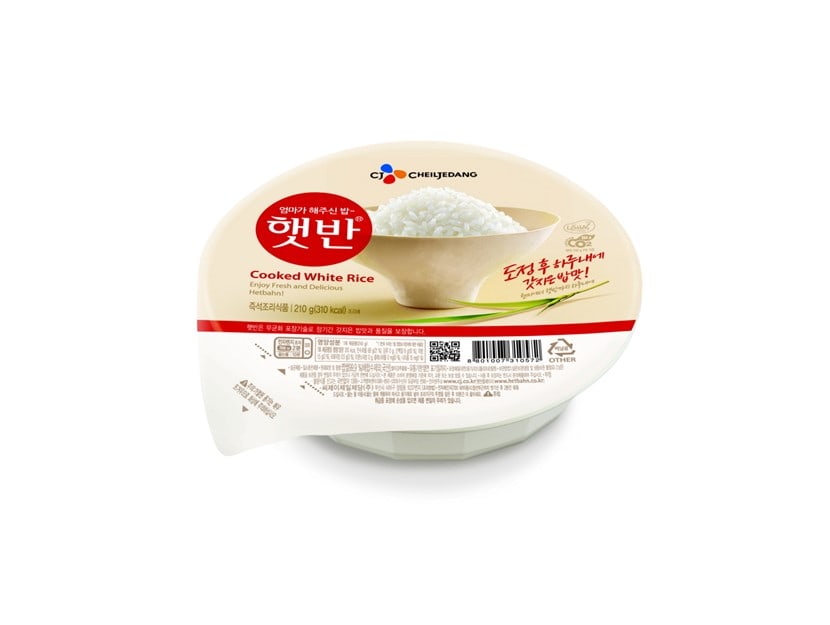
Hetbahn: What Korea's Instant Rice Is Made Of, and How to Heat It Without a Microwave
햇반 is 99.9% Korean rice and water plus 0.1% rice bran extract, sealed in a room cleaner than a hospital ward. The lid prints three cooking times and one of them needs no microwave at all. Prices, varieties, and the mistake almost everyone makes with the film.
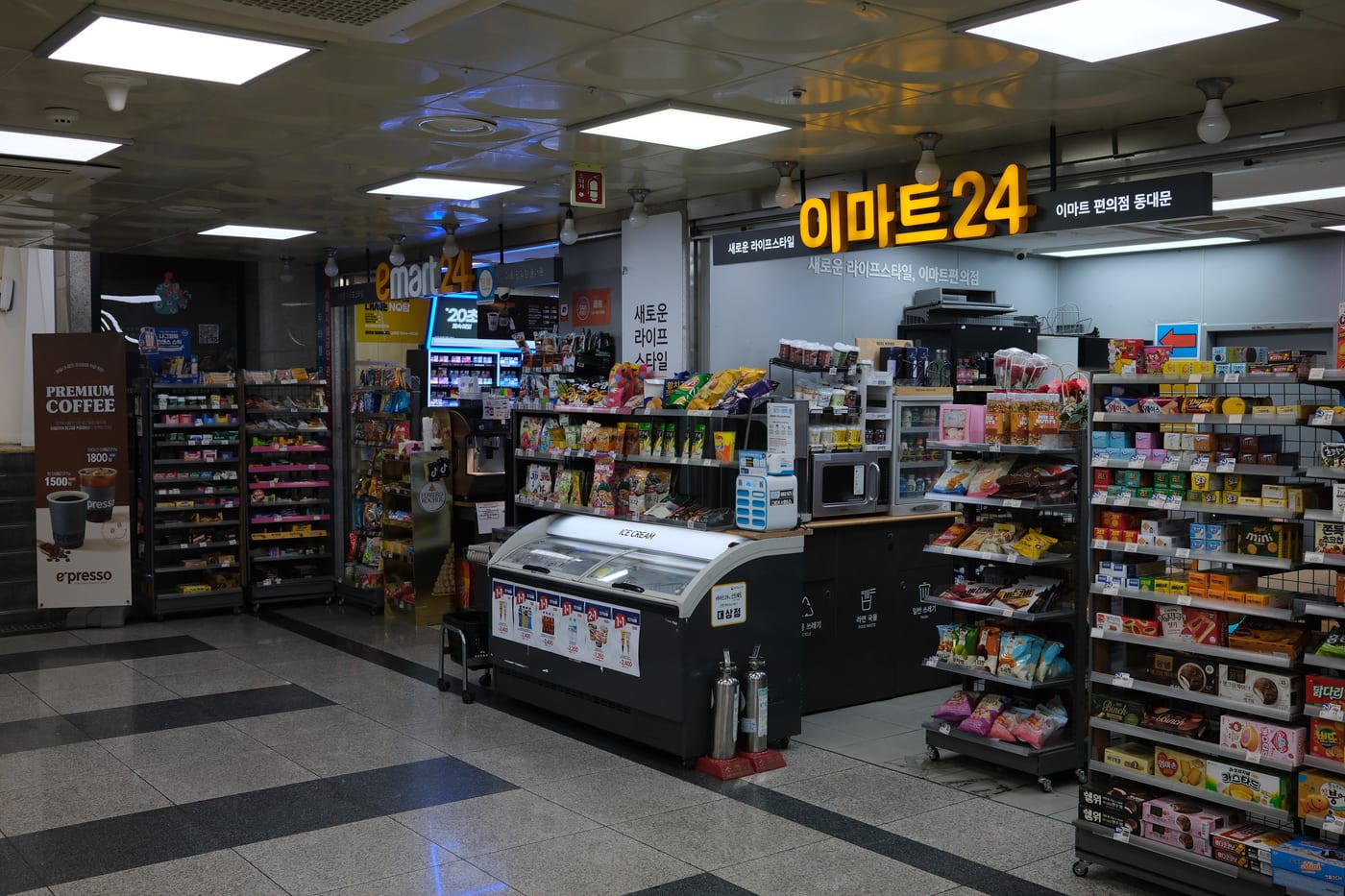
Korean Food Prices in August 2026: What Already Rose, and What Changes on the 25th
Four Korean food makers raised prices within three weeks, and Paris Baguette's 127-item increase lands on 25 August. The exact brands, dates and won amounts, why wheat and corn are behind it, and what it actually changes for a visitor.