Chaltteok Pie: The Korean Mochi Snack Behind the Dubai Chocolate Craze
In early 2026 Korea went briefly insane for 두쫀쿠 — Dubai jjondeuk cookie, a homemade chewy cookie built to taste like the pistachio-and-kadayif chocolate bar that took over the internet. Then the ingredients ran out. Pistachio spread vanished from shelves, kadayif was hard to find, and Korean social media did what Korean social media does: it improvised.
What people reached for was a 찰떡파이 — a soft, coated mochi pie that has been sitting in Korean supermarkets since 1998.
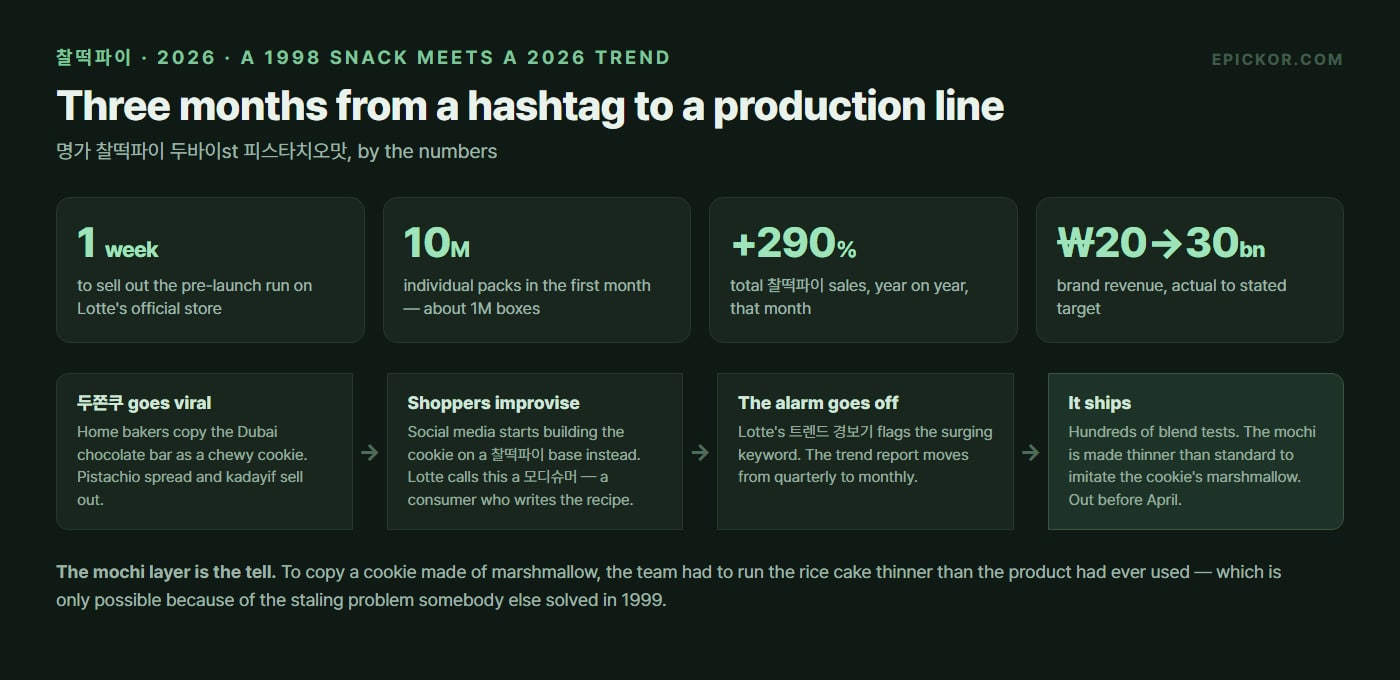
It worked well enough that Lotte Wellfood shipped an official version. That product sold out on the company's own store in one week, moved roughly one million boxes and ten million individual packs in its first month, and pushed total 찰떡파이 sales up 290% year on year.
And almost none of that is the interesting part.
| Korean name | 찰떡파이 — sold by Lotte as 명가 찰떡파이 |
|---|---|
| Literally | Chewy-rice-cake pie |
| What it is | Chocolate coating over a soft 찰떡 (glutinous rice cake) centre |
| Declared rice content | 찹쌀 2.7% on the current box — see the honest notes |
| Box on shelves now | 350 g, 10 packs (1,450 kcal). A 210 g / 12-piece format also exists |
| First launched | Late 1998 — by 삼진식품 (Samjin Food), not by Lotte |
| Who makes the Lotte one | Still Samjin. Lotte has been an OEM customer since late 2001 |
| Why it exists at all | A 1999 patent on stopping rice cake from going hard inside a sealed snack |
| Price, 2026 | The Dubai-style version was widely reported at ₩7,980 at large marts |
First, What Is Actually In It
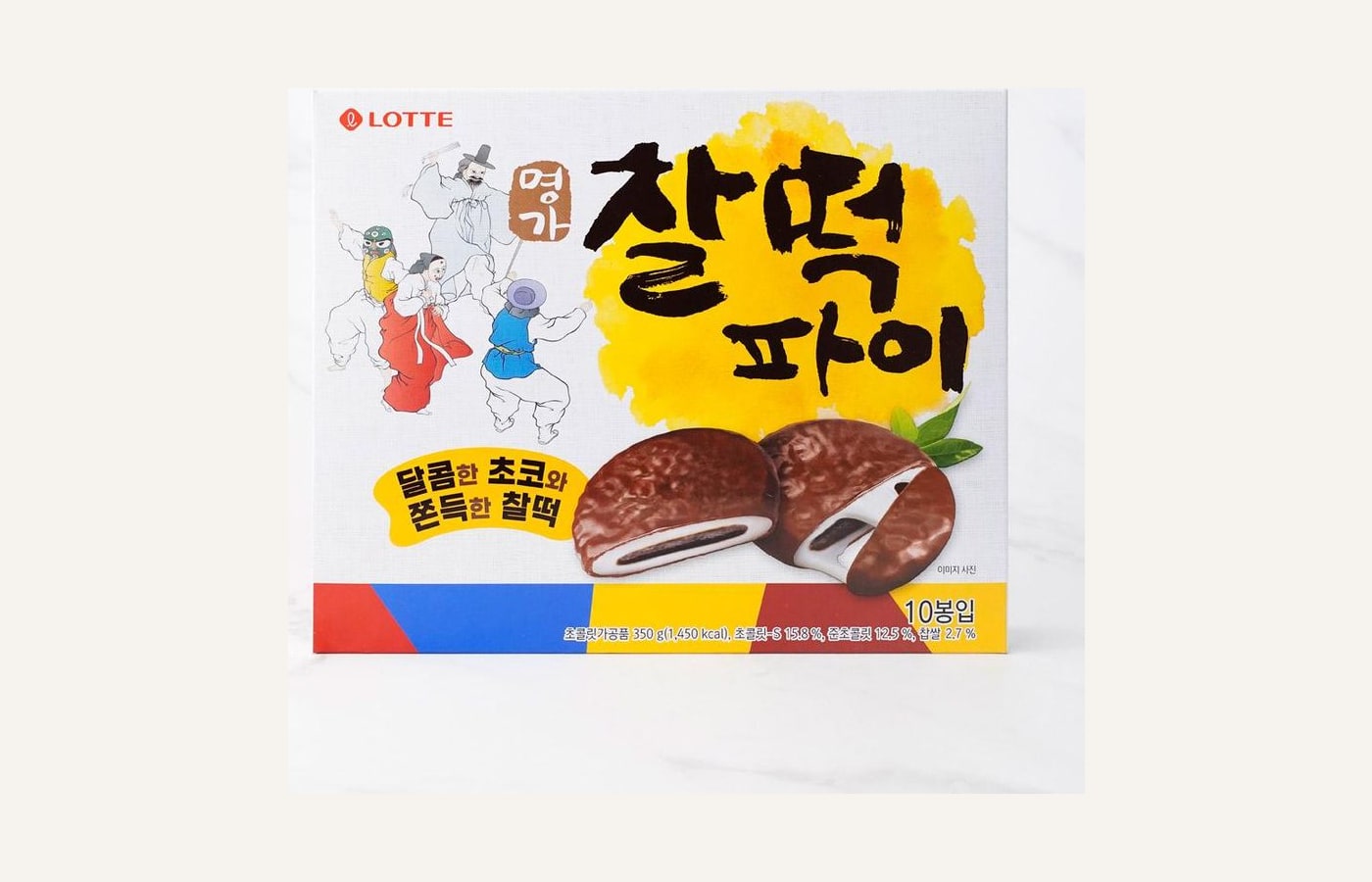
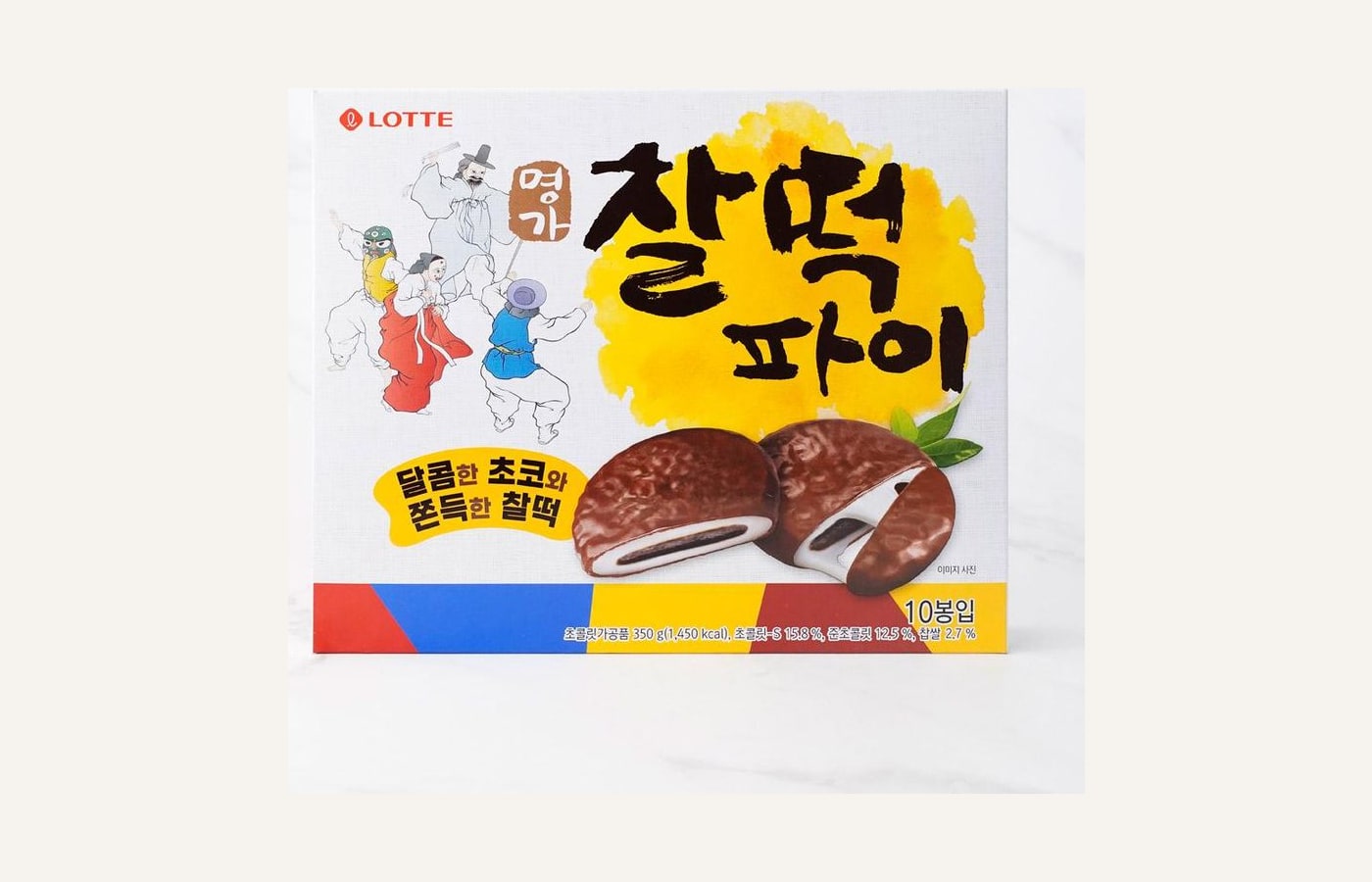
A 찰떡파이 is chocolate over rice cake, and the box says so in four words: 달콤한 초코와 쫀득한 찰떡 — sweet chocolate and chewy rice cake.
Outside is the coating, declared on the label as two separate things: 초콜릿-S and 준초콜릿, "quasi-chocolate", the Korean regulatory category for a coating made with vegetable fat rather than cocoa butter alone. Inside is 찰떡 — glutinous rice cake, the same material as Korean 인절미, genuinely chewy rather than cake-soft.
If you have eaten a Choco Pie, this is the same silhouette with the marshmallow replaced by real rice cake, and the difference is enormous. Choco Pie is airy. This is dense and elastic, and it weighs more than it looks like it should.
It also does not shed crumbs, which is a small thing that turns out to explain a lot about where this snack became popular.
You might like: Korean Custard Cake: Lotte Invented It, Orion Copied It
The declared percentages are worth reading, because they are surprising. The current box states 초콜릿-S 15.8%, 준초콜릿 12.5%, 찹쌀 2.7% across 350 g. A 2020 label for the 375 g version gave 16.2% / 12.8% / 2.8%.
So a product whose name is glutinous rice cake pie declares under 3% glutinous rice, against roughly 28% chocolate. The rice cake is a thin shell around a filling, not a slab — and the reason it can be that thin at all is the subject of the next section.
The Hard Part Was Never the Chocolate
Anyone can coat a rice cake in chocolate. The problem is what happens two days later.
Cooked rice starch does not stay soft. It retrogrades — the starch molecules recrystallise, water migrates out, and the cake turns hard and dry. That is why fresh 떡 from a Korean rice-cake shop is a same-day food and why Koreans reflexively freeze it. A rice cake sealed in a wrapper for a supermarket shelf should be a brick within a week.
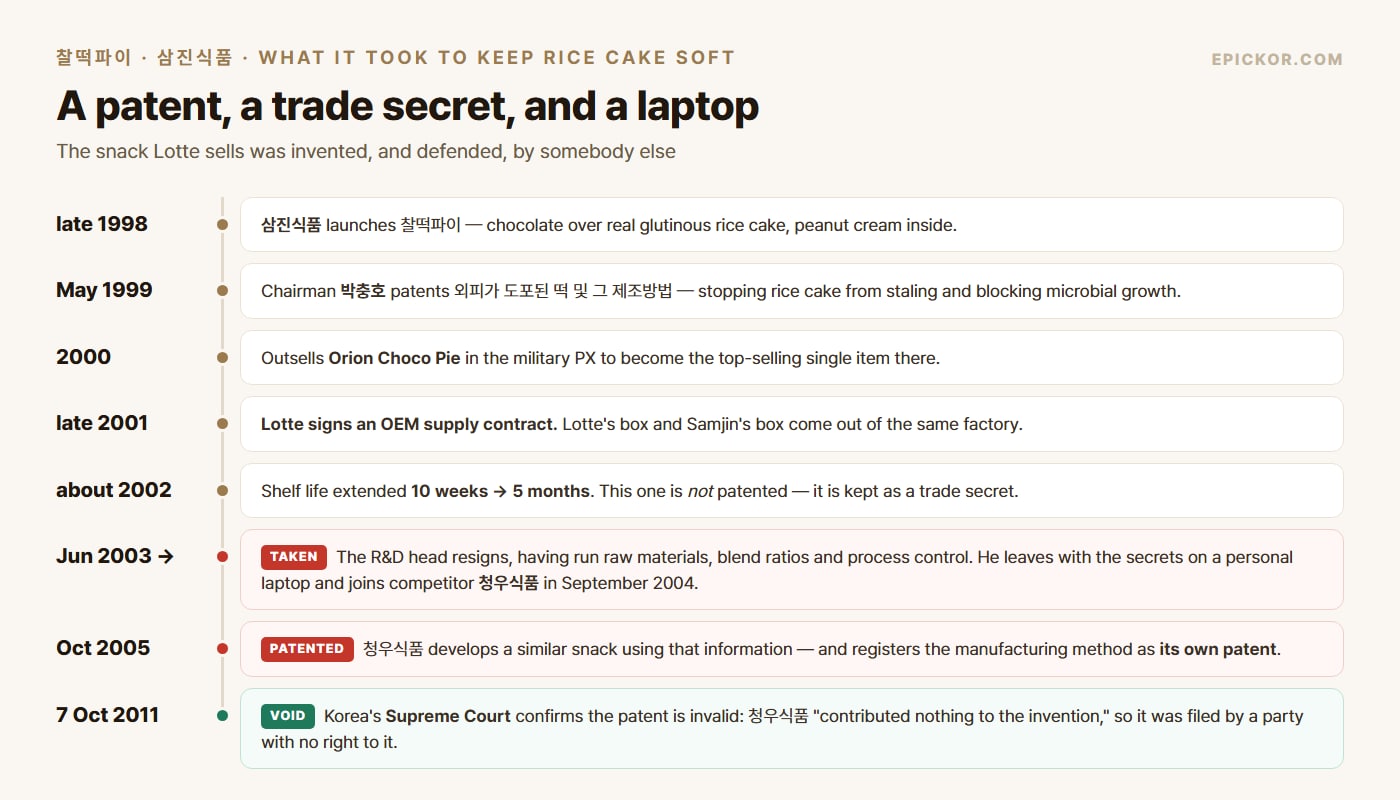
On May 1999, 삼진식품's chairman 박충호 registered a Korean patent for "외피가 도포된 떡 및 그 제조방법" — a coated rice cake and the method of making it. Its stated purpose was to prevent the staling of rice cake over time and to block microbial growth.
Around 2002 the company developed a further method that extended the rice cake's usable life from ten weeks to five months. It deliberately did not patent that one. It classified it as a trade secret.
That decision is the hinge of everything that follows.
Lotte Sells It. A Company You Have Never Heard Of Makes It.
찰떡파이 was launched in late 1998 by 삼진식품 (Samjin Food), a small Korean manufacturer, and it did not start life in supermarkets. It went after niches: military bases and PC bangs — places where people eat standing up, in a hurry, next to a keyboard. The no-crumbs property was not a footnote there.
In 2000 it did something a small company almost never does. In the Korean military PX market it outsold Orion's Choco Pie — the most famous snack in the country and, at that time, a semi-official currency of Korean army life — to become the top-selling single item, and was named the snack soldiers liked most.
In September 2000 the company was certified as a technology-development venture firm by Korea's Small and Medium Business Administration. In late 2001 it signed an OEM supply contract with Lotte Confectionery.
That contract is why this article exists. Lotte's 명가 찰떡파이 and Samjin's own 찰떡파이 are made in the same factory, by the same company. So is the version sold under other labels. When you buy the Lotte box, you are buying a small company's invention in a large company's packaging — which is completely normal in food manufacturing.
And it is not hidden. It is printed on the box. Korean food labels separate two roles: 제조원, the manufacturer, and 유통전문판매원, the company that distributes and sells it. A 명가 찰떡파이 label reads:
- 유통전문판매원: 롯데제과(주), Yeongdeungpo-gu, Seoul
- 제조원: 삼진식품, Sudirae-gil 3, Cheongpyeong-myeon, Gapyeong-gun, Gyeonggi-do
Lotte's name is on the front in the largest type on the box. Samjin's name, and the address of the factory in Gapyeong where the thing is actually made, is in small print on the side. Nothing is being concealed — it is simply that almost nobody turns the box over.
Then the Recipe Walked Out on a Laptop
In June 2003, the head of Samjin's R&D department resigned. He had overseen the raw materials, the blend ratios and the process control — that is, the trade secret the company had chosen not to patent.
He took the information out on a personal laptop. In September 2004 he joined 청우식품, a competitor. By October 2005 청우식품 had developed a similar snack using that information, and then did something bolder: it registered the manufacturing method as its own patent.
Chairman 박충호 filed to have that patent invalidated. Korea's Intellectual Property Trial and Appeal Board rejected him. He sued to overturn that decision at the Patent Court and won, and on 7 October 2011 the Supreme Court confirmed it. The panel's reasoning was blunt: 청우식품 "contributed nothing to the invention in question," making it a case of a party with no right to the patent filing for and registering it — and therefore void.
박충호 was 78 years old when the judgment came down.
You might like: Samanco: Korea's Fish-Shaped Ice Cream Is Named "Cheap and Plentiful"
And Then Korea Started Building Dubai Cookies Out of It
Twenty-eight years after that first box, the snack got the strangest promotion of its life.
두쫀쿠 — 두바이 쫀득 쿠키, "Dubai chewy cookie" — was a home-baking craze built on pistachio cream and 카다이프 (kadayif, the shredded pastry that gives the Dubai chocolate bar its crunch). When the ingredients ran short, Korean social media started assembling it on top of a 찰떡파이 instead.
Lotte Wellfood has a name for this: 모디슈머 (modisumer), a consumer who writes the recipe. It also has machinery for catching it. The company runs a 트렌드 경보기 — a "trend alarm" that fires when a keyword spikes online — and a trend report called 민트 whose publication cycle was recently cut from quarterly to monthly, because, as the research lead put it, new trends now arrive every month.
The team went from a viral hashtag to mass production in about three months, which Korean confectionery coverage described as unusually fast. Two details from the development team are worth having:
They made the mochi thinner. 두쫀쿠 gets its texture from marshmallow, which is lighter than rice cake, so the 두바이 version runs a thinner 찰떡 layer than the standard product. Finding that thickness took hundreds of blend tests.
They designed the box around a photograph. The product's three layers — chocolate coating, mochi, cream — are shown as three colour bands, and the wrapper carries camels and palm trees. The marketer's stated reason was that colour-forward products do better on social media, so it is considered from the planning stage.
The result: sold out on Lotte's official store in a week, roughly 1 million boxes and 10 million packs in the first month, and 찰떡파이 sales up 290% year on year that month. The brand was doing about ₩20 billion a year; the stated goal is now ₩30 billion.
You might like: Jayu Sigan: The Korean Chocolate Bar Designed to Leave No Evidence
The Dubai part travels; the mochi part does not. Pistachio cream and kadayif are what the whole craze is actually built on, and both are easy to get outside Korea. As an Amazon Associate, EpicKor earns from qualifying purchases at no extra cost to you.
What to Buy, and What It Costs
The standard product is 명가 찰떡파이, 210 g, 12 pieces, sold in supermarkets, online and in convenience stores in smaller counts. That is the one to start with — it is the original recipe and it is available all year.
The Dubai-style version was widely reported at ₩7,980 at large marts in 2026. Treat that as the mart shelf price rather than a fixed one: it began as a limited pre-launch run, sold out, and went into additional production, and limited editions in Korean confectionery move in and out of stock constantly.
Check whether the box says 두바이st before you get excited. Lotte expanded the 두바이st 피스타치오 line to six products across biscuits and frozen desserts, with more after that, so the pistachio wrapper on the shelf next to it may be a different snack entirely.
Every other Korean confectioner did the same thing. Crown released a 두바이스타일 쵸코하임 capped at 550,000 units, and Haitai released five pistachio versions of existing products including 홈런볼, 버터링 and 자유시간. If you want the pistachio thing, you have options; if you want the mochi thing, this is the one.
Honest Notes
The packaging has been mocked for fifteen years. In June 2011 a Korean student's video comparing box volume to contents made 찰떡파이 a standing example of 과대포장 — over-packaging. The defence is real: rice cake is dense, so the box weighs more than a Choco Pie box of the same size, and the pieces need protection. It is still a lot of cardboard for what you eat.
Mochi texture is genuinely divisive. Korean commentary is candid that visitors from countries without a rice-cake tradition often do not enjoy the chew, describing it as gummy rather than pleasant. It became a word-of-mouth hit with Japanese visitors from the late 2000s — Japan has 餅 — and that is not a coincidence. Buy one packet before you buy a box for someone.
Try it frozen. Korean readers recommend a short stint in the freezer, the same trick people use with Choco Pie. The rice cake firms up and the coating snaps.
It contains a sugar alcohol, and the box carries a warning about it. The label declares 말티톨시럽 10.6% — maltitol syrup — and prints the line 과량 섭취시 설사를 일으킬 수 있습니다: excessive consumption may cause diarrhoea. That is standard for maltitol at this level and it is not a scare, but it is printed on a snack box for a reason, and a 10-pack is easy to work through.
"Lotte invented it" is wrong, and so is "Lotte copied it." Lotte is a distribution and branding customer of the company that invented it — a normal OEM relationship, disclosed on the label if you read the manufacturer line. The company that did try to take it lost at the Supreme Court.
The 290% figure is one month against the same month a year earlier, during a national craze, reported by the manufacturer. It is a real number and it is not a run rate.
Lotte's own box does not ship to the US, but Cheongwoo's does — and Cheongwoo (청우식품) is the company from the middle of this story, the one that patented the method in 2005 before the Supreme Court voided it in 2011. Their Chal-Tteok pie is the same idea: shelf-stable chewy rice cake inside a chocolate coating, which travels in a way fresh 떡 never will.
CW (Cheongwoo) chal-tteok choco pie, 10 count, on Amazon
Cheongwoo Chal-Tteok choco pie on AmazonFAQ
Q: What is 찰떡파이? A: A Korean snack: a chocolate coating over a soft glutinous rice cake centre. Lotte sells it as 명가 찰떡파이; the box currently on shelves is 350 g with 10 individually wrapped packs.
Q: Is it the same as a Choco Pie? A: No. Same silhouette, but the middle layer is real rice cake instead of marshmallow, so it is denser, chewier and heavier.
Q: Who actually makes it? A: 삼진식품 (Samjin Food), which launched it in late 1998 and patented the method in May 1999. Lotte has been an OEM customer since late 2001, so both companies' boxes come from the same factory.
Q: What is the Dubai version? A: 명가 찰떡파이 두바이st 피스타치오맛, launched in 2026 after Koreans started using the ordinary pie as a base for homemade Dubai-style chewy cookies. It has a thinner mochi layer and pistachio. Widely reported at ₩7,980 at large marts.
Q: Why did it become popular with soldiers? A: It went after the military PX early, it does not shed crumbs, and it is dense enough to be filling. In 2000 it outsold Orion's Choco Pie there to become the top-selling single item.
Sources Checked
- The product label itself for the declared 초콜릿-S 15.8% / 준초콜릿 12.5% / 찹쌀 2.7% on the current 350 g (1,450 kcal) box, the 16.2% / 12.8% / 2.8% on a 2020 375 g label, 말티톨시럽 10.6% with the printed 과량 섭취시 설사를 일으킬 수 있습니다 warning, 140 kcal per 37.5 g pack, and the 제조원 / 유통전문판매원 split naming 삼진식품 in Gapyeong as manufacturer and 롯데제과(주) as distributor.
- Korean-language reference sources for the late-1998 launch by 삼진식품, the niche entry through military bases and PC bangs, the 2000 military-PX result against Orion Choco Pie, the September 2000 venture-firm certification, the late-2001 OEM contract with Lotte Confectionery, the popularity with Japanese visitors, the freezing tip, and the June 2011 over-packaging controversy.
- Kyunghyang Shinmun (7 October 2011) for the Supreme Court judgment: 박충호 of 삼진식품 as original inventor, the May 1999 patent 외피가 도포된 떡 및 그 제조방법 covering prevention of rice-cake staling and microbial growth, the roughly-2002 trade secret extending shelf life from ten weeks to five months, the June 2003 departure of the R&D head, the transfer of information via personal laptop, his September 2004 move to 청우식품, that company's October 2005 development and patent registration, the initial rejection at the IPTAB, and the court's finding that 청우식품 "contributed nothing to the invention."
- Herald Business (2026) interview with the Lotte Wellfood cake-and-bakery marketing team and the Lotte Central Research Institute global innovation team for the roughly three-month development, the 트렌드 경보기 and 민트 trend report, the quarterly-to-monthly reporting change, the hundreds of blend tests, the thinner mochi layer, the three-colour packaging design, the one-week sell-out, roughly 1 million boxes and 10 million packs in the first month, the 290% year-on-year sales rise, and the ₩20 billion to ₩30 billion brand revenue target.
- Money Today (23 March 2026) for the 두쫀쿠 background, the 모디슈머 framing, the expansion of Lotte's 두바이st 피스타치오 line to six products, Crown's 550,000-unit 두바이스타일 쵸코하임, and Haitai's five pistachio products.
- Korean retail listings for the standard 명가 찰떡파이 210 g / 12-piece pack and Korean shopper reports for the ₩7,980 mart price of the Dubai-style version.
Korean confectionery prices vary by retailer and promotion, and limited editions go in and out of stock. Verified August 2026.
You Might Also Like
Hetbahn: What Korea's Instant Rice Is Made Of, and How to Heat It Without a Microwave
햇반 is 99.9% Korean rice and water plus 0.1% rice bran extract, sealed in a room cleaner than a hospital ward. The lid prints three cooking times and one of them needs no microwave at all. Prices, varieties, and the mistake almost everyone makes with the film.
Korean Food Prices in August 2026: What Already Rose, and What Changes on the 25th
Four Korean food makers raised prices within three weeks, and Paris Baguette's 127-item increase lands on 25 August. The exact brands, dates and won amounts, why wheat and corn are behind it, and what it actually changes for a visitor.
Kkokkalcorn: Korea's Cone Snack, and Why Each Convenience Store Has a Different Flavor
Lotte split one snack across three convenience store chains on purpose, and Koreans started touring stores to collect all four flavors. Which chain has which, what 꼬깔콘 costs in August 2026, and why the convenience store is the worst value per gram.