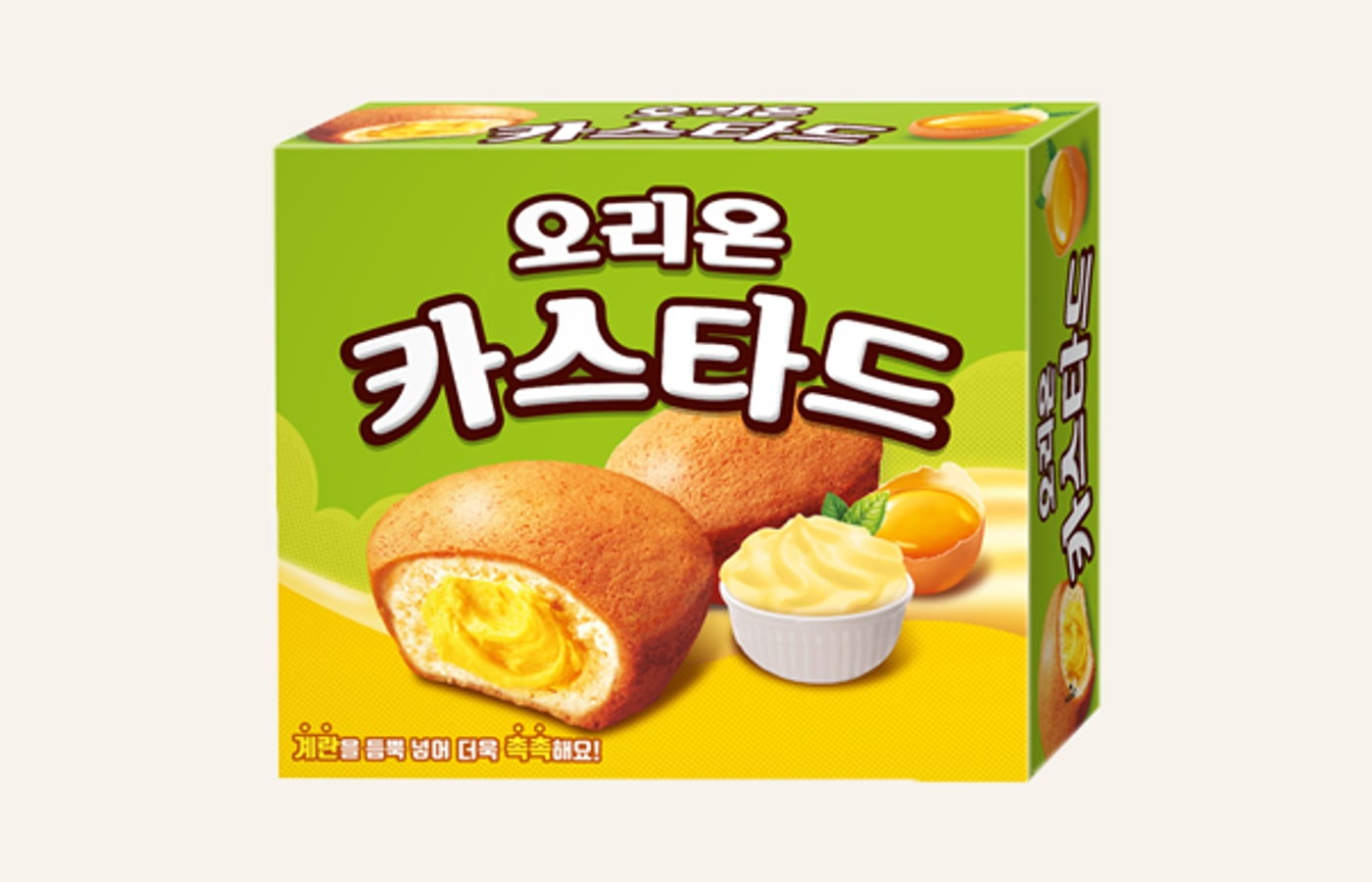
Korean Custard Cake: Lotte Invented It, Orion Copied It — the Reverse of Choco Pie
Korean custard cake — 카스타드 — is a soft yellow sponge cake with a pale custard cream injected into the middle, sold in a cardboard box of individually wrapped cakes, and it is in every Korean supermarket, convenience store and airport. It is also the single most confusing thing on the Korean snack shelf, because two different companies sell it under the same name, in nearly the same box.
There is a right answer to which one is 원조 — the original — and it is the reverse of what most people assume.
| Korean name | 카스타드 (Kaseutadeu, from English "custard") |
|---|---|
| What it is | Egg sponge cake with custard cream injected through the underside |
| The original | 롯데 카스타드 — Lotte Wellfood, Korea November 1989 (Japan, September 1986) |
| The imitation | 오리온 카스타드 — Orion, 2004, fifteen years later |
| Egg content | Lotte 24% · Orion 23.39% |
| Per cake | About 110 kcal |
| Price | Around ₩3,500 for a six-pack since September 2021; larger boxes roughly ₩3,000–4,000 depending on retailer, as of August 2026 |
| Which to buy | Lotte, on the numbers — but see the honest notes |
The Copy Is the One That Advertises the Eggs
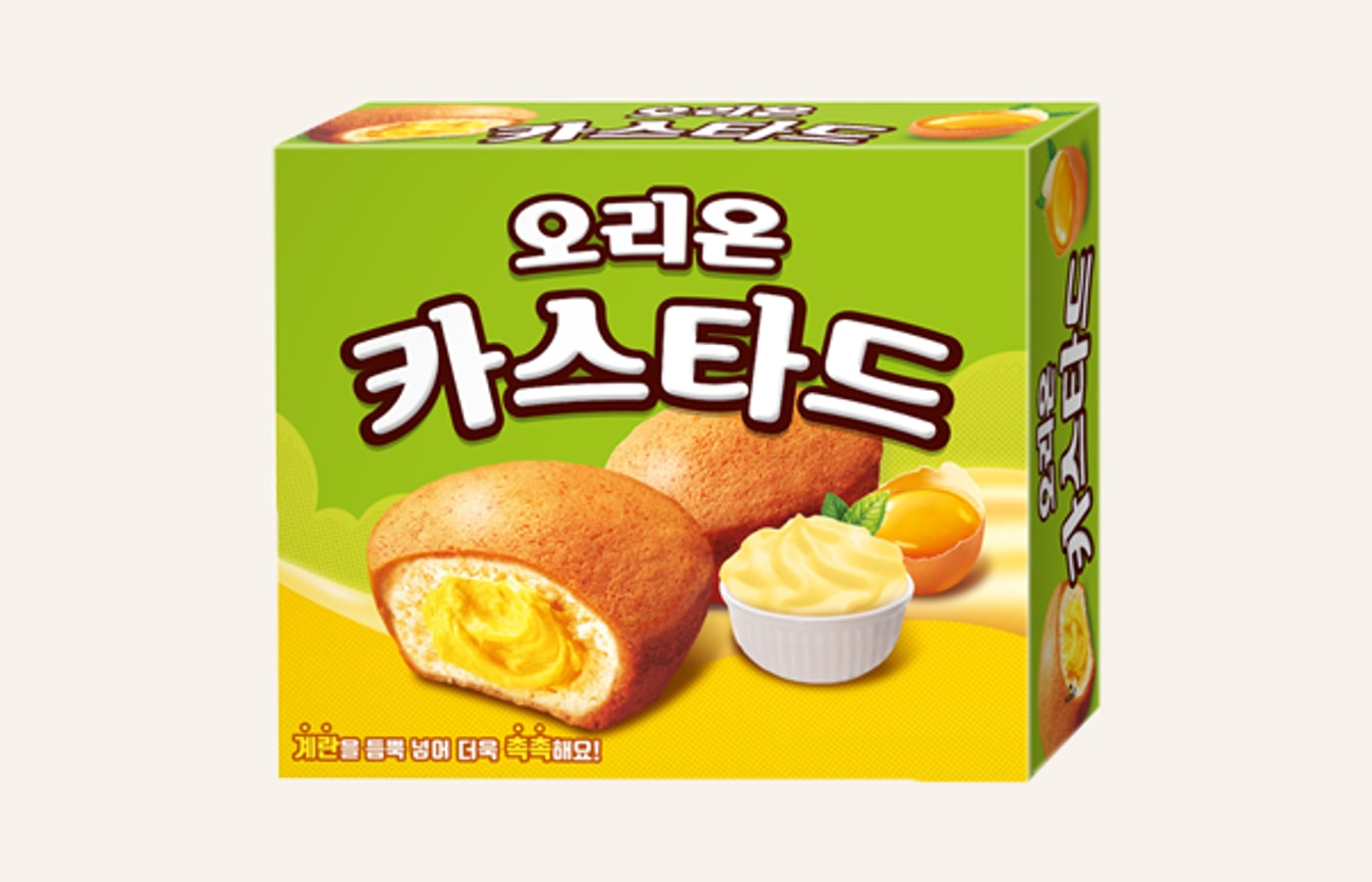
The box in the photo, if you want to try it: Orion Custard Soft Cake (오리온 카스타드), 12 individually wrapped cakes is on Amazon US; Lotte's original was not in stock there when we checked in late September 2026. As an Amazon Associate, EpicKor earns from qualifying purchases.
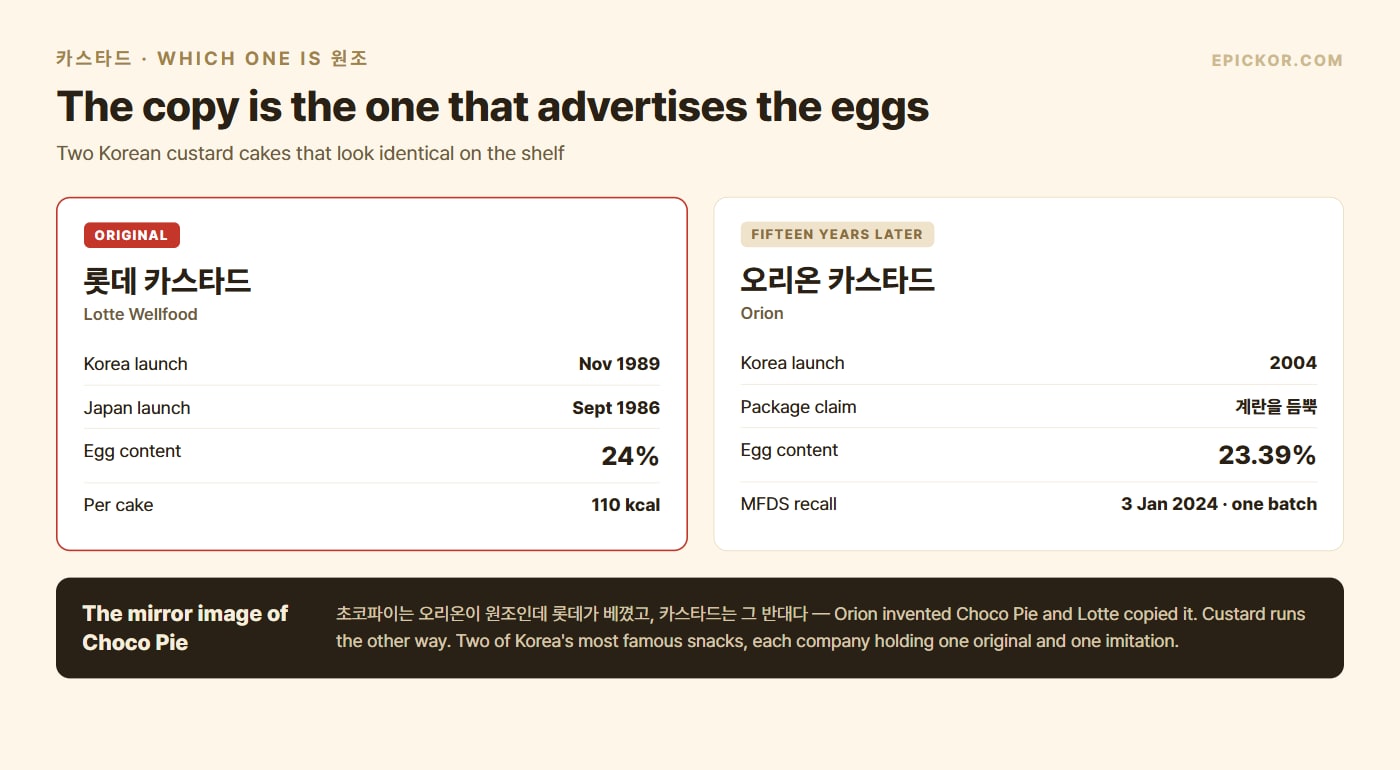
Lotte Custard came first. Japan's Lotte launched it in September 1986; the Korean product followed in November 1989. Orion's version arrived in 2004 — fifteen years later.
And here is the detail that makes this worth writing down. Orion's packaging leans on the phrase 계란을 듬뿍 — "generously filled with egg." It is the product's stated selling point.
Orion's egg content is 23.39%. Lotte's is 24%.
The one that advertises the eggs has slightly fewer of them. It is a small gap and it will not decide your snack, but it is a nearly perfect illustration of how packaging claims work: the phrase is doing competitive positioning, not reporting a fact about the competitor.
ORION Choco Pie & Custard combo, 24 cakes — both halves of the reversal in one box Orion invented Choco Pie and copied Custard, so this mixed box holds one original and one imitation from the same company, as the next section explains. It is the easy way to taste the pair side by side; Lotte's Custard is the one it cannot give you. As an Amazon Associate, EpicKor earns from qualifying purchases.
See the Orion Choco Pie & Custard combo on AmazonWhy This Confuses Even Koreans
Because the other famous case runs the other way.
초코파이는 오리온이 원조인데 롯데가 베꼈고, 카스타드는 그 반대다 — Orion invented Choco Pie in 1974 and Lotte copied it; Custard runs backwards. Two of the most recognisable snacks in Korea, and each company holds one original and one imitation.
So a Korean who confidently knows the Choco Pie story will often get Custard wrong by applying the same pattern. If you have ever been told "Orion makes the real one," that is where it comes from.
You might like: Nunettine: The Korean Snack Whose Real Name Is Italian
The Holes Are Not a Defect
Turn a custard cake over and you will find small holes in the base. People assume they are a fault, or air pockets, or that the cake has been damaged in the box.
They are injection points. The cream is not baked in; it is pumped into a finished sponge through the underside, and the holes are where the nozzles went. A custard cake with no holes would mean the cream never got in.
This is the single most-asked question about the product in Korean, and it has never been answered anywhere in English.
If you want to compare the two yourself, do it in Korea. In late September 2026 Orion's box was on Amazon US but Lotte's was not, and imported listings of Korean snacks come and go. A convenience store or supermarket in Korea sells both, usually on the same shelf: buy one of each, eat them side by side at room temperature, and the difference in texture and sweetness shows up in the first bite — which is more than either label will tell you.
The 2021 Price Rise, and the Part That Was Not on a Label
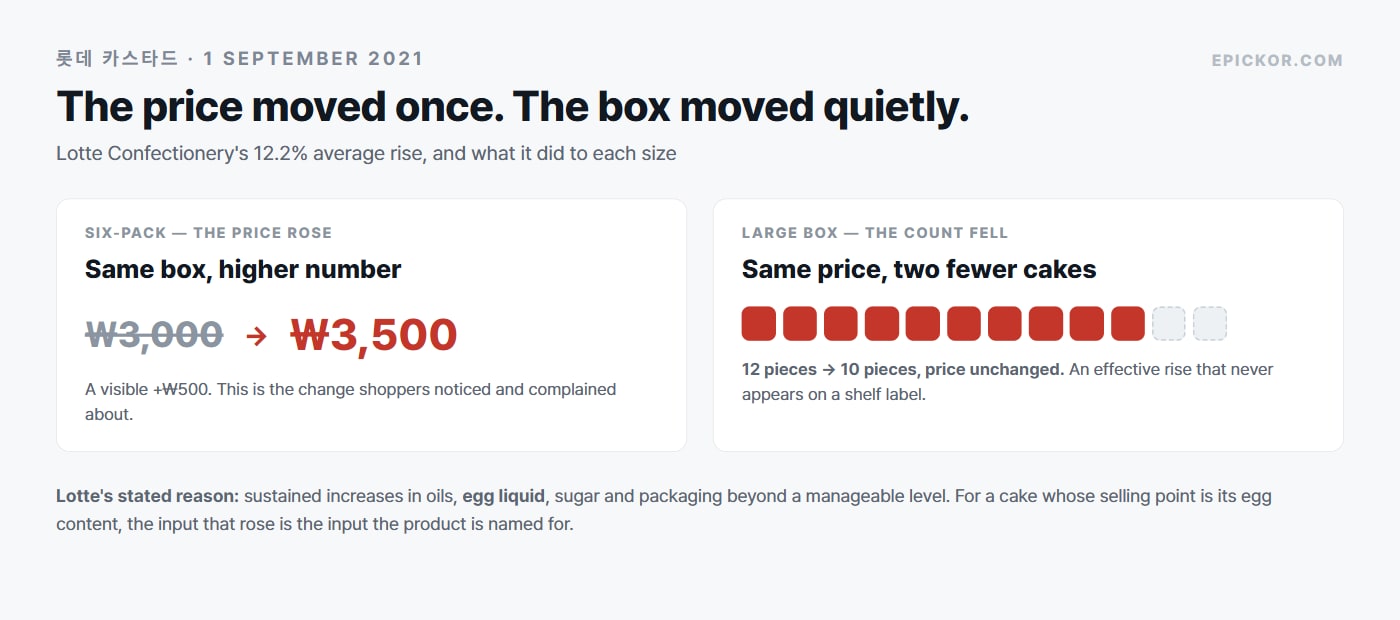
On 1 September 2021, Lotte Confectionery raised prices across its snack range by an average of 12.2% per unit weight. Custard was one of the named products: the six-pack went from ₩3,000 to ₩3,500.
That was the visible half. The other half was that the large box went from 12 pieces to 10, and the price did not change.
Both are price increases. Only one of them appears on a shelf label, and it is the reason a Korean shopper who remembers this box as good value is remembering a box with two more cakes in it. The company's stated cause was sustained rises in oils, egg liquid, sugar and packaging — which, for a cake whose entire selling point is egg content, means the input that rose is the input the product is named after.
Korean listings today show the range at roughly ₩3,000–4,000 depending on box size and retailer. Convenience-store singles cost proportionally more, as always.
Which One to Actually Buy
On the numbers, Lotte. It is the original, it has been in continuous production since 1989, and it has marginally more egg.
On taste, Korean opinion genuinely splits. The two are close enough that side-by-side comparisons are a recurring Korean internet pastime with no settled winner. Orion's is often described as slightly softer and sweeter; Lotte's as a touch more eggy. If you strongly prefer one, buy that one — the origin question is trivia, not a quality ruling.
On availability abroad, take whichever your Korean grocery stocks. They will not both be there.
You might like: Samanco: Korea's Fish-Shaped Ice Cream Is Named "Cheap and Plentiful"
Where You Will Actually Meet It
카스타드 is not a snack Koreans go out to buy. It is a snack that arrives.
It is a fixture of the Korean gift box. Confectionery assortments given at Chuseok and Seollal, hospital-visit boxes, and the 종합선물세트 handed to children almost always contain custard cakes, because the box is bulky, looks generous and survives being carried around.
It is standard 간식 provisioning. Company pantries, church halls, study rooms, army care packages, and the snack drawer at a 학원 all run on it. If you spend a month in Korea in any institutional setting, someone will hand you one.
Convenience stores carry the small box; supermarkets carry the large. For a traveller the practical note is that the six-pack fits in a bag and the large box does not, and neither survives being crushed — this is a soft cake in a soft box, and it will arrive home flattened if you pack it under anything.
It travels well as a gift, badly as a souvenir. It is genuinely well liked, it is cheap, and it says nothing at all about Korea to somebody who has never been. Buy it because you want to eat it.
Honest Notes
Orion's version was recalled once, in 2024. On 3 January 2024 Korea's Ministry of Food and Drug Safety ordered a sale halt and recall of Orion Custard after Staphylococcus aureus was detected in a batch manufactured on 22 December 2023 at Orion's fourth Cheongju plant, with a use-by date of 21 June 2024. Roughly 4,700 units were subject to recall.
That is one batch, caught by routine regulatory sampling and pulled — which is the system working rather than failing. But it happened, it is a matter of public record, and English-language coverage of this product does not mention it at all. Both products are on shelves normally today.
The nitrogen complaint was real and was addressed. Custard boxes were long mocked in Korea for how much of the packet was gas rather than cake — 질소를 샀더니 과자를 덤으로 줬다, "I bought nitrogen and they threw in a snack." Lotte made quality and packaging changes around 2020, alongside redesigns in 2010, 2020 and 2022. The box is still mostly air by volume, because a soft sponge cake needs it.
It is a sweet, soft, mild snack, and that is the whole proposition. There is no textural surprise, no heat, no fermented note. If you are shopping for something distinctively Korean to bring home, this is not that — it is the comfort item Koreans grew up with, which is a different and less exportable kind of appeal.
Egg allergy: this is an egg product, not an egg-flavoured one, at roughly a quarter of the cake by content in both brands.
Do not judge by the box design. Both companies have redesigned repeatedly, so the packaging you remember from a photograph may not be the packaging on the shelf, and a box that looks "older" is not the original brand.
FAQ
Q: Which Korean custard cake is the original? A: Lotte. 롯데 카스타드 launched in Korea in November 1989, following Japan's Lotte in September 1986. Orion's version arrived in 2004.
Q: Is Orion's the one with more egg? A: No, despite the 계란을 듬뿍 claim on the box. Orion's egg content is 23.39%; Lotte's is 24%.
Q: Why does the cake have holes in the bottom? A: They are injection points. The custard cream is pumped into a finished sponge from underneath, so the holes are a necessary part of manufacture, not damage.
Q: How much does it cost in Korea? A: Around ₩3,500 for a six-pack since the September 2021 rise, with larger boxes roughly ₩3,000–4,000 depending on size and retailer as of August 2026.
Q: Wasn't there a recall? A: Yes — Orion's version, on 3 January 2024, for Staphylococcus aureus in one batch made on 22 December 2023. About 4,700 units. Both brands are sold normally today.
Sources Checked
- Korean-language reference sources for the Japanese September 1986 and Korean November 1989 launch of 롯데 카스타드, the 2004 launch of 오리온 카스타드, the egg-content figures of 24% and 23.39%, the 계란을 듬뿍 packaging claim, the roughly 110 kcal per cake, the cream-injection explanation for the holes, the 2010 / 2020 / 2022 redesigns and the nitrogen-padding complaints addressed around 2020, and the 초코파이는 오리온이 원조인데 롯데가 베꼈고 카스타드는 그 반대다 framing of the two origin disputes.
- Korean news coverage (12 August 2021) for Lotte Confectionery's 1 September 2021 price rise averaging 12.2% by unit weight: Custard six-pack ₩3,000 to ₩3,500, the large box reduced from 12 pieces to 10 at unchanged price, and the company's stated cause of rising oils, egg liquid, sugar and packaging costs.
- Korean news coverage of Korea's Ministry of Food and Drug Safety announcement of 3 January 2024 for the Orion Custard recall: Staphylococcus aureus detected, batch manufactured 22 December 2023 at the fourth Cheongju plant, use-by 21 June 2024, roughly 4,700 units.
Korean snack prices change by retailer and promotion, and both brands revise packaging frequently. Verified August 2026.
You Might Also Like
Hetbahn: What Korea's Instant Rice Is Made Of, and How to Heat It Without a Microwave
햇반 is 99.9% Korean rice and water plus 0.1% rice bran extract, sealed in a room cleaner than a hospital ward. The lid prints three cooking times and one of them needs no microwave at all. Prices, varieties, and the mistake almost everyone makes with the film.
Korean Food Prices in August 2026: What Already Rose, and What Changes on the 25th
Four Korean food makers raised prices within three weeks, and Paris Baguette's 127-item increase lands on 25 August. The exact brands, dates and won amounts, why wheat and corn are behind it, and what it actually changes for a visitor.
Kkokkalcorn: Korea's Cone Snack, and Why Each Convenience Store Has a Different Flavor
Lotte split one snack across three convenience store chains on purpose, and Koreans started touring stores to collect all four flavors. Which chain has which, what 꼬깔콘 costs in August 2026, and why the convenience store is the worst value per gram.