Postick: The Korean Snack That Used to Come With a Ketchup Packet
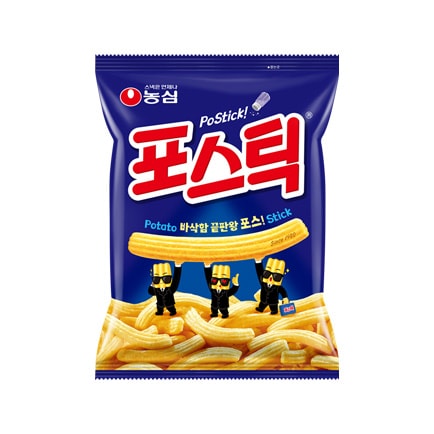
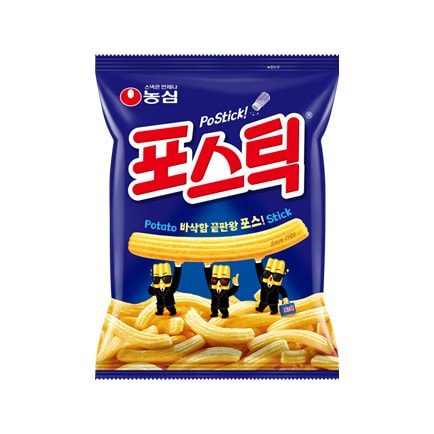
The 84g bag of 포스틱. The English on the pack reads "PoStick!" and "Since 1980." Image: Nongshim official brand page.
There is a blue bag on the Korean convenience store snack shelf with ridged yellow sticks on the front, and almost every English list of Korean snacks skips it. Postick — 포스틱, made by Nongshim — has been there since 1980, which makes it older than most of the snacks those lists do cover.
Two things about it are more interesting than the snack itself. It is barely a potato product. And it used to come with a ketchup packet inside the bag, which is why Koreans still search for how to eat it with ketchup forty-six years later.
The Short Answer
| Detail | |
|---|---|
| Korean name | 포스틱 (Postick) — a contraction of "potato stick" |
| Maker | 농심 (Nongshim) |
| On sale since | 1980 |
| Potato content | 23%. The rest is wheat flour and cornstarch |
| Seasoning | Barbecue seasoning with onion. Salty, mildly savoury, not spicy |
| Bag | 84g, about 390 kcal |
| Price, Aug 2026 | ₩1,700, and it runs 2+1 at GS25 — about ₩1,133 a bag |
| The old gimmick | A tomato ketchup sachet in the bag. Dropped on cost |
| The current one | Koreans tip ramyun soup powder into the bag and shake |
Ottogi Jin Ramen — the soup powder Koreans shake into a bag of PostickAffiliate link. As an Amazon Associate, EpicKor earns from qualifying purchases at no extra cost to you.
If you only remember one line: it is a savoury cracker shaped like a chip, and Koreans treat it as a base rather than a finished snack.
It Is Only 23% Potato
The name says potato. The ingredient list disagrees.
Postick is built on a wheat flour and cornstarch dough, extruded into ridged sticks and fried. Potato is in there — it is on the front of the bag and it is real — but at 23% of the product. And that figure has moved: the earlier formula ran nearer 29% potato, with cornstarch at a level closer to the wheat flour. The potato share came down and the cornstarch share went up.
This matters for what you should expect in your mouth. Postick is not a potato chip and it does not behave like one. A crisp is a slice of potato; the potato is the structure. Postick is a fried dough stick that is seasoned to taste of potato and barbecue, so the texture is firmer and drier, closer to a savoury breadstick than to a chip. People who go in expecting a French fry are the ones who come out disappointed.
If you want actual sliced-potato products from the same aisle, that is a different shelf — our Korean snacks guide covers what is what.
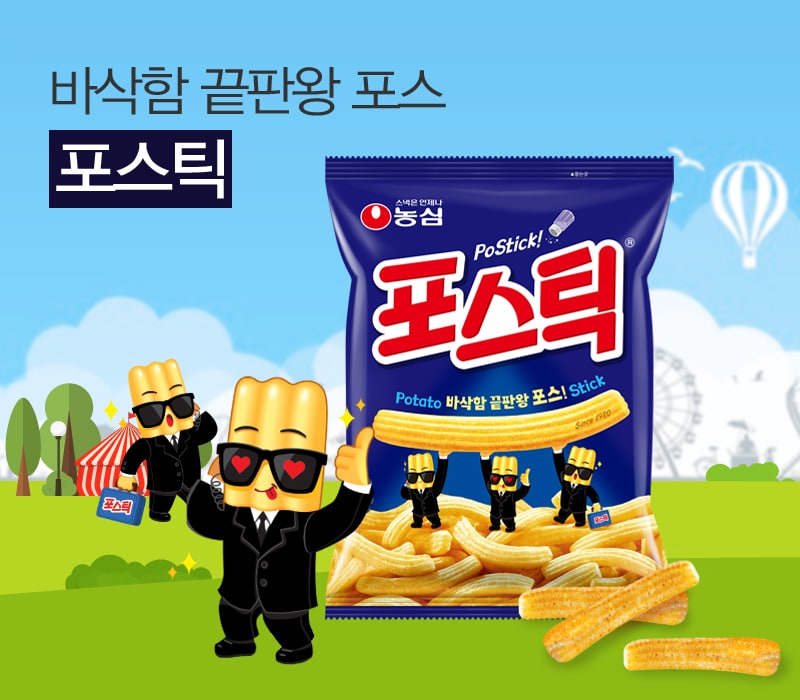
Nongshim's own brand artwork. The ridges on the sticks are the point — they are what holds seasoning, which turns out to matter. Image: Nongshim official brand page.
You might like: Badacoconut: The Korean Biscuit That Survived by Spelling Its Own Name Wrong
The Ketchup Packet, and Why It Still Shows Up in Searches
Search 포스틱 in Korean and one of the branches Naver offers is 포스틱 케찹 — Postick ketchup. That looks like a random pairing until you know the history.
Early bags of Postick shipped with a sachet of tomato ketchup inside. You tore it open and dipped, which made the product a home version of fries-and-ketchup at a time when that was a novelty in Korea. The sachet was eventually dropped on cost — it was a meaningful share of the price of a cheap snack — but the habit outlived the packet.
So Korean households kept dipping, using the ketchup bottle from the fridge. Two generations later the search query is still there, which is a small but genuine piece of evidence about how long a product ritual can survive the thing that started it.
If you are eating one for the first time, this is the intended experience and it is worth doing once: ketchup, on the side, not squeezed into the bag. The sticks are dry and firm enough to survive a dip without collapsing, which is exactly what the ridges are for.
What Koreans Actually Do With It Now
The modern habit is better, and it is not in any English write-up of this snack.
Open the bag, tip in ramyun soup powder, close it, and shake.
The combination Koreans name most often is Postick with 진라면 (Jin Ramen) soup powder. The logic is sound: Postick's own seasoning is mild and slightly sweet-savoury, and ramyun powder brings salt, chilli warmth and MSG-backed depth that the plain snack does not have. The ridges catch the powder well enough to coat without turning the sticks soggy, so you keep the crunch and gain the flavour.
The one rule everybody repeats: add it a little at a time. Ramyun powder is engineered to season 550ml of broth, so a whole sachet on 84g of dry snack is inedibly salty. The Korean search suggestion for this is literally 포스틱 라면스프 양 — "Postick ramyun soup powder, how much" — which tells you people get this wrong.
This is treated as an 안주 move in Korea, a snack engineered to go with beer, rather than something you would make for a child. If you have a half-used ramyun soup sachet in the cupboard — and if you cook Korean instant noodles you probably do, since plenty of people use less than the whole packet — this is the standard use for it. Our Korean ramyun guide covers which soup bases are worth saving.
Trying it before a trip: As an Amazon Associate, EpicKor may earn from qualifying purchases at no extra cost to you. Postick itself moves through Korean grocery importers rather than the big snack brands, so availability is patchy — check current listings and price per bag before paying import pricing for a snack that costs ₩1,133 on promotion in Seoul. If it is not in stock, the ramyun-powder trick works on any ridged dry stick snack, which is the more useful half of this article anyway.
Check listings on AmazonWhat It Costs, and What It Used to Cost
The current number first. ₩1,700 for the 84g bag, and Korean convenience stores run it on 2+1 regularly — GS25's listing has carried that promotion repeatedly, which brings the effective price to about ₩1,133 a bag. Never pay the shelf price for this if a promotion tag is on the shelf edge; on this product there usually is one.
The longer arc is where it gets interesting, because Postick has been on sale long enough to have a price history worth plotting.
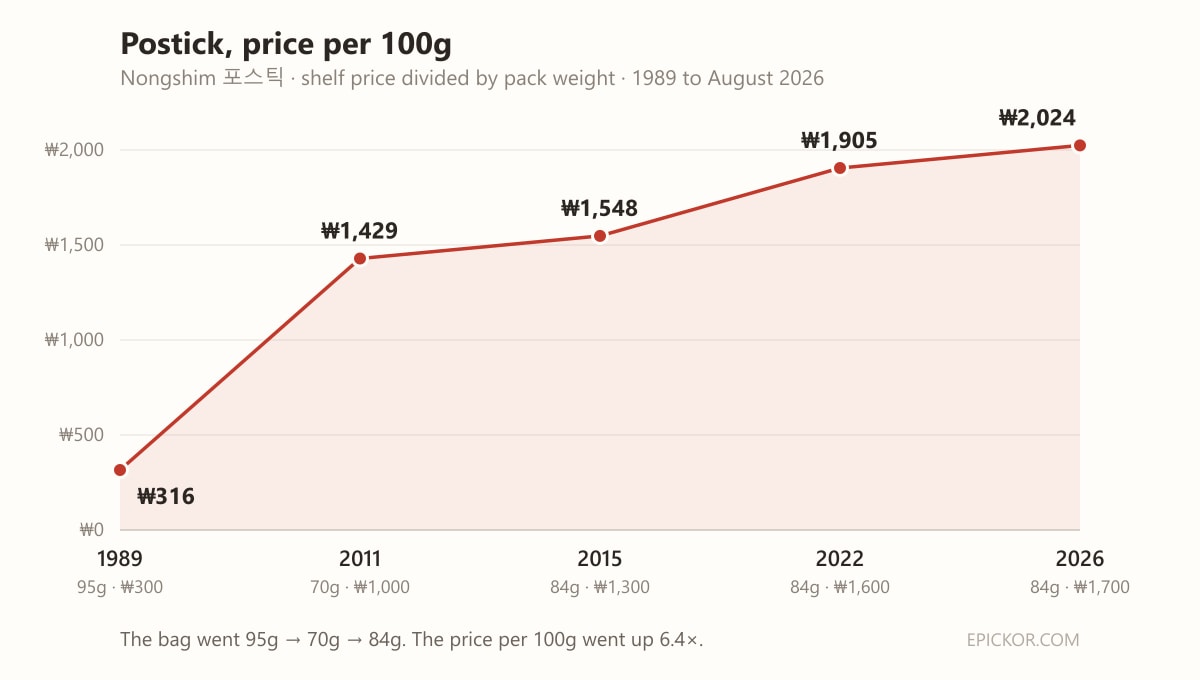
Price per 100g, not price per bag — the bag changed size twice, so per-bag prices understate the change. Chart: EpicKor, from the price points listed below.
| Year | Bag | Price | Per 100g |
|---|---|---|---|
| 1989 | 95g | ₩300 | ₩316 |
| 2011 | 70g | ₩1,000 | ₩1,429 |
| 2015 | 84g | ₩1,300 | ₩1,548 |
| 2022 | 84g | ₩1,600 | ₩1,905 |
| 2026 | 84g | ₩1,700 | ₩2,024 |
Read the middle column and the right column together. Between 1989 and 2011 the bag lost 25 grams while the price more than tripled, so the per-100g price went up 4.5× in a period when the sticker price went up 3.3×. The bag has since come back up to 84g and held there.
Across the whole period the price per 100g rose 6.4×. That is the shape of Korean snack pricing generally — the sticker moves slowly enough that nobody complains, and the pack weight does the rest of the work. It is also why "it costs ₩1,700" is a less honest answer than "it costs ₩2,024 per 100g," and why we put the second number in the chart.
Things That Were Tried and Dropped
Postick has had a quieter product history than its shelf-mates, which is part of why it has lasted.
- The ketchup sachet. The original gimmick, removed on cost.
- A sweet potato version. Discontinued. Sweet potato is a crowded shelf in Korea and this did not win it.
- A 2014 chilli-sauce dip edition, 104g for ₩1,500 — a bigger bag with a sauce packet, essentially a revival of the original ketchup idea in spicier form. Also discontinued.
The pattern is legible: every attempt to sell Postick with a sauce included has failed, and the plain bag keeps outliving them. Meanwhile the sauce habit thrives anyway, because people supply their own. That is arguably the more efficient outcome for everyone except the marketing department.
Where to Find It, and What to Expect
Postick is a mainstream, everywhere snack in Korea — CU, GS25, 7-Eleven, Emart24, plus every supermarket. It is not a specialty item, a regional item, or a limited edition, and there is no hunt involved. Our Korean convenience store food guide covers what else is worth putting in the same basket.
Set your expectations correctly and you will like it. It is salty, mildly barbecue-and-onion, firm rather than delicate, and engineered to be eaten by the handful while doing something else. It is not a premium snack and does not pretend to be. At ₩1,133 on promotion it is one of the cheaper things in the shop.
Skip it if you want a potato chip experience, if you dislike dry firm textures, or if you are looking for something distinctively Korean to take home as a gift — Postick's charm is that it is ordinary, which does not travel well as a souvenir.
FAQ
Q: What is Postick?
A: A Korean savoury stick snack made by Nongshim, on sale since 1980. Ridged fried sticks of wheat-and-cornstarch dough seasoned with barbecue and onion, about 23% potato despite the name. The 84g bag runs ₩1,700 and about 390 kcal.
Q: Is Postick a potato chip?
A: No, and this is the most common misunderstanding. A potato chip is a slice of potato. Postick is a dough-based extruded stick that contains 23% potato and is seasoned to taste of it. The texture is firmer and drier than a chip — closer to a savoury breadstick.
Q: How do Koreans eat Postick?
A: Two ways. Ketchup, which is a leftover habit from the sachet that used to come in the bag. And ramyun soup powder tipped into the bag and shaken through — 진라면 powder is the combination named most often. Add the powder gradually; a full sachet is meant to season 550ml of broth and will make 84g of snack far too salty.
Q: How much does Postick cost in Korea?
A: ₩1,700 for the 84g bag as of August 2026, which works out to ₩2,024 per 100g. Korean convenience stores run it 2+1 frequently, taking the effective price to roughly ₩1,133 a bag. Check the shelf-edge tag before paying full price.
Q: Is Postick spicy?
A: No. The standard bag is a mild barbecue-and-onion seasoning with no chilli heat. The heat that Koreans associate with it comes from what they add — ramyun soup powder — not from the snack itself. A chilli-sauce edition existed in 2014 and was discontinued.
Q: Can you buy Postick outside Korea?
A: Sometimes, through Korean grocery importers and online marketplaces, but it is not a reliably stocked export product the way Nongshim's ramyun is. Availability and price both vary a lot, so it is worth checking the per-bag price against the ₩1,133 it costs on promotion in Seoul before ordering.
The One Thing to Remember
Postick is not a snack you eat as sold. It is a base — mild, dry, ridged, and cheap — that Korean households have been improving with a sauce or a powder for forty-six years, first with a ketchup packet the manufacturer supplied and now with one they do not.
Buy a bag, eat a few plain to see what the baseline is, then tip in half a spoon of ramyun powder and shake.
Sources and Further Reading
- Nongshim official brand page for 포스틱 (
brand.nongshim.com/potatostick/main/index) — product identity, pack imagery and the "Since 1980" mark, checked 26 August 2026 - 나무위키 포스틱 — launch year, the 포스틱 → 포테토스틱 → 포스틱 naming history, the wheat-and-cornstarch composition and the 29% → 23% change in potato content, the barbecue-and-onion seasoning profile, the original tomato ketchup sachet and why it was removed, and the discontinued sweet potato and 2014 chilli-dip editions
- 펴늬 (pyony.com), GS25 listing for 농심 포스틱 84G — shelf price ₩1,700 and the recurring 2+1 promotion at an effective ₩1,133 per bag, with the July 2022 ₩1,600 and November 2023 ₩1,700 price points
- Korean recipe and food coverage of the 포스틱 + 진라면 스프 combination, including the method (tip into the bag, shake) and the warning to add the powder gradually
- Historical price points: 1989 at 95g for ₩300, 2011 at 70g for ₩1,000, 2015 at 84g for ₩1,300. Per-100g figures in the chart are calculated from those
- Image sources and licensing are documented in this post's
image-sources.md
Prices checked 26 August 2026. Korean convenience store promotions rotate monthly; confirm the shelf-edge tag rather than assuming a 2+1 is running.
You Might Also Like
Banana Kick: Korea's Banana Snack Is 1.6% Banana, and That's the Point
It is a corn puff with 1.6% banana powder, and it dissolves — which is why a 12-month-old just made it go viral with 25.8 million views. Launch history, what Melon Kick and Mango Kick are, August 2026 prices, and who should skip it.
Hetbahn: What Korea's Instant Rice Is Made Of, and How to Heat It Without a Microwave
햇반 is 99.9% Korean rice and water plus 0.1% rice bran extract, sealed in a room cleaner than a hospital ward. The lid prints three cooking times and one of them needs no microwave at all. Prices, varieties, and the mistake almost everyone makes with the film.
Korean Food Prices in August 2026: What Already Rose, and What Changes on the 25th
Four Korean food makers raised prices within three weeks, and Paris Baguette's 127-item increase lands on 25 August. The exact brands, dates and won amounts, why wheat and corn are behind it, and what it actually changes for a visitor.