Korean Bidets Explained: The Buttons, the Brands, and Why Half of Korea Has One
The first time you sit on a Korean toilet with a control panel bolted to the side, the problem is not the technology. It is that there are eight buttons, several are in Korean, and one of them is going to do something to you.
This guide is the thing most English pages about Korean bathrooms skip: what the buttons mean, why Korea adopted these so completely, and which brands you can actually buy if you want one at home.
The short version: more than half of Korean households have an electronic bidet seat, most of them do not own it outright, and the two names on the panel are usually Coway or Novita.
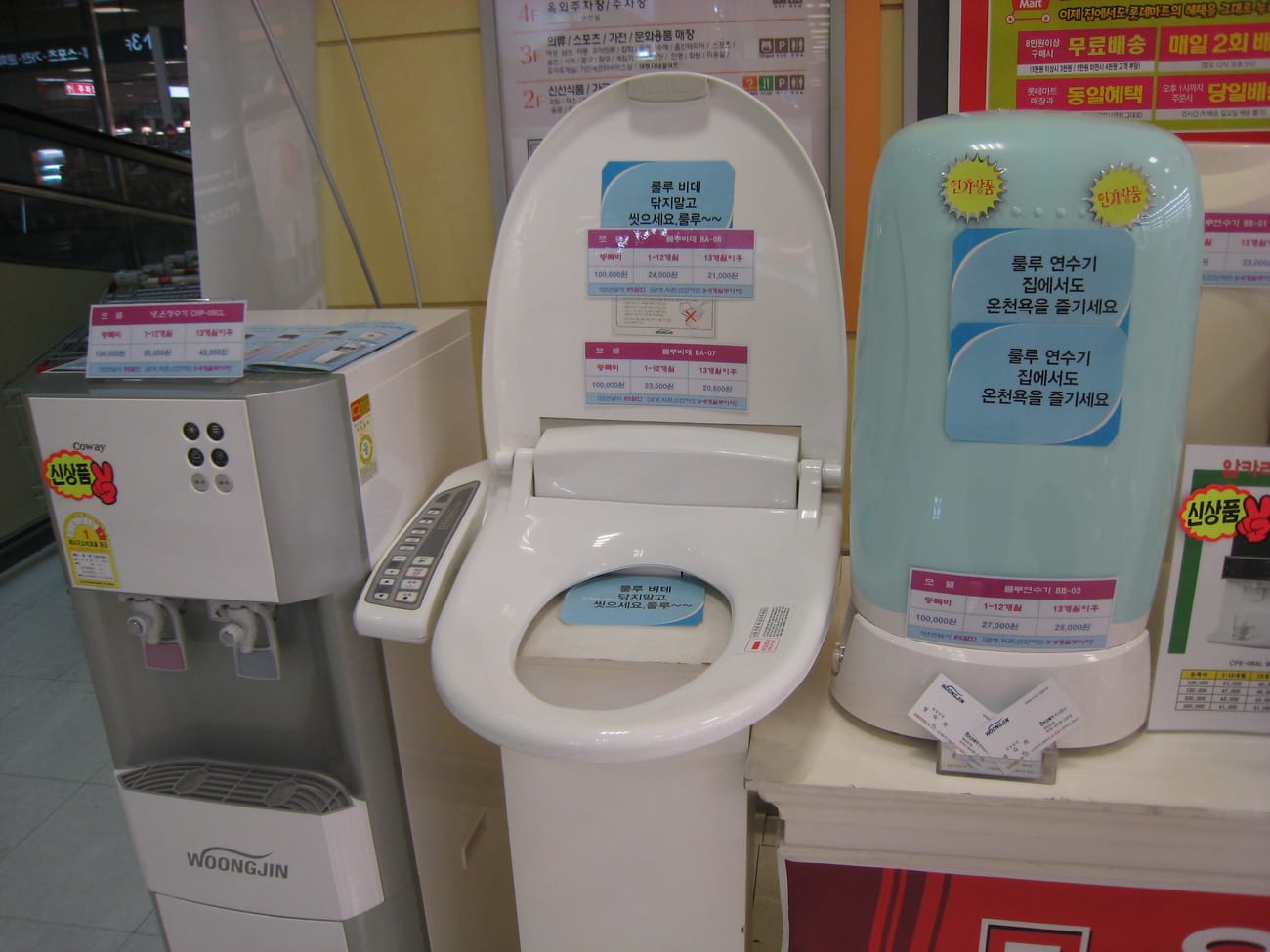
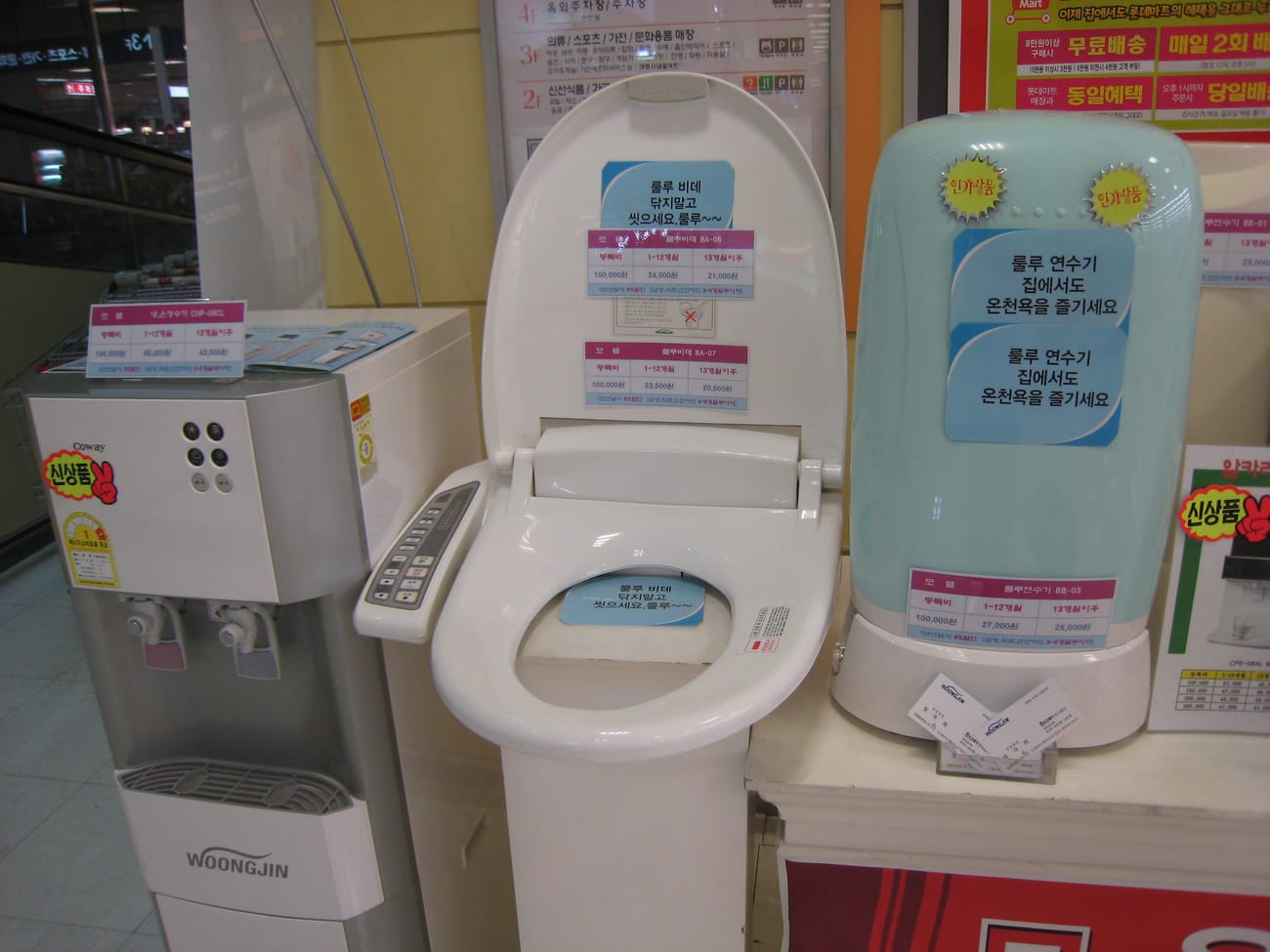
신상품 stickers on the shelf. This is the whole story in one photograph — the bidet spread through Korea on the same rental counter as the water purifier. Photo by Syced, CC0, via Wikimedia Commons.Coway Bidetmega 400S — the Korean bidet seat you can buy in the US, with instant water heatingAffiliate link. As an Amazon Associate, EpicKor earns from qualifying purchases at no extra cost to you.
Quick Guide: The Buttons
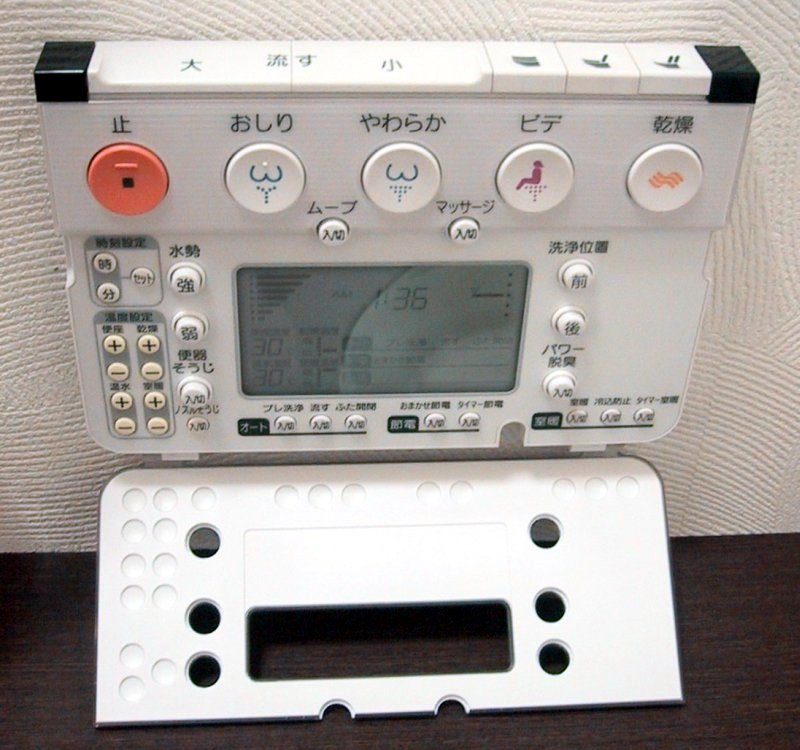
Panels vary, but the vocabulary does not. These are the words and icons you will meet.
| Korean | Romanised | What it does |
|---|---|---|
| 비데 | bide | The front wash. Aimed forward, gentler. |
| 세정 | sejeong | The rear wash. This is the main one. |
| 건조 | geonjo | Warm air dryer. Slow — most people still use paper. |
| 수압 | suap | Water pressure, usually with + and −. |
| 수온 | suon | Water temperature. |
| 노즐 | nojeul | Nozzle position, forward or back. |
| 착좌 | chakjwa | Seat sensor indicator — nothing sprays unless you are sitting. |
| 정지 / 멈춤 | jeongji / meomchum | Stop. Learn this one first. |
Two things worth knowing before you press anything:
- Nothing will fire while you are standing. Korean units use an occupancy sensor, so a curious press at the sink does nothing. This is deliberate and it is why the panel is safe to explore.
- Start at the lowest pressure. The default is often set by whoever used it last, and the range at the top end is genuinely strong.
Coway Bidetmega 500S — the Korean market leader's full-feature seat, sold in the US The same button vocabulary as above, plus instantaneous water heating, an auto-opening lid and a deodorizer. Before ordering any seat, measure your bowl — elongated or round cannot be fixed after delivery — and skip Novita listings marked 220V, which are Korean-market imports that will not run on a US outlet. As an Amazon Associate, EpicKor earns from qualifying purchases at no extra cost to you.
See Coway Bidetmega 500S on AmazonWhy More Than Half of Korean Homes Have One
Korean household penetration passed 50% in Gallup Korea's 2023 survey of ownership across eighteen kitchen, environmental and health appliance categories. That is not a niche product. That is a majority appliance, on the same list as water purifiers and air purifiers.
It got there quickly, and for reasons that are more commercial than cultural.
Electronic bidet seats were developed in Japan by TOTO in 1980. Korea began adopting them seriously in the late 1990s, and the moment they became a normal household object rather than a luxury is dateable: May 2002, when Woongjin Coway put its 룰루 (LooLoo) bidet into a heavy national television campaign.
That campaign worked because it was attached to a business model, not just a product — which is the same story as Korean air purifiers and water purifiers.
The Rental Model Again
If you have read EpicKor's Coway versus Winix guide, this will sound familiar.
Koreans largely do not buy bidet seats outright. They rent them on a monthly plan, and a Coway service worker — a 코디 (Cody) — visits on a schedule to clean the unit and change the filter. Coway has been ranked first in bidets in Korea's KPEI purchase-confidence survey for twelve consecutive years.
The rental structure is why penetration climbed so fast. A ₩400,000 appliance is a decision. A monthly fee with someone else handling maintenance is a subscription, and subscriptions spread through households far faster than purchases do — especially for a device with a water filter that most owners would rather not think about.
It also explains why the market is concentrated. Industry estimates put Coway at roughly 24–28% share and Kohler Novita at roughly 21–24%, with Daelim B&Co and others behind them. Those numbers describe a market where distribution and service, not just hardware, decide the winner.
The Filter Is the Whole Argument
If you want to understand why a country rents bathroom fixtures, look at the filter.
An electronic bidet takes mains water, warms it, and sprays it. Everything unpleasant that can go wrong with that device is downstream of water sitting in a line and a filter that nobody replaced. It is also invisible: a neglected bidet looks exactly like a maintained one.
That is an awkward product to sell outright, because the manufacturer's reputation depends on maintenance the owner will not perform. Rental solves it structurally rather than by persuasion — the filter change is not a task the customer remembers, it is a visit that arrives.
It also explains a difference foreign buyers walk into. Buy a Korean bidet seat abroad and you have bought the hardware without the service loop it was designed around. Nobody is coming. You will need to know your model's filter interval and buy the cartridge yourself, and the first sign that you have forgotten is not a warning light — it is the smell.
Two practical habits, whichever way you got the unit:
- Run the nozzle-clean function regularly. Most Korean models have a dedicated
노즐 세척button or a self-cleaning cycle; it exists because it is needed. - Note the filter date somewhere that is not the bathroom. A calendar reminder outlives a sticker on a wet appliance.
The Brands, and What Happened to Them
Two of the three names you will see have unexpected corporate histories.
Novita was founded in 1984 as a Samsung subsidiary. It built its reputation on build quality and design, and it is now owned by Kohler, the American plumbing company — which is how a Korean bidet brand ended up with mainstream US retail distribution under the name Kohler Novita.
Coway is the rental company covered in the air purifier guide: founded 1989, invented Korea's appliance rental market in 1998 after the IMF crisis, and now the largest bidet brand at home.
So the two leading Korean bidet brands reached foreign buyers by completely different routes — one through acquisition by an American plumbing giant, the other through its own export operation.
What to Expect Versus a Western Bidet Seat
If your reference point is a non-electric bidet attachment, the differences are large:
- Heated water on demand. Better Korean units heat instantaneously rather than storing a small tank, which is why they do not run cold partway through.
- Heated seat. In an unheated Korean bathroom in February this is not a luxury feature.
- Occupancy sensing, deodoriser, night light, auto lid. Standard on mid-range models, not premium extras.
- Stainless steel nozzles with self-cleaning. The hygiene question most first-time buyers ask is answered in the hardware.
- A filter you are expected to change. This is the part rental exists to solve, and the part owners abroad most often neglect.
The one genuine downside: electronic seats need a nearby outlet, and many bathrooms outside Korea and Japan do not have one near the toilet. Check that before you buy anything.
Buying One Outside Korea
Both leading Korean brands sell internationally, at very different price points.
Novita, through Kohler, is the easier one to find abroad — and it is not cheap. Specialist retailers list the side-panel BN-330 from about $425, the BG-90/93 from about $526, and the flagship BH-90/93 at $699 on sale against a $999 list price.
Be careful reading marketplace listings here. Searching "Novita bidet" on a marketplace mixes cheap non-electric bidet attachments and accessories in with the seats. A real Korean electronic seat is an appliance — the specialist-retailer prices above are the benchmark — and anything priced like an accessory is a different category of product.
Both round and elongated fits exist, and elongated versus round is the measurement that decides whether it fits your toilet at all, so check that before anything else.
Coway sells bidet seats internationally too, though its US model lineup rotates and older models such as the BidetMega 200E have been discontinued while newer 400S and 500S seats continue.
Where You Will Actually Meet One
Coverage is uneven in a way that is worth knowing before you plan around it.
Hotels and serviced apartments: near-universal in mid-range and above. If the room has a control panel, it is usually a full-feature unit.
Private homes: better than half, and skewed toward newer apartments. An older 빌라 or a 고시원 room may have nothing.
Cafés and restaurants: inconsistent. A single-toilet café is unlikely to have one; a department-store food floor almost certainly does.
Public and transit toilets: the newer the building, the better the odds. Department stores, large bookshops and recently rebuilt subway stations are the reliable ones — EpicKor's guide to Korean public toilets covers how to find the good ones and why Korea has so many.
Jjimjilbang and saunas: usually yes, and usually well maintained, because the whole business is built on bathing.
One thing that surprises visitors from countries where public facilities are scarce: you are rarely more than a few minutes from a clean toilet in urban Korea, and a decent share of them will have a heated seat. That combination is a bigger part of why Korean cities feel comfortable to walk than most travel writing admits.
What Tourists Should Actually Do
- In a hotel or a home, the panel is safe to explore. The seat sensor means nothing happens unless you are sitting.
- Find
정지before you press anything else. It is usually the largest or the red button. - Public toilets often have them too, though the fanciest units are in department stores, hotels and newer subway stations rather than street-level facilities. EpicKor's guide to Korean public toilets covers where to find the good ones.
- The dryer is slower than you want. Koreans generally use it as a finisher, not as a replacement for paper.
Rechargeable portable bidet — the wash without the plumbing project The common story after a Korea trip is wanting the wash, not an installation job. A travel sprayer needs no outlet and no filter, and it is the zero-commitment step before a non-electric attachment or an electronic seat like the Coway units above. As an Amazon Associate, EpicKor earns from qualifying purchases at no extra cost to you.
See the portable bidet on AmazonFrequently Asked Questions
Q: Do Koreans use bidets or toilet paper?
Both. An electronic bidet seat washes; most people still finish with paper or the warm-air dryer. The bidet does not replace toilet paper in Korean homes, and Korean bathrooms are stocked with both.
Q: What is the difference between the 비데 and 세정 buttons?
세정 (sejeong) is the rear wash and the one most people use. 비데 (bide) is the front wash, aimed forward and set gentler. Panels list them separately because they use different nozzle positions.
Q: Are Korean and Japanese bidets the same?
They share an origin — TOTO developed the electronic seat in Japan in 1980 — but the Korean market developed its own manufacturers and, crucially, its own rental distribution model. Korean brands such as Coway and Novita compete on service contracts and filter maintenance in a way Japanese brands generally do not.
Q: How common are bidets in Korea?
More than half of households have one, according to Gallup Korea's 2023 appliance ownership survey. It sits alongside water purifiers and air purifiers as a normal Korean home appliance rather than a luxury.
Q: Are electronic bidets hygienic?
The hardware answers most of the concern: nozzles are stainless steel, retract when not in use, and have a self-cleaning cycle on most Korean models. The real variable is the water filter, which has to be replaced on a schedule. In Korea that is handled by the rental service visit; if you own one abroad, it is your job, and a neglected filter is the single most common cause of complaints.
Q: Can I buy a Korean bidet seat outside Korea?
Yes. Kohler Novita, the Korean brand Samsung founded in 1984 and Kohler now owns, is the most widely available abroad; specialist retailers list its electronic seats from about $425. Coway also exports, with a rotating model lineup. Check that you have a power outlet near the toilet and confirm whether your bowl is elongated or round before ordering.
Sources Checked
Gallup Korea's 2023 Market 70 appliance ownership survey for the household penetration figure; Korean industry reporting on bidet market share for Coway and Kohler Novita; Korean coverage of the category's history, including TOTO's 1980 electronic seat and the May 2002 Woongjin Coway LooLoo advertising campaign; Coway's twelve consecutive KPEI first-place rankings in bidets; and Novita's 1984 founding as a Samsung subsidiary and subsequent acquisition by Kohler. Market shares are industry estimates and model availability changes frequently — confirm current specifications and fit before buying.
You Might Also Like
Korean Water Purifiers: The 1998 Rental Bet That Built Coway's Empire
In the worst month of Korea's IMF crisis, a water purifier company started lending machines instead of selling them. That decision built a ₩4 trillion empire, invented Korea's rental economy, and explains half the appliances on this site.
Coway vs Winix: Which Korean Air Purifier Fits Your Home
Coway and Winix dominate American air purifier shelves, and both are Korean. Here is what Koreans actually buy, why Coway rents instead of sells at home, and which one belongs in your room.
Korean Humidifiers: Buy the One That Comes Apart
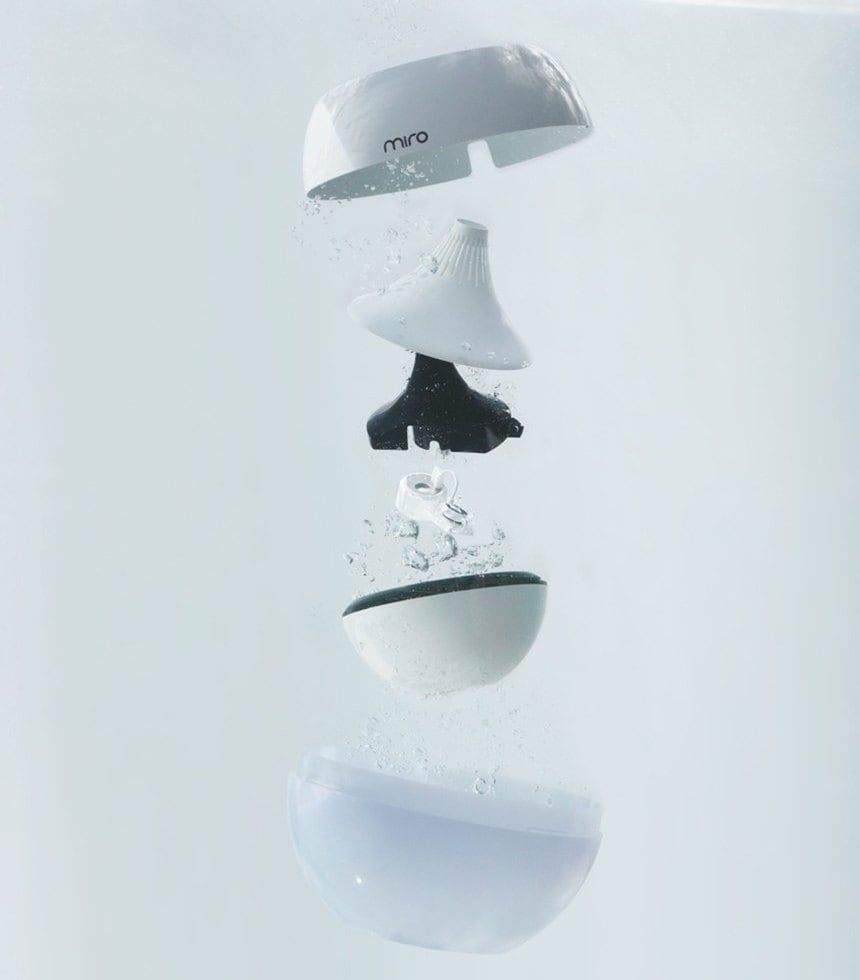
Korean humidifiers pull apart into six washable pieces, the humidifying engine included. Korea's consumer agency measured why: daily water changes cut bacteria 87.3%, washing every second day 98.8%. What Amazon lists is a generation behind Korea's shelves.