Where to Buy Electronics in Seoul: What Yongsan Electronics Market Is Now, and Is Tech Cheaper in Korea?
Last updated: 1 October 2026 (Galaxy S26 price rise confirmed in effect). Building status re-checked against Korean press reports from March to September 2026; phone prices read from Apple's Korean and US stores on 30 September 2026; dollar figures use ₩1,356.7 to US$1 (Seoul close, 29 September 2026).
Where to buy electronics in Seoul, in one line: new phones, laptops and tablets at an official brand store or a big chain such as 롯데하이마트 (Lotte Hi-Mart); PC parts and repairs at what is left of 용산전자상가 (Yongsan Electronics Market); cables and adapters at 다이소 (Daiso) or a convenience store. The famous market is no longer the answer for a visitor — and electronics are not cheaper in Korea, as the iPhone numbers below show.
Most tech-shopping guides still send you to Yongsan first. That advice is now out of date. Since 2024 the 나진상가 (Najin) buildings have been coming down one by one; by August 2026 seven were rubble behind metal hoardings and three more were shut with chains on the doors. What still trades is largely business-to-business — parts, assembly, repair, used stock.
| You want | Go to | Why |
|---|---|---|
| New phone, laptop, tablet | Apple Store, Samsung store, 롯데하이마트, 전자랜드 (Electroland) | Fixed prices, receipts, tax-refund paperwork, returns |
| PC parts, assembly, upgrades | 선인상가 (Seonin, buildings 21–22), Yongsan | Still trading; stock today, assembly on site |
| Repair, obscure cables | Yongsan | The one thing online never replaced |
| Anime figures, gacha, goods | 국제전자센터 (Seocho) — not for electronics any more | Floors 3 and 6–9 are now largely figure and gacha shops |
| Power banks, cables, adapters | 다이소, convenience stores | Cheap, everywhere, no bargaining |
| Is it cheaper here? | Usually no | iPhone 17 256GB: ₩1,450,000 in Seoul, US$929 in the US |
| Instant tax refund | Purchases under ₩1,000,000, up to ₩5,000,000 per trip | A flagship phone is over the line — that refund goes through the airport |
| Do not | Plan a half-day around browsing the electronics market | Half of it is a building site |
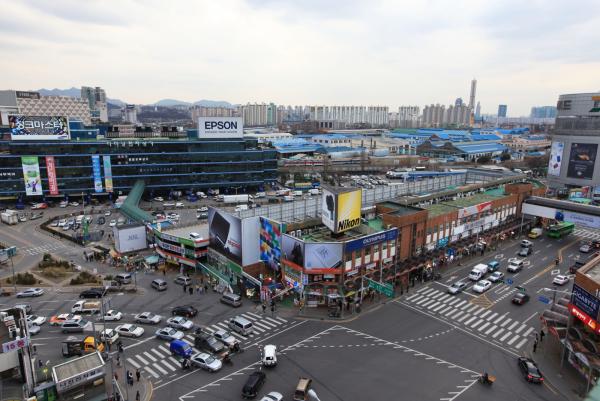
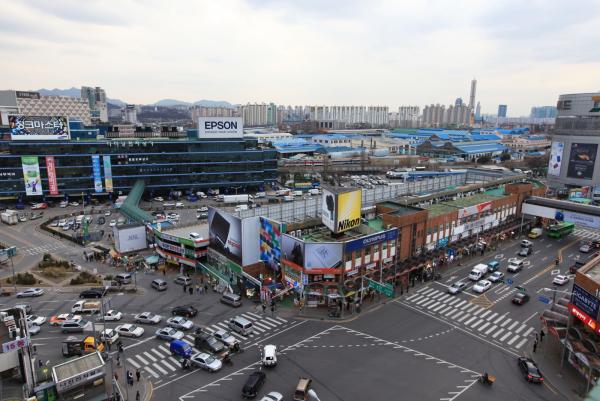
The Yongsan electronics district in March 2010, fourteen years before the first Najin building came down. Photo: The Seoul Institute, Seoul Research Data Service / KOGL Type 1 / CC BY 4.0.
Korea runs 220V on Type F sockets — pack a TESSAN Korea plug adapter so anything you buy in Seoul works the day you landAffiliate link. As an Amazon Associate, EpicKor earns from qualifying purchases at no extra cost to you.
Is Tech Cheaper in Korea? The iPhone and Galaxy Numbers
This is the question most visitors actually have, so here is the arithmetic rather than a feeling.
| Phone (256GB) | Korean price | Before 10% VAT | Compare |
|---|---|---|---|
| iPhone 17 | ₩1,450,000 (Apple Korea, 30 Sep 2026) | ₩1,318,182 ≈ US$972 | US$929 on Apple's US store, before sales tax |
| Galaxy S26 | ₩1,403,600 (since 1 October 2026; launch price ₩1,254,000) | ₩1,276,000 ≈ US$941 | Raised ₩149,600 on Samsung.com and Korean retail from 1 October 2026 |
Korean shelf prices include 10 percent VAT; American prices are quoted before sales tax. Take the VAT out and the Seoul iPhone is still dearer than the American one. The tax refund does not close the gap either: refund operators keep a fee, and what comes back is roughly 5 to 8 percent of the price, not the full tenth (our Korea tax refund guide has the minimums, limits and airport steps).
The Galaxy line is the one place a Korean price can look tempting, and it is moving the wrong way. On 1 October 2026 Samsung raised the Korean price of the S26 range on Samsung.com and across Korean retail — the first time a Galaxy S model's price has gone up after launch. The S26, S26+ and Ultra 256GB/512GB each rose ₩149,600 (the S26 256GB from ₩1,254,000 to ₩1,403,600), and the Ultra 1TB rose ₩276,100 to ₩2,821,500. Korean press put it down to memory-chip and component costs and the weak won.
Two catches apply to any phone bought here:
- The camera shutter sound cannot be turned off on phones sold for the Korean market, and it stays on after you fly home.
- Warranty is local. Apple's iPhone service can be restricted to the country of sale, and a Korean-market Galaxy is serviced through Samsung Korea. Fine for a cable, a real problem for a ₩1.4 million phone.
Anker 10,000mAh power bank — the one gadget not worth buying in Seoul. You need charge on day one for maps, translation and QR menus, and a power bank is the same product at home as at a Yongsan counter. Bring it in your carry-on, not your checked bag. As an Amazon Associate, EpicKor earns from qualifying purchases at no extra cost to you.
See the Anker power bank on AmazonWhat Is Left of 용산전자상가
The market was never one building. It is a cluster, and the cluster is coming apart plot by plot. This is the state of it as of September 2026.
| Building | Korean | Status |
|---|---|---|
| Buildings 1–3 | 전자랜드 | Trading. Owner announced a 265-room Sheraton hotel and 264 officetels in November 2024; no demolition date yet |
| Buildings 4–7 | 원효상가 | Trading. Owners passed 80% consent for reconstruction in October 2025 |
| Buildings 8–9 | 터미널상가 | Demolished 2015 → Seoul Dragon City hotel since October 2017 |
| Buildings 10–13 | 나진상가 | Demolished (2024–July 2025). 12–13: construction due to start October 2026 |
| Building 14 | 나진상가 | Shut, shutters down; demolition scheduled from October 2026 |
| Building 15 | 나진상가 | Demolished end of February 2026; construction due October 2026 |
| Buildings 17–18 | 나진상가 | Shut, doors chained. 26-storey office block, construction 2027, completion 2030 |
| Buildings 19–20 | 나진상가 | Demolished July 2025. 28-storey AI/ICT office block approved March 2026, construction 2027 |
| Buildings 21–22 | 선인상가 | Trading. PC parts and assembly. No redevelopment date |
The replacement district is being built for AI and ICT offices, not shops. The plots move at different speeds: the Najin buildings each have a single owner and are going fast, while 원효상가 and 선인상가 are split among many individual owners, and merchants there told Korean reporters in August 2026 that agreement would not come easily. Korean sources note one small, telling detail: the 용산전자상가 intersection is due to be renamed, because it will no longer be an electronics market.
Console-game specialists that used to be a draw have scattered with the Najin buildings; some reportedly moved toward 원효로2가.
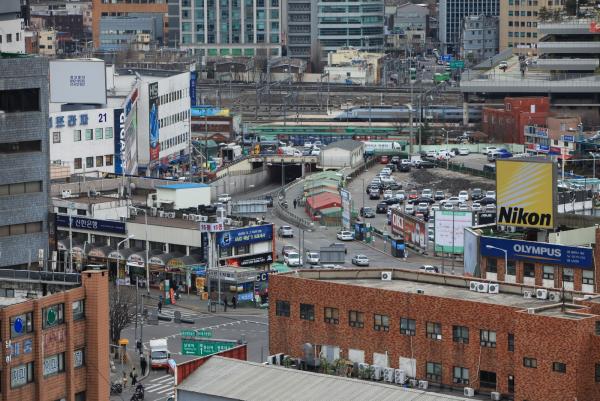
Nikon and Olympus signs on the Yongsan blocks in 2010. Buying a camera here is no longer the plan it once was — the used-camera trade moved to specialists. Photo: The Seoul Institute, Seoul Research Data Service / KOGL Type 1 / CC BY 4.0.
Why It Emptied Out
Two forces, and the second one is not obvious.
The first is the ordinary one. Price comparison went online. Once a shopper could check every price in Korea from a phone, the whole basis of a haggling market — that the seller knew the price and you did not — was gone. Korean commentary is blunt that by 2025 there was little reason to go to Yongsan for straightforward shopping.
The second is more recent. The memory-chip shortage that set in during late 2025 hit small retailers unusually hard. Large technology firms bought up supply for AI data-centre build-outs, and the allocation ran through channels that bypass small shops entirely. Shelves thinned out. A major PC retailer, 컴마왕, walked out of its premises in 선인상가 in November 2025. A market cannot work as a comparison venue when the stock is not there to compare — and the same component costs are what Korean carriers cited for the Galaxy price rise above.
That combination is why the honest description of Yongsan today is not "dying" and not "gone." It is a working trade district that stopped being a shopping destination.
What It Is Still Genuinely Good For
Do not write it off. Go for the right reasons.
PC parts and custom builds. 선인상가 is still where Koreans go to have a machine assembled or to buy a specific component today rather than wait for delivery. Reporters in August 2026 found its merchants still managing stock and packing parcels. If you need a part now, this is the fastest place in Seoul.
Repair. Screen replacements, board-level repair, connector work, obscure adapters, legacy cables. This is the market's most durable function and the one online cannot replace.
Used and legacy stock. Older components, discontinued cables, things that no longer have a retail channel.
What it is not good for: buying a new phone, laptop, tablet or camera as a visitor. You will not beat a brand store on price, and you will lose on warranty, language support and returns.
Where to Actually Buy Electronics in Seoul
| You want | Go to | What to know |
|---|---|---|
| iPhone, iPad, Mac | Apple Store — Garosu-gil, Yeouido, Myeongdong, Jamsil, Gangnam, Hanam, Hongdae | Seven stores, the newest (Hongdae) opened January 2024 |
| Galaxy phones, Samsung and LG appliances | Samsung and LG brand stores, 롯데하이마트 | Fixed prices, receipts; ask about tax refund before you pay |
| General electronics under one roof | 전자랜드 branches, department-store electronics floors | The Yongsan 전자랜드 building itself still trades |
| PC parts today | 선인상가, Yongsan | Immediate stock, assembly on site |
| A multi-floor electronics mall | 강변 테크노마트 (Gangbyeon Techno Mart), linked underground from 강변역 (Line 2) Exit 1 | Many floors now empty; 6F is phones and cameras, 7–8F PCs, laptops and parts, 2F used-camera dealers |
| Cables, adapters, organisers | 다이소, convenience stores | Cheap, everywhere, no negotiation |
| Used cameras | Specialist used dealers | Grading, warranty, returns |
Two warnings on the malls. The phone floor at Techno Mart is known in Korea as a "성지" for subsidised handset deals, and those deals are tied to Korean mobile contracts, so they are not for a visitor on a tourist stay. And 국제전자센터 (International Electronics Center, connected underground to 남부터미널역 on Line 3) still carries "electronics" in its name, but since the gacha boom that began in 2024 its floors have filled with figure, goods and capsule-toy shops. Shops open 10:00–20:00 and close on the first and third Sunday of each month. Go if you want anime figures; do not go for a laptop.
For small things, Daiso is the answer — organisers, pouches, cable cases — with one exception: its "110V 여행용 어댑터" is built for Koreans travelling abroad, not for your plug in Korea.
Two Korea-specific things to hold in mind wherever you buy.
Korea runs on 220 V, 60 Hz, with the round two-pin Type C/F plug — the same shape used across most of Europe, but not the UK, US, or Japan. A device rated 100–240V is fine with a plug adapter. A device rated for 110 V only is not, and no adapter fixes that.
Your home customs allowance applies on the way back. Korea's own arrival allowance — US$800 per person, and a 30 percent cut in duty (up to ₩200,000) if you declare it yourself — is explained in what you cannot bring into Korea; your own country's rules apply to the laptop you carry home.
The Buying Filter
Before you hand over money:
| Question | Good sign | Bad sign |
|---|---|---|
| Exact model number? | Seller shows the label and lets you look it up | Seller avoids details or hurries you |
| Warranty valid where? | Written warranty or official receipt | "Don't worry about it," no paperwork |
| Voltage and plug? | Input reads 100–240V | No label, or 220V-only on a device you will take home |
| Return or exchange? | Stated window, receipt issued | Cash-only final sale on something expensive |
| Tax refund? | TAX FREE sign, passport asked for at the till | "Refund later" with no form or receipt |
| Packable? | Small, durable, fits the bag you actually have | Bulky box, fragile, no luggage plan |
Paying is rarely the problem: foreign Visa and Mastercard cards work at every chain and brand store in this guide. Where foreign cards actually get used in Korea, and where they do not, is in our foreign card spending guide.
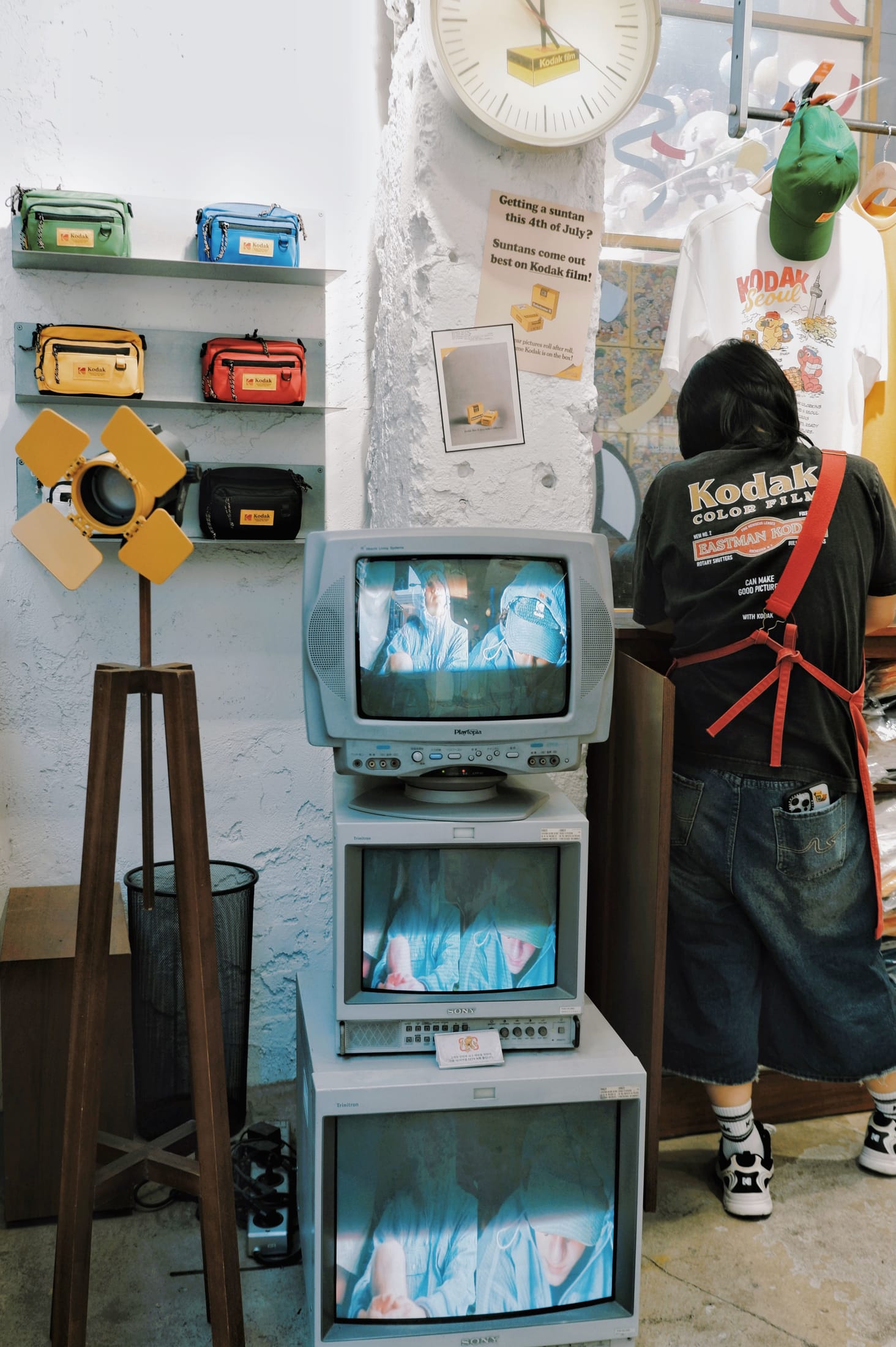
A Kodak-branded lifestyle shop in Seoul: camera bags and T-shirts, not cameras. A bag you can inspect is a safer purchase than a used lens. Photo: Pexels.
Camera Shopping, Honestly
Seoul makes you want a lens. Neon alleys, palace roofs, Han River evenings, rain on a cafe window — the city is a permanent argument for more gear.
Accessories are low-risk. Straps, pouches, filters, cloths, small tripods, card cases. Inspect it, pay, done.
Used bodies and lenses are not a market purchase any more. The trade moved to specialists who grade condition and offer some form of return. If you are buying used, check the exact model, shutter count where it applies, fungus and haze, autofocus, stabilisation, mount compatibility, battery health, charger, menu language and the return terms. Take test frames and look at the corners.
If you cannot run those checks, the atmosphere of a shop is not a substitute for them.
Tax Refund on Electronics: The ₩1,000,000 Line
This matters most on exactly the sort of purchase a tech shopper makes.
Korea's 사후면세 system refunds VAT to foreign visitors at participating stores. Some stores can take the tax off at the till instead of sending you to the airport, within limits that were doubled on 1 January 2024:
| Rule | |
|---|---|
| Minimum purchase | ₩15,000 on one receipt (since 1 January 2024; it was ₩30,000) |
| Instant refund at the till | Each purchase under ₩1,000,000 |
| Instant refund per trip | Up to ₩5,000,000 in total |
| Above those limits | Keep the refund slip and claim at the airport |
| What comes back | Roughly 5 to 8 percent of the price, after the operator's fee |
The practical reading for a tech shopper: a camera lens, a tablet or a pair of earbuds under ₩1,000,000 can be refunded on the spot. A flagship phone cannot — the iPhone 17 at ₩1,450,000 and the Galaxy S26 at ₩1,403,600 are both over the line, so their refund goes through the airport kiosk and customs.
Look for a TAX FREE sign and ask before you pay, not after. Carry your passport; it is required at the point of sale. Keep receipts flat, and photograph the receipt, box label and serial number. Customs may ask to see the item unopened at the airport, so pack it where you can reach it.
Valante travel document organizer — one zipped folio for passport, receipts and refund slips. An airport refund on a phone or laptop needs paperwork that survives a week in a bag first; a flat document sleeve is a duller purchase than a lens and saves more money. As an Amazon Associate, EpicKor earns from qualifying purchases at no extra cost to you.
See the Valante document organizer on AmazonThe Yongsan People Actually Go To Now
This is the part no English tech guide mentions, and it is the more useful half of the answer if you are in Yongsan anyway.
Cross to the other side of the station and you are in 용리단길 — Yongridan-gil, the alleys of 한강로2가 between 신용산역 and 삼각지역. It is two minutes from 삼각지역 Exit 3, or five to ten minutes from 신용산역 Exit 1 or 용산역 Exit 1.
It was an old low-rise residential and light-industrial pocket. Then 아모레퍼시픽 put its headquarters there, the daytime population changed, and the alleys filled with small, heavily designed restaurants and cafés — places built around a specific reference, whether Hong Kong, San Francisco or Paris. The Michelin Guide has published a Yongsan neighbourhood guide. Korean media file it under 핫플레이스.
The practical point for a traveller: if you are going to Yongsan, the food street is the reason, and the electronics market is now the curiosity you look at on the way. Popular places take walk-in queues at peak times. Koreans check 캐치테이블 before going.
You might like: Seoul by neighbourhood — all twelve compared
A Half Day in Yongsan That Makes Sense Now
The old version of this route sent you to browse the market. Here is one built on what is actually there.
- 삼각지역 Exit 3, 신용산역 Exit 1 or 용산역 Exit 1. Start on the 용리단길 side.
- Walk the alleys of 한강로2가. This is the part worth your time. Coffee, look at shops, notice how new the whole thing is.
- Cross to the market if you are curious. Twenty minutes is enough to see the hoardings where the Najin buildings stood and the blocks that still trade.
- 선인상가 only if you need a part. Otherwise it is a working building, not an attraction.
- Buy accessories at 다이소 or a convenience store, not at a counter where you have to negotiate.
- Eat back on the 용리단길 side. Check 캐치테이블 first if it is a weekend.
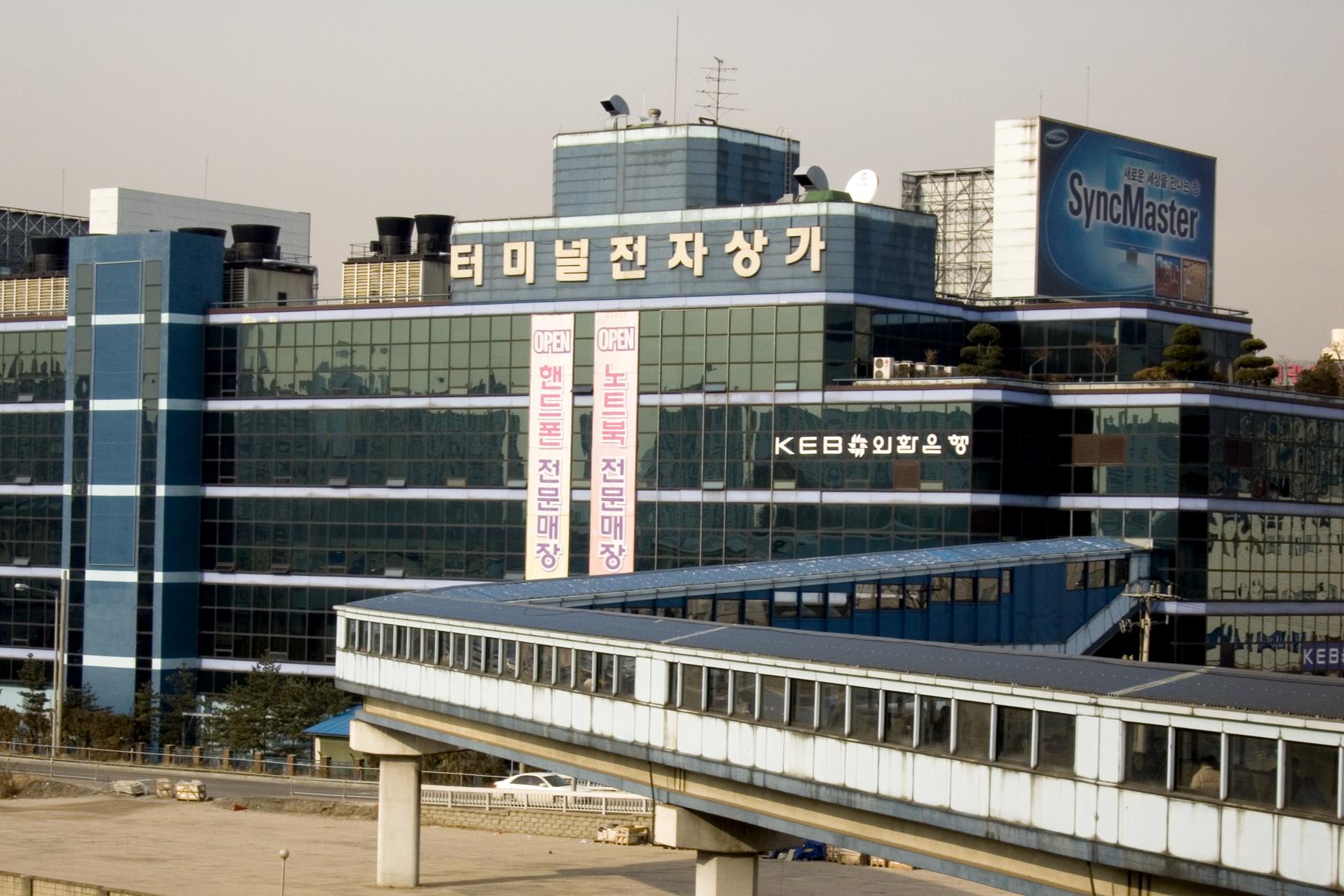
터미널전자상가, buildings 8 and 9, in January 2007. The building is gone: demolished in 2015 and replaced by the Seoul Dragon City hotel, which opened in October 2017. Photo: Andrew Currie, Wikimedia Commons / CC BY 2.0.
What Not to Buy in Korea
- Flagship phones. Dearer than at home once VAT is taken out, over the instant-refund line, locked to a shutter sound and a Korean warranty.
- Bulky appliances. Voltage, shipping and warranty all work against you.
- Laptops and tablets, unless the warranty situation is clear and you have accepted it.
- Anything 220 V only that you intend to use at home.
- Used gear you cannot inspect and cannot return.
- Anything sold with pressure rather than information.
The worst purchase is rarely a fake. It is usually a genuine product that is wrong for you: Korean plug only, Korean manual only, no overseas service, too heavy, no return, and cheaper at home once you have paid the airline for the weight.
Frequently Asked Questions
Q: Where is the best place to buy electronics in Seoul? A: For a new phone, laptop or tablet, an official brand store (Seoul has seven Apple Stores) or a chain such as 롯데하이마트 or 전자랜드, where you get a fixed price, a receipt and tax-refund paperwork. For PC parts and repairs, 선인상가 in Yongsan. For cables and adapters, 다이소 or a convenience store.
Q: Is Yongsan Electronics Market still worth visiting? A: As a shopping trip, no. Seven Najin buildings have been demolished since 2024, three more are shut, and the trade that remains is parts, assembly, repair and used stock. As a twenty-minute look at a disappearing piece of Seoul, yes — and the 용리단길 food street across from the station is worth the trip on its own.
Q: Has Yongsan Electronics Market closed? A: Not entirely. 전자랜드 (buildings 1–3), 원효상가 (4–7) and 선인상가 (21–22) were still trading in September 2026. The Najin buildings are demolished or shut, and office towers are due to be built on their plots from October 2026 to about 2030.
Q: Are electronics cheaper in Korea? A: Usually not. An iPhone 17 256GB is ₩1,450,000 at Apple Korea — about US$972 even with the 10 percent VAT removed — against US$929 before sales tax in the US. Korean-brand phones are closer, but the Galaxy S26 went up ₩149,600 to ₩1,403,600 on 1 October 2026, and Korean-market phones keep a shutter sound you cannot switch off.
Q: How much tax can I get refunded on electronics in Korea? A: The instant refund at the till covers purchases under ₩1,000,000 each and ₩5,000,000 per trip (limits doubled on 1 January 2024); anything larger is refunded at the airport. What comes back is roughly 5 to 8 percent of the price after fees. Bring your passport to the till.
Q: Will my Korean electronics work at home?
A: Korea is 220 V, 60 Hz with the round two-pin Type C/F plug. Anything rated 100–240V works anywhere with a plug adapter. Anything rated 220 V only will not work on a 110 V supply, and an adapter does not convert voltage.
Q: What is Yongridan-gil? A: 용리단길 — the restaurant and café alleys in 한강로2가 between 신용산역 and 삼각지역, two minutes from 삼각지역 Exit 3, or five to ten minutes from 신용산역 Exit 1 or 용산역 Exit 1. It grew after Amorepacific moved its headquarters there and is now one of Seoul's busier young-crowd food streets.
Sources
Building status: bizhankook "정비계획 발표 후 3년, 용산전자상가 재개발 어디쯤 왔나" (18 August 2026, site visit: Najin 10, 11, 12, 13, 15, 19 and 20 demolished; 14 shuttered; 17–18 chained; 원효상가 and 선인상가 trading; Najin 12–13 and 15 construction due October 2026); Seoul Economic Daily (15 July 2026, Najin 17–18: 26 storeys, construction 2027, completion 2030); Asia Economy (11 March 2026, Najin 19–20: 28 storeys, AI/ICT offices, construction 2027); etnews (27 November 2024) for 전자랜드's Sheraton and officetel plan; Korean-language reference sources for demolition months, 전자랜드's 2026 trading, 원효상가's October 2025 consent, 컴마왕's November 2025 exit, Terminal Electronics Market and Seoul Dragon City, and the planned renaming of the 용산전자상가 intersection. Prices: Apple Korea and Apple US online stores, read 30 September 2026; Galaxy S26 launch prices and the 1 October 2026 increase from Hansbiz (13 September 2026), Money Today (14 September 2026) and Korea Financial Newspaper (한국금융신문, 1 October 2026, prices applied on Samsung.com and Korean retail from that day). Exchange rate: Seoul foreign-exchange market close, 29 September 2026. Tax refund: Korea Tax Times (27 November 2023) on the limits doubled from 1 January 2024. Apple Store locations from Apple Korea. Techno Mart and 국제전자센터 floor use from Korean reference sources and 2026 visitor reports. 용리단길 and its station exits from Seoul Metropolitan Government neighbourhood coverage (mediahub.seoul.go.kr) and Korean food media.
Demolition schedules move, shops relocate, and refund rules change. Check before you travel, and check again before you buy.
You Might Also Like
National Museum of Korea Crowds 2026: 17,000 Visitors a Day Against a 15,000 Limit — Free Entry, the One Chuseok Closure, and When Seoul's Busiest Museum Is Quiet
Korea's national museum drew 3.8 million people in the first half of 2026, up 40%, and ran above its own 15,000-a-day comfort limit. It is still free for now, closes only on 25 September over Chuseok, and booking and paid entry are planned for 2027.
Gwangjang Market's Second Floor: Seoul's Vintage Arcade, and the One Day It's Shut
Everyone knows Gwangjang for the food alley that never closes. Above it is a vintage arcade signed 수입구제 where most items run under ₩20,000 — and it shuts every Sunday, which is exactly when visitors turn up.
Where to Buy Luggage in Seoul: Namdaemun, Real Prices, and When Not to Bother
You shopped too well and now you need another suitcase. Namdaemun is the answer, but the underground arcade shuts on the 2nd and 4th Sunday, the bag shops close for Chuseok, and a cheap case is not always cheaper than shipping.